Rain tapped against the metal roof of Cole Motor Works, leaking through three places Ethan Cole had marked with empty oil pans. One sat beside the tire rack, another near the customer entrance, and the third directly beneath the faded photograph of Ethan’s father standing proudly in front of the garage forty years earlier. The picture showed freshly painted doors, six mechanics, and a line of customers waiting outside. Now Ethan worked alone most days, and the only person waiting for him was his nine-year-old son, Noah, doing homework behind the parts counter.
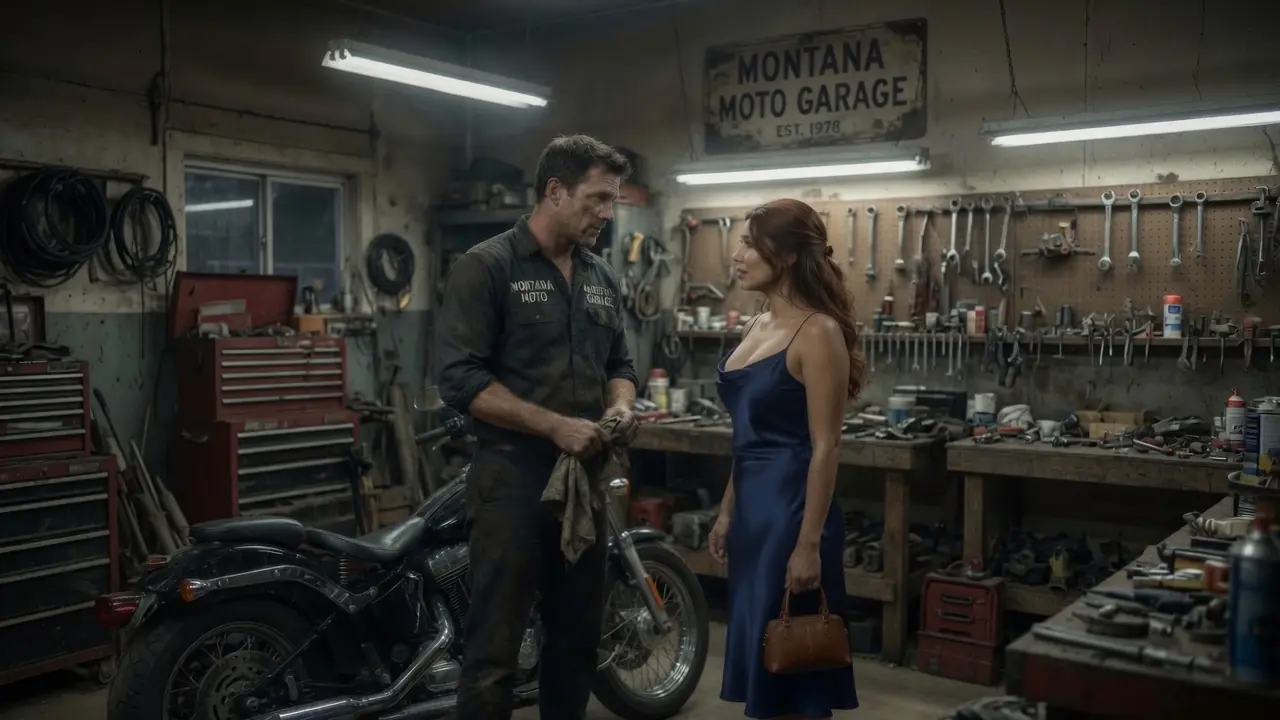
The woman standing across from Ethan’s workbench looked too polished for a garage that smelled of wet concrete and old transmission fluid. Claire Bennett wore a cream blouse beneath a dark wool coat, fitted charcoal trousers, and black ankle boots dampened by the storm outside. Her auburn hair was tied loosely behind her head, and she carried a leather folder that had clearly survived more interviews than she wanted to admit. She had entered asking about the handwritten HELP WANTED sign taped crookedly to the front window.
Ethan had forgotten the sign was still there.
He had posted it four months earlier, before his senior mechanic accepted a better-paying position at a dealership in Billings. At the time, Ethan believed he could afford an office manager if winter business improved. Winter had arrived early, business had slowed instead, and the bank had sent two letters reminding him that optimism was not an acceptable form of payment.
Claire glanced toward Noah, who was hunched over a math worksheet with a pencil between his teeth. “Is he always here?”
“Only when school ends before the work does.”
Noah raised his head. “That means every day.”
Ethan gave his son a look that should have ended the conversation, but Claire smiled. It was not the polite smile adults offered children when they wanted them to disappear. She walked over, examined the multiplication problem Noah had been staring at, and showed him a faster way to solve it without touching his pencil.
“You’re good at numbers,” Noah said.
“I used to be paid for it.”
“Why aren’t you now?”
Claire’s smile weakened. Ethan expected her to avoid the question, but she answered carefully. “I told the truth in a place where the truth was expensive.”
Noah accepted that explanation more easily than most adults would have. He returned to his worksheet while Ethan studied Claire’s résumé again. She had spent twelve years in supply-chain compliance and financial operations for Meridian Automotive Components, a national manufacturer with facilities across four states. Her final position had been director of regional quality administration, a title far beyond the needs of a small-town garage.
“You’re overqualified,” Ethan said.
“I’m unemployed.”
“That doesn’t make you less qualified.”
“It makes me available.”
Ethan looked around the garage. One lift was functional. The second had been waiting six months for a hydraulic seal he could not afford. Three vehicles filled the schedule, but only one customer had paid a deposit. The office was hidden behind towers of unopened envelopes, incomplete invoices, warranty forms, and receipts Ethan had promised himself he would organize after his wife died.
That had been three years ago.
Megan had handled the garage’s books while Ethan and his father repaired cars. After his father retired, Ethan ran the shop floor and Megan managed everything else. She remembered customer birthdays, chased late payments without embarrassing anyone, negotiated with suppliers, and somehow kept Noah entertained beneath her desk. When illness took her, Ethan lost his wife, Noah lost his mother, and Cole Motor Works lost the person who had understood how all its pieces fit together.
Ethan could rebuild an engine from scattered parts. He could not rebuild the life surrounding it.
“I cannot pay what you earned before,” he told Claire.
“I’m not asking you to.”
“I might not be able to pay much at all for the first month.”
“Give me access to your invoices, supplier contracts, and appointment records.”
“You haven’t asked what the hourly rate is.”
Claire set her folder on the workbench. “You haven’t asked what I can recover.”
Ethan should have refused. He did not know her, and desperation was a dangerous reason to trust anyone. Yet there was something in her expression that looked familiar—not weakness, but the exhaustion of someone who had spent too long proving she was not what other people had decided she must be.
He gave her one week.
Claire arrived the next morning before Ethan opened the bay doors. She brought coffee for him, hot chocolate for Noah, and three empty storage boxes labeled CURRENT, OVERDUE, and DISPUTED. She did not ask permission before clearing the office chair, but she asked before discarding every piece of paper, including expired coupons and a seven-year-old parts catalog Ethan had forgotten existed.
By noon, she had found twenty-three customer invoices marked unpaid.
Ethan insisted several customers had already settled their bills. Claire compared deposit records against the invoice numbers and discovered he was right about nine of them. Four payments had been entered without customer names, three had been applied to the wrong repair orders, and two checks had been deposited but never recorded. The remaining five invoices, totaling nearly eight thousand dollars, had never been collected.
“You completed the work,” Claire said. “Why didn’t you follow up?”
“One customer lost his job.”
“That explains one.”
“Another was caring for his wife.”
“That explains two.”
Ethan tightened his grip on a socket wrench. “People here helped my family when Megan was sick.”
Claire lowered her voice. “Kindness does not require you to destroy the place that allows you to help them.”
She called each customer personally. She offered payment plans, removed unnecessary penalties, and explained that the garage needed accurate records to remain open. Four people paid something that same afternoon. The fifth customer, an elderly rancher named Lewis Harper, arrived carrying six hundred dollars in cash and an apology.
“I thought Ethan had forgotten,” Lewis said.
“He remembered why you needed time,” Claire replied. “That’s different.”
At closing, Ethan found Claire sitting alone in the office, entering figures into a spreadsheet on an aging computer that froze every fifteen minutes. Noah had fallen asleep in the waiting area with his cheek against a stack of tire brochures. The storm had turned to sleet, coating the windows in silver.
“You said I should ask again after closing,” Ethan reminded her. “Why are you staying?”
Claire looked through the office doorway at Noah. “Because someone once gave me a place to work when I needed more than a paycheck.”
“Who?”
“My father. He owned a small machine shop. When my marriage ended, I moved back home and worked beside him until I could start over.”
Ethan noticed the past tense. “What happened to the shop?”
“A corporation bought the supplier that kept him alive. They raised prices, shortened payment terms, and offered to purchase his building for almost nothing. He refused until there was nothing left to refuse with.”
“And Meridian was that corporation?”
“No. But Meridian used the same methods against smaller companies.”
Claire closed the spreadsheet. She explained that Meridian had ordered a large batch of brake-pressure sensors from a subcontractor whose testing records showed intermittent failures. The sensors were cheaper than the approved components, and replacing them would have delayed a major delivery. Claire refused to authorize shipment after learning that several units could fail without triggering a dashboard warning.
Her supervisor approved them anyway.
Claire reported the decision internally, then provided evidence to an independent safety regulator when the company ignored her. Meridian recalled the parts before anyone was seriously injured, but senior executives blamed her for the financial damage. Her position was eliminated, her professional reputation was quietly attacked, and every application she submitted to another automotive company disappeared after the reference stage.
“I did what I was hired to do,” she said. “They made sure no one hired me to do it again.”
Ethan leaned against the doorframe. “You could have hidden it from me.”
“I’m tired of earning trust with half the truth.”
He looked at the boxes she had organized, the recovered invoices, and the woman waiting for him to decide whether honesty made her dangerous. “You still have the job.”
Claire’s shoulders relaxed. “For the rest of the week?”
“For as long as we can afford each other.”
During the next month, the garage changed so gradually that Ethan did not notice until customers began commenting. Calls were returned. Appointments stopped overlapping. Claire negotiated lower delivery fees with two suppliers and persuaded a third to extend payment terms. She discovered that Cole Motor Works had been paying for an equipment-maintenance plan covering machines the garage no longer owned.
Canceling that contract saved eleven hundred dollars a month.
She also created an after-school corner for Noah with a lamp, shelves, and a small desk salvaged from the storage room. Noah began helping her sort receipts by date. She paid him in quarters and insisted he issue handwritten invoices for his work.
“You’re teaching him to charge his own father,” Ethan complained.
“I’m teaching him that labor has value.”
Noah held up his first invoice. “You owe me three dollars.”
Ethan paid.
The garage still faced serious problems. A regional repair chain called Titan Auto Centers had recently opened a location twelve miles away. Its owner, Grant Mercer, had spent years purchasing independent garages, closing the least profitable ones, and moving their customers into standardized service centers. He had approached Ethan twice with offers to buy Cole Motor Works.
Ethan rejected him both times.
Grant returned on a clear Thursday afternoon wearing a tailored coat and shoes too clean for the gravel lot. He walked through the garage without waiting to be invited, examining the walls, lifts, and storage areas as though preparing an inventory. Claire recognized him immediately from Meridian supplier meetings.
“Ms. Bennett,” Grant said. “I heard you had fallen far. I did not realize how far.”
Ethan stepped between them. “State your business.”
Grant placed an envelope on the workbench. It contained a purchase offer significantly lower than the property’s assessed value but high enough to eliminate Ethan’s debt. Grant explained that Titan intended to build a fleet-service center on the land. Ethan could remain for six months as transition manager.
“And after six months?” Claire asked.
“He can apply for another position.”
Ethan pushed the envelope back. “No.”
Grant’s expression remained pleasant. “Your bank may give a different answer.”
The words stayed with Claire after he left.
That evening, she reviewed every bank statement Ethan had received during the previous year. The garage had never missed a loan payment, but the bank had recently reclassified it as a high-risk commercial account. The change increased fees and allowed the lender to demand additional collateral if revenue declined for two consecutive quarters.
Claire asked Ethan who had recommended the loan.
“Grant Mercer.”
She looked up sharply.
Years earlier, before Titan expanded into the region, Grant had worked as a commercial adviser for the same bank. He helped Ethan refinance the garage during Megan’s illness, presenting the arrangement as a favor. Ethan had never questioned why the contract contained conditions more appropriate for a failing corporation than a family repair shop.
Claire requested a complete copy of the loan file.
The bank delayed.
Two days later, Cole Motor Works lost access to its primary parts supplier. The supplier claimed the garage had exceeded its credit limit, although Claire’s records showed the account was current. Without brake assemblies, electrical modules, and suspension components, Ethan could not complete half the week’s scheduled repairs.
Grant returned with a revised offer.
“This is not a negotiation,” he said. “It is an exit.”
Claire placed the supplier statement beside his envelope. “Your company bought their regional distribution contract last month.”
Grant smiled. “Business changes.”
“And our account was restricted forty-eight hours after Ethan refused to sell.”
“Coincidence is not evidence.”
Claire held his gaze. “You should hope so.”
She contacted every customer whose repair depended on the blocked supplier. Rather than make excuses, she explained the delay and offered temporary transportation whenever possible. Ethan loaned his own truck to a nurse whose brakes could not be repaired in time for her night shift. Claire drove an elderly couple home in her sedan.
No one canceled.
Several customers began bringing smaller work to the garage specifically because they had heard Titan was pressuring Ethan. The town’s loyalty helped, but loyalty alone could not replace essential parts. Claire searched state business registrations and learned that Titan had created a separate purchasing company called Mercer Regional Supply.
The company’s address matched a warehouse connected to Meridian Automotive Components.
Claire stared at the filing until Ethan noticed her silence. “What is it?”
“Grant is not only trying to buy your garage. He is selling the defective sensors Meridian was forced to remove.”
The recalled components had never been destroyed. According to internal shipping numbers preserved in Claire’s old evidence, thousands had been transferred to a liquidation warehouse. Mercer Regional Supply later bought the inventory under a different description and began distributing the sensors to small repair chains that did not have access to Meridian’s original test reports.
Titan was installing them in customer vehicles.
Claire still possessed copies of the laboratory results, shipment authorizations, and internal messages proving Meridian executives knew the parts were unsafe. Grant knew she had once reported the issue, but he apparently believed her evidence had been surrendered during the investigation.
It had not.
Claire kept encrypted copies because the company had repeatedly altered internal records. She had never used them publicly because the recall appeared to have removed the danger. Now the same components were returning to the road through Titan.
Ethan read the reports at the kitchen table while Noah slept upstairs. “How many cars?”
“I don’t know.”
“Can one of these sensors cause the brakes to fail?”
“The brakes still work, but pressure assistance can disappear suddenly. A driver expecting normal response might not stop in time.”
“We report it tonight.”
Claire hesitated. Reporting it before establishing the distribution chain could allow Grant to move the inventory and erase records. She wanted several days to document shipments, identify repair centers, and secure independent testing.
Ethan shook his head. “If someone gets hurt tomorrow, the perfect case won’t matter.”
The answer reminded Claire why she had stayed.
They notified the state transportation-safety office and provided the original Meridian data. An inspector collected two sensors Claire had purchased anonymously from Mercer Regional Supply. Independent testing confirmed the hidden failure.
Grant retaliated before the recall became public.
The bank issued Ethan a notice claiming Cole Motor Works had violated its loan terms by allowing an unauthorized employee to access financial records. The letter demanded immediate repayment of the outstanding balance—more than Ethan could raise in ten years.
Claire recognized the language. It had been copied from a clause Grant inserted when he arranged the refinancing.
For the first time, Ethan looked defeated.
He sat on the garage floor after closing, his back against Noah’s desk, while snow gathered outside the bay doors. The shop had belonged to his father, and his grandfather had operated a service station on the property before that. Losing it would not merely leave him unemployed. It would erase the one place where Noah still remembered his mother laughing.
“I should have accepted the first offer,” Ethan said.
“No.”
“My son needs a home more than I need this building.”
“This building pays for that home.”
“Not if they take both.”
Claire sat beside him on the concrete. “Grant expects you to choose fear before we can prove what he did.”
Ethan looked at her. “You lost your career for telling the truth. How can you still believe it wins?”
“I don’t always believe it wins.” Her voice softened. “I believe I have to stand beside it anyway.”
He reached for her hand, stopping just before touching it. Claire closed the distance herself.
“I haven’t felt anyone carrying this with me since Megan died,” he admitted.
“I’m not trying to replace her.”
“I know.”
“Then what are you afraid of?”
“That I’ll start depending on you, and you’ll realize this garage is not enough.”
Claire rested her head lightly against his shoulder. “This garage was never what made me stay.”
The following morning, they met with Eleanor Price, the bank’s senior commercial director. Claire presented payment records proving Ethan had complied with every financial obligation. She then showed that Grant had maintained access to the account as an outside adviser years after leaving the bank—a serious violation that no current employee had noticed.
Someone using Grant’s old credentials had changed the garage’s risk classification three times.
The most recent change occurred eleven minutes after Ethan rejected Titan’s offer.
Eleanor froze the foreclosure action and opened an internal investigation. Digital access logs revealed that Grant had persuaded a former colleague to alter the account in exchange for a promised management position at Titan. The bank restored Ethan’s original loan terms, refunded years of excessive fees, and provided a written confirmation that the garage had never been delinquent.
Those refunds covered nearly half the cost of repairing the second lift.
The larger investigation moved quickly. Transportation officials traced the defective sensors to forty-three Titan locations and more than two thousand customer vehicles. Grant attempted to claim he had purchased the parts legally and never received Meridian’s failure reports.
Claire produced an email from eight years earlier.
Grant had attended the Meridian meeting where she presented the failed test results. His reply appeared beneath the report: Delay will cost more than field replacement. Proceed with distribution and manage complaints locally.
He had known from the beginning.
Titan was ordered to stop installing the parts and fund a complete replacement program. Several executives lost their positions, and Grant faced charges related to falsified safety certifications, financial coercion, and destruction of business records. Meridian reopened its internal investigation after Claire’s evidence showed senior leaders had transferred unsafe inventory rather than destroying it.
Claire’s professional name was cleared publicly.
A national manufacturer offered to restore her former title with higher pay, relocation assistance, and authority over a new compliance division. The offer arrived by courier at Cole Motor Works while Ethan was repairing a delivery truck.
He saw the company logo before she opened it.
“You should take it,” he said.
Claire read the letter alone in the office. The salary could change her life. The position carried prestige, resources, and proof that the industry finally recognized she had been right.
That evening, she found Ethan teaching Noah how to replace a worn belt on an old pickup. Father and son stood together beneath the raised hood, Noah’s small hands copying every movement Ethan made. The second lift was working again. Three mechanics had applied for positions after learning the garage had survived Titan’s attack.
Claire placed the job offer on the workbench.
“I declined it.”
Ethan stared at her. “Why?”
“Because they want the woman who exposed their mistake. They still don’t understand the woman they tried to destroy.”
“And I do?”
“You trusted me before anyone gave you permission.”
He stepped closer. “I don’t want you sacrificing your future for us.”
Claire smiled. “Then stop calling it a sacrifice.”
Noah looked between them. “Are you staying forever?”
Claire laughed softly. “Your father hasn’t asked me that.”
Ethan glanced at the wrench in his hand, suddenly more nervous than he had been while facing the bank. “Claire, I can offer you a desk, half a garage, and a house where the kitchen faucet makes terrible noises.”
“It needs a washer.”
“I know. I never get around to fixing my own things.”
She touched his grease-stained hand. “Maybe you don’t have to fix everything alone anymore.”
Months later, Cole Motor Works reopened its second bay and hired two mechanics. Claire became a legal co-owner, created a technical apprenticeship for local high-school graduates, and established a small fund offering free safety inspections to single parents who could not afford unexpected repairs. Ethan handled the engines. Claire handled the systems surrounding them.
Noah continued issuing invoices for his work.
On the anniversary of the afternoon Claire entered asking for a job, Ethan waited until the garage closed. Rain tapped gently against the metal roof, and the empty oil pans remained beneath the leaks because he still had not repaired them. Claire stood at the office desk reviewing payroll while Noah pretended not to watch from behind the parts counter.
Ethan placed a small ring beside her calculator.
It was not expensive, and his hands shook slightly as he pushed it forward.
“The first time you stood here, I told you this garage might not have a future,” he said.
Claire looked at the repaired lifts, the organized office, and Noah’s smiling face.
“You were wrong.”
“I was.” Ethan took her hand. “Because I was trying to imagine one without you.”
Claire’s eyes filled, but she kept smiling. “Is this a business proposal?”
“No.”
“A permanent employment contract?”
“Noah wrote one of those, but I refused his commission.”
Noah lifted a folded paper. “Ten percent.”
Ethan laughed, then turned back to Claire. “It’s a promise that you’ll never have to prove you belong here again.”
She kissed him before he could ask the question properly.
Their wedding took place inside the garage the following spring. Customers brought folding chairs, mechanics hung white lights from the rafters, and Noah stood beside Ethan wearing a small navy suit and a tie that remained straight for less than five minutes. The workbenches were covered with flowers, but no one attempted to remove every trace of oil from the floor.
Claire said it would not feel like their garage if they did.
Cole Motor Works survived because Claire recovered money, exposed sabotage, and brought evidence powerful companies believed had disappeared. Yet Ethan understood that she had saved more than a business. She restored the part of him that had confused surviving alone with being strong.
Claire had entered the garage asking for employment.
She stayed because a tired single father trusted her when the rest of the industry did not. Ethan had offered her a desk without promising a future. Together, they built one large enough for the garage, for Noah, and for two people who had both believed the most important parts of their lives were already behind them.