Sophia Took Two Abandoned Elders Home — Years Later, They Called Her Daughter
Sophia Williams hurried through the cold evening air on the edge of Richmond, her coat pulled tight around her thin frame and her last few dollars folded inside her pocket.
She had just finished a long shift at First Richmond Bank, followed by two hours cleaning offices after everyone else had gone home.
Her feet ached.
Her stomach was empty.
All she wanted was to get back to her small apartment, make a cup of tea, and sleep before another impossible day began.
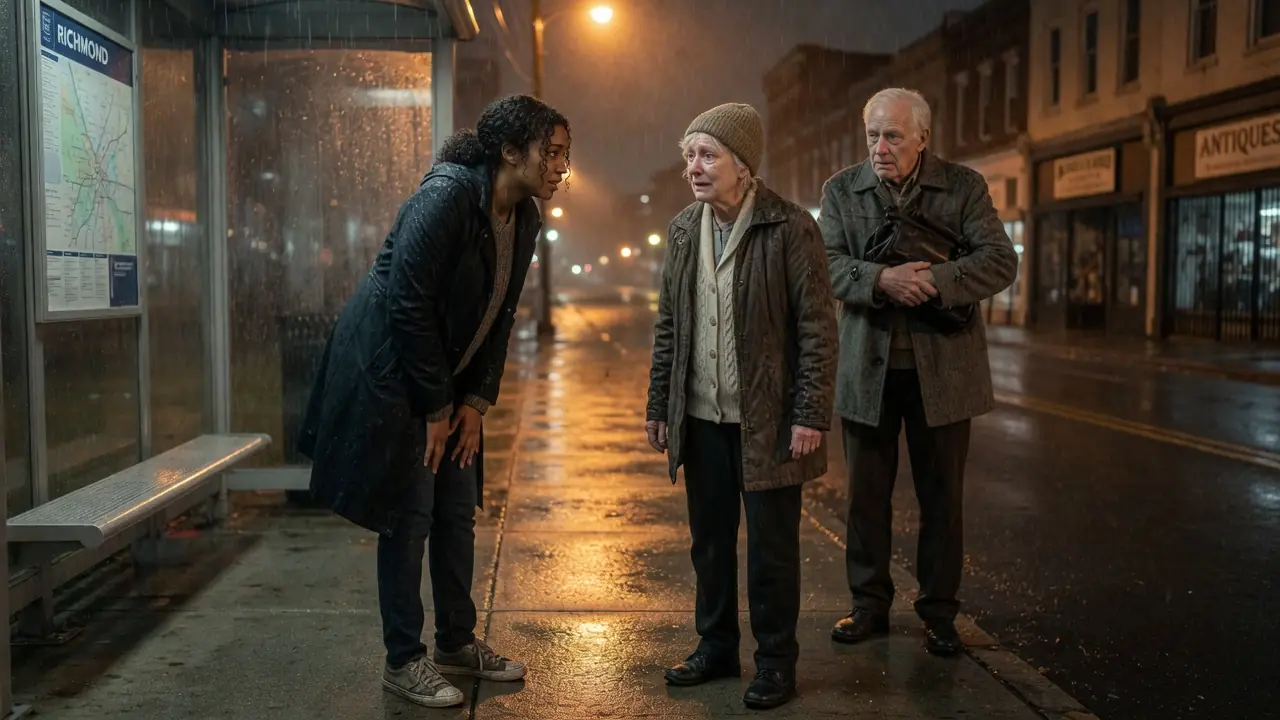
But as she passed the lonely bus stop beneath a flickering streetlight, she heard someone sobbing.
Not a small cry.
Not a quiet sniffle.
It was the broken kind of sobbing that sounded like someone’s whole life had collapsed in their hands.
Sophia stopped.
Her first instinct was to keep walking.
She was tired.
She had rent due in three days.
She had groceries she could barely afford.
She had enough problems of her own.
But something in the sound pulled at her.
She turned toward the bus stop.
On the stone bench sat an elderly couple, both white-haired, both trembling in the cold.
The woman’s face was buried against the man’s shoulder.
The man stared straight ahead, tears sliding down his weathered cheeks as if he had forgotten how to wipe them away.
Sophia looked around.
The street was nearly empty.
The shops were closed.
No bus was coming.
No one else was stopping.
She walked closer.
“Excuse me,” she said gently. “Are you okay?”
The woman looked up.
Her blue eyes were red and swollen.
She must have been in her early 70s, though fear made her look older.
“Oh, honey,” the woman whispered. “We didn’t mean to disturb anyone.”
“You’re not disturbing me,” Sophia said. “Are you waiting for someone?”
The man opened his eyes.
His voice came out rough and hollow.
“Our son Ryan. He brought us here six hours ago.”
Sophia froze.
“Six hours?”
The woman nodded, wiping her face with a trembling hand.
“He said he’d be back in an hour. He said he had an appointment, important business. We waited and waited, but he never came back.”
Sophia glanced toward the empty road.
“Do you have a phone? Can you call him?”
The man pulled a flip phone from his coat pocket.
The screen was cracked and completely dark.
“Dropped it last week,” he said. “Haven’t had a chance to replace it.”
“What about his number? I can call from mine.”
The woman’s face crumpled again.
“I don’t remember it. Arthur, do you remember Ryan’s number?”
Arthur shook his head slowly.
“It’s programmed in the phone. I never had to memorize it.”
Sophia felt something cold settle in her stomach.
She looked at the elderly couple, then at the darkness pressing in around the lonely bus stop.
This was not downtown.
This was the edge of nowhere.
“Where do you live?” Sophia asked. “I can help you get home.”
“Acacia Gardens,” Arthur said. “On Flower Street. Ryan bought us a beautiful little house there. Small, but perfect for us.”
The woman managed a fragile smile.
“I’m Evelyn,” she said softly. “Ryan has been so good to us. Selling our old house, handling the paperwork, moving us somewhere easier. He said we didn’t have to worry about anything.”
Something about that sentence felt wrong.
Sophia had worked in banking long enough to recognize the danger hidden behind words like “handled everything.”
But she pushed the thought aside.
Right now, they needed warmth.
They needed safety.
“Okay,” Sophia said. “Let me order you a car.”
“Oh, no, sweetheart,” Evelyn said quickly. “We couldn’t ask you to do that.”
“You’re not asking,” Sophia replied. “I’m offering.”
She pulled out her phone.
The battery warning flashed red.
The Uber estimate made her wince.
Thirty-eight dollars.
That was nearly everything she had left until payday.
For a second, her thumb hovered over the screen.
She thought about her empty refrigerator.
She thought about the rent notice on her kitchen counter.
Then she looked at Arthur and Evelyn.
Two elderly people abandoned in the cold by the one person they trusted most.
Sophia pressed confirm.
The Uber arrived twelve minutes later.
Sophia climbed in with them, telling herself she only wanted to make sure they reached their house safely.
That was all.
Just see them to the door.
The driver, a man in his 50s with tired but kind eyes, nodded as Arthur gave him the address.
“Acacia Gardens,” the driver said. “Nice area. New development.”
They drove in silence for a while.
Sophia watched the couple through the rearview mirror.
Arthur held Evelyn’s hand, his thumb moving slowly over her knuckles.
It was such a simple gesture, but it made Sophia’s chest ache.
She had never had that kind of love.
Not really.
Her own life had been a long lesson in leaving.
A father who disappeared before she was old enough to ask why.
A mother who worked herself sick and still died with unpaid bills on the counter.
Friends who brought flowers after the funeral, then faded away when grief became inconvenient.
Sophia understood abandonment better than she wanted to.
“Turn here,” Arthur said as they entered a neighborhood of neat houses with small yards. “Flower Street should be the third right.”
The driver turned.
Then turned again.
Sophia felt the shift before anyone spoke.
The way the driver’s shoulders tensed.
The way the car slowed.
“Sir,” the driver asked carefully, “what number on Flower Street?”
“Forty-two,” Arthur said. “A small yellow house with white shutters.”
They drove the length of Flower Street once.
There was no number 42.
There was no yellow house with white shutters.
There was only an empty lot with a for sale sign and tall weeds moving in the wind.
“Arthur,” Evelyn whispered. “Where’s our house?”
“I don’t understand.”
Arthur leaned forward, squinting through the window.
“This is Flower Street. Ryan showed it to me. He sent pictures. I saw it.”
The driver caught Sophia’s eye in the mirror.
His expression said everything.
Sophia’s hands went cold.
“Arthur,” she said carefully, “do you have any paperwork? Anything with the address?”
“Ryan has all of that,” he answered. “He said we didn’t need to worry about the details.”
Sophia swallowed.
“Can you describe Ryan? Your son?”
Evelyn turned sharply.
“Why are you asking us that?”
“Please,” Sophia said. “Just describe him.”
“He’s 42,” Evelyn said. “Brown hair. Glasses. He’s a financial adviser. He’s been helping us for months, getting our affairs in order after we retired. He sold our old house and helped us invest the money.”
Arthur’s voice broke.
“Oh God.”
Evelyn grabbed his arm.
“Arthur, what’s wrong?”
“Our house,” he whispered. “Our real house. Downtown Richmond. Forty years we lived there. He said it was too big, too old. He said we needed the money. He said he would invest it for us and get us better returns. He said…”
Arthur could not finish.
His whole body started shaking.
The driver pulled over to the curb.
The meter kept climbing.
Sophia stared at the empty lot, then at the two people behind her.
Then she made a decision that would change all of their lives.
“Come home with me.”
Three heads turned toward her.
“What?” Evelyn whispered.
“Come home with me tonight,” Sophia said. “It’s late. You’re exhausted. We need to figure this out, but not on the side of the road. I have a spare room. You can stay there tonight.”
Arthur shook his head.
“We can’t possibly.”
“Yes, you can.”
Sophia’s voice became firmer.
“I’m not leaving you at a hotel. I’m not leaving you alone. You come home with me, get some sleep, and tomorrow we figure out what Ryan did.”
The words came out with more certainty than she felt.
Her apartment was tiny.
Her life was barely held together with tape and determination.
She did not know how she would afford any of this.
But looking at Arthur and Evelyn, at the way they clung to each other like shipwreck survivors, Sophia knew she could not walk away.
“Okay,” Arthur said finally, his voice hollow. “Okay.”
The driver met Sophia’s eyes in the mirror.
This time, there was respect there.
He reset the route.
“New address?”
Sophia gave it to him.
As they drove through the dark streets toward her apartment, Evelyn suddenly placed her hand over Sophia’s.
“Thank you,” the older woman whispered. “I don’t know why you’re doing this, but thank you.”
Sophia looked down at the woman’s trembling hand.
Then she looked at Arthur, whose whole world had collapsed in the back seat of a stranger’s car.
“Because someone should,” Sophia said quietly. “Someone should.”
The car pulled up outside Sophia’s apartment building twenty minutes later.
She paid the driver and watched her bank balance drop to a number that made her stomach hurt.
Then she led Arthur and Evelyn up three flights of stairs to her small two-bedroom apartment.
When she unlocked the door and flipped on the lights, she saw her home through their eyes.
Modest.
Clean.
A worn couch.
A tiny kitchen.
A bookshelf filled with secondhand novels.
A framed photograph of her mother on the wall.
A stack of bills on the counter she wished she had remembered to hide.
“It’s not much,” Sophia started.
“It’s perfect,” Evelyn said.
And she meant it.
Morning light came too early.
Sophia woke to the sound of someone moving in her kitchen.
For one strange second, she thought it was her mother.
Then reality returned.
She found Evelyn at the stove scrambling eggs.
The coffee maker was already bubbling.
Arthur sat at the small table, looking smaller somehow in daylight, staring at his hands.
“You didn’t have to do that,” Sophia said.
Evelyn turned, managing a tired smile.
“Old habits. I haven’t slept past six in fifty years.”
They ate in awkward silence.
After breakfast, Sophia opened her laptop.
She tried to make her voice calm.
“Arthur, do you remember how much Ryan sold your house for?”
Arthur’s jaw tightened.
“Three hundred and twenty thousand. He said it was fair market value. Said he’d invest it, and we’d have five hundred thousand in six months. Guaranteed returns.”
Sophia felt ice slide through her veins.
“Where was the house?”
“Chester Avenue. Downtown Richmond. We bought it in 1985 for forty-eight thousand.”
Sophia typed quickly.
Real estate values.
Richmond.
Chester Avenue.
The results loaded.
Her hands started shaking.
Evelyn moved closer.
“What is it?”
“Houses on Chester Avenue are selling for five hundred and fifty thousand. Some are going for six hundred.”
The words hung in the air.
Arthur stood so fast his chair scraped the floor.
“No. He said three hundred and twenty was generous. He said the neighborhood had declined. He showed us comparisons.”
“He lied,” Sophia said softly.
Evelyn sank into a chair.
“No. No, he’s our son. He wouldn’t.”
“Where are the papers? The deed transfer, sale documents, investment papers?”
“Ryan kept them,” Arthur said. “He said he would handle everything.”
Every instinct Sophia had developed at the bank started screaming.
This was not just a bad deal.
This was fraud.
Systematic.
Calculated.
Cruel.
Sophia picked up her phone and called the only lawyer she knew, David Ross, the man who had helped settle her mother’s small estate after she died.
He answered on the third ring.
“Sophia? Everything okay?”
“David, I need your help. I need it now, and I need it pro bono.”
There was a pause.
“Tell me.”
She told him everything.
The bus stop.
The missing house.
The fake address.
The numbers that did not add up.
Arthur and Evelyn sat frozen, listening to their nightmare being laid out in clinical detail.
When Sophia finished, David was quiet for a long moment.
“Sophia, those are all signs of elder financial abuse. Fraud, possibly identity theft. This is criminal.”
“Can you help them?”
“Yes, but it’s going to take time. Months, maybe years. The legal system moves slowly, and if Ryan has the paperwork…”
“Just tell me you’ll try.”
Another pause.
“I’ll try. Send me everything you have. I’ll start making calls Monday morning.”
“Thank you, David.”
“Sophia, why are you doing this?”
She looked at Arthur and Evelyn, at their faces carved with betrayal and fear.
“Because when my mother died, I felt abandoned by the whole world. Like I was falling and no one would catch me. They were abandoned by their own son. I know how much it hurts to feel like you have no one.”
She hung up.
Evelyn was crying again, but differently this time.
“Why?” Evelyn whispered. “Why would you do this for us?”
“Because someone should,” Sophia said.
The weekend crawled by in a strange fog.
Sophia called out sick from work Monday, something she never did, and spent the day on her laptop while Arthur and Evelyn sat nearby, speaking in low, broken sentences.
David called at three in the afternoon.
“I found the property records,” he said without preamble. “Your house on Chester Avenue sold three months ago for two hundred and eighty thousand.”
Arthur’s face went gray.
“Two hundred and eighty?”
“Ryan told you three hundred and twenty,” David said. “He pocketed forty thousand before you even saw a dime. But that’s not the worst part.”
Sophia gripped the phone tighter.
“What’s the worst part?”
“The buyer was a shell corporation. I tracked it back. Ryan owns it. He sold your house to himself below market value, then likely flipped it immediately for full price.”
Evelyn made a sound like she had been punched.
David continued.
“You were never going to see that five hundred thousand. You were never going to see any of it.”
Arthur walked to the window, his back to them.
His shoulders shook.
“There’s more,” David said. “I did some digging. This isn’t Ryan’s first time. He’s done this to at least three other elderly couples in the past four years. Different names, different schemes, same pattern. He gains their trust, convinces them to sell property, then vanishes with the money.”
“So he’s a con artist,” Sophia said.
Arthur turned around slowly.
“Our son is a professional con artist.”
David’s voice softened.
“I’m filing a police report today. I’ll submit everything to the district attorney’s office. But Sophia, you need to understand something. Even if they catch him, even if they prosecute, the money may be gone. Hidden, spent, laundered. Recovery is unlikely.”
“So they lost everything.”
“I’m so sorry,” David said. “Yes.”
After the call ended, no one spoke for a long time.
Arthur stayed at the window.
Evelyn sat with her hands folded in her lap, staring at nothing.
Finally, Arthur turned.
His eyes were red.
“Forty years,” he said. “Forty years I worked at the shipyard. Double shifts, holidays, weekends. We saved every penny. We bought that house with money we earned with our own hands. We raised our children there. We were going to leave it to them.”
He could not finish.
“Now we have nothing,” Evelyn whispered. “We’re homeless. We’re seventy-five years old, and we’re homeless.”
Sophia felt something crack open in her chest.
She thought about her tiny apartment.
Her unpaid bills.
Her empty refrigerator.
Her life that already felt too small for one person’s grief.
Then she looked at the two elders in front of her.
“You’re not homeless,” she said.
Arthur shook his head.
“We can’t ask that of you.”
“You’re not asking.”
“Sophia…”
“You live here,” she said. “Until we figure this out, you live here.”
Evelyn stood and walked toward her.
She took Sophia’s hands in both of hers.
“You’re a young woman working too many hours. You can’t take on two broken old people.”
“Watch me.”
Arthur’s voice was rough.
“We have no money. We can’t pay rent.”
“I don’t care about rent.”
“Then what do you want from us?”
The question hung in the air.
Sophia looked around the apartment.
The leaky kitchen faucet.
The cracked tile by the bathroom.
The broken shelf she had been meaning to fix for six months.
The silence that had lived here with her since her mother died.
Actually, she realized, there was something.
“I don’t want charity, and I don’t want you to feel like charity,” Sophia said. “So if you stay, we make it a real arrangement. We help each other.”
Arthur straightened slightly.
“What kind of arrangement?”
“You both get a safe place to stay. Evelyn, maybe you can help with cooking, if you want. Arthur, you said you worked maintenance?”
“Thirty years,” Arthur said. “Shipyard, apartments, schools, whatever needed fixing.”
“Then maybe you can help with the apartment. Little things. Only if you’re comfortable.”
Evelyn’s eyes changed.
For the first time since Sophia found them, she looked less like a victim and more like herself.
“I can cook,” Evelyn said. “I can clean. I can make this place feel like a home.”
Arthur nodded.
“I can fix that sink before lunch.”
Sophia laughed despite herself.
A small laugh.
A surprising one.
Something shifted in the room.
Not pity.
Not charity.
Something else.
Something that felt almost like a family agreement.
“A family arrangement,” Evelyn said softly.
“Yes,” Arthur agreed. “We share responsibilities. We help each other. We pull our strength together until we figure out what comes next.”
Sophia looked between them.
Arthur sat straighter now.
Evelyn’s eyes had light in them again.
“Okay,” Sophia said. “It’s a deal.”
They shook hands across the table like it was a business contract.
Maybe it was.
Maybe that was exactly what it needed to be.
The first week was chaos.
Sophia went back to work Tuesday morning, worried the entire day.
She called during lunch.
Evelyn reported that she had made soup, organized the pantry, and found a way to stretch Sophia’s groceries for the whole week.
Arthur had already fixed the kitchen faucet and tightened the loose railing outside the apartment stairs.
When Sophia came home that evening, dinner was on the table.
Pot roast with vegetables.
Something she had not eaten since her mother was alive.
The apartment smelled like a home instead of a waiting room for loneliness.
The floorboards in the hallway did not creak anymore.
By Friday, a strange rhythm had developed.
Sophia woke to find coffee already made.
Evelyn packed her lunch in a brown paper bag with her name written on it in careful cursive.
Arthur kept a list of repairs he was working through, humming old Motown songs while he worked.
At night, they ate dinner together at the table.
Real dinners.
Not canned soup standing over the sink.
Not crackers in bed because she was too tired to cook.
Arthur told stories about the shipyard.
Evelyn talked about raising children before cell phones and online calendars, when mothers kept entire families running with memory, instinct, and handwritten notes.
Sophia talked about work at the bank, difficult customers, office politics, and the quiet humiliation of pretending everything was fine when her life was not fine at all.
It felt almost normal.
Almost like family.
Two weeks in, Sophia came home to find Arthur building a small shelf unit for the living room out of scrap wood he had found near the dumpster.
Evelyn was kneading bread at the counter, flour dusting her hands.
“This is working,” Sophia said, surprised by her own surprise.
“Of course it is,” Evelyn replied. “We’re good at this. We may have lost everything else, but we’re still good at taking care of people.”
That night, after Arthur and Evelyn had gone to bed, Sophia sat in the dark living room with a cup of tea.
For the first time since her mother died, the apartment did not feel empty.
The call from David came on a Wednesday morning while Sophia was at work.
“They found Ryan.”
Sophia stepped into an empty conference room and closed the door.
“Where?”
“Maryland. Arrested two days ago trying to run the same scam on another elderly couple. The police found documents linking him to Arthur and Evelyn’s case. They’re extraditing him back to Virginia.”
“That’s good news, right?”
“It’s a start,” David said. “But there’s a problem.”
Sophia’s stomach tightened.
“What problem?”
“Adult Protective Services received an anonymous tip yesterday that Arthur and Evelyn are living with you. Someone reported that they’re in an unsafe living situation.”
Sophia’s blood went cold.
“What?”
“A social worker named Katherine Miller is being assigned to investigate. She’ll probably contact you this week.”
“Investigate what? They’re fine. They’re better than fine.”
“I know, but the state takes these things seriously. Elder abuse, exploitation, unsafe housing conditions. They have to follow up.”
“Who would report them?”
David was quiet for a moment.
“The call came from a Richmond area code. That’s all I know.”
After hanging up, Sophia sat in the conference room staring at nothing.
Someone had called Adult Protective Services.
Someone who knew Arthur and Evelyn were staying with her.
Maybe one of Ryan’s associates.
Maybe Patricia, their daughter, if she had somehow heard.
Maybe a neighbor who thought a young woman could not possibly be helping two elderly white people without a hidden motive.
Sophia did not know.
But she knew trouble was coming.
The social worker showed up Thursday evening.
Katherine Miller was a thin woman in her 50s with sharp eyes and a clipboard.
She smiled, but it did not reach her eyes.
“Miss Williams, I’m Katherine Miller from Adult Protective Services. May I come in?”
Sophia led her inside, where Arthur and Evelyn sat on the couch.
Evelyn had been mending one of Sophia’s work blouses.
Arthur had a toolbox open at his feet.
They looked like a small tableau of ordinary domestic peace.
Katherine’s smile tightened.
“Mr. and Mrs. Thompson, I’m here to check on your welfare. I understand you’ve been staying here for approximately two weeks.”
“Three weeks,” Arthur corrected. “And we’re fine. Better than fine.”
“I see.”
Katherine made a note.
“Miss Williams, can you tell me about your experience caring for elderly individuals?”
“They don’t need caring for,” Sophia said. “They take care of themselves.”
“But you work full-time, correct?”
“Yes.”
“Who supervises them when you’re not home?”
Evelyn’s voice went sharp.
“Supervises? We’re not children.”
“Of course not,” Katherine said. “But at your age, accidents can happen. Falls, medication issues, confusion.”
She turned back to Sophia.
“Miss Williams, are you trained in elder care? Do you have medical knowledge?”
“No, but they don’t require medical care. They require housing and support.”
“Do you have adequate insurance to cover medical emergencies? Have you made arrangements for their long-term care?”
The questions kept coming.
Each one designed to prove Sophia was inadequate, unprepared, unsuitable.
Finally, Katherine closed her folder.
“Miss Williams, I’m going to be frank. While your intentions may be good, you’re a young woman with a full-time job and limited resources. These individuals require specialized care and attention. There are facilities specifically designed for their needs.”
“We don’t want a facility,” Arthur said firmly. “We want to stay here.”
“Mr. Thompson, with all due respect, you’re not in a position to make that assessment. You’ve been through a traumatic experience with your son. Your judgment may be compromised.”
“My judgment is fine.”
“Nevertheless, the state has a responsibility to ensure your safety and well-being. I’ll be recommending a more appropriate placement.”
Sophia felt rage building in her chest.
“They’re not going anywhere.”
“That’s not your decision to make,” Katherine replied.
Arthur stood.
His voice filled the room, steady and strong.
“It is our decision. We are not mentally incompetent. We are not being held here. We are not being used. We are choosing to stay because this woman showed us more loyalty in one night than our own son showed us in a year.”
Katherine’s expression did not change.
“I’ll be filing my report next week. Someone will be in touch about placement options.”
After she left, the three of them sat in silence.
“She’s going to take us away,” Evelyn whispered. “She’s going to put us in some horrible facility.”
“No,” Sophia said. “No, she’s not.”
She called David immediately.
“There’s one option,” he said after she explained everything. “Legal guardianship. If you become their legal guardian, the state can’t remove them without proving you’re unfit. You’d have legal responsibility for their welfare, but you’d also have the authority to make decisions about their care.”
“How do I do that?”
“It requires a court petition, a hearing, possibly a home study. It’s not simple. And Sophia, you need to understand what you’re taking on. If their medical bills pile up, you could be responsible. If something happens to them, you’ll be questioned. This isn’t just having roommates. This is becoming their legal caregiver.”
Sophia looked at Arthur and Evelyn, at the fear in their faces.
“I want to do it,” she said. “I want to be their guardian.”
David was quiet.
“Okay. I’ll start the paperwork. This is going to get complicated.”
“When is it not?”
The guardianship petition took two weeks to process.
During that time, Katherine Miller called twice more, each time with thinly veiled threats about non-compliance and state intervention.
The hearing was scheduled for Friday morning.
David met them at the courthouse.
“The judge is fair but thorough,” he said. “She’ll ask about finances, housing, your ability to provide care. Be honest, be clear, and show her this is what Arthur and Evelyn want.”
They entered the courtroom.
The judge, a woman in her 60s named Judge Patricia Harrison, looked over her glasses at them.
“Miss Williams, you’re petitioning for guardianship of Arthur and Evelyn Thompson. Can you explain why?”
Sophia stood.
Her hands trembled, but her voice did not.
“Because they’re my family, Your Honor. Not by blood, but by choice. Because they need someone who will fight for them, protect them, and give them dignity. Because I can provide that.”
“Can you afford to provide that? Guardianship includes responsibility.”
“I work full-time at First Richmond Bank. I have a stable home. They also contribute. Evelyn helps with cooking, household management, and emotional support. Arthur handles repairs and maintenance. We’re partners.”
Judge Harrison turned to Arthur and Evelyn.
“Mr. and Mrs. Thompson, is this what you want?”
“Yes,” Arthur said firmly. “Absolutely.”
“You understand that Miss Williams would have legal authority over medical decisions and living arrangements?”
“We trust her completely,” Evelyn said. “She saved our lives. Literally saved our lives.”
The judge made notes.
“I’m going to approve this guardianship on a provisional basis for six months. Miss Williams, you’ll submit quarterly reports about their welfare. If I see any indication this arrangement isn’t working, I’ll revisit the decision. Do you understand?”
“Yes, Your Honor.”
“Then guardianship is granted.”
Outside the courthouse, Evelyn grabbed Sophia and held on tight.
“Thank you,” she whispered. “Thank you.”
Arthur shook David’s hand, then Sophia’s.
“You didn’t have to do this.”
Sophia looked at them both.
“Yes,” she said. “I did.”
That night, she lay awake thinking about what she had just committed to.
Legal responsibility for two people she had known for less than a month.
If something went wrong, it would be on her.
But nothing felt wrong.
For the first time in months, everything felt exactly right.
The call came on a Tuesday morning, two weeks after the guardianship hearing.
Sophia was at work when her phone rang with an unknown number.
“Hello, is this Sophia Williams?”
A woman’s voice, sharp and educated.
“Yes. Who’s this?”
“Patricia Thompson. Evelyn and Arthur’s daughter. I’d like to know why you have my parents.”
Sophia stepped outside the bank, her heart pounding.
“Your parents are staying with me because they had nowhere else to go.”
“That’s impossible. They have a house. Ryan bought them a house.”
“Ryan sold their house and stole the money. Your parents were abandoned at a bus stop. I found them.”
There was a long silence.
“I don’t believe you.”
“Ryan is in jail, Patricia. He’s being charged with elder fraud. You can call the Richmond Police Department and confirm that yourself.”
Another silence.
Longer this time.
“I want to see them. Give me your address.”
“I need to ask them first if they want to see you.”
“They’re my parents. You can’t keep them from me.”
“I’m not keeping them from anyone,” Sophia said. “But I’m not giving out my address without their permission.”
She hung up, hands shaking.
She called home immediately.
Arthur answered.
“Your daughter Patricia just called me. She wants to see you.”
She heard Arthur tell Evelyn.
Muffled conversation.
Then Evelyn came on the line.
“What did she say?”
“That she wants to see you. That she didn’t know about Ryan.”
“She knew,” Evelyn said, bitterness sharpening her voice. “She knew something was wrong. We told her Ryan was acting strange. That money was disappearing. She said we were being paranoid. She said we should trust our son.”
“Do you want to see her?”
A long pause.
“I don’t know. I honestly don’t know.”
“It’s your choice,” Sophia said. “Completely your choice.”
Arthur’s voice came from the background.
“Give her the address. Let her come. We need to face this eventually.”
Saturday morning arrived with gray skies and cold wind.
Sophia had cleaned the apartment obsessively, though she was not sure why.
Arthur and Evelyn sat on the couch like they were waiting for judgment.
The knock came at ten exactly.
Sophia opened the door to find a woman in her late 40s, blonde hair pulled back, expensive coat, designer bag.
Behind her stood a man in a business suit, equally polished.
“Patricia?”
“Where are my parents?”
“Inside,” Sophia said. “But before you come in, we need to establish some ground rules.”
Patricia pushed past her.
“Mom? Dad?”
Evelyn stood slowly.
She did not move toward her daughter.
“Hello, Patricia.”
“What is happening?” Patricia demanded. “Why are you living here with…”
She looked at Sophia with barely concealed disgust.
“Her?”
“Because she saved us,” Arthur said quietly. “When Ryan left us with nothing, she took us in.”
“Ryan didn’t leave you with nothing. He bought you a house.”
“He stole our house,” Evelyn said. “He sold it for a fraction of its value and kept the money. We have nothing, Patricia. Nothing.”
“That’s ridiculous. Ryan is a financial adviser. He was helping you invest.”
“He’s a con artist,” Sophia said. “He’s done this to multiple elderly couples. He’s currently in jail awaiting trial.”
Patricia’s husband stepped forward.
“Who the hell are you to make accusations about a family you don’t know?”
“I’m the person who found your in-laws sobbing at a bus stop where their son abandoned them,” Sophia said. “Where were you?”
“We live in New York. We have our own lives.”
“Your parents needed help, and you weren’t there.”
“So you swooped in to play savior?”
Patricia turned to her parents.
“Can’t you see what’s happening? She isolated you, convinced you that your own family abandoned you, made herself indispensable. This is textbook elder manipulation.”
Sophia felt her temper snap.
“Manipulation? I work full-time to support them. I used my own money to hire a lawyer. I became their legal guardian so the state wouldn’t put them in a facility. What have you done?”
“Legal guardian?”
Patricia’s face went white.
“You had no right.”
“The court gave me that right,” Sophia said. “Your parents chose this.”
“They’re not mentally competent to make that choice. Ryan proved that by taking advantage of them.”
Arthur stood up.
His voice was like thunder.
“Don’t you dare suggest we’re incompetent. We made a mistake trusting Ryan, but we are perfectly capable of deciding where we want to live and who we want to live with.”
“Dad, please.”
“No, you listen to me. When Ryan sold our house, we called you. Do you remember? We called you crying, saying something felt wrong, and you told us we were overreacting. You told us to trust Ryan because he was family. Well, family destroyed us, Patricia. A stranger saved us. So don’t you come into this home and question our judgment.”
Patricia looked like she had been slapped.
Her eyes welled up.
“I didn’t know. I swear I didn’t know it was this bad.”
“You didn’t want to know,” Evelyn said softly. “It was easier to believe everything was fine.”
“So what?” Patricia said. “You’re just going to live here forever?”
“As long as she’ll have us,” Arthur said.
Patricia turned to Sophia, her expression hardening.
“You can’t take care of them properly. You’re too young. You work all day. They need proper care, professional care.”
“They need family,” Sophia said. “They need people who actually show up.”
“I’m here now.”
“Three weeks too late.”
Patricia’s husband grabbed her arm.
“Come on. We’re not getting anywhere.”
He looked at Arthur and Evelyn.
“We’re staying at the Marriott downtown, room 412. If you change your minds, if you want real help, call us.”
They left without saying goodbye.
After the door closed, Evelyn sank back onto the couch.
She was not crying, but she looked hollowed out.
“She thinks we’re senile,” Arthur said. “Our own daughter thinks we’ve lost our minds.”
“She’s scared,” Sophia said. “She’s dealing with guilt and fear, and it’s coming out as anger.”
“She’ll be back,” Evelyn whispered. “She won’t let this go. She’ll try to take us away from you.”
Sophia sat between them on the couch.
“Then we’ll fight her together.”
But she knew Evelyn was right.
Patricia was not done.
The letter from Patricia’s lawyer arrived four days later.
David called Sophia at work the moment he received the court filing.
“Sophia, Patricia is challenging the guardianship. She’s petitioning for it to be transferred to her, claiming you’re too young and inexperienced, that you coerced Arthur and Evelyn during a vulnerable time, and that keeping them in Virginia away from their New York family is harmful to their well-being.”
“Can she do that?”
“She can try. And she has resources. Good lawyers, expert witnesses. This won’t be easy.”
That night, Sophia sat at the kitchen table with Arthur and Evelyn.
The legal papers were spread between them.
“You should let us go,” Evelyn said quietly.
“What?”
“To New York with Patricia. You’ve done so much already. You shouldn’t have to fight a legal battle for us.”
“You don’t want to go to New York.”
“No,” Arthur admitted. “We don’t. But we also don’t want to destroy your life.”
Sophia looked at them both.
These two people who had filled her apartment with warmth, laughter, arguments about soup recipes, and stories from lives longer than hers.
She thought about coming home to an empty apartment again.
She thought about the silence waiting for her if they left.
“You’re not destroying my life,” she said. “You’re the best thing that’s happened to my life since my mother died.”
“But the legal fees, the time, the stress…”
“I don’t care. We’re fighting this.”
David warned them the trial would be thorough.
Patricia’s lawyer, Richard Chen, was known for being aggressive.
“He’ll bring in psychologists to evaluate Arthur and Evelyn’s mental capacity,” David said. “Social workers to inspect your home. Financial experts to question your ability to provide adequate care. He’ll try to paint you as a well-meaning but naive young woman in over her head. He’ll suggest you’re financially benefiting from this arrangement somehow. He’ll make it sound like you’re the one taking advantage of them.”
“Let him try,” Sophia said.
The preparation was exhausting.
Sophia documented everything.
Every meal.
Every doctor’s appointment.
Every expense.
She photographed the apartment from every angle.
She got letters from neighbors, from her employer, from David, from the driver who had picked them up that first night and remembered the elderly couple crying in the back seat.
Two days before the trial, Sophia sat with Arthur and Evelyn in the living room.
“I need to tell you both something before we go into that courtroom.”
They looked at her, waiting.
“When I found you at that bus stop, I thought I was doing the right thing. Being a good person. Helping strangers.”
She paused, her throat tight.
“But somewhere along the way, you stopped being strangers. You became my parents. The parents I wish I had after my mother died. The family I didn’t know I still needed.”
Evelyn’s eyes filled with tears.
“Oh, sweetheart.”
“So tomorrow, when we go into that courtroom, I need you to know something. I’m not fighting out of obligation or stubbornness. I’m fighting because you’re my family. And family doesn’t give up on each other.”
Arthur reached over and took her hand.
His grip was strong.
“You’re the daughter we wish had been born to us,” he said. “The one who showed up when it mattered.”
The courthouse on Monday morning was packed.
Patricia sat at the plaintiff’s table with her husband and lawyer, all three of them polished and confident.
On Sophia’s side were David, Arthur, Evelyn, and a folder full of documents three inches thick.
Judge Harrison entered.
“We’re here on a petition to transfer guardianship of Arthur and Evelyn Thompson from Sophia Williams to Patricia Thompson, their biological daughter. Mr. Chen, you may begin.”
Patricia’s lawyer stood, smoothing his tie.
“Your Honor, this case is straightforward. Miss Williams is a 28-year-old bank employee with limited means, no training in elder care, and no family connection to Mr. and Mrs. Thompson. Mrs. Thompson, by contrast, is their biological daughter, lives in a city with excellent medical facilities, has the financial means to provide top-tier care, and has a stable family home with her husband.”
He called his first witness, a psychologist named Dr. Raymond Foster.
“Dr. Foster, in your evaluation of Mr. and Mrs. Thompson, what did you find?”
“I found two elderly individuals who have suffered significant trauma and financial exploitation. Such trauma can impair judgment and make individuals susceptible to undue influence.”
“In your professional opinion, could they have been influenced to accept Miss Williams’s guardianship?”
“It’s certainly possible. In vulnerable states, people often attach to their rescuers. It’s a form of trauma bonding.”
David stood for cross-examination.
“Dr. Foster, did you find any evidence of cognitive impairment in Arthur or Evelyn Thompson?”
“No.”
“Did you find any evidence that Miss Williams has harmed them in any way?”
“Not directly, but the situation itself…”
“Yes or no, doctor. Has Miss Williams harmed them?”
“No.”
“Have they expressed any desire to leave her care?”
“No, but…”
“Thank you. No further questions.”
Next came a social worker who testified about age-appropriate care and proper elder facilities.
Then a financial analyst who questioned Sophia’s ability to handle future medical expenses.
Each witness was professional, articulate, and devastating.
Finally, Richard Chen called Patricia to the stand.
“Mrs. Thompson, can you describe your relationship with your parents?”
“We’ve always been close. I call every week. I visit when I can. They’re wonderful people who worked hard their whole lives.”
“Did you know about the situation with your brother Ryan?”
“Not until recently. I knew they had sold their house, but Ryan told me he was helping them invest the money. I had no idea he was stealing from them.”
“And when you learned Miss Williams had guardianship of your parents, how did you feel?”
Patricia’s voice broke.
“Terrified. My parents are in their 70s. They need specialized care, people who understand their needs. This young woman, with all good intentions, simply isn’t equipped to provide that. I love my parents. I want what’s best for them, and I can give them that in New York.”
It was a perfect performance.
Sophia watched the judge’s face, trying to read her reaction.
Then it was their turn.
David called Arthur to the stand first.
“Mr. Thompson, do you want to live with your daughter Patricia?”
“No.”
“Why not?”
Arthur took a breath.
“Because Patricia loves us the way you love a responsibility. Sophia loves us the way you love family. Patricia would put us somewhere nice, somewhere safe, somewhere supervised. Sophia made us part of her life. There’s a difference.”
“Do you feel Miss Williams has taken advantage of you?”
“Absolutely not. She saved our lives. And more than that, she gave us purpose again. I fix things around her apartment. I feel useful. Evelyn cooks. We sit at the table every night. We are not just being taken care of. We are contributing. We matter.”
“If the court transfers guardianship to your daughter, what would you do?”
Arthur’s voice was firm.
“I’m 75 years old. At some point, the court has to respect that I know what I want and where I want to be. I want to be with Sophia.”
Evelyn’s testimony was similar, but more emotional.
She talked about cooking again.
About sewing curtains for Sophia’s kitchen.
About feeling like a mother again instead of a burden.
“My daughter wants to do the right thing,” Evelyn said. “But the right thing to her means putting us somewhere safe and supervised. The right thing to Sophia means making us part of her family. I don’t want safe if safe means lonely. I want family.”
Finally, David called Sophia.
“Miss Williams, why did you take in Arthur and Evelyn Thompson?”
“Because they needed help, and I could help them.”
“Are you benefiting financially from this arrangement?”
“No. They had no money when they came to me.”
“Then why continue? Why fight so hard to keep guardianship when your life would be easier without them?”
Sophia looked at Arthur and Evelyn.
“Because they’re not a burden. They’re my family. They’ve taught me things about patience, strength, forgiveness, and what it means to show up for people. When my mother died, I thought I had lost my family. But I didn’t lose it. I found a new one.”
Richard Chen stood for cross-examination.
“Miss Williams, you’re 28 years old with a full-time job. What happens when Arthur or Evelyn has a medical emergency and you’re at work?”
“I call 911. Same as anyone would. And I leave work if they need me.”
“What if they need long-term care? Nursing facilities cost thousands per month. Can you afford that?”
“We’ll figure it out together.”
“Together? Or will you be the one making all the decisions because you hold the legal power?”
“I make decisions with them, not for them.”
“But legally, you have the authority to override their wishes, correct?”
“Legally, yes. But I never would.”
“How can the court trust that?”
Sophia met his eyes.
“Because for six months, I’ve proven it. Every decision, every plan, every choice, we make together. That’s what family does.”
Judge Harrison called a recess.
They waited in the hallway, none of them speaking.
Sophia’s hands would not stop shaking.
Thirty minutes later, they were called back in.
Judge Harrison looked at her notes, then at everyone in the courtroom.
“I’ve reviewed all the evidence and testimony. This is an unusual case. On paper, Mrs. Thompson appears to be the more suitable guardian. She is the biological daughter. She has more resources. She can provide what many would consider more appropriate care.”
Sophia’s heart sank.
“However,” the judge continued, “this court must consider what the individuals in question want. Mr. and Mrs. Thompson are not cognitively impaired. They are not being coerced. They have made a clear, rational choice about where they want to live and who they want caring for them. I believe that choice should be respected.”
Sophia could barely breathe.
“Family is not just blood,” Judge Harrison said. “It is love, care, respect, and commitment. From what I’ve seen, Miss Williams has provided all of those things. Therefore, guardianship will remain with Sophia Williams. However, I’m ordering quarterly check-ins for the next year to ensure this arrangement continues to serve everyone’s best interests.”
The gavel came down.
Sophia grabbed David’s arm to keep from falling.
Arthur and Evelyn were hugging each other and crying.
Across the aisle, Patricia sat frozen, her face pale.
Outside the courthouse, Patricia caught up to them.
“Mom. Dad. Please.”
Evelyn turned.
For a long moment, they just looked at each other.
“I love you,” Patricia said. “I know I wasn’t there when you needed me. I’m sorry. I’m so sorry.”
“We love you too,” Evelyn said softly. “But we’re staying with Sophia.”
Patricia nodded slowly.
Then she looked at Sophia.
“Take care of them.”
“I will.”
“If you need anything, money, medical help, anything, call me. Please.”
“Okay.”
Patricia walked away, her husband’s arm around her shoulders.
Sophia felt a strange mix of victory and sadness.
That night, back at the apartment, they ordered pizza and ate in tired silence.
“We need to talk about the future,” Arthur said finally. “Medical costs, long-term planning, what happens if our health declines.”
“We’ll face it together,” Sophia said. “As a family. The way it should be.”
Evelyn reached across the table and took Sophia’s hand.
“Thank you for fighting for us.”
Sophia squeezed her hand back.
“Thank you for being worth fighting for.”
Three months after the trial, Sophia got the call she had been hoping for.
“We’d like to offer you the position,” said the HR director from Charlotte First Financial. “Senior customer relations manager. It’s a significant step up from your current role.”
“What’s the salary?” Sophia asked.
When she heard the number, she had to sit down.
Nearly double what she made now.
Better benefits.
Better hours.
A real future.
“There’s just one thing,” Sophia said. “I need to bring my family with me.”
“Of course, the relocation package includes…”
“No, I mean, it’s complicated.”
She explained Arthur and Evelyn.
There was a pause.
“That’s very unusual.”
“I know,” Sophia said. “But they’re non-negotiable.”
Another pause.
“Okay. We’ll make it work.”
That evening, Sophia sat Arthur and Evelyn down.
“I got a job offer in Charlotte. Better pay, better hours, better everything. But I need to know if you’d want to come with me.”
They looked at each other, one of those married-for-fifty-years looks that communicated everything without words.
“Yes,” Arthur said. “Absolutely, yes.”
The move took six weeks to arrange.
Sophia found a small house to rent.
Three bedrooms.
A yard.
A porch.
Something they never could have afforded in Richmond.
The extra money from the new job meant she could buy better health coverage and finally breathe without counting every dollar twice.
Charlotte was different.
Quieter than Richmond, but with a warmth that surprised them.
The neighbors brought over casserole when they moved in.
The grocery store clerk chatted with Evelyn about recipes.
Arthur found a community garden two blocks away and started spending mornings there with his hands in the soil, talking to other retirees about tomatoes and proper mulching techniques.
He came home dirty and happy.
Evelyn joined a book club at the local library.
She came home talking about characters and plot twists, her eyes bright.
“I forgot what it was like to have friends,” she told Sophia one night. “Real friends. Not just people you nod to at church.”
Sophia began to change, too.
At work, she was calmer, steadier.
She no longer felt like she was sprinting through life alone.
When coworkers asked about her family, she stopped trying to explain.
She simply said, “My parents live with me.”
And in every way that mattered, it was true.
Six months into Charlotte, Sophia met Julian at the hospital during one of Arthur’s routine checkups.
He was a nurse, tall, kind-eyed, with an easy smile that seemed to quiet whatever room he entered.
When Arthur’s blood pressure spiked from anxiety, Julian sat beside him and talked about baseball until Arthur calmed down.
“You’re good at that,” Sophia said afterward.
“Twenty years of practice,” Julian replied. “Your dad was really worried.”
Sophia hesitated.
“He’s not my dad. It’s complicated.”
Julian smiled.
“Family usually is.”
They ran into each other again at the grocery store.
Then at a coffee shop.
Then he asked her to dinner.
Sophia said no at first.
Too complicated.
Too soon.
Too much going on.
But Julian was patient.
He did not push.
He just kept showing up, being kind, making her laugh.
Their first real date was three months later.
Sophia was nervous the entire day, changing outfits twice and nearly canceling once.
Evelyn shooed her out the door.
“Go have fun,” she said. “Remember what that feels like.”
Dinner turned into coffee.
Coffee turned into a walk.
A walk turned into standing outside Sophia’s house at midnight, talking about everything and nothing.
“I should warn you,” Sophia said. “I come with a lot of baggage.”
“Most interesting people do.”
“I mean a lot. Two elderly dependents who are also my parents in every way that counts, a complicated legal history, a dead mother, a con artist in the extended family, and about fifteen different kinds of trauma.”
Julian smiled.
“I’m a nurse. I’ve seen worse.”
He did not run.
That was the shocking part.
He met Arthur and Evelyn and treated them like important people, not obstacles to navigate around.
He helped Arthur in the garden.
He let Evelyn feed him too much pie.
He listened to their stories like they mattered.
“I like him,” Arthur said after Julian left one evening. “He’s steady.”
Coming from Arthur, that was the highest compliment.
The relationship moved slowly.
Sophia needed slow.
Julian understood that.
He never pushed, never demanded, never made her feel guilty for having priorities beyond him.
One night, a year after they had moved to Charlotte, Julian stayed for dinner.
It had become routine by then.
He would show up with dessert, help Arthur set the table, chat with Evelyn about her book club, then sit beside Sophia afterward while the porch lights glowed and the air cooled around them.
After dinner, after Arthur and Evelyn had gone to their room, Julian and Sophia sat on the porch in the quiet darkness.
“I love you,” he said simply.
Sophia’s breath caught.
“Julian…”
“You don’t have to say it back. I’m not asking for anything. I just wanted you to know.”
“I’m terrified,” she admitted. “Of losing someone again. Of building something and watching it disappear.”
“I know,” Julian said. “But you can’t live your whole life afraid of love just because grief knows where you live.”
Two years after moving to Charlotte, on an ordinary Tuesday evening, Julian asked everyone to sit down in the living room.
Arthur lowered himself into the recliner.
Evelyn sat beside Sophia, already suspicious.
Julian stood in front of them with nervous hands and a small velvet box.
Sophia’s heart stopped.
“Before I ask,” Julian said, “I need to say something to Arthur and Evelyn.”
Arthur’s eyes narrowed.
Julian smiled.
“You’re part of this family. You’re important. And if Sophia says yes, I’m not just marrying her. I’m joining all of you.”
Arthur’s eyes filled with tears.
“Son,” he said, voice rough, “that’s the best thing anyone has said to me in a long time.”
Julian turned to Sophia.
“Will you marry me?”
Sophia looked around the room.
At Arthur and Evelyn, who had become her parents.
At Julian, patient and steady and real.
“Yes,” she whispered. “But I have conditions.”
Julian laughed through tears.
“Of course you do.”
“Arthur walks me down the aisle. Evelyn is my matron of honor. And we’re doing this in the backyard so everyone we love can be there.”
“Deal.”
The wedding was small.
Sophia wore a simple white dress.
Arthur cried the entire way down the aisle.
Evelyn stood beside her in lavender, holding a bouquet Sophia had picked from Arthur’s garden.
Patricia came.
So did Evelyn and Arthur’s other children, Alex and Jennifer, people who had been absent for years but could not miss this.
They looked at Sophia with a mixture of gratitude and shame.
“Thank you,” Patricia said quietly before the ceremony. “For saving them. For loving them. For doing what I should have done.”
“They saved me too,” Sophia replied.
The ceremony was simple.
No elaborate speeches.
No grand gestures.
Just promises made in front of the people who mattered.
When the officiant said,
“You may kiss the bride,”
Arthur started clapping first.
Everyone laughed.
At the reception in the backyard, Arthur gave a toast.
“Two and a half years ago, Evelyn and I were abandoned at a bus stop by someone we trusted. We thought our lives were over. We thought we had lost everything.”
His voice shook.
“But a young woman with more problems than anyone should have to carry decided we were worth saving. She didn’t just give us a place to live. She gave us a reason to keep living. So here’s to Sophia and Julian. May they have half the love and strength she has already shown us.”
Everyone drank.
Sophia cried.
It was perfect.
Life did not become easy after that.
It became full.
There were doctor’s appointments and bills.
There were arguments over salt intake and whether Arthur was allowed to climb ladders.
There were Evelyn’s pies, Julian’s terrible singing, Sophia’s long workdays, and evenings where all four of them sat at the kitchen table playing cards until someone laughed so hard they had to wipe their eyes.
Then Arthur collapsed in the garden on a Tuesday morning.
The cardiac surgeon was brutally honest.
“Severe coronary artery disease. He needs bypass surgery. At his age, there are risks. Significant risks.”
“What are his chances?” Sophia asked.
“Sixty percent survival rate. Maybe seventy if everything goes perfectly.”
Arthur was surprisingly calm about it.
“I’ve had a good run. Whatever happens, happens.”
Evelyn’s voice snapped like a whip.
“Don’t talk like that. You’re not going anywhere.”
The surgery took six hours.
Sophia, Julian, Evelyn, Patricia, Alex, and Jennifer sat in the waiting room.
For the first time in years, all of Arthur and Evelyn’s children were in the same room.
“Thank you for calling us,” Patricia said to Sophia. “And for everything else.”
When the surgeon finally came out, everyone stood at once.
“He made it. The next 72 hours are critical, but he made it.”
Evelyn’s legs gave out.
Julian caught her.
Arthur’s recovery was slow.
Weeks in the hospital, then weeks at home with round-the-clock care.
Julian, being a nurse, took over most of it, monitoring vitals, managing medications, helping Arthur relearn how to walk without getting winded.
“Now it’s our turn to take care of you,” Julian told Arthur. “Fair is fair.”
Gradually, Arthur got stronger.
Six months after surgery, he was back in the garden, though under strict orders to take it easy.
He looked frailer now and moved slower, but his eyes still lit up when the tomatoes ripened.
Two years later, Evelyn started forgetting things.
Small things at first.
Where she had put her glasses.
What day book club met.
The name of the neighbor’s dog.
Then bigger things.
“She called me Patricia yesterday,” Sophia told Julian one night. “She thought I was her daughter.”
The diagnosis was Alzheimer’s.
Early stage, but progressing.
“How long?” Sophia asked the doctor.
“Impossible to say. Could be five years. Could be fifteen. Everyone is different.”
They made adjustments.
Labels on cabinets.
Calendars everywhere.
A routine that never varied.
Arthur took it the hardest, watching the woman he had loved for fifty years slowly slip away.
“She still knows me,” he said one morning after a particularly bad episode. “Most days, she still knows me.”
“She’ll always know you,” Sophia said, though neither of them fully believed it.
For three more years, they managed.
Good days and bad days.
Days when Evelyn was completely herself, laughing with Sophia and beating everyone at cards.
Days when she did not know where she was or why strangers were in her house.
She died quietly in her sleep on a Sunday morning.
She was 80 years old.
The funeral was packed.
Friends from the book club.
Neighbors.
People from the community garden.
Patricia and her family.
Alex and his husband.
Jennifer and her kids.
So many people whose lives Evelyn had touched.
Arthur stood at the graveside, dry-eyed and silent.
Sophia held his hand.
“She was ready,” he said finally. “She told me last month, on a good day. She said she was ready to rest.”
After the funeral, Arthur moved differently through the house.
Quieter.
Smaller.
Like he was already halfway gone.
Three years after Evelyn’s death, on a cold November morning, Ryan showed up at their door.
Sophia answered it, not recognizing him at first.
He had aged badly.
Gray hair.
Hollow cheeks.
Eyes that had seen things.
“I’m looking for Arthur and Evelyn Thompson,” he said. “I’m their son.”
Sophia’s hand tightened on the doorknob.
“I know who you are.”
“Is my mother here? I need to apologize. I need to make things right.”
“Your mother is dead. She died three years ago.”
Ryan’s face crumpled.
He staggered backward like the words had struck him.
“And your father is inside,” Sophia said. “Probably making breakfast. The question is whether I let you in to see him or call the police.”
“I did my time,” Ryan whispered. “Seven years. I just got out.”
“You stole everything from them. You left them at a bus stop.”
“I know.”
Ryan’s voice broke.
“I know what I did. I’ve had seven years to think about nothing else. I’m not here for forgiveness. I’m just here to say I’m sorry.”
Sophia wanted to slam the door in his face.
She wanted to scream at him about the terror she had seen in his parents’ eyes, about the years they spent rebuilding from nothing, about the fact that Evelyn died without ever fully understanding why her son betrayed her.
Instead, she said,
“Wait here.”
She found Arthur in the kitchen, buttering toast.
“Arthur, someone’s here to see you.”
“Who?”
“Ryan.”
The knife slipped from his hand and clattered onto the plate.
They talked on the porch.
Sophia watched through the window.
She could not hear what they said, but she saw Ryan crying.
She saw Arthur’s face move through anger, pain, and something softer.
After an hour, they came back inside.
“He’s staying for breakfast,” Arthur said quietly.
Ryan ate without speaking, tears streaming down his face the whole time.
After breakfast, Arthur and Ryan went for a walk.
When they came back, Arthur looked exhausted but lighter somehow.
“I forgave him,” he told Sophia later. “I don’t know if I should have. I don’t know if Evelyn would have. But I forgave him.”
“Why?”
“Because I’m 83 years old, and I don’t have energy left for hate. And because he’s still my son, even after everything.”
Ryan started visiting once a month.
Awkward, painful visits where everyone tiptoed around the past.
He offered money, which Arthur refused.
“Keep your money,” Arthur said. “If you want to make things right, be here. Show up. That’s all I want.”
One night, a year after Ryan had reappeared, Arthur called Sophia into his room.
He looked tired.
So tired.
“I need to tell you something,” he said. “The doctor says my heart is failing. Not an emergency. But soon. Maybe months, maybe a year.”
Sophia’s throat closed.
“Arthur…”
“Listen. I need you to promise me something. When I’m gone, don’t let Ryan disappear again.”
“What?”
“He’s broken. He’s trying. He needs family.”
“Arthur, I don’t know if I can promise that.”
“He’s still my son,” Arthur said. “And you are still my daughter. Promise me you won’t forget that.”
Sophia was crying now.
“I promise.”
Arthur smiled.
“You gave me so much more time than I ever expected. That night at the bus stop, I thought I was waiting to die. But you gave me nine more years. Nine years of being useful, of being loved, of being someone’s father again. That’s more than most people get.”
He died six months later, peacefully, with Sophia holding one hand and Ryan holding the other.
At the funeral, Ryan gave the eulogy.
“My father had every reason to hate me,” he said, voice shaking. “I stole from him. I betrayed him. I abandoned him and my mother when they needed me most. But he forgave me. He showed me it is never too late to try to be better. And he introduced me to the woman who saved him, Sophia Williams, who taught all of us what family really means.”
After the funeral, Patricia pulled Sophia aside.
“You did something incredible,” she said. “You gave our parents nine more years of happiness. Real happiness, not just survival. Thank you.”
“They gave me more,” Sophia said simply.
Years later, Sophia would look back at that night at the bus stop and wonder what would have happened if she had just gone home.
If she had minded her own business.
If she had kept her head down.
If she had protected her own heart.
She would have missed everything.
The chaos.
The grief.
The legal battles.
The impossible family built from nothing.
She would have missed Evelyn calling her daughter on a bright Sunday morning.
She would have missed Arthur fixing her kitchen sink and telling her she deserved a life bigger than survival.
She would have missed Julian, who loved the family she carried instead of asking her to set it down.
She would have missed Ryan’s broken return and Arthur’s impossible forgiveness.
She would have missed the strange, beautiful truth that family was not always something you were born into.
Sometimes, family was a choice made in the cold, under a dying streetlight, when someone was crying and everyone else kept walking.
Julian once asked her,
“Was it worth it? Everything that came after?”
Sophia thought about the sleepless nights, the courtrooms, the fear, the financial strain.
She thought about Evelyn’s last lucid day, when she had held Sophia’s hand and said,
“You’re the best daughter I ever had.”
She thought about Arthur smiling in the garden, dirt under his nails, sunlight on his face.
“Yes,” Sophia said. “Every second of it.”
Because family was not just blood.
It was not just obligation.
It was showing up when someone needed you, even when it was hard.
It was choosing to stay when everyone else left.
It was a young woman finding two abandoned people at a bus stop and deciding, against all logic and reason, that they were worth saving.
And in saving them, she had saved herself.