Rain struck the tin roof of McAllister Woodworks just before midnight, loud and unrelenting, the kind of rain that made Providence feel smaller than it was.
Sawyer McAllister had already killed most of the lights and was reaching for the last switch when he heard a knock at the door. It was not loud or urgent, only persistent, the way someone knocked after already talking themselves out of turning back.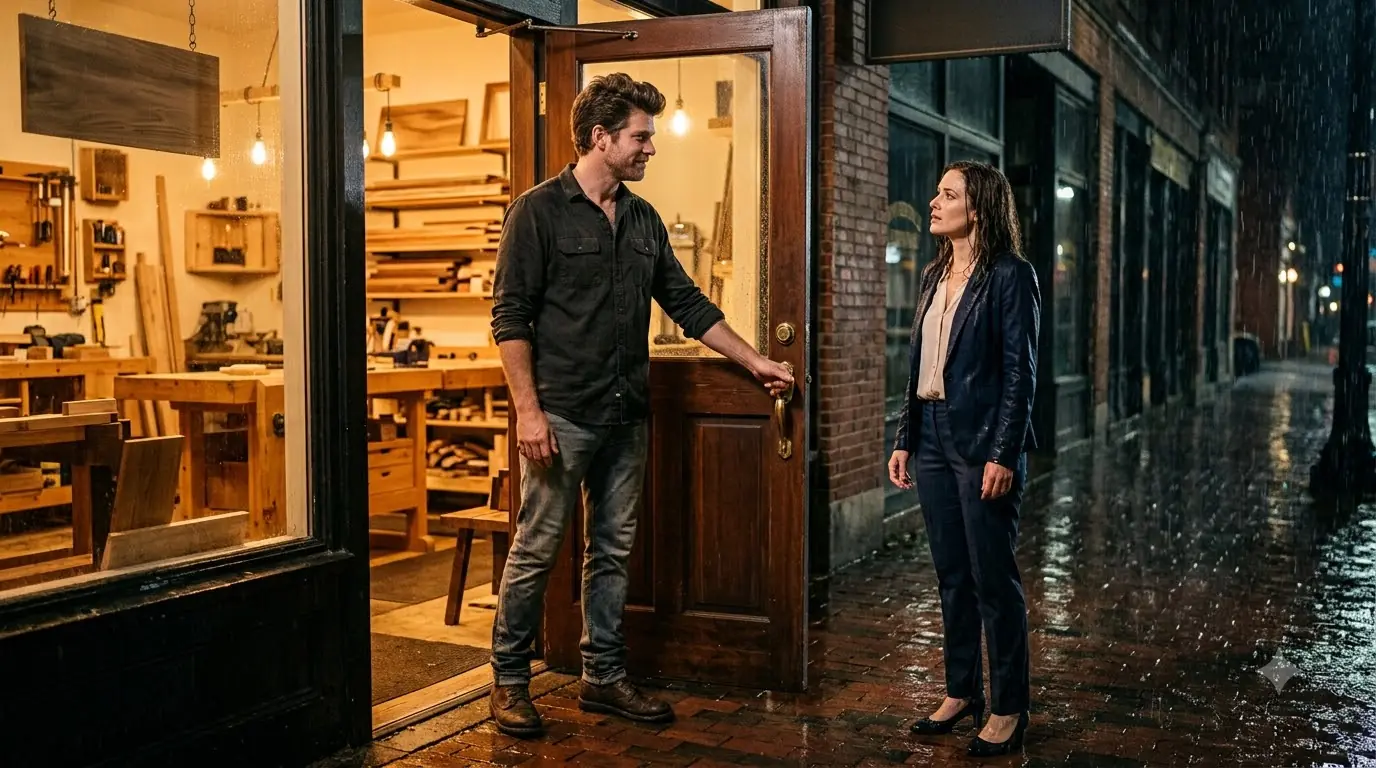
He crossed the shop floor and pulled the door open. A woman stood in the downpour, her blazer soaked through, dark wool pressed flat against her shoulders, her hair plastered against one cheek.
Maren Aldridge, the youngest federal judge in Rhode Island, looked at him with an expression that had never appeared on her face in any courtroom.
“Please,” she said. “Please let me stay one night.”
Sawyer looked at her, then out at the wall of water falling from the eave. His hand stayed on the doorframe, neither opening it wider nor closing it.
The man she had looked through every time she passed him was the only person she had left to ask.
What had happened to put a judge alone in the rain at midnight, knocking on a carpenter’s door?
Three days earlier, Sawyer’s alarm had gone off at five in the morning, the same way it always did. No snooze, no negotiation. He sat up in the dark, listened for a moment to the silence of the house above the shop, and got out of bed.
He had oatmeal cooking by 5:15. Wren came downstairs at 6:45 in her socks, her hair still carrying the shape of her pillow and a spiral notebook tucked under one arm. She was eight years old, with her mother’s eyes and her father’s habit of saying nothing until she had something worth saying.
Sawyer set a bowl in front of her and refilled his coffee. The shop was connected to the back of the house by a covered walkway, a layout that worked when you were the only parent and the school bus came at 7:50.
He had built the walkway himself the winter after Elena died because it meant he could hear Wren from inside the shop, and Wren could find him without going out into the cold.
The house was modest in every way that mattered. The furniture was handmade: the chairs, the table, and the low bookshelf Wren used as both storage and a reading perch. The walls were mostly bare, except for a few of Wren’s drawings taped at her eye level near the kitchen doorway.
On the mantel above the fireplace stood a single framed photograph. A woman was laughing at something off camera, dark hair caught in motion, one hand raised as if she had just said something she was about to take back. Sawyer walked past it every morning. He never stopped in front of it, but he always noticed it.
After dropping Wren at school, he returned to find a letter wedged into the shop door. It was a third notice.
The building that housed his workshop was under review for lease termination, a process managed by Fenn and Associates, a property firm operating out of downtown Providence.
He stood in the doorway and read the letter twice. Then he folded it carefully along its original crease and placed it on the workbench beside a set of hand-drawn structural calculations that had nothing to do with furniture. He knew that name. He had known it for nine years.
That same morning, twelve blocks north, Maren Aldridge was dismantling a contract clause in open court. The error was in the fourth paragraph, a definition cross-reference that quietly voided the indemnification clause it was meant to support.
She did not raise her voice or lean forward. She asked one question, and the lead attorney stopped speaking in the middle of a sentence and did not begin again.
Maren was thirty-three years old. She had graduated from law school at twenty-four, clerked for two years, and spent the next seven building a record that gave no one anything to argue with.
Her mother had wanted her to enter the family business, Aldridge Construction, a mid-sized firm her grandfather had built from a single concrete plant in Warwick.
Maren had chosen the law. It was a decision that had cost her something. She felt the shape of that cost sometimes in quiet moments, in the distance between who she had been raised to become and who she had made herself instead.
A photograph of Maren hung on the wall beside her office door, a framed newspaper clipping from three years earlier, the day she had been confirmed. She was shaking hands with the senior senator from Rhode Island and looked the way she always looked in photographs: composed, pulled together, occupying the frame without leaving room for any other interpretation.
Her law school mentor had emailed her the morning after her confirmation. “You’ll be the one they call when no one else has the stomach for it.”
She had printed the email and kept it in her desk drawer, not because it flattered her, but because it described exactly the kind of judge she had decided to become.
She had not imagined that the hardest cases would require anything more than precision and courage. She had not imagined that the institution she trusted would itself become the thing she had to navigate around.
There was a particular kind of loneliness in that realization. It was not the loneliness of being alone, but the loneliness of being the only person in a room who still believed the rules meant something. She had felt its first edge when she found the missing pages. She felt its full weight now.
The case that arrived on Maren’s docket that week had a plain surface and a complicated interior. A construction company called Hargrove-Pell had been contracted to build a federal residential development in South Providence: 212 units across four buildings, funded through a HUD program targeting working-class families.
The buildings were now four years old. The city’s structural inspection office had flagged two of them for bearing-wall irregularities. An independent engineer’s report suggested those irregularities were consistent with the substitution of lower-grade load-bearing materials at some point during the original construction.
The firm denied everything. The federal case turned on the documentation, specifically the original approved design specifications compared with what had actually been installed.
Chief Judge Douglas Fenn had been assigned as supervising authority over the related judicial proceedings. He was fifty-five, silver-haired, and had spent three decades accumulating the kind of institutional goodwill that made him effectively untouchable.
He called Maren into his chambers on Tuesday morning and offered her coffee before she had taken her seat.
“You’re moving fast on Hargrove-Pell,” he said, pleasantly, as if discussing the weather.
“The inspection report gives us cause,” she replied. “Two hundred families are living in buildings that may not meet structural code. I would rather move quickly than wait.”
Fenn nodded slowly. “There are political dimensions here, Maren. Organizations with long histories in this city. People who have been part of how Providence gets built. It is worth being measured.”
“The supplemental engineering review was requested by the firm’s own attorneys,” Maren said. “I do not consider that independent analysis.”
She left his office with her coffee untouched.
She had met men like Fenn throughout her career, men who had accumulated enough institutional goodwill to mistake it for invulnerability. She had always found them manageable because their confidence was usually proportional to the size of the thing they were protecting. The larger the protection, the more visible its outline.
She had learned that from her grandfather, who had built a construction business in an industry where every handshake contained a negotiation.
Back at her desk, she opened the case files and began working through the technical specifications. She stopped on page fourteen. The structural-load documentation for the bearing walls in Building Three was missing. It was not misfiled or cross-referenced elsewhere. It was gone.
She checked the intake log. The file had arrived complete. Someone had removed those specific pages after intake and before the file reached her hands.
Ruth Callaway appeared again in the doorway. She set down a second folder, thinner than the first, and left without speaking. Inside was a single page bearing an address on Crane Street in Providence and a name above it: McAllister Woodworks.
Maren drove to Crane Street on Wednesday afternoon. She had not called ahead. She pulled into the gravel lot and walked toward the open bay door with the bearing of someone accustomed to being the most prepared person in any room she entered.
She could hear machinery inside and smell wood shavings and linseed oil. A man worked at a long bench near the far wall, his back to her, drawing a hand plane across a piece of oak in long, even strokes.
She announced herself and asked directly whether he had any professional connection to the Hargrove-Pell project or its related entities. Her questions were clear, and her tone left no ambiguity about whether this was a friendly conversation.
Sawyer McAllister set the hand plane down and turned around. He was lean and unhurried, with sawdust along one forearm and the calm expression of someone who had long ago stopped being startled by strangers entering his shop with questions.
He looked at her with steady, uncomplicated patience and said he did not know what she was talking about.
He was still saying so when a black town car pulled into the lot. Douglas Fenn stepped out with two men in suits. He looked around the workshop lot with mild amusement, as if he had arrived at the scene of a minor and predictable social error.
A couple of workers from the auto shop next door drifted over, unhurried and curious. Fenn spoke at a volume intended for all of them.
“Judge Aldridge.” He smiled broadly. “You’re asking a carpenter about structural documentation? I sincerely hope the federal bench has not run that short on expertise.”
A dry laugh came from somewhere nearby. Maren went very still. In four years on the federal bench, no one had publicly diminished her. She felt the heat of it in her jaw and kept her face entirely even.
Fenn turned toward the workshop, his smile holding. “Mr. McAllister.” He allowed the name to sit in the air for a beat. “It has been a while. I see you are still working with wood.”
The pause before the final three words had been placed with care, and it landed exactly as he intended.
Sawyer said nothing. He looked at Fenn the way someone looked at a figure on a spreadsheet: registered, logged, not particularly interesting. He did not appear offended or amused. He simply regarded Fenn as something he had already fully understood a long time ago.
Then he turned back to the workbench, picked up the hand plane, and resumed the stroke across the oak. The sound of the blade on the wood filled the lot, clean, deliberate, and entirely unconcerned.
Fenn blinked. Something shifted in his expression, a small involuntary recalculation, there and gone before anyone else would have caught it. He said something quietly to his attorneys, summoned the town car, and left.
The workers drifted back to their own work. The lot went quiet.
Maren stood in the bay doorway and considered the fact that Douglas Fenn, a man who had never shown deference to anyone in thirty years of federal judiciary, had taken half a step backward from a carpenter who had not said a single word to him.
She remained there after the town car disappeared, replaying what she had just seen. She had watched Fenn handle prosecutors twice his intelligence, journalists looking for blood, and colleagues who had outmaneuvered him publicly. He had never once been the person who retreated or looked uncertain.
But for one unguarded second, standing in a gravel parking lot before a man in a work apron, he had looked at Sawyer McAllister like a problem he thought he had already solved. That was worth more to her than anything in the file Ruth had left on her desk.
She returned that evening alone.
She told herself it was because she still needed information. She told herself it was professional due diligence following a lead in a case that had been actively tampered with. She believed approximately half of that on the drive over.
Inside the open bay door, she looked around the shop as someone actually trying to see it rather than merely observe it. Tools were arranged on the walls in disciplined rows, the kind of intentional order that came from years of knowing exactly where a hand needed to go in the dark.
A wood-burning stove stood in the corner. The layered smell of linseed oil and cedar warmed the room. On the drafting table along the near wall lay drawings that stopped her in mid-step.
They were not furniture plans. They were structural-elevation drawings, load-bearing calculations annotated in fine print, shear-force notations at connection points, and span ratios marked in pencil along the margins with the quiet authority of someone who had practiced this work for so long that the notation had become its own language.
The handwriting was small and exact, the kind of precision that years of technical work produced without conscious effort.
Sawyer came in from the back and found her standing at the table. He crossed the shop without hurry, folded the drawings closed, and placed his hand flat over them.
“Where did you study?” she asked.
He looked at her for a moment. “Wood,” he said.
She did not push. Instead, she looked at his hands: the placement of the calluses, the width of his grip, and the ink stain faded to pale gray along the side of his right index finger. They were the hands of a craftsman, certainly, but also of someone who had spent years pressing a technical pen into vellum.
The back door opened, and Wren entered still wearing her school shoes and carrying a large sketchbook. She dropped her backpack against the wall without slowing and spread the sketchbook across the corner of the workbench.
“Pa, look what Miss Reeves said about the perspective.”
She turned the book toward him. Maren looked at the drawing. It showed a building rendered in pencil from a three-quarter elevated angle, with proportional accuracy that had no business appearing in the work of an eight-year-old.
The building had a distinctive roofline and a particular arrangement of exterior stairwells and access corridors. Maren had seen that roofline in the case files that morning.
She looked at Sawyer. He was studying the drawing, not exactly with pride, but with something older than pride, something that had lived with him for a long time and learned to occupy very little space.
“Do you recognize that building?” she asked.
He did not answer immediately. He looked at Wren’s drawing for another long moment.
Then he said quietly, without turning toward Maren, “I designed it.”
He turned away and returned to his workbench. That was all he said.
The structural inspection report became public on Thursday morning. A section of Building Three’s eastern load-bearing wall had developed visible cracking consistent with material fatigue under sustained occupancy load.
The city’s Office of Emergency Management ordered the immediate evacuation of forty-seven households. Families with children, elderly residents on fixed incomes, two people using supplemental oxygen, all of them had four hours to gather what they could carry.
The story ran on every local channel by noon. Maren watched the footage on her laptop. A city official in a rain jacket stood outside the building with yellow barrier tape stretched across the entrance, using phrases like “precautionary measure,” “full cooperation,” and “the safety of our residents is paramount.”
Behind him, a woman loaded a laundry basket into the bed of a pickup truck. A man in slippers stood on the sidewalk holding a cat carrier. There were children, a folded stroller, and the particular geometry of people who had not planned to leave.
By two in the afternoon, Fenn had released a statement from the chief judge’s office calling for suspension of the judicial investigation pending an independent structural review. The named review firm, Maren discovered when she checked the registry, had a documented prior billing relationship with Hargrove-Pell’s parent company.
Maren filed a formal objection. She documented every step and submitted it through every channel available to her.
At 4:17 that afternoon, her building-access card was declined at the main entrance of the courthouse. She called the clerk’s office and was told, with courteous professionalism, that she had been placed on administrative leave pending review of a judicial-conduct complaint filed by an unnamed third party alleging a financial conflict of interest in her handling of the Hargrove-Pell matter.
She stood on the sidewalk outside the Thomas J. Donahue Federal Building and felt, with particular clarity, the specific shape of having run out of moves inside the system for the night.
She called two colleagues. Neither answered. She called a law school friend who now practiced private litigation, and he advised her to be patient, cooperate, and let the process resolve itself. She ended the call before he finished the sentence.
She sat in her car in the parking garage for a long time, both hands on the steering wheel, watching rain she had not noticed beginning run down the windshield in sheets. She had spent her entire professional life ensuring she never had to ask anyone for anything. She had built her career precisely so asking would never be required.
Then she got out of the car and drove to Crane Street.
She did not allow herself to consider whether she was making a mistake. She had spent enough years in high-stakes rooms to know that the moment one began analyzing a decision from inside the decision was exactly when clarity abandoned them.
She drove. She found the shop. She parked, walked to the door through the rain, and knocked.
Sawyer did not ask why she was there. He filled a kettle, hung her coat, and placed a spare jacket over the back of the chair nearest the stove. He moved through the shop with the economy of someone who had learned long ago how to care for a space and the people inside it without turning the act into something that required acknowledgment.
The tea was plain, without ceremony. He placed the mug before her and sat on the opposite side of the drafting table. Outside, the rain worked steadily against the roof.
After a long silence, he said, “The wall cracked at the northeast load-bearing junction. It was not poor-quality material. It was the correct material removed and replaced with a cheaper substitute after the approved drawings had already been signed off.”
Maren looked across the table. “How long have you known?”
“Since it happened.”
He crossed to the large workbench along the back wall and opened the bottom drawer. From it he removed a package wrapped in oilcloth, the kind of careful wrapping that meant the contents had survived years, two moves, and at least one flood.
Inside were architectural drawings on vellum with a signature block in the lower right corner: S. T. McAllister, P.E., a federal project-license number, and a date nine years earlier. Behind the drawings lay a three-page, single-spaced technical objection formally documenting the proposed material substitution and recommending against it on structural-integrity grounds.
Below that recommendation was a countersignature: Douglas A. Fenn, approving the substitution over the written objection.
Maren read the documents without speaking. When she finished, she looked up.
“You held a federal engineering license.”
“Yes.”
“And you left the profession.”
He said nothing.
“Why did you not come forward?” she asked. “Nine years. You had all of this.”
He looked toward the staircase at the far end of the shop, the one leading to where Wren slept. He held his gaze there for a moment, then looked back at the table without answering.
It was an answer. Maren understood without requiring him to say it.
They worked through the night.
At some point, Maren moved her chair to the same side of the table as the drawings rather than remaining across from them. Sawyer shifted one desk lamp to a better angle without being asked. Neither commented on either adjustment.
Sawyer arranged the technical documentation in the order a structural argument required: material specifications, load tolerances, and comparison analysis between the original specifications and what the inspection confirmed had been installed. He explained the engineering in plain language without condescension, and she understood it faster than he had expected.
She built the legal framework around his technical architecture and asked exactly the right questions. Neither had ever worked beside someone quite like the other. Neither said so. It was not that kind of conversation.
Around two in the morning, the staircase door opened. Wren came down in her pajamas, barefoot and blinking in the light. She looked at her father, then at Maren, then at the table buried beneath papers and drawings.
She went to the small kitchen at the back of the shop and poured herself a glass of water. On her way back to the stairs, she stopped at the arm of the couch, picked up a thin folded blanket, walked quietly around the table, and laid it over the back of Maren’s chair.
She did not touch her or say anything. She returned upstairs, and the door clicked shut behind her.
Maren looked at the blanket for a moment. She did not speak either.
Sawyer glanced up from the page he was annotating, then looked back down. He did not turn it into a moment. Maren appreciated that more than she could have explained.
By five in the morning, they had assembled everything they possessed. By six, Maren had found the flaw in the document Fenn had used to retroactively undermine his own authorization.
The cancellation stamp placed over his approval signature was a slightly different shade of black than the rest of the document. It reflected different pressure and came from a different stamp entirely. Someone had attempted to invalidate Fenn’s authorization after the fact, but they had not been careful enough.
Ruth Callaway called at seven. She spoke quickly and quietly, like someone who had spent years waiting for the moment when speaking would no longer destroy her.
“The court’s electronic archive system,” she said. “The one from before the server migration in 2016. Douglas never fully understood it. He believed it was wiped during the transfer. It was not.”
Sawyer was already on his feet. “I know where the physical terminals are,” he said. “I wrote the indexing protocol.”
The storage annex stood two blocks from the main courthouse, in the basement of an auxiliary building that had been functionally abandoned for most of a decade. The air inside smelled of concrete and old paper.
Sawyer moved through it with complete confidence, never hesitating at a turn or guessing at a terminal station. He had designed the navigation logic himself. He opened the correct interface and began working through it without pause.
They found the internal meeting minutes from March 2015. The document was twelve pages long.
On page seven, formal institutional language recorded that the engineering oversight team had been notified in writing that the proposed load-bearing material substitution at the South Providence Federal Residential Development did not meet minimum structural standards for sustained occupancy load. The notification carried signatures and a date.
Page eight contained Douglas Fenn’s written authorization to proceed with the substitution regardless, citing the project timeline and cost efficiency.
Page nine listed the technical staff members who had filed formal objections. The third name on that list was Elena J. McAllister, structural verification engineer.
Maren read the name, then the meeting date, and finally looked at Sawyer. He stood with his back to her, one hand resting against the shelf beside the terminal, perfectly still.
She already knew.
Elena McAllister had died on March 17, 2015. The meeting minutes were dated March 14. Three days.
Sawyer had never needed to say it aloud. He had carried it without words for nine years. Maren understood why he had remained silent, because speaking required believing the system would listen, and he had watched the system choose not to.
He had watched it sign the authorization, close the file, and move on.
She thought about Wren drawing buildings in her sketchbook. She thought about the photograph on the mantel, a woman caught mid-laugh with one hand raised just before the moment passed. She understood things now that she had not understood when she first entered the shop looking for documentation.
She had been searching for evidence. She had found something considerably heavier.
After a long silence, Sawyer said, “I do not need you to believe me. I need you to do your job.”
Maren nodded once. They photographed every page.
Maren filed the emergency motion at 8:53 that morning. She requested immediate judicial reinstatement and an emergency evidentiary hearing before the Federal Judicial Council.
She attached the original structural drawings, the objection report, the March 2015 internal meeting minutes, and a technical declaration from a licensed federal engineering consultant whom she had reached by telephone before seven that morning.
The hearing convened at 10:30 in a mid-sized conference room on the fourth floor of the Donahue Building. Four senior judges were present, each with authority to act without the delay of full courtroom proceedings.
Fenn arrived with three attorneys. He was composed. Thirty years had taught him that composure was the majority of the battle in a room like this.
He moved immediately to discredit Sawyer’s documentation.
“McAllister was removed from federal engineering practice for failure to complete contracted deliverables,” he said. “What he has presented today consists of reconstructions, not original documents. They carry no evidentiary standing.”
Sawyer entered wearing work clothes, with a faint trace of sawdust still visible along his left forearm. He placed a small hard drive and a bound technical packet on the table before the council. He did not perform composure. He simply stood as someone who had waited a long time and had decided the waiting was finished.
He addressed the council members directly rather than looking at Fenn.
“The federal archive system used between 2014 and 2016 ran AES-256 encryption with a session-locked timestamp protocol. Every document created in that system carries an embedded creation date that cannot be modified after the session closes, not by the filing user, not by a system administrator, and not through standard database-migration procedures.”
He paused only briefly.
“I know this because I wrote the protocol. Your technical staff can verify the timestamp integrity of any file from that archive in approximately fifteen minutes.”
One council member leaned toward the technical coordinator standing against the wall and spoke quietly. The coordinator left the room.
Fenn’s lead attorney rose and began a procedural objection. He cited chain of custody, the unconventional manner in which the archive had been accessed, and the absence of a court-appointed technical authority to verify Sawyer’s claim.
He spoke for three minutes with the fluency of someone who billed at an extremely high hourly rate. No one on the council appeared to be listening.
Twelve minutes later, the coordinator returned. He confirmed that the timestamp data on every retrieved archive file showed no indication of tampering or post-creation alteration.
The room settled.
Sawyer looked at the documents in front of him, then lifted his eyes.
“Mr. Fenn signed the authorization for the load-bearing material substitution on March 14, 2015. My wife, the structural engineer who wrote the formal objection to that substitution, died on March 17, 2015.”
His voice remained level.
“I am not asking this council to draw any conclusion from that proximity. I am asking this council to read the correct numbers.”
The silence that followed had weight. No one moved. No one reached for a pen, a glass of water, or a phone.
Fenn’s lead attorney kept one hand flat on the table. Fenn himself stared at a point on the tabletop with an expression that had emptied completely.
At 11:40, Fenn stepped out, telling his attorney he needed water. In the hallway, he called a number he had used only twice before, a contact at the parent company behind Hargrove-Pell’s financing structure.
He instructed the contact to initiate deletion of the secondary backup server housing archived internal correspondence and billing records from 2012 through 2017.
The call was captured by a judicial-monitoring flag Maren had placed the previous evening on communications linked to the case entities. She had created it while still holding partial access to the court’s administrative system before her suspension.
The flag triggered an automated log and routed it directly to the Judicial Council’s secure inbox before Fenn ended the call.
When Fenn returned to the room, one council member was already reading from a tablet. He looked up and informed Fenn’s attorney that the hearing was being paused pending review of newly captured communications.
The room became very quiet.
Fenn’s attorneys exchanged a glance that contained, in its brevity, full acknowledgment of what the captured call meant for everything they had been paid to protect. Fenn returned to the table but sat differently now, with the particular stillness of someone who had run every available calculation and found that none of them closed.
Ruth Callaway had been in the building since nine that morning without being summoned. She carried a manila folder she had kept for four years in a locked drawer at her home, never in the courthouse or any court system, because she had known for a long time that nothing inside the court’s infrastructure was safe from Douglas Fenn.
The folder contained a chain of invoices routed through a Delaware limited-liability company called Pallister Group. They were billed as consulting services and paid quarterly.
The accounts receiving the payments passed through three intermediate entities before reaching a personal account held by Fenn’s adult son. The total across six years was slightly more than three million dollars.
Ruth placed the folder on the council table. She looked at Fenn without particular emotion.
“I have been waiting long enough,” she said.
Fenn was placed on immediate administrative suspension. A federal criminal referral was initiated covering construction fraud, obstruction of justice, and abuse of judicial authority.
The council’s lead attorney noted for the record that the investigation would include a formal review of the circumstances surrounding Elena McAllister’s death in March 2015.
When the suspension order was read aloud, Fenn stood and collected his jacket from the chair. His attorneys conferred in low voices.
He walked toward the exit and passed the row of seats at the back of the room, where Sawyer sat with his jacket across his knees, watching the council members organize their documents.
Fenn stopped for two or three seconds and looked at Sawyer. Then he walked out.
Sawyer did not look up.
Maren was reinstated by four that afternoon. She stood at the head of the council table while the paperwork was completed and looked toward the back of the room, where Sawyer was gathering the oilcloth package with the same patient, unhurried care he brought to everything.
He was about to stand when she spoke, not loudly, but clearly enough for everyone to hear.
“The only person in this room today who did not need a title to do the right thing was the man sitting in the back row.”
Sawyer paused with one hand on the table. He did not turn around. He finished securing the package, stood, and walked to the door.
The lease termination against McAllister Woodworks was voided three weeks later. The contract on which it had been based had been executed under authority Fenn no longer legally possessed at the time of signing.
The notice arrived in a plain envelope on a Tuesday morning. Sawyer read it, placed it on the corner of the workbench, and returned to the cabinet he was finishing.
He did not apply for reinstatement to federal engineering practice. He did not return any of the calls from reporters.
The Providence Journal ran an article with his name in the headline. He saw the paper on a neighbor’s doorstep and did not pick it up.
A television crew drove slowly past the shop one afternoon. Wren watched from the upstairs window and asked who they were.
“People who want a story,” Sawyer said.
“What story?”
“Someone else’s.”
She accepted the answer and returned to her drawing.
The shop opened the following Monday exactly as it opened every Monday. Wren came downstairs at 6:45 in her socks, her sketchbook under her arm and her hair still carrying the shape of sleep.
Maren returned on a Saturday afternoon in early November. The trees along Crane Street had gone mostly bare, with only a few last leaves clinging to gutters and fences, orange and rust-colored in the low afternoon light.
She sat in her car for a moment before getting out. It was not because she was uncertain. She wanted to arrive correctly, as herself, without the armor the job required.
She was not wearing a blazer. A pale-blue cardboard bakery box tied with string rested beneath one arm.
Wren had called her three days earlier using the number Maren had left on the workbench the morning they finished working. Wren had described, with great specificity, the kind of cookies she considered appropriate to bring. She had not told her father about the call.
The door opened before Maren reached it. Wren stood in the frame in a paint-stained sweatshirt, examining Maren from her shoes to the crown of her head with the measuring attention of someone twice her age.
“Pa says you stand in the rain a lot.”
Maren opened her mouth and discovered she had no immediate answer.
Sawyer appeared from the direction of the shop, holding a piece of half-sanded cherry wood. He looked at Maren, then at the bakery box, and finally at Wren, who wore the satisfied expression of someone watching a plan arrive exactly on schedule.
“I do not know the right way to apologize,” Maren said.
Sawyer remained quiet for a moment. “I know.”
He placed the cherry wood on the entry table and opened the door wider.
They sat around the large worktable, Wren cross-legged on her stool and describing a school project about suspension-bridge design. The bakery box stood open in the center.
Sawyer listened more than he spoke, as he always did. Maren found herself listening more than she had expected, following Wren’s explanation with the same attention she brought to a legal brief.
Afternoon light entered through the high shop windows and stretched across the table in long, flat bands. It caught the suspended dust and made it appear like something deliberately chosen.
The conversation moved the way good conversations do, not in a straight line, but by circling back and following whatever Wren decided was interesting. That turned out to include quite a lot.
She asked Maren what judges did when they did not know the answer to something.
“They still have to decide,” Maren said. “Then they have to be able to explain why.”
Wren considered this seriously. “Pa says the same thing about measuring. You have to commit to the cut.”
Sawyer looked up briefly from his tea. He said nothing.
At some point, Wren took a sheet of drawing paper from her sketchbook and slid it across the table with a pencil.
“Draw something,” she instructed.
Maren picked up the pencil and stared at the blank page. With a specific and slightly embarrassing clarity, she realized she did not know where to begin.
The blankness was not metaphorical. She genuinely had no idea where to place the first line.
Sawyer reached across without looking directly at her and rested two fingers lightly on the lower-left corner of the paper. It was only a gesture.
“Start here,” he said.
Maren looked at his hand, then at him. He had already turned back toward Wren, who was explaining the tensile limits of steel cable with more authority than most adults managed on any subject.
Maren looked down at the page. She set the pencil point against the corner he had indicated and began.
Neither of them had been searching for this, but some things found people anyway, quietly, through a side door in the middle of the rain.