Megan Morrison stood at the empty bus stop on Willow Street at 11:47 p.m. on Thanksgiving night, watching the taillights of the last bus disappear around the corner three blocks away.
She wanted to scream.
She had missed it by maybe ten minutes.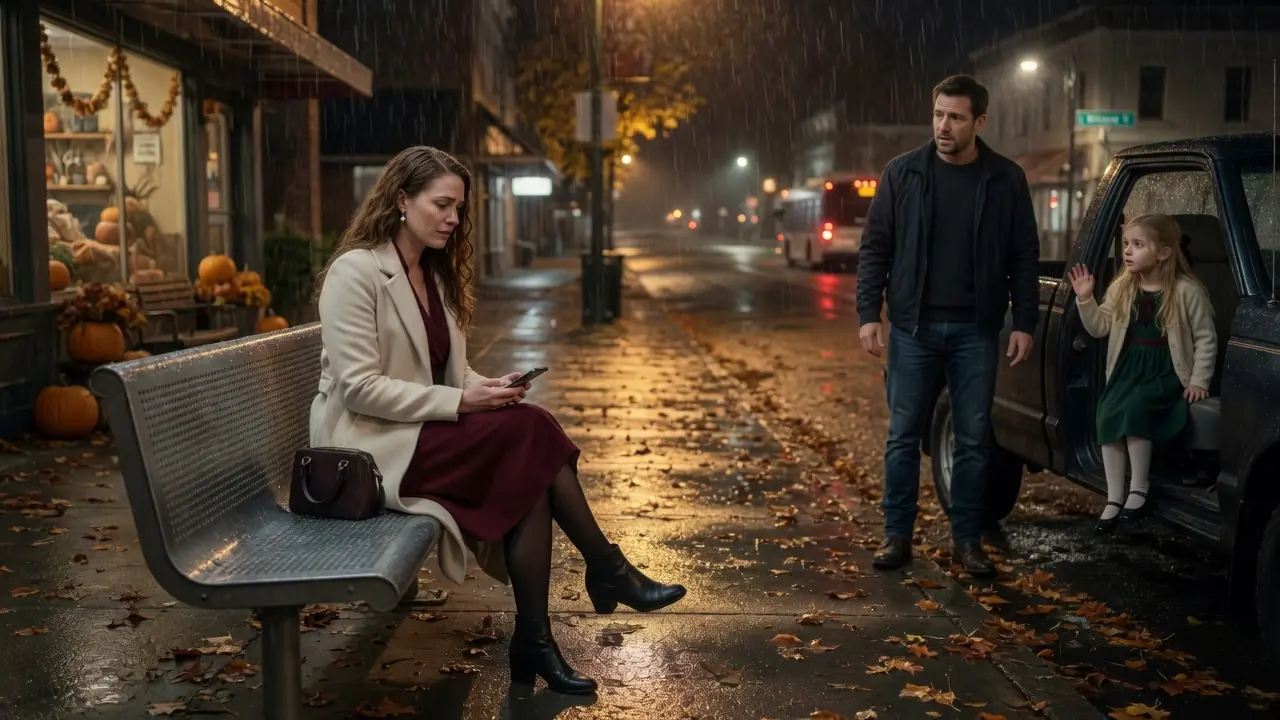
Maybe less.
Now she was completely stranded in twenty-eight-degree Oregon rain, wearing nothing but navy scrubs and a thin jacket that did absolutely nothing against the wind slicing through the wet fabric.
The bus shelter had no walls, just a scratched plastic roof and a narrow metal bench slick with rain. Water dripped steadily from one corner of the shelter onto the sidewalk, tapping out a rhythm that made the silence feel even colder.
Behind her, Will Valley Hospital still glowed on the hill, all white lights and glass doors and humming machines. Inside, families were gathering around bedsides with paper plates of reheated turkey, nurses were handing out tiny pumpkin pies from the cafeteria, and patients who could not go home were trying to be grateful from behind IV poles and oxygen tubes.
Outside, Megan stood alone, soaked to the skin, with her feet aching so badly she could barely feel her toes.
She had just finished a brutal sixteen-hour shift, covering for a coworker who had called in sick before sunrise. Her back hurt from bending over beds. Her shoulders ached from repositioning patients. Her eyes burned from fluorescent lights, charting, grief, and exhaustion.
She had stayed forty-five minutes past the end of her shift, sitting with an elderly patient named Mr. Chen, who had no family nearby and was actively dying.
Mr. Chen had been eighty-four.
He had liked warm blankets, lemon ice chips, and the old Chinese songs his wife used to sing before she died. His English came and went near the end, but loneliness needed no translation.
Megan could have left when her shift officially ended.
Another nurse could have checked on him.
A hospice volunteer might have been called if anyone had time.
But he had reached for her hand with fingers as thin and cold as folded paper, and Megan had not been able to leave.
Nobody should have to die alone.
Especially not on Thanksgiving, when the rest of the country was sitting at tables, passing plates, and pretending every family had someone waiting with a warm chair.
Mr. Chen passed at 11:15, holding Megan’s hand while the hospital cafeteria staff cleared away leftover turkey trays somewhere down the hall. His breathing had slowed, then paused, then slipped away so gently that for a moment Megan thought he had only fallen asleep.
She stayed with him until the funeral home came.
She helped wash his face.
She folded his blanket.
She stood in the hallway afterward with her hands shaking and realized she had given the last warm part of herself to a man whose children had not arrived in time because their flight from California had been delayed by holiday weather.
Then she ran for the bus.
Too late.
Now the street was nearly empty. Storefront windows were dark. A coffee shop across the road had a chalkboard sign still out front that said, Give Thanks, Get Pie, the words bleeding down in the rain. Somewhere far away, someone laughed loudly in a parking lot, probably leaving a family dinner with leftovers packed in plastic containers and someone to hug goodbye.
Megan had no one.
Her phone was at three percent because she had forgotten to charge it during her double shift. When she opened the Uber app, her hands trembling from cold, the holiday surge pricing said eighty-seven dollars to get to her apartment.
It might as well have been a million.
She had exactly thirty-two dollars in her checking account until payday on Friday.
There were two granola bars in her locker at the hospital, a half-empty carton of milk in her refrigerator, and a landlord who had just raised rent again because “the market had changed.”
Megan stared at the screen until the battery dropped to two percent.
Then she closed the app.
Here was the thing about moving to a small town six months ago to escape a bad breakup and start over completely alone: the loneliness did not arrive all at once.
At first, it felt like freedom.
A new apartment.
A new job.
A new badge clipped to her scrubs.
A new grocery store where nobody knew that she had once cried in the freezer aisle after finding out her boyfriend of four years had been cheating with someone from his office.
She had left Portland with two suitcases, one box of books, and a determination so fierce it had almost looked like hope. She told herself Will Valley would be a clean start. Smaller town. Slower pace. Better air. Fewer memories waiting at every intersection.
And for a while, it worked.
She worked too many hours.
Slept too little.
Learned the hospital layout.
Learned which vending machine stole dollar bills and which doctor never answered pages on the first try. Learned where to buy cheap coffee before a shift and which laundromat dryer ran hot enough to shrink her socks.
But she had not learned how to belong.
Not yet.
Six months later, she still had no one to call when things went wrong.
No friend to pick her up from a bus stop near midnight.
No family within five hundred miles who cared whether she spent Thanksgiving eating a vending machine dinner after watching a man die.
Her mother had remarried years earlier and moved to Arizona, where every phone call became a report about golf, weather, and why Megan worked “such depressing jobs.”
Her father had not spoken to her since she switched from pre-med to nursing because, in his words, she had “settled for almost.”
Her ex had texted twice after she moved.
The first message said he hoped she was doing well.
The second asked if she had accidentally packed his Bluetooth speaker.
Megan sat down on the frozen bench.
The cold went straight through her scrubs.
She pressed both hands over her face and started crying.
Not delicate tears.
Not movie tears.
Hard, ugly, exhausted tears that shook her shoulders while rain slid down the back of her neck.
She cried because she was cold.
Because she was hungry.
Because Mr. Chen had died holding her hand while his children were trapped in holiday airport chaos somewhere between California and Oregon.
Because she had spent all day being useful to strangers and still had no one who would notice if she did not make it home.
Because Thanksgiving was supposed to be a day when people gathered around tables and named what they were grateful for, and Megan could not think of a single person who was waiting to save her a seat.
Megan only had a wet bus stop, a dying phone, and the sharp knowledge that starting over did not automatically mean being found.
Five miles away, Nathan Sullivan was driving home from his sister Jess’s Thanksgiving dinner with his seven-year-old daughter, Ellie, half asleep in the back seat.
He was relieved to finally be leaving because he hated Thanksgiving with every fiber of his being.
Not in a casual, grumpy-dad way.
In a way that settled in his chest days before the holiday arrived.
His wife, Clare, had died three years earlier on the Saturday after Thanksgiving, after an eight-month battle with ovarian cancer. Every Thanksgiving since then felt like a door opening into the week when everything had ended, the last holiday they had tried to celebrate before the disease took the final pieces of her strength.
Their last Thanksgiving together had been quiet.
Clare had been too tired for the full family dinner, though she had insisted Nathan take Ellie to Jess’s house for a few hours. When they came home, Clare had been on the couch in fuzzy socks, a blanket over her lap, Ellie’s handmade turkey drawing taped to the wall beside her.
Nathan had brought her a small plate from the dinner.
Turkey.
Mashed potatoes.
A spoonful of stuffing.
Pumpkin pie she barely touched.
She had smiled and said, “Look at that. A feast delivered directly to my throne.”
Ellie had climbed beside her and fallen asleep against her side, one hand resting over Clare’s arm.
Nathan had stood in the doorway holding back tears because the room looked too beautiful and too temporary.
Two days later, Clare’s pain became unbearable.
A week after that, Nathan stood beside a hospital bed and watched the woman who had made his house feel alive fade into stillness while monitors beeped in a room that smelled like antiseptic and helplessness.
He had never forgiven Thanksgiving for pretending to be warm after that.
He only went to his sister’s dinner because Ellie needed to be around family. She needed cousins, noise, pie, board games, paper turkeys, and the sight of her father at least pretending he could survive a holiday table.
Jess had tried.
She always tried.
She hugged him too tightly when he arrived. She handed Ellie off to a group of cousins making handprint turkeys with markers. She put a plate of food in Nathan’s hands and told him not to stand alone in the corner looking like a haunted coat rack.
Nathan loved his sister.
But he had spent the entire evening watching the clock.
At 11:30, after leftover containers had been stacked, coffee had gone cold, and half the children had fallen asleep on couches, he made his excuses.
Jess caught him by the front door.
“Nate.”
He already knew the tone.
“I stayed two hours longer than last year,” he said.
“That is not the victory you think it is.”
“It’s progress.”
“It’s avoidance wearing a nicer sweater.”
He zipped Ellie’s jacket.
“She’s tired.”
Jess looked toward Ellie, who was yawning dramatically against the wall, then back at him.
“Are you tired, or are you running?”
“Both.”
Jess softened.
“Clare would not want you to keep punishing yourself.”
Nathan looked away.
“Please don’t.”
“I’m serious.”
“I know.”
“That’s why I’m asking you to hear it.”
He kissed Jess on the cheek.
“Happy Thanksgiving.”
She sighed.
“Drive safe.”
Now Ellie was bundled in the back seat beneath a pink fleece blanket, her paper turkey crown slipping over one eye. Nathan drove through the wet streets with the heater on low and the wipers beating time against the windshield.
He was almost home when he saw the woman at the bus stop.
Scrubs.
Thin jacket.
Face in her hands.
Shoulders shaking.
Nathan’s first instinct was to keep driving.
He had his daughter in the car.
It was late.
It was not his problem.
There were rules for a reason, he told himself. A single father did not pull over near a stranger at midnight with his child in the back seat. A responsible man did not invite trouble into his life simply because someone looked sad.
He drove past.
Made it about two blocks.
Then Ellie’s sleepy voice came from the back seat.
“Daddy?”
“Yeah, bug?”
“Why didn’t we help that sad lady?”
Nathan tightened his hands on the wheel.
“She’s probably just waiting for someone, honey. I’m sure she’s fine.”
Even as he said it, he knew it was a lie.
Nobody was fine sitting alone at a bus stop crying in freezing rain on Thanksgiving night.
Ellie sat up straighter, her paper crown falling into her lap.
“But she was really crying. Like, a lot.”
Nathan exhaled slowly.
“Ellie—”
“And Mommy always said Thanksgiving means you don’t just say you’re grateful. You share what you have. Remember Mommy said that?”
The guilt hit him like a punch to the gut.
Because yes.
Clare had said that.
Many times.
Clare had been the kind of person who stopped for everyone who needed help. She kept granola bars in her purse for strangers outside grocery stores. She knew the names of cashiers, crossing guards, and elderly neighbors. She once made Nathan turn around on the highway because she saw a dog limping near an exit ramp.
He had spent three years trying to live up to her example.
And here he was, driving past someone in obvious distress on the very holiday Clare had loved most.
Ellie’s voice came again, smaller this time.
“Daddy, if Mommy was sad somewhere, I’d want someone to help her.”
Nathan closed his eyes for half a second.
Then he made a U-turn in the middle of the empty street and drove back toward the bus stop.
When he pulled up, the woman looked terrified.
She stood quickly, backing away from the curb as if she thought he was going to attack her.
Nathan rolled down his window, keeping both hands visible on the steering wheel.
“Hey,” he said carefully. “I know this is really weird, and you have zero reason to trust me, but my daughter saw you, and we were wondering if you need a ride somewhere. It’s freezing out here, and it’s Thanksgiving.”
The woman took another step back.
Rain shone on her hair and cheeks.
Nathan could see her doing the calculation every woman had to do too often.
Good Samaritan or danger.
He said, “I’m Nathan Sullivan. I own Sullivan Construction here in town. You can Google me if your phone works. I have my seven-year-old daughter in the back seat. I promise I’m not a creep. I’m just a dad who got guilted into stopping by a child with strong holiday morals.”
Ellie popped her head up and waved through the window.
“Hi, I’m Ellie. You look really cold. We have heat in our car. Also, we have leftover rolls.”
Despite everything, the woman laughed a little.
The sound came out broken, but real.
She walked closer, still cautious.
“I’m Megan. Megan Morrison. I’m a nurse at the hospital. I just got off a double shift, and I missed the last bus, and my phone’s almost dead, and I can’t afford an Uber.”
Her voice cracked on the last word.
She looked ashamed of it.
Nathan’s chest tightened.
“Where do you need to go?”
“Riverside Apartments on Fourth Street, if that’s not too far out of your way.”
“It’s not.”
“It is.”
“A little,” he admitted. “But not enough to leave you here.”
She looked at Ellie.
Ellie nodded solemnly.
“Daddy drives everywhere. He complains, but he does it.”
Nathan shot his daughter a look in the rearview mirror.
Ellie smiled innocently.
Megan hesitated only a moment longer before opening the back door and climbing in beside Ellie instead of the front passenger seat.
Nathan respected that.
Smart.
Careful.
Alive because she knew not to trust too easily.
The moment the door shut, warmth surrounded her. Megan’s body started trembling harder, the kind of shaking that began only after a person was safe enough to feel how cold they had been.
Ellie looked at her with wide concern.
“Your lips are purple.”
“Ellie.”
“What? They are.”
Megan tried to smile.
“I’m okay.”
“People always say that when they’re not.”
Nathan glanced at her in the mirror.
“Ellie is unfortunately correct.”
Megan let out another tired laugh.
It felt strange.
She had been crying three minutes ago.
Now she was sitting in a stranger’s warm truck, next to a child wearing a crooked paper turkey crown and an expression of fierce moral authority.
They drove toward Riverside Apartments through nearly empty streets.
Rain hit the windshield hard, then harder, turning streetlights into gold smears on wet pavement. Most houses they passed were dark except for porch lights and the glow of televisions where families were probably half asleep after too much food and too much noise.
Ellie studied Megan’s scrubs.
“Were you crying because someone died? You’re wearing hospital clothes, so maybe someone died, and that’s really sad.”
“Ellie, sweetheart,” Nathan said, mortified, “we don’t ask people things like that.”
But Megan said, “Actually, yes. A patient passed away tonight.”
Ellie went still.
Megan continued gently. “He didn’t have any family with him, so I stayed so he wouldn’t be alone when it happened.”
Ellie nodded very seriously.
“My mom died three years ago. It’s really sad when people die. I’m sorry your patient died. You’re really nice for staying with him.”
The truck went quiet.
Nathan kept his eyes on the road.
Megan looked from Ellie to Nathan and felt something shift in the air.
“I’m sorry about your mom,” Megan said softly.
“She was really pretty,” Ellie said. “And funny. And she made cinnamon pancakes, but Daddy burns them.”
“I do not burn them.”
“You make them extra brown.”
“That is different.”
“It tastes like burned.”
Megan smiled despite herself.
Nathan caught it in the mirror and smiled too, but the smile disappeared quickly, as if his face had forgotten how to hold it.
Megan asked about Ellie’s mom very gently.
Nathan gave the short version.
Married young.
Clare.
Ovarian cancer.
Eight months from diagnosis to goodbye.
Just him and Ellie now, figuring life out.
He did not say much more, but Megan heard the weight under each sentence. She knew grief voices. She had spent years hearing them in hospital rooms, in hallways, at bedsides where people signed forms with shaking hands.
Nathan Sullivan’s grief was not raw anymore.
It had become architecture.
He lived inside it.
When they pulled up to Riverside Apartments at 12:03 in the morning, Megan’s relief lasted exactly three seconds.
The building was surrounded by fire trucks and emergency vehicles. Red tape blocked the entrance. Water poured from the second-floor windows in steady sheets, splashing onto the sidewalk below.
Megan’s face went white.
“No.”
Nathan parked by the curb.
Megan jumped out before he could stop her and ran toward the building manager, who stood under an umbrella with a clipboard and the defeated look of a man who had already explained bad news too many times.
Nathan and Ellie followed because this clearly was not good.
“I live in 2B,” Megan said breathlessly. “What happened?”
The manager looked at her, then at the building.
“Pipe burst around eight. Main line on the second floor. Flooded multiple units before we could shut it off.”
“My apartment?”
“What unit?”
“2B.”
His face answered before his mouth did.
“I’m sorry.”
Megan felt the world tilt.
“What does that mean?”
“It means water damage. Ceiling, walls, flooring. We posted notices. Tried calling everyone.”
“My phone died. I was at work.”
“The building is condemned until repairs are made.”
“For how long?”
“Two to four weeks minimum. Maybe longer depending on inspection.”
Megan stared at him.
Rain ran down her face, but she could no longer tell what was rain and what was tears.
“What am I supposed to do tonight?”
The manager shifted awkwardly.
“Hotel, maybe? Family?”
Like those were ordinary things everyone had waiting.
Like shelter was simply a matter of choosing from a menu.
Megan looked past him toward the building where everything she owned was either wet, locked away, or ruined.
Her work shoes.
Her extra scrubs.
Her nursing textbooks.
Her few framed photos.
The blanket her grandmother had made before dementia took her hands.
She sat down on the curb.
Most of the town was asleep now, full of turkey and pie and family stories.
Megan sat in the cold rain and realized she had nowhere to go on Thanksgiving night.
Ellie tugged on Nathan’s jacket.
“Daddy,” she whispered, “she doesn’t have anywhere to go.”
Nathan looked at Megan.
At the way she sat with her elbows on her knees and her head in her hands.
At the hospital badge still clipped to her scrub pocket.
At the rain soaking through her jacket.
Ellie continued, “We have the guest room.”
Nathan knew it was crazy.
He knew you did not invite a complete stranger to stay in your house.
He knew his sister would call him reckless, his contractor friends would call him insane, and every practical instinct in his body was telling him to offer to pay for a hotel if he could find one.
But he also knew what Clare would have done.
And more than that, he knew Ellie was watching.
He knelt down near Megan, keeping enough distance not to crowd her.
“Do you have somewhere you can stay tonight?”
Megan did not look up.
“I’ll figure something out. Thank you for the ride. You’ve already done more than enough.”
Nathan could hear the pride and exhaustion fighting in her voice.
Ellie came and stood right in front of Megan.
“You can stay at our house. We have a guest room, and it’s really nice, and Daddy makes good pancakes in the morning.”
Megan finally looked up.
Tears streamed down her face.
“I can’t just move into a stranger’s house. That’s insane.”
Nathan nodded.
“It is definitely not normal.”
“That’s not helping your argument.”
“I know.” He rubbed the back of his neck. “But it’s Thanksgiving. Every hotel in town is probably full or too expensive. You clearly don’t have family nearby. You can’t sleep outside in this weather. Just stay tonight. Tomorrow you can figure something else out. It’s one night, and Ellie’s right. We do have space.”
Megan looked between him and Ellie.
Her whole body seemed to sag under the weight of surrender.
“Just tonight,” she said. “Just one night. I’ll be out of your hair first thing tomorrow.”
Ellie nodded like a tiny judge approving a reasonable motion.
“Good. You can have the good pillow.”
Nathan glanced at her.
“We have a good pillow?”
“I hide it.”
“Noted.”
They drove to Nathan’s house in silence.
When they pulled up to the modest craftsman with Thanksgiving decorations still hanging on the porch, Megan followed them inside like she was walking in a dream.
A paper wreath of orange and brown leaves hung on the front door. A small wooden sign beside it read Give Thanks. Rainwater dripped from Megan’s sleeves onto the entry rug as she stepped inside.
The house was warm.
That was the first thing she noticed.
Not just heated.
Warm.
There were boots by the door, school papers on a side table, a small pink backpack hanging from a hook, and a row of framed photos along the staircase wall.
A beautiful blonde woman appeared in many of them.
Laughing on a beach.
Holding a baby Ellie.
Standing beside Nathan in a wedding dress.
Sitting on the porch with flour on her cheek and a child’s birthday cake in front of her.
Clare.
The house made Megan’s chest tight because it was clearly a shrine to Nathan’s dead wife.
Not in an eerie way.
In a tender, frozen way.
The kind of house where grief had been dusted carefully instead of moved.
Everything looked preserved.
Like a museum of a life interrupted.
Nathan showed her to the guest room.
The moment he opened the door, he hesitated.
Megan understood why.
It was clearly Clare’s craft room.
There was a sewing machine in the corner. Half-finished quilts sat folded on shelves. Fabric squares were stacked in color groups. A corkboard above a small desk held sketches, patterns, and two photographs of Clare and Ellie holding matching stuffed rabbits.
Nathan swallowed.
“I’m sorry. This room is kind of…”
“It’s okay,” Megan said softly.
“No. It’s not really set up for guests. I should have—”
“Nathan, I’ve slept in hospital break rooms under paper towels. This is fine.”
He looked at her, and for a second, something like a laugh almost reached his face.
“Bathroom’s across the hall. Towels in the closet. Help yourself to anything you need.”
“Thank you.”
“And Megan?”
She looked up.
“Seriously, don’t worry about leaving early. Get some rest. You’ve had a hell of a night.”
After he left, Megan sat on the bed and looked around at Clare’s things.
A basket of thread.
A quilt block pinned unfinished.
A measuring tape curled near the sewing machine.
A blue cardigan hanging over the chair.
She thought, I just moved into a dead woman’s craft room on Thanksgiving night.
Then she covered her face with both hands and whispered, “This is either the beginning of something or the biggest mistake of my life.”
Megan woke up the morning after Thanksgiving at 8:00 to the smell of pancakes and the sound of a seven-year-old climbing onto the edge of her bed.
“You’re still here,” Ellie announced. “You didn’t leave.”
Megan opened one eye.
“Was I supposed to vanish?”
“No. But sometimes grown-ups say they’ll stay and then they don’t.”
The sentence landed gently and terribly.
Megan sat up.
“Your dad said he was making pancakes?”
“Yes. He never makes breakfast unless Aunt Jess yells at him. This is very exciting.”
Ellie hopped off the bed.
“Also, I brought you socks.”
She held up a pair of fuzzy socks with penguins on them.
“They’re clean. I think.”
Megan smiled.
“For me?”
“You were cold last night.”
For the first time in six months, Megan woke up feeling like maybe she was not completely alone in the world.
Downstairs, Nathan stood in the kitchen with flour on his shirt, flipping pancakes while the radio played a soft country station. A pan of Thanksgiving leftovers sat on the counter, covered in foil from the night before. The house smelled like coffee, cinnamon, and the faint savory scent of reheated stuffing.
Nathan looked clumsy and determined, the way men often look when cooking to prove they can.
Ellie climbed onto a stool and whispered loudly, “Don’t worry. We have cereal if they’re bad.”
“I can hear you,” Nathan said.
“I know.”
Megan sat at the table wrapped in borrowed socks and one of Nathan’s old sweatshirts because her scrubs were still damp. The entire scene was so domestic and normal that it made her ache.
Over breakfast, she explained that her landlord had texted saying the apartment inspection would take at least three to four weeks before anyone could move back in.
She was doing math in her head.
Hotel for a month.
Laundry.
Food.
Bus fare.
Phone bill.
She could maybe ask the hospital social worker for emergency housing resources, but she was not a patient. She could try a short-term rental, but every place in town had raised prices for the holiday weekend. She could sleep in the hospital parking lot during breaks, except she did not own a car.
Nathan watched her face.
He saw the calculations.
He recognized them, though his had once been different.
How many hours could he work while Clare was sick? How many bills could wait? How much pain medication did insurance cover? How many times could he tell Ellie everything would be okay before the words became a lie?
He set his fork down.
“Look,” he said, “this is going to sound crazy.”
Megan looked at him warily.
“I feel like that sentence has become a theme.”
“The guest room is just sitting empty. Your building is down for weeks. Why don’t you stay here until it’s fixed?”
Megan stared.
“No.”
“Just hear me out.”
“No, because my answer is already no. I can’t just move into your house. We literally met twelve hours ago. That’s insane.”
Ellie bounced in her seat.
“Please stay. Please, please, please. I really like you. And Daddy is never home after school, and the babysitter’s boring.”
Nathan pointed at her.
“Not helping.”
“I am helping.”
He turned back to Megan.
“I’m not asking you to be a nanny. I’m just saying my construction hours are unpredictable. If you happen to be around when Ellie gets home from school, that would be huge. You get a free place to stay, and I get peace of mind. Think of it as roommates, not charity.”
Megan shook her head.
“I work nights sometimes.”
“That’s fine.”
“I sleep weird hours.”
“We already live with a seven-year-old. Weird hours are normal.”
“I barely know you.”
“True.”
“You barely know me.”
“Also true.”
“I could be terrible.”
“Ellie says no.”
Ellie nodded confidently.
“I have instincts.”
Megan almost laughed.
Nathan’s face grew serious.
“I can give you references. My sister. My pastor. My business accountant. The police chief, if you want. You can put a lock on the bedroom door. You can keep your own schedule. You can leave anytime.”
Megan looked down at her plate.
She hated needing help.
She hated how badly she wanted to say yes.
“Why are you doing this?” she asked quietly.
Nathan looked toward the window.
Rain still streaked down the glass.
“Because my daughter asked me why I didn’t help you.”
The answer was so honest that Megan had no defense against it.
So she moved in temporarily with the four boxes that contained everything she owned.
Nathan helped carry them up to Clare’s craft room.
When he saw how little she had, his face changed.
Not pity.
Not exactly.
Recognition.
As if he suddenly understood that “new start” sometimes meant “almost nothing survived.”
Megan saw the look and wanted to cry.
She did not.
She was tired of crying in front of people she barely knew.
The first few days were awkward.
Megan tried to be invisible.
She washed her own dishes immediately.
Kept her shoes lined neatly by the door.
Asked before using the washing machine.
Cleaned the bathroom after every shower.
Moved through the house like someone staying in a museum after hours.
Nathan tried to be polite but distant.
He worked long construction days and came home smelling of sawdust, rain, and cold air. He checked Ellie’s homework, heated frozen dinners, answered work calls, and spoke to Megan with the careful courtesy of a man afraid one wrong word would make the entire arrangement collapse.
Ellie had no such hesitation.
She attached herself to Megan with the full confidence of a child who had decided something.
“What’s your favorite color?”
“Green.”
“Mine is purple, but not dark purple. Happy purple.”
“That’s very specific.”
“Do you like cats or dogs?”
“Both.”
“That’s cheating.”
“Then dogs.”
“Good. Daddy says we can’t get one because he works too much, but now you’re here.”
“Ellie.”
“What? I’m making long-term plans.”
By the second week, a routine had formed.
Megan worked night shifts at the hospital and came home in the morning to sleep. She woke around three and was there when Ellie got off the school bus. They did homework at the kitchen table, where Ellie pretended to hate math but secretly liked it when Megan explained fractions with pancake slices.
They started dinner together.
At first, Megan only made simple things.
Soup.
Pasta.
Chicken and rice.
Then she began cooking real meals because she could not keep watching Nathan and Ellie survive on frozen nuggets, toast, cereal, and drive-thru hamburgers.
She told herself she was just helping.
Temporary people could still chop onions.
Nathan came home around six, covered in sawdust and exhaustion, and the house felt alive in a way it clearly had not in years.
He found fresh flowers on the table one Friday.
Grocery store carnations in a jar.
“Where did these come from?” he asked.
“Discount bin,” Megan said. “They were too depressing to leave there.”
Ellie looked up from her homework.
“Megan says sad flowers still deserve a chance.”
Nathan met Megan’s eyes across the kitchen.
Something softened in his face.
“Sounds like Megan.”
She looked away first.
By late December, Megan had quietly added small touches to the house. Curtains that actually let light into the kitchen. A bowl for keys so Nathan would stop losing them. A plant near the sink. A blanket folded over the couch that was not connected to a memory of Clare.
Nothing disrespectful.
Nothing large.
Just signs that time had started moving again.
Nathan caught himself smiling at dinner for the first time in three years.
Ellie was thriving too.
Her teacher sent a note saying she was more focused in class. Her reading improved. She laughed more. She started talking about Megan like she was a permanent fixture.
“Megan and I are going to plant flowers in spring.”
“Megan says we can make soup from scratch.”
“Megan says nurses are basically detectives with snacks.”
Nathan heard those sentences and felt both warmth and fear.
Because Ellie had already lost one woman she loved.
He could not let her build her heart around someone temporary.
And yet, every evening when Megan walked through the house in socks and hospital scrubs, hair pulled into a messy bun, asking Ellie about homework or telling Nathan he needed actual vegetables, the place felt less like a memorial and more like a home.
Everything shifted one night in late December.
Ellie woke at 2:00 a.m. with a fever of 103.
Nathan panicked in a way Megan had never seen.
He stood in Ellie’s doorway with the thermometer in his hand, breathing too fast, his face drained of color.
“We need to go to the hospital,” he said. “Right now. Something’s really wrong. We can’t wait.”
Megan was already moving.
She touched Ellie’s forehead, checked her pulse, listened to her breathing, assessed the color in her cheeks and the clarity of her eyes.
“Nathan,” she said calmly, “look at me.”
He did not.
“Nathan.”
His eyes snapped to hers.
“She has the flu. It’s going around her school. Her fever is high, but manageable. I’m a nurse. I’ve got this, but I need you to breathe.”
“She’s burning up.”
“I know.”
“What if—”
“I know what you’re thinking. But this is not that.”
He flinched.
She stayed up all night monitoring Ellie’s fever, giving medication, keeping her hydrated, and setting cool cloths on her forehead. Nathan sat in the hallway outside Ellie’s room with his back against the wall, head in his hands, clearly trapped somewhere far worse than the present moment.
Around 4:00 a.m., Ellie’s fever finally broke.
Her breathing eased.
She fell into peaceful sleep.
Megan found Nathan still sitting in the hallway.
She slid down beside him, shoulder brushing the wall.
“Want to tell me what that was about?”
Nathan’s voice was wrecked.
“Clare’s cancer started with symptoms we thought were just exhaustion. Some fever. Aches. Stomach pain. She kept saying she was fine. I kept believing her because I wanted it to be true. By the time we realized how serious it was, it was stage four.”
He rubbed both hands over his face.
“Every time Ellie gets sick, I’m back there. Watching Clare fade. Wondering what I missed. Wondering if I’m missing something again.”
Megan sat very still.
“I’m an oncology nurse,” she said quietly. “That’s my specialty. I work with cancer patients every day.”
Nathan looked at her like he was seeing her for the first time and understanding something terrible and strange.
“Of course you are,” he whispered. “That’s some kind of cosmic joke, isn’t it? The universe putting you in my house when hospitals are the last place I ever want to think about.”
“It may not be a joke,” Megan said. “Maybe it’s just life being clumsy.”
He gave a broken laugh.
“That sounds about right.”
They sat in silence.
The hallway nightlight glowed faintly near the stairs. Rain tapped against the windows. Ellie slept peacefully behind the half-open door.
Nathan finally said, “Thank you for tonight. For knowing what to do. For not letting me spiral. I don’t know what I would have done without you here.”
“You would have figured it out.”
“I’m not sure.”
“I am.”
He turned his head toward her.
Megan held his gaze.
“You’re a good dad, Nathan. You’re doing better than you think.”
His eyes filled, but he blinked it away.
No one had said that to him in a long time.
January arrived with gray skies, muddy boots, and feelings no one knew how to name.
Megan and Nathan moved around each other carefully, like two people carrying full glasses in a crowded room.
They were not dating.
They were not family.
They were not strangers.
They were some impossible thing in between.
Ellie made it worse by being completely unbothered by complexity.
She made a winter art project at school with three hearts on it.
One said Daddy.
One said Mommy Clare.
One said Megan.
Nathan found it on the kitchen counter and stared at it for a long time.
Megan found him there.
“Is that okay?” she asked quietly.
“I don’t know.”
“That’s honest.”
“I’m scared that if I say yes, I’m replacing Clare.”
“You’re not.”
“I know that in my head.”
“But not in your bones.”
He looked at her.
She shrugged.
“Hospitals teach you that grief lives in strange places.”
He wanted to ask where hers lived.
He did not.
One night after Ellie went to bed, they sat on the couch watching a movie neither of them was paying attention to.
The house was quiet.
The kind of quiet that no longer felt empty.
Their shoulders touched.
Neither moved away.
Nathan turned to say something at the same moment Megan turned toward him. Suddenly, their faces were inches apart.
For one suspended second, both of them leaned in.
Then Nathan pulled back.
“This is really complicated.”
Megan swallowed.
“I know.”
“I’m sorry.”
“No. You’re right.”
The words hurt because they were true.
She looked around the living room.
At Clare’s photos.
At the quilt over the armchair.
At the wedding portrait still hanging in the hallway.
At the house where past and present had not yet learned how to share space.
“I should probably find my own place,” Megan said.
Nathan’s face changed.
“What?”
“My apartment’s been ready for two weeks. The landlord texted me.”
“You didn’t tell me.”
“I know.”
“Why?”
“Because I didn’t want to leave.”
The honesty hung between them.
Nathan’s voice lowered.
“You don’t have to go.”
“But I can’t stay like this.”
“Like what?”
“Like a ghost’s roommate.”
He looked wounded, but she kept going because she had spent too many years swallowing truth to keep other people comfortable.
“I’m not your wife, Nathan. I can’t replace Clare. I shouldn’t have to. Look around. You haven’t changed a single thing in this house in three years. I’m sleeping in her craft room surrounded by quilts she made. Her photos are in every room. Her cardigan is still over the chair upstairs.”
His jaw tightened.
“That’s Ellie’s mother.”
“I know. I would never ask you to erase her.”
“Then what are you asking?”
“I’m asking whether there is room for anyone else here.”
He had no answer.
That was answer enough.
Two days later, Nathan’s in-laws, Tom and Linda Walsh, showed up unannounced for their monthly visit with Ellie. They had been part of Nathan’s life since he was twenty-two, and after Clare died, their relationship became a fragile bridge held together by shared love for Ellie and shared grief that could turn sharp without warning.
Tom was a retired high school principal, tall, serious, and emotionally clumsy in the way men of his generation often were.
Linda was softer on the surface but harder underneath. She carried grief like a porcelain cup, beautiful and brittle, always one accidental touch from shattering.
They walked into the house to find Megan cooking dinner and Ellie setting the table.
The scene looked domestic.
Too domestic.
Linda’s face went cold.
Introductions were painfully awkward.
Nathan explained that Megan was staying temporarily after her apartment flooded.
Tom looked around.
“Temporarily? It’s been weeks. That’s not really temporary anymore, is it?”
Megan wished the floor would open.
Dinner was tense and terrible.
Linda barely spoke to Megan and kept making comments about Clare.
“Clare always made pot roast on Sundays. It was Ellie’s favorite. Remember, sweetheart?”
Ellie looked down at her plate.
“I like Megan’s chicken too.”
Linda’s smile tightened.
“I’m sure you do.”
Nathan set his fork down.
“Linda.”
“What? I’m just remembering my daughter.”
“No one is stopping you.”
Megan stared at her plate.
After Ellie went to bed, the confrontation Megan had been dreading finally happened.
Linda stood in the living room with her purse held tightly in both hands.
“I need to know what’s going on here, Nathan. Who is this woman really? Because it looks an awful lot like you’re replacing our daughter.”
Nathan’s face hardened.
“That’s not fair.”
“Isn’t it?”
“Megan needed help, and we had space.”
Tom crossed his arms.
“She’s an oncology nurse, Nathan. Really?”
Nathan flinched.
Tom continued, his voice colder than he likely intended. “You are working through your grief by playing house with someone who reminds you of the hospital and the doctors who couldn’t save Clare. This is textbook transference.”
Megan had gone into the hallway to retrieve her phone from the charger.
She heard every word.
It felt like being slapped.
Nathan said something, but Megan did not wait to hear more.
She went upstairs quietly and started packing.
By morning, her bags were by the door.
When Nathan found her, he looked like he had not slept.
“Megan.”
“I’m going back to my apartment.”
“You don’t have to.”
“I do.”
“No, you don’t.”
She turned to him.
“Your in-laws are right.”
“They’re grieving.”
“So are you.”
“That doesn’t mean they’re right.”
“They’re right enough.” Her voice cracked. “I’m a stand-in for everything you lost, and that’s not fair to anyone.”
Nathan stepped closer.
“That’s not true. You’re not a stand-in.”
“Aren’t I?” She gestured toward the stairs, toward the craft room, toward the house itself. “You haven’t moved on, Nathan. Your entire house is a museum to Clare. I can’t compete with a ghost, and I shouldn’t have to.”
“I’m not asking you to compete.”
“You’re not asking anything. That’s the problem.”
He had no response because she was right.
Then Ellie came running down the stairs and saw the bags.
Her face crumpled instantly.
“No.”
Megan’s heart broke.
“No, Megan, don’t go. Please don’t leave us.”
Megan knelt down and opened her arms.
Ellie rushed into them, sobbing.
“I love you,” Ellie cried into her shoulder.
Megan closed her eyes.
“I love you too, sweetheart.”
“Then stay.”
“I can’t.”
“Why?”
Because adults are broken in ways children should not have to understand.
Because love is not enough when a house has no room for the living.
Because I am terrified of becoming another woman you lose.
Megan could not say any of that.
So she kissed Ellie’s hair and whispered, “I’ll still see you. I promise.”
Even though all three of them knew it might become a lie.
February was miserable.
March was worse.
Ellie’s grades dropped.
She stopped sleeping through the night. She had tantrums over small things, like socks, cereal, missing crayons, and the wrong cup at dinner. She asked every day when Megan was coming back until Nathan finally said, “I don’t know,” and she screamed that he always said that when grown-ups left forever.
Nathan threw himself into work, taking twelve-hour days because it was easier than being in the house that felt empty again.
But work did not help.
Every evening, he came home to silence and saw what Megan had left behind.
The jar where she had put flowers.
The bowl for keys.
The curtains she had chosen.
A sticky note inside the spice cabinet that said, cumin is not cinnamon, Nathan.
He found it one night and laughed for half a second.
Then sat down on the kitchen floor and cried.
Megan picked up every extra shift the hospital offered. She worked herself to exhaustion because sleeping meant dreaming about the family she had lost. Her apartment was technically habitable again, but it felt colder than before. The walls smelled faintly of repaired drywall. Her belongings, what survived the flood, sat in boxes she had no energy to unpack.
She told herself she had done the right thing.
She repeated it like medication.
Still, every time a child visited the oncology floor, she thought of Ellie.
Every time a contractor came through the hospital to repair something, she thought of Nathan’s sawdust-covered jacket.
They did not text.
They did not call.
Both too stubborn.
Too scared.
Too hurt to be first.
One day in late April, Nathan found a letter Ellie had written but never sent.
It was folded beneath her pillow, written in purple marker on notebook paper.
Dear Megan,
I miss you so much. Daddy is sad again like he was before you came. I think he loves you, but he’s too scared to say it. Can you please come back?
Love, Ellie.
P.S. I still think your chicken is better than pot roast.
Nathan sat at the kitchen table staring at his daughter’s handwriting for over an hour.
Then he called Jess.
His sister answered on the second ring.
“Is Ellie okay?”
“She wrote Megan a letter.”
Jess was quiet.
“And?”
“And I think I ruined everything.”
Jess sighed softly.
“Finally.”
“That is not supportive.”
“It is very supportive. I have been waiting for you to catch up.”
Nathan pressed his thumb and forefinger to his eyes.
“What am I supposed to do?”
“Start by being honest with yourself.”
“I am.”
“No, you’re being miserable. That’s different.”
He almost laughed.
Jess continued, “Do you love Megan?”
He looked toward the living room, toward Clare’s photo on the mantel.
“I think so.”
“Wrong answer.”
“What?”
“You don’t think so. You know. You’re just afraid knowing means betraying Clare.”
Nathan said nothing.
Jess’s voice softened.
“Nate, Clare loved you. She loved Ellie. She would not want her daughter growing up in a house where love is treated like a museum artifact nobody is allowed to touch.”
The words landed hard.
On April 30th, Nathan drove to the cemetery where Clare was buried.
The sky was gray, but for once, it was not raining. He stood in front of her headstone with his hands in his jacket pockets, feeling foolish and desperate and painfully alive.
“Hey, Clare,” he said.
The wind moved softly through the trees.
“I think I’m falling in love with someone.”
His voice broke on the words.
“And I feel guilty. God, I feel so guilty. Like I’m taking something from you. Like if I love her, it means I loved you less.”
He wiped his eyes.
“But I’m so tired of being sad. Ellie is tired too. She misses Megan. I miss Megan. The house misses her, which sounds insane, but it does.”
He laughed shakily.
“You’d like her. She’s stubborn. She saves people for a living. She thinks cumin and cinnamon should be stored on different shelves because apparently I am a danger to dinner.”
A voice behind him said, “She’d want you happy, Nathan.”
He turned.
Linda stood there with flowers in her hands.
For one painful second, he braced for another confrontation.
But Linda’s face was wet with tears.
“Tom and I have been talking,” she said. “A lot.”
Nathan looked down.
“About that dinner?”
“Yes.”
“You were hurt.”
“We were cruel,” Linda said.
The words startled him.
She stepped closer, holding the flowers against her coat.
“I saw that girl in Clare’s kitchen, helping Ellie set the table, and all I could think was, That should be my daughter. I forgot that Clare is gone whether Megan is there or not.”
Nathan’s throat tightened.
“Linda—”
“No. Let me say it.” She looked toward the headstone. “Clare would not want you frozen in grief. She would not want Ellie afraid to love anyone because adults keep teaching her love disappears. And she would not want us guarding her memory so tightly that nobody living can breathe.”
Nathan’s eyes filled.
“That girl Megan is good for both of you,” Linda said. “Go get her before it’s too late.”
Nathan showed up at Will Valley Hospital on May 1st at 11:00 p.m., knowing Megan’s shift ended at midnight.
He sat in his truck in the parking lot, rehearsing what he was going to say for the hundredth time.
Every version sounded too small.
Too late.
Too clumsy.
At five minutes past midnight, Megan walked out of the hospital entrance looking exhausted, her hair pulled back, her scrubs wrinkled, her shoulders slumped.
When she saw Nathan leaning against his truck, her face went through fear first.
Then concern.
Then confusion.
She walked over quickly.
“Nathan, what are you doing here? Is Ellie okay? Did something happen?”
“Ellie’s fine. She’s at Jess’s house.”
Megan’s face tightened.
“Then why are you here?”
“Because I needed to see you.”
“That’s not fair.”
“I know.”
“No, Nathan, you can’t just show up here after two months and—”
“I love you.”
The words stopped her completely.
Rain misted in the hospital lights. Somewhere behind them, the automatic doors opened and closed as night-shift staff moved in and out.
Nathan took a step closer.
“I should have said it two months ago. I should have said it before you left. I should have said a lot of things, but I was scared and stuck and still living in a house where grief had more rights than anyone alive.”
Megan’s eyes filled.
“You’re not a replacement,” he said. “You’re not a stand-in for Clare or for the doctors who couldn’t save her. You’re not filling a Clare-shaped hole in our lives. You’re Megan. The real, actual you. The nurse who stayed with a dying man because nobody should die alone. The woman who helped my daughter with fractions and told me to stop feeding her beige food. The person who made my house feel like morning again.”
Megan covered her mouth.
Nathan kept going because if he stopped, he would lose his nerve.
“I’ve been living in the past for three years, keeping everything exactly the same because changing anything meant admitting Clare was really gone. But you showed me I can honor her memory and still build a new life. Those two things can exist together.”
Megan was crying now.
“I’m so scared, Nathan.”
“I know.”
“I’m terrified of not being enough. Of you comparing me to her. Of Ellie losing someone else if this doesn’t work out. I can’t break that little girl’s heart.”
Nathan wiped the tears from her face with his thumb.
“I can’t promise everything will be perfect. But I can promise I see you. The real you. Not anyone else. And Megan, Ellie already lost you once. She’s been grieving you for two months. She wrote you a letter saying I love you, but I’m too scared to say it.”
Megan laughed through tears.
“She wrote that?”
“Yes. With a postscript about chicken.”
“That sounds like her.”
“She was absolutely right.”
Megan looked at him for a long time.
“I love her so much,” she whispered. “I love both of you so much it terrifies me.”
“Then come home for real this time,” Nathan said. “Not as a temporary roommate. Not because your apartment flooded. Come home and let’s build something together.”
They kissed right there in the hospital parking lot under the streetlights.
It was gentle at first.
Then desperate.
Then both of them were laughing and crying because it felt impossible and exactly right.
A small voice from Nathan’s truck said, “Finally. Oh my God, you guys took forever.”
Both adults jumped.
Ellie popped up from the back seat, where she had apparently been hiding beneath a blanket the entire time.
Nathan stared at her.
“Ellie Marie Sullivan.”
Megan started laughing harder.
Nathan pointed toward the truck.
“You were supposed to stay at Aunt Jess’s house.”
“I snuck out.”
“How did you get in my truck?”
“You left it unlocked when you went back inside for your coat.”
Nathan closed his eyes.
“I am grounding you until college.”
Ellie grinned.
“But she said she loves us.”
Megan walked to the truck and opened the back door.
Ellie launched herself into her arms.
For a long moment, Megan held her tightly, one hand on the back of Ellie’s head, the other gripping Nathan’s jacket like she needed proof both of them were real.
“Can we go home now?” Ellie whispered.
Megan looked at Nathan.
Nathan looked back.
Home.
The word no longer felt like a place that belonged only to the past.
“Yes,” Megan said softly. “Let’s go home.”
That November, one year after the night they found Megan at the bus stop, Nathan hosted Thanksgiving at his house.
Not Jess.
Not Tom and Linda.
Nathan.
He cleaned for three days, burned one test pie, and called Megan from the grocery store seven times because apparently there were too many kinds of cranberry sauce and he did not trust himself.
Megan cooked most of the food anyway.
Ellie made place cards.
Jess brought rolls.
Linda brought Clare’s old pumpkin pie recipe and gave it to Megan with shaking hands.
“I think she’d want this used,” Linda said.
Megan took the card carefully.
“Thank you.”
The house looked different now.
Clare’s photos were still there, but not everywhere.
Her craft room had become Megan and Ellie’s sewing-and-homework room, with Clare’s unfinished quilt folded respectfully in a glass-front cabinet and Megan’s nursing books on the desk.
The blue cardigan was packed away with care, not abandoned on the chair like someone might return at any moment to wear it.
Fresh curtains hung in the kitchen.
A dog named Biscuit slept under the table because Ellie’s long-term plans had finally succeeded.
Before dinner, Nathan stood at the head of the table and looked around.
Jess and her family.
Tom and Linda.
Ellie with mashed potatoes already on her sleeve.
Megan beside him, wearing a green sweater, her hair loose around her shoulders, one hand resting near his.
He cleared his throat.
“I’m not great at speeches.”
Jess muttered, “Confirmed.”
Everyone laughed.
Nathan smiled, then looked at Megan.
“Last Thanksgiving, I drove past someone who needed help because I was scared. My daughter made me turn around. That was the best thing anyone ever guilted me into doing.”
Ellie sat up proudly.
“You’re welcome.”
Nathan’s voice thickened.
“I used to think Thanksgiving was only about what I had lost. This year, I understand it can also be about what love brings back when you finally open the door.”
He took Megan’s hand.
“I’m grateful for Clare. Always. I’m grateful for the life she gave me, for Ellie, for every good thing she left behind. And I’m grateful for Megan, who came into our house on the worst night and somehow taught us that being alive means there is still room for more love.”
Megan’s eyes filled.
Linda wiped her tears with a napkin.
Ellie whispered loudly, “This is a really good speech for someone who said he was bad at speeches.”
Nathan laughed through tears.
They ate together that night at a table full of food, noise, stories, and imperfect healing.
Later, after everyone left and Ellie fell asleep on the couch with Biscuit curled beside her, Megan stood at the kitchen sink washing glasses.
Nathan came up behind her and wrapped his arms around her waist.
“You okay?” he asked.
She looked out the window at the wet street beyond the glass.
A year ago, she had stood alone at a bus stop, crying in freezing rain, convinced no one in the world would notice if she disappeared.
Now there were leftovers in the refrigerator, a sleepy child on the couch, a dog snoring under the table, and a man holding her like she belonged exactly where she stood.
“I’m more than okay,” she said.
Nathan kissed her temple.
From the living room, Ellie stirred and mumbled, half asleep, “Don’t forget the good pillow.”
Megan laughed softly.
Nathan smiled.
Outside, the Oregon rain kept falling, cold and steady.
But inside the house, no one was alone.
And every Thanksgiving after that, Megan thought about Mr. Chen, about the last bus she missed, about a little girl who refused to let her father drive past someone in pain, and about the strange mercy of a holiday that had taken Nathan’s heart apart before giving both of them a reason to build again.
Sometimes life does not bring you home through the front door.
Sometimes it finds you at a bus stop in freezing rain, when you have nothing left but wet scrubs, a dead phone, and the belief that nobody is coming.
Then headlights appear.
A child waves from the back seat.
A grieving man rolls down the window.
And suddenly, the thing you thought was the end of your strength becomes the beginning of your family.