Emma Whittaker did not look away as Cal Monroe stared across the temporary electric fence. Thirty-two feeder pigs moved beneath the mature pecan trees, their noses pressing through damp leaves, cracked shells, rotten husks, and nuts the harvesting equipment had missed. From the county road, the South Block no longer resembled the spotless orchard floor local farmers expected after harvest; it looked rough, noisy, and dangerously uncontrolled. Yet every fence line, irrigation pipe, soil marker, and sampling square had been measured before the first pig entered.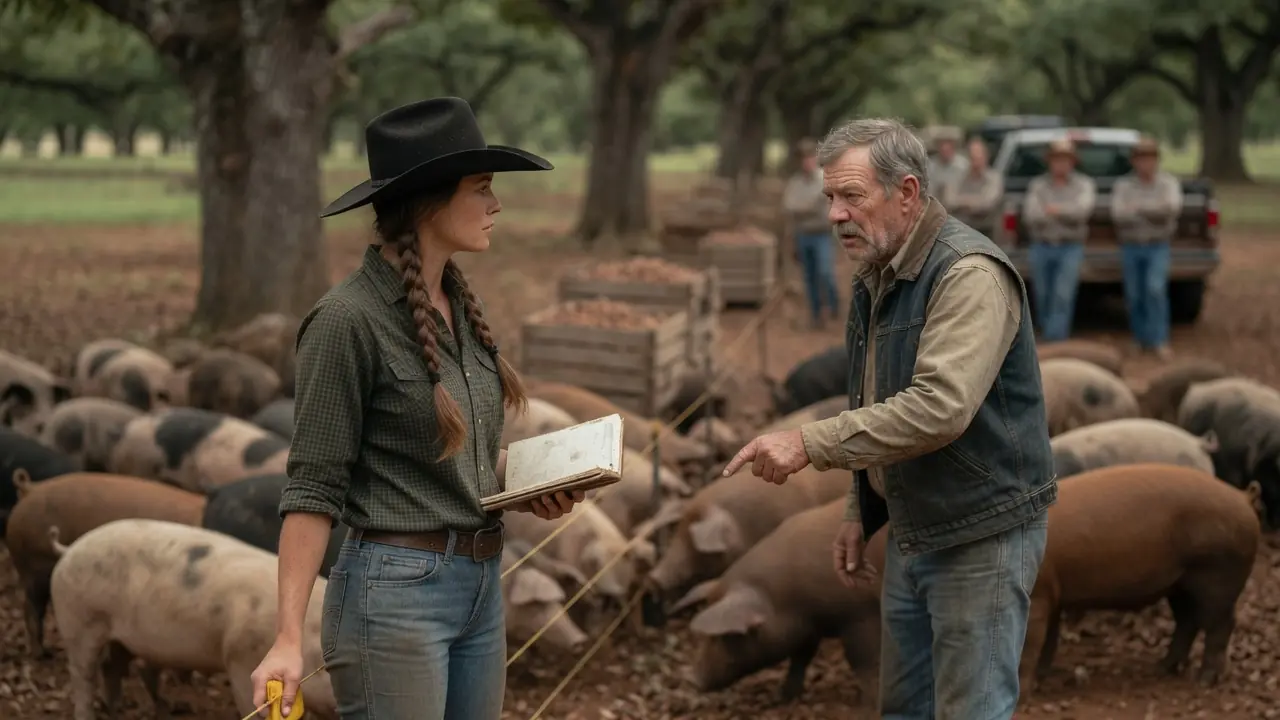
Cal turned toward the pickup trucks parked along the road, where four neighboring growers had stopped to watch. He owned Monroe Agricultural Supply, the largest farm-service business within forty miles, and his opinion carried more weight than most county officials. If Cal called an idea foolish over morning coffee, the story usually reached every equipment shed and feed store before sunset. Emma understood that he had not come merely to warn her; he had come to witness her failure early enough to claim he had predicted it.
Her father, Ray Whittaker, stood near the machinery barn with his arms folded. He had planted some of the younger orchard blocks himself and had spent nearly four decades protecting trees his father had established before him. Ray did not defend Emma, but he did not order her to stop. That narrow silence was the only permission she needed.
Emma was twenty-seven, with sun-touched fair skin, green eyes, and long chestnut hair braided beneath a black felt cowboy hat. She had changed her usual work clothes for the trial, choosing a dark olive plaid shirt, faded jeans, and worn leather boots that could survive mud, manure, and endless walks between marked trees. The notebook in her hand contained soil-moisture readings, pig weights, photographs, pest counts, and maps of buried irrigation lines. Cal saw a young woman trying to prove college had made her smarter than experience, but Emma saw a controlled five-acre experiment with a neighboring untreated block for comparison.
The Whittaker orchard had suffered three increasingly expensive seasons. Each spring brought heavier populations of pecan weevils, hickory shuckworms, and fungal damage in several older rows. Cal’s answer was always another treatment, another application schedule, or a stronger mixture timed earlier in the season. The chemicals sometimes reduced visible damage, but the total cost kept climbing while the results became less reliable.
Emma had begun questioning the pattern during her final year studying agricultural science at the University of Georgia. In an integrated pest-management class, her professor taught that many outbreaks began months before growers saw insects on leaves or damage on developing nuts. Larvae survived inside fallen pecans, fungal material remained in rotting husks, and orchard debris sheltered the beginning of next year’s trouble. Farmers kept looking upward toward the branches while the next infestation waited beneath their boots.
When Emma returned home, she collected material from twelve orchard blocks. She cracked damaged nuts, sifted through damp litter, and sent samples to an extension laboratory. The oldest sections contained far more overwintering material than the cleaner blocks, especially where machinery could not recover nuts around uneven ground and mature roots.
She proposed using pigs after harvest because pigs did more than graze. They searched, disturbed surface litter, consumed fallen nuts, and exposed hidden material to drying temperatures and predators. Emma did not believe they were magical or harmless; unmanaged pigs could compact wet soil, damage irrigation, strip bark, or expose roots. Her plan depended on small paddocks, short rotations, mature trees, dry conditions, supplemental feed, and daily inspections.
Ray rejected the idea the first time she presented it at the kitchen table. He reminded her that his father had spent twenty years establishing those trees and that one badly managed week could damage roots that took decades to grow. Emma did not argue that experience was outdated. She asked for five acres, one control block, and permission to stop immediately if the measurements showed harm.
Her mother, Linda, broke the silence by pointing out that five acres represented less than three percent of the orchard. Ray finally agreed, but he made Emma responsible for every fence, damaged pipe, escaped pig, and neighbor who called to laugh. Emma accepted before he could reconsider. She spent the next six weeks preparing as though the trial were a court case and the land itself would serve as the jury.
Cal heard about it while supplying fencing materials to another grower. He joked that the Whittakers had begun raising bacon beneath pecan trees because Emma could not distinguish farming research from a social-media stunt. By the time she entered his store to purchase additional posts, six men were already discussing her experiment around the coffee counter. Cal asked whether pigs had learned to spray fungicide while she was away at college.
Emma told him the pigs were not replacing the entire pest program. They were removing part of the food and shelter that allowed the problem to carry over. Cal smiled and warned her that pleasant theories became expensive once they touched real soil.
What Emma did not yet know was that Cal had a stronger reason to dislike her trial than professional skepticism. Monroe Agricultural Supply had signed exclusive distribution agreements with two chemical manufacturers, and Cal received substantial volume bonuses whenever county growers purchased complete seasonal treatment packages. The worsening pest pressure had been profitable for him. A management method that reduced even one application across hundreds of acres threatened money he never discussed at the coffee counter.
For eight days, Emma moved the pigs through narrow sections of the South Block. They stayed no longer than the soil and residue measurements allowed, and she removed them early from any area that became too wet. Twice each day, she inspected trunks, surface roots, water lines, fencing voltage, and disturbance depth.
The animals created problems. One overturned a water container, another pushed beneath a loose section of fencing, and several rooted too deeply in a low corner after overnight rain. Emma immediately closed that section, photographed the damage, and recorded it instead of hiding the mistake.
Ray saw the photographs at supper. “Cal will use that corner against you for the next ten years.”
“Only if I pretend it didn’t happen,” Emma replied.
She filled the shallow holes, marked the area as unsuitable for future grazing, and added a rule prohibiting pigs from any block when soil moisture exceeded the limit established during the trial. Ray did not praise her, but the following morning he helped her reinforce the portable water system. It was the first sign that he had stopped waiting for the project to collapse and begun helping it survive.
When the pigs left, the treated block looked uneven but not destroyed. Visible fallen nuts and husks had dropped by more than sixty percent in the sampling squares. Surface disturbance remained mostly within the upper two inches, and no measured tree showed serious root exposure or bark injury.
Emma weighed the pigs before returning them. They had gained enough weight from the orchard residue and supplemental feed to reduce the rental cost. The experiment had not merely removed waste; it had converted part of that waste into value.
Still, the real answer would not come until spring. Winter rain settled the orchard, leaves decomposed, and the county returned to familiar conversations about fertilizer prices, equipment repairs, and the upcoming spray calendar. Cal repeated the story of the low wet corner whenever anyone mentioned Emma’s numbers.
By February, his version had grown. He claimed the pigs had exposed major roots, broken three irrigation lines, and nearly escaped onto the highway. None of it was true, but the exaggerations circulated faster than Emma’s tables.
Emma refused to fight every rumor. She completed a winter report containing photographs, disturbance measurements, residue counts, costs, and documented mistakes. She gave copies to Ray, the county extension agent, and two neighboring growers who had asked serious questions.
Cal received no copy. Emma knew he would hear about the results soon enough.
Spring arrived early and wet. Warm weather pushed insect activity ahead of the normal schedule, then weeks of rain accelerated the decay of residue beneath untreated trees. Across Turner County, growers found damage sooner than expected.
Cal’s store became crowded each morning. He sold emergency treatments, adjusted schedules, and warned farmers that the season might become the worst in years. Monroe Agricultural Supply’s delivery trucks moved from sunrise until after dark.
At the Whittaker orchard, Emma checked traps and sampled both the pig-treated block and the untouched control rows. The first week showed little difference. The second produced a modest gap that could still have been chance.
By the fourth week, the pattern had become difficult to dismiss. The untreated block contained significantly more pest activity around areas where fallen nuts and damaged husks had remained through winter. The pig block still required management, but pressure was lighter and appeared later.
Ray discovered it before Emma presented the charts. He stopped between two marked rows, examined the traps, and walked back toward the control block without speaking. That evening, he asked her to bring the notebook to the kitchen table.
Emma showed him every number, including those that weakened her case. The pigs had not reduced all pests equally, and the wet corner had cost additional labor to repair. Yet the treated block required one fewer early intervention, carried less infected residue, and showed lower damage at the same stage of development.
Ray adjusted his reading glasses. “What would twelve acres cost next fall?”
Emma kept her expression controlled. “You want twelve?”
“I asked what it would cost.”
She opened a clean page and began listing stronger fencing, a portable water trailer, additional labor, and the need to exclude every low area. Linda smiled over her coffee, but neither woman celebrated in front of Ray. His trust had not been won by a single good result; it had merely opened far enough for the next trial.
News spread through the county. Some growers remained dismissive, but others drove slowly past the South Block or asked Ray indirect questions at the fuel station. Cal stopped laughing publicly and began saying the Whittakers had probably benefited from a naturally lighter pocket of pest pressure.
Then Emma received an anonymous envelope. Inside were copies of pest-scouting reports Cal had provided to several growers during the previous season. The handwritten note said, “Compare the dates to the sales invoices.”
Emma initially assumed a competitor was trying to damage Cal. She compared the reports with Monroe Agricultural Supply’s billing records available through the farm’s account. On multiple occasions, Cal had warned Ray of unusually high pest counts before anyone from his company had visited the orchard.
The scouting sheets claimed samples had been collected from specific Whittaker blocks on days when security-camera footage showed no Monroe vehicle entering the property. Invoices for emergency products were issued within hours of those false observations. Someone had fabricated field data to create urgency.
Emma told Ray, who became angrier than she had ever seen him. For years, he had trusted Cal’s recommendations because Cal had known their family, attended funerals, extended credit during difficult seasons, and claimed to understand the orchard. Ray wanted to drive directly to the supply store and confront him.
Emma stopped him. “If we accuse him with one envelope, he’ll say the papers are fake.”
Ray struck the table with his palm. “Then what do you want to do?”
“Measure it.”
The answer irritated him again, but this time he understood its value.
Emma contacted the county extension agent and asked whether growers could independently verify pest pressure before purchasing emergency treatments. The agent agreed to conduct blinded scouting in selected orchard blocks, provided multiple farms participated. Emma quietly recruited four growers who had complained that Cal’s expensive programs were no longer delivering expected results.
They created a simple protocol. Independent samples would be collected from marked locations, sealed, dated, and analyzed without revealing which blocks had received pig treatment. Cal’s company would continue submitting its usual recommendations, unaware that its findings were being checked.
For six weeks, the differences grew. Independent counts repeatedly came in lower than the danger levels described by Cal’s sales staff. The strongest exaggerations appeared on farms purchasing the largest treatment packages.
Emma also discovered that Monroe Agricultural Supply routinely recommended a proprietary mixture before laboratory confirmation of the pest involved. The mixture was one of the products tied to Cal’s highest manufacturer bonus. In some blocks, growers were treating problems that were not present at economically significant levels.
The pigs had not simply challenged Cal’s preferred method. They had threatened a sales system built on fear, incomplete information, and growers’ trust.
Cal realized someone was comparing his reports when two customers postponed major purchases pending extension results. He drove to the Whittaker orchard on an August afternoon and found Emma near the pump house repairing a fence charger.
He did not mention the investigation. Instead, he asked whether she intended to expand the pig trial again.
“Thirty acres next year,” Emma said.
“That would be reckless.”
“Why?”
“Because you’ll convince people they don’t need proper protection.”
Emma set down the screwdriver. “I tell everyone pigs are only one tool.”
“Farmers hear what they want to hear.”
“And sellers tell them what increases the invoice.”
Cal’s face hardened. “Be careful, Emma. Your family still depends on credit, replacement parts, and emergency deliveries. People who make enemies of their suppliers usually learn what that costs.”
It was not a direct threat, but it was clear enough. Emma’s phone, resting on the workbench, recorded every word.
Two days later, Monroe Agricultural Supply froze the Whittaker credit account. Cal claimed the action resulted from a routine financial review, though the farm had never missed a payment. He also called three equipment dealers and suggested the Whittakers were facing serious cash-flow problems.
Ray wanted to retaliate publicly. Emma asked him to wait three more weeks, until the independent scouting project ended and the extension office completed its report.
The final results showed that Monroe’s recommendations had overstated pest pressure across six participating farms by an average large enough to alter treatment decisions. Some differences could be explained by sampling methods, but several reports referenced visits that had never occurred. Two contained identical pest counts for separate farms on the same date, including the same unusual handwritten correction.
The county extension agent referred the records to the state agriculture department. The growers hired an attorney and requested sales contracts, manufacturer incentives, scouting logs, and communications connected to Cal’s recommendations.
Cal responded by organizing a public growers’ meeting at his store. He told customers that outside activists were trying to destroy local agricultural businesses and replace proven farm management with untested trends. He specifically described Emma as a young woman using her father’s land to build a reputation.
Emma attended wearing a dark green work jacket, jeans, boots, and her black hat. Ray sat in the back row but allowed her to speak for herself.
Cal invited her forward, expecting anger or defensiveness. Instead, Emma placed three enlarged charts on an easel.
The first compared residue levels before and after the pig trial. The second showed soil disturbance, including the wet corner where the method had failed. The third compared independent pest counts with Monroe Agricultural Supply’s reports.
Emma did not accuse Cal of stealing. She asked him to explain why his company had reported scouting visits that no employee had made.
Cal said records could contain clerical errors.
Emma showed security timestamps, vehicle logs, and invoices issued immediately after the false visits.
Cal accused her of manipulating data to sell livestock consulting services. Emma explained that she sold no pigs, chemicals, consulting packages, or farm products. Every participating grower had retained complete control of his records.
Then Ray stood. He held up four years of Monroe invoices and asked why his oldest friend had charged the family for emergency treatments based on pest counts nobody had collected.
Cal’s confidence cracked. He said he had protected the orchard when Ray lacked time to monitor every block. He insisted that preventive applications were safer than waiting for certainty.
A grower near the front asked why preventive advice required invented numbers.
Another asked about manufacturer bonuses.
Cal looked toward the door. Two state agriculture investigators were standing beside it.
The meeting ended without applause or shouting. Farmers gathered their documents, exchanged account histories, and began comparing notes in the parking lot. Cal had depended on each customer believing his experience was isolated; once the growers spoke to one another, the pattern became visible.
The state suspended Monroe Agricultural Supply’s scouting certification while investigators reviewed its records. The manufacturers terminated the bonus agreements after discovering that sales thresholds had been supported by fabricated field reports. Several growers filed civil claims seeking repayment for unnecessary products and false consulting charges.
Cal was not taken away in handcuffs. His punishment arrived more slowly. Customers stopped trusting his recommendations, the morning coffee crowd disappeared, and the business built on personal authority could no longer survive once every claim required evidence.
The Whittakers recovered part of their losses through a settlement. Ray used the money to build a permanent livestock-handling system and improve independent pest monitoring across the entire orchard. Emma insisted that they retain multiple tools rather than replace one rigid program with another.
During the second year, pigs rotated through twelve mature acres. The paddocks were smaller, the moves faster, and the wet areas completely excluded. The results improved.
By the third year, thirty acres were included. Some blocks showed meaningful reductions in residue and early pest pressure, while others showed little economic benefit. Emma stopped using pigs where the numbers did not justify the labor.
That honesty became the reason other farmers trusted her. She never claimed the animals solved every orchard problem. She showed where they worked, where they failed, what they cost, and what conditions turned them from useful workers into destructive animals.
Four years after the first trial, Emma spoke at a regional pecan growers’ conference. Her presentation was titled, “Pigs Beneath Mature Trees: What Worked, What Failed, and What We Measured.” Ray sat near the back holding a box of handouts he had volunteered to carry without being asked.
Emma showed photographs of the successful rows and the damaged wet corner. She explained fencing, soil limits, animal size, food-safety timing, irrigation protection, control blocks, and the continuing need for professional pest management. The farmers listened because she included mistakes instead of hiding them.
When questions ended, an older grower asked whether the method would have spread if Cal had not tried to discredit her.
Emma considered the question. “Maybe not as quickly,” she said. “But this was never about proving pigs were better than chemicals. It was about proving farmers deserve honest information before anyone sells them a solution.”
Ray looked down, hiding a smile.
The following spring, Emma walked through the South Block beside her younger cousin Tyler. He carried a poorly drawn map and an article about using ducks around irrigation ponds to control insects and snails. He spoke quickly, afraid she would laugh before he finished.
Emma studied the map. “Have you counted what’s living around the pond now?”
“Not yet.”
“Then start there. Baseline first, control area second, and no animals until we know what damage they could cause.”
Tyler grinned. “So you think it could work?”
“I think we don’t know yet.”
He ran toward his truck to begin sampling. Emma remained beside the fence, looking across the orchard her grandfather had planted, her father had protected, and she was learning to understand in a different way.
The pigs had never been the miracle people later claimed. They were simply one carefully managed tool that removed part of a problem before it reached the trees. The real change came from refusing to accept either ridicule or authority as proof.
Cal had expected spring to expose a young woman who did not understand real farming. Instead, spring exposed falsified reports, manufactured fear, and a business that profited whenever growers stopped asking questions.
The orchard did not survive because Emma ignored experience. It survived because she respected experience enough to test it against the ground.
And while everyone else had been watching the branches, she found the truth waiting beneath their feet.