“Clear out these peanut shells—you’ve turned good farmland into a stinking dump.”
Reggie Sloan stood beside the white pasture fence with one hand hooked through his belt and contempt written across his weathered face. Beyond him, a flatbed truck tilted its steel bed and released another rattling mountain of dry peanut hulls onto the Bennett farm. The pale shells rolled across the red Alabama clay, catching in weeds and piling nearly as high as the fence posts. Reggie spoke loudly enough for the truck driver, two passing neighbors, and everyone gathered near the feed store across the road to hear him.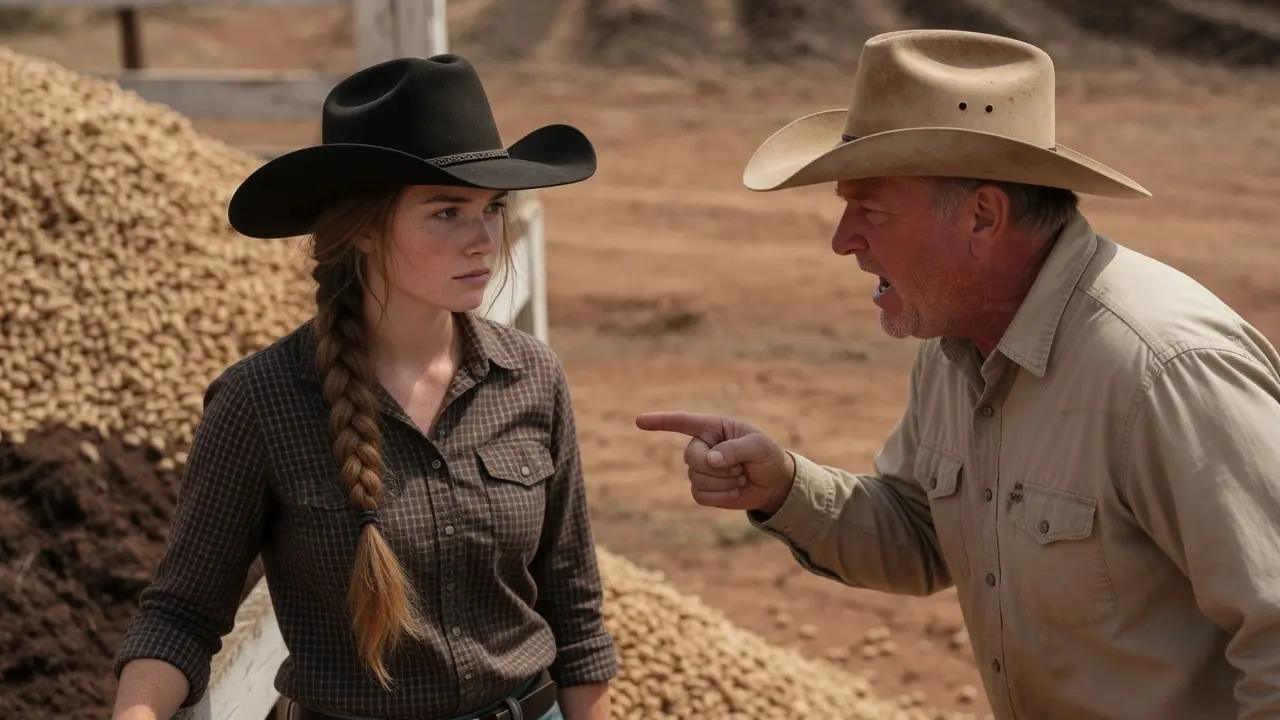
Twenty-seven-year-old Nora Bennett did not move away from the growing pile. She stood in dusty work boots, fitted blue jeans, and a dark-brown plaid shirt with the sleeves rolled above her forearms. Her long light-brown hair had been woven into a thick braid beneath a wide black cowboy hat, and her clear blue-gray eyes remained calm despite the humiliation. She looked too young, too beautiful, and too composed for the failure the town had already decided she represented.
“You call it garbage because you’re too blind to see what the soil needs,” Nora said.
Reggie’s mouth twisted. “The county inspector comes tomorrow, and he’ll shut this mess down.”
Nora rested one hand against the fence. “Bring him—then watch dead clay become the richest soil in this county.”
Laughter traveled from the men standing near the feed store.
Nora heard every word.
She heard someone call the farm a peanut graveyard. Another man said her late grandfather would climb out of his coffin if he saw what she had done to his land. A woman at the roadside mailbox shook her head and whispered that grief had made Nora foolish.
Nora gave the truck driver a signal to continue unloading.
The Bennett farm consisted of nine tired acres outside Briar Creek. Once, her grandfather Henry had raised tomatoes, peppers, squash, and enough sweet corn to fill the bed of his truck every Saturday morning. He sold produce beside Route 31 beneath a handmade sign painted in red letters. Children came for peaches, old women came for conversation, and Henry gave away more food than he ever admitted.
By the time Nora inherited the property, the garden was gone.
Years of hard rain, neglect, and erosion had stripped the upper soil from the sloped fields. What remained was dense red clay that turned slick during storms and cracked like broken pottery during summer. The barn leaned east, the irrigation pump coughed rust into its pipes, and thorny weeds had swallowed the lower pasture.
Nora originally intended to sell everything.
She had spent five years working for a logistics company near Montgomery, answering emails beneath fluorescent lights and tracking shipments she never touched. The job paid regularly, the apartment stayed cool, and nothing depended on weather. Her coworkers called that stability.
Nora called it disappearing slowly.
When Henry died, she returned to Briar Creek for the funeral and remained long enough to clean the farmhouse. She filled boxes with his clothes, old seed catalogs, rusted tools, and coffee tins containing screws he had saved because “a good screw always finds another job.” Every room held evidence that he had expected one more season.
On her third evening at the farm, Nora found his gardening notebook beneath the kitchen table.
Henry had documented rainfall, planting dates, failed crops, insect damage, and soil conditions for thirty-seven years. His handwriting grew shakier near the final pages, but one sentence remained underlined twice.
The ground is not dead. It is only hungry for what we keep throwing away.
Nora read the sentence several times.
The next morning, she heard the peanut-processing plant operating beyond the pine trees. The mechanical hum had always been part of Briar Creek, like church bells and summer insects. Trucks entered carrying harvested peanuts and left with packaged products, while huge bins behind the plant filled with discarded hulls.
Nora walked there before she could talk herself out of it.
The plant manager, Dennis Ward, initially assumed she wanted employment. When she asked what happened to the hulls, he stared as if she had requested the building’s roof. Dennis explained that the shells were bulky, dry, difficult to store, and expensive to transport.
“We pay people to take them,” he said.
“How much?”
“Depends on distance.”
“No. How much would you charge me?”
Dennis laughed. “You want them?”
“Yes.”
“All of them?”
Nora looked through the open warehouse doors at the overflowing bins. “Start with one truck.”
Dennis made her sign an agreement accepting responsibility for storage, smell, runoff, and local complaints. He warned her that wanting a waste product was different from knowing how to use it. Nora signed anyway.
The first truck arrived three days later.
By sunset, Briar Creek had decided she was insane.
Nora did not begin with a business plan. She began with questions. She searched agricultural publications, contacted the county extension office, and read late into the night about composting ratios, carbon, nitrogen, moisture, and microbial activity.
Peanut hulls contained useful structure, but they decomposed slowly alone. They needed nitrogen-rich materials, water, oxygen, and time. Too much moisture created foul anaerobic rot. Too little stopped decomposition almost entirely.
Nora’s first pile failed in every possible way.
She stacked the hulls nearly four feet deep and soaked them with a garden hose. The top remained dry while the bottom collapsed into a sour, airless mass. When she dug into it two weeks later, the smell forced her backward.
Reggie happened to be driving past.
He stopped his truck and leaned through the window. “Richest soil in the county?”
Nora covered her nose with one sleeve. “Not yet.”
“Smells rich.”
He drove away laughing.
Her second attempt became too hot. Nora mixed hulls with fresh grass clippings and chicken manure, assuming more nitrogen would speed the process. Within forty-eight hours, steam rose like smoke, and the internal temperature climbed high enough to damage the microbial life she was trying to support.
The pile smelled sharp enough to sting her eyes.
Her third attempt attracted flies.
The fourth dried into a pale, useless mound.
Every failure became another story at the diner. Men discussed Nora’s “science experiments” over breakfast, and children dared one another to approach the peanut mountains after school. Her aunt Margaret telephoned every Sunday and gently suggested selling before the property value disappeared.
Nora listened without arguing.
Then she returned to her notebook.
She recorded every mistake: pile dimensions, ingredients, weather, moisture, turning schedule, smell, and temperature. She purchased a compost thermometer with money she had planned to spend repairing the farmhouse porch. Three times a day, she pushed the long metal probe into different sections and wrote down the readings.
She learned to squeeze the material in her hand.
If water dripped, the pile was too wet. If the shells crumbled like paper, it was too dry. The correct moisture felt like a sponge after someone had squeezed out nearly all the water.
Slowly, the failures became less complete.
A county inspector arrived one humid morning after Reggie filed a complaint about smell and pests. His name was Thomas Grady, a thin man in a khaki shirt carrying a clipboard and no patience for enthusiasm without evidence. He walked between Nora’s piles, examined the runoff ditch, and pointed out every problem she had not yet solved.
“You cannot simply stack agricultural waste and call it composting,” he said.
“I know.”
“Do you?”
“Yes. I learned from the smell.”
Thomas almost smiled, but did not.
He issued her thirty days to correct the drainage, reduce the largest piles, control insects, and demonstrate that her operation would not contaminate neighboring property. Failure meant fines and an order to remove the hulls.
Reggie waited near the fence during the inspection.
When Thomas left, he folded his arms. “Thirty days. Then the county cleans this place up.”
Nora looked across the heaps that had already cost her weeks of labor. “The county won’t need to.”
“You still think you can turn shells into gold?”
“No.”
“Then what are you making?”
“Something farmers actually need.”
Reggie glanced toward her cracked field. “You don’t even have a farm anymore. You have nine acres of brick.”
Nora stepped closer to the fence. “Then imagine what it will mean when something grows here.”
That afternoon, she destroyed nearly every pile she had built.
It hurt to undo weeks of work, but protecting bad decisions because they required effort would only create larger failures. Nora separated the wet material, mixed dry shells into the sour sections, and rebuilt everything into smaller windrows.
She dug drainage channels and covered them with gravel.
A nearby horse stable agreed to provide manure if Nora collected it herself. The church kitchen saved coffee grounds. A produce stand gave her damaged vegetables and wilted greens that would otherwise enter the trash.
Nora spent her mornings gathering ingredients and her afternoons turning piles with a pitchfork.
Her hands blistered beneath leather gloves. Her back burned each night, and her apartment savings disappeared into hoses, tarps, gravel, and used equipment. Some mornings she stood beside the windrows before sunrise wondering whether the town was right.
Then the first good pile changed.
The smell softened.
Instead of sour rot, the wind carried something earthy and clean. Heat remained steady rather than violent, and the pale peanut hulls slowly darkened as their hard edges broke apart.
Nora waited.
That became the hardest skill.
She wanted to spread the material immediately, prove everyone wrong, and silence Reggie before another joke reached the diner. Henry’s notebook warned against impatience.
Unfinished compost steals before it gives. Let it become what it is becoming.
Nora moved the pile into a covered curing area and left it alone for six additional weeks.
When she finally opened it, the material fell through her fingers like dark cake. Most of the hulls had disappeared into a loose, textured blend with a mild forest-floor smell. Nora pressed a handful against her palm and began crying.
Not because she had created anything miraculous.
Because she had finally created something honest.
She divided the lower field into four test plots. One received no treatment. One received commercial fertilizer. One received raw manure. The final plot received Nora’s cured peanut-hull compost mixed into the upper clay.
She planted identical rows of beans and tomatoes.
For the first two weeks, the differences appeared small. Then a spring storm dropped three inches of rain in one night. Water slid from the untreated clay and carried red soil into the ditch.
The compost plot absorbed the storm.
Its surface remained dark and textured rather than sealing into a smooth crust. When Nora pushed a shovel into it the following morning, the blade entered twice as deeply as it did in the untreated ground.
Roots had room to move.
Air remained inside the soil.
Moisture stayed where plants could reach it.
By early summer, the tomatoes in the compost plot stood nearly a foot taller than those in the other rows. Their leaves were darker, their stems thicker, and the soil beneath them stayed damp longer between watering.
Reggie saw the difference from the road.
He did not stop.
Nora’s first customer was Mrs. Bell, a seventy-year-old gardener who had purchased vegetables from Henry for decades. Nora filled two feed sacks and refused payment.
Mrs. Bell returned one sack three weeks later.
A folded note was tied to it.
Better, but not ready. Lettuce yellowed. Give it more time.
Nora could have dismissed the criticism. Instead, she taped the note above her workbench.
Testing revealed the batch had not cured long enough. Microbes were still consuming nitrogen while finishing decomposition, temporarily competing with young plants. Nora extended her curing period and stopped selling anything that retained heat in the center.
She purchased a simple screen made from hardware cloth and built a wooden frame around it.
The finished compost passed through while larger hull fragments returned to the next pile. Every bag became more consistent.
Nora gave away twenty improved samples.
One went to a greenhouse. Another went to a tomato grower whose soil had compacted after years of machinery traffic. One went into Reggie’s truck while he argued with someone outside the feed store.
He discovered it when he reached home.
Two months passed before he mentioned it.
Nora was repairing a broken wheelbarrow beside the barn when Reggie’s truck entered her driveway before breakfast. He stepped out, glanced toward the windrows, and removed his hat.
“You got any more of that black mixture?”
“What mixture?”
“The bag you put in my truck.”
“I thought it was a stinking dump.”
“It was.”
“And now?”
Reggie avoided her eyes. “My worst pasture patch held grass through three dry weeks.”
Nora waited.
He shifted his weight. “I need enough for half an acre.”
“That will cost money.”
His head snapped up. “You gave me the first bag.”
“The first bag was evidence.”
“Of what?”
“That you’d come back.”
Reggie almost smiled.
He purchased Nora’s first large order.
Word traveled more quickly than mockery ever had.
The greenhouse owner requested forty bags. The roadside tomato grower returned with photographs showing improved root development. A church garden ordered enough material for six raised beds.
Nora named the product Bennett Soil Blend.
She printed simple labels featuring a peanut hull opening into a green sprout. Each bag listed the ingredients, curing date, recommended application, and a warning not to treat compost as a replacement for soil testing.
Demand created new problems.
Turning windrows by hand was impossible at larger volume. Nora found a used windrow turner listed two counties away, but the seller wanted more money than she had. The local bank refused her loan after reviewing photographs of peanut hulls covering the farm.
The loan officer tapped her application. “You have limited revenue, no substantial collateral, and a business model built around waste.”
“It’s built around soil restoration.”
“The bank cannot loan against optimism.”
Nora left without arguing.
She prepared sales records, customer reports, laboratory results, and a six-month production plan. Then she approached a small agricultural cooperative rather than another commercial bank.
The cooperative board included working farmers.
They understood degraded soil, hauling costs, and the value of a local amendment produced from materials already available. They did not give Nora money because her story moved them. They approved a modest equipment loan because her testing, sales, and contracts demonstrated a viable operation.
Nora purchased the windrow turner.
She learned to repair it almost immediately.
The motor coughed, one chain slipped constantly, and the steering pulled right. An elderly mechanic named Amos Grant offered to maintain it in exchange for part-time employment.
Within a year, Nora hired two more workers.
One was a single mother named Carla, who organized invoices and deliveries with greater precision than Nora ever managed. The other was a young man recently released from county jail who needed someone willing to judge his work rather than his history.
Nora paid hourly wages she could sustain.
She refused to build the company faster than the compost could mature.
The county inspector returned several times. Thomas Grady measured runoff, reviewed records, and inspected curing bays. Nora passed every requirement.
On his final visit, Reggie happened to be collecting a pallet.
Thomas glanced toward him. “You filed the original complaint.”
Reggie loaded the bags without looking up. “I was helping.”
Nora laughed.
By the second full year, the Bennett farm no longer resembled a dump.
Covered bays stood where chaotic piles once collapsed in rain. Gravel lanes separated organized windrows. Trucks arrived carrying peanut hulls, manure, coffee grounds, and plant waste, then left with finished soil blend.
The red clay test field remained the strongest proof.
Tomatoes grew chest-high. Peppers hung thick beneath healthy leaves. During dry spells, the amended soil required less irrigation than neighboring plots.
A regional garden supplier placed a trial order.
Nora did not celebrate until payment cleared.
The retailer tested Bennett Soil Blend in three stores, then expanded to twelve. A city parks department purchased bulk compost for compacted roadside tree beds.
The peanut plant began scheduling deliveries rather than treating Nora as a strange woman accepting unwanted material.
Dennis Ward stood beside her one afternoon while a truck unloaded hulls.
“Five years ago, I paid to remove this.”
“Now I pay you a small handling fee.”
“You turned our cost into your product.”
Nora shook her head. “The microbes did most of it.”
“You’re difficult to compliment.”
“I’m trying not to become Reggie.”
Dennis laughed.
The town’s attitude changed without apology.
People who once joked about the peanut mattress brought relatives to tour the operation. Nora’s aunt Margaret began describing the business as though she had supported it from the beginning. The feed store created an entire display for Bennett Soil Blend.
Nora stopped needing anyone to admit they had been wrong.
The ground had already testified.
Reggie remained her most satisfying customer.
Every spring, he arrived early and complained about the price. Every spring, he purchased more than the previous year.
One morning, Nora found him examining a new compost pile.
“What?” she asked.
He lifted a handful and squeezed it. “Too dry.”
She raised an eyebrow. “You’re an expert now?”
“I’ve learned things.”
“You called this garbage.”
“And you never let me forget it.”
“You asked the whole town to laugh.”
Reggie let the material fall from his palm. “I was wrong.”
Nora became still.
It was the first direct apology he had offered.
He continued before she could respond. “I thought being older meant I understood the land better than you. Truth is, I’d been doing the same things for thirty years and calling that knowledge.”
Nora looked toward his truck. “Do you want a discount for emotional growth?”
“No.”
“Good.”
He smiled. “I want six pallets.”
Three years after the first truck arrived, Nora stood beside the white fence at sunset. Her black cowboy hat rested low over her braid, dust marked her jeans, and the fields beyond her looked greener than they had during her childhood.
The original pile was gone.
In its place stood a small but profitable soil company employing six local people. The operation diverted hundreds of tons of agricultural waste each year and supplied farmers, nurseries, gardeners, and public projects across three counties.
Nora did not become rich overnight.
She paid loans, repaired machinery, managed weather delays, and rejected orders when inventory had not finished curing. Some customers complained about waiting.
“Compost does not care about your delivery deadline,” she told them.
Most learned patience.
One evening, Nora walked into Henry’s old garden and knelt beside a row of tomatoes. She pushed her hand into the darkened earth.
The soil gave beneath her fingers.
It held moisture without becoming mud. Small roots moved through spaces that once had not existed. Earthworms twisted beneath the surface where the clay had once been too hard for life.
Nora opened Henry’s notebook.
On the final blank page, she wrote:
They called it waste because they judged it before it finished changing.
She paused, then added another line.
Maybe they did the same to me.
The sun lowered behind the pine trees.
Across the farm, workers covered the final windrow before night. A truck waited beside the loading bay, and neat pallets carried the Bennett name into towns where no one knew about the laughter that began it all.
Nora closed the notebook and looked toward the first field she had restored.
The town believed she had filled good land with garbage.
The truth was simpler.
The land had not been good for years.
Nora had simply been the first person brave enough to admit it was broken—and patient enough to help it become alive again.