The storm reached Knoxville, Tennessee, just after sunset, rolling over the roofs of Briar Lane with a low, angry sound that made every window in Maya Coleman’s little white house tremble.
Rain struck the front porch in hard silver sheets, ran down the steps, and gathered in dark puddles along the narrow street.
The wind bent the bare branches of the oak tree in her front yard until they scratched against the siding like nervous fingers.
Inside, the house smelled of chicken stew, steamed rice, and the lemon candles Maya lit whenever life felt too heavy.
Maya was thirty-four years old, a single mother with tired feet, steady hands, and a face that had learned how to look calm even when the bills on the kitchen counter said otherwise.
She worked long shifts at a pharmacy on Magnolia Avenue, standing behind the counter for ten hours at a time, filling prescriptions, handling insurance problems, and smiling at customers who sometimes forgot she was human too.
Every evening, she came home to her eight-year-old son, Caleb, who believed his mother could fix anything because she usually had to. Money was always tight, the roof leaked over the laundry room, and the old heater rattled loudly every time it kicked on, but the house stayed clean, bright, and loved.
That Thursday night, Caleb sat at the kitchen table in his blue school sweatshirt, chewing the end of his pencil while working through multiplication problems. His homework paper was already smudged in one corner with gravy because he had leaned too close to his dinner bowl.
Maya stood at the stove, stirring the stew with one hand while using the other to hold her phone against her shoulder, listening to an automated message from the electric company. The message reminded her that the past-due balance needed attention soon, as if worry became easier when delivered in a polite recorded voice.
She ended the call and placed the phone facedown on the counter, refusing to let Caleb see her expression change. He had already noticed too much for a child, the way she clipped coupons, stretched leftovers, and turned the thermostat down after he went to bed.
Maya looked at him, at his thin wrists and serious little face, and made herself smile. “How’s that math coming, baby?” she asked, and Caleb sighed like a man carrying the weight of complicated business. “Seven times eight is acting suspicious,” he said.
Maya laughed, and for a few seconds, the storm outside seemed less powerful. She walked over, kissed the top of his head, and pointed to the problem.
“Seven groups of eight. Count it out slow.”
Caleb nodded and started again, whispering numbers under his breath. The heater clanked in the hallway, the candle flame flickered, and the house settled around them with the fragile peace Maya protected every day.
Then came the knock.
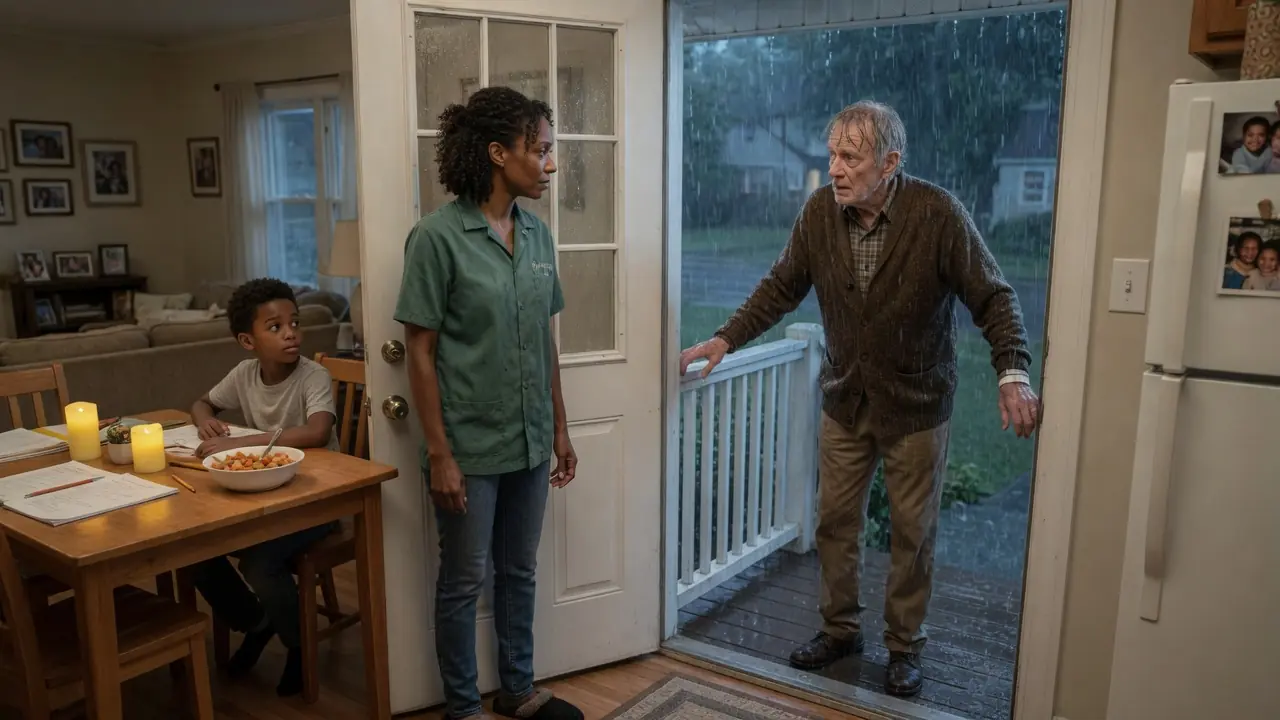
It was not loud. It was not demanding. It was three weak taps against the front door, so soft the rain nearly swallowed them whole. Maya froze with the spoon still in her hand, her eyes lifting toward the hallway. Caleb looked up from his homework and whispered, “Did somebody knock?”
“Stay back,” Maya said gently, though her voice carried enough firmness that Caleb stopped near the hallway table. She looked through the peephole, but rain blurred the porch light and turned the figure outside into a bent shadow. All she could make out was gray hair, a soaked cardigan, and one hand gripping the porch railing. Her first instinct was caution, the hard, necessary caution of a woman raising a child alone. Her second instinct was louder: whoever that was could barely stand.
Maya opened the door with the security chain still latched. Cold rain blew into the hallway immediately, carrying the smell of wet leaves and flooded asphalt. An elderly white man stood on the porch, soaked through his brown cardigan and pale blue shirt, his gray hair plastered to his forehead. His face was lined, frightened, and deeply embarrassed, and one of his hands clutched the railing as if it was the only thing keeping him upright. “My name is Arthur Bell,” he said, his voice shaking. “I’m sorry. I got turned around. I don’t know where I am.”
Maya looked past him into the street, but there was no car, no neighbor waving from a driveway, no one searching with a flashlight. The rain had emptied the block and blurred the yellow porch lights into halos. Arthur’s shoes were soaked, his lips trembled, and water dripped from his sleeves onto the wooden step. Caleb peeked from behind the hallway table, his eyes wide. “Mom,” he whispered, “he’s shaking.”
Maya had every reason to be careful. She had a child in the house, no husband asleep in the next room, no extra money for trouble, and no room in her life for risks she could not control. She also had a father who had died three years earlier, a gentle man who once got confused after a stroke and wandered out of a rehab facility before a stranger found him sitting by a bus stop. Maya remembered the relief of that phone call, the way one person’s decision to stop had kept grief from arriving early. She unlatched the chain and opened the door wider.
“Come inside, Mr. Bell,” she said. “Let’s get you warm first.”
Arthur stepped inside with careful, uncertain movements, apologizing before both feet crossed the threshold. “I’m sorry about the floor,” he said, looking down at the water pooling beneath him. “I didn’t mean to make a mess.” Maya closed the door against the wind and guided him toward the kitchen. “Floors can be mopped,” she said. “People are harder to replace.” Caleb ran ahead and pulled out a chair, then looked up at his mother for approval.
Arthur lowered himself into the kitchen chair like sitting required concentration. Up close, Maya could see that he was older than she first thought, perhaps eighty or close to it, with careful manners that remained even while his mind struggled. His cardigan was heavy with rain, and his fingers shook so badly that he could not unbutton it. Maya touched his shoulder lightly before helping him, careful not to startle him. “I’m going to get this wet sweater off you, okay?” she said, and Arthur nodded with shame in his eyes.
Caleb stood near the refrigerator, silent now, watching the old man with the solemn concern of a child who understood helplessness when he saw it. Maya handed Caleb the clean towel from the laundry basket and told him to bring the spare blanket from his room. He ran down the hall without complaint. Maya turned back to Arthur, who stared at the family photos on the refrigerator as if they were clues from a life he almost recognized. One picture showed Caleb holding a spelling bee certificate, grinning with one front tooth missing.
Arthur smiled faintly at it. “I had a daughter who smiled like that once,” he said. “Her name is Rachel. I think she still does.”
Maya paused with the towel in her hand. “Rachel is your daughter?” Arthur nodded, then frowned as if the movement had shaken the memory loose. “Rachel Bell. Or maybe Rachel Bell Whitaker. No, no, she kept Bell after the divorce, I think.” He closed his eyes, embarrassed by his own uncertainty. “I should know that. A father should know his daughter’s name properly.”
“You know her first name,” Maya said softly. “That is a start.”
She warmed soup on the stove while Caleb returned with his blue dinosaur blanket, the one he had used since kindergarten. He hesitated only a moment before placing it around Arthur’s shoulders. “This one keeps bad dreams away,” Caleb said seriously. Arthur looked at the boy for a long time, then wiped his eyes with the back of his hand. “That is a very important blanket,” he said. “You must be a generous young man.”
Caleb shrugged, suddenly shy. “Mom says sharing doesn’t count unless it costs you something.”
Maya glanced at her son, surprised he had remembered that. She had said it months earlier when Caleb asked why they still put cans into the church food box when their own pantry was thin. At the time, she had wondered if she was teaching him wisdom or foolishness. Now, watching him tuck the blanket around Arthur’s feet, she decided perhaps it was a little of both. The best kinds of goodness often were.
Arthur kept apologizing as Maya placed a bowl of chicken stew in front of him. “I don’t have money,” he said, reaching weakly toward his pockets. “I had a wallet. I think I had one.” Maya set a spoon beside the bowl and pulled out a chair across from him. “You do not need money at my table tonight.” Arthur looked at her, stunned by the simplicity of the answer. Then he lowered his head and whispered, “Thank you.”
He tried to eat but his hands trembled too much, so Maya quietly gave him a soup mug instead of the bowl. She told him it was easier that way and pretended not to notice the relief on his face. He drank slowly, pausing between sips as color began returning to his cheeks. Caleb sat at the corner of the table, homework forgotten, watching Arthur like he was a mystery that needed kindness instead of solving. Outside, rain hammered the windows harder.
Maya noticed the medical bracelet when Arthur lifted the mug again. It was silver, scratched with age, and partly hidden beneath his wet sleeve. She asked if she could look at it, and he extended his wrist obediently. The bracelet carried his name, Arthur Bell, along with the words memory impairment and a faded emergency contact number. Maya reached for her phone immediately.
The first call went straight to voicemail. Maya tried again, then a third time, but the result did not change. She left a careful message, giving her name, address, and the fact that Arthur was safe inside her home. Then she searched his pockets for a phone with his permission, but found only a damp handkerchief, an old receipt from a grocery store, and a small wooden pencil sharpened almost to nothing. Arthur watched her search with humiliation written across his face.
“I am sorry,” he said again. “I am making trouble.”
“No, sir,” Maya said. “You came to the right porch.”
Arthur closed his eyes as if those words had reached a place warmer than soup.
Maya called the local non-emergency line next. The operator sounded exhausted, and Maya could hear other voices in the background, reports coming in from across the city. Storm damage had knocked out traffic lights, several roads were blocked, and emergency crews were stretched thin. The operator took Arthur’s information and told Maya to keep him safe until an officer or caseworker could come. “It may take a while,” the woman warned. “Please do not let him leave alone.”
Maya looked at Arthur, whose chin had dipped toward his chest as exhaustion pulled at him. She looked at Caleb, who was now standing beside the sink with a towel, wiping up the water that had dripped from Arthur’s clothes. She looked toward the living room couch, toward the hallway, toward the lock on the front door. A careful woman might have insisted he wait on the porch for someone official. A kind woman might let him warm up, then send him to a shelter. Maya knew she had to be both careful and kind, which made the decision harder.
She went to the closet and pulled out a cardboard box of her late father’s clothes. After her father died, she had given most of his things away, but some shirts and sweatpants remained because grief sometimes hides in fabric. She found a soft flannel shirt, a pair of loose gray sweatpants, and thick socks. “My father was about your size,” she told Arthur. “You can change in the bathroom, and I’ll dry your clothes by the heater.”
Arthur touched the flannel shirt with trembling fingers. “This is too much.”
“It is just dry clothing,” Maya said.
“No,” Arthur whispered. “It is not just.”
Maya turned away before her own eyes filled.
That night, Arthur slept on the living room couch beneath two blankets, with Caleb’s dinosaur blanket folded over his feet. Maya slept lightly in the chair near the hallway, her phone beside her, one ear trained toward the living room. She had locked the front door, left a lamp on, and placed Caleb’s baseball bat behind her chair more for courage than expectation. Arthur slept fitfully, murmuring names in the dark. Once, he woke and asked for Helen, and Maya answered softly that he was safe, though she did not know who Helen was yet.
Around 3:00 a.m., Caleb appeared in the hallway in his pajamas, rubbing one eye. “Is he okay?” he whispered. Maya nodded and held out one arm. Caleb came to her, and she pulled him close without taking her eyes off the sleeping man. “He got lost,” she said. “Sometimes people’s minds make the world confusing.” Caleb leaned against her shoulder. “Will I get lost when I’m old?” he asked.
Maya kissed his forehead. “Maybe not. But if you ever do, I pray someone opens the door.”
By morning, the storm had passed, leaving Briar Lane littered with branches, wet leaves, and one overturned trash can rolling slowly near the curb. The sky was pale gray, and sunlight tried weakly to push through the clouds. Arthur woke disoriented, sitting up suddenly and asking where he was. Maya knelt in front of him and spoke slowly. “You are at Maya Coleman’s house in Knoxville. You came here last night in the storm. You are safe.”
Arthur stared at her face, then around the living room, then down at the dinosaur blanket. “There was a boy,” he said. Caleb popped his head around the kitchen doorway, holding a piece of toast. “That’s me.” Arthur smiled, and the fear eased from his face. “The blanket boy,” he said.
Maya missed the first half of her pharmacy shift that morning. She called her supervisor, apologized, and explained there had been an emergency with an elderly neighbor, though Arthur was not truly a neighbor yet. Her supervisor sighed, then told her to come in when she could because three people had already called out after the storm. Maya knew the missed hours would hurt her paycheck, but there are moments when doing the right thing comes with a receipt. She accepted that quietly.
She called the emergency contact again. Still voicemail. She called nearby clinics, shelters, and senior care offices, giving Arthur’s name but withholding her full address unless necessary. She posted carefully in a neighborhood group, writing that an elderly man named Arthur Bell had been found safe after the storm and asking anyone with verified information to contact her privately. Within minutes, replies came in. Some praised her, others warned her she was risking too much.
Her neighbor Linda Price arrived before noon wearing rain boots and a frown. Linda was a retired school secretary who watched the street with the intensity of someone who considered caution a civic duty. She stepped onto the porch and lowered her voice even though Arthur was inside. “Maya, you’ve got a child in this house,” Linda said. “You can’t just take in strangers.”
Maya looked through the front window. Arthur was sitting at the kitchen table with Caleb, both of them eating toast with grape jelly. Arthur was helping Caleb line up numbers on scratch paper, his face calm for the first time since he arrived. “Last night, he wasn’t a stranger,” Maya said quietly. “He was someone’s father in the rain.”
Linda’s expression softened, but worry remained. “Kindness can still be dangerous.”
“I know,” Maya said. “That’s why I called it in, and that’s why you’re going to check on us every few hours like you already want to.”
Linda blinked, then huffed. “I can do that.”
“Thank you,” Maya said.
For three days, Arthur stayed in Maya’s home. The storm had made a mess of city services, and the emergency contact remained unreachable. A police officer came once, took notes, checked Arthur’s bracelet, and promised to file an updated report, but no immediate match came through. Arthur could not remember enough to provide an address, and every attempt to push him too hard left him trembling with shame. Maya quickly learned that memory loss was not only confusion; it was grief repeating itself.
Arthur helped Caleb with math in small moments of clarity. He showed him how to stack numbers neatly, how to check multiplication by working backward, and how to breathe before getting angry at a problem. “Carpenters measure twice,” Arthur said one afternoon, tapping the paper with the pencil he had carried in his pocket. “Students should too.” Caleb grinned and said, “Were you a carpenter?” Arthur’s face brightened with sudden certainty. “Yes. Yes, I was.”
Pieces of his life came in fragments. He remembered working with cedar and oak. He remembered building cabinets for a church that later burned down. He remembered carving a porch swing for Rachel when she was ten, then repainting it blue because she said white was too boring. He remembered his wife Helen standing in the kitchen with flour on her cheek, laughing at him because he kept bringing home broken chairs from other people’s trash. But whenever he tried to remember how he had wandered so far from home, fear crossed his face and the words disappeared.
Maya learned to stop chasing the missing piece. Instead, she built small routines around him. Breakfast at eight, tea at ten, porch time if the weather allowed, rest in the afternoon, supper with Caleb at the kitchen table. Arthur folded dish towels with careful hands, swept the porch without being asked, and once repaired the loose handle on Maya’s pantry cabinet with a screwdriver from her junk drawer. When she thanked him, he stood a little straighter.
“You should not have to fix things in a stranger’s house,” Maya said.
Arthur looked around the kitchen. “Does not feel like a stranger’s house.”
That answer stayed with her.
Caleb became attached quickly, in the open-hearted way children sometimes do before adults can build protective walls. He called Arthur “Mr. Bell” at first, then “Mr. Arthur” by the second afternoon. He showed him his spelling bee certificate, his dinosaur drawings, and the Lego car he had built without instructions. Arthur admired each thing with grave seriousness, as if Caleb had presented architectural plans.
At night, when Arthur grew more confused, Caleb became quieter. He learned to speak gently, to repeat his name without annoyance, to answer the same question more than once. Maya watched her son learning patience in real time and felt both proud and sad. Some lessons came too early for children. Still, Caleb never complained when Arthur asked where he was, or why the rain had stopped, or whether Helen had called.
On the fourth morning, Maya found Arthur standing by the front window holding a pencil and a grocery receipt. The heater rattled in the hallway, and thin sunlight rested on his white hair. He had drawn a small house with a bright blue door, two oak trees, a low fence, and a mailbox shaped like a barn. The lines were shaky but precise in the way of a craftsman whose hand remembered structure even when his mind lost directions.
Under the drawing, he had written one word.
Fairview.
Maya stood beside him carefully. “Is that where your house is?”
Arthur stared at the drawing. “Rachel wanted the door blue,” he said. “Helen said it was too bright. I painted it while Helen was at church.”
Maya felt a rush of hope so strong it made her dizzy.
She searched Fairview Knoxville blue door oak trees mailbox shaped like barn and found a quiet residential area nearly seven miles away. There were too many houses to search one by one, but the drawing helped. She called her supervisor again and asked for the morning off, promising to make up the hours. Then she packed Arthur’s folded clothes into a grocery bag, made sure Caleb had his coat, and helped Arthur into the passenger seat of her old Honda.
Caleb sat in the back holding the dinosaur blanket, just in case.
The drive to Fairview was quiet at first. Arthur looked out the window with both hope and dread, gripping the grocery receipt drawing in both hands. Maya drove slowly through the neighborhood, past brick ranch houses, old maples, chain-link fences, and neat porches still wet from the storm. Every time they passed a blue door, Arthur leaned forward, then slumped back when recognition did not come. Caleb watched him in the rearview mirror with worried eyes.
After twenty minutes, Maya turned onto a narrow street lined with two old oak trees at the far end. Arthur suddenly sat straighter. His breath caught. “That fence,” he whispered. “I painted that fence.”
Maya slowed the car.
Ahead stood a gray house with a bright blue door.
Two oak trees framed the front yard, and beside the driveway stood a mailbox shaped like a little red barn.
Before Maya could even turn off the engine, the front door opened and a woman in her forties rushed onto the porch. She wore jeans, a sweatshirt, and the hollow-eyed look of someone who had not slept in days. For a moment, she stood frozen, staring at Arthur through the windshield. Then she ran down the steps crying, “Daddy!”
Arthur reached for the door handle with shaking hands. Maya rushed around to help him, but Rachel reached him first. She wrapped both arms around him and sobbed into his shoulder. Arthur touched her hair like he was trying to recognize her through his fingers. “Rachel,” he whispered, and the woman broke completely.
“My God, Daddy, where were you?” Rachel cried. “I looked everywhere.”
Arthur began crying too, not loudly, but with a lost, exhausted sorrow. “I could not find the blue door,” he said. Rachel held him tighter. Maya stood beside the car with Caleb, unsure whether to step forward or give them privacy. Then Rachel looked at her, saw the grocery bag of clothes, the blanket in Caleb’s arms, and seemed to understand all at once.
“You found him,” Rachel said.
“He found my porch,” Maya replied.
Inside the blue-door house, Rachel explained everything through tears. Arthur had early-stage dementia that had recently worsened under stress. He lived with Rachel now, though he sometimes believed he still lived with Helen, his late wife. During the storm, Rachel had gone upstairs to change his bedsheets while Arthur sat in the sunroom. When she came back, the back door was unlocked and he was gone.
Rachel had searched the yard first, then the street, then called neighbors, then police, then hospitals. She had driven through the rain for hours, calling his name into streets that answered only with water and wind. The emergency number on Arthur’s bracelet had once belonged to her old landline, which had been disconnected after she switched service providers; she had updated his medical records but not the bracelet. That mistake had nearly destroyed her.
“I kept thinking he was cold somewhere,” Rachel said, pressing both hands over her mouth. “I kept seeing him sitting alone, scared, thinking I had abandoned him.”
Maya placed a hand on Rachel’s arm. “He was scared, but he was not alone.”
Rachel began crying again.
She wanted to know everything, and Maya told her gently. The three weak knocks. The soaked cardigan. The soup. The dry clothes. Caleb’s dinosaur blanket. Arthur helping with math. The drawing of the blue door. Rachel listened like every detail was both a wound and a blessing.
When Maya said Arthur had apologized for dripping water on the floor, Rachel closed her eyes. “That sounds like him.”
“He was very polite,” Caleb said from beside Maya.
Rachel knelt in front of him. “You helped my dad too?”
Caleb held out the dinosaur blanket. “He used this. It keeps bad dreams away.”
Rachel took the blanket carefully, pressed it to her chest, and whispered, “Thank you.”
Maya did not ask for anything. She did not mention the missed work hours, the extra food, the laundry, the fear, the neighbors’ warnings, or the way her own roof still leaked into a bucket whenever the rain came hard. She only helped Arthur settle into his armchair by the window and said she was glad he was home. Arthur reached for her hand before she could leave. His grip was weak, but his eyes were clear.
“You opened the door,” he said.
Maya smiled softly. “You knocked.”
Before she left, Arthur pressed something into Caleb’s hand. It was the pencil drawing of the blue-door house, folded carefully down the middle. “So you remember,” he said, “that lost people can still find kind doors.” Caleb nodded solemnly and placed the drawing inside his coat pocket like treasure. Rachel walked them to the car, thanking Maya so many times that Maya finally had to touch her shoulder and say, “Your father would have done the same for someone else.”
Rachel looked back at the blue door.
“He would have,” she whispered. “Before all this, he always did.”
Two weeks passed.
Life on Briar Lane returned to its narrow rhythm. Maya went back to the pharmacy, worked extra hours to make up for the missed shift, and argued with the insurance system on behalf of customers who needed medication more than paperwork. The roof leaked again during a small rain, and Caleb placed the bucket under the laundry room ceiling before Maya even asked. At night, Caleb kept Arthur’s drawing taped above his desk, beside his spelling bee certificate. “It reminds me to be a kind door,” he told his mother.
Maya thought often about Arthur and Rachel, but she did not expect to hear from them again. She had done what needed doing, and the reward was knowing an old man had found his way home. That was enough, or at least she told herself it was. There were bills in the mail, shifts on the schedule, lunches to pack, homework to check, and a heater that still rattled like it resented being alive. Kindness did not cancel ordinary life.
Then one evening, Maya came home from work and found an envelope taped to her porch door.
It was thick, cream-colored, and sealed carefully against the wood. Her name was written across the front in neat handwriting: Maya Coleman. Caleb noticed it first and ran up the steps while Maya carried grocery bags from the car. “Mom, there’s mail on the door,” he called, his voice bright with curiosity.
Maya set the groceries on the kitchen counter and opened the envelope slowly. Inside were two letters and a smaller sealed envelope. The first letter was from Rachel Bell. The second was written in shaky handwriting Maya recognized from Arthur’s drawing.
She read Rachel’s letter first.
Dear Maya,
I have started this letter at least ten times and failed each time because thank you is too small for what you did. My father has not stopped talking about your kitchen, Caleb’s dinosaur blanket, your chicken stew, and the way no one in your house made him feel ashamed for being confused. Some days, he remembers your full name. Some days, he remembers only “the lady with the lemon candle.” But every time he remembers you, he smiles.
Rachel wrote that she had reviewed the neighborhood group post, spoken with the responding officer, and learned from Maya’s neighbor Linda that Maya had missed work, fed Arthur, clothed him, and kept him safe for three days. She wrote that her father had spent his life building houses, repairing porches, and helping neighbors, but in his most vulnerable moment, it was Maya’s small home that gave him shelter. She wrote that she had spoken with an attorney and a contractor and had arranged, with Maya’s permission, to pay for the roof repairs, Caleb’s school expenses for the year, and a new heating system before winter. At the bottom, Rachel had added one more line: Please do not refuse kindness from a family who is alive because you gave it first.
Maya sat down hard on the kitchen chair.
Caleb leaned over her shoulder. “What does it say?”
Maya covered her mouth with one hand, overwhelmed and unsure whether to accept. Pride rose first, strong and familiar. She had never wanted anyone to think she opened her door for a reward. She had never wanted Caleb to believe kindness was a transaction. But then the heater rattled in the hallway, loud and uneven, and a drop of water fell into the laundry room bucket with a soft, accusing sound.
Her hand shook as she opened Arthur’s letter.
Dear Maya,
Rachel is helping me write because my hand forgets what my heart remembers. I spent my life building houses, but you reminded me what a home is. A home is not wood, paint, or a roof that never leaks. A home is the place where someone sees you lost and does not turn away.
Maya stopped reading because her eyes blurred.
Caleb pressed against her side.
She wiped her face and continued.
I remember rain. I remember being cold. I remember a boy giving me a blanket with dinosaurs on it, and I remember soup that tasted like mercy. I do not remember every road I took to get to your porch, but I remember that your door opened. If my mind loses that memory someday, Rachel has promised to read this letter to me.
The final line was written larger than the rest.
Thank you for letting an old man still be somebody’s father.
Maya lowered the paper to her lap and cried.
Not loud, not dramatically, but with the deep release of someone who had been holding too much for too long. Caleb climbed into the chair beside her and leaned against her shoulder. They sat that way while evening light settled over Briar Lane, soft and gold behind the wet branches. For once, Maya did not count bills in her head. She simply let herself feel held by the kindness returning to her porch.
Inside the smaller envelope was a contractor’s estimate marked paid, a school account confirmation for Caleb, and a note from Rachel asking Maya to call before making any decisions. Maya called that night. Rachel answered on the first ring, as if she had been waiting by the phone. The conversation began with thanks, then tears, then apologies neither woman needed to make. By the end, Maya agreed to accept the repairs, not as charity, but as family gratitude.
The new heater was installed the following week.
The roof repair took two days. Caleb stood in the driveway watching the workers with fascination, asking enough questions that one of them finally handed him a measuring tape and let him help mark boards. Maya made lemonade for the crew and tried not to cry when the bucket disappeared from the laundry room floor. Warm air moved through the house quietly for the first time in years, without rattling, without clanking, without making her fear the next bill.
The next Sunday, Rachel brought Arthur back to visit.
She arrived with a basket of blueberry muffins, a bouquet of yellow flowers, and a folded blue blanket for Caleb. Arthur stepped carefully onto Maya’s porch, holding Rachel’s arm, his face searching the house before settling on Maya. Some part of him recognized the porch first. Then the lemon candle through the open door. Then Caleb standing in the hallway with a grin too big to hide.
“The blanket boy,” Arthur said.
Caleb ran forward and hugged him gently around the waist.
Arthur laughed, startled and delighted.
From then on, Arthur came every Sunday afternoon when his health allowed. Sometimes he remembered everything, and he would sit at Maya’s kitchen table talking about carpentry, Helen, Rachel, and the porch swing he still wanted to repaint. Sometimes he remembered only pieces, and Rachel would patiently guide him through names and places. Sometimes he remembered Maya’s face but not her name. But he always smiled when he reached her porch.
Caleb began saving his best school papers to show Arthur. Arthur praised every one as if Caleb had built a bridge with his bare hands. He taught Caleb how to sand wood properly, how to hold a pencil when sketching a straight line, and how to measure twice before cutting once. Maya watched them together and understood that Arthur had given Caleb something more than school money or a warm house. He had given him another grandfather-shaped place in the world.
Rachel became family in a quieter way.
She and Maya talked on the porch while Caleb and Arthur played checkers or folded paper airplanes in the living room. Rachel admitted how exhausted she was from caregiving, how guilty she felt when she became impatient, how terrifying it was to watch her father drift in and out of himself. Maya admitted how tired she was from carrying motherhood alone, how often she feared one unexpected bill could knock her life sideways, how much she missed having someone to call when the house made strange noises at night. The two women found relief in telling the truth without being judged for it.
One spring afternoon, nearly a year after the storm, Rachel brought Arthur over while Maya was planting flowers near the porch steps. Caleb was helping, though mostly by getting dirt on his shoes and announcing the worms by name. Arthur stood at the edge of the yard, looking at the house with deep concentration. For a moment, Maya thought he was confused. Then he pointed toward the front door.
“You should paint it blue,” he said.
Maya looked at Rachel.
Rachel laughed softly, covering her mouth.
Caleb’s eyes widened. “Like your house?”
Arthur nodded. “A kind door should be easy to find.”
Two weeks later, Maya painted the front door a clear, bright blue.
Neighbors noticed immediately. Linda Price stood on the sidewalk with her hands on her hips and said, “Well, that door is not shy.” Maya smiled from the porch. “Good,” she said. “It is not supposed to be.” Caleb made a small sign for the inside of the door with crayon and tape. It read: Lost people can still find kind doors.
Years later, Caleb would remember that storm as one of the most important nights of his childhood. Not because it frightened him, though it had. Not because a stranger slept in their living room, though that was unusual enough. He remembered it because it taught him that safety and kindness are not opposites when guided by wisdom. His mother had been careful, but she had still opened the door.
Maya would remember the three knocks for the rest of her life.
She would remember the rain on Arthur’s cardigan, the shame in his voice when he said he did not know where he was, and the way his hand shook around the soup mug. She would remember Rachel running from the blue-door house, crying like a lost child finally found her father. She would remember the letter taped to her porch and the sentence that changed how she understood her own home. A home is the place where someone sees you lost and does not turn away.
And Arthur, even as his memory continued to fade, remembered in the way the heart remembers when the mind cannot. He did not always know Briar Lane. He did not always know the year. Some Sundays, he asked Rachel why they were visiting, and she would say, “We are going to see Maya and Caleb.” Sometimes that was enough. Sometimes it was not.
But whenever they reached the small white house with the bright blue door, Arthur smiled before Rachel said a word.
His mind might lose the road.
But his heart remembered the house that had opened its door.