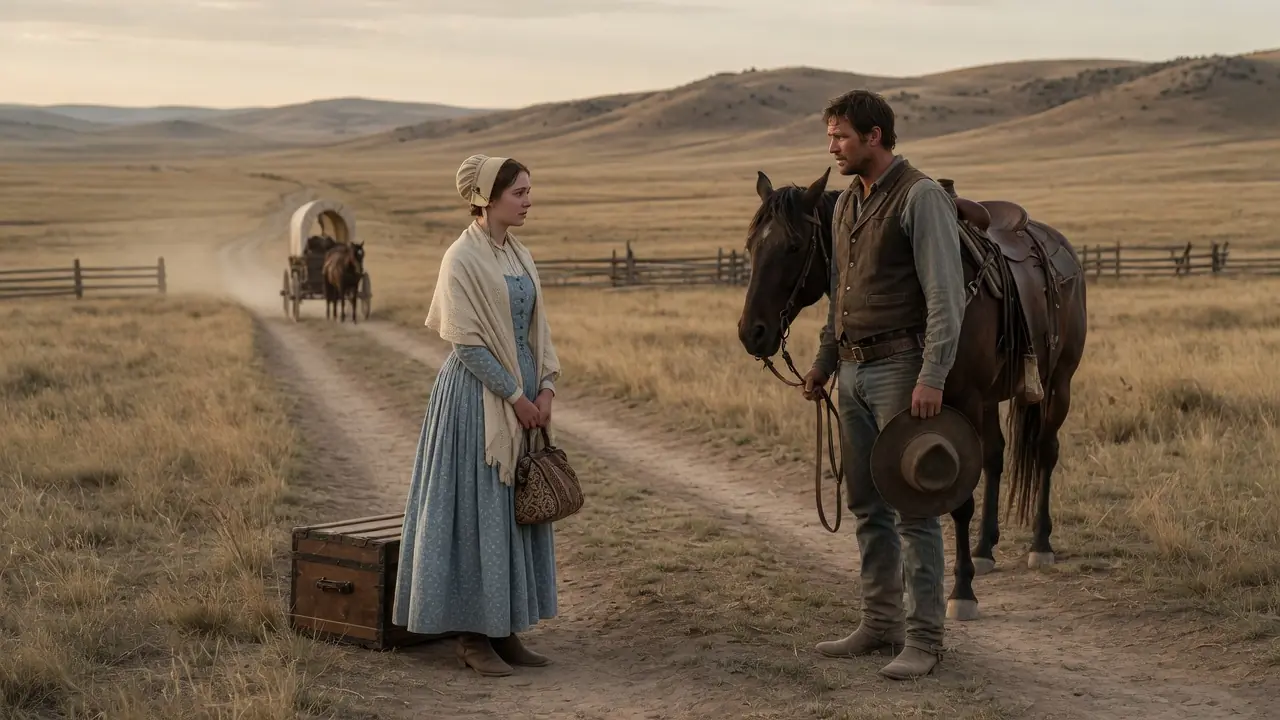
The day her family left her behind, the sky stretched wide and empty over the prairie, as if it had swallowed every promise they had ever made.
The wind moved slow across the tall grass, brushing against her black mourning veil and carrying away the last sound of wagon wheels.
She stood there in the open field, dust settling around her boots, and watched the only life she had ever known disappear toward the horizon.
No one looked back.
The land around her was wild and golden, the kind of land that could make a strong man rich or break him in half. Fences were few. The nearest town was a thin line of rooftops far off in the distance, smoke rising from a handful of chimneys.
This was the American West, hard and beautiful, where cattle trails cut through valleys and cowboys followed the sun from one season to the next.
It was not a place for a young woman to stand alone with a single trunk at her feet.
Her father had called it a new beginning. Her stepmother had called it a fair arrangement, but she knew what it was.
It was abandonment wrapped in polite words.
A lone rider waited a few yards away, sitting tall in the saddle of a dark bay horse. He had not spoken during the exchange. He had only tipped his hat once, a quiet acknowledgement, as if she were part of a business deal already settled.
The cowboy’s jaw was set firm, and the wind tugged at the brim of his hat. His shirt sleeves were rolled, his hands rough from rope and rain. There was dust on his boots and something steady in his eyes.
He had paid her father’s debt.
That was the simple truth of it.
In this part of the West, land and cattle meant survival. A bad season could empty a man’s pockets and pride in equal measure. Her father had gambled on rain that never came. When the drought stretched on, so did the loans.
And when the lender wanted payment, her father had found a different kind of bargain.
The cowboy needed a wife to help run his ranch. A woman who could cook for the hands, keep the books, mend clothes, and hold the house together while he rode long hours under the blazing sun.
Her family needed money and relief from shame.
So they placed her future into his calloused hands as if she were another head of cattle to be traded.
She had not cried in front of them.
Not once.
Even when her stepmother pressed the black veil into her hands and whispered that it would make her look proper. Even when her father avoided her eyes as he counted the coins, she kept her chin lifted.
Pride was the only thing they had not managed to sell.
Now, as the wagon shrank into the distance, she felt the full weight of what had happened. The silence pressed in around her.
The cowboy cleared his throat, the sound low and careful.
“We should ride,” he said.
His voice was deep, not unkind, but it carried the firmness of a man used to giving orders.
She did not answer right away. Instead, she bent down, closed the lid of her trunk, and lifted it with both hands.
Before she could take a step, he was off his horse.
“I’ll get that,” he said.
Their fingers brushed for the briefest moment as he took the trunk from her. His hand was warm and steady. She looked up, meeting his eyes for the first time without the noise of her family between them.
There was no mockery there.
No triumph.
Only something she could not yet name.
He tied her trunk behind the saddle with practiced ease. Then he turned to her and held out his hand.
“You’ll ride with me.”
“It’s a long way,” she hesitated.
Every lesson she had been taught warned her about strange men and lonely roads. But she had no other choice.
With a small nod, she placed her hand in his. He lifted her as if she weighed nothing, settling her in front of him on the saddle.
The horse shifted beneath them, muscles strong and sure.
As they began to ride, she kept her back straight and her gaze forward.
The prairie rolled out in waves of gold and green. The air smelled of dry grass and distant rain. She could feel the cowboy’s steady breath behind her, the solid presence of him, close enough that she was aware of every movement.
This was not how she had imagined her life.
When she was a girl, she had dreamed of lace gloves and Sunday picnics by the river. She had imagined love letters folded carefully into a wooden box, a husband who would ask for her hand with trembling hope, not count coins across a table.
But dreams were fragile things in the Old West. They could not stand against drought, debt, and hard winters.
They rode for hours.
The sun dipped lower, painting the sky in shades of amber and rose. At last, the ranch came into view, a wide stretch of land bordered by split-rail fences. A modest house stood near a large red barn, smoke curling from the chimney. Cattle grazed in the distance, dark shapes moving slowly against the fading light.
“This is it,” he said quietly.
The ranch did not look cruel.
It looked honest, worn by wind and weather, but standing firm.
As he helped her down from the horse, she felt a strange twist in her chest.
Fear, yes, but also something softer.
Something like possibility.
Inside the house, the air was warm from the stove. A wooden table stood in the center of the room, polished by years of use. There were no frills, no fine curtains, or delicate china. Only sturdy chairs, iron pans, and shelves lined with jars of preserved fruit.
“I had one of the town ladies come by yesterday,” he said, setting her trunk near the stairs. “She cleaned up the spare room. It’s yours.”
“Spare room?”
The word echoed in her mind.
Not wife’s room.
Not our room.
She looked at him sharply, searching for understanding.
“I thought…” she began, then stopped.
“I won’t force anything,” he said. “Not until you’re ready. I gave my word on that.”
His words caught her off guard.
No one had asked her what she wanted before. Not her father, not her stepmother. And yet this cowboy, who had every legal right to claim her as his wife, spoke as if her comfort mattered.
“Why?” she asked softly.
He met her gaze without flinching.
“Because I know what it’s like to have something taken from you.”
The room fell quiet again.
There was a story behind his eyes. A shadow of loss that matched her own.
In that moment, she realized he was not untouched by hardship. The West had shaped him too. Carved lines into his face, hardened his hands, but it had not stolen his sense of decency.
Over the next days, she began to see the rhythm of ranch life.
Dawn came early with the crow of roosters and the lowing of cattle. The cowboy worked from sunup to sundown, mending fences, driving herds, fixing broken wheels. She learned the kitchen, the pantry, the careful balance of stretching supplies.
She watched from the porch as dust rose behind galloping horses and wondered where she fit in this wide, restless world.
The townsfolk were curious.
News traveled fast in small western towns. They knew a woman had come to live at the ranch. Some looked at her with pity, others with suspicion, a few with open kindness. She felt the weight of their glances when she walked down the wooden boardwalk beside him.
“Are you happy?” one older woman asked her in a hushed tone near the general store.
The question lingered long after she returned home.
Was she happy?
She did not know yet.
What she did know was that the cowboy never raised his voice at her. He never spoke to her as if she were property. He asked her opinion about the books, about hiring new hands, about planting a small garden near the house.
He listened when she answered.
One evening, as the sun slipped behind the hills, she found him by the fence, watching the cattle settle. The sky burned orange behind him, turning his outline into something almost tender.
She stepped closer, the hem of her dress brushing against dry grass.
“Why did you agree to this arrangement?” she asked.
He did not look at her right away.
“I needed help,” he admitted. “But I also needed someone who could see this place as a home, not just land.”
“And you think that could be me?”
He finally turned, his gaze steady and searching.
“I hope so.”
The honesty in his voice made her heart stumble.
No grand speeches, no fancy promises, just hope.
For the first time since the wagon disappeared over the horizon, she felt something shift inside her. A small crack in the wall she had built around herself. The thought frightened her more than the empty prairie ever had, because if she allowed herself to care, truly care, then she would have something to lose again.
That night, as a storm gathered in the distance and thunder rolled low across the plains, she stood at her bedroom window. Lightning flickered over the fields, illuminating the ranch in sharp white flashes.
She could see him below, securing the barn doors against the coming wind.
The rain began to fall, heavy and sudden. He ran toward the house, hat pulled low, shirt plastered to his shoulders.
For a moment, he looked up and saw her watching from the window. Their eyes locked through the glass and rain.
There was no contract in that look.
No debt.
No bargain.
Only a question neither of them had yet dared to speak.
And as the storm broke over the ranch, shaking the walls and rattling the windows, she felt the first fragile stirrings of true love take root in the most unlikely soil.
But beyond the thunder, beyond the flicker of lightning on the horizon, there were still debts unpaid and secrets buried deep in the past.
She did not yet know that someone from her old life was already on the road, riding hard toward the ranch, carrying news that would test everything she was beginning to believe.
And by the time the storm passed, nothing would ever be the same.
By morning, the storm had passed, but the air still felt heavy, as if the land itself was holding its breath. The fields glistened with rain, and the scent of wet earth drifted through the open window.
She had barely slept.
Every crack of thunder from the night before still echoed in her mind, mixing with the memory of his eyes finding hers through the rain.
She dressed quietly and stepped outside just as the sun began to rise over the western horizon.
The ranch looked different after a storm. The fences leaned a little more. The ground turned soft and dark, and the cattle moved slowly, unsettled by the night’s noise.
He was already awake, checking the pasture with long strides, boots sinking slightly into the mud.
“You should have woken me,” she said when she reached him.
He glanced at her, surprise flickering across his face.
“You needed rest.”
“So did you.”
A faint smile touched his mouth, but it faded quickly.
“Storms don’t wait for sleep.”
She noticed the way his gaze kept drifting toward the distant road that led into town. It was a thin ribbon of dirt cutting across miles of open land. Anyone coming from her old life would have to travel that path.
She felt a chill that had nothing to do with the cool morning air.
After breakfast, he rode into town to check on supplies and see if the river had flooded. She stayed behind, learning how to mend a torn saddle blanket and tally numbers in the worn ledger he kept in the desk.
The ranch depended on careful math, on cattle counts and feed costs, on honest trade. It was not glamorous, but it was steady.
Still, she could not shake the feeling that something was coming.
In town, word had already spread that strangers were asking questions. She learned that later from one of the ranch hands, a young man with kind eyes who stopped by the kitchen for coffee.
“Man came through yesterday evening,” he said quietly, leaning against the doorway. “Didn’t look like he belonged around here. Clean boots, city coat. Asking about this place.”
Her hand stilled on the dishcloth.
“What did he want?”
The ranch hand shrugged.
“Said he was looking for someone. Didn’t say who.”
Her stomach tightened.
There was only one person he could be searching for.
When the cowboy returned that afternoon, his jaw was set in a way she had not seen before. He tied his horse to the post with more force than necessary and walked toward the house without speaking.
“You heard?” she said softly.
He nodded once.
“Man’s been asking about you.”
The words fell between them like a stone.
“I don’t know who it could be,” she lied.
He studied her face, and she felt the weight of his silence.
“If there’s something I need to know, you should tell me.”
The truth sat heavy on her tongue.
Before the drought, before the debts, there had been another arrangement, quietly forming in her father’s mind. A wealthy landowner from back east had taken interest in expanding westward. He had seen her once at a church gathering and later sent a letter expressing his intentions.
It had not been a love letter.
It had been a proposal of ownership dressed as romance.
Her father had considered it seriously.
“I may have been promised before,” she admitted at last. “Not by my choice.”
His shoulders stiffened, but he did not interrupt.
“It never became official,” she continued. “When the money ran out, my father chose a different path.”
“And the man?” he asked.
“He would not take kindly to losing what he believes is his.”
The word his sounded bitter in her mouth.
He exhaled slowly, looking back toward the road.
“You’re not anyone’s property here.”
She searched his face for doubt or anger, but found neither, only determination.
It made her chest ache in a way she did not fully understand.
Days passed, and the tension stretched thin as a rope pulled too tight.
Every time a rider appeared on the horizon, her heart leapt into her throat. The cowboy kept a closer watch on the ranch boundaries. He cleaned his rifle one evening at the kitchen table, not in threat, but in caution.
Life in the American West had always required readiness.
Still, the sight of cold metal under lamplight unsettled her.
“I don’t want trouble,” she said quietly.
“Neither do I,” he replied. “But I won’t let anyone drag you away.”
The promise lingered in the warm air between them.
She began to learn more about him during those quiet evenings. He had grown up not far from here, the son of a rancher who believed in hard work and few words. When illness took his parents within the same winter, the ranch had nearly slipped through his fingers.
He fought to keep it, working as a trail hand, sleeping under open skies, driving cattle across long distances to pay off old debts.
“This land is the last thing my father built,” he said one night, staring into the fire. “I couldn’t let it die.”
She understood that kind of loyalty.
Even after her family abandoned her, part of her still longed for their approval. Blood ties were complicated in the West. They could protect you or ruin you.
The more time she spent on the ranch, the more it began to feel less like a sentence and more like a beginning.
She planted seeds in the small garden beside the house, pressing them carefully into the soil. She baked bread that filled the rooms with warmth. She laughed once, unexpectedly, when a calf nudged her skirt and nearly knocked her over.
He heard that laugh from across the yard and paused midstep, as if the sound had startled him.
When their eyes met, something unspoken passed between them.
But the shadow of the approaching rider never fully left.
One late afternoon, as golden light spilled across the fields, a cloud of dust rose on the far road. This time it did not disappear. It grew closer, steady and sure.
She felt it before she saw the rider clearly.
The posture was straight, almost rigid. The coat was too fine for ranch work. Even from a distance, she recognized the shape of his ambition.
The cowboy stepped up beside her on the porch.
“Is that him?”
Her throat tightened.
“Yes.”
They did not move as the horse approached the gate.
The newcomer dismounted with slow precision, brushing imaginary dust from his sleeve. His eyes traveled from the barn to the house and finally to her, lingering there with open claim.
“I’ve been looking for you,” he said, voice smooth as polished wood.
The cowboy’s presence beside her felt like a wall, solid and protective.
“I am married now,” she replied, forcing calm into her words.
The man’s lips curved into a thin smile.
“Married under what terms? I was promised.”
“Promised by someone who had no right,” she answered.
The air turned sharp.
Even the wind seemed to pause.
The newcomer stepped closer to the fence, but did not cross it.
“Your father signed papers,” he said. “Agreements do not vanish because circumstances change.”
She felt the weight of those words.
Papers.
Signatures.
Legal claims that could reach further than personal feelings.
The cowboy’s voice came low and steady.
“Whatever was signed, she stays here by choice.”
“Choice?”
The man’s gaze hardened.
“You think the law will see it that way?”
The threat was clear, but not loud.
It was the kind that lingered, quiet and dangerous.
She realized then that this conflict was not just about pride or romance. It was about power, about land contracts, and the way women were treated as bargaining pieces in the growing West.
“I am not leaving,” she said, though her hands trembled at her sides.
The man studied her as if calculating the cost of resistance.
“You have until the end of the week,” he said finally. “After that, I return with documents and witnesses.”
He mounted his horse without another word and rode back the way he had come, leaving dust swirling behind him.
Silence settled over the ranch once more, but it was different now.
Thicker.
Heavier.
The cowboy turned to her slowly.
“Did he truly have papers?”
She nodded.
“My father believed security mattered more than my heart.”
He ran a hand through his hair, frustration breaking through his calm.
“If there are legal documents, we’ll need to see them.”
“And if they hold up?”
He did not answer right away.
Fear crept in, cold and sharp.
She had begun to imagine a future here, one built on respect and growing affection. But the Old West did not care about tender feelings. It cared about contracts and land claims.
That night, sleep did not come easily to either of them.
She lay awake, listening to the steady rhythm of his boots pacing downstairs long after the lamps were out. Each creak of the floorboards reminded her that everything they had started to build could be taken away.
Yet beneath the fear, something else had grown stronger.
She was no longer the quiet daughter standing in a field while her family drove away. She had found her voice. She had chosen where she stood.
As dawn crept over the prairie again, painting the sky pale gold, she made a silent promise to herself.
No matter what papers were brought to this ranch, no matter what claims were made, she would not be handed over like livestock ever again.
Outside, the wind shifted direction, carrying the faint sound of distant riders somewhere beyond the hills.
The week had only just begun.
The week did not move slowly.
It raced forward like a runaway horse, and every sunrise felt like a step closer to something neither of them could fully control.
The prairie seemed wider now, the western sky too open, as if it offered no shelter from what was coming. She tried to keep her routine steady, tending the garden, cooking for the ranch hands, checking the ledger books, but her thoughts kept drifting to the road.
In town, whispers had already begun.
A signed agreement.
A broken promise.
A marriage born from debt.
People in small western towns had long memories and sharp opinions. Some believed a contract was sacred. Others believed a woman’s word should matter more. The general store became a quiet battleground of glances and hushed conversations.
He rode into town two days after the man’s visit, determined to learn the truth about any legal claim.
She insisted on going with him.
She would not hide while others spoke about her fate.
The ride felt different this time, not silent and unsure like the first journey to the ranch, but tense and purposeful. She could feel the strength in his arms around her as they shared the saddle. There was no distance between them now, not in the way there had been at the beginning.
Fear had a way of drawing people closer.
At the sheriff’s office, the air smelled of tobacco and dust. The sheriff, a broad-shouldered man with tired eyes, listened carefully as they explained the situation.
“You say your father signed papers?” he asked her.
“Yes,” she replied. “But I never agreed.”
The sheriff leaned back in his chair.
“Law in these parts favors written agreements, especially if money changed hands.”
The words hit harder than she expected.
Money.
Always money.
But then he added, “A forced marriage is another matter. If you stand firm, it won’t be simple for him.”
Simple.
The word offered little comfort.
Outside, the town felt smaller than ever. The wooden boardwalk creaked beneath their boots. A few women watched her pass with soft sympathy in their eyes.
One older widow stopped her near the well.
“Don’t let them trade you like cattle,” the woman said gently. “This land has enough of that.”
The support warmed her, but it also reminded her of how fragile her position was. Reputation mattered in a western romance as much as any deed or contract. If the man from back east painted her as unfaithful or dishonest, the town could turn cold.
On the ride home, she finally asked the question she had been holding inside.
“If he takes this to court, will you regret marrying me?”
He pulled the reins slightly, guiding the horse along the narrow trail.
“No.”
That was quick.
“I don’t regret doing what’s right.”
His answer was simple, but there was something beneath it.
Not just duty.
Not just protection.
She felt it in the way his voice softened when he spoke to her now, in the way his hand lingered a moment longer when helping her down from the saddle.
That evening, one of the ranch hands brought troubling news.
A group of men had been seen riding with the stranger at a nearby saloon.
“Not local ranchers,” the ranch hand said quietly. “Outsiders. He’s not just talking law. He’s building pressure.”
Pressure could come in many forms.
Harassment.
Claims against cattle ownership.
Rumors spread to suppliers.
In the American West, business and personal grudges often tangled together.
They decided to review every document tied to the ranch.
Bills of sale.
Property deeds.
Marriage papers.
She sat beside him at the kitchen table long into the night, candlelight flickering over stacks of parchment. The intimacy of working side by side felt different from stolen glances in the yard.
Their shoulders brushed. Their hands sometimes reached for the same paper at once.
“I don’t want this place to suffer because of me,” she said softly.
“It won’t,” he replied. “You are part of this place now.”
Part of this place.
The words rooted deep inside her.
Still, doubt crept in during the quiet hours. What if her father had signed more than she realized? What if there were clauses she did not understand?
She remembered overhearing fragments of conversations months ago, phrases like settlement expansion and property merger.
At the time, they meant nothing.
Now, they sounded dangerous.
The next morning, she decided to write a letter to her father, not to beg or accuse, but to demand the truth. Her handwriting trembled at first, then steadied as she found her voice.
She asked directly what had been promised, what had been signed, and why she had never been told.
When she sealed the letter, she felt both stronger and more exposed.
There was no guarantee he would answer honestly, but silence was no longer an option.
Meanwhile, the stranger did not stay idle. He returned to town midweek, this time carrying a leather case. He made a show of visiting the bank and the sheriff’s office.
By evening, word reached the ranch that he had indeed presented documents bearing her father’s signature.
“They’re dated before your marriage,” the sheriff told them later that day. “But they do not mention your consent.”
Consent.
The word echoed like a lifeline.
The stranger argued that a father’s authority was sufficient. The sheriff argued that times were changing, even in the West.
The disagreement did not end in resolution.
It ended in delay.
Delay, however, brought its own strain.
Suppliers began to hesitate when extending credit to the ranch. One cattle buyer postponed a deal, claiming uncertainty about ownership disputes. The stranger was not attacking directly, but he was tightening a slow grip around their livelihood.
“I can fight a storm,” he muttered one night as they stood in the barn. “I can mend fences, but this kind of fight feels like smoke. You can’t grab hold of it.”
She stepped closer.
“Then we don’t fight alone.”
Her suggestion was simple.
They would gather allies, other ranchers who respected him, women in town who believed in her right to choose.
The American West was harsh, but it was not heartless.
Community mattered.
Over the next days, she spoke quietly with neighbors. She shared her story not as a victim, but as a woman who wanted to build a home freely.
Some listened with doubt, others with fierce loyalty.
One rancher agreed to stand as a witness that she had entered her marriage willingly. A church elder offered to testify that she had never publicly accepted the stranger’s proposal.
These small acts of support formed a fragile shield.
Yet beneath this growing network, another tension brewed.
Feelings that had begun as respect were turning into something deeper, and with deeper feelings came fear.
One evening, after a long day of work, she found him sitting alone on the porch. The sunset cast a soft glow over the rolling plains. He looked tired in a way that had nothing to do with labor.
“You didn’t ask for this trouble,” she said.
He gave a faint smile.
“I asked for you.”
Her breath caught.
He stood, closing the small distance between them.
“When I made that arrangement, I told myself it was practical. I needed help on the ranch. That’s all. But it hasn’t stayed practical.”
She searched his face, heart pounding.
“What has it become?”
He hesitated, as if stepping onto uncertain ground.
“It has become something I’m afraid to lose.”
The honesty in his voice made her hands tremble.
She had felt the same shift, but had not dared to name it.
Before either of them could say more, the sound of hoofbeats broke the moment. A rider approached fast, urgency clear in the rhythm. It was the ranch hand who had warned them earlier in the week. His face was pale.
“They’re filing a formal claim tomorrow,” he said. “Not just for her. For partial rights to the ranch. They’re arguing the marriage affects property transfer.”
The words struck like a blow.
Partial rights.
If the stranger succeeded, he could gain control over decisions tied to the land. The ranch would no longer be solely under her husband’s authority.
“That wasn’t part of the agreement,” she whispered.
“Maybe not the one you heard,” the ranch hand replied.
The West had a way of turning private disputes into public battles. This was no longer just a romantic conflict. It was a fight over land, legacy, and freedom.
As darkness fell, the three of them stood in heavy silence. The wind rustled through the grass, carrying distant sounds of coyotes.
The ranch felt vulnerable in a way it never had before.
Inside, she paced the small bedroom that had once been called spare.
It no longer felt separate from him.
It felt like part of a shared life.
She thought of the seeds she had planted in the garden, the bread she had baked, the laughter that had begun to echo through the house. All of it hung in the balance.
Downstairs, he spread out the ranch maps across the table. He traced boundary lines with rough fingers, calculating what a legal challenge might cost. Money was already tight from the drought seasons of past years. A drawn-out dispute could bleed them dry.
She joined him without a word, placing her hand over his on the map.
“I will not run,” she said firmly. “If this becomes a fight, I stand beside you.”
He looked up at her, and for a moment, the fear in his eyes softened into something fierce and protective.
“And I beside you.”
Outside, another rider could be heard passing along the distant road, heading toward town.
News traveled fast, and tomorrow would bring confrontation.
The candle burned low as they sat together, neither willing to step away from the fragile comfort of each other’s presence. The ranch felt both like a sanctuary and the battlefield waiting to be claimed.
Beyond the hills, in the quiet dark, the stranger was preparing his next move.
And as the wind shifted once more across the wide western plains, it carried with it the promise that the coming days would test not only their claim to the land, but the strength of the love that had begun to grow between them.
The morning of the formal claim arrived colder than the season allowed, as if the prairie itself sensed the weight of what was about to unfold. A thin mist clung to the fields, drifting low over the fences and cattle pens.
She stood on the porch with her shawl wrapped tight around her shoulders, watching him saddle his horse in silence.
The ranch hands moved more slowly than usual, their eyes flicking toward the road every few minutes.
Today was not about storms or stray cattle.
It was about papers, signatures, and a fight that could change everything.
They rode into town side by side, not speaking much. There was nothing left to say that had not already been felt. The tension between them was no longer uncertain. It was strong and steady, built from shared fear and shared choice.
The American West had taught them both how to endure, but this felt different.
This was not about surviving the land.
It was about defending their future.
The courthouse was small, a wooden building with wide steps worn smooth by years of boots. A handful of townsfolk had gathered outside. Some stood in quiet support. Others simply came for the spectacle.
In small western towns, conflict was rarely private.
He helped her down from the saddle, his hand firm around hers. She felt the calluses of his palm and the steadiness in his grip.
That steadiness anchored her as they walked inside together.
The stranger was already there.
He stood near the front, dressed as sharply as before, his posture straight and confident. A leather folder rested on the table beside him.
When he saw them enter, his gaze settled on her first.
There was no warmth in it.
Only calculation.
“You came?” he said smoothly.
“I always intended to,” she replied.
The sheriff stood at the side, along with a local judge who had been called in to oversee the matter. A few respected ranchers from the area took seats along the wall. The church elder, who had offered support, gave her a small nod.
The proceedings began with a reading of the documents.
Her father’s signature was there, clear and unmistakable.
The agreement outlined an understanding that she would enter into marriage with the stranger in exchange for financial settlement and shared business interests tied to future land expansion.
She felt her stomach twist.
The document did not mention her consent.
It did not record her voice.
It treated her as part of a negotiation.
The stranger spoke calmly, arguing that the contract represented a lawful promise, and that her sudden marriage to another man interfered with his rightful claim.
He went further, suggesting that the ranch marriage had been rushed specifically to avoid honoring the agreement.
A murmur ran through the room.
He stepped forward then, his voice steady but firm.
“The marriage was not rushed for convenience. It was entered with full understanding and mutual agreement.”
The judge turned to her.
“Did you willingly marry him?”
Every eye in the room shifted toward her.
The weight of generations pressed down in that moment.
Women in the West were often spoken for, decided over, moved like pieces in a larger game. But she had changed since the day she stood alone in the field, watching her family disappear.
“Yes,” she said clearly. “I chose this marriage.”
The words hung in the air like a challenge.
The stranger’s jaw tightened.
“Choices can be influenced,” he replied. “A young woman under financial pressure may not fully understand her options.”
She felt anger rise in her chest.
“I understand them now.”
Silence followed.
The judge leaned back, studying the papers.
“The agreement is incomplete without proof of the woman’s acceptance. However, there is a matter of compensation tied to the broken arrangement.”
There it was.
Money again.
The stranger did not miss a beat.
“I invested based on expectation. Land purchases were delayed. Partnerships were arranged. I have suffered financial loss.”
The implication was clear.
If he could not claim her, he would seek damages, and damages could mean liens against the ranch.
Outside, clouds began to gather again, gray and heavy over the horizon.
The hearing stretched on, arguments circling like hawks.
Technicalities were debated. Dates were questioned. Witnesses were called. The rancher who stood in their defense spoke plainly about her arrival, about the respect shown to her, about the clear understanding that the marriage was not forced.
The church elder confirmed that she had never publicly pledged herself to the stranger, but none of it felt final.
At one point, the judge requested a recess to review the papers more closely.
The room emptied slowly, tension crackling like dry brush before a fire. He led her outside, away from listening ears.
They stood beside the hitching post, the town quieter now under the growing clouds.
“Whatever happens in there,” he said softly, “I won’t let them take you.”
She looked at him.
Really looked at him.
This cowboy who had once seemed distant and practical now carried the weight of her entire future in his stance. The western romance that had begun in uncertainty now felt forged in something stronger.
“I’m not afraid of losing comfort,” she said. “I’m afraid of losing this.”
He stepped closer, his hand lifting to brush a strand of hair from her face. The gesture was simple, tender. It steadied her more than any legal argument could.
Before he could reply, the courthouse door opened sharply.
The stranger stepped out, his expression unreadable.
“There is another matter,” he said, glancing between them. “One the judge has only just considered.”
Her heart pounded.
He opened his leather folder again and withdrew another document.
“Your father signed not only a marriage agreement, but a preliminary business partnership tied to projected inheritance. If the marriage failed to proceed, the financial guarantee falls to the ranch through association.”
She stared at the paper.
“That makes no sense.”
“It makes legal sense,” he replied coolly. “Your father used this ranch’s name in his projections once he learned of the arrangement. It strengthened his position for credit.”
She felt the world tilt slightly.
He had never known about this.
“You’re saying my father bound this ranch without his consent?” she demanded.
The stranger gave a slight shrug.
“Intent can be interpreted.”
Rage flickered in his eyes.
“My name was never part of your deal.”
“Perhaps not directly,” the stranger replied. “But influence spreads.”
The sky rumbled faintly in the distance.
They returned inside, and the second document was presented. The judge examined it closely, his brow furrowing. The sheriff shifted uncomfortably.
If the claim held, the ranch could face heavy financial penalties.
Even if they proved the marriage valid, they might still be dragged into costly settlements.
She realized then that this was never only about marrying her. It was about leverage, about using her as a doorway into land ownership in the growing West.
The judge spoke carefully.
“This matter is more complex than originally stated. I will require further review before issuing any ruling.”
The stranger’s lips curved slightly, not in victory, but in patience.
Delay worked in his favor.
Outside, thunder rolled again, closer this time.
As they stepped out of the courthouse, they found people gathered in small clusters, whispering. Some offered encouraging words. Others avoided their gaze, uncertain which side would prevail.
The wind picked up, lifting dust from the street.
Back at the ranch, the atmosphere felt charged. The cattle were restless, shifting uneasily in the pasture. The ranch hands sensed that something larger than legal trouble hovered over them.
That evening, she found him standing alone near the fence line, staring out across the open plains. The storm clouds had thickened, casting long shadows over the land.
“He wants the ranch as much as he ever wanted me,” she said quietly.
He nodded.
“And he won’t stop with paperwork.”
They both knew what that meant.
Financial pressure could lead to forced sales. Rumors could scare off buyers. A damaged reputation could isolate them.
“I will not let my father’s mistake destroy this place,” she said.
He turned toward her, eyes dark with resolve.
“Then we stand and fight.”
Lightning split the sky in the distance.
For the first time since this conflict began, she allowed herself to imagine a future beyond it.
A garden fully grown.
Cattle grazing under clear skies.
Laughter on the porch without fear of riders approaching with claims.
But that future felt fragile, suspended on the edge of decisions yet to be made.
As the first drops of rain began to fall, they walked back toward the house together. The wind whipped around them, strong and sudden.
Behind them, at the far edge of the property, a group of riders appeared along the ridge, silhouettes against the storm-dark sky.
Not just one.
Several.
They paused there, watching the ranch below.
Her breath caught.
The stranger had promised to return with witnesses.
He had not said how many.
The storm broke fully then, rain pouring down in sheets, thunder shaking the ground beneath their feet. The riders remained on the ridge, unmoving, as if waiting for the right moment to descend.
He placed himself slightly in front of her without thinking, his body a shield against both storm and threat.
The ranch lights flickered inside the house.
This was no longer just a legal battle in a small town courthouse. It was a challenge laid at their door, and as the riders began to move slowly down the slope toward the ranch, the sound of hooves mixing with thunder, she knew the next hours would decide not only the fate of the land, but the future of the love they had fought so hard to claim.
The rain blurred her vision, but she did not step back.
She stood her ground beside the cowboy, who had once seemed a stranger and now felt like home, waiting for the confrontation that would push everything to its breaking point.
The riders came down the ridge slowly, rain pouring over them in silver sheets. Thunder rolled across the western plains, shaking the windows of the ranch house. She stood beside him, her heart pounding so hard she could feel it in her throat.
The storm blurred the world, but the shape of the stranger at the front of the group was clear enough.
The ranch hands gathered near the barn, tense but steady. No one reached for a weapon.
This was not the kind of fight they wanted.
It was a fight over land, law, and pride.
When the riders reached the fence, they stopped.
The stranger dismounted first. Rain soaked his fine coat, but his posture remained stiff and controlled. Two men stood behind him carrying leather satchels. One of them held a folded document wrapped carefully in oilcloth.
“This ends tonight,” the stranger called over the wind.
He stepped forward beside her, his presence firm.
“It ends when the truth is settled.”
The stranger signaled to the man holding the satchel.
“I have brought official notice from the territorial office. If the ranch cannot guarantee settlement of the partnership debt outlined in these documents, the property may be subject to review.”
The words cut through the storm.
She felt anger rise again, sharper than fear.
“You used my father’s desperation to build a trap,” she shouted back. “You never wanted a wife. You wanted leverage.”
A flicker of irritation crossed his face.
“Business requires foresight.”
“No,” she said, her voice steady despite the rain. “Business requires honesty.”
The sheriff rode in at that moment, arriving from town with two deputies behind him. The sight of law on horseback shifted the air.
The sheriff removed his hat, rain dripping from the brim.
“I was informed this matter was escalating,” he said calmly. “And it will not be decided in a field during a storm.”
The stranger’s jaw tightened.
“I am within my rights.”
“Then we will confirm those rights properly,” the sheriff replied. “The judge has reviewed additional statements this evening.”
Her breath caught.
Additional statements.
The sheriff looked at her gently.
“A letter arrived from your father this afternoon. Brought by a courier who rode hard.”
The world seemed to narrow around that single sentence.
The sheriff withdrew a folded paper from his coat and handed it to the judge’s deputy, who had accompanied him. Even in the rain, the seal was visible.
“It appears,” the sheriff continued, “that your father has admitted the business projections tied to this ranch were exaggerated without consent. He acknowledges that the marriage agreement did not include your approval, and that he had no authority to bind another man’s property.”
The stranger’s face went pale beneath the rain.
“He retracts his claims and releases both parties from the arrangement,” the sheriff finished.
Silence followed, broken only by thunder.
She felt her knees weaken slightly, but he steadied her with a hand at her back. The tension that had gripped her chest for weeks began to loosen.
“That letter proves nothing about financial damages,” the stranger argued, though his voice had lost some of its strength.
“It proves intent,” the sheriff said firmly. “And without lawful consent or valid partnership authority, your claim against this ranch collapses.”
One of the men behind the stranger shifted uneasily. The confidence that had carried them down the ridge began to drain away.
The judge’s deputy stepped forward.
“You are advised to withdraw any further claims unless you wish to pursue costly litigation with little chance of success.”
Rain ran down the stranger’s face, washing away the polished certainty he had worn since the beginning. He looked at her one last time, not with ownership now, but with frustration.
“This is not finished,” he said quietly.
“It is for me,” she replied.
For a long moment, he stood there, weighing pride against reality.
Then he turned sharply, mounted his horse, and signaled his men.
The group rode back up the ridge, disappearing into the storm the same way they had come.
The ranch fell quiet, except for the steady fall of rain.
She did not realize she was shaking until he pulled her gently against him, not out of possession, not out of obligation, but out of shared relief.
“It’s over,” he whispered.
The sheriff approached them with a tired smile.
“Get some rest. The paperwork will take a few days to finalize, but you’re clear.”
She nodded, gratitude filling her chest.
“Thank you.”
As the lawmen rode back toward town, the ranch hands slowly returned to their tasks, murmuring with cautious optimism. The storm began to ease, thunder fading into distant rumbles.
Inside the house, she unfolded her father’s letter with trembling hands. The words were uneven, as if written in haste and regret. He admitted his mistakes plainly. He confessed that he had been blinded by fear of poverty and shame.
He wrote that he never meant to cause such harm, and that seeing her stand for herself had forced him to confront his own failings.
There was no request for forgiveness.
Only an apology.
She read it twice before lowering the page.
“I don’t know if I can forgive him yet,” she said softly.
“You don’t have to decide tonight,” he answered.
That simple understanding meant more than any grand speech.
The next morning, the prairie looked washed clean. Sunlight spilled across the fields, turning droplets of rain into tiny sparks of light. The ranch stood steady, untouched by the threat that had hovered over it.
Word spread quickly through town that the claim had fallen apart. Neighbors who had hesitated before now offered open support. The cattle buyer returned, ready to finalize the delayed deal. Suppliers extended credit again without suspicion.
Life began to move forward.
In the days that followed, she felt a change within herself that had nothing to do with legal papers.
She was no longer the girl left behind in a field.
She had faced down a powerful man, spoken her truth in a courthouse, and defended her place on the ranch.
One evening, as they walked along the fence line under a calm western sky, he stopped and turned toward her.
“When you first arrived here,” he said, “I told myself this was an arrangement. Practical. Necessary.”
She smiled faintly.
“It never felt practical.”
He chuckled softly.
“No, it didn’t.”
The wind moved gently through the grass around them. The horizon stretched wide and golden, no longer threatening, but full of promise.
“I don’t want you here because of debt,” he continued. “Or obligation. I want you here because you choose this life. Because you choose me.”
She stepped closer, her heart steady this time.
“I do.”
There were no witnesses, no documents, no bargains.
Just two people standing in open land, choosing each other freely.
He reached for her hands, rough palms warm against her fingers.
“Then let’s build this ranch together. Not as part of a deal, but as partners.”
The word partner carried more weight than any contract.
Seasons began to shift.
The garden she had planted grew strong, rows of green stretching beside the house. The ranch flourished under careful management. She took charge of the books with quiet skill, while he expanded the herd thoughtfully instead of recklessly.
Their western romance became something steady and rooted, not loud or dramatic, but built on trust earned through hardship.
Sometimes, when she thought back to that first day in the field, watching her family disappear, she felt a quiet gratitude. Not for the abandonment itself, but for the strength it forced her to discover.
She had been traded once, but she had refused to remain a bargain.
The townsfolk began to see her not as the woman at the center of scandal, but as a respected part of the community. She volunteered at church gatherings, offered help to new settlers, and spoke openly about the importance of consent and choice.
The sheriff once remarked that the West was changing slowly but surely. Laws were adapting. Voices that had once been ignored were being heard.
One warm evening months later, as they sat on the porch watching the sun dip behind the hills, she leaned her head against his shoulder.
“Do you ever think about how close we came to losing this?” she asked.
He nodded.
“Every day. And it makes me value it more.”
The prairie stretched before them, wide and endless, but no longer lonely.
It felt like home.
A pair of riders passed along the distant road, heading toward town, their shapes small against the vast sky. She watched them without fear.
The past had tried to claim her.
Contracts had tried to bind her.
But in the end, truth and courage had held firm.
She looked at him, this cowboy who had once been a stranger and was now her heart.
“Thank you,” she said quietly.
“For what?”
“For seeing me as more than a debt.”
He smiled, brushing his thumb lightly across her knuckles.
“You were never a debt. You were the best thing that ever happened to this ranch.”
The sun disappeared fully then, leaving behind a sky painted in deep amber and soft blue. The wind carried the scent of fresh grass and distant cattle.
Their story had begun with abandonment and fear, with a forced bargain under an unforgiving western sky. It had traveled through conflict, courtroom battles, and storm-soaked confrontations.
But it ended here, not with victory over an enemy, but with something stronger.
Choice.
Love freely given.
A ranch built not on contracts, but on partnership.
And as the first stars appeared above the wide American West, she knew that for the first time in her life, she had not been traded or promised or claimed.
She had chosen her own true love.
And that made all the difference.