“I told you to move.”
The words came low and hard across the crowded dining hall of the Washington State Public Safety Academy.
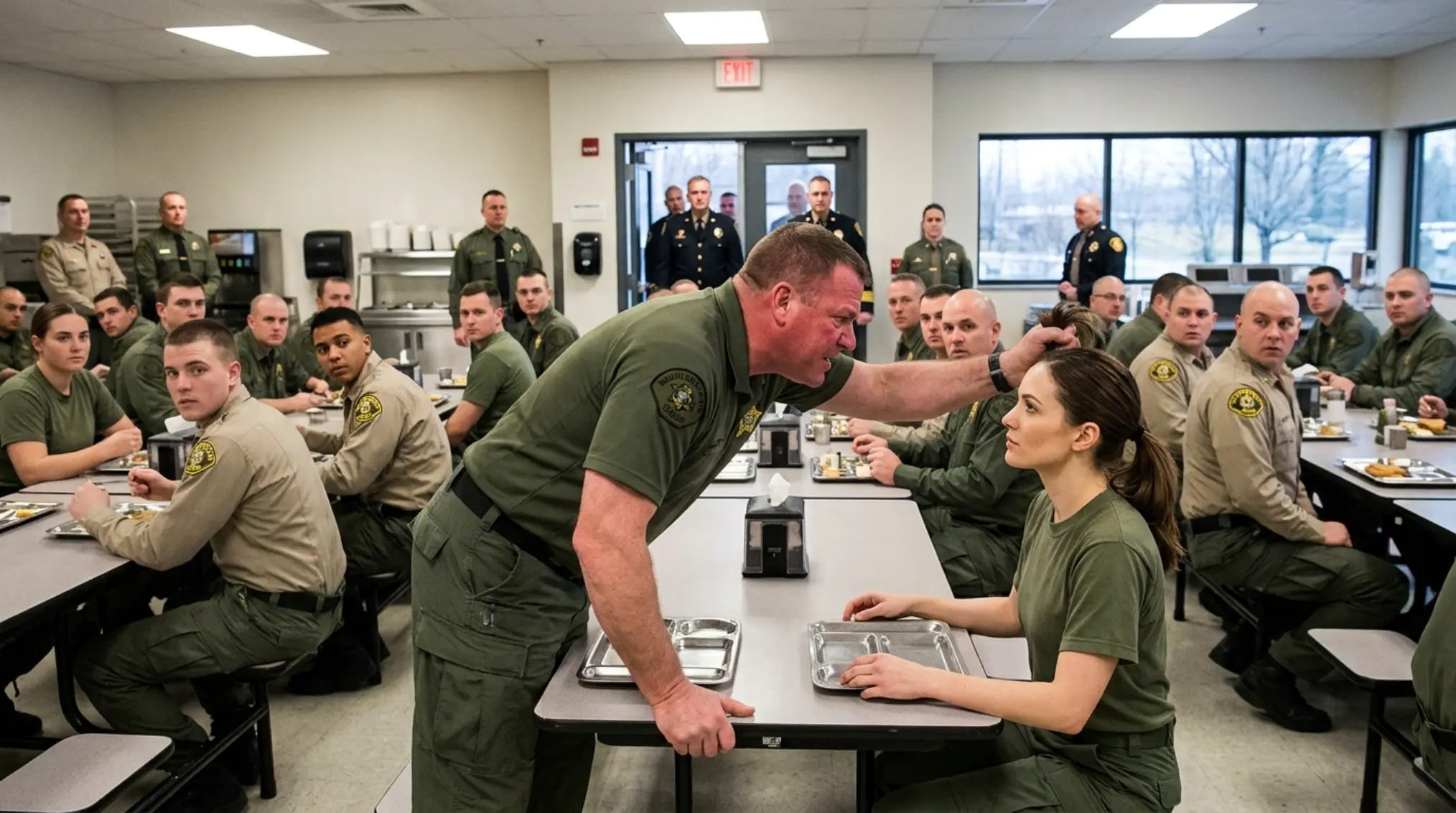
The Woman did not move.
She sat alone at the end of a long table beneath bright fluorescent lights, slowly separating another piece of orange from its peel while conversations around her faded one by one.
Across from her stood the Academy Supervisor.
Forty-eight years old.
Tall.
Muscular.
Close-cropped brown hair.
A face already red with anger.
He had spent nearly fifteen years training new public-safety recruits and had developed a reputation for turning every correction into a performance.
People moved when he entered a room.
People stopped talking when he looked their way.
Most trainees had learned within their first week that arguing with him was pointless.
The Woman apparently had not received that lesson.
She wore a plain olive-green academy field shirt, matching utility pants, black boots, and no visible badge, title, or identification.
Her dark-brown hair was tied into a low ponytail.
She looked about thirty.
Calm.
Almost irritatingly calm.
The Supervisor placed his tray on the table.
“That seat is reserved.”
The Woman peeled away another strip of orange skin.
“For whom?”
“For senior academy staff.”
She glanced at the empty tables around them.
“There are eleven open seats.”
“That isn't what I said.”
She looked back at her orange.
Several trainees nearby began watching.
The Supervisor noticed.
His jaw tightened.
“Stand up.”
The Woman did not.
Instead, she placed one orange slice neatly on her napkin.
“I’m eating.”
A few people exchanged looks.
Nobody spoke.
The Supervisor leaned closer.
“You deaf?”
“No.”
“Then move.”
The Woman finally lifted her eyes.
Her hazel gaze was steady.
“No.”
That single word changed the room.
The Supervisor stared at her.
He was accustomed to resistance arriving loudly.
Excuses.
Complaints.
Anger.
Nervous jokes.
Her refusal contained none of those things.
She simply did not accept his authority over the chair.
And somehow that felt more insulting to him than shouting would have.
He slapped one hand against the table.
Trays jumped.
A cup tipped over.
“You think you're proving something?”
“No.”
“Then why are you still sitting there?”
“Because I was cleared to sit here.”
“By whom?”
“The Commissioner’s office.”
The Supervisor laughed.
Not because it was funny.
Because people were watching.
“The Commissioner’s office cleared you personally?”
“Yes.”
“Name?”
She did not answer.
His smile hardened.
“That’s what I thought.”
He looked around at the trainees.
Then back at her.
“You walk into my academy wearing field clothes, refuse to identify yourself, sit in a staff section, and expect me to believe some secret story?”
The Woman ate another orange slice.
“I don't need you to believe me.”
That was the sentence that broke his restraint.
He stepped around the table.
“Wrong answer.”
The Woman looked at him.
“Do not touch me.”
Several people heard it.
So did he.
And he smiled.
Then his right hand shot forward.
His fingers closed around her ponytail near the base of her neck.
He yanked.
Her head snapped backward.
Gasps spread through the dining hall.
A fork fell onto the floor.
Someone near the coffee station whispered, “What the hell?”
The Supervisor leaned inches from her face.
“I told you to move.”
The Woman did not scream.
Did not claw at him.
Did not panic.
Her right hand rose and closed around his wrist.
Not hard.
Not yet.
Her voice was almost quiet.
“Take your hand off me while you still control how this ends.”
His eyes narrowed.
“You threatening me?”
“No.”
He tightened his grip.
“You don't get to threaten anyone in this building.”
The Woman’s gaze shifted slightly.
Past him.
Toward the double doors at the far end of the hall.
They had just opened.
Every senior officer sitting near the front stood simultaneously.
Chairs scraped backward.
The sound moved through the dining hall like a wave.
The Supervisor noticed too late.
The State Public Safety Commissioner had entered.
And he was looking directly at them.
The Woman’s name was Elena Ward.
Almost nobody at the academy knew it.
That was intentional.
For eight years, Elena had worked inside a small state investigative office responsible for sensitive oversight cases involving public corruption, internal misconduct, protective operations, and threats against critical state institutions.
She did not wear a recognizable uniform.
She rarely appeared at public events.
Her name was absent from most press releases.
She liked it that way.
People behaved differently when they knew an investigator was present.
Elena’s job often required seeing what happened when people believed nobody important was watching.
Three months earlier, the Commissioner had asked her office to conduct a quiet cultural review of the academy.
Graduation numbers looked excellent.
Testing scores were high.
Recruit retention appeared stable.
Yet anonymous complaints had increased.
Not about training difficulty.
About instructors.
Several recruits described intimidation.
Others described retaliatory assignments after questioning supervisors.
A few alleged that senior instructors used physical contact unnecessarily during ordinary corrections.
Nothing in the complaints alone established a systemic problem.
So Elena did what she did best.
She observed.
No announcement.
No investigative team walking around with folders.
No obvious interviews.
She entered using temporary academy credentials without revealing her actual role.
For four days she watched.
Most instructors impressed her.
They were demanding but professional.
Tough without becoming personal.
Clear about expectations.
Then she started hearing the same name.
The Academy Supervisor.
Some recruits admired him.
Others lowered their voices whenever he walked past.
One young trainee told another near a vending machine:
“Never ask him why. Just do it.”
Elena wrote that sentence down.
The next day she heard:
“He doesn't care whether you're right. He cares whether you obeyed fast enough.”
She wrote that down too.
Then came the dining hall.
Elena had deliberately chosen a seat in the area her clearance allowed her to use.
She wanted to observe how staff interacted when training was over and nobody believed evaluation was happening.
The Supervisor saw her.
Asked her to move.
She requested clarification.
He escalated.
And now his hand was wrapped around her hair in front of almost the entire academy.
The Commissioner could not have arrived at a more revealing moment.
“Remove your hand.”
The Commissioner’s voice carried across the hall.
The Supervisor released Elena immediately.
She stood slowly.
One hand smoothed the back of her hair.
The Commissioner crossed the floor with three senior administrators behind him.
Nobody spoke.
The Supervisor tried first.
“Commissioner, this individual refused multiple lawful directions and—”
The Commissioner stopped several feet away.
“I said nothing about her.”
The Supervisor froze.
“I told you to remove your hand.”
Elena looked down at the floor for a moment.
Then back up.
The Commissioner turned toward her.
“Are you injured?”
“No.”
“Do you need medical evaluation?”
“No.”
The Supervisor stared between them.
“You know her?”
The Commissioner did not answer.
Instead he looked toward the ceiling.
“Cameras?”
The Dining Services Director responded immediately.
“Full coverage, sir.”
“Audio?”
“Yes.”
“Preserve all footage beginning thirty minutes before this incident.”
“Yes, sir.”
The Supervisor’s face changed.
“This is being blown out of proportion.”
Elena finally looked at him.
“You grabbed a stranger by the hair in front of a room full of witnesses.”
“You refused instruction.”
“What instruction gave you authority to put your hands on me?”
He opened his mouth.
Nothing came.
The Commissioner looked toward him.
“I’d like that answer too.”
The Supervisor straightened.
“She was sitting in a restricted staff area.”
The Commissioner glanced toward the nearest table sign.
There was none.
“Restricted under what written policy?”
The Supervisor hesitated.
“Operational practice.”
“Meaning?”
“Senior personnel typically sit there.”
“Typically?”
“Yes.”
“So not restricted.”
The Supervisor’s jaw tightened.
“She claimed your office had authorized her presence.”
“It had.”
Silence.
The Supervisor stared at Elena.
Then at the Commissioner.
“I wasn't informed.”
“You weren't required to be.”
The Commissioner stepped closer.
“And even if she had been an ordinary visitor, you would still need to explain why asking questions ended with your hand in her hair.”
The entire dining hall remained silent.
No one was eating now.
Elena could feel hundreds of eyes on them.
She hated attention.
But this moment mattered.
The Supervisor tried another defense.
“She was deliberately provoking me.”
Elena almost laughed.
“With an orange?”
Several trainees failed to hide their reactions.
The Supervisor turned toward them.
The Commissioner said sharply, “Eyes here.”
The Supervisor looked back.
“You are relieved of academy duties pending review.”
His face went pale.
“Commissioner—”
“Turn over your facility access badge.”
“This is ridiculous.”
“Badge.”
The Supervisor looked around.
For perhaps the first time in years, nobody looked afraid of him.
He removed his access card.
Placed it into the Commissioner’s hand.
Then his eyes settled on Elena.
“Who are you?”
The Commissioner looked at her.
Elena gave a slight nod.
He could reveal enough.
“This is Senior Investigator Elena Ward from the State Public Safety Oversight Directorate.”
The room seemed to stop breathing.
The Supervisor whispered, “Oversight?”
“Yes.”
The Commissioner continued.
“She was here under my authorization.”
Elena added quietly:
“And until ten minutes ago, this review was mostly about institutional culture.”
The Supervisor stared at her.
“What is it about now?”
Elena looked toward the dozens of recruits still watching.
“Evidence.”
The review began before sunset.
Elena technically should not have led it.
She was now directly involved.
So another investigative team took control while she became a witness.
The first evidence was simple.
Dining hall footage.
The Supervisor approaching.
Elena remaining seated.
No shouting.
No aggression.
No threatening gestures.
His tray hitting the table.
Her warning.
Do not touch me.
Then his hand grabbing her hair.
The sequence lasted less than two minutes.
The physical contact lasted only seconds.
But when investigators began interviewing witnesses, those seconds opened a door nobody had expected.
A trainee asked whether his statement would affect graduation.
“No,” the investigator said.
“Can my instructor see it?”
“No.”
The trainee exhaled.
Then talked for forty minutes.
He described being shoved against a locker after questioning a disciplinary order.
Another recruit described the Supervisor grabbing the collar of her training shirt during a disagreement.
A third said he had watched the Supervisor knock a meal tray from someone’s hands because the trainee was speaking during quiet study hours.
One report became five.
Five became fourteen.
By the end of the first week, forty-one current and former academy members had agreed to interviews.
Not every complaint involved physical behavior.
Many involved something more difficult to document.
Humiliation.
Threats.
Retaliation.
The Supervisor seemed particularly hostile toward recruits who asked for explanations.
One former trainee remembered challenging an evaluation score.
The next week, he received the academy’s least desirable overnight assignments.
Another filed a complaint about an instructor.
The Supervisor allegedly called him into an office and asked:
“You sure you want to become known as the guy who complains?”
The trainee withdrew the complaint.
Investigators found the withdrawal.
They also found the original.
The deeper they looked, the clearer the pattern became.
The problem was not that the Academy Supervisor demanded discipline.
Everyone expected discipline.
The problem was that he increasingly treated personal obedience as proof of professionalism.
Questioning him became disrespect.
Disagreement became insubordination.
Embarrassing him became something that required punishment.
And because he produced strong test results, people tolerated it.
Elena gave her formal statement on the third day.
The investigator interviewing her had known her for years.
He still followed procedure exactly.
“What did you believe his intention was when he approached?”
“To make me move.”
“Did you know why?”
“He believed the seat belonged to senior academy personnel.”
“Did you intentionally refuse to identify your position?”
“Yes.”
“Why?”
“My assignment required limited disclosure.”
“Could you have privately shown credentials?”
“Yes.”
“Did he request them privately?”
“No.”
“What did he do?”
“He turned the interaction into a public dominance contest.”
The investigator wrote that down.
“That's interpretation.”
“Yes.”
“What observable behavior supports it?”
Elena appreciated the correction.
“He repeatedly looked toward the trainees before escalating. His tone increased when they began watching. He ignored alternative seating. He did not call security. He did not verify my clearance. He focused on whether I complied immediately.”
The investigator nodded.
“What happened before he grabbed you?”
“I told him not to touch me.”
“Why?”
“His posture changed. He moved into contact distance.”
“Then?”
“He grabbed my ponytail.”
“Why didn't you physically respond?”
Elena thought.
“I believed immediate defensive action might escalate the room unnecessarily.”
“You were capable of responding?”
“Yes.”
“How capable?”
Elena smiled faintly.
“You know the answer.”
He did.
“I'm putting down yes.”
“Good.”
The investigator leaned back.
“One more question.”
“Go ahead.”
“Did knowing the Commissioner was about to enter influence your decision not to respond?”
“No.”
“Why not?”
“I didn't know he was there until the doors opened.”
That surprised him.
“You looked past the Supervisor.”
“I saw movement.”
“So if the Commissioner hadn't entered?”
Elena considered.
“I would have removed his hand.”
“Forcefully?”
“If necessary.”
“Would he have been injured?”
“Only if he continued.”
The investigator closed his notebook.
“That may be the most Elena Ward answer you've ever given.”
The Supervisor hired an attorney.
His defense centered on academy security.
The attorney argued that an unidentified woman wearing field clothing inside a controlled facility represented a legitimate concern.
Investigators agreed that verifying her identity would have been appropriate.
Then they asked why verification never happened.
No call to security.
No request for private credentials.
No contact with the Commissioner’s office.
No attempt to escort Elena to reception.
Instead:
Move.
Stand up.
Final warning.
Then physical contact.
The attorney shifted toward provocation.
Elena’s refusal, he argued, created uncertainty.
The review panel rejected the logic.
A person asking why does not automatically create danger.
A person remaining seated does not automatically become a threat.
Most damaging was the Supervisor’s own history.
Investigators reviewed performance complaints from the previous seven years.
Several had been closed with almost identical language:
Instructor style may be perceived as overly direct but remains within acceptable training standards.
The panel compared those summaries with newly obtained witness accounts.
In some cases, supervisors had never interviewed the complainant.
In others, no video had been reviewed.
One complaint involving unnecessary physical contact had been closed after the Supervisor himself submitted a written explanation.
No independent investigation.
The Commissioner read that finding twice.
Then placed the report on his desk.
The problem was bigger than one man.
The institution had taught him that results would protect his methods.
Five weeks after the dining hall incident, the final review was presented.
The Supervisor had violated conduct policy.
Used unnecessary physical contact.
Misrepresented a nonrestricted dining area as restricted.
Failed to follow visitor-verification procedures.
And demonstrated a pattern of retaliatory leadership inconsistent with academy standards.
He was offered reassignment outside trainee supervision while a broader personnel process continued.
He refused.
Then resigned.
Some instructors thought the outcome was excessive.
Others believed it had taken too long.
Elena offered no public opinion.
She cared more about the policy changes.
Complaint reporting was moved outside immediate training chains.
Every physical-contact complaint required independent review.
Dining and common areas received clearly defined access rules so staff could not invent authority based on custom.
Instructor evaluations began including anonymous trainee feedback.
Most importantly, academy leadership introduced a principle Elena strongly supported:
Questions are not automatically defiance.
Professional environments still required direction.
Emergencies still required rapid compliance.
Training still demanded discipline.
But leadership had to distinguish between hesitation that endangered others and a person simply asking for justification.
That distinction seemed obvious.
Apparently it had not been.
Three months later, Elena returned.
No olive-green field shirt.
No utility pants.
No hidden assignment.
She wore black trousers, a cream blouse, and a charcoal coat.
She came because her younger brother had completed advanced training.
He met her outside the administrative building.
“You wore normal clothes.”
“I own normal clothes.”
“I was beginning to doubt it.”
They hugged.
Her brother stepped back.
“You know people still talk about you?”
“Unfortunately.”
“There are at least four versions of what happened.”
“How many involve me throwing him through a table?”
“Two.”
“I did not.”
“I know.”
“One says I arrested him personally.”
“That one's popular.”
“I wasn't even carrying restraints.”
Her brother smiled.
“You ruined everybody’s dramatic version.”
“Good.”
They walked toward the dining hall.
Elena slowed when they reached the doors.
Her brother noticed.
“You okay?”
“Yes.”
“You sure?”
She looked inside.
The table was there.
Same fluorescent lights.
Same coffee station.
Different people.
Then something small happened.
A young trainee was sitting at one end of the table.
A supervisor approached.
Elena instinctively watched.
The supervisor pointed toward a sign.
“This section is reserved after one for instructor meetings.”
The trainee looked at the clock.
12:46.
“I've got fourteen minutes?”
The supervisor smiled.
“You've got fourteen minutes.”
Then walked away.
Elena smiled.
Her brother noticed.
“What?”
“Nothing.”
But it was not nothing.
That ordinary interaction told her more about whether the academy had changed than any official report.
Authority explained itself.
The question did not become a battle.
Nobody needed to win.
During lunch, a young female trainee approached Elena.
“Investigator Ward?”
Elena looked up.
“Yes?”
“Can I ask something?”
“If it's about throwing someone through a table, no.”
The trainee laughed.
“Not that.”
“Go ahead.”
“I was here that day.”
Elena nodded.
“I was near the coffee station.”
The trainee hesitated.
“I filed a complaint afterward.”
“About the Supervisor?”
“Yes.”
“Good.”
“I had been thinking about it for months.”
“What happened?”
“He grabbed my arm during an evaluation. Hard.”
Elena waited.
“I thought maybe that was just how training worked.”
“It isn't.”
“I know now.”
The trainee looked toward the floor.
“When I saw him grab you, I thought you were going to be terrified.”
“Reasonable expectation.”
“You weren't.”
Elena smiled faintly.
“I was angry.”
“You looked calm.”
“Those are not opposites.”
The trainee considered that.
Then asked, “How do you stay calm?”
Elena shook her head.
“I don't.”
The trainee looked confused.
“I control what I do while I'm not calm.”
That answer seemed to land.
“Is that different?”
“Very.”
Elena leaned slightly closer.
“People think composure means you feel nothing. It doesn't. It means the feeling doesn't get to make the decision.”
The trainee smiled.
“Thank you.”
Then walked away.
Elena’s brother stared at her.
“What?”
“You actually give good advice.”
“Rarely.”
“I’m writing this date down.”
A year later, the dining hall footage became part of academy ethics training.
Elena agreed on one condition.
Her identity would be removed from the lesson.
New trainees watched only the beginning.
A Woman sitting.
A Supervisor approaching.
An argument over a seat.
A warning not to touch her.
A hand grabbing her hair.
Then the instructor stopped the video before the Commissioner entered.
The class received one question:
What facts matter before you learn who either person is?
The discussion usually began slowly.
The Supervisor held institutional authority.
The Woman had clearance.
He had options.
He did not verify.
She refused.
Refusal alone did not establish threat.
He escalated physically.
She warned him first.
Only after those points were discussed did instructors reveal that the Woman worked for state oversight.
By then, the title no longer mattered.
That was Elena’s goal.
If students decided the Supervisor was wrong only after learning who she was, they had missed the lesson.
She deserved boundaries before anyone knew her position.
A visitor would have deserved them.
A cafeteria worker would have deserved them.
A contractor would have deserved them.
A trainee would have deserved them.
The Commissioner once asked Elena whether she regretted staying seated.
She considered it.
“No.”
“Even knowing what happened?”
“Yes.”
He smiled.
“Why?”
“Because if I had moved, we'd have learned nothing.”
The Commissioner looked uncomfortable.
“That sounds like you intentionally tested him.”
“No.”
She shook her head.
“I simply didn't surrender a choice I was entitled to make.”
“And he revealed himself.”
“Yes.”
The Commissioner looked through his office window toward the academy grounds.
“That's the terrifying thing about small power.”
Elena raised an eyebrow.
“What?”
“People think abuse begins when someone controls something important.”
She waited.
He continued.
“Sometimes it starts over a chair.”
Elena smiled.
“Now that belongs on the wall.”
Years afterward, Elena remembered very little about the pain.
She remembered the fluorescent lights.
The orange peel.
The tray hitting the table.
The first trainee turning to watch.
And the sentence that started it.
I told you to move.
The Academy Supervisor believed the entire situation was about whether she moved from a chair.
It never was.
It was about whether authority had limits when someone refused.
Whether questioning was allowed.
Whether a powerful person could tolerate being told no without turning disagreement into punishment.
He failed that test before he ever touched her.
Grabbing her hair simply made the failure impossible to hide.
The dramatic moment came when the dining-hall doors opened and every senior officer stood.
People remembered the Commissioner entering.
They remembered the Supervisor realizing the quiet Woman had been cleared by the highest office in the agency.
They remembered his face.
Elena remembered something else.
The silence before the doors opened.
Dozens of people had watched him grab her.
Many were shocked.
Some were angry.
But almost nobody moved.
Not because they approved.
Because they had spent months learning that challenging him had consequences.
That was the part the academy needed to change.
And eventually it did.
The Supervisor thought he was teaching one quiet Woman to remember her place.
Instead, one hand around a ponytail forced an entire institution to remember the limits of his.