“Put that paddle down, little girl—this auction is for farmers, not children playing with Daddy’s money.”
Boyd Heck’s voice thundered through the Callaway County auction barn as he pointed his wooden gavel directly at eleven-year-old May Cutler. She stood in front of a weathered green John Deere tractor, holding a wooden BID paddle in one hand and a narrow spiral notebook in the other. Around her, more than fifty farmers, equipment dealers, and scrap buyers turned to see which foolish child had interrupted the sale.
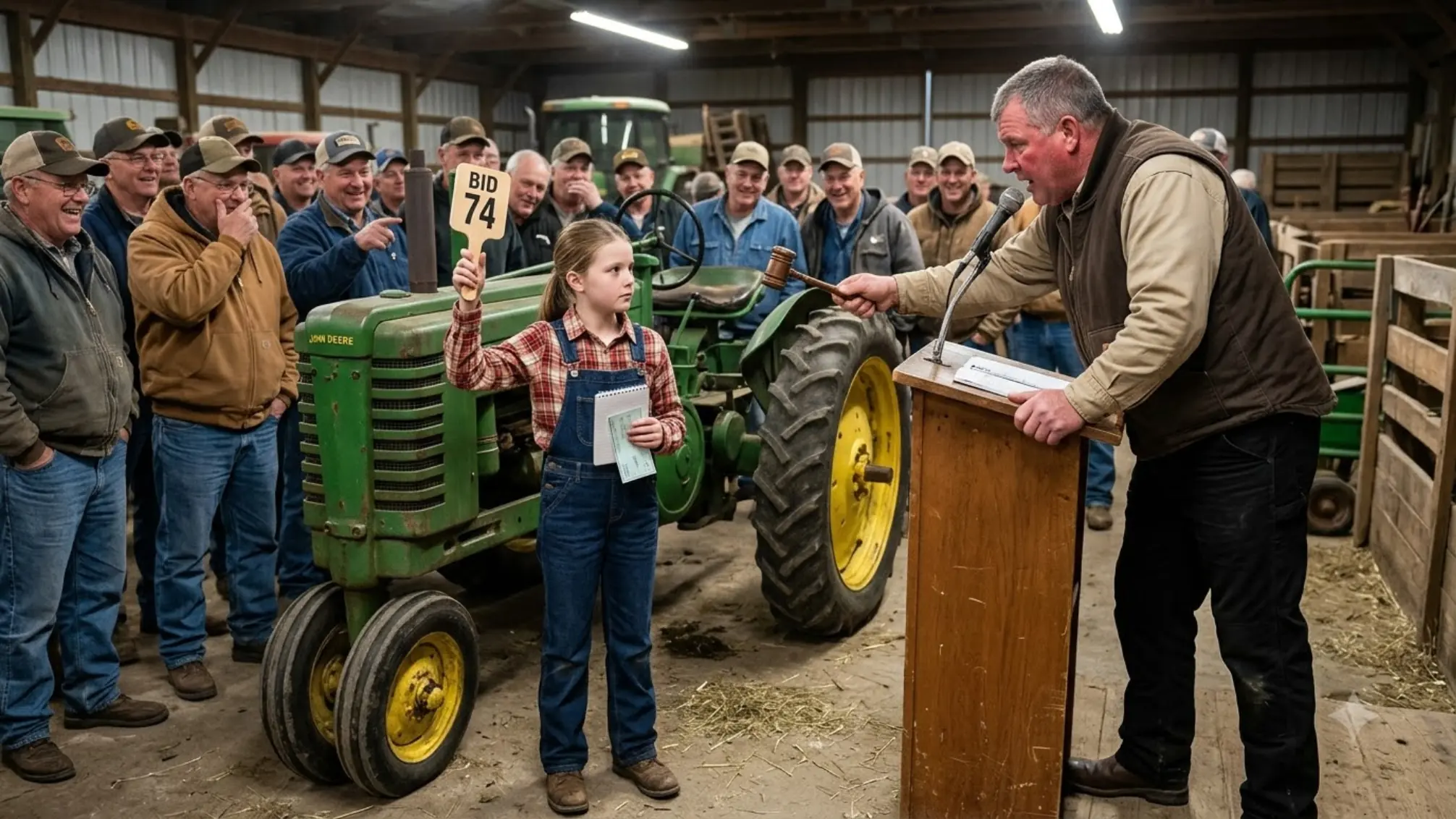
May did not lower the paddle.
She had fair skin, clear blue eyes, and long light-brown hair pulled into a neat ponytail. A red-and-cream plaid farm shirt showed beneath her dark denim overalls, while the toes of her brown work boots were scuffed from years of following her father through barns, fields, and machinery yards. She looked small beside the tractor’s towering rear wheel, but nothing in her expression suggested uncertainty.
“The money is mine,” May said. “And I already inspected what none of you bothered to check.”
Laughter broke across the room.
Raymond Stubbs, a broad sixty-year-old farmer leaning against the tractor’s front tire, slapped one hand against his knee. He had farmed nearly eight hundred acres outside Auxvasse and considered himself an authority on any machine painted green.
“That broken pile will bury your savings before it leaves the barn,” he said. “The engine’s locked, the hood doesn’t match, and the transmission probably hasn’t turned since before your mother was born.”
May opened her notebook.
“Then keep laughing,” she said. “Because the serial number says you’re all bidding on the wrong tractor.”
For half a second, the barn became quiet.
Then the laughter returned louder than before.
Boyd shook his head and looked toward the adults gathered behind May.
“Whose child is this?”
“My father is Warren Cutler.”
“Where is he?”
“Home sick.”
“And he sent an eleven-year-old girl to purchase farm machinery alone?”
“He sent me to inspect the auction.”
Boyd placed both hands on the podium.
“That is not the same as authorizing you to spend money.”
May held up her registered buyer’s card.
“My grandmother signed the guarantor form. The auction office accepted my cashier’s check.”
Several men stopped laughing.
Boyd looked toward the clerk’s table. The office manager checked the registration sheet and gave a reluctant nod.
May Cutler was legally registered.
The battered tractor behind her had been listed as Lot 41, a 1946 John Deere Model A, nonrunning, mismatched sheet metal, sold for restoration or parts. Its green paint had faded nearly gray along the hood, rust surrounded the grille, and one front tire had gone completely flat. Mud and grease covered the serial plate so thoroughly that no one reading the catalog had questioned the auction company’s description.
Most buyers had inspected it for less than a minute.
May had arrived at 6:40 that morning, more than two hours before the equipment session began. She spent forty-five minutes with the tractor before speaking to anyone. She checked the oil, transmission housing, rear hubs, hand clutch, frame length, casting marks, drawbar, and hydraulic assembly.
The engine did not turn when a worker pulled the starter.
But May noticed that the flywheel had shifted slightly.
A completely seized engine would not have moved at all.
The hood carried Model A sheet metal, but the frame beneath it was longer and heavier. The rear axle housing was shaped differently from the common Model A tractors Warren had taught her to recognize. A later replacement seat and improvised battery box hid several original features, but the clutch housing carried a casting code that did not belong to the year printed in the auction catalog.
May had crawled beneath the left side with a rag and small wire brush.
Under nearly eighty years of grease, she found the serial plate.
She copied every digit into her notebook.
Then she went to the truck, opened the equipment guide her grandfather had left her, and checked the serial-number tables three times.
The tractor was not a 1946 Model A.
The replacement hood had fooled almost everyone in the barn.
Beneath it stood an early-production John Deere Model G from the first year of its limited run, built with several factory components that were later changed. According to the notes in her grandfather’s restoration ledger, tractors from that specific serial range were difficult to find intact because many had been converted, dismantled, or worked until their original parts disappeared.
May believed this one retained most of its important components.
She also believed the engine was not truly seized.
The auction began at $400.
A scrap buyer raised the price to $500. Raymond bid $550, planning to use the rear tires and sell the remaining iron by weight. Another dealer offered $600.
May raised her paddle at $650.
That was when the laughter started.
Boyd had paused, believing she was waving at someone. When May repeated the bid, he demanded that she lower the paddle. His public insult drew everyone’s attention, turning a quiet equipment sale into a confrontation between a child and an entire barn full of adults.
May’s registered funds totaled $1,600.
The money had not come from Warren.
Two years earlier, he had allowed each of his three daughters to raise one calf from the family herd. May’s first heifer produced a strong steer calf, and she saved nearly every dollar after feed costs. She added money from cleaning stalls, repairing fences, and keeping auction records for a neighbor who struggled with reading.
Warren offered to double her account if she used it for school.
May declined.
She wanted to build the money herself.
For thirteen months, she attended livestock and equipment auctions without purchasing anything. She inspected hay rakes, stock trailers, small tractors, and damaged balers. Every time she considered bidding, she wrote down the likely repair cost, resale value, and worst possible loss.
Nothing had been worth the risk.
Until Lot 41.
Raymond stepped closer to her.
“Serial plates get replaced all the time,” he said. “A number on a dirty tag doesn’t make that thing valuable.”
“The plate has factory rivets.”
“You know what factory rivets look like?”
“Yes.”
“You read that in a book?”
“My grandfather restored John Deere tractors for thirty-eight years.”
Raymond smiled.
“And now an eleven-year-old thinks she inherited his eyes?”
“No,” May replied. “I inherited his notebooks.”
The smile disappeared from Raymond’s face.
Boyd struck the podium with his gavel.
“We are selling a nonrunning tractor as listed. Current bid is six hundred and fifty dollars.”
Raymond raised one finger.
“Seven hundred.”
May lifted her paddle.
“Seven twenty-five.”
The scrap buyer bid $750.
May answered with $775.
Boyd’s chant regained its rhythm. The crowd watched the numbers climb, not because the tractor interested them, but because they expected May to panic when the price approached the limit of a child’s savings.
At $850, the scrap buyer withdrew.
Raymond remained.
“Nine hundred,” he called.
May looked at the tractor.
Her maximum number was written at the bottom of the notebook page.
Purchase limit: $1,150, including buyer’s fee.
Above that amount, the risk became unreasonable even if she had identified the machine correctly. Transportation would cost nearly a hundred dollars, and repairing the engine could require several hundred more.
“Twenty-five,” May said.
Boyd turned toward her.
“Nine hundred twenty-five dollars.”
Raymond laughed.
“You are about to lose every dollar you own.”
“Then stop bidding.”
Several men murmured.
Raymond’s face reddened.
“Nine fifty.”
May calculated the fee in the margin.
“Nine seventy-five.”
Raymond looked at the tractor again.
He did not believe May’s serial-number claim, but he disliked the idea of losing to her more than he disliked the machine. That emotion had already pushed him beyond what he originally intended to pay for parts.
“One thousand.”
May stared at him.
Raymond spread his hands.
“Go ahead, little expert. Show us how brave you are.”
May looked toward the serial plate beneath the grease-darkened frame.
“One thousand twenty-five.”
The room became quiet again.
Raymond could afford ten tractors. May could barely afford one. Everyone understood that the same bid carried different consequences for each of them.
“One thousand fifty,” Raymond said.
May did not raise the paddle immediately.
She checked the calculation once more.
The buyer’s fee would place the total near the maximum she had set before bidding. Transportation remained possible, though almost nothing would be left for repairs.
Warren had taught her never to change a maximum because someone insulted her.
Pride was not value.
But the tractor still fit beneath her number.
“One thousand seventy-five.”
Raymond opened his mouth.
Then he stopped.
At that price, the tires and scrap metal would barely justify the purchase. He had no intention of restoring the machine, and he still believed May was wrong about its identity.
Boyd looked across the room.
“One thousand seventy-five dollars. Do I hear eleven hundred?”
No one answered.
The auctioneer looked toward May.
“You understand this tractor is sold as-is?”
“Yes.”
“No guarantee that it runs?”
“Yes.”
“No refund when your father discovers what you bought?”
“My father reads auction terms.”
A few men covered their smiles.
Boyd raised the gavel.
“Sold.”
The wood struck the podium.
May lowered her paddle.
Lot 41 belonged to her.
Raymond shook his head and walked toward the coffee table. Several farmers returned to their conversations, already dismissing the purchase as a painful lesson Warren Cutler would have to explain to his daughter.
May walked to the payment office.
She placed the cashier’s check, buyer’s card, and her grandmother’s signed guarantor agreement on the counter. The clerk counted the amount, added the fee, and handed her the paid receipt.
Total purchase price: $1,128.75.
May folded the document into her notebook.
Outside the office, a thin older man waited beside the tractor. He wore faded coveralls beneath a brown coat, and his hands were blackened permanently around the fingernails by decades of machine work.
His name was Elias Benton.
For forty-two years, Elias had repaired agricultural equipment throughout central Missouri. He had watched the bidding without participating and now stood near the serial plate, holding May’s wire brush.
“You found this?” he asked.
“Yes.”
“Show me.”
May crouched beside him.
She pointed to the digits beneath the remaining grease. Elias wiped the plate with his thumb, then removed a small flashlight from his pocket. He examined the rivets, frame stamping, and nearby casting marks.
The auctioneer approached.
“What are you two doing?”
Elias did not look up.
“Checking whether the girl just embarrassed the whole barn.”
Boyd’s expression tightened.
Raymond and several others returned from the coffee table.
Elias read the serial number aloud.
He compared it with a worn pocket guide carried inside his coat. Then he walked around the tractor, studying the axle housings and transmission case.
“This is not a Model A,” he said.
No one laughed.
Boyd stepped closer.
“What is it?”
“Early G.”
Raymond folded his arms.
“With an A hood?”
“Replacement sheet metal.” Elias pointed toward the frame. “Wrong hood, wrong grille, later seat. The tractor underneath is older and heavier.”
He placed one hand against the hydraulic housing.
“This lift assembly is early, too.”
May opened her grandfather’s notebook.
“Serial range begins here.”
Elias read the handwritten table.
“Your grandfather write this?”
“Yes.”
“What was his name?”
“Samuel Cutler.”
Elias looked at her for the first time with visible surprise.
“Sam Cutler from Auxvasse Creek?”
May nodded.
“I knew him.”
The farmers moved closer.
Elias returned to the engine.
“Who said it was seized?”
One of the auction workers raised his hand.
“We tried the starter.”
“Battery barely had enough power to click.”
“We pulled it with a truck yesterday. Wheels locked.”
Elias reached toward the hand clutch.
“This clutch is stuck engaged.”
He adjusted the lever, then opened two compression-release valves. With help from another mechanic, he placed a bar carefully against the flywheel.
The flywheel moved.
Only an inch.
But it moved.
A murmur passed through the barn.
Elias repositioned the bar and pushed again. The engine turned farther, forcing stale air through the exhaust.
“Not seized,” he said. “Stiff from sitting.”
Raymond’s face changed.
Boyd looked at the paid receipt in May’s hand.
“What is something like this worth?”
Elias stood slowly.
“Running, with the right parts and a careful restoration?”
He glanced at the serial number.
“More than she paid.”
“How much more?”
“That depends on what is original inside.”
A collector named Charles Vickers stepped forward. He owned a private museum of early tractors near Columbia and had been buying rare equipment for more than twenty years.
“Let me see the number.”
May remained beside the plate.
“You may look. Don’t remove anything.”
Charles crouched.
He used his phone to photograph the serial plate and sent the image to someone. A reply arrived within minutes.
Charles read it, then looked toward May.
“If the major castings match, I’ll give you fifteen thousand dollars for it today.”
The barn went completely silent.
May’s purchase receipt was less than ten minutes old.
Raymond stared at the tractor he had abandoned at $1,050.
Boyd stepped down from the podium.
“Fifteen thousand?”
“As it sits,” Charles said. “I transport it.”
May closed her notebook.
“No.”
Charles blinked.
“You paid a little over eleven hundred.”
“I know.”
“I just offered you nearly fourteen thousand dollars in profit.”
“I heard you.”
“Then why are you refusing?”
“Because you haven’t inspected the major castings.”
Charles studied her.
“You think it’s worth more.”
“I think neither of us knows yet.”
A few farmers exchanged looks.
May had not bought the tractor to prove she was clever. She had purchased it because her inspection suggested the gap between price and value was large enough to justify the risk. Accepting the first offer before confirming the machine would replace one kind of guessing with another.
Elias smiled faintly.
“Sam taught you that?”
“He taught my father. My father taught me.”
The barn manager, Clifford Reese, arrived holding the auction catalog.
“There may be a problem.”
May looked at him.
“What problem?”
“The tractor was materially misidentified.”
“You sold it as-is.”
“We listed the wrong model.”
“I inspected it before bidding.”
Clifford glanced toward Charles.
“A mistake of this size may require us to cancel the sale.”
May held up the paid receipt.
“The gavel fell. You accepted payment.”
“The consignor may object.”
“Did the consignor provide the model information?”
Clifford checked the sheet.
“The estate did.”
“Then the auction company repeated information without verifying it.”
Boyd stepped between them.
“Watch your tone.”
May faced him.
“You called me a child playing with Daddy’s money in front of the whole barn. Now you want to cancel because the child read the serial number.”
Several men looked away.
Clifford lowered his voice.
“We need to contact the estate representative.”
The tractor had come from the property of Harold Gentry, a retired farmer who had entered assisted living after breaking his hip. His nephew, Daryl Gentry, managed the equipment sale under a financial power of attorney.
Daryl arrived forty minutes later.
He was fifty-one, heavyset, and visibly angry before reaching the tractor. Charles’s offer had already traveled through the auction crowd, growing larger with every retelling.
“I’m not selling a fifteen-thousand-dollar tractor for a thousand,” Daryl announced.
“You already did,” May said.
“I thought it was a Model A.”
“So did everyone who didn’t inspect it.”
“You knew the listing was wrong and stayed quiet.”
“I told the auctioneer before the gavel fell.”
Boyd’s face tightened.
Daryl turned toward him.
“She did?”
“She made a claim about the serial number.”
“And you ignored her?”
“She is eleven.”
Daryl stared at him.
That answer damaged the auction company more than it helped.
Clifford asked everyone to move into the office. May’s grandmother, Ruth Cutler, had arrived after receiving a call from the clerk. Ruth was sixty-eight, sharp-eyed, and carried the signed registration documents inside her handbag.
Daryl demanded cancellation.
Clifford read the auction terms. All equipment was sold as-is, where-is, with buyers responsible for inspection. Descriptions were provided as a convenience and did not constitute a warranty. The auction company retained the right to correct errors before the hammer fell, but Boyd had not stopped the sale when May challenged the description.
Payment had been accepted.
Ownership had transferred.
Daryl pointed toward May.
“She took advantage of an old man.”
May’s grandmother leaned forward.
“Choose those words carefully.”
“I’m talking about Harold.”
“May never met Harold.”
“She knew the tractor was worth more.”
“That is why people inspect equipment.”
Daryl struck the table with his palm.
“She is a child!”
May opened her notebook.
“You signed a consignment contract telling the auction company to sell this tractor. You identified it as a Model A without checking the serial plate. I arrived early, inspected it, registered legally, bid openly, and paid the invoice.”
Daryl stared at her.
May continued.
“You didn’t lose the tractor because I’m eleven. You lost it because you never looked beneath the grease.”
Clifford asked the auction company’s attorney to review the paperwork.
The attorney returned an hour later.
The sale would stand.
The auction’s own terms placed the duty of inspection on the buyer, and May had fulfilled it. The company had been given an opportunity to stop and correct the description after her warning but continued the sale. Canceling only after a higher value became possible would expose the auction house to a stronger claim than honoring the transaction.
Daryl left without speaking to May.
Boyd avoided her eyes.
Elias helped load the tractor onto a flatbed trailer that afternoon. May paid eighty-five dollars for delivery, leaving less than four hundred in her account.
Before the truck departed, Raymond approached.
“You got lucky.”
May looked at him.
“Which part was luck?”
“The serial plate.”
“It was there for everyone.”
“You happened to know what it meant.”
“I studied.”
Raymond’s jaw tightened.
“That tractor may still be ruined inside.”
“Yes.”
“You could lose money.”
“Yes.”
He seemed frustrated by her refusal to pretend the risk did not exist.
“You’re not scared?”
“I set the maximum before I raised the paddle.”
Raymond looked toward the tractor.
“That isn’t what I asked.”
May folded her receipt into the notebook.
“I’m scared of changing the number after the bidding starts.”
Warren Cutler was waiting beside the barn when the trailer reached their farm.
He looked pale from fever and wore a heavy coat over his work clothes. When the truck stopped, he walked slowly around the tractor without touching it.
May stood beside him.
“You heard?”
“Half the county called.”
“Are you angry?”
Warren looked at the replacement hood, heavy frame, and early hydraulic housing.
“How much?”
“With the fee and transportation, twelve hundred thirteen dollars and seventy-five cents.”
“How much is left?”
“Three hundred eighty-six and twenty-five.”
“You stayed under your limit?”
“Yes.”
“Why?”
“Because the engine may be worse than it looks.”
Warren nodded.
“Good.”
May stared at him.
“That’s all?”
“What else should I say?”
“The auctioneer said I was playing with your money.”
“Was it my money?”
“No.”
“Then he was wrong.”
“They laughed.”
“People laugh when they decide before inspecting.”
Warren touched the hood.
“Show me what you saw.”
For the next twenty minutes, May walked her father through every clue. She explained the frame dimensions, serial range, casting marks, clutch housing, and movement in the flywheel.
Warren listened without interrupting.
When she finished, he said, “We’ll open it carefully.”
They did not attempt to start the tractor immediately.
Elias returned the following weekend and helped remove the replacement hood. Beneath it, they found a complete original fuel system, early cylinder head, and correct transmission case. The engine contained surface corrosion but no catastrophic damage.
Two valves were stuck.
The clutch plates had bonded together after years of moisture.
A mouse nest blocked part of the intake.
The tractor had appeared dead because no one had taken enough time to diagnose it.
May photographed every step and recorded each removed bolt in labeled bags. She refused to repaint anything until the mechanical condition was confirmed. Warren ordered only the parts they knew were necessary, while Elias contributed labor in exchange for permission to document the restoration.
Charles Vickers visited twice.
His first offer rose from fifteen thousand to twenty-two thousand after the engine casting numbers matched the early production range. May refused again.
“You are taking a risk,” Charles warned.
“I know.”
“If the block is cracked, my offer changes.”
“I know.”
“If the tractor runs, I’ll pay more.”
“That is why we’re checking.”
Three months after the auction, they were ready to attempt the first start.
May filled the fuel system, checked the oil pressure line, and stood beside the controls. Warren remained near the rear wheel while Elias worked the starting sequence.
The engine turned.
Once.
Twice.
Smoke rose from the exhaust.
On the fourth attempt, the tractor fired.
The first sound was uneven and violent, shaking dust from the barn rafters. Then the rhythm settled into a slow, heavy beat that could be heard across the Cutler property.
May stood completely still.
Warren looked at her.
“Listen before you touch anything.”
They watched for leaks, temperature changes, and abnormal vibration. Oil pressure held. The repaired clutch disengaged. The transmission entered first gear without grinding.
Warren climbed onto the seat.
“No.”
He looked down at May.
“You found it.”
May climbed up.
The tractor moved out of the barn under its own power for the first time in nearly nineteen years. She drove slowly into the yard while Warren walked beside the rear wheel and Elias followed with a fire extinguisher they never needed.
Neighbors heard the engine.
Trucks began appearing along the road.
Raymond arrived before May completed the second circle of the yard. He leaned against the fence without speaking as the old John Deere passed in front of him.
The following week, a specialist confirmed the tractor’s historical significance. It belonged to a small early-production group with original components often lost during later repairs. The replacement hood had hidden its identity, but the frame, engine, transmission, and hydraulic assembly matched.
Charles made a final offer.
Sixty-eight thousand dollars.
May sat at the kitchen table with Warren and Ruth while the written proposal rested in front of them. The collector promised to preserve the tractor, document its restoration, and display May’s notebook beside it during exhibitions.
“You don’t have to sell,” Warren said.
May looked toward the barn.
The money could pay the remaining loan on the Cutler property, replace the failing hay baler, and leave enough in her account to continue purchasing equipment. Keeping the tractor would preserve a piece of history, but selling it to a responsible collector would preserve it too.
“What would Grandpa do?” she asked.
Warren considered the question.
“He’d tell you not to make a financial decision for a dead man.”
May smiled faintly.
She accepted the offer under three conditions.
The collector had to credit Samuel Cutler’s restoration records in the display. The tractor could not be modified beyond historically correct repairs. And for ten years, the machine had to return to Callaway County once annually for the youth agricultural fair.
Charles agreed.
May used part of the money to repay Warren’s original farm advance, even though he insisted none had been involved in the tractor purchase. She placed most of the remaining funds in a supervised agricultural investment account.
Five thousand dollars created a small equipment-inspection scholarship for local 4-H and FFA students.
The first class met inside the same auction barn.
Elias taught them how to read casting numbers. Warren explained how to set a maximum bid before an auction began. May showed younger students how to inspect serial plates, tires, frames, hydraulic systems, and engine movement.
Boyd Heck remained the auctioneer.
During the first class, he stood near the podium and watched May clean grease from an old baler identification plate. At the end of the lesson, he approached her.
“I treated you badly.”
May closed her notebook.
“Yes.”
“I thought you were interrupting the sale.”
“I was bidding.”
“I should have verified your registration before speaking.”
“Yes.”
Boyd exhaled.
“You make apologies difficult.”
“I make them accurate.”
He almost smiled.
“I was wrong.”
May nodded.
“Then announce the next lot correctly.”
Years later, farmers still discussed the morning when an eleven-year-old girl bought the wrong tractor—or, as May always corrected them, the correctly identified tractor under the wrong catalog description.
Raymond eventually admitted the truth.
He had seen only scrap because he spent less than a minute looking. He had continued bidding because losing to a child embarrassed him. The higher May raised her paddle, the less he thought about the tractor and the more he thought about protecting his pride.
That nearly cost him more than the machine was worth to him.
May’s notebook remained different.
It contained no insults, laughter, or personal victory. The auction page recorded only the facts.
Lot 41. Listed as 1946 Model A. Replacement sheet metal. Actual early-production Model G confirmed by serial and castings. Engine stiff, not seized. Purchase: $1,075. Total with fee and transport: $1,213.75. Restoration and parts: $4,906. Final sale: $68,000.
Beneath the numbers, she added one final sentence.
Everyone saw the green paint. Almost no one checked the machine beneath it.
At sixteen, May had completed nine equipment purchases.
Not every one became valuable.
One hay rake required more repairs than expected and produced a small loss. A grain wagon she believed was undervalued sold for nearly the same amount she paid. Another tractor generated a modest profit after months of work.
She recorded the failures as carefully as the successes.
The John Deere remained the purchase people remembered because the difference between appearance and reality had been so large. But May understood that one extraordinary result did not make every neglected machine a hidden treasure.
Inspection came before hope.
Evidence came before confidence.
A maximum came before bidding.
And pride never changed the number.
Each year, the restored John Deere returned to the Callaway County agricultural fair. Its green paint shone again, but the collector left a small section near the serial plate unrestored, preserving the dark stain where May’s wire brush had first uncovered the digits.
Children gathered around the tractor.
Adults usually asked how much it sold for.
Children asked how May knew.
She always gave them the same answer.
“I didn’t know everything.”
She pointed toward the plate.
“I knew the catalog didn’t match the serial number. So I kept checking.”
During the fifth annual visit, an eight-year-old girl stood beneath the rear wheel with a small notebook clutched against her chest.
“Were you scared when all those men laughed?”
May looked across the barn.
Boyd was calling another equipment sale from the same podium. Raymond stood near the coffee table, older now, but still studying every machine carefully before bidding.
“Yes,” May said.
“Then why didn’t you stop?”
“Because being scared didn’t change the serial number.”
The child wrote the sentence down.
May watched her.
The John Deere had been dismissed by every experienced buyer in the barn. They saw rust, a flat tire, mismatched sheet metal, and an engine that refused to start. They trusted the auction catalog because checking required time, dirt, and the willingness to admit that the obvious answer might be wrong.
May saw those problems too.
She simply looked longer.
The men believed she had taken a reckless chance with a broken tractor.
May knew she had done the opposite.
She had arrived early, inspected every important component, verified the serial range, calculated the repair risk, set a maximum, and refused to let humiliation move that number by a single dollar.
She had not been gambling.
She had been collecting on the work everyone else had decided was unnecessary.