A widow and her daughter were struggling to keep their little roadside diner alive.
But on a freezing night, when a group of weary truck drivers knocked on the door asking for warmth and a cup of coffee, she did not hesitate to let them in, sharing her very last meal.
A few days later, convoys of trucks rolled in one after another, engines roaring like thunder.
What she witnessed next would forever change the way she understood miracles.
The snow came down the way it does in the mountains of Colorado, thick and relentless, erasing the world one flake at a time.
Inside Carter's Kitchen, Sarah Carter stood behind the cash register, her hand smoothing the creases of yet another overdue notice from the bank.
The paper felt thin between her fingers, as fragile as everything else in her life lately.
"Mama, it's almost 10," Maya said softly from across the diner.
Her daughter was 23, with her father's dark eyes and her mother's quiet determination.
She had been wiping down the same table for the past 5 minutes, the kind of busy work you do when there is nothing else left to do.
Sarah nodded but did not move toward the door to flip the sign.
"Just a few more minutes," Sarah said, though she knew no one was coming.
They had not had a customer since noon, and that had been old Joe Miller, who came every Tuesday out of loyalty more than hunger.
The highway reroute 3 years ago had been the beginning of the end.
What had once been a bustling stop for truckers heading east through the Rockies was now a forgotten building on a forgotten road.
The cash register held $27.43.
The bills stacked on the counter beside it told a different story.
Three months behind on the mortgage.
Two months behind on the electric.
A furnace that needed replacing before next winter.
The bank's final notice gave her 30 days.
Thirty days to come up with $12,000 or lose everything.
Sarah's fingers traced the edge of the foreclosure notice.
Her eyes drifted to the photograph hanging near the coffee station, the only decoration she had kept when she had stripped the walls of everything else to sell.
Marcus stood beside his Peterbilt, one hand on the chrome bumper, his smile wide enough to light up the whole frame.
That picture was taken 32 years ago, back when he was still driving cross-country routes.
Back before they had saved enough to buy this place together.
Before Highway 29 became the center of their universe.
Before the highway department rerouted the main road 5 miles east and took their dreams with it.
Before Marcus collapsed behind that same counter where Sarah now stood, his heart giving out at 58, leaving her with a business she did not know how to save and a daughter who had given up her own dreams to help.
She thought about Marcus, about the way he used to fill this place with his laughter during the morning rush.
He had known every trucker by name, remembered their favorite meals, and asked about their families.
He treated this diner like it was a cathedral, and every customer like they were kin.
"Mama."
Sarah looked up.
Maya stood at the window, her dishrag frozen mid-wipe, her voice strange.
"Someone's pulling in."
The door opened with the jingle of the brass bell.
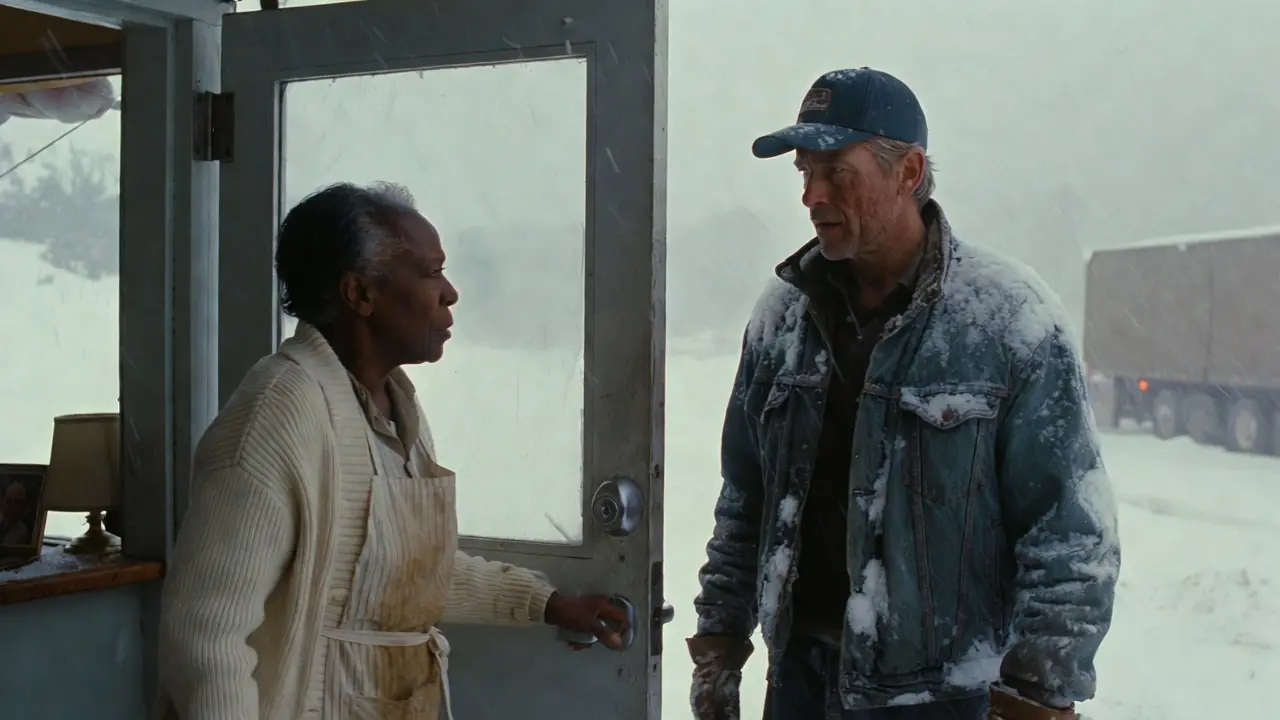
A gust of wind and snow blew in, and with it came a man Sarah had never seen before.
He was maybe 50, with tangled hair visible beneath a dark blue trucker's cap.
His face was weathered in that particular way that comes from years behind a windshield, watching America scroll by through reinforced glass.
"Evening, ma'am," he said, his voice like gravel rolling down a hill. "Any chance you're still serving? It's turning into a real mess out there."
Sarah glanced at the clock above the grill.
9:54.
Every instinct told her to say no.
To flip that sign and go upstairs to the tiny apartment where the heat worked better than it did down here.
To stop pretending that staying open another 6 minutes would make any difference at all.
But something in the man's eyes stopped her.
They were tired eyes, worried eyes.
The eyes of someone who had been driving too long and still had too far to go.
"Kitchen's still hot," she heard herself say. "What can I get you?"
The man's shoulders dropped with visible relief.
"Coffee, , and whatever you've got that's warm."
He crossed to the counter, his boots tracking snow across floors Sarah had mopped three times that day out of sheer nervous energy.
"Name's Raymond, but everybody calls me Ray."
He settled onto a stool, his large frame making the old seat creak.
"Appreciate you being open. They've closed the highway about 10 miles back. Complete whiteout conditions."
Sarah's hand froze halfway to the coffee pot.
"Closed it for how long?"
"Till morning at least. Maybe longer."
Ray pulled off his cap, revealing close gray hair.
"Way it's coming down, I was lucky to make it this far before they blocked it off."
The bell above the door jingled again.
Two more truckers came through the door, shaking snow from their jackets like wet dogs.
Then another.
Then three more.
Their voices were low and relieved as they realized they had found shelter.
By 10:15, Sarah had 12 truckers scattered throughout her diner, their presence filling the space with a sound she had not heard in months.
The low rumble of conversation.
The scrape of chair legs.
The clink of coffee cups.
The simple noise of human beings being human together.
Sarah's mind raced as she moved through the kitchen.
She had enough soup for maybe six people.
The freezer held a few pounds of ground beef, some chicken that needed to be used soon, and not much else.
She had planned to restock on Friday when her small allowance arrived.
It was the only reliable income she had left since her back injury last year made it hard to stand for long shifts.
"Mama," Maya whispered, appearing at her elbow with empty hands and worried eyes. "We don't have enough food for all of them."
Sarah looked at her daughter and saw the girl who had turned down a full scholarship to Denver State to stay here and help.
The girl who had taken a waitressing job she was overqualified for because her mama needed her.
The girl who had never once complained about the sacrifice, even though Sarah could see the college brochures hidden in her room.
Even though she heard Maya crying sometimes late at night when she thought no one could hear.
"We'll make it work," Sarah said quietly, her voice steady even as her heart hammered. "We don't turn away hungry people, not in this house."
Sarah moved through the kitchen with the kind of efficiency that comes from 30 years of practice.
She stretched what little she had.
She made sandwiches from the last of the bread.
She heated the soup and watered it down just enough to make it go further.
She started another pot of coffee.
When it became clear it still would not be enough, she sent Maya upstairs to raid their personal supplies.
The pasta they had been planning to eat that week.
The canned vegetables from the pantry.
The frozen casserole meant for their own dinners.
"You folks planning to head out once you've eaten?" Sarah asked Ray, who seemed to have become the unofficial spokesman for the group.
Ray shook his head slowly.
"Highway patrol says nothing's moving till morning at the earliest. Maybe longer if this keeps up."
He gestured toward the window where his rig sat barely visible through the curtain of falling snow.
"Motels in town are already full. Called ahead. Looks like we'll be sleeping in our trucks tonight."
Sarah followed his gaze.
The wind was picking up, rattling the old windows and howling around the corners of the building like something alive and angry.
She knew what it meant to sleep in a truck during weather like this.
Marcus had done it more times than she could count before they had saved enough to buy this place.
He told her about waking up with ice on the inside of the windows.
About running the engine all night and praying you did not run out of fuel.
About the bone-deep cold that no amount of blankets could touch.
"You can't sleep in your trucks in this," she said, the words coming out before her practical side could stop them. "You'll freeze."
"Wouldn't be the first time, ma'am," another trucker called out, a younger man with kind eyes and laugh lines.
But Sarah could see it on their faces.
She could see them doing the math.
How long their fuel would last.
Whether their rigs could handle idling all night in sub-zero temperatures.
What would happen if something went wrong.
She thought of the empty diner.
Of the bills she could not pay.
Of the foreclosure notice that gave her 30 days to come up with money she did not have.
She thought of Marcus, of his big heart that had gotten them into financial trouble more than once because he could never turn away someone in need.
She thought of what he would do.
"The diner stays open all night," Sarah heard herself say.
"And I've got a small apartment upstairs with some spare blankets and pillows. It's not much, but it's warm and it's dry. You're welcome to stay."
The diner went quiet.
Twelve faces turned to look at her, and Sarah saw the surprise in every one of them.
"Ma'am," Ray said carefully, "that's real generous, but we couldn't impose like that. You don't even know us."
"I know you're people who are stuck in a storm," Sarah replied. "And I know this building has heat and space. That's enough."
Ray studied her face for a long moment.
"You sure about this?"
"I'm sure."
And somewhere deep in her chest, in the place where grief and hope tangled together like old rope, she felt something shift.
Something that had been frozen for 5 years started, ever so slightly, to thaw.
Around 10:00 that night, the furnace made a sound Sarah had been dreading for the past two winters.
A deep mechanical groan.
A rattling wheeze.
And then nothing.
The temperature in the diner immediately began its slow, inexorable drop.
Sarah stood in the cramped utility room, staring at the ancient heating system with a despair so heavy it felt like hands around her throat.
She did not have money to fix it.
She did not even have money to call a repairman to tell her what was wrong.
The truckers upstairs and throughout the diner were depending on her for warmth, for safety, for shelter from a storm that showed no signs of stopping.
And she could not even provide that.
"Mind if I take a look?"
Sarah turned to find Ray standing in the doorway, wiping his hands on a paper napkin.
His face was kind, patient, free of judgment.
"I don't have money to pay you," Sarah said, and hated herself for having to say it.
Hated the way poverty stripped away your dignity one honest admission at a time.
Ray waved that away like it was smoke.
"Didn't ask for money, ma'am. Asked if I could look."
He moved past her into the tiny room, crouching down beside the furnace with a series of small grunts that spoke of a back that knew hard work.
Sarah watched as his large, calloused hands moved over the machinery with surprising gentleness.
Touching.
Testing.
Listening.
By the time Ray finished tightening the last bolt, their breath hung in the air like ghosts.
Then, with a low rumble, the furnace came back to life.
Sarah nearly cried from the sound of it.
"Should hold through the night," Ray said, standing and stretching his back with a wince. "But you're going to want to get someone to look at it proper when this weather clears. The pilot light assembly is about shot, and the heat exchanger's got some cracks. It's running, but it won't run forever."
"Add it to the list," Sarah murmured, then immediately wished she could take the words back.
Ray studied her face, his expression thoughtful.
"Tough times."
Sarah usually kept her troubles to herself.
She had learned even younger, being one of the few families of color in her small town, that you had to be twice as strong and half as needy just to be treated the same.
She had carried that lesson into adulthood, into business ownership, into widowhood.
But something about Ray's genuine concern, about the way he had fixed her furnace without asking for anything in return, without making her feel small or helpless, broke through the careful walls she had built.
"The highway reroute took most of my business 3 years ago," she said quietly. "We went from 50 or 60 customers a day to maybe five or six. Been barely hanging on since."
She nodded toward the window, where, if you looked hard enough through the falling snow, you could just make out the edge of the for sale sign planted in the frozen ground.
It had been there for 6 months without generating a single inquiry.
"Bank's foreclosing at the end of the month. This month is probably my last."
Ray was quiet for a moment, his face unreadable.
Then he nodded just once, slow and deliberate.
He did not offer empty platitudes about how it would all work out.
He did not tell her to pray harder, try smarter, or any of the other useless advice people gave when they did not know what else to say.
He just acknowledged her truth with a simple nod.
And somehow, that respect meant more than any words could have.
"Your husband," Ray asked, glancing toward the picture by the coffee station. "The one in the picture?"
"Was," Sarah said. "Heart attack 5 years ago. He was a trucker 15 years before we bought this place. Loved it and hated it in equal measure."
Sarah felt a smile tug at her lips despite everything.
"Said the road was freedom and prison all rolled into one. But he never forgot what it meant to be out there. That's why he wanted this place to be different. Wanted it to feel like home."
Ray nodded again, still looking at her with those steady, weathered eyes.
"Well," he said finally, "I reckon he'd be proud of what you did tonight. Opening your doors to strangers when you've got nothing left to give. That takes a particular kind of strength."
After he left to rejoin the others, Sarah stood alone in the utility room, listening to the furnace rumble and feeling something dangerous blooming in her chest.
Hope.
By midnight, Sarah had used nearly every scrap of food in the diner and her apartment.
She had made sandwiches from the last of her bread.
Heated three different soups, stretched thin with water and canned vegetables.
Brewed countless pots of coffee.
Maya had volunteered her own groceries, the ramen and canned soup she kept in her room.
When the truckers tried to pay, Sarah waved them off.
"Your company is payment enough," she told them. "It's been too quiet around here since the highway changed."
It was true.
The diner had been so silent for so long that she had almost forgotten what it felt like to be full of life.
Full of voices and laughter and the clatter of dishes.
She had almost forgotten what Marcus had loved about this place.
Not the money.
The people.
The connections.
The stories.
The truckers shared tales of the road.
Close calls in bad weather.
Strange cargo they had hauled.
Characters they had met at truck stops across America.
Sarah found herself laughing for the first time in months.
Really laughing.
The sound came from somewhere deep in her chest that had been locked tight with grief and worry.
"This place reminds me of a diner up in Nebraska," one of the older truckers said, a white man with kind eyes and sun-weathered skin. "Run by an ex-trucker who made the best peach cobbler you ever tasted."
"What was the name of it?" another asked.
"Don't recall exactly. Something like Mike's or Marcus's Place."
Ray, who had been examining the photographs on the wall, suddenly turned.
His voice was careful, almost hesitant.
"Was the owner's name Marcus Carter by any chance?"
Sarah's head snapped up, her heart suddenly pounding.
"You knew Marcus?"
Ray was staring at a particular photograph now.
Marcus with a group of fellow truckers at a rest stop somewhere in Wyoming, circa 1998.
His arm was around Ray's shoulders, both of them grinning at the camera.
"Is this him?" Ray asked, his finger hovering near the glass.
"Marcus Carter. That's my daddy," Maya said softly, moving to stand beside Sarah.
"Well, I'll be damned," Ray said, his voice rough with emotion. "He helped me once years back. My rig broke down in the middle of nowhere, middle of winter, no cell service back then."
He paused, his jaw working.
"Marcus stopped, spent 3 hours in the freezing cold helping me fix it enough to limp to the next town. Wouldn't take a dime for his trouble."
Sarah's vision blurred.
"That sounds like Marcus."
"You're Marcus Carter's wife," another trucker said, a woman with silver streaks in her braids. "The Marcus Carter who used to run CB channel 19 during big storms, guiding folks through the mountain passes?"
"He loved that old CB," Sarah whispered, pointing to the base unit still sitting on a shelf behind the counter. "Silent for 5 years now. Said it was a trucker's lifeline."
One by one, the truckers began to share stories.
Marcus had helped one deliver emergency supplies after a tornado, driving through debris-strewn roads when everyone else turned back.
He talked another through a panic attack on an icy bridge, his calm voice on the CB keeping them focused until they reached safety.
He had lent money to a young trucker whose rig was impounded, never asking for it back.
He had organized a convoy to help a driver being harassed by local police, standing up when no one else would.
Sarah listened, tears streaming down her face, as these strangers painted a picture of the man she had loved.
Not just as she had known him, as husband and father and partner, but as a legend of the open road.
A man whose kindness had rippled outward for decades, touching lives in ways she had never known.
"He never told me most of these stories," she admitted, her voice breaking.
"That was Marcus," Ray said gently. "Never one to brag. Never needed the recognition. Just did what was right."
Maya wrapped her arm around Sarah's waist, her own face wet with tears.
They stood together, mother and daughter, learning about the full measure of the man they had lost.
Understanding, finally, why his death had left such a vast emptiness.
It was not just their loss.
It was the loss of everyone who had ever been helped by Marcus Carter's unending generosity.
By dawn, the snow had stopped, though drifts piled 6 feet high in some places.
The highway remained closed while plows worked to clear the roads.
Sarah, who had caught only fragments of sleep between keeping the coffee flowing and making sure everyone was comfortable, felt exhausted down to her bones.
But there was something else too.
Something she had not felt in five long years.
A sense of connection.
Of belonging.
Of not being quite so alone.
When highway patrol finally announced the roads would reopen by noon, there was an almost reluctant atmosphere among the truckers as they prepared to leave.
They had formed something here in this storm-bound night.
Something fragile and unexpected.
"What do we owe you?" Ray asked, reaching for his wallet.
Sarah shook her head firmly.
"Not a thing. It was my pleasure."
"You can't mean that. We cleaned you out of nearly every scrap of food."
"And gave me the best night I've had in 5 years," Sarah countered, her voice soft but certain. "Consider it payback for all the times Marcus helped one of you out there on the road."
The truckers insisted on at least leaving generous tips for Maya, who had stayed up all night despite Sarah's protests.
They pressed bills into her hands, telling her to use it for college, to follow her dreams, to make her father proud.
Ray was the last to leave, lingering by the counter while the others warmed up their rigs outside.
"That for sale sign," he said finally. "Is it just the diner or the whole property?"
"Both," Sarah replied, forcing her voice to stay steady. "The apartment upstairs goes with it. Bank's foreclosing at the end of the month if I can't catch up on the mortgage."
Ray nodded, his expression unreadable.
"Shame to see a place with this much history disappear."
"Life moves on," Sarah said, trying to sound matter-of-fact rather than heartbroken. "The highway moved, so I guess I will, too."
Ray looked like he wanted to say more, but instead he just nodded, put his cap back on, and headed for the door.
He paused on the threshold, looking back at her one more time.
"Thank you, Mrs. Carter. For everything."
Then he was gone, and the diner fell silent once more.
Not empty, exactly.
But full of something Sarah could not quite name.
Like the air after a storm passes, clean and new and full of possibility, even if you cannot yet see what that possibility might be.
The next few days passed quietly.
The storm was over, the highway reopened, and life in Holbrook slipped back to its usual rhythm.
Only the diner seemed to stand still.
Sarah and Maya spent their time cleaning up and trying not to think about what came next.
They worked in practiced silence, the kind of quiet that comes from knowing someone so well that words become optional.
The diner had never been used so thoroughly.
Every table was marked with coffee rings.
Every booth bore the imprint of bodies.
Every surface somehow felt warmer than it had been before the storm.
"What are we going to do, Mama?" Maya finally asked as they wiped down the last table.
Sarah looked at her daughter, this brave, selfless girl who had put her own life on hold to help a mother who could not even pay her a decent wage.
"I don't know, baby. I honestly don't know. We could try to borrow more money, or maybe sell some of the equipment."
"There's nothing left to borrow against," Sarah said gently. "And the equipment's all mortgaged already. The bank owns everything except our clothes and the photographs on the walls."
Maya's face crumpled.
"So that's it? We just give up?"
"I don't know if it's giving up, or if it's just accepting reality," Sarah said. "Maybe some things aren't meant to last forever. Maybe we gave it our best shot, and that's enough."
But as she said it, the words hung heavy in the air.
Too final.
Too empty.
Marcus would not have said them.
Marcus never stopped fighting.
And neither, she realized, could she.
Days later, Sarah began the grim task of packing up Marcus's things.
The for sale sign had not generated any interest in 6 months, but the bank would be coming at the end of the month regardless.
She needed to be ready.
She started with the photographs on the walls, taking them down one by one and wrapping them in newspaper.
Each one was a memory.
Marcus at the grand opening.
Marcus with satisfied customers.
Marcus behind the grill with his sleeves rolled up and flour on his forearms.
She traced the outline of his face in one photo, remembering the exact moment it was taken.
Their 10th anniversary.
He had been so happy that day.
Last, she took down the CB radio base unit that had sat on its shelf behind the counter for 5 years, silent and gathering dust.
Sarah held it in her hands, feeling the weight of it, running her fingers over the volume knob that Marcus had turned thousands of times.
The radio had been his favorite thing in the whole place.
More precious to him than any profit margin or positive review.
It had connected him to a community that stretched across state lines and time zones.
A community of people who had known him only by his voice but had loved him for it.
"Miss you, old man," Sarah whispered into the empty diner. "I tried. I really tried to keep your dream alive. I'm sorry I couldn't do it."
She was wrapping the radio in bubble wrap, tears blurring her vision, when she heard it.
The distinctive sound of air brakes outside.
The rumble of a diesel engine cutting off.
Then another.
Then another.
Sarah moved to the window, her heart doing something strange and fluttery in her chest.
Ray's truck was pulling into the parking lot.
Behind it came another semi.
And another.
And another.
They kept coming, filling every parking space, then lining up along the roadside in both directions.
Some of the drivers honked their horns in greeting.
Not the aggressive city honks, but the friendly, rhythmic honks of people saying hello.
All of them had their running lights on despite the early evening sun still providing plenty of visibility.
Sarah stepped outside, her coat forgotten, her breath coming in short gasps as truck after truck continued to arrive.
The cold bit through her thin sweater, but she barely felt it.
Ray was the first to approach, his weathered face split by a smile she had not seen from him before.
Wide and genuine and full of something that looked like triumph.
"What is this?" Sarah asked, her voice barely audible over the rumble of engines and the crunch of boots on snow-packed ground.
"We got to talking," Ray said. "On the CB, on the truckers forums online, about you, about Marcus, about what happened during the storm, and about what this place meant to people over the years."
He gestured to the growing crowd of truckers climbing down from their cabs, bundled against the cold, their faces a mosaic of ages and backgrounds.
"Turns out damn near every driver out there has a Marcus Carter story, or knows someone who does. Word spreads fast."
Sarah's hands flew to her mouth.
Maya appeared beside her, drawn by the noise, and stood staring at the scene with wide, disbelieving eyes.
"Marcus helped me change a tire outside Omaha back in '95," one trucker called out, a younger man with kind eyes. "I was a rookie, scared out of my mind, didn't know a lug nut from a lug wrench. He spent 2 hours teaching me how to do it right. Wouldn't let me go until I could do it myself."
"He lent me money when my kid got sick and I couldn't afford the hospital bills," another said, an older white woman with a face like worn leather. "Said to pay it forward when I could. I've been trying to live up to that ever since."
"He stood up for me when some good old boys at a truck stop decided they didn't like my kind eating at their counter," a Hispanic man added quietly. "This was back in '04 down in Texas. Your husband made it real clear that I was eating wherever I damned well pleased. Then he sat down and had breakfast with me to prove the point."
On and on they came, these stories.
Each one a piece of Marcus she had never known.
Each one a testament to a life spent giving without counting the cost.
Ray raised his voice to be heard over the murmuring crowd.
"Marcus's legacy deserves better than a foreclosure sign. So we made some calls."
From the back of the crowd, a man in his 50s emerged, wearing a company polo shirt rather than the typical trucker's flannel and denim.
He had the bearing of someone used to being in charge, but his eyes were respectful as he approached Sarah.
"Mrs. Carter, my name is William Porter. I'm regional operations manager for Porter Continental Trucking. We run about 80 rigs through this part of Colorado regularly."
He paused, seeming to choose his words carefully.
"My drivers need a place where they're treated like human beings instead of just customers, where they can get a decent meal and feel safe for a few hours."
"After hearing what you did during that storm, and after learning about your husband's history, I'd like to make Carter's Kitchen an official stop for our company. We'd establish a regular schedule, guarantee a certain number of customers per day."
"It wouldn't be charity. It would be good business for both of us."
Before Sarah could process what he was saying, another company representative stepped forward.
A woman in her 40s with an authoritative air and warm eyes.
"Tamika Washington, operations director for Midwest Express," she said, extending her hand. "We've got 45 drivers on routes through here. After what I heard about you and about your husband, I'd be honored to make this an official stop for our fleet as well."
Then another company stepped forward.
And another.
Representatives from trucking outfits Sarah had never heard of, all pledging their business, all committing to make Carter's Kitchen a regular stop for their drivers.
Ray handed Sarah an envelope, thick, heavy, sealed.
His hands were gentle as he pressed it into hers.
"Donations," he explained, his voice rough with emotion. "From trucking companies, independent drivers, people who remember Marcus or who heard what you did during the storm. People who believe that places like this matter, that people like you matter."
He paused, making sure she was looking at him.
"Between company donations, independent drivers, and a few old-timers who owed Marcus more than they could ever repay, it added up faster than we expected. Should be enough to catch up your mortgage and restock your supplies, with some left over to get that furnace fixed properly."
Sarah's knees went weak.
Maya caught her, held her up, both of them shaking now.
"I don't know what to say," Sarah whispered.
"Say you'll keep this place going," Ray replied. "For Marcus. For all of us who need to know that somewhere out there, there's still a light on, that someone still cares."
An older trucker pushed through the crowd.
White hair.
Face like worn leather.
Eyes that had seen decades of highway.
He was carrying something carefully in his weathered hands, cradling it like something precious and fragile.
"Found this in my storage unit last night when Ray put the word out," he said, his voice thick with emotion.
He held it out to Sarah.
"Your husband gave it to me when my own CB broke down. Must have been 20-some years ago. Said he had a spare, told me to keep it."
The man's voice cracked.
"I always meant to return it, but I never got the chance. Figured it should come back home now."
Sarah took the CB radio handset, her hands trembling so hard she almost dropped it.
The plastic was worn smooth from years of use, the cord slightly frayed but still intact.
It would fit perfectly with the base unit she had been packing away just minutes ago.
The one she had almost wrapped up and buried in a box.
A perfect fit.
Just like these people who had suddenly filled the empty space in her life.
"There's one more thing," Ray said, leading Sarah back toward the diner entrance.
He nodded to someone in the crowd.
A young man stepped forward, maybe 25, with artistic hands and nervous energy.
He was carrying a large roll of paper.
"Mrs. Carter, I'm Kevin Miller. I do graphic design when I'm not helping my dad with his rig."
He glanced at the older trucker who had brought the CB radio.
"That's my dad, Terrence. Anyway, we thought maybe..."
He unrolled the paper to reveal a design for a new sign, rendered in warm colors that seemed to glow even on the page.
The sign read, Carter's Trucker Haven: Where the Highway Meets Home.
Beneath that, in smaller letters, it said, Built on kindness, sustained by community.
Sarah's breath caught in her throat.
The design was beautiful.
Professional but warm.
Modern but respectful of the diner's history.
It honored everything Marcus had built without being a shrine to the past.
"The old highway might have moved," Ray said quietly, "but we're the highway. We go where we need to go, and we can make sure every trucker in six states knows about this place."
"Social media, CB channels, trucking forums, word of mouth. We'll spread it far and wide. Carter's Trucker Haven will become legendary on this route."
Someone had already gone inside and connected the CB handset to the base unit.
The radio crackled to life for the first time in 5 years, making Sarah jump.
Static filled the air for a moment, then voices filtered through, clear and strong.
"Breaker 1-9, this is Nighthawk eastbound on 29. Just heard about Carter's Trucker Haven. Anyone been there?"
"Roger that, Nighthawk. This is Silver Fox. Stopped there during that big storm couple days ago. Best coffee and hospitality you'll find anywhere. Mrs. Carter's the real deal, just like her husband was."
"10-4, Silver Fox. Adding it to my regular stops. Tell Mrs. Carter the whole convoy sends their respect."
Sarah listened to voices passing between strangers, talking about her, about Marcus, about this place like it mattered.
Like it was important.
Like it was worth saving.
Maya appeared at her side, tears streaming down her face.
"Mama, should I start some coffee?"
Sarah looked at the sea of faces before her.
, white, Hispanic, Asian, young, old.
All different, but all the same in the way that mattered.
She looked at the line of trucks stretching into the distance, their lights creating rivers of illumination in the gathering dusk.
She looked at the diner that had been empty for so long, now surrounded by more people than she had seen in 3 years.
She thought of Marcus, of his unending kindness that had rippled outward for decades without her even knowing.
Of how he had given and given without ever expecting anything in return.
Of how he had taught her, through 30 years of marriage and 5 years of memory, that generosity was not something you did when you could afford it.
It was who you were, regardless of circumstance.
And now, finally, impossibly, that generosity was coming back.
"Start the coffee," Sarah said, her voice breaking with emotion. "And call Darla from down the street. She used to waitress."
"See if Miguel Garcia is available, too. He's been looking for kitchen work since the Riverside closed. Tell them both we're going to need help."
She looked at the crowd, at the impossible blessing standing before her.
"Something tells me we're about to get real busy."
The next few hours passed in a blur of activity that felt less like real life and more like one of those dreams where everything impossible becomes possible.
Darla arrived first.
Sarah's neighbor, a woman in her 60s who had been waitressing since before Sarah was born.
She took one look at the crowd and tied on an apron without asking a single question.
Miguel came next.
A young man with steady hands and a quiet demeanor, who had been out of work since the Riverside restaurant closed 6 months ago.
He walked into the kitchen, saw the empty freezer and bare pantry, and immediately started taking inventory.
"Don't worry about supplies, Mrs. Carter," he called over his shoulder. "Let's see what we've got to work with first."
The truckers themselves had brought food from their own rigs.
Canned goods.
Packages of pasta.
Frozen meat from their coolers.
Even fresh vegetables that someone had been hauling to Denver.
They piled it all on the counter like offerings at an altar.
Like they understood without being told that Sarah had given them everything she had and now had nothing left.
"Can't have you feeding us with an empty pantry," one said.
"This is what your husband would have done for us," said another.
Sarah and her impromptu staff worked through the evening.
Miguel proved to be a master at stretching limited supplies into filling meals.
Darla moved through the dining room like she had been working there for years, calling out orders and refilling coffee cups before they were even empty.
Maya coordinated everything with a natural leadership Sarah had not seen in her daughter before, directing traffic and making sure no one fell through the cracks.
Around 9:00, when the initial chaos had settled into something resembling a rhythm, Ray found Sarah in the kitchen.
She was washing dishes, her hands moving automatically while her mind tried to process everything that had happened.
"Mrs. Carter," he said gently, "you should know something."
Sarah turned, wiping her hands on her apron.
"That envelope we gave you, you should count it when you get a chance."
He paused, his expression serious.
"It's more than just enough to catch up the mortgage. A lot more. There's enough there to expand if you want to, to build what this place deserves to be."
Sarah's throat tightened.
"I can't accept that much. It's too..."
"It's not charity," Ray interrupted firmly. "It's investment. Every company that pledged their business tonight meant it. They'll be here regularly, and they'll pay good money for meals and services. This is the trucking community taking care of its own."
He placed a hand on her shoulder, his touch gentle despite his size.
"Your husband took care of us for decades, Mrs. Carter. Let us take care of his family now. That's what he would have wanted."
After Ray left to join the others, Sarah finally opened the envelope with shaking hands.
She had to sit down when she saw the amount.
$47,000.
She counted it three times, certain she had made a mistake.
But the bills kept adding up to the same impossible total.
More money than she had seen at once in her entire life.
She thought of the foreclosure notice that gave her 30 days.
Of the 3 months of missed mortgage payments.
Of the broken furnace and the ancient refrigerator that barely worked.
Of the roof that leaked every spring.
Of Maya's deferred dreams and abandoned scholarship.
She thought of Marcus, of his calloused hands and his generous heart, of the way he had worked himself to exhaustion to buy this place and make it something special.
"We're going to make it," she whispered to the photograph she had rewrapped and placed behind the counter. "Marcus, we're really going to make it."
Later that night, after most of the truckers had left and only a few remained drinking coffee and sharing quiet conversation, Sarah found herself at a booth with Ray, Maya, and Kevin Miller.
"The sign is beautiful," Sarah said, looking at Kevin's design again. "But I have to ask, did you know Marcus? You look too young to have crossed paths with him."
Kevin shook his head, then smiled.
"No, ma'am, but my father did. That's him over there, Terrence Miller. He's the one who brought back the CB radio, and he's the one who organized about half of this convoy."
"The older gentleman?" Maya asked.
"That's him."
Kevin's expression grew thoughtful.
"My dad doesn't talk much about his past. He's a quiet man, keeps things inside. But when Ray put the word out about you and this place, something changed."
"Dad stayed up all night making phone calls. Called in favors from people he hadn't spoken to in years. Called people I didn't even know he knew."
He paused, his voice dropping.
"He told me your husband saved his life once. Not just helped him out. Actually saved his life. And he said he'd been waiting 20 years for a chance to pay that debt."
Sarah felt her eyes well up again.
"I don't know that story."
"Maybe you should hear it from him," Ray suggested quietly.
They found Terrence Miller standing outside, despite the cold, looking up at the stars.
The storm had cleared completely, leaving the night sky impossibly bright with the kind of stars you only see far from cities.
When Sarah approached, he turned, and she saw tears on his weathered face.
"Mrs. Carter," he said, his voice thick with emotion, "I need to tell you something. Something I should have told you 5 years ago at your husband's funeral, but I couldn't. I wasn't strong enough then."
"You don't have to," Sarah began.
"Yes, I do," Terrence said firmly. "I need you to understand why we're all here. Why this matters so much."
They sat on the bench outside the diner, the same bench where Marcus used to sit during his breaks, watching the highway traffic and waving at passing trucks.
Terrence took his time gathering his thoughts, his breath visible in the cold air.
"It was winter of '98," he began. "Late December. I was driving through Wyoming in the middle of a snowstorm. Shouldn't have been on the road at all, but I was running from something."
He paused, his jaw working.
"My wife had just left me. Took my son, Kevin, with her. Said I was never home, that I loved the road more than I loved them. And the worst part was, she was right."
Sarah waited, sensing he needed to tell this his own way.
"I was distracted, not paying attention like I should have been. My rig started to jackknife on ice. I overcorrected."
His voice dropped to barely a whisper.
"Nearly went off a cliff. Would have, too, except there was another driver behind me. He saw what was happening, used his own rig to block the highway, put on his hazards, then got out in the middle of that storm."
Terrence looked at Sarah, his eyes intense with the weight of old gratitude and old pain.
"Your husband didn't just help me get my rig under control, Mrs. Carter. He talked to me. Really talked to me."
"For 3 hours while we waited for a tow truck, he kept me on that CB radio. And somewhere in those 3 hours, I told him things I had never told anyone."
"About my marriage falling apart. About my son who barely knew me. About how I was thinking maybe it would be easier if I just kept driving through that storm, just kept going until something happened."
Sarah's hand went to her mouth.
"Marcus knew," Terrence continued. "He knew what I was saying without me saying it directly, and he talked me down."
"Told me about his own struggles, his own doubts. Told me about almost giving up on his dream of owning this place. Told me about his daughter Maya, who was just a baby then, and how becoming a father had changed everything for him."
Terrence wiped his eyes roughly.
"He made me promise two things that night. First, that I would call my son as soon as I got to a phone. Second, that I would keep living, keep trying, keep showing up."
"Did you?" Maya asked softly, her own voice choked with tears. "Call your son?"
Terrence smiled, gesturing to where Kevin stood talking with other truckers.
"Every week for the next 20 years. It took time, but we rebuilt our relationship from nothing. Rebuilt it into something real and strong. He's my whole world now."
He turned back to Sarah.
"I owe your husband everything, Mrs. Carter. My life, my relationship with my son, my second chance at being the man I should have been all along."
He pulled an envelope from his jacket pocket, a different one, separate from the collective donation.
"When Marcus helped me that night, he also lent me $5,000 from his own savings. Said I would need it to get back on my feet, to afford a lawyer for the custody dispute, to have something to fall back on while I figured things out."
Terrence's voice was steady now, determined.
"I paid him back 2 years later, with interest, even though he said not to bother with the interest. And I made him a promise that if I ever had the means, I would pass that kindness forward."
"I've been saving for years, waiting for the right moment."
He placed the envelope on the bench between them.
"$20,000. Enough to cover what you still need after the convoy's donation. Enough to expand. Enough to build something that will last."
He looked Sarah directly in the eyes.
"And before you say you can't accept it, remember this. Refusing it means refusing to honor what your husband taught me about helping people. It means refusing to let his legacy continue through me. Can you do that?"
Sarah stared at the envelope, her vision blurring completely now.
She thought about Marcus, about secret acts of kindness she had never known about.
About money lent from savings they could barely afford to spare.
About a generosity so deep and so constant that it had touched people's lives in ways that echoed forward through decades.
"Why didn't he tell me?" she whispered. "About lending you money, about saving your life?"
"Because that was Marcus," Terrence replied gently. "He didn't do good things for recognition or gratitude, or even for the story. He did them because they were right, because someone needed help and he could provide it. That was enough for him."
Terrence stood, placing a gentle hand on Sarah's shoulder.
"Let me do what's right now. Let me be the kind of man your husband taught me to be. Let me give my son the gift of seeing his father honor a debt that can never truly be repaid."
After Terrence walked away, Sarah sat on that cold bench with Maya beside her, holding the envelope, and wept.
She wept for Marcus's secret kindness.
She wept for the impossible generosity of near strangers.
She wept for the burden lifting from her shoulders, even as she felt humbled and unworthy of such grace.
"Mama," Maya whispered. "Daddy was amazing."
"Yes," Sarah agreed. "Yes, he was. And you know what? So are we. So are all these people. That's what he showed us. That kindness isn't rare. It's everywhere, if we just have the courage to practice it."
In the weeks that followed, Carter's Trucker Haven, as it was now officially called, transformed in ways Sarah could not have imagined.
The mortgage was paid in full, with the bank representative looking genuinely shocked when Sarah walked in with a cashier's check.
The furnace was completely replaced with a new, efficient system.
The roof was repaired properly for the first time in a decade.
The ancient refrigerator gave way to a commercial-grade unit that actually kept things cold.
Sarah hired Miguel full-time as head cook, with a salary that let him move out of his sister's basement and into his own apartment.
Darla came on as senior waitress, bringing with her 40 years of experience and a warmth that customers responded to immediately.
Two other locals were hired.
James, a young man who had been struggling to find work after a stint in prison.
And Keisha, a 19-year-old single mother who needed flexible hours.
Sarah trained them all in what she now thought of as Marcus's philosophy.
Treat every customer like family.
Remember their names when they come back.
Ask about their lives.
And actually listen to the answers.
The CB radio remained in its place of honor behind the counter, always on.
Sarah had learned to use it, and now she was the voice that came through when truckers called out on channel 19.
She shared weather updates and road conditions, just like Marcus used to do.
Sometimes late at night, when the diner was quiet, she would hear truckers sharing Marcus stories over the airwaves.
Some she recognized from that first night.
Others were new, passed down from driver to driver like folklore.
Each story was a gift.
Each one filled in another piece of the man she had loved.
Maya enrolled in community college, taking business management classes during the day and helping at the diner in the evenings.
She was building something now, not just desperately trying to keep something from dying.
Her smile came back.
The real one.
Not the brittle one she had been wearing for the past 3 years.
The light returned to her eyes.
The parking lot was expanded and properly paved for the first time, with diagonal spaces that made it easier for trucks to maneuver.
A small building went up beside the diner.
Shower facilities and a lounge where truckers could rest for a few hours.
Nothing fancy.
But clean and warm and welcoming.
Kevin Miller had designed it pro bono, and Terrence had helped with the construction, refusing to accept payment despite working for 3 solid weeks.
"This is what Marcus would have wanted," Terrence had said simply when Sarah tried to pay him. "This is me honoring him."
The companies kept their word.
Porter Continental, Midwest Express, and half a dozen others made Carter's Trucker Haven an official stop on their routes.
The steady flow of business was more than Sarah had seen even in the best days before the reroute.
But more than that, it was consistent, predictable, sustainable.
Because now it was not just about convenience or location.
It was about connection.
About honoring a good man's memory.
About belonging to something larger than themselves.
Sarah started keeping a journal of Marcus stories, a thick leather-bound book that sat on a shelf behind the register.
Every trucker who came through with a memory was invited to write it down, or tell it to Sarah so she could record it.
Slowly, page by page, she was piecing together the full picture of the man she had loved.
The legend of the highways.
The guardian of the CB.
The man who had helped countless people and never asked for recognition.
But not everything was easy.
Not everything was a fairy tale.
Three months after the miracle convoy, on a Tuesday morning when the diner was humming with the breakfast rush, a man walked in who made Sarah's instincts prickle with unease.
He was in his 50s, white, wearing an expensive suit that looked out of place among the flannel and denim of the truckers.
He carried a leather briefcase and an air of superiority that set Sarah's teeth on edge before he had even opened his mouth.
"Mrs. Carter," he said, not bothering with pleasantries or even a greeting. "My name is Richard Holbrook. I represent Mountain West Development Corporation. We're interested in this property."
Sarah continued wiping down the counter, not looking up.
"It's not for sale."
"I haven't made an offer yet."
"Don't need to hear it. Answer's the same."
Holbrook's smile was cold, calculated.
"I think you'll want to hear our offer. $200,000 for the property, cash. You could retire, Mrs. Carter. Leave this struggling business behind and live comfortably."
Sarah's hand stilled.
She looked up slowly, meeting his eyes.
"Struggling?"
"Let's be realistic."
Holbrook pulled papers from his briefcase with the smooth confidence of someone used to getting his way.
"You're in a relocated highway zone. Your customer base is limited. This recent surge of support won't last. It never does. Sentiment fades. People move on. In 6 months, you'll be right back where you started."
He spread the papers on the counter like a card dealer.
"We want to build a modern truck stop here. Corporate efficiency, professional facilities, proper parking, fuel pumps, convenience store. Better for everyone."
"Better for who?" Maya asked sharply, emerging from the kitchen with a tray of plates.
Holbrook barely glanced at her.
"Better for the trucking industry. Professional facilities mean professional service, streamlined operations. It's how modern business works."
"You mean no personal connections?" Sarah said quietly, her voice calm but her eyes fierce.
"No one remembering names or asking about families or caring if someone's having a bad day. Just transactions. Just money changing hands with no humanity attached to it."
"Business is business, Mrs. Carter. Sentiment doesn't pay the bills."
Sarah thought of Marcus.
Of Ray and Terrence and all the truckers who came back, who kept coming back.
Of the CB radio crackling with voices that called her by name now.
That asked about Maya's classes and whether Miguel had perfected his new chili recipe.
Of the community they had built.
The family they had created.
"Mr. Holbrook," she said, her voice calm but firm. "My husband spent 15 years on the road before we bought this place. He knew exactly what it meant to be treated like a number instead of a person, to stop at places that saw him as nothing but a wallet with legs."
"That's why he built this diner to be different. To be a place where people mattered more than profit."
She leaned forward, holding his gaze steadily.
"So, no, I'm not selling. Not for $200,000. Not for 2 million."
"This place isn't about money. It's about family. It's about proving that in a world that's getting colder and more corporate every day, there are still places where you can be human, where you can be seen, where you can matter."
Holbrook's expression hardened, the polite mask slipping to reveal something uglier underneath.
"You're making a mistake."
"Maybe," Sarah acknowledged, "but it's mine to make. Now, unless you're planning to order some breakfast, I'd appreciate it if you'd leave. We've got paying customers to serve."
After he left, Maya hugged her mother tightly.
"You were amazing, Mama."
But Sarah could not shake the feeling in her gut.
The cold certainty that this was not over.
Men like Holbrook did not take no for an answer.
They just found other ways to get what they wanted.
She was right.
Two weeks after Richard Holbrook's visit, the trouble began in earnest.
It started small, the way these things always do.
A health inspector arrived unannounced on a Monday morning, his clipboard thick with forms and his expression already set in disapproval before he had even stepped through the door.
He spent 4 hours examining every corner of the kitchen, every inch of the dining area, his pen scratching notes with an aggressive precision that made Sarah's stomach twist with anxiety.
"You're operating shower facilities without the proper commercial water heater permits," he said, not looking up from his clipboard. "And your dining capacity exceeds what's listed on your original business license by 14 seats."
"The showers were just added a few months ago," Sarah explained, keeping her voice calm despite the fear rising in her chest. "And we've been working with the county to update our license to reflect the expanded seating."
"Working on it isn't the same as having it."
He tore off a yellow citation sheet with a flourish that felt deliberately cruel and handed it to her.
"You've got 30 days to comply or face fines, possibly closure pending full inspection."
After he left, Sarah sat at the counter with the citation in her trembling hands.
Maya read over her shoulder, her jaw tight with anger.
"This is Holbrook," Maya said. "It has to be. We've been operating those showers for 3 months without any problems. The county inspector came out himself when we built them and said everything looked good."
"Can't prove it's him," Sarah replied quietly.
But she knew her daughter was right.
She could feel it in her bones.
The same way she had felt the shift coming before Marcus died.
The same way she had known the mortgage was going to break them before the foreclosure notice arrived.
The next day, a building inspector appeared.
Then a fire marshal.
Then someone from the Environmental Protection Agency concerned about the parking lot runoff.
Each one found violations.
Some legitimate.
Some that felt invented.
All of them expensive to fix.
The shower facility needed additional ventilation systems.
The parking lot expansion required environmental impact studies and storm drain modifications.
The kitchen's grease trap system was potentially non-compliant with current regulations.
Each citation came with a price tag.
Each deadline was impossibly short.
Thirty days to comply with fixes that would normally take months to properly plan and execute.
Sarah sat up late into the night, surrounded by paperwork, trying to calculate if she could afford all the repairs and permits.
The $47,000 from the convoy had seemed like a fortune just a few months ago, but the expansion had taken a large portion of it.
The new equipment.
The staff salaries.
The regular operating expenses of keeping the diner running.
It all added up faster than the income coming in, even with the increased business.
She was $15,000 short, and she had 30 days to come up with it or face closure.
Ray noticed something was wrong on his next stop through.
Sarah's smile did not quite reach her eyes anymore, and there was a tension in her shoulders that had not been there before.
The kind of tension that comes from carrying too much weight for too long.
"What's going on?" he asked quietly, catching her alone in the kitchen during a rare lull.
Sarah considered lying.
Considered protecting her pride.
Keeping her troubles to herself the way she had been taught.
But Ray had become family over these past months, and the weight of it all was too heavy to carry alone.
She told him everything.
About Holbrook's offer.
About the sudden wave of inspections.
About the mounting costs and the impossible deadlines.
Ray's expression darkened, his weathered face going hard with anger.
"He's trying to force you out. Make it too expensive to stay open so you'll have to sell to him."
"I know," Sarah said tiredly. "But knowing doesn't help me fix it."
"How much do you need?"
"Ray, no."
Sarah shook her head firmly.
"You all already gave so much. I can't ask for more. I won't."
"You're not asking. I'm offering."
"And I'm saying no."
Sarah's voice was gentle but immovable as stone.
"Marcus would never have accepted charity when he could fight for himself, when he had other options. Neither will I. This is my battle to fight."
Ray studied her face for a long moment.
Sarah saw the war happening behind his eyes.
The desire to help warring with respect for her autonomy, her dignity, her right to make her own choices.
"You're as stubborn as he was," Ray said finally.
"I learned from the best."
But Ray did not leave it alone entirely.
That night, the CB radio came alive with voices.
Truckers spreading the word about what was happening at Carter's Trucker Haven.
About the corporation trying to push them out through bureaucratic harassment.
About the fight they were facing.
"This is Silver Fox on Channel 19. Got word that Carter's Trucker Haven is facing some corporate pressure. Anyone got information on this Richard Holbrook or his company?"
"Roger that, Silver Fox. This is Nighthawk. I've hauled for companies that worked with Holbrook's developments before. They're known for pushing out small businesses, then building generic truck stops, all profit, no soul. They've done it in Nebraska, Kansas, half of Wyoming."
"10-4, Nighthawk. Sounds about right. What can we do to help?"
Sarah listened from behind the counter, feeling warmth spread through her chest even as anxiety gnawed at her stomach.
These people cared.
These strangers who had become family cared enough to want to help.
But she also knew, with a bone-deep certainty, that some battles you had to fight yourself.
Accepting too much help, becoming too dependent on others' generosity, could steal something essential from you.
It could make you forget how to stand on your own two feet.
The next morning, Sarah made a decision.
She called a staff meeting before the diner opened.
Maya, Miguel, Darla, James, and Keisha all gathered around a table with coffee cups and worried faces.
"I need to be honest with you all," Sarah said, her voice steady despite the fear churning in her gut. "We're facing some challenges. Some expensive challenges that might mean I can't keep everyone on full-time hours for a while. I wanted you to hear it from me first before rumors start flying."
"What kind of challenges?" Miguel asked.
Sarah explained the situation, watching their faces shift from concern to anger to determination.
She laid out all the citations, all the deadlines, all the costs.
She did not sugarcoat anything.
They deserved the truth.
"This is wrong," Keisha said fiercely when Sarah finished.
She was young, only 19, but there was steel in her voice.
"They can't just harass you like this. Can't just push you out because some rich developer wants your land."
"They can if I can't afford to fight back," Sarah replied quietly. "They can if the system is designed to favor people with money and lawyers."
"Then we help you fight," Darla said firmly, her 60-something face set with determination. "I'll work for half pay until this is settled. I've got my pension from the factory. I'll be fine."
"Me too," Miguel added immediately. "I was unemployed before you hired me. I'm not going back to that, and I'm not letting you go through this alone."
"All of us," Maya said, looking around at the others, who were all nodding. "This place is more than a job, Mama. It's family, and family doesn't abandon each other when things get hard."
Sarah's eyes filled with tears.
"I can't ask you to do that."
"You're not asking," James said quietly.
It was the first time he had spoken up in a staff meeting, usually content to listen.
"We're telling you. We're in this together."
Even with everyone taking reduced pay, the numbers still did not quite add up.
Sarah spent sleepless nights running calculations, looking for solutions that did not exist.
She considered taking out another loan, but her credit was already stretched thin from the years of struggle.
She thought about selling her car, but it was 17 years old and would not bring in enough to matter.
She was sitting at the counter at 2:00 in the morning, her head in her hands, papers spread around her like accusations, when she heard the distinctive sound of the brass bell above the door.
She looked up, startled.
She had locked that door hours ago.
Terrence kept his promise, returning weeks later with more help.
After Terrence left, Sarah sat at that counter with the envelope in her hands, and she wept.
She wept for Marcus's secret kindness that kept revealing itself in new ways.
She wept for the impossible generosity of people who owed her nothing.
She wept for the burden lifting even as she felt humbled by grace she had not earned and did not deserve.
Maya found her there an hour later.
She came and sat beside her without saying a word, just held her mother while she cried out years of grief and worry and fear.
"We're going to be okay, aren't we, Mama?" Maya whispered finally.
"Yes, baby," Sarah replied, her voice hoarse but certain. "Yes, we are."
But even with Terrence's gift and the staff salary reductions, they were still $5,000 short.
And Holbrook, it seemed, was not finished.
A week before the 30-day deadline, a lawyer appeared at the diner during the lunch rush.
He was young, nervous, clearly uncomfortable with the task he had been given.
He handed Sarah a thick envelope, his expression professionally neutral, but his eyes apologetic.
"Miss Carter, I'm required to inform you that you're being sued by a former customer who claims to have suffered food poisoning from your establishment."
Sarah's heart dropped into her stomach.
"What? When? Who?"
"The plaintiff wishes to remain anonymous at this time, as is their right. The alleged incident occurred approximately 2 months ago. The lawsuit seeks $50,000 in damages for medical expenses and suffering."
After the lawyer left, Sarah looked at the papers with growing horror.
The alleged incident was dated to a random Tuesday in March.
She could not even remember if they had been particularly busy that day.
The description of the meal was vague.
The symptoms listed were generic.
There were no hospital records attached.
No doctor's statements.
No proof of any kind beyond the plaintiff's word.
"This is fake," Maya said, reading over her mother's shoulder, her voice shaking with rage. "This is completely fake."
"This is Holbrook. Another angle."
"Probably," Sarah agreed, feeling suddenly terribly tired. "But even if it's fake, even if we prove it's fake, the legal fees alone will destroy us. Just defending against this lawsuit will cost more than we have. And if we lose..."
She could not even finish the sentence.
That evening, the diner was quieter than usual.
Word had spread about the lawsuit through the small community, and Sarah could see the worry on her regular customers' faces.
Some of them were whispering, and she caught fragments of conversation.
Food poisoning.
Lawsuit.
Maybe it's true.
The doubt was poison, spreading through her customer base like an infection.
Even if she won, even if the lawsuit was proven false, the damage might already be done.
Ray arrived around 8:00, his expression grim.
He had heard the news over the CB.
"This is escalating fast," he said bluntly, not bothering with pleasantries. "Holbrook's not going to stop until he forces you out. He's got money, lawyers, connections. He can keep this up indefinitely."
"I know," Sarah said, her voice hollow. "I just don't know how to fight someone with this much power. Someone willing to destroy people's lives just to make a profit."
"Maybe you don't fight him directly," Ray said thoughtfully, his eyes distant like he was working through something. "Maybe you go around him instead."
"What do you mean?"
"Your story is powerful," Maya interjected suddenly, her eyes lighting up with an idea. "Mama, what Daddy built here, what you've continued, what this community has done, it's powerful. What if we went public with it?"
"Really public. Local news, social media, everything. Tell people what's happening. Show them what this place means."
"That could backfire," Ray cautioned. "Could make Holbrook push even harder."
"Or it could make him back off," Maya countered, her voice growing more confident. "Corporations hate bad publicity. If people know he's trying to destroy a beloved local business through harassment and fake lawsuits, especially a business with a story like ours..."
She pulled out her phone, fingers already flying across the screen.
"We could show people that this isn't just about one diner. It's about what happens when corporate greed tries to erase community. When profit becomes more important than people."
"It's a risk," Sarah said slowly.
"Everything's a risk at this point," Maya replied. "But at least this way, we're not just sitting here waiting to be crushed. We're fighting back. We're telling our truth."
Sarah looked at Ray and saw the approval in his weathered face.
She thought about Marcus, about what he would do.
He had never been one to back down from a fight, especially not when something important was at stake.
"Okay," she said finally. "Let's do it. Let's tell our story."
Over the next week, Maya transformed into someone Sarah barely recognized.
Her quiet, uncertain daughter became a force of nature, organizing and strategizing with a confidence that seemed to come from nowhere and everywhere at once.
She and Kevin worked late into the nights, documenting everything.
They filmed interviews with Ray and Terrence, their weathered faces telling stories that went beyond words.
They gathered written testimonials from dozens of truckers about what Carter's Trucker Haven meant to them.
They compiled evidence of Holbrook's harassment, the suspicious timing of the inspections, the vague lawsuit, the pattern of intimidation.
Kevin created a website that told the whole story beautifully, with photographs spanning three decades.
Pictures of Marcus in his trucking days.
Pictures of the diner in its early years.
Pictures from the night of the blizzard and the convoy that followed.
Pictures of the community that had formed around this place.
Maya set up social media accounts and began posting daily updates about the diner and the fight to save it.
She wrote with a clarity and passion that surprised Sarah, telling their story in ways that made it feel universal.
This was not just about one diner in Colorado.
It was about the battle between community and corporation.
Between human connection and cold efficiency.
Between the world as it should be and the world as it was becoming.
The response was immediate and overwhelming.
Local news picked up the story first.
A young reporter named Jasmine Williams came to interview Sarah, her questions thoughtful and her empathy genuine.
She had grown up in a small town that had been hollowed out by big box stores and chain restaurants, and she understood viscerally what was at stake.
"Mrs. Carter, what would you say to the corporation trying to take your business?"
Sarah looked directly into the camera, summoning every ounce of strength she had left.
Her voice was steady, clear, certain.
"I'd say that some things are worth more than money. This diner represents 30 years of my husband's vision, 5 years of my determination to honor his memory, and months of a community coming together to prove that people still care about each other."
She paused, her eyes fierce with conviction.
"My husband always said that truckers take care of their own. Well, I'm a trucker's widow, and these drivers are my family."
"We're not giving up. Not for any amount of money, not for any amount of pressure. Because what we have here, this community, this connection, this proof that kindness still matters, that's worth fighting for."
The interview aired that evening on the local news.
By morning, it had been shared thousands of times across social media.
Regional news outlets picked it up.
Then national news.
The story seemed to touch something raw in people.
A longing for connection.
For places that felt like home.
For proof that the world had not completely lost its soul to corporate efficiency.
Truckers from across the country began calling the diner, offering support.
Some sent small donations.
$20 here, $50 there.
Others pledged to deliberately route through Carter's Trucker Haven and to spread the word to every driver they knew.
The CB radio became a constant stream of voices.
All of them angry about what was happening.
All of them ready to help however they could.
A GoFundMe appeared.
Sarah did not know who started it, though she suspected Maya and Kevin.
Within 3 days, it had raised $12,000 from complete strangers who had been moved by the story.
Enough to cover the remaining costs and mount a legal defense against the fake lawsuit.
The local newspaper ran a scathing editorial about Holbrook's tactics, comparing him to robber barons of old who had crushed small businesses without conscience.
The town council received hundreds of emails from people urging them to protect Carter's Trucker Haven.
To investigate the suspicious string of citations.
To stand up to corporate bullying.
Even the mayor, who had been notably silent until now, made a public statement about the importance of preserving local businesses with historical and cultural significance.
And then Holbrook called Sarah's cell phone directly.
She was in the kitchen when her phone rang, showing a number she did not recognize.
Something made her answer it anyway.
"Mrs. Carter," his voice was smooth, controlled, but there was an edge to it that had not been there before. "I think we may have gotten off on the wrong foot."
"I don't think we did, Mr. Holbrook," Sarah replied calmly, wiping her hands on her apron. "I think you showed me exactly who you are from the very start."
"I'm prepared to increase my offer. $250,000 for the property."
"Not interested."
"You're making this much harder than it needs to be."
"No, Mr. Holbrook. You are."
There was silence on the other end.
Then his voice sharpened.
"You think a few sentimental news stories will protect you forever? Public attention fades. Lawsuits don't. Regulations don't. You cannot win this fight."
Sarah looked out through the kitchen window at the parking lot, where three rigs were parked under the afternoon light.
She could hear Miguel laughing in the kitchen.
Maya talking to a customer near the register.
The CB radio crackling softly behind the counter.
For the first time in weeks, she did not feel alone.
"Maybe I can't win it the way you fight," she said. "But that's the difference between us. You fight with fear. We fight with people."
Holbrook laughed once, bitter and cold.
"People are unreliable."
"No," Sarah said. "People are exactly what you've underestimated."
Then she ended the call.
The lawsuit began to collapse within 48 hours.
A paralegal from Holbrook's own legal team contacted Jasmine Williams anonymously, forwarding documents that proved Mountain West Development had encouraged the claim.
The anonymous plaintiff turned out to be connected to one of Holbrook's subcontractors.
There were emails.
Payment records.
Draft language prepared before the alleged food poisoning incident had even been formally reported.
The health inspections came under review after the county commission received pressure from the public.
The original inspector who had approved the shower facility stepped forward and confirmed that Sarah had been following the proper process.
A county attorney quietly admitted that several of the citations had been rushed, unusually harsh, and possibly politically motivated.
The mayor called a special meeting.
By then, dozens of truckers had parked their rigs along the road outside the municipal building, not blocking traffic, not making threats, just being visible.
Their signs were simple.
Save Carter's.
Community over greed.
Marcus fed the road. Now the road stands with Sarah.
Sarah sat in the front row beside Maya, Ray on one side, Terrence on the other.
When it was her turn to speak, she stood with shaking hands but a steady voice.
"I don't want special treatment," she said. "I don't want anyone bending rules for me. I built this place back up by working hard, by following the process, by trusting that if I did things right, the system would be fair."
She looked around the room, at neighbors, truckers, reporters, officials, and strangers who had come because the story mattered to them.
"But when a company with money and lawyers can weaponize that system against a small business, then it stops being regulation and becomes intimidation."
"This diner is not perfect. I'm not perfect. But we have tried to do right by people. We have fed them, sheltered them, hired them, listened to them. And I am asking this town to decide whether that kind of place is worth protecting."
The room erupted in applause.
The council voted unanimously to suspend the questionable citations pending independent review.
They also opened an investigation into Mountain West Development's conduct.
Within a week, Holbrook resigned from the project.
Within two weeks, Mountain West Development withdrew its interest in the property entirely.
A company spokesperson released a statement about reconsidering strategic priorities, but everyone knew what it meant.
They had lost.
Not because Sarah had more money.
Not because she had better lawyers.
But because she had something Richard Holbrook never understood.
A community.
The first anniversary of the storm arrived quietly, then all at once.
Snow began falling in the afternoon, gentle this time, nothing like the blizzard that had nearly taken everything and somehow saved it.
Carter's Trucker Haven was full before sunset.
Truckers came from six states.
Some regulars.
Some first-timers who had heard the story and wanted to see the place for themselves.
The new sign glowed above the entrance, strong and bright against the winter sky.
Carter's Trucker Haven: Where the Highway Meets Home.
Inside, the diner was warm and loud and alive.
Miguel worked the grill with effortless rhythm.
Darla moved between tables, calling everyone honey whether she knew them or not.
Keisha balanced plates with one hand and her toddler on her hip during her break, laughing as customers made faces at the little girl.
James had become the quiet backbone of the evening shift, reliable and gentle, the kind of man who remembered every regular's favorite pie.
Maya stood behind the counter, reviewing invoices between coffee refills, already thinking like the manager she was becoming.
Sarah watched it all from near the CB radio, one hand resting on the worn counter Marcus had once polished every night before closing.
Ray walked in just after 7:00, snow dusting his shoulders.
The room cheered when they saw him.
He tipped his cap, embarrassed but smiling.
Terrence and Kevin arrived behind him, carrying a framed photograph.
It showed Marcus standing beside his Peterbilt in the old days, one hand raised in greeting, his CB mic clipped to his shirt.
Beneath the photo, Kevin had designed a small plaque.
Marcus Carter.
Guardian of the Road.
His kindness still travels.
Sarah covered her mouth, tears rising instantly.
"You didn't have to do this," she whispered.
"Yes, we did," Terrence said. "Some men deserve to keep speaking after they're gone."
They hung the photograph above the CB radio.
For a moment, the whole diner went quiet.
Then the radio crackled.
"Breaker 1-9, this is Silver Fox calling Carter's Trucker Haven. You got ears on, Mrs. Carter?"
Sarah laughed through her tears and picked up the mic.
"This is Carter's Trucker Haven. We got ears on, Silver Fox."
"Just wanted to say the eastbound convoy is 20 minutes out. And Mrs. Carter?"
"Yes?"
"Tell Marcus we're still listening."
Sarah looked up at the photograph, at the smile that had carried her through grief, debt, fear, and finally miracle.
"I think he knows," she said softly.
The diner cheered.
Outside, engines rolled in one after another, their headlights cutting through the falling snow like stars coming home.
Sarah stepped outside for a moment, needing air, needing space to understand the fullness of what had happened.
A year ago, she had been standing behind a dying register with $27.43 and a foreclosure notice.
A year ago, she had thought the story was ending.
Now, she watched trucks fill the lot, watched people walk toward her door with hunger and weariness and trust.
She understood then that miracles did not always arrive as lightning from heaven.
Sometimes they came as tired men knocking during a storm.
Sometimes they came as coffee brewed from the last grounds in the tin.
Sometimes they came as stories carried across highways for decades.
Sometimes they came back to you wearing work boots, driving 18 wheels, and saying, "You once helped me. Now let me help you."
Maya came outside and stood beside her.
"You okay, Mama?"
Sarah slipped an arm around her daughter.
"I'm more than okay."
They stood together in the snow, watching the lights, listening to the engines, feeling the warmth from the diner glowing behind them.
"I used to think your father's kindness had cost us too much," Sarah said quietly. "All the money he gave away, all the favors, all the times he said yes when he should have said no. I used to wonder if we'd be better off if he had been a little more careful."
Maya leaned her head against her mother's shoulder.
"And now?"
Sarah smiled, tears warm on her cold cheeks.
"Now I think kindness was the only investment he ever made that truly lasted."
Inside, Ray raised a mug of coffee.
"To Marcus," he called.
The room answered as one.
"To Marcus."
Sarah and Maya went back inside, where the diner smelled of coffee, bacon, pie, and home.
The snow kept falling outside, but no one was cold.
No one was alone.
And somewhere, if love could travel beyond the veil between this world and the next, Marcus Carter was surely smiling.
Because the road had remembered him.
And because the little diner he built had become what he always dreamed it would be.
Not just a place to eat.
Not just a business.
A shelter.
A family.
A light left on for anyone still trying to find their way home.