She opened the door, and the wind rushed in like it had been waiting all night.
For one terrible second, Margaret Ellis could not see anything except white.
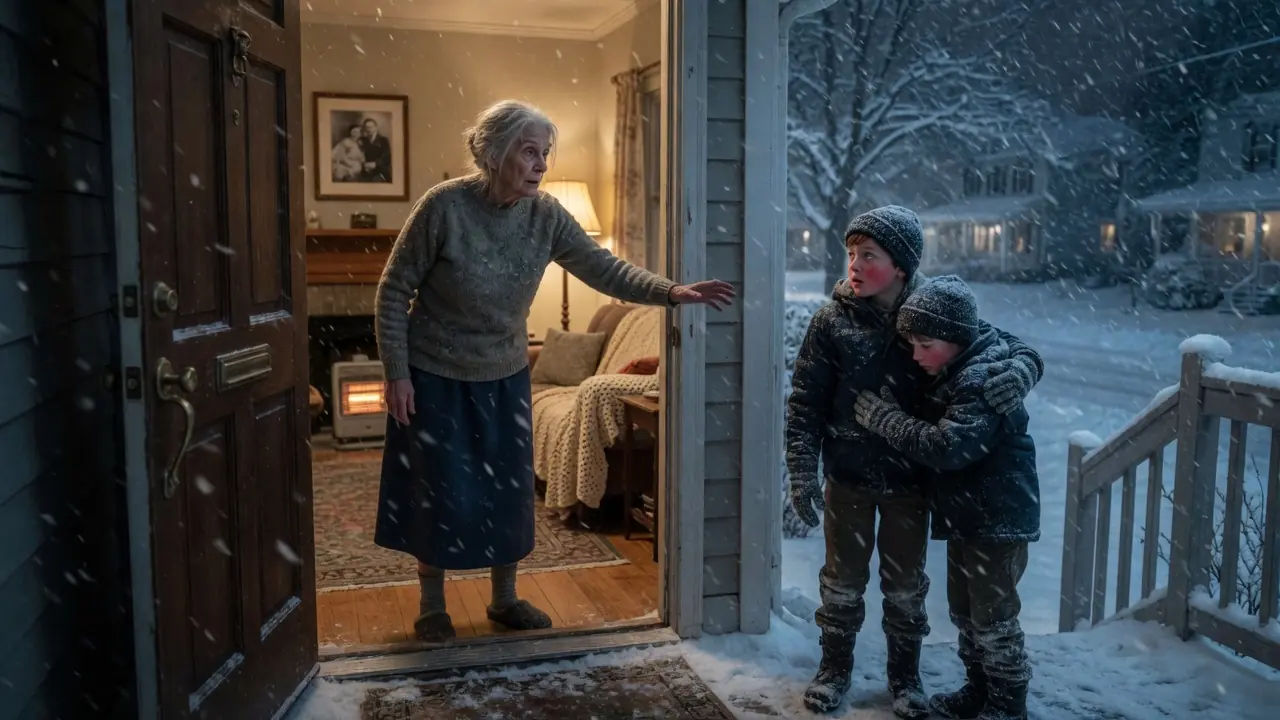
Snow blew across her porch in wild, twisting sheets, stinging her face, scattering across the hallway floor, and carrying with it a cold so sharp it seemed to reach straight into her bones.
Then she saw them.
Two boys stood on her porch, barely standing at all.
They looked about eight or nine years old, though fear and cold made them seem even smaller. Their faces were red and pale at the same time. Their lips were cracked. Their eyelashes were crusted with ice, and snow clung to their hair, their shoulders, and the sleeves of their winter jackets.
Neither boy cried.
Neither boy spoke.
They simply looked at her with eyes that said everything.
Help us.
Margaret did not ask questions.
She did not ask who they were, where they came from, or why two children were outside alone in the middle of the worst storm Glenwood County had seen in years.
She only reached forward.
“Come here,” she said, her voice shaking. “Come here, babies.”
The taller boy tried to step inside first, but his knees folded.
Margaret caught him under the arms with more strength than she thought she still had. Pain shot through her lower back, and her right shoulder protested sharply, but she ignored both. She dragged him across the threshold, then reached for the second boy, who seemed too numb even to understand that he had made it to a door.
“Inside,” she whispered. “You’re inside now.”
The second boy stumbled against her, and Margaret pulled him in too.
The wind tried to follow.
She shoved the door shut with her hip, pressed her trembling hands against the wood, and threw the deadbolt with a hard metallic click.
For a moment, she stood there breathing heavily in the dark hallway while the two boys leaned against each other, shaking so violently their teeth chattered.
Her house was not very warm.
The old heater in the living room groaned more than it worked, and the storm had found every weak place in the windows. But compared to the night outside, the little house at the end of Birch Lane felt like shelter.
And shelter, Margaret knew, could mean the difference between fear and survival.
“Come,” she said. “Near the heater. Slowly.”
The boys tried to move, but their feet dragged as if their boots had turned to stone.
Margaret guided them into the living room one careful step at a time. The lamp beside her old recliner cast a soft yellow light over the worn carpet, the crocheted blanket on the couch, the framed photograph of her late husband, Samuel, on the mantel.
The taller boy’s eyes flicked toward the photograph, then away.
The smaller one stared at the heater as if it were a miracle.
Margaret eased them onto the rug a safe distance from it.
“Sit right there,” she said. “Not too close. We’re going to warm you slow.”
She did not know much about emergencies, but she knew enough not to place frozen hands directly against heat. Her husband had worked winter roads for nearly thirty years before he passed, and he had told her stories she never forgot.
Warm them gentle, Maggie.
Cold takes patience to leave the body.
She wrapped the boys in the thick quilt from the back of the couch, then hurried to the hallway closet and pulled down every blanket she could reach. One blue wool blanket. One faded Christmas throw. One patchwork quilt she had sewn years ago from old shirts Samuel could no longer wear.
Her hands trembled as she layered the blankets around the boys’ shoulders.
The smaller boy’s fingers were curled tightly against his chest.
The taller boy kept blinking slowly, fighting to stay awake.
“No sleeping yet,” Margaret said gently, kneeling in front of them. “You hear me? Stay with me a little while.”
The taller boy nodded once.
The smaller one only stared.
Margaret hurried into the kitchen and put a pot of water on the stove. The gas still worked, thank heaven. She lit the burner with a match because the electric starter had failed twice that week and she had not had money to fix it.
The blue flame caught.
She nearly cried from relief.
In the cupboard, she found the cheap hot chocolate powder she kept for visiting children from church.
Not the fancy kind.
Not rich or thick.
Just a half-empty container with a cracked plastic lid.
But it was warm, and warm was all that mattered.
She stirred two mugs carefully, testing them with her finger to make sure they would not burn. Then she carried them back to the living room, moving slowly because her knees were stiff and she did not trust herself not to spill.
The boys took the mugs in silence.
Their small hands wrapped around the ceramic like they were holding on to life itself.
Margaret sat on the edge of the coffee table, watching their faces.
“That’s it,” she said softly. “Little sips. Don’t rush.”
The taller boy obeyed.
The smaller one tried, but the mug trembled so badly that Margaret gently steadied it for him.
“What are your names?” she asked.
The taller boy swallowed.
“Ethan,” he whispered.
The other boy’s voice came even softer.
“Noah.”
“Ethan and Noah,” Margaret repeated, as if speaking their names could help anchor them to the room. “All right. I’m Margaret. You’re safe in my house.”
The word safe seemed to undo something in Ethan.
His eyes filled with tears, but he turned his face away quickly, trying to hide it.
Margaret’s heart ached.
“Where are your parents?” she asked gently.
Ethan’s mouth opened.
No words came.
Noah shook his head once and pulled the blanket higher around his chin.
Margaret did not push.
She could see they were exhausted and frightened beyond ordinary words. Whatever had happened out there, questions could wait.
Warmth could not.
“It’s okay,” she said. “You don’t have to tell me everything right now.”
Noah looked at her then, truly looked at her for the first time.
“Are we in trouble?” he whispered.
Margaret’s throat tightened.
“No, baby. You are not in trouble.”
Ethan’s face crumpled.
“We didn’t mean to run.”
“I believe you.”
“We couldn’t see the road.”
“I know.”
“Noah fell, and I told him to get up, but he was so cold.”
Noah stared into his hot chocolate, ashamed.
Margaret leaned forward.
“You got him here,” she said to Ethan. “That means you did good.”
Ethan looked up quickly.
“I did?”
“Yes. You brought him to a door.”
The boy’s tears spilled then, silent and sudden.
Margaret reached for a tissue and handed it to him without making a fuss.
Pride mattered, even in children.
Especially in children.
She let them sit by the heater until their shivering eased from violent to small, uneven tremors. Then she helped them out of their wet jackets, gloves, and boots. The boots were stiff with frozen snow, and both pairs of socks were damp.
Margaret laid everything out near the kitchen doorway to dry.
That was when she noticed the quality of the clothes.
Not flashy.
Not rich in the spoiled way.
But well-made.
Durable.
Thick winter jackets with reinforced seams. Heavy boots built for long distances. Wool-lined gloves. Neck warmers. The kind of gear bought by someone who understood cold roads and outdoor travel.
The kind of gear a father would choose carefully.
She did not think much of it.
Not yet.
She found two pairs of old socks in a drawer, both too large but clean, and helped the boys put them on. Noah’s feet looked tiny inside them.
Then she warmed soup from a can and buttered two slices of bread.
The boys ate slowly at first.
Then faster.
Hunger returned once the worst cold began to leave them.
“Easy,” Margaret said, smiling faintly despite herself. “The soup won’t run away.”
Noah glanced at her.
Then, for the first time, he almost smiled.
It vanished quickly, but Margaret saw it.
She held on to that small sign.
After they ate, she tried to call the sheriff’s office, but the phone line was dead.
She checked her old cell phone, the one her neighbor insisted she keep charged.
No service.
The storm had knocked out half the county, maybe more.
Margaret stood by the kitchen window, staring into the white darkness beyond the glass.
Somewhere out there, someone was missing these boys.
Someone was terrified.
She looked back at the living room.
Ethan and Noah had finally surrendered to sleep.
They lay curled on the couch beneath three blankets, shoulder against shoulder, as if even sleep could not convince them to separate. Noah’s breathing had steadied. Ethan’s hand still clutched the edge of the quilt like he feared it might be taken from him.
Margaret sat in the old chair across from them.
She had not had children sleeping in her house in years.
Not since her own daughter grew up and moved three states away.
Not since Samuel passed and the house became too quiet.
Margaret had learned to live with silence, but she had never learned to love it.
Tonight, for the first time in a long while, her house felt warm in a way the heater could not explain.
Outside, the storm continued to rage.
The wind screamed.
Snow piled higher against the porch steps.
Tree branches bent beneath the weight of ice.
And somewhere beyond Birch Lane, desperate fathers were still searching through a blizzard that showed no mercy.
They did not know their sons were safe.
They did not know a stranger had already pulled them out of the cold.
They would not find out until morning.
And by then, fear would have nearly broken them.
The morning came, but it brought no real relief.
The storm had passed, leaving behind a world buried in white. Everything looked unfamiliar. Streets had disappeared. Cars were rounded mounds beneath snowdrifts. Fences vanished halfway up their rails, and mailboxes looked like small black flags rising from a frozen sea.
The silence was heavy.
It was the kind of silence that comes after something terrible has moved through a place and left people afraid to speak too loudly.
William Carter had not slept.
None of them had.
As soon as there was enough light to see, the search began again.
The night before, a youth winter ride had ended badly when the storm rolled in faster than anyone expected. The boys had been at a roadside community hall with their fathers and several members of a family riding group called Mercy Road Riders. It was supposed to be simple: a charity supply run, hot dinner, a few speeches, and then home before the snow became dangerous.
But weather has no respect for plans.
By the time the families began leaving, the road out of the hall had already become nearly invisible. Vehicles moved slowly, hazard lights blinking. Snow swallowed signs, ditches, and driveways.
Then, in the confusion near a blocked intersection, Ethan and Noah had been separated from the adults.
No one could say exactly how.
One moment, they were near the front entrance of the community hall while the men helped clear a stuck van from the road.
The next, they were gone.
At first, everyone thought they had gone back inside.
Then they checked the hall.
The bathrooms.
The storage room.
The kitchen.
The coat closet.
Nothing.
Someone remembered seeing two small figures near the side door.
Someone else thought they heard Noah call for Ethan.
Then the storm grew louder than every voice.
By midnight, the search had spread through half the county.
By dawn, it had become the only thing anyone cared about.
William Carter moved quietly through the snow, checking places twice, looking beneath porch overhangs, behind sheds, inside unlocked outbuildings, and along the edges of driveways where children might have tried to escape the wind.
He was Ethan’s father.
A tall man with broad shoulders, a short beard, and eyes that had not softened once since his son disappeared.
He did not shout anymore.
His voice had given out sometime after three in the morning.
Now he searched with a methodical kind of terror.
Hope felt dangerous to him.
Hope felt like something that could break him if he let it grow too large.
So he did not hope.
He moved.
He checked.
He kept breathing because collapsing would not find his boy.
Thomas Mallister was different.
Noah’s father had shouted until his voice was raw.
His face was red from cold and exhaustion. His eyes were swollen from wind and fear, and every time someone said they had not found anything, he looked as if another piece of him had been cut loose.
“Noah!” he tried to call again, but only a rasp came out.
William looked at him.
“Save your voice.”
Thomas turned on him.
“My son is out here.”
“So is mine.”
The words hung between them.
Not angry.
Not cruel.
Just broken.
Thomas looked away first.
“I can’t lose him, Will.”
William swallowed hard.
“You won’t.”
“You don’t know that.”
“No,” William said. “I don’t.”
That was the worst truth.
More men joined as morning brightened.
Volunteers from town.
Neighbors.
Church members.
People who had heard about two missing boys and could not stay home drinking coffee while fathers searched snowbanks.
They spread out in groups, calling names, checking every alley, every abandoned building, every shed, every porch, every place a child might have tried to hide from the cold.
But there was nothing.
A red scarf caught on a fence turned out to belong to no one.
Small tracks near the church vanished under drifting snow.
A child-sized glove found beside the road sent Thomas running so fast he nearly slipped, only for William to recognize it was not Noah’s.
Hours passed.
The sun climbed higher, but it did not warm anything.
The cold was still brutal, and with every minute that passed, fear grew heavier.
“We need to check the hospitals again,” someone suggested.
“We already did,” another man said.
“Then we do it again.”
No one wanted to say what they were all thinking.
If the boys had been outside all night in that storm, if they had not found shelter somewhere, then the search might no longer be about rescue.
Thomas seemed to hear that unspoken thought anyway.
He grabbed the nearest man by the front of his jacket.
“Don’t,” he rasped.
The man lifted his hands.
“I didn’t say anything.”
“Don’t think it either.”
William stepped between them.
“Tom.”
Thomas released the man and stumbled back, breathing hard.
William put one hand on his shoulder.
For a second, Thomas looked like he might shove it away.
Then he folded forward, pressing both hands to his face.
“He still sleeps with that stupid dinosaur nightlight,” he whispered. “He says he’s not afraid of the dark, but he is. He just says the dinosaur likes company.”
William looked away.
His own son, Ethan, had been trying to be older than his years since his mother died three years earlier. Always helping. Always pretending he did not need comfort. Always saying, “I’ve got it, Dad,” when William could see he did not.
If Ethan had been with Noah, William knew what had happened.
Ethan would have tried to protect him.
That thought both comforted and destroyed him.
A sheriff’s deputy approached, face grim.
“We’re expanding south toward Birch Lane.”
William looked up.
“Birch Lane?”
“Older houses. Not many occupied full-time. Road was blocked most of the night.”
Thomas wiped his face with his sleeve.
“Then why didn’t we check it earlier?”
“We tried,” the deputy said. “Snowdrift blocked the turn. Plow just cleared enough to walk through.”
William was already moving.
Thomas followed.
So did half the search party.
At Margaret’s house, the boys woke to the smell of toast.
For a few seconds, neither remembered where they were.
Ethan opened his eyes first.
He saw the unfamiliar ceiling, the old lamp, the crocheted blanket, the framed photo of a smiling older man on the mantel.
His body tensed.
Then he felt warmth.
A blanket.
A couch.
Noah curled beside him, still asleep.
He remembered the storm.
The road disappearing.
Noah crying that his feet hurt.
The light in the distance.
The porch.
The old woman opening the door.
Ethan sat up too quickly and winced as dizziness swept through him.
Margaret turned from the kitchen.
“Easy now,” she said. “No jumping around.”
“Where are we?”
“My house. Birch Lane.” She carried a plate of toast and scrambled eggs into the living room. “You came here last night.”
Noah stirred.
“Dad?”
Ethan looked at him quickly.
“Noah, it’s okay.”
Noah opened his eyes fully.
His face crumpled.
“I want Dad.”
“I know,” Margaret said gently, setting the plate on the coffee table. “I tried to call, but the lines are down. The storm made a mess of everything.”
Ethan’s eyes filled with panic.
“Do they know we’re here?”
“Not yet.”
Noah began to cry quietly.
Margaret sat beside the couch, not crowding him.
“Listen to me. Your fathers are looking for you. I know they are. And as soon as someone comes down this road, we will tell them you are safe.”
Ethan wiped his eyes with the back of his hand.
“They’re going to be mad.”
Margaret shook her head.
“No, baby. They are going to be grateful enough to fall apart.”
The boys ate a little, though Noah kept looking toward the window.
Margaret found an old radio in the kitchen, but the batteries were weak and only gave her bursts of static. Still, she turned the dial slowly, hoping for weather reports, emergency announcements, anything.
Nothing useful came through.
Around 9:30, Margaret heard voices outside.
She turned sharply.
So did the boys.
A faint call came through the snow-heavy silence.
“Ethan!”
Then another.
“Noah!”
Noah froze.
“Dad?”
Thomas’s voice, raw and nearly broken, carried again from farther down the road.
“Noah!”
Noah threw off the blanket and nearly tripped trying to stand.
Margaret caught him by the shoulder.
“Shoes first.”
“No, that’s my dad!”
“I know. Shoes.”
Her voice was firm enough that he obeyed without thinking.
Ethan was already pulling on oversized socks and half-dry boots.
Margaret hurried to the front door, unlocked it, and opened it before the next call came.
The morning cold rushed in, but it did not feel like the same enemy now.
Down the road, figures moved through the snow.
Men in heavy coats.
Volunteers.
Deputies.
And at the front, two fathers walking like their bodies were being held up only by fear.
Margaret stepped onto the porch.
“They’re here!” she shouted.
Her voice cracked.
She tried again, louder.
“They’re here! The boys are here!”
For one second, nobody moved.
The words seemed too impossible to understand.
Then Thomas ran.
He stumbled twice, nearly falling in the deep snow, but he kept coming.
William followed, not quite running, but moving with a speed that made every step look painful.
Noah burst past Margaret onto the porch.
“Dad!”
Thomas made a sound no grown man would ever want remembered.
He reached the steps and dropped to his knees in the snow before Noah even got down to him.
Then Noah was in his arms.
Thomas held him so tightly Margaret nearly told him to loosen his grip, but she saw his face and stopped.
“Noah,” Thomas whispered, voice destroyed. “Noah, Noah, Noah.”
“I’m sorry,” Noah cried. “I’m sorry, Dad.”
“No,” Thomas said, shaking his head hard. “No, don’t you dare. You’re safe. You’re safe.”
William reached the porch more slowly.
Ethan stood frozen near the doorway.
For a moment, father and son only looked at each other.
Ethan’s face twisted.
“I tried to keep him warm,” he said.
William broke.
He crossed the porch in two strides and pulled Ethan into his arms.
“I know,” he whispered into his son’s hair. “I know you did.”
“I got lost.”
“You came back.”
“I didn’t know where to go.”
“You found a door.”
Ethan clutched his father’s coat.
“I was scared.”
William closed his eyes.
“Me too.”
The volunteers reached the yard, then stopped at a respectful distance.
Some cried openly.
One deputy turned away and wiped his face.
Margaret stood by the door, one hand pressed against her chest, watching two fathers hold their sons as if the world had been returned to them piece by piece.
Thomas looked up first.
His eyes found Margaret.
He stood slowly, Noah still tucked against him.
“You,” he said, voice rough.
Margaret suddenly felt self-conscious in her old house slippers and faded sweater.
“They knocked,” she said. “I opened.”
Thomas stared at her as if that sentence contained more mercy than he could carry.
“You saved my son.”
“I warmed him,” she said softly.
William stepped forward with Ethan under one arm.
“You saved both of them.”
Margaret shook her head.
“They were brave boys.”
“No,” Thomas said. “They were children. You were the adult who didn’t turn away.”
The words went straight through her.
Because Margaret knew what it felt like to be overlooked.
Since Samuel died, she had become less visible year by year. People at church were kind, but busy. Her daughter called when she could, but distance had a way of thinning daily love into scheduled updates. Neighbors waved. Store clerks called her ma’am. Doctors spoke slowly, as if age had made her simple.
But these men looked at her like she mattered.
Like her little house had become the most important place in the world because she had opened the door.
Paramedics arrived soon after.
They checked the boys carefully, asked Margaret questions, praised what she had done, and recommended both children be taken in for observation just to be safe.
Noah cried at the idea of leaving his father’s arms.
Ethan insisted he felt fine until William gave him one look, and then he stopped arguing.
Before they left, Noah turned back toward Margaret from the ambulance.
“Can I come back?” he asked.
Margaret blinked.
“To my house?”
He nodded.
“You have good hot chocolate.”
A laugh moved through the gathered volunteers.
Thomas closed his eyes and smiled through tears.
Margaret’s own eyes filled.
“Yes,” she said. “You can come back.”
Ethan looked at her too.
“Thank you, Mrs. Margaret.”
She touched his cheek gently.
“You take care of yourself now, Ethan.”
He nodded.
Then the ambulance doors closed.
The vehicles pulled away slowly through the snow.
The crowd began to disperse.
Soon, Margaret was left standing on her porch as the street returned to quiet.
Only William remained for a moment.
He had not gone with the ambulance because Thomas had climbed in with both boys while deputies arranged for William to follow in a cleared vehicle.
William stood at the bottom of the steps, looking up at her.
“Mrs. Ellis,” he said.
“Margaret.”
His face was pale with exhaustion.
“Margaret. My son’s mother died three years ago. Since then, I’ve been terrified of failing him. Last night, I thought I had.”
Margaret gripped the porch railing.
William continued.
“You gave him back to me.”
She did not know what to say to a sentence that heavy.
So she only said, “He found his way here.”
William shook his head.
“A lot of doors stay closed in storms.”
Then he lowered his head.
“Yours didn’t.”
He left after that.
Margaret went back inside.
The living room still held the shape of the night.
Blankets on the couch.
Empty mugs on the table.
Wet boots near the heater.
A few crumbs from toast.
For the first time in years, the house looked lived in by more than memory.
Margaret sat in her old chair.
Then she cried.
Not from fear.
Not exactly from relief.
From the sudden return of feeling needed.
Three days later, she was making tea when she heard engines outside.
At first, she thought it was the county plow.
Then the sound grew deeper.
A low, rolling rumble that seemed to move through the floorboards.
Margaret walked to the window.
Motorcycles were coming down Birch Lane.
Not one or two.
Dozens.
Then more.
Behind them came trucks, vans, and cars.
The line stretched as far as she could see along the cleared road, engines rumbling gently, headlights bright in the gray afternoon.
Margaret’s hand flew to her chest.
“Oh my,” she whispered.
They stopped in front of her house.
Men and women climbed off motorcycles, wearing heavy coats and leather vests with patches Margaret did not fully understand.
Mercy Road Riders.
A family riding group, not exactly a club, not just friends either.
People who rode together, raised money together, fixed houses together, and apparently appeared in large numbers when one of their own had been saved.
At the front stood William Carter and Thomas Mallister.
Beside them were Ethan and Noah, both bundled in warm coats, cheeks pink, eyes bright.
Noah waved wildly.
Margaret opened the door before anyone could knock.
“What is all this?” she asked, overwhelmed.
Thomas stepped forward first.
His voice was still hoarse, but stronger now.
“This is us saying thank you.”
Margaret looked past him.
People were unloading things from trucks.
Firewood.
Groceries.
A new space heater.
Weather stripping.
Bags of salt for the walkway.
Boxes labeled pantry supplies.
Someone carried a folded wheelchair ramp.
Another person held a toolbox.
Margaret shook her head immediately.
“No. No, I can’t accept all this.”
William smiled faintly.
“We expected that.”
Thomas nodded.
“We prepared arguments.”
“I don’t need charity.”
“Good,” William said. “Because this isn’t charity.”
Margaret looked at him.
“It isn’t?”
“No,” Thomas said. “It’s gratitude with tools.”
Noah ran up the steps before his father could stop him and hugged Margaret around the waist.
She froze for half a second, then placed her arms around him.
“Thank you for the hot chocolate,” he said into her sweater.
Margaret looked down at him.
“You’re very welcome.”
Ethan came next, more reserved, but his eyes were soft.
“My dad said I could help fix your porch rail,” he said.
Margaret looked at the crooked porch rail, then at William.
William lifted both hands.
“He insisted.”
Ethan straightened.
“I want to.”
Margaret’s heart opened painfully.
“All right,” she said. “But no power tools.”
Ethan smiled.
“Yes, ma’am.”
For the next five hours, Margaret’s quiet house became the center of a storm of kindness.
Not the loud kind that humiliates.
The careful kind.
A woman named Carla organized groceries in the pantry and asked permission before moving anything.
A retired plumber named Reese fixed the kitchen sink that had dripped for months.
Two riders sealed the draft around the living room windows.
William replaced the loose porch rail with Ethan handing him screws one at a time.
Thomas and Noah stacked firewood by the back door, though Noah carried only the smallest pieces and announced each one like a major achievement.
Someone shoveled the entire walkway.
Someone repaired the broken mailbox.
Someone replaced the old smoke detector and added two more.
Margaret kept trying to serve tea until Carla gently took the kettle from her and said, “Today you sit. We work.”
Margaret did not know how to sit while people helped her.
She had been independent for so long that receiving kindness felt almost indecent.
But every time she tried to stand, Noah or Ethan appeared with another reason she was needed in the chair.
“Mrs. Margaret, should this blanket go here?”
“Mrs. Margaret, do you want your mugs on this shelf?”
“Mrs. Margaret, can I have more hot chocolate?”
That last one was Noah.
By late afternoon, her house was warmer than it had been in years.
The windows no longer hissed.
The porch rail stood firm.
The pantry held more food than she had seen in months.
A new emergency radio sat on the kitchen counter with fresh batteries beside it.
Margaret stood in the doorway of the living room, overwhelmed.
Thomas came to stand beside her.
“I don’t know how to thank you,” she said.
He looked at Noah, who was sitting at the kitchen table drawing with Ethan.
“Now you know how we felt.”
She smiled through tears.
“You’re a good father.”
Thomas’s face changed.
He looked away.
“I didn’t feel like one that night.”
“Good fathers get scared too.”
He swallowed.
“Noah keeps saying your house was warm.”
“It barely was.”
“To him it was.”
Margaret looked at the boy.
Thomas continued quietly, “He says when you opened the door, the storm stopped being everywhere.”
Margaret covered her mouth.
William joined them, wiping his hands on a rag.
“Ethan said you told him he did good.”
“He did.”
“He needed to hear that,” William said. “He carries too much for his age.”
Margaret nodded.
“Children who lose someone often do.”
William looked at her then, understanding passing between them.
“You lost someone too.”
“My husband.”
“I’m sorry.”
“Me too.”
The three stood in the warm house, surrounded by the sounds of people repairing what winter and time had worn down.
Margaret thought of Samuel.
He would have loved this.
Not the attention.
The usefulness.
The way a house could become alive again when people chose to enter it with care.
Before leaving, the Mercy Road Riders gathered in Margaret’s yard.
William stood beside Thomas, both boys in front of them.
Noah held a mug of hot chocolate in both hands.
Ethan stood close to William’s side.
Thomas looked at the group, then at Margaret.
“Last week, we thought we were searching for our sons,” he said. “We were. But now I think we also found the person who kept believing in open doors.”
Margaret shook her head, embarrassed.
“I only did what anyone should have done.”
William’s voice was steady.
“Maybe. But you did it.”
The riders placed their hands over their hearts.
One by one.
A silent gesture.
Respect.
Margaret had never seen anything like it.
She stood on her porch with tears running down her face, one hand pressed to her chest.
For years, she had thought the warmest part of her life was behind her.
Her husband gone.
Her daughter far away.
Her rooms too quiet.
Her days folded neatly around routines that kept loneliness from spilling over.
Then two boys knocked on her door in a storm.
And suddenly, warmth came back wearing boots, gloves, leather vests, children’s laughter, and gratitude too large to fit inside a thank-you card.
After that day, Ethan and Noah visited often.
At first, it was because their fathers insisted on checking the repairs.
Then because the boys asked.
Then because Margaret’s house became part of their lives.
Every other Saturday, William and Thomas brought them by.
Sometimes they fixed small things.
Sometimes they brought groceries.
Sometimes they stayed for lunch.
Sometimes they only drank hot chocolate and let the boys sit on Margaret’s living room floor playing board games Samuel had bought decades earlier.
Noah loved checkers and cheated badly.
Ethan loved puzzles and worked quietly until he solved them.
Margaret began keeping marshmallows in the cupboard.
Then extra crackers.
Then apples.
Then a small basket near the door with gloves and hats in case the boys forgot theirs.
Her house changed slowly.
Not dramatically.
No one moved in.
No miracle erased age, grief, or distance.
But the silence no longer felt permanent.
It became something interrupted by laughter.
A few months later, on a spring afternoon, Margaret sat on the porch watching Ethan help William paint the repaired railing.
Noah chased a butterfly near the yard, narrating the entire event as if it were a heroic mission.
Thomas sat beside Margaret with two cups of tea.
“You know,” he said, “Noah asked if you were his snow grandma.”
Margaret looked at him.
“His what?”
“Snow grandma. Because he found you in the snow.”
Margaret laughed, then wiped her eyes.
“What did you tell him?”
“I told him he’d have to ask you.”
Noah came running at that exact moment.
“Mrs. Margaret!”
She looked down at him.
“Yes?”
“Can you be our snow grandma?”
The yard went quiet.
Ethan stopped painting.
William looked at Margaret, eyes soft.
Thomas looked into his tea like it had suddenly become very interesting.
Margaret’s heart swelled so quickly it hurt.
“I would be honored,” she said.
Noah grinned and threw his arms around her knees.
Ethan came more slowly, but when he reached her, he leaned against her side.
That was enough.
Margaret placed one hand on each boy’s shoulder and looked out over the yard.
For the first time in years, she did not feel like a widow living at the edge of other people’s busy lives.
She felt claimed.
Chosen.
Needed.
The following winter, the first snow fell softly over Birch Lane.
Not a storm.
Just a quiet dusting that made the porch rail shine white beneath the morning light.
Margaret stood at the window holding a mug of tea.
On the mantel, beside Samuel’s photograph, sat a framed picture from the previous spring.
Margaret on the porch.
Noah on one side.
Ethan on the other.
William and Thomas behind them.
The Mercy Road Riders gathered in the yard, smiling like family.
At the bottom of the frame, Noah had written in careful letters:
The Door That Opened.
Margaret touched the frame.
She remembered the night the boys came.
Their frozen eyelashes.
Their silent plea.
The hot chocolate.
The blankets.
The storm screaming outside.
She remembered thinking she was only giving shelter.
Only doing what anyone should do.
But now she understood something she had not known then.
Sometimes, when you open your door to someone lost in the cold, you are not only letting them in.
You are letting life back in too.
And on the coldest night of her lonely years, two boys had found Margaret’s porch.
She had saved them from the storm.
Then, in ways none of them could have imagined, they saved her from the silence.