She had nine dollars in a coffee can, a cracked window patched with cardboard, and four little girls sleeping under one roof who had already learned not to ask adults for too much.
And still, Clara Mae Thompson said yes.
She said yes before she counted the groceries.
She said yes before she checked the rent.
She said yes before she asked how long they would stay.
Because in Clara’s world, a hungry child standing in front of her mattered more than the numbers that said she could not afford to care.
In 2001, Clara was forty-five years old and living in a small blue house on the edge of Birmingham, Alabama. The house had belonged to her mother before her, and before that, to her grandmother. It sat behind a rusted chain-link fence, with a front porch that leaned slightly to the left and a pecan tree in the yard that dropped more branches than fruit.
Clara worked nights at St. Mary’s Laundry, folding hospital sheets until her fingers cramped. During the day, she cooked meals for neighbors, watched children when mothers had double shifts, and made sweet potato pies every Friday to sell from her kitchen.
She was not rich.
She was not even comfortable.
But everybody on East Marlow Street knew one thing about Clara Thompson.
If a child knocked on her door hungry, that child ate.
Her husband, Raymond, had died five years earlier from a stroke, leaving behind no savings, no insurance, and a mortgage Clara barely understood. She kept his old work jacket hanging on the hook by the back door. Sometimes, when the house was too quiet, she touched the sleeve as if the cloth could answer her.
“You would’ve helped,” she whispered to it some nights.
And she was right.
Raymond would have.
The first girl came in the rain.
Her name was Maya Brooks, eleven years old, thin, watchful, and silent in a way that did not belong to childhood. A social worker named Denise Harper brought her to Clara’s house after sunset, apologizing before Clara even opened the door.
“Clara,” Denise said, soaked through her coat, “I know I shouldn’t ask. I really know. But I have nowhere else tonight.”
Clara looked past her and saw Maya standing on the porch with a black trash bag in one hand.
Not a suitcase.
A trash bag.
That alone answered the question.
“What happened?” Clara asked softly.
“Emergency removal,” Denise said. “The placement fell through. She needs somewhere safe for a few days.”
Maya stared at the porch floor.
Clara opened the door wider.
“Come in, baby.”
Maya did not move.
Denise touched her shoulder gently.
“It’s okay.”
Maya looked up at Clara as if she had heard that sentence too many times from people who left.
Clara stepped aside.
“I made chicken and rice,” she said. “You can decide whether I’m trustworthy after supper.”
That was the first yes.
Maya stayed three days.
Then a week.
Then Denise called and asked if Clara could keep her a little longer.
Clara looked at the pantry, where one box of cornmeal, half a bag of rice, and two cans of green beans sat like witnesses.
“Yes,” she said.
The second girl came two months later.
Tasha Reed, nine years old, loud, angry, and always ready to run. She arrived with scraped knees, a backpack full of clothes that did not fit, and a file that said she had been removed from three homes in two years because she was “difficult.”
Clara read that word once.
Then she closed the folder.
“Difficult is what people call a child when they don’t want to admit she’s hurt,” Clara told Denise.
Tasha refused to sleep in the bed Clara made for her. She slept under the kitchen table the first night, curled around her backpack. Clara did not drag her out. She simply placed a blanket over her and left a biscuit on a plate near her hand.
In the morning, the biscuit was gone.
Tasha still glared.
But she stayed.
The third girl came in winter.
Lily Anne Carter, seven years old, small and pale, with thick glasses and a stutter that made adults finish her sentences before she could. Her mother had disappeared for three days. Her grandmother was too ill to take her. Lily arrived holding a doll with no hair and a blue ribbon tied around its neck.
Clara bent down to her level.
“What’s her name?”
Lily held the doll tighter.
“P-P-Penny.”
Clara nodded seriously.
“Well, Miss Penny looks tired from the road. We’ll have to give her the good pillow.”
Lily’s mouth opened slightly.
Nobody had asked about the doll before.
That night, Clara gave Lily and Penny the pillow.
The fourth girl came near Easter.
Renee Jackson, four years old, still wearing pajamas under a winter coat, with shoes on the wrong feet and eyes too big for her face. She did not cry. She did not speak. She simply followed Denise inside, climbed into Clara’s lap, and fell asleep against her chest like her body had been waiting for permission to collapse.
Denise stood in the kitchen, exhausted and ashamed.
“I’m sorry,” she whispered. “I know this is too much.”
Clara looked down at Renee, whose tiny hand had curled around one button of her blouse.
“No,” Clara said. “Too much is a child with nowhere to lay her head.”
And just like that, Clara’s small blue house became a home for four girls the system had not known how to hold.
The house was crowded.
Maya slept in the front bedroom near the window because she liked to see the street. Tasha slept on the bottom bunk but kept her backpack under the bed for almost a year. Lily slept above her, whispering stories to Penny at night. Renee slept in a little cot beside Clara’s bed because she woke silently from nightmares, and Clara learned to feel the shift in the room before the child made a sound.
Money was always short.
Clara stretched meals until they became miracles.
A pot of beans became dinner, then lunch, then soup. Chicken bones became broth. Day-old bread became pudding. She watered down juice and called it “porch tea.” She mended socks, traded pies for school supplies, and took extra laundry shifts until her feet swelled inside her shoes.
But the girls had clean clothes.
They had food.
They had birthdays.
Clara celebrated birthdays even when she had to make a cake from a box mix bought with coins. She wrote each girl’s name in icing with a butter knife and sang loudly even if there were only three candles to reuse.
Maya learned to laugh first.
It happened one Saturday morning when Clara burned pancakes and tried to blame the stove.
“That stove is innocent,” Maya said quietly.
Clara turned around, stunned.
Tasha burst out laughing.
Lily giggled.
Renee clapped because everyone else made noise.
After that, laughter came easier.
Tasha stopped sleeping under the table.
Lily began speaking full sentences because Clara never interrupted her.
Renee started talking in tiny, careful words, mostly to Clara at first.
Maya became the helper, though Clara often reminded her she was still a child.
“You don’t have to raise everybody in this house,” Clara told her one evening.
Maya looked at the sink full of dishes.
“Somebody does.”
Clara took the dish towel from her hands.
“I do. You go draw something ugly for the refrigerator.”
Maya frowned.
“I draw good.”
“Then draw something good. But go be eleven.”
The refrigerator filled slowly with paper.
Lily drew Penny wearing crowns.
Tasha drew houses with strong doors and big locks.
Renee made circles and called them people.
Maya drew the blue house with Clara standing on the porch, one hand raised, as if she was always waving someone inside.
Clara taped every drawing up.
Even the ones she didn’t understand.
Especially those.
Neighbors warned her.
Some gently.
Some not.
“Clara, you already struggling.”
“Four girls is too many.”
“The county don’t care how much heart you got.”
“You need to think about yourself.”
Clara listened, nodded, and kept cooking.
Because she had thought about herself.
And every time she did, she saw herself alone in that house with Raymond’s jacket on the hook, eating dinner in silence while somewhere a child learned that no door would open.
She could not live with that.
The first winter with all four girls nearly broke her.
The furnace quit during a cold snap in January. Clara called two repair companies, then hung up after hearing the prices. She pulled every blanket from every closet, covered the windows with plastic, and moved all four girls into the living room at night.
They slept near the small electric heater, all in one room.
Clara stayed awake in the armchair, wearing Raymond’s work jacket over her nightgown, listening to the house creak in the cold.
At 2 a.m., Renee woke and whispered, “Mama Clara?”
It was the first time she had called her that.
Clara did not move for a second.
She was afraid if she breathed too hard, the words would disappear.
Then she leaned down.
“Yes, baby?”
“Cold.”
Clara picked her up, tucked her inside the jacket, and held her against her chest.
“I know,” she whispered. “I got you.”
By morning, Clara’s hands were numb.
But Renee slept.
Two days later, Lily developed a fever.
Clara took her to the clinic and paid for medicine with the money she had saved for the mortgage. On the way home, she stopped at a discount store and bought children’s gloves for all four girls because Tasha’s fingers had cracked from the cold.
That night, a late notice arrived in the mail.
Clara folded it and placed it under the sugar jar.
She did not want the girls to see.
But the system saw.
It always saw the numbers before it saw the love.
The review began in March 2002.
Denise came first, looking more tired than usual. She sat at Clara’s kitchen table, hands wrapped around a coffee mug, and did not drink.
“What is it?” Clara asked.
Denise looked toward the hallway, where the girls were doing homework.
“There’s going to be an inspection.”
Clara nodded slowly.
“Because of the furnace?”
“The furnace. The mortgage late notices. The number of children in the home. Your income.”
Clara looked down.
“I feed them.”
“I know.”
“They go to school.”
“I know.”
“They sleep safe.”
Denise closed her eyes.
“I know, Clara.”
“Then why do you look like you’re about to apologize for something you didn’t do?”
Denise’s eyes filled.
“Because sometimes knowing isn’t enough.”
The inspector arrived two weeks later.
Her name was Marilyn Voss, and she wore a gray suit that looked untouched by weather. She carried a clipboard and spoke in a tone that had been trained not to bend.
Clara welcomed her inside.
The girls sat together on the couch.
Maya stared directly at Marilyn.
Tasha crossed her arms.
Lily held Penny tightly.
Renee hid behind Clara’s skirt.
Marilyn walked through the house.
She noted the crowded bedrooms.
She noted the patched window.
She noted the portable heater.
She noted the peeling paint near the back door.
She noted the late mortgage warning on the kitchen table, though Clara had meant to hide it.
She noted everything that proved Clara was poor.
She did not note the refrigerator full of drawings.
She did not note Tasha’s backpack finally unpacked in the closet.
She did not note Lily raising her hand in class now.
She did not note Renee’s first full sentence.
She did not note Maya smiling when Clara called her baby.
At the end, Marilyn stood in the kitchen.
“Ms. Thompson, no one doubts your intentions.”
Clara hated that sentence immediately.
“Intentions don’t keep children safe,” Marilyn continued.
Clara’s voice stayed calm.
“No, ma’am. Food does. Heat does. A locked door does. Somebody waking up when they cry does.”
Marilyn looked at the clipboard.
“Stable income and adequate space are required.”
Clara nodded.
“Does your paper have a line for whether a child stops flinching when someone reaches for a spoon?”
Marilyn did not answer.
“Does it have a line for a girl finally sleeping on top of the bed instead of under the table?”
Silence.
“Does it have a place to write that Renee called me Mama Clara?”
Marilyn’s expression shifted slightly.
But not enough.
“I understand this is emotional,” she said.
Clara nodded again.
“No. You understand this is inconvenient.”
Four weeks later, the letter came.
Clara’s foster approval was suspended pending corrective action.
Corrective action meant repairs she could not afford, income proof she did not have, and space requirements impossible in a house built for a smaller life.
Denise came in person to deliver what the letter had already said.
“They’re going to move them,” she whispered.
Clara held the paper in both hands.
“All of them?”
Denise’s face broke.
“Yes.”
“Together?”
Denise looked away.
Clara knew.
No.
Not together.
She fought.
She called offices.
She filled out forms.
She attended meetings in borrowed church shoes that pinched her toes. She brought school reports, clinic records, photos, letters from teachers, neighbors, and her pastor. She showed them the girls were improving. She showed them they were safe. She showed them love in every form paperwork allowed.
The decision did not change.
The system did not call Clara bad.
That almost made it worse.
It called her insufficient.
The girls were removed on a Tuesday morning in May.
Clara woke before sunrise and cooked breakfast because she did not know what else to do with her hands.
Pancakes shaped like hearts for Renee.
Toast triangles for Lily because she liked corners.
Scrambled eggs with cheese for Tasha.
Grits with butter for Maya because Maya pretended not to like sweet food.
She set the table with paper napkins folded carefully.
The girls ate slowly.
No one said much.
Even Renee understood something was wrong.
When the county van arrived, Tasha ran to the bathroom and locked the door.
Maya stood frozen in the hallway.
Lily cried so hard she could not speak.
Renee climbed into Clara’s lap and wrapped both arms around her neck.
Marilyn Voss waited on the porch.
Denise cried openly by the car.
Clara did not scream.
She wanted to.
She wanted to break every dish in the kitchen and tear the papers in half and stand in front of the van until the whole world had to admit that it was taking children from the only home where they had begun to heal.
But four girls were watching her.
So she became steady for them one last time.
She held Maya’s face first.
“You are not too old to be loved,” Clara said.
Maya’s lips trembled.
“You hear me?”
Maya nodded once.
Then Tasha came out of the bathroom, eyes red, fists clenched.
Clara knelt in front of her.
“Your anger is not bad,” she whispered. “It’s just hurt standing up. Don’t let anybody make you ashamed of it.”
Tasha broke then, falling against her.
Clara held her hard.
Then Lily.
Clara touched Penny’s ribbon and said, “Your words matter, baby. Slow words still count.”
Lily sobbed into her shoulder.
Then Renee.
The smallest.
The one who still smelled faintly of baby shampoo and pancakes.
Clara could barely breathe.
“Mama Clara,” Renee whispered.
Clara closed her eyes.
“Yes, baby.”
“Come too.”
The sound that came from Clara then was not a cry.
It was something deeper.
Something pulled from the place where a mother keeps her last strength.
“I can’t,” she whispered. “But you carry me, okay? Right here.”
She touched Renee’s chest.
“Right here.”
The girls were placed in the van one by one.
Maya pressed her hand to the window.
Tasha refused to look back until the very last second.
Lily held Penny so tightly the doll’s ribbon came loose.
Renee waved with her whole small hand, not understanding why Clara was getting smaller as the van pulled away.
Clara stood in the yard until the van disappeared.
Then she went inside the blue house.
Four bowls still sat on the table.
Four beds waited.
Four drawings hung on the refrigerator.
Four little pairs of shoes stood by the back door.
Clara touched each pair.
Then she sank to the kitchen floor and cried until afternoon light moved across the wall.
The house never recovered.
Not fully.
Clara kept working. She had to. The mortgage did not vanish because grief entered the room. The hospital laundry still needed sheets folded. Neighbors still ordered pies. Children still knocked sometimes, and Clara still fed them, though she was no longer allowed to take anyone in officially.
But the rooms stayed almost the same.
Maya’s drawing of the house remained on the refrigerator until the paper curled at the edges.
Tasha’s backpack hook stayed empty.
Lily’s spare glasses case remained in the drawer.
Renee’s little cup with a faded cartoon rabbit stayed beside the sink.
Every May, Clara made pancakes.
Four plates.
She ate none of them.
She wrote letters too.
At first, she wrote every week.
Then every month.
Then on birthdays and holidays, when her hands shook too much to hold the pen steady.
She wrote to Maya about the pecan tree.
She wrote to Tasha about how anger could become courage if held carefully.
She wrote to Lily slowly, leaving space between lines, as if that might help her read without rushing.
She wrote to Renee about the word Mama Clara and how she still heard it in dreams.
Most letters came back.
No forwarding address.
Unable to deliver.
Some disappeared into offices and never returned at all.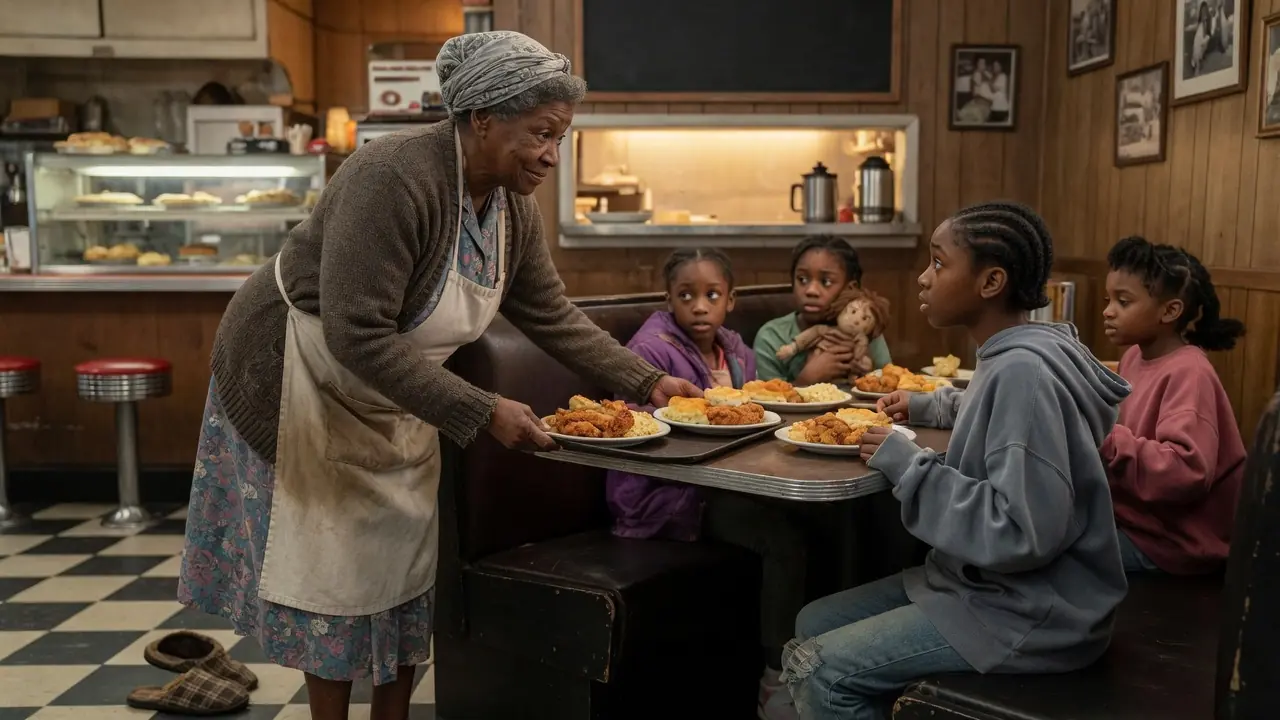
Years passed.
The neighborhood changed.
Some houses were repaired. Others collapsed. The corner store became a church thrift pantry. The bus route changed twice. Clara’s hair turned silver, then white at the temples. Her knees began to ache. The hospital laundry closed, and she cleaned offices at night instead. Eventually, she sold pies from her porch more than she worked outside the home.
The mortgage fell behind again.
This time, there were no children to hide the letters from.
The blue house needed repairs Clara could not manage. The roof leaked near the hallway. The porch leaned worse. The back steps rotted. The heater worked, but only after Clara whispered threats to it.
Her niece in Atlanta called often.
“Aunt Clara, you can come stay with me.”
Clara always said, “I know.”
But she did not leave.
How could she?
The girls might come back.
People told her gently that twenty years was a long time.
Clara knew that.
But love did not measure time the same way paperwork did.
On a Saturday morning in June, Clara was seventy-three years old.
She sat at the kitchen table sorting bills into three piles.
Pay now.
Pay later.
Pray over.
The pray-over pile was tallest.
A foreclosure warning lay open in front of her. Not immediate, but close enough that the word made the room feel smaller. The house her grandmother had owned, the house where four forgotten girls had once learned to sleep safely, was slipping away.
Clara touched the sugar jar, the same one where she had hidden the late notice years earlier.
Then the doorbell rang.
She froze.
The doorbell rarely worked.
It rang again.
Slowly, Clara stood, one hand on the table for balance. She walked through the narrow hallway past the old drawings, past Raymond’s jacket, past the spot where Renee’s cot had once been.
She opened the door.
Four women stood on her porch.
For one breath, Clara did not understand what she was seeing.
Then the tallest woman stepped forward.
Her eyes were the same.
Watchful, deep, holding back too much.
“Mama Clara?” she said.
Clara’s hand flew to her mouth.
“Maya?”
The woman began to cry.
Then another stepped forward, strong jaw, sharp eyes, hair pulled back, anger transformed into power.
“Tasha,” Clara whispered.
Tasha nodded, tears already falling.
The third woman held a small worn doll with a blue ribbon tied around its neck.
Clara gasped.
“Lily Anne.”
Lily smiled through tears.
“I kept Penny.”
The fourth stood slightly behind them, younger-looking somehow despite being grown, her eyes wide and shining.
Clara stared.
“Renee?”
Renee stepped forward with both hands over her heart.
“You told me to carry you here,” she whispered.
Clara made a sound and reached for them.
All four women came into her arms at once.
They were not little anymore.
They were grown.
Strong.
Real.
But Clara felt the children inside them—the silent girl, the angry girl, the stuttering girl, the baby who asked her to come too.
She held them on the porch while neighbors stopped walking, while the morning sun rose over East Marlow Street, while twenty years collapsed into one embrace.
Inside, she made coffee because her hands needed work.
The women sat around the kitchen table, too large now for the chairs they once used. Clara kept touching their faces, their hands, their sleeves, as if the world might still take them back if she did not keep proof.
“Tell me,” she said. “Tell me everything.”
And they did.
Not all at once.
Some stories came slowly.
Some hurt too much to detail.
They had not stayed together. Maya went to a group home first, then aged out and worked her way through college. She became a social worker, the kind who refused to let files describe children as problems.
Tasha bounced through three homes, ran away twice, and nearly lost herself to the kind of trouble people expected from angry girls. But she remembered Clara saying anger was hurt standing up. She turned it into purpose. She became a youth counselor, working with girls who fought because they were tired of crying.
Lily was placed with an older couple who meant well but rushed her speech. She struggled for years. Then a teacher helped her find confidence. She became a speech therapist for children with trauma-related delays, and she still carried Penny to every new office as a reminder.
Renee remembered the least clearly, but felt the most deeply. She grew up with a hole where a mother should have been, carrying one sentence she did not understand until adulthood: right here. She became a pediatric nurse, known for sitting beside frightened children long after her shift ended.
They found each other slowly.
Maya found Tasha first through records she should not have had access to but somehow did.
Tasha found Lily.
Lily found Renee.
Then together, they searched for Clara.
“We were afraid you had moved,” Renee said.
Clara shook her head.
“I couldn’t.”
“We know,” Maya said softly.
Clara looked at her.
Maya placed a folder on the table.
“We know more than you think.”
Clara frowned.
“What is that?”
Tasha smiled through tears.
“Something you’re going to argue about.”
“I don’t like the sound of that.”
“You never did,” Lily said softly.
Maya opened the folder.
Inside were documents.
Legal forms.
Property papers.
Architectural drawings.
Financial statements.
Clara stared at them, confused.
“What is all this?”
Maya took her hand.
“We bought the house.”
Clara pulled back slightly.
“No.”
“Mama Clara—”
“No,” Clara repeated, shaking her head. “I won’t let you spend your lives fixing mine.”
Tasha leaned forward.
“You spent yours saving ours.”
“That was different.”
“How?”
“You were children.”
“And now we’re not.”
Clara looked down at the papers again.
Lily spoke gently.
“The mortgage is paid. The repairs are funded. The house is staying yours.”
Clara’s eyes filled.
“I can’t accept that.”
Renee reached across the table and touched Clara’s hand.
“You told me to carry you here,” she said. “I did.”
Clara looked at her.
Renee continued, voice trembling.
“Now let us carry something back.”
The room went quiet.
Maya turned one of the drawings around.
It was a blueprint.
Not only for repairs.
For transformation.
The blue house would be restored, expanded, and licensed as a small family-style support home for girls aging out of foster care and young mothers with children who had nowhere stable to go. Not a facility. Not a shelter with rows of beds. A home.
A kitchen big enough for shared meals.
A reading room.
Four bedrooms upstairs.
A nursery.
A counseling office.
A porch rebuilt strong and wide.
A shoe rack by the back door.
A refrigerator wall left empty for drawings.
The name at the top read:
The Clara House
A Home for Girls Who Need Time to Heal
Clara stared at the words until they blurred.
“No,” she whispered. “Not my name.”
“Yes,” Tasha said.
“I didn’t do enough.”
All four women reacted at once.
Maya’s voice broke. “You did everything.”
Clara shook her head, crying now.
“They took you.”
Lily reached for Penny and placed the old doll on the table.
“But they didn’t take what you gave us.”
Tasha wiped her face angrily.
“They took the beds. They took the rooms. They took the address. But they did not take the part of us that knew what safe felt like.”
Renee moved from her chair and knelt beside Clara.
“You were my first memory of being held without someone being tired of me.”
Clara covered her mouth.
Maya took out one more paper.
“We want you to be the founding housemother.”
Clara almost laughed through her tears.
“I’m seventy-three.”
“And bossy,” Tasha said.
“And needed,” Lily added.
“And home,” Renee whispered.
Clara looked around the kitchen.
At the peeling paint.
At Raymond’s jacket.
At the old refrigerator where the edges of drawings still clung under faded magnets.
At four women who had crossed twenty years to stand in the house that once failed an inspection but had succeeded in ways no clipboard could measure.
“What if I say yes?” Clara asked.
Maya smiled.
“Then we begin.”
Clara looked at each of them.
The silent one who became a voice for children.
The angry one who became protection.
The stuttering one who helped others speak.
The baby who became comfort in hospital rooms.
Her girls.
Not by blood.
By pancakes, blankets, medicine, whispered promises, and the kind of love that survived being interrupted.
Clara wiped her face with both hands.
Then she nodded.
“Yes,” she said.
The women cried again.
Tasha laughed and cried at the same time.
“I knew she’d say yes.”
Clara looked at her.
“I have been saying yes to foolish plans for thirty years.”
Maya laughed.
“So this is tradition.”
The restoration took eight months.
Clara complained through most of it.
She complained about contractors touching Raymond’s jacket.
She complained about paint colors.
She complained that the new kitchen was “too fancy for beans.”
She complained when Tasha suggested security cameras.
“This house is not a bank.”
“No,” Tasha said. “It’s a safe place. Safe places need working locks.”
Clara accepted the locks.
Lily designed a quiet room for children who needed calm. She painted the walls soft blue and placed shelves for books, stuffed animals, and drawing supplies. Clara added a rocking chair.
Renee organized the nursery and stocked it with blankets, diapers, medicine, and a nightlight shaped like a moon.
Maya handled licensing, staff training, policies, grants, and the kind of paperwork Clara still distrusted but now appreciated when it protected instead of punished.
Tasha built the shoe rack herself.
When Clara saw it by the back door, she touched the smooth wood.
Four lower shelves for small shoes.
Four upper shelves for older girls.
And one small engraved line across the top:
Nobody’s Spot Gets Taken
Clara cried in the hallway where no one could see.
But Renee saw.
She always did.
The Clara House opened on a cool spring morning.
The porch no longer leaned.
The blue paint was fresh.
The pecan tree had been trimmed but not removed.
Raymond’s jacket still hung by the back door.
The refrigerator was empty, waiting.
The first arrival came at 4:20 p.m.
A fourteen-year-old girl named Jada stepped out of a county car holding a black trash bag.
Clara stood on the porch.
For one second, twenty years vanished.
She saw Maya in the rain.
Tasha under the table.
Lily with Penny.
Renee in pajamas.
She saw every child who had ever been asked to carry their life in something meant for garbage.
Clara walked down the steps slowly.
Jada looked defensive.
“I’m not staying long,” she said.
Clara nodded.
“You don’t have to decide that today.”
“I’m not hungry.”
From the porch, Tasha muttered, “Classic.”
Clara glanced back at her.
Then looked at Jada.
“I made chicken and rice,” she said. “You can decide whether I’m trustworthy after supper.”
Jada stared at her.
Something small shifted.
Not trust.
Not yet.
But hunger.
She stepped forward.
Inside, the house smelled of food, clean paint, and new wood. Maya handled the paperwork quietly. Lily showed Jada the room. Renee checked that she had warm socks. Tasha stood near the door, arms crossed, looking exactly like someone who would fight the world if it tried to take this child before she was ready.
That night, after dinner, Jada drew something on a piece of paper.
A house.
Blue.
With a woman on the porch.
Clara taped it to the refrigerator.
Then she stood back.
The wall had begun again.
Years later, people would say Clara Thompson was lucky her girls came back.
Clara always corrected them.
“No,” she would say. “I was blessed they survived.”
The Clara House grew slowly.
Never too big.
Never more than eight girls at once.
That was Maya’s rule.
“No child heals in a crowd,” she said.
The house had Sunday dinners, birthday cakes, school picture hair days, homework nights, counseling sessions, hard conversations, slammed doors, apology pancakes, porch talks, and quiet mornings when girls who once flinched at footsteps learned to sleep late.
Clara did not pretend love fixed everything.
She knew better.
Love did not erase trauma.
Love did not rewrite court records.
Love did not stop every nightmare.
But love made a room where healing could begin.
And sometimes that was the difference between a child surviving and a child believing she deserved to.
On the first anniversary of the Clara House, the four women gathered in the kitchen before sunrise.
Clara was already making pancakes.
“What are you doing up?” Maya asked.
Clara looked at the griddle.
“Tradition.”
There were four plates on the counter.
Then a fifth.
Then a sixth, seventh, and eighth for the girls sleeping upstairs.
Renee wrapped her arms around Clara from behind.
“You don’t have to make the old plates anymore.”
Clara smiled softly.
“I know.”
Tasha leaned against the counter.
“But you will.”
“Yes.”
Lily placed Penny on the shelf near the sugar jar.
“Then we’ll eat them this time.”
Clara looked at the four women in her kitchen.
The plates were no longer empty.
The rooms were no longer silent.
The shoes by the door belonged to children who would not be carried away without a fight from people who knew exactly how that loss felt.
Clara turned the pancakes carefully.
Outside, morning light touched the porch.
Inside, the house breathed.
And on the refrigerator, surrounded by new drawings, one old picture remained in the center.
Maya’s drawing.
The blue house.
The woman on the porch.
One hand raised.
Always waving someone inside.
Clara looked at it for a long time.
Then she whispered, “Thank you, Lord.”
Tasha heard her.
“For what?”
Clara smiled.
“For letting me live long enough to see love come home.”
And when the next child arrived carrying fear, silence, anger, or a trash bag full of clothes, Clara Thompson met her at the porch with the same question that had built a family once before.
“Are you hungry, baby?”
Because some homes are not saved by money first.
They are saved by someone who says yes when every number says no.
And sometimes, twenty years later, the children who were taken away come back not only to return the love—
but to make sure the door stays open for everyone after them.