Snow had been falling over Cedar Falls, Montana, since early afternoon.
By evening, Main Street looked almost abandoned. Neon signs flickered through the storm while icy wind swept loose snow across empty parking lots.
At the corner of Main and Oak sat Margaret's Diner, a tiny old restaurant with faded red booths and a buzzing neon coffee sign that had survived more winters than Margaret Ellis could count.
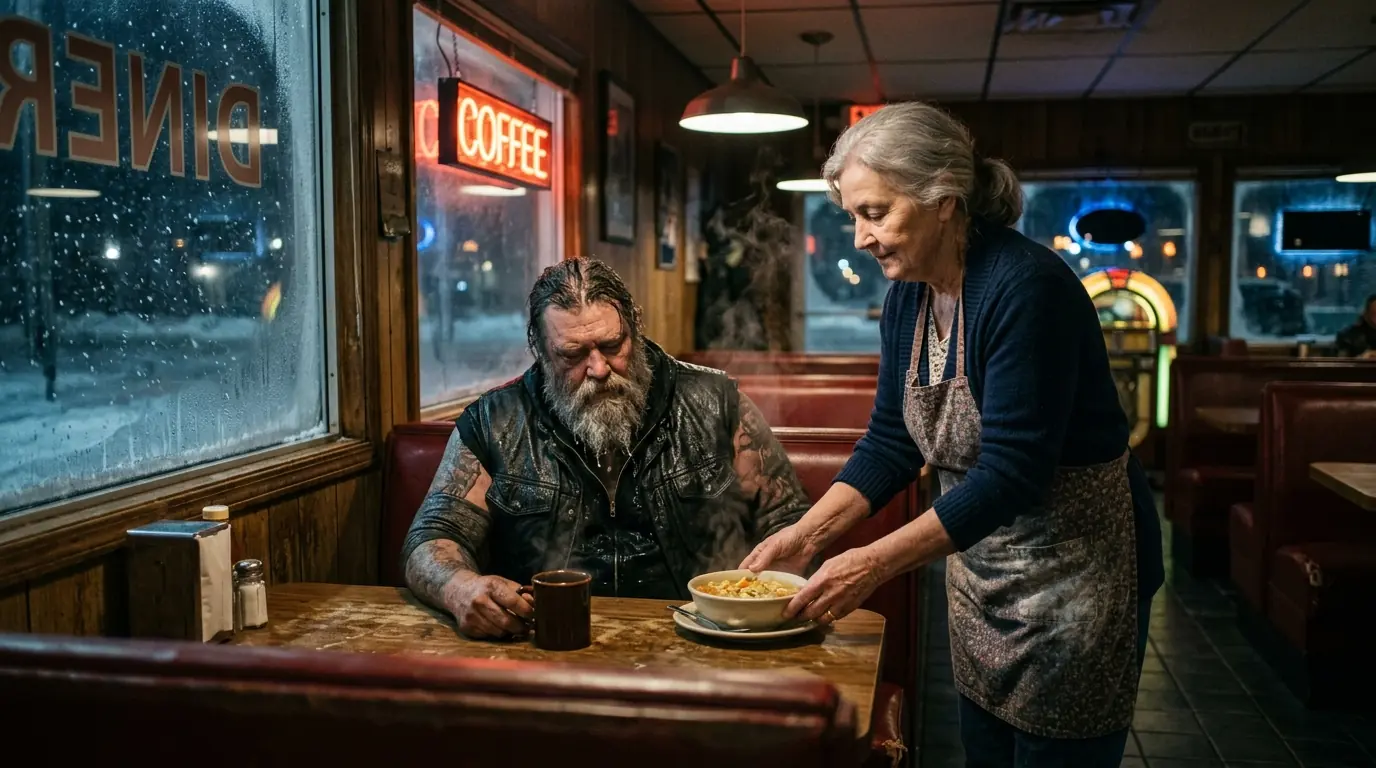 Seventy-eight-year-old Margaret stood behind the counter, wiping coffee cups.
Business had been terrible lately.
Three tables all day. One coffee refill. One slice of pie. And two customers who asked for water.
She opened the old cash register and stared at the money inside. Thirty-two dollars.
She quietly sighed. Rent was due in five days. The heater barely worked. Half the kitchen equipment was older than her grandson. Still, she smiled to herself.
"Tomorrow might be better."
Outside, wind slammed snow against the windows. Margaret was preparing to close when headlights suddenly swept across the diner windows. Then she heard it.
A motorcycle engine.
Then silence.
She looked outside. Near the edge of the parking lot sat a large black Harley, tilted awkwardly beside a snowbank.
Next to it stood a massive man in a black leather vest, covered in snow.
He took two steps toward the diner. Then staggered.
Margaret frowned. She quickly unlocked the front door. The bell above it rang as freezing wind rushed inside.
The man looked enormous. Heavy beard. Tattoos ran down both arms. Snow covered his shoulders and boots.
And on the back of his vest were words Margaret recognized immediately.
Hells Angels.
For a second, her heart skipped. People talked. Everyone did. Bikers. Trouble. Danger. Violence.
Then she looked closer. The man's lips were turning blue. His hands were shaking. His eyes looked exhausted.
"Ma'am," he said weakly. "Sorry… my bike died five miles back. Been walking. I saw the lights."
Margaret crossed her arms.
"Sit."
He blinked.
"What?"
"I said sit before you fall on my floor."
The giant biker obeyed instantly.
Margaret disappeared into the kitchen. A minute later, she returned with a steaming bowl of chicken soup and coffee.
The man stared.
"I don't have enough money for all this."
Margaret waved her hand. "You look half dead."
"I mean it."
"I do too."
He stared at the bowl.
"My name's Ray."
"I'm Margaret."
Ray slowly picked up the spoon. He took one bite. Then another. Then another. Margaret noticed the way his shoulders relaxed—not like a dangerous man, like a tired one.
Outside, the storm became worse. Road alerts flashed across local news on the TV over the counter.
Roads Closed Until Morning.
Ray rubbed his face.
"Damn."
Margaret looked up. "No family nearby?"
Ray shook his head. "My father. Hospital in Brookhaven. Been trying to reach him."
"What's wrong with him?"
Ray stared into his coffee. "Cancer."
Silence settled between them. Margaret quietly refilled his cup. Hours passed. The snow kept falling.
Margaret eventually locked the diner. Ray stood.
"I'll sleep on my bike."
Margaret looked at him like he had lost his mind.
"You'll freeze."
"I can't stay here."
Margaret pointed toward the back room. "I've got an old couch."
Ray blinked. "You'd let a Hells Angel sleep in your diner?"
Margaret shrugged. "I'd let a freezing human sleep in my diner."
Ray stared at her for several seconds. His eyes suddenly looked wet. "My mother used to say things like that."
That night, Ray slept in the diner office while Margaret slept upstairs in the tiny apartment above the restaurant.
The next morning, roads reopened. Before leaving, Ray fixed a loose shelf, repaired a broken stool, and shoveled the entire parking lot. Then he stood beside his motorcycle.
"I'll repay you."
Margaret laughed. "You already did."
Three days later, around lunchtime, the ground began shaking. Margaret looked outside. Motorcycles. Dozens of them.
Customers stopped eating. People outside stared. Motorcycles filled the diner parking lot. One after another. Twenty. Thirty. Forty.
Ray stepped off the first bike. Behind him stood dozens of Hells Angels riders.
Margaret slowly walked outside. "Ray… what on earth is happening?"
Ray removed his gloves. "My father passed yesterday morning."
Margaret's face fell. "Oh no…"
Ray nodded. "But I got there because of you. If you hadn't let me stay, I would've frozen out there."
Behind him, the bikers opened truck trailers: groceries. New kitchen equipment. Paint. Tables. Boxes of supplies.
Margaret stared in shock. "What is all this?"
Ray smiled. "My family wanted to meet the woman who fed one of us when nobody else would've."
A large biker carried out a brand-new diner sign. Another unloaded restaurant booths. Someone replaced broken windows. Someone fixed heaters. Someone repaired lights.
Customers stood frozen inside, watching everything. Margaret began tearing up.
"Ray… I only gave you soup."
Ray shook his head. "No. You gave me one last chance to say goodbye to my father."
By sunset, Margaret's old diner looked alive again. Warm lights glowed through clean windows. Fresh paint covered cracked walls. New signs stood outside. Above the entrance hung a wooden plaque:
Margaret's Diner
Nobody Leaves Hungry
Margaret covered her mouth and cried. Around her stood dozens of bikers smiling quietly. Ray put an arm around her shoulders.
"You gave shelter to one cold biker."
He looked around at the crowd. "You ended up getting an entire family."
In the days that followed, Margaret’s diner became more than a restaurant. The new equipment gleamed under the warm fluorescent lights. Booths were repaired, tables polished, and a fresh coat of paint made the walls look almost new. The smell of brewing coffee mixed with the faint scent of fresh paint, and for the first time in years, Margaret felt a flicker of hope for her business.
Ray returned daily to check on the progress, though he no longer wore the rugged biker attire that had terrified her at first. Instead, he carried a calm presence, helping wherever he could, arranging deliveries, and guiding other riders who were volunteering their time. “Your diner deserves the same care you showed me,” he said quietly one afternoon, lifting a box of flour onto the counter.
Margaret chuckled softly. “I didn’t do anything special.”
“You did,” Ray replied firmly. “You gave me shelter when no one else would. You gave me warmth when I had none. That counts for more than you know.”
As the snow melted into slush on Main Street, word of the restoration spread. Local residents peeked through the windows, witnessing a transformation that had seemed impossible just days ago. People whispered about the generosity of the Hells Angels, but Margaret always made it clear that the real kindness had begun with her.
“It’s your spirit that brought all of this together,” Ray said one morning as he helped Margaret carry crates of fresh ingredients from the delivery truck.
Margaret smiled, wiping her hands on her apron. “Well, it certainly doesn’t hurt having a lot of strong hands helping, does it?”
The community slowly began returning to the diner. Regulars who had drifted away on bitter winter days came back, curious to see the changes. Families trickled in for coffee and pie, taking in the clean, restored interior, the warm light, and the comforting hum of activity. Margaret greeted each guest with her characteristic smile, but now it carried a quiet pride—pride in surviving, pride in giving, and pride in seeing her diner come alive again.
Ray’s story, too, had begun to shift in the town’s imagination. The man who had once appeared intimidating and dangerous now inspired quiet admiration. People noted the way he stayed respectful, never flaunting his wealth or influence, and how he worked quietly alongside Margaret and others to restore the diner. He never demanded credit, never sought recognition, only ensured that Margaret received what she truly needed.
One evening, as Margaret was closing the diner, Ray approached her with a small envelope. “I wanted to make sure you had this before winter really set in,” he said.
Margaret took the envelope cautiously and opened it. Inside were receipts for groceries, new kitchen tools, and a personal note: For all the times you gave without asking for anything in return, here is something to keep you going. From my family and me.
Tears welled in Margaret’s eyes. She had expected nothing. She had only given what she could: warmth, food, and shelter for one cold man on a snowy night. And yet, this act of kindness had rippled outwards in ways she could not have imagined.
“You really didn’t have to,” she whispered.
Ray smiled. “You already did everything, Margaret. We’re just returning the favor. That’s what family does.”
Weeks passed, and Margaret’s diner thrived. Not just because of the new equipment or fresh supplies, but because the story of her compassion drew people in. Travelers stopped on snowy roads, locals returned to support her business, and even teenagers, previously indifferent to the town’s small streets, began spending time in the diner, warmed by both coffee and the story of generosity they had heard whispered through Cedar Falls.
Ray and the other bikers stayed in touch. On weekends, they helped with repairs, cleaned the parking lot, and even hosted small events to bring the community together. Margaret noticed how the presence of these once-feared figures had softened the town’s attitude. People began looking past the leather and tattoos to the humanity beneath, inspired by the simple fact that a stranger’s need could be met with generosity rather than suspicion.
One morning, months after that snowy night, Margaret looked out her diner window and saw Ray waiting by his Harley. She stepped outside, her hands tucked into her coat pockets.
“You didn’t have to come back,” she said.
Ray shook his head. “I wanted to. Just checking in. And I wanted to see how you’re doing.”
Margaret smiled. “Better than I have in years. The diner… it feels alive again. And I feel alive again, too.”
“You deserved it,” Ray replied. “It’s incredible how one small choice can set so many things in motion. That night, you didn’t just help me. You helped my family, you helped my friends, and now you’re helping an entire community. That’s a rare kind of bravery.”
Margaret looked down at her hands, imagining how fragile a single act could seem in the moment, yet how powerful it could become over time. “I just did what I could,” she said softly.
Ray’s eyes held hers. “And that’s exactly why everything changed. One night, one meal, one bit of compassion… and now look at all that’s grown from it.”
The wind outside had calmed, and the first light of dawn painted the snow with pale gold. Margaret and Ray stood together, looking out over the parking lot. Behind them, the diner buzzed quietly with customers, laughter, and the comforting aroma of fresh coffee and warm pie.
Margaret realized that she no longer saw the diner as just a business or a place to pass the time. It was a sanctuary. A reminder that small acts, even in the darkest moments, could have monumental consequences. It was proof that kindness could ripple outward, touching lives in ways impossible to foresee.
Ray’s presence had reminded her of one undeniable truth: even the most feared or misunderstood people could carry a story of hardship, need, and humanity. And a single gesture—a warm meal, a seat at a table, a place to rest—could change everything.
Margaret turned to Ray. “I’ll never forget that night.”
He smiled softly. “Neither will I. And neither will anyone who comes through these doors. Your kindness lives in more than just the diner—it lives in all of us.”
For the first time in years, Margaret felt fully at peace. The storm outside had passed, but the warmth of that single night remained, permanent and unshakable, in both her heart and her diner. And she knew that no matter what storms came again, she could face them—not alone, but with the knowledge that humanity, compassion, and courage were always within reach.
The diner’s lights glowed warmly as evening fell. The town of Cedar Falls had been quiet, almost abandoned, under snow and wind, but inside Margaret’s Diner, life, laughter, and hope flourished—a beacon of warmth in the cold, a testament to one woman’s choice to help a stranger when it mattered most.
Margaret glanced at the wooden plaque above the door:
Margaret’s Diner
Nobody Leaves Hungry
And she smiled, knowing it was true in more ways than anyone could ever imagine.