“Get out. You’re in the wrong building.”
Derek Hansen did not even look up from his phone. He stood at the counter in his designer suit, blocking the elderly woman’s way.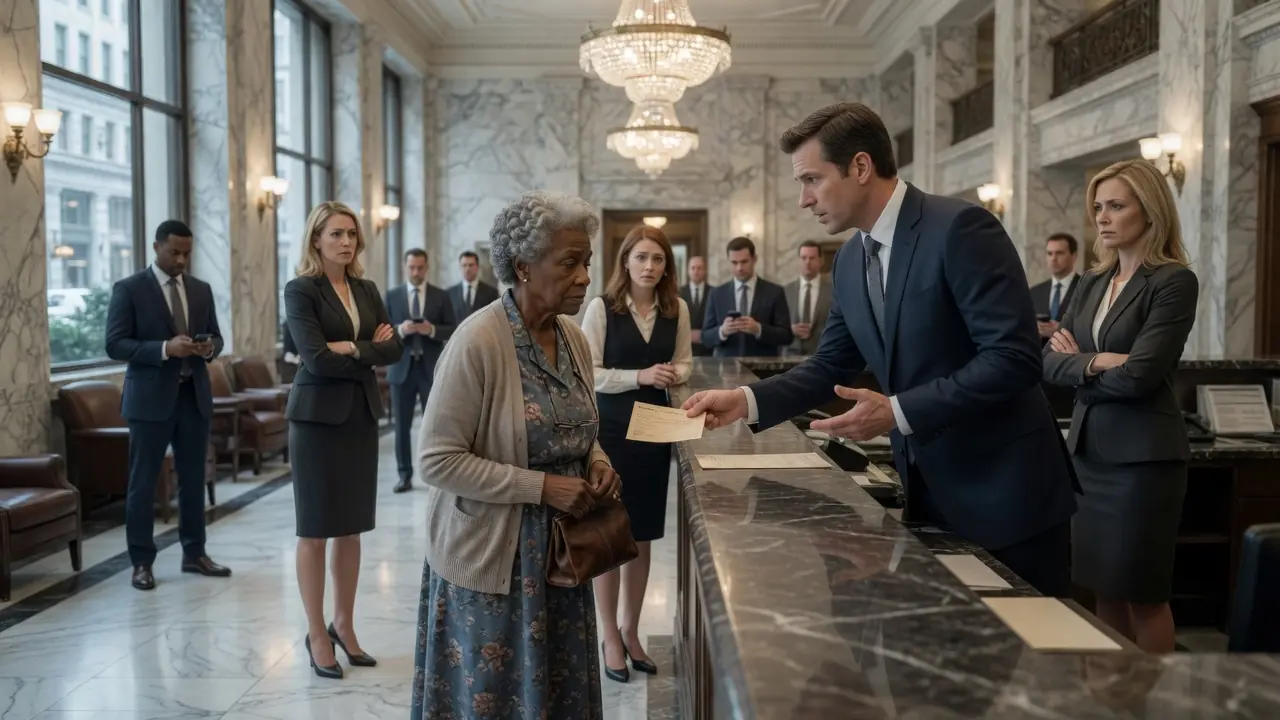
“This bank is for people who actually have money.”
The woman clutched her worn purse. Her voice shook slightly.
“Sir, I have an account here. I just need to—”
“An account?”
Derek’s laugh was sharp and mean.
“What account? The one you clean for?”
He turned toward the tellers.
“Call security now, please.”
“I only want to—”
“Listen, Grandma.”
He leaned in close. His cologne was expensive and suffocating.
“I’ve seen your type before. Coming in here with fake IDs, stolen checkbooks.”
He snapped his fingers near her face.
“You don’t belong here. Leave before I have you arrested.”
The marble floor was cold. The air smelled like shame.
Six hours earlier, morning sunlight filtered through lace curtains. A small kitchen smelled like Earl Grey tea and toast. The counters were spotless. Family photographs lined the walls in simple frames.
Evelyn Carter stood at her kitchen window.
She was seventy-three years old. She watered a row of roses in clay pots. Her movements were careful and deliberate. Arthritis made her fingers stiff in the mornings.
The kitchen table held neat stacks of paperwork: bank statements, investment portfolios, legal documents with official seals, everything organized in labeled folders.
She sat down with her tea and opened the top folder. Her reading glasses hung on a chain around her neck.
The numbers on the statements were large.
Very large.
Her phone rang.
She answered on the second ring.
“Carter residence.”
“Mom, it’s Patricia. Are you sure about today? I can come with you, or I can handle it myself.”
Evelyn’s voice was gentle but firm.
“Patricia, I’ve handled far worse than a bank visit. I’ll be fine.”
“But Mom, that’s a lot of money to withdraw. What if—”
“What if what?”
“What if they treat you like you don’t belong?”
Evelyn sipped her tea.
“Then they’ll learn something today.”
Patricia sighed on the other end.
“Just be careful. Call me when you’re done.”
“I will, sweetheart.”
Evelyn hung up.
She looked at the wall behind the table.
There was a wedding photograph from 1972. Young Evelyn in a simple white dress. Beside her, James Carter in his Army uniform. Both of them smiled like they owned the world.
Next to it was a frame holding military medals: a Bronze Star, a Purple Heart, certificates of service spanning twenty-five years.
Another frame showed James shaking hands with a man in an expensive suit. The plaque beneath it read:
Heritage Trust Bank, 40th Anniversary Gala.
Evelyn finished her tea.
She picked up her purse. The leather was worn soft from decades of use.
Inside, she carefully placed her wallet, her ID, her bank card, and something else: documents folded neatly and a credit card that caught the light.
She locked her front door.
The house sat in a quiet working-class neighborhood with small yards, chain-link fences, and cars that had seen better years.
The bus stop was two blocks away.
She could drive. She had cars. But she preferred the bus. She always had.
James used to laugh about it.
“Evelyn, we can afford a driver.”
But she liked seeing her community. Talking to neighbors. Staying grounded.
The bus arrived. She climbed aboard slowly.
The driver smiled.
“Morning, Mrs. Carter.”
“Good morning, Raymond.”
She sat near the front.
A young mother struggled with a stroller. Evelyn helped her fold it.
The woman thanked her three times.
“How old?” Evelyn asked.
“Seven months.”
“Beautiful age. Mine are all grown now.”
The bus rolled through downtown, past struggling shops and gentrified cafés, past neighborhoods that used to be hers before the prices went up.
Heritage Trust Bank rose ahead.
Glass and steel.
Twelve stories.
The largest financial institution in three counties.
Its lobby was visible through massive windows: chandeliers, leather chairs, wealth on display.
Evelyn stepped off the bus and stood on the sidewalk for a moment.
Her reflection showed in the bank’s windows: an old woman in a faded dress, comfortable shoes, and a purse that had been seen for forty years.
She did not look like she belonged there.
That was the point.
Her attorney had called yesterday.
“Mrs. Carter, the scholarship fund is ready. Once you transfer the $2.8 million, we can finalize everything.”
Two-point-eight million dollars for kids who looked like her.
Kids who got judged before anyone knew their names.
Kids who deserved a chance.
James would have loved this.
He had grown up poor in Alabama. The Army had been his way out. Smart investing had been their way up. But he never forgot where he came from.
Neither had she.
Five years since he died.
Five years of managing their portfolio alone.
Financial advisers were shocked.
“Mrs. Carter, your returns are better than most professionals.”
She smiled at the memory.
Today’s withdrawal would be her fifth annual scholarship endowment.
Fifteen million dollars given away over five years.
The Carter Foundation helped students the world overlooked.
Students who were told they were in the wrong place.
Evelyn walked toward the bank entrance.
The brass handles shone in the sun. She could see people inside moving quickly, with confidence, with belonging.
She pulled open the door.
The air conditioning hit her face. The lobby smelled like money and leather. Marble floors clicked under her shoes.
A man in a navy suit watched her approach.
His smile disappeared.
Evelyn approached the main counter.
Her worn shoes made soft sounds on the marble. Around her, the bank hummed with quiet efficiency. Keyboards clicked. Printers worked. Wealthy customers received warm greetings and coffee in china cups.
She was twenty-eight, white, nervous, and energetic. She forced a professional smile.
“How can I help you today?”
Evelyn slid a withdrawal slip across the counter.
“I’d like to make a withdrawal, please.”
Madison picked up the paper. Her eyes scanned the form.
They stopped at the amount line.
Her face went pale.
“Ma’am.”
She glanced around nervously.
“This says $2.8 million. There must be some kind of mistake.”
“No mistake,” Evelyn said calmly.
Madison’s hands trembled slightly. She typed something into her computer, waited, then typed again. Her eyebrows drew together.
“The account number. Let me just verify.”
Derek Hansen had been watching from his glass-walled office.
He had seen the old woman approach. He had seen Madison’s reaction.
Now he stood, straightened his tie, and walked over with purposeful strides.
“I’ll handle this.”
His voice had authority. Command.
“Madison, go process Mrs. Henderson’s mortgage application.”
Madison looked relieved. She practically ran to another station.
Derek picked up the withdrawal slip and studied it like it was contaminated.
His cologne was overwhelming this close. Expensive. Aggressive.
“Mrs…”
He squinted at Evelyn’s handwriting.
“Carter, is it?”
“Yes. Mrs. Carter.”
He set the paper down.
“I’m Derek Hansen, branch manager. I’m afraid there’s been some confusion here.”
His smile was condescending. Practiced.
“This account number. Are you certain this is yours?”
“That’s my account. My husband and I opened it in 1978.”
Derek’s eyebrows rose.
“1978. I see.”
He picked up the paper again.
“Mrs. Carter, this account holds substantial assets. Very substantial. I’ll need to verify your identity thoroughly.”
He paused.
“How exactly did you obtain this withdrawal slip?”
The question hung in the air.
The implication was clear.
“I filled it out this morning,” Evelyn said. “From my checkbook.”
“Your checkbook.”
Derek nodded slowly.
“Do you have secondary identification? Proof of address? Any documentation showing your relationship to this account?”
“I have my driver’s license and my bank card.”
Derek made a show of examining her driver’s license. He held it up to the light, compared her face to the photo, and took his time.
“The thing is, Mrs. Carter, identity theft is a serious issue these days. I’m sure you understand. We have protocols.”
A security guard appeared.
Frank was fifty years old, white, with the energy of an ex-cop. Thick arms crossed over his chest.
“Frank.”
Derek did not look away from Evelyn.
“Please stand by. We may have a situation here.”
Frank positioned himself behind Evelyn, close enough to intimidate.
“Sir, I’m not committing any crime,” Evelyn said. Her voice remained steady. “I’m trying to access my own money.”
“Of course. Of course.”
Derek’s tone was soothing and false.
“But you have to understand our position. An account of this magnitude, a withdrawal of this size, and…”
He gestured vaguely at her appearance.
“Well, you don’t exactly present as our typical high-net-worth client.”
Two other customers were watching now.
A woman in a Chanel suit whispered to her companion.
Derek pulled out his phone and took a picture of Evelyn’s license.
“Standard procedure,” he said.
But his voice was loud enough for others to hear.
Then he spoke into a radio clipped to his belt.
“Yes, we have a situation at the main counter. Possible fraud attempt. Elderly female. Stand by.”
Evelyn’s jaw tightened, but she said nothing.
“Mrs. Carter, I’m going to need you to wait over there.”
Derek pointed to a row of chairs near the entrance, visible to everyone.
“While I verify this information.”
“How long will that take?”
“As long as it takes.”
His smile was thin.
“Unless you’d like to leave and come back with proper documentation.”
“This is proper documentation.”
Derek sighed like she was being difficult.
“Frank, please escort Mrs. Carter to the waiting area.”
Frank’s hand hovered near Evelyn’s elbow. He did not touch her, but the threat was clear.
Evelyn walked to the chairs and sat with her purse in her lap.
Her back was straight.
Derek returned to his office, but he made phone calls where she could hear.
His voice carried across the lobby.
“Yes, Charles Morrison’s office, please. I have an elderly woman claiming to own the Carter account.”
Pause.
“No, she doesn’t look like our typical client at all.”
Pause.
“Right. Better safe than sorry.”
He hung up and made another call.
“Legal department. Derek Hansen at the downtown branch. I need fraud prosecution protocols ready.”
He glanced at Evelyn.
“Elderly female, approximately seventies, attempting to access the Carter estate account.”
Twenty minutes passed.
Other customers were served immediately.
A man in a golf shirt wanted to transfer funds. Madison processed it in five minutes, smiled, and offered him bottled water.
Evelyn sat and waited.
Thirty minutes.
A teenager opened a checking account and received a welcome packet and a branded pen. The teller laughed at something he said.
Evelyn’s hands rested on her purse.
Steady.
Patient.
Derek’s assistant manager approached.
Brenda Wilcox was thirty-eight, white, ambitious, with a sharp blazer and sharper heels.
“Derek, what’s the situation?”
He showed her the withdrawal slip.
Brenda’s eyes widened. They talked in low voices, but their body language was clear.
Skeptical.
Suspicious.
They kept looking at Evelyn.
Brenda examined the paperwork and tapped her manicured nails on the counter.
“Have you run her name through the system?”
“Doing that now.”
“What about the account owner?”
“James Carter. Deceased five years ago.”
“So the account should have been frozen for probate.”
Brenda’s voice rose slightly.
“She’s trying to steal from a dead man’s estate.”
Derek nodded.
“That’s what I’m thinking.”
This was a lie.
Derek had not verified anything about James’s death or the estate status. He was assuming. Guessing. Judging.
Brenda walked over to Evelyn and stood too close.
“Ma’am, we’re going to need additional information. Do you have the death certificate for James Carter? Probate documents? Letters testamentary?”
“Those were filed five years ago,” Evelyn said, “with this bank.”
“Then we’ll need to locate them, which could take days.”
Brenda’s smile was cold.
“Perhaps you should come back next week with an attorney.”
“I don’t need an attorney to access my own account.”
“That remains to be seen.”
Brenda turned on her heel and returned to Derek.
They whispered. They nodded.
Derek picked up his phone again.
“Yes, police non-emergency line. This is Derek Hansen at Heritage Trust Bank downtown. We have a potential fraud situation. Elderly woman attempting to access an account that likely isn’t hers.”
Pause.
“Yes, we’ll wait for officers.”
Evelyn heard this.
Her expression did not change, but her grip on her purse tightened.
Around the lobby, customers openly stared now. Some had their phones out, recording.
A well-dressed woman leaned toward her husband.
“Can you believe that? Coming in here like she owns the place.”
Derek stood near his office door, arms crossed, waiting, victorious.
Frank, the security guard, positioned himself between Evelyn and the exit, just in case.
Madison, the teller, kept her head down.
She looked uncomfortable, but she said nothing.
The air conditioning hummed.
The clock on the wall ticked.
Outside, traffic flowed past on the street.
Evelyn sat in her chair, surrounded by marble and judgment. Her faded floral dress stood in stark contrast to the polished wealth around her.
She looked small.
Old.
Out of place.
Derek checked his watch and smiled to himself.
He had no idea what was in her purse.
Two police cruisers pulled up outside. Red and blue lights flashed across the bank’s glass facade.
Customers craned their necks to see.
The doors swung open.
Two officers entered.
Officer Mitchell was thirty-five, white, tall, and broad-shouldered. His hand rested casually on his belt near his weapon. Authority radiated from every step.
Officer Garcia followed. Twenty-nine. Hispanic. Quieter. His eyes scanned the room carefully, taking everything in.
Derek rushed to meet them, all smiles and handshakes.
“Officers, thank you for coming so quickly.”
“What’s the situation?” Mitchell asked.
His voice was deep and commanding.
Derek gestured toward Evelyn.
“That woman there. She’s attempting to withdraw $2.8 million from an account that couldn’t possibly be hers.”
He lowered his voice, but not enough.
“The actual account owner died five years ago. I believe she somehow obtained his information illegally.”
Mitchell nodded.
Garcia glanced at Evelyn. She sat perfectly still, hands folded over her purse.
“Has she been aggressive?” Mitchell asked.
“No, but she’s been evasive. Refuses to provide adequate documentation.”
“I provided my ID and bank card,” Evelyn said from her chair.
Her voice carried clearly.
Mitchell turned to her.
“Ma’am, I’m going to need you to remain silent until I ask you questions directly.”
Derek led them closer to Evelyn.
They formed a semicircle around her chair.
Derek.
Brenda.
Mitchell.
Garcia.
Frank, the security guard.
Five people towering over one elderly woman.
Mitchell pulled out a notepad.
“Ma’am, I need you to explain exactly how you obtained the account information you presented today.”
Evelyn looked up at him.
“Officer, I didn’t obtain anything. This is my account. My late husband, James, and I opened it in 1978.”
“Do you have documentation proving ownership besides the withdrawal slip?”
“I have my identification and my bank card. I can provide account passwords, security questions, transaction history.”
Mitchell cut her off.
“That’s not what I asked. Do you have legal documents, estate papers, power of attorney?”
“Those documents are on file with this bank,” Derek interjected. “We have no record of any such documents.”
Another lie.
Derek had not checked.
Had not looked.
Had not tried.
Brenda added, “The account should have been frozen when Mr. Carter died. The fact that she has access suggests fraudulent activity.”
Mitchell wrote something in his notepad.
“Ma’am, I’m going to need to search your purse. Make sure you don’t have any other stolen documents or account information.”
“Officer, I haven’t committed any crime. I don’t consent to a search.”
Mitchell’s jaw tightened.
“You can consent to the search, or I can detain you on suspicion of fraud and identity theft. Your choice.”
Garcia shifted uncomfortably.
“Mitchell, maybe we should—”
“I’ve got this, Garcia.”
Mitchell took a step closer to Evelyn, invading her space.
“Ma’am, things can go easy or they can go hard, but that purse is getting searched one way or another.”
Evelyn’s voice remained calm and professional.
“If you’re going to search my belongings, I want it documented. I want your badge numbers, and I’m recording this encounter.”
She reached for her phone in her purse.
“Stop.”
Mitchell’s hand went to his weapon.
“Put your hands where I can see them. Now.”
Evelyn froze.
Her hand was still partially inside her purse.
“Slowly,” Mitchell commanded. “Remove your hand. Slowly.”
She did.
Empty-handed.
Raised slightly.
The entire bank had gone silent.
Every customer was watching.
Every employee was frozen.
“Officer,” Evelyn said quietly, “I was reaching for my phone, not a weapon.”
“I’ll determine what you were reaching for.”
Mitchell’s voice was hard.
“Stand up.”
Evelyn stood. Her knees shook slightly, arthritis making the movement painful.
“Are you armed?”
“No.”
“Any weapons in your purse? Knives? Needles? Anything that could hurt me?”
“No.”
“We’ll see about that.”
Mitchell reached for her purse.
Garcia spoke up again.
“Mitchell, she’s seventy years old. Maybe we should—”
“Garcia. Step back.”
Mitchell’s tone brooked no argument.
Derek watched with barely concealed satisfaction.
Brenda had her arms crossed, nodding along.
Mitchell emptied Evelyn’s purse onto a nearby table.
The contents spilled out.
Wallet.
Tissues.
Reading glasses.
Prescription bottles.
A small photo of James in uniform.
Breath mints.
Hand sanitizer.
He opened her wallet and examined her credit cards one by one.
Visa.
Mastercard.
Discover.
Then he held up a card.
“What’s this?”
“My bank card.”
“For which account?”
“The account I’m trying to access.”
He set it aside and continued searching. He found a folded piece of paper and opened it.
“What’s this?”
“My account statement from last month.”
Mitchell read it.
His eyebrows rose slightly, but he said nothing.
He folded it back up.
Derek leaned in.
“Find anything?”
“Still looking.”
Mitchell went through every pocket of her purse, every zipper, every compartment. He was thorough and invasive.
He dumped out her pill bottles, counted the pills, and checked the prescription labels.
“These yours?”
“Yes.”
“Blood pressure and arthritis medication. You get them legally?”
Evelyn’s eyes flashed.
“Of course I did.”
“Just asking questions, ma’am. No need to get defensive.”
He finished the search and found nothing incriminating because there was nothing to find.
But he did not apologize.
He did not acknowledge the violation.
Derek stepped forward.
“Officers, I should mention something important. Mr. James Carter, the actual account holder, was a decorated military veteran. Highly respected. This woman is claiming to be his wife, but…”
He paused dramatically.
“How do we know that’s true?”
Mitchell nodded.
“Good point. Ma’am, do you have your marriage certificate?”
“Not with me. It’s at home.”
“Convenient,” Brenda muttered.
Evelyn’s voice rose slightly.
“I’ve been a customer at this bank for forty-seven years. I’ve never been treated like a criminal. I came here to do something good.”
Derek laughed.
“Something good, like stealing millions?”
“I’m not stealing anything.”
Mitchell held up a hand.
“Ma’am, you need to calm down.”
“I am calm. But I’m being accused of crimes I didn’t commit.”
“That’s for us to determine.”
Mitchell exchanged a look with Derek.
“Sir, have you contacted the bank’s corporate security?”
“They’re aware. They defer to local law enforcement.”
“And you want to press charges?”
Derek did not hesitate.
“Absolutely. Attempted fraud, identity theft, whatever applies.”
Garcia finally spoke up.
“Mitchell, her ID checks out. Her name matches the withdrawal slip. Maybe we should verify her story before we—”
“Garcia. I said I’ve got this.”
Mitchell turned back to Evelyn.
“Ma’am, I’m placing you under investigative detention. You’re not under arrest yet, but you’re not free to leave.”
“On what grounds?”
“Suspicious activity. Attempted fraud. Take your pick.”
Brenda suggested, “Should we handcuff her? She might try to run.”
Evelyn’s voice broke slightly.
“I’m seventy-three years old with arthritis in both knees. Where exactly would I run?”
“Plenty of criminals your age,” Mitchell said. “Don’t play the sympathy card.”
He reached for his handcuffs.
The metal glinted under the fluorescent lights.
Customers gasped.
Phones recorded everything.
Frank, the security guard, looked away. Even now, he seemed uncomfortable.
Madison, the teller, had tears in her eyes, but she stayed silent, afraid for her job.
Derek stood tall, chest out.
He believed he was protecting his bank. Doing his duty. He saw himself as the hero of this story.
Mitchell opened the handcuffs.
“Ma’am, put your hands behind your back.”
Evelyn’s hands trembled.
Not from fear.
From rage.
From decades of this same treatment in different forms.
“Officer,” she said quietly, “before you put those on me, I suggest you make one phone call.”
Mitchell paused.
“Excuse me?”
“One phone call to your police chief, or to this bank’s district manager.”
She straightened her shoulders.
“Call Charles Morrison. Tell him Evelyn Carter is being detained at the downtown branch.”
Derek scoffed.
“Charles Morrison? You don’t know Charles Morrison.”
“Call him.”
“Lady, Charles Morrison is the regional director of this entire banking network. He doesn’t have time for—”
“Call him now.”
Something in Evelyn’s voice changed.
The softness was gone. Authority replaced it.
Garcia looked at Mitchell.
“It couldn’t hurt to make the call.”
Mitchell’s jaw worked. He did not want to. He did not want to give her anything.
But Garcia was right.
“Fine.”
He pulled out his phone and looked at Derek.
“You have his number?”
Derek hesitated.
“I can get it from corporate.”
“So you don’t have his direct line?”
“No, but—”
“I do,” Evelyn said.
Her voice was steel now.
“It’s in my phone. The one you wouldn’t let me touch.”
Mitchell nodded to Garcia.
“Check her phone. Recent calls.”
Garcia picked up Evelyn’s phone from the table, unlocked it with her permission, and scrolled through recent calls.
His eyes widened.
“Mitchell.”
“What?”
“She has Charles Morrison in her recent calls from yesterday.”
The air in the bank shifted.
Subtle, but real.
Derek’s confidence wavered just slightly.
“That could be anyone. A different Charles Morrison.”
“Call it,” Evelyn said.
Garcia dialed and put it on speaker.
It rang once.
Twice.
“Evelyn.”
A man’s voice. Professional. Concerned.
“Is everything all right? You don’t usually call twice in one week.”
Silence.
Derek’s face drained of color.
Garcia cleared his throat.
“Mr. Morrison, this is Officer Garcia with the city police. We’re at the Heritage Trust downtown branch with a Mrs. Evelyn Carter.”
“Who?”
“What?”
Charles Morrison’s voice exploded through the speaker.
“Mrs. Carter is there? At the downtown branch?”
A pause.
Heavy breathing.
“Is she all right? Has anyone hurt her?”
Garcia glanced at Mitchell.
“Sir, she’s fine, but there’s been a situation regarding—”
“Put Derek Hansen on the phone. Right now.”
Derek’s hand shook as he took the phone.
“Mr. Morrison, sir, I can explain. We had a woman attempting to withdraw a large sum, and the account information seemed—”
“Do not speak.”
Morrison’s voice was ice.
Pure fury.
“Do you have any idea what you’ve done?”
“What I’ve done, sir?”
“I was following protocol for potential fraud.”
“Protocol? Protocol?”
Morrison’s shout made everyone flinch.
“Mrs. Evelyn Carter is one of the most important clients in this bank’s history. If anyone has laid one hand on her, if anyone has said one disrespectful word, you’re finished. All of you.”
Derek’s mouth opened.
Closed.
No sound came out.
“I’m ten minutes away. Do not move her. Do not speak to her. Do not breathe near her. Am I clear?”
“Yes, sir.”
The line went dead.
The silence in the bank was suffocating.
You could hear a pin drop on the marble floor.
Derek stared at the phone in his hand. His expression was that of a man watching his entire life collapse in real time.
Brenda backed away slowly, as if distancing herself might save her.
Mitchell stood frozen, handcuffs still in his hand.
Garcia looked at Evelyn with new eyes.
“Ma’am, I… we apologize for any—”
“Don’t.”
Evelyn’s voice was quiet but sharp.
“Not yet. Wait for Charles.”
The next ten minutes felt like hours.
Customers whispered.
Phones recorded.
No one left.
This was too important to miss.
Derek tried to speak to Evelyn.
“Mrs. Carter, perhaps there has been a misunderstanding.”
She did not even look at him.
Frank, the security guard, had moved away and now stood by the door, as far from the situation as possible.
Madison, the teller, cried quietly at her station.
Then the doors burst open.
Charles Morrison entered like a hurricane.
Fifty-five years old. White. Impeccable charcoal suit. Silver hair.
Behind him came three people in expensive business attire: the bank’s head of legal, the vice president of operations, and the regional security chief.
Charles’s eyes scanned the lobby.
They found Evelyn.
His face flooded with relief and fury simultaneously.
He rushed to her.
“Mrs. Carter. Evelyn, I am so deeply, profoundly sorry.”
He knelt beside her chair.
Actually knelt.
“Are you hurt? Did anyone touch you?”
“I’m fine, Charles.”
“You are not fine. This is unacceptable.”
He stood and turned to Derek.
The temperature in the room seemed to drop twenty degrees.
“What have you done?”
Derek stammered.
“Sir, I was protecting the bank’s assets. This woman presented a withdrawal slip for $2.8 million, and I had no way of knowing—”
“No way of knowing?”
Charles’s voice could cut glass.
“You had every way of knowing. It’s called pulling up her account, which takes thirty seconds. Thirty seconds.”
He strode to the nearest computer. Madison scrambled out of his way.
Charles typed rapidly. The account appeared on screen.
He turned the monitor so everyone could see.
“Officer Mitchell. Officer Garcia. Derek. Brenda. Everyone in this building, look at this screen.”
The account balance showed:
$47,342,691.
The number hung in the air like a physical thing.
“Mrs. Evelyn Carter,” Charles continued, his voice shaking with barely controlled rage, “is not just a client. She and her late husband, James, are founding investors of this bank. They’ve held accounts here since 1978. Forty-seven years.”
He pulled up another screen.
“Transaction history. These are her charitable contributions. Three million dollars annually for the past five years. Fifteen million dollars given to scholarship funds for underprivileged students.”
Derek’s legs looked unsteady. He leaned against the counter for support.
Charles was not finished.
“Today’s withdrawal, the $2.8 million she came to collect, is this year’s scholarship endowment. The Carter Foundation. I personally process it every single year.”
He turned back to Evelyn. His voice softened.
“I am so sorry. This should never have happened.”
Evelyn stood slowly.
The room watched.
She was no longer a suspicious old woman.
The air around her had changed.
Authority radiated from her small frame.
“Charles, I appreciate your concern, but this isn’t about me.”
She looked at Derek.
“It’s about every person who doesn’t fit someone’s narrow idea of what wealth looks like.”
Derek tried to speak.
“Mrs. Carter, I sincerely apologize. I was simply being cautious with the bank’s—”
“Cautious?”
Evelyn’s voice cut through his excuse.
“You humiliated me publicly. You called the police. You had me searched like a criminal.”
She paused.
“You did all of that because you judged me by my clothes and my skin. That’s not caution. That’s prejudice.”
Brenda attempted damage control.
“Mrs. Carter, we treat all potential fraud cases with the same level of—”
“Do you?”
Evelyn’s eyes were steel.
“Show me one video of you treating a well-dressed white customer the way you treated me today.”
No one answered.
Evelyn reached into her purse.
The purse Mitchell had searched and dumped out.
She pulled items out slowly and deliberately.
First, a credit card.
Not regular .
Deep obsidian.
Charles recognized it immediately.
“Platinum Elite,” he said. “Reserved for clients with over fifty million dollars in managed assets. Only forty people in the entire region have one.”
Derek stared at it.
His hands started to tremble.
Second, a folded certificate.
Evelyn unfolded it carefully.
Heavy paper.
Gold seal.
Certificate of Appreciation.
Heritage Trust Bank Board of Advisers.
Evelyn Carter.
In recognition of forty-five years of partnership and investment excellence.
Brenda’s face went pale.
Third, a photograph.
Evelyn held it up.
A younger version of her stood with an older white man in a tuxedo. Both held champagne glasses. The banner behind them read:
Heritage Trust Bank 40th Anniversary Gala.
Charles pointed to the man in the photo.
“That’s our founder, Henry Mitchell. He died twelve years ago, but he and Mr. Carter were close friends.”
Fourth, a letter.
Official letterhead.
Charles Morrison’s signature at the bottom.
Dated three months ago.
Dear Mrs. Carter,
On behalf of Heritage Trust Bank, we thank you for your continued confidence in our wealth management services. Your recent investment of $10 million in our emerging markets fund demonstrates…
Derek’s legs gave out.
He grabbed the counter and sank into a chair.
Mitchell, the officer, looked like he wanted the floor to swallow him.
Evelyn carefully returned each item to her purse.
“Now, Derek. You were saying something about protocols.”
Derek could not speak.
His mouth opened.
Nothing came out.
Charles turned to his legal team.
“Conference room. Derek and Brenda. Now.”
He looked at the officers.
“Unless you’re charging Mrs. Carter with a crime, you’re dismissed.”
Mitchell found his voice.
“No, sir. No charges. Mrs. Carter, we apologize for the confusion.”
“Confusion?”
Evelyn’s eyebrow rose.
“Is that what we’re calling it?”
Garcia stepped forward.
“Ma’am, I want you to know I tried to—”
“I know, Officer Garcia. I noticed.”
Her eyes shifted to Mitchell.
“Your partner did not.”
Mitchell’s face burned red. He turned and walked out. Garcia followed but looked back once, apologetic.
The bank remained silent.
Customers were still filming everything.
Charles extended his hand to Evelyn.
“Please let me personally process your transaction in my office, with coffee and my deepest apologies.”
Evelyn looked at Derek, Brenda, Frank, Madison, and all the faces that had judged her.
“Yes, Charles. Let’s finish what I came here to do.”
As she walked toward the private offices, every eye followed her.
The small woman in the faded floral dress had just brought a bank manager to his knees.
Derek watched her go.
His career, his reputation, his life, all destroyed in less than sixty seconds.
The conference room had glass walls.
Everyone in the bank could see inside.
Derek and Brenda sat on one side of the long table. Charles Morrison stood on the other, flanked by the head of legal and the vice president of operations. The HR director joined by video call on the wall screen.
Charles did not sit.
He paced.
“Give me one reason. One single reason I shouldn’t fire both of you right now.”
Derek’s voice cracked.
“Sir, I was protecting the bank’s assets. How was I supposed to know she—”
“By doing your job.”
Charles slammed his hand on the table.
The sound echoed.
“You could have pulled up her account in thirty seconds. Thirty seconds. Instead, you called the police. You had her searched. You humiliated one of our most valued clients in front of dozens of witnesses.”
He leaned forward, with cameras recording everything.
Brenda tried.
“Mr. Morrison, we were following standard fraud prevention protocols.”
“Show me the protocol that says humiliate elderly clients,” Charles said. “Show me where it says judge people by their clothing. I’ll wait.”
Silence.
The head of legal spoke.
“Mr. Hansen. Mrs. Wilcox. You’re aware this bank has a zero-tolerance policy for discrimination.”
Derek nodded frantically.
“Yes, but I wasn’t discriminating. I would have questioned anyone trying to withdraw that amount without proper—”
“Without proper what?” Charles cut him off. “She had her ID. Her bank card. She knew her account number, her password, everything.”
He pulled out his phone and showed them a video.
“This is already trending online. Hashtag Heritage Shame. Three million views in the last hour.”
Derek’s face turned gray.
“The NAACP has already contacted our corporate office,” the legal director added. “They’re asking questions. Lots of questions.”
Charles stopped pacing and looked directly at Derek.
“You need to apologize to Mrs. Carter. Now. Publicly.”
“Of course. Absolutely. I’ll—”
“I’m not asking.”
They walked back to the main lobby.
Evelyn sat in Charles’s private office, visible through the glass partition. She was drinking coffee from a real cup, not the paper ones given to regular customers.
Derek and Brenda approached. Charles followed close behind.
Derek knocked on the door frame.
“Mrs. Carter, may we come in?”
Evelyn set down her cup.
“Yes.”
They entered.
Derek’s hands shook. Brenda would not make eye contact.
“Mrs. Carter,” Derek said, his voice barely audible. “I sincerely apologize for the misunderstanding today. I was simply being cautious with the bank’s security procedures, and I—”
“Stop.”
Evelyn’s voice was calm and firm.
“That’s not an apology. That’s an excuse.”
Derek swallowed hard.
“I’m sorry.”
“For what?”
“Specifically, for… for questioning your account.”
“Try again.”
Derek’s eyes glistened.
The reality was sinking in.
“I’m sorry for humiliating you. For treating you like a criminal. For judging you based on your appearance and…”
“And?”
“For calling the police. For having you searched.”
His voice broke.
“For making assumptions about who you were before I knew anything about you.”
Evelyn nodded slowly.
“And would you have treated me that way if I’d walked in wearing a Chanel suit? If my skin was white?”
Derek opened his mouth, then closed it.
The answer was obvious to everyone.
“That’s what I thought.”
Evelyn stood.
“Your apology is noted, but not accepted. Because this isn’t about me forgiving you. This is about you understanding what you did wrong.”
Brenda tried to speak.
“Mrs. Carter, we treat all potential fraud cases with the same—”
“Do you?”
Evelyn’s gaze was sharp.
“Then show me your security footage from the past month. Show me every time you questioned a well-dressed white customer about their accounts. Show me when you last called the police on someone driving a Mercedes.”
Brenda had no answer.
Charles stepped forward.
“Mrs. Carter, I want you to know we’re taking immediate action. Effective right now, Derek Hansen is suspended without pay pending a full investigation.”
He looked at Derek.
“Clear out your desk. Security will escort you out.”
Derek’s face crumbled.
“Charles, please. I have a mortgage. Kids in private school. I can’t—”
“You should have thought about that before you terrorized a seventy-three-year-old woman.”
Charles turned to Brenda.
“Ms. Wilcox. Same. Suspended without pay.”
“This is unfair,” Brenda said, her voice rising. “We were doing our jobs.”
“No,” Charles said quietly. “You were letting your biases do your jobs for you.”
Security arrived.
Two guards.
Not Frank. He had already been reassigned.
Derek stood on shaking legs.
“Mrs. Carter, please. I made a mistake. I have a family.”
Evelyn looked at him.
Really looked at him.
“So do the hundreds of people you’ve probably treated this same way over the years. People who didn’t have millions of dollars to prove their worth. People who just left quietly, humiliated, thinking that’s how the world works.”
Derek had no response.
The guards escorted him and Brenda out through the lobby, past customers still filming, past tellers who would not meet their eyes, past Madison, who was still crying.
The glass doors closed behind them.
Charles turned to his legal team.
“Pull all security footage from the past two years. Every interaction Derek and Brenda had with minority clients. I want a full audit.”
He returned to Evelyn.
“Now, let’s complete your transaction properly.”
Evelyn sat back down.
“The $2.8 million for the scholarship fund.”
“Of course.”
Charles processed it himself. His fingers flew across the keyboard.
Transfer to the Carter Foundation account.
Authorized by account holder.
Transaction complete.
He printed a receipt and handed it to her.
“Mrs. Carter, I know this doesn’t fix what happened, but I want you to know I’m personally ashamed. This bank is better than this. Or it should be.”
“Make sure it is,” Evelyn said. “Not just for me. For everyone.”
Outside, news vans were arriving.
Word had spread fast. Reporters set up cameras on the sidewalk.
Inside, customers whispered, shared videos, posted updates.
Within two hours, the story was national news.
Millionaire Philanthropist Treated Like a Criminal at Own Bank.
The hashtags trended everywhere.
Heritage Shame.
Dignity Matters.
Evelyn Carter.
Derek Hansen’s name trended too, for all the wrong reasons. His phone exploded with messages. Some were supportive. Most were angry.
Screenshots of his social media spread. Old posts surfaced. Comments that revealed patterns.
Brenda’s LinkedIn profile was flooded with angry comments. People she had wronged came forward with their own stories.
Officer Mitchell was called back to the station. His body camera footage went under review. Internal Affairs wanted answers.
Garcia wrote a report noting Mitchell’s aggressive behavior, poor judgment, and violations of protocol. It also noted Garcia’s attempt to de-escalate.
And Evelyn?
She finished her coffee, thanked Charles, and walked out of the bank with her head high.
The same way she had walked in.
The video went viral within hours.
Shot from multiple angles by different customers.
Same scene.
Same humiliation.
Same reversal.
By midnight, fifteen million views.
By morning, thirty million.
The comments exploded.
This is why we still need to talk about racism.
That manager’s face when he realized who she was.
How many people did this happen to who weren’t millionaires?
That last question began trending on its own.
News outlets picked it up.
Local first.
Then national.
CNN ran a segment. Fox covered it. MSNBC interviewed civil rights attorneys.
Heritage Trust’s corporate headquarters issued a statement.
We deeply regret the treatment of Mrs. Carter. The employees involved have been terminated. We are implementing immediate reforms.
But the internet wanted more.
Details.
Accountability.
Real change.
The internal investigation began.
Three attorneys.
Two weeks.
Hundreds of hours of security footage.
What they found was damning.
Derek Hansen had worked there for twelve years. The footage showed a clear pattern.
A young man in a hoodie opened a savings account. Derek made him wait forty minutes, asked for three forms of ID, and questioned his employment twice.
A Hispanic woman needed a cashier’s check. Derek suggested a money order instead.
“Might be easier for you.”
An elderly Asian couple inquired about investments. Derek directed them to basic checking and assumed they would not understand complex products.
Meanwhile, white customers in casual clothes received immediate service, friendly conversation, coffee offers, and no extra questions.
The pattern was undeniable.
Consistent.
Documented.
Brenda’s footage showed similar bias. Less aggressive, but equally harmful.
The report went to corporate, to the board, to the NAACP, and to the ACLU.
Two weeks later, they contacted Evelyn.
They met in her living room. Tea and cookies sat on the table.
Attorney James Wilson spoke.
“Mrs. Carter, we’ve been contacted by thirty-seven other customers. All people of color. All with similar stories.”
Evelyn listened.
“We’d like to file a class-action discrimination lawsuit, with you as lead plaintiff.”
He paused.
“We know you’re private, but your story has power.”
Evelyn sipped her tea.
“I don’t want this to be about me.”
“It’s not. It’s about every person who was treated this way and couldn’t fight back.”
Patricia sat beside her mother.
“Mom, you don’t have to.”
“Yes, I do. Your father would want me to.”
The lawsuit was filed three weeks later.
Forty plaintiffs.
Two hundred pages of stories.
A teacher denied a mortgage despite excellent credit.
A doctor questioned about legitimate paychecks.
“Are you sure these aren’t fake?”
A veteran trying to access VA benefits, treated like a scammer.
Story after story.
Pattern after pattern.
Heritage Trust fought initially.
Isolated incidents.
Misunderstandings.
But the evidence was overwhelming.
The trial began six months after that day at the bank.
The courthouse was packed. Media everywhere. Cameras on the steps.
Evelyn arrived in a gray suit, Patricia on one side, her attorney on the other.
Inside, the courtroom was formal.
Wood paneling.
High ceilings.
The jury was diverse: eight women, four men, multiple races.
Opening statements began.
The plaintiff’s attorney spoke first.
“This case is about dignity. About being judged before anyone knows your name. About a system that assumes poverty and criminality based on skin color.”
Heritage Trust’s attorney argued procedure.
“Our clients followed protocol. Understandable mistakes were made.”
Then the evidence came.
Video after video.
Testimony after testimony.
Expert witnesses on implicit bias.
Statistical analysis.
The numbers did not lie.
customers waited eighteen minutes longer on average.
Hispanic customers were asked for additional ID forty-seven percent more often.
Asian customers were steered toward lower-yield accounts despite higher balances.
Derek took the stand.
He had lost weight. His suit did not fit well. His confidence was gone.
“Mr. Hansen, what was your first thought when Mrs. Carter approached?”
“I thought she looked out of place.”
“Out of place? How?”
“Her clothes were modest. She seemed… I don’t know.”
“Did you think she was poor?”
Derek hesitated.
“Yes.”
“Because of her clothes?”
“Yes.”
“And because she was ?”
“I… no. I—”
“Mr. Hansen, we have footage of you serving a white man in gym shorts and a stained T-shirt that same day. You processed his fifty-thousand-dollar withdrawal in five minutes. No questions. Why the difference?”
Derek had no answer.
Evelyn’s testimony was powerful, quiet, and dignified.
“They didn’t see a decorated veteran’s widow. They didn’t see a woman who had built a fortune through hard work. They saw an elderly woman and assumed I was poor, uneducated, and criminal.”
Her voice did not waver.
“I could fight back because I had resources. But what about everyone else? What about the people who left quietly, believing that was simply how the world worked?”
Several jurors wiped their eyes.
The defense tried to discredit her.
“Mrs. Carter, isn’t it true you chose to wear modest clothing that day?”
Evelyn’s response was sharp.
“Are you suggesting that wearing an old dress justifies being treated like a thief?”
The courtroom gasped.
Officer Mitchell testified.
He was no longer with the police department. He had been terminated two months after the incident.
“I made assumptions,” he admitted. “I saw an elderly woman and a white bank manager. I believed the manager. I was wrong.”
His body camera footage played for the courtroom.
The intimidation.
The threats.
The demand to search her purse.
The jury watched in silence.
Garcia testified too, now a sergeant.
“I tried to intervene, but I didn’t try hard enough.”
The trial lasted three weeks.
Closing arguments were emotional.
“This isn’t about money. It’s about sending a message that dignity isn’t for sale. That every person deserves respect, regardless of their bank balance.”
The jury deliberated for eight hours.
They returned with a verdict.
The foreman stood.
“In the case of Carter v. Heritage Trust Bank, we find in favor of the plaintiffs.”
The courtroom erupted.
Tears.
Applause.
The judge called for order.
The damages were twelve million dollars in compensatory damages, distributed among thirty-seven plaintiffs, and fifty million in punitive damages.
But more importantly, the court ordered systemic changes.
Mandatory bias training.
External monitoring for five years.
Quarterly audits of customer service by race.
Public reporting of findings.
Heritage Trust had to issue a public apology.
A real one.
Not corporate language.
The CEO read it on the courthouse steps.
“We failed. We allowed bias to flourish. We hurt people. We are sorry, and we are changing.”
Derek Hansen’s life was ruined.
No job.
No career.
His wife left.
His house went into foreclosure.
He stocked shelves at night now for minimum wage.
Brenda was listed from finance. Her public defense online went viral for the wrong reasons.
Mitchell lost his pension.
Twenty years gone.
He drove for a rideshare company. Passengers recognized him and left one-star ratings.
But Garcia thrived.
He began running a bias training program. Five hundred officers trained. Complaints down thirty-four percent.
The verdict sent shock waves across the banking industry.
Thirty-four other banks implemented changes within months.
Evelyn gave her settlement portion away to the scholarship fund.
Twenty million dollars total for kids who got judged before anyone knew their names.
Six months after the verdict, the James and Evelyn Carter Education Center stood three stories tall.
Red brick.
Large windows.
Solar panels gleaming in the sun.
Two hundred people gathered for the ribbon-cutting ceremony.
Evelyn stood at the podium in a simple new blue dress.
Patricia stood beside her.
“Six months ago, I was humiliated in a bank where I had been a customer for forty-seven years. But that humiliation revealed something important.”
She paused.
“Dignity should not depend on your bank balance. Justice should not be a luxury only the wealthy can afford.”
Applause rippled through the crowd.
“This center is for every person judged by their appearance, dismissed because of their age, discriminated against because of their race.”
She gestured to the building.
“The scholarship fund started with $2.8 million. We have now endowed it with $20 million. Students who face barriers will receive opportunities forever.”
Five students joined her on stage.
The first Carter scholarship recipients.
Marcus, , from foster care, now studying engineering.
Sophia, Hispanic, from an immigrant family, now pre-law.
Wei, Asian, the daughter of restaurant workers, now studying creative writing.
David, white, from rural Appalachia, now pre-med.
Amira, a refugee and war survivor, now studying social work.
Each spoke briefly about being underestimated.
About second chances.
About hope.
Evelyn listened, eyes bright.
This was why she fought.
The ribbon was cut.
The building opened.
Tomorrow, the first tutoring sessions would begin.
Later, Evelyn sat in the garden.
A young girl approached, maybe nine years old, shy.
“Mrs. Carter, my mom showed me the video. You stood up for yourself even when they were mean.”
Evelyn smiled.
“I did.”
“I get treated mean sometimes too, because of how I look.”
Evelyn took her hand.
“Listen to me. Your worth isn’t determined by how others see you. Stand in your truth. Demand respect. You are enough exactly as you are.”
The girl hugged her, then ran back to her mother.
Patricia watched from nearby.
“You changed things, Mom.”
“We all did.”
Evelyn stood.
“Change doesn’t happen alone.”
The sun set golden light across the building, across the students who now had hope.
Evelyn thought about Derek.
About Mitchell.
She did not hate them.
But she would not forget.
Because that little girl deserved better.
Thousands like her deserved better.
They deserved a world where dignity was not for sale, where justice did not depend on bank balances, where every person received respect.
That world did not exist yet.
But it was closer than it had been six months ago.
The numbers told the story.
banking customers were far more likely to be questioned about legitimate transactions.
Heritage Trust Bank processed zero discrimination complaints after the reforms.
The Carter Scholarship Fund awarded twenty million dollars to 247 students.
Officer Garcia trained five hundred officers annually in bias-free policing.
Derek’s case led to policy changes at thirty-four banks nationwide.
Change was real.
Change was happening.
But only because people demanded it.
Dignity is not for sale.
And justice should not be either.