“You stole this car. I saw you take it.”
Karen Whitmore pointed one manicured finger at Marcus Reed as though she had already convicted him. Her bright red blazer stood out against the quiet lawns of Briar Glen, while oversized sunglasses covered half her face. Behind her, eighteen-year-old Tyler Whitmore leaned against the mailbox in a beige patterned hoodie, wearing the satisfied grin of someone expecting his mother to deliver whatever he wanted.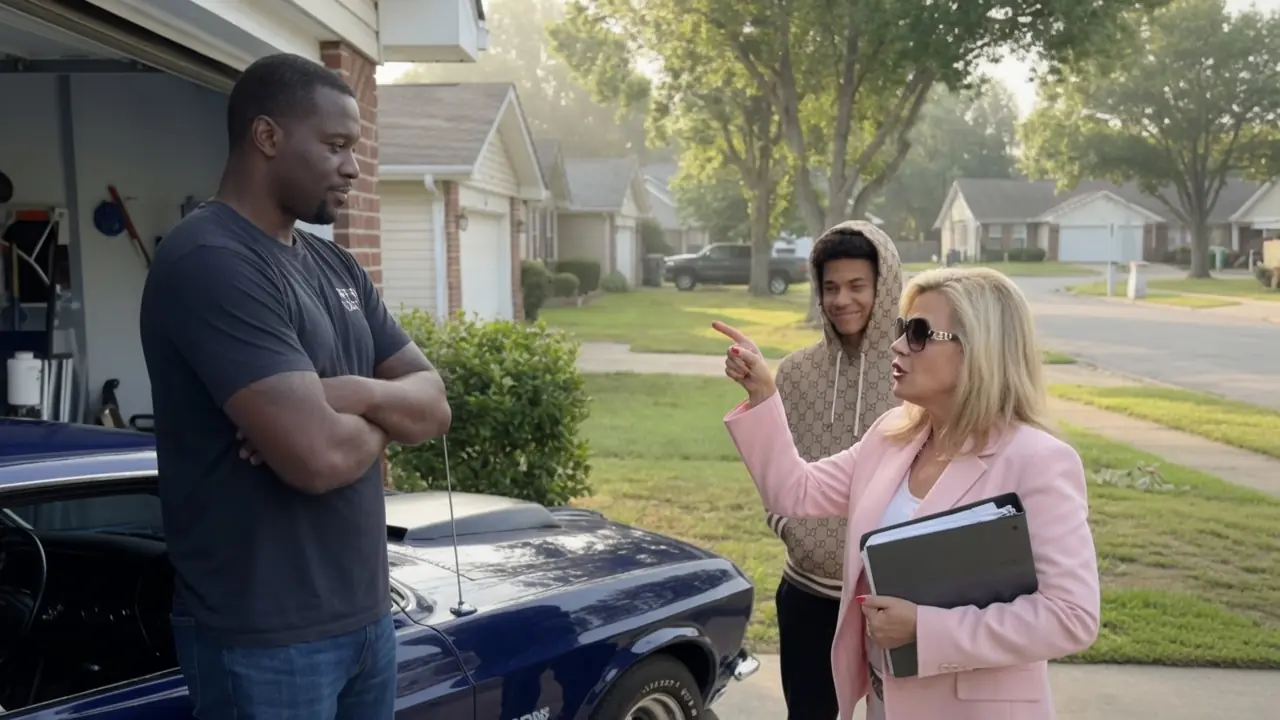
Marcus remained beside the bright-blue 1970 Ford Mustang parked in his driveway. At thirty-five, he was tall and powerfully built, with deep-brown skin, closely cropped black hair, and the calm expression of a man who understood that anger would be used against him before the truth was considered. He wore a charcoal T-shirt, jeans, and black sneakers, his arms folded loosely across his chest. The garage door behind him stood open, revealing tools, restoration photographs, and an empty space where the Mustang had rested overnight.
“This car is mine,” Marcus said.
Karen lifted her phone higher. “My son told me exactly what happened. You took that Mustang after he chose it, and the police are already coming.”
Tyler’s grin widened.
Marcus looked past them toward the entrance of the neighborhood. “Then let them explain why your son’s name is on the attempted-theft report.”
Tyler stopped smiling.
Karen turned toward him, but before she could demand an explanation, two police cruisers entered Briar Glen. They drove slowly beneath the stone neighborhood sign and stopped in front of Marcus’s home. Neighbors began appearing on porches, attracted by the flashing lights and Karen’s raised voice.
Sergeant Elena Ruiz stepped from the first cruiser with Officer David Collins beside her. Ruiz was in her early forties, composed and observant, and she did not approach with her hand resting on her weapon. Instead, she looked at all three people, then at the Mustang, the open garage, and the security camera mounted above the door.
“Who placed the call?” Ruiz asked.
Karen rushed toward her. “I did. That man stole my son’s car and threatened us when we confronted him.”
Marcus did not move.
Ruiz glanced at Tyler. “Is the vehicle registered to you?”
Tyler opened his mouth, but Karen answered for him. “He was supposed to have it. Marcus knew Tyler wanted it and took it before my son could complete the purchase.”
“That was not my question,” Ruiz said. “Is the Mustang registered to your son?”
Karen’s face tightened. “Ownership is complicated.”
Marcus reached slowly toward the workbench beside him. “My registration and insurance card are in this folder. May I pick it up?”
Ruiz nodded.
Marcus handed her the documents. The registration identified Marcus Anthony Reed as the sole owner of the Mustang, with the same address where they were standing. The title had been issued eight years earlier, long before Tyler was old enough to drive.
Collins walked around the vehicle and compared the identification number beneath the windshield with the registration. “VIN matches.”
Karen folded her arms. “Paperwork can be forged.”
Ruiz looked at her. “Do you have any document showing that your son owns this vehicle?”
“No, because Marcus interrupted the agreement.”
“There was no agreement,” Marcus said.
Tyler finally spoke. “He said he might sell it.”
Marcus faced him. “I told you it was not for sale.”
“You said everything has a price.”
“I said your mother treats everything like it has a price.”
Karen stepped between them. “Do not twist your words now. Tyler offered you more than this old car is worth.”
“He offered me five thousand dollars.”
“It is almost fifty years old.”
“It is worth over sixty thousand, but that is not why I refused.”
Marcus looked at the Mustang. The polished blue body reflected the trees above them, and the chrome wheels carried the same design his father had chosen when Marcus was sixteen. The car had never been a trophy purchased to impress strangers. It was the last major project Marcus had completed with his father before lung cancer weakened the older man’s hands.
James Reed bought the Mustang as a rusted shell when Marcus was eleven. For years, father and son spent weekends rebuilding it inside a narrow rented garage behind their apartment. James taught Marcus how to repair brakes, align body panels, rebuild a transmission, and step away from an engine when frustration threatened to make the problem worse.
They finished the car three months before James died.
Marcus drove him along the lakefront on a clear Sunday morning, the windows down and James’s favorite soul music playing through the restored speakers. His father had rested one hand on the dashboard and told him that a machine became valuable because of the memories people built around it. The Mustang had belonged to Marcus ever since.
Tyler first saw it four weeks after Marcus moved into Briar Glen. He appeared in the driveway without introducing himself, walked around the vehicle, and asked how much Marcus wanted for it. When Marcus explained that it was not for sale, Tyler laughed and said everyone eventually sold when the offer came from the right family.
The following afternoon, Karen delivered an HOA notice claiming the Mustang might violate the community’s vehicle standards. The rules prohibited abandoned automobiles, commercial trucks, and cars undergoing major repair in visible driveways. Marcus’s fully restored, registered Mustang violated none of those restrictions.
Karen nevertheless demanded photographs of the engine, proof of insurance, maintenance records, and written confirmation that Marcus did not operate a repair business from his garage. Marcus gave her only the documents the HOA had a lawful right to request. Three days later, he received a two-hundred-dollar fine for “failure to cooperate with community inspection.”
That was when Marcus began recording every interaction.
He had moved to Briar Glen because it was quiet, close to his engineering firm, and offered a garage large enough for his cars and tools. He designed safety systems for public transportation vehicles, but working on classic automobiles remained his private passion. He had hoped the neighborhood would provide stability after years of moving between cities for contracts.
Instead, Karen visited his house almost daily.
She photographed his garage from the sidewalk, questioned delivery drivers, and asked neighbors whether Marcus rented or owned the property. She once followed his visiting sister to her car and demanded identification. When Marcus filed a complaint with the HOA board, Karen responded that strict monitoring protected property values.
Tyler’s behavior became more aggressive.
He left handwritten offers beneath the windshield wiper, each one slightly higher than the last. Then he posted photographs of the Mustang online, claiming he would own it before summer. One post showed him standing beside the car while Marcus was at work, his hand resting on the hood.
Marcus warned him not to enter the property again.
Two nights before Karen called the police, Marcus woke at 2:13 in the morning when his security system sent an alert to his phone. The garage camera showed a hooded figure using a copied remote to raise the door. A second person waited near the sidewalk while the first entered and moved directly toward the Mustang.
Marcus called the police from his bedroom and activated the garage alarm.
The intruder fled before officers arrived, but not before forcing a tool into the ignition and damaging the steering column. He also knocked over a cabinet, leaving a dark sneaker print on the floor and a torn piece of beige fabric caught on the corner. The cameras recorded his height, clothing, face, and the Whitmore family SUV waiting two houses away.
Marcus filed a full report and gave investigators the unedited footage.
He did not confront Tyler immediately because Sergeant Ruiz had asked him not to interfere with the investigation. Officers wanted time to identify the second person and determine how Tyler obtained the copied garage remote. Marcus agreed, secured the car, and spent the following day repairing the ignition.
On the morning of Karen’s accusation, Tyler returned while Marcus was moving the Mustang into the sunlight to inspect the paint. He stared at the repaired steering column and asked whether Marcus had reported the break-in. Before Marcus could answer, Tyler called his mother.
Karen arrived carrying a binder and began shouting that Marcus had stolen the car Tyler intended to purchase. Then she called the police and described a Black man who had taken her son’s Mustang and was behaving aggressively. She never mentioned that she was standing on Marcus’s property.
Sergeant Ruiz closed the registration folder and looked toward Tyler’s hoodie.
“Mr. Whitmore, were you inside this garage two nights ago?”
“No.”
Karen interrupted. “He was at home.”
Ruiz continued watching Tyler. “We have already reviewed video from the attempted theft.”
Karen’s voice sharpened. “What attempted theft?”
Collins returned to the cruiser and retrieved a sealed evidence bag. Inside it was the torn piece of beige patterned fabric recovered from Marcus’s garage. The pattern matched a missing section near the lower pocket of Tyler’s hoodie.
Tyler looked down.
Karen grabbed his sleeve and examined the tear. “That proves nothing. Hoodies like this are sold everywhere.”
Ruiz removed her tablet from its holder. “The video also captured his face when the garage light activated.”
Tyler stepped backward.
Karen moved with him. “You cannot question my son without an attorney.”
“He is eighteen,” Ruiz said. “He can decide whether he wants to answer.”
“I decide what happens in this neighborhood.”
“No, ma’am. You do not decide how a criminal investigation proceeds.”
Several neighbors had moved closer. Among them was Samuel Price, a retired accountant who had served briefly on the HOA board before resigning after repeated conflicts with Karen. Beside him stood Denise Holloway, a Black nurse whom Karen had accused the previous year of operating an illegal business because coworkers sometimes picked her up for hospital shifts.
Samuel raised his phone. “This entire conversation is being recorded.”
Karen pointed at him. “You are violating neighborhood privacy rules.”
“We are standing on a public street.”
“This community is private.”
“The roads belong to the city.”
Karen turned back toward Ruiz. “Marcus manipulated that footage because he wants to destroy my family.”
Marcus remained by the Mustang. “I did not force Tyler to enter my garage.”
“You tempted him by displaying that car.”
The words drew murmurs from the neighbors.
Marcus stared at her. “Are you saying your son tried to steal my Mustang because I parked it at my own house?”
“I am saying you knew a boy his age would want it.”
“He is eighteen, not eight.”
“He made you a fair offer.”
“The word ‘no’ ended the negotiation.”
Karen looked toward the police cruisers and seemed to understand that the officers had not arrived to remove Marcus. Her accusation had not redirected the investigation as she expected. It had only brought the people holding evidence directly to Tyler’s location.
Ruiz asked Tyler to turn around.
Karen blocked her path. “You are not arresting him.”
“Step aside.”
“He made a teenage mistake.”
“You just called us claiming someone stole a vehicle.”
“That was different.”
“How?”
Karen glanced at the neighbors. “Marcus is not really part of this community.”
Marcus’s expression did not change, but several people reacted audibly.
Ruiz’s voice became firmer. “Move away from your son.”
Karen refused.
Collins stepped beside Ruiz. “Ma’am, interfering with an arrest may result in your own detention.”
Karen’s confidence faltered. She had called officers to enforce the social order she believed she controlled. Now the same officers were asking her to move while her neighbors watched.
Tyler turned around before she could stop him.
Ruiz placed him in handcuffs and informed him that he was being arrested for attempted motor-vehicle theft, burglary, property damage, and conspiracy. Tyler began crying almost immediately. He insisted he only wanted to borrow the Mustang for photographs and planned to return it before Marcus noticed.
“You forced the ignition,” Marcus said.
“I panicked when the alarm went off.”
“You entered with tools.”
“My friend brought those.”
“Who was your friend?”
Tyler looked at his mother.
That single glance changed the investigation.
Ruiz noticed it. “Mrs. Whitmore, where were you at two in the morning on Tuesday?”
“At home.”
“Was your SUV used that night?”
“Anyone could have taken it.”
“Do you know how your son obtained a copy of Mr. Reed’s garage remote?”
Karen’s face became still.
Marcus had given no remote to the HOA. However, a maintenance company hired by Karen had entered his garage three weeks earlier to inspect a water meter located behind the house. One worker later admitted that Karen asked him to photograph the remote’s serial number while Marcus was distracted.
She used the number to order a replacement transmitter.
Tyler’s phone contained the receipt.
It also contained messages from Karen.
Take it before he registers another complaint. Once the car is gone, he’ll stop acting like he owns the street.
Another message instructed Tyler to park the Mustang at his uncle’s warehouse until Karen could pressure Marcus into signing a sale agreement. She believed that if Marcus appeared careless enough to lose the vehicle, he would have difficulty proving Tyler took it.
The plan depended on Marcus being too frightened or embarrassed to involve the police.
When the theft failed, Karen created a new story. She called the officers herself and accused Marcus before he could publicly identify Tyler. She expected her position as HOA president, her appearance, and her practiced confidence to outweigh the evidence of a Black homeowner she had spent weeks portraying as suspicious.
The strategy collapsed in his driveway.
Ruiz asked Karen to place her hands behind her back.
Karen stared at the officer. “You cannot arrest me based on messages taken out of context.”
“The context is an attempted vehicle theft.”
“I was teaching Marcus a lesson.”
“That statement will be documented.”
Karen looked toward the neighbors for support. No one moved.
Even residents who once tolerated her aggressive enforcement now understood what she had done. She had tried to turn neighborhood authority into permission to take private property. When the crime failed, she attempted to weaponize the police against the victim.
Collins secured her wrists.
As Karen was led toward the second cruiser, she shouted that the HOA would place a lien on Marcus’s house, fine everyone recording the arrest, and remove any board member who cooperated with investigators. Samuel Price lowered his phone only after the cruiser door closed.
“You heard that,” he told the officers.
“We did,” Ruiz said.
The police recovered additional evidence from the Whitmore residence later that afternoon. Inside Karen’s home office were printed photographs of Marcus’s garage, copies of his property records, the replacement-remote order, and a drafted contract transferring the Mustang to Tyler for five thousand dollars. Marcus’s signature had already been copied onto the final page.
Investigators also found folders on seventeen other residents.
The files contained vehicle registrations, mortgage information, employment details, photographs of backyards, and handwritten notes describing which homeowners were likely to challenge fines. Karen labeled some residents “financially weak,” “outsider families,” or “easy foreclosure targets.”
The criminal inquiry expanded into an investigation of the Briar Glen HOA.
For six years, Karen had issued selective fines and then directed residents to a legal-services company owned by her brother. Homeowners who could not pay immediately accumulated processing fees, inspection charges, and attorney costs. The association placed liens on three properties, including the home of an elderly widower who owed less than nine hundred dollars in original fines.
Karen’s brother purchased one of those homes after foreclosure.
Marcus attended the emergency HOA meeting held two weeks after the arrests. The community clubhouse was filled beyond capacity, with residents standing along the walls and gathering outside the open doors. Karen’s chair at the front remained empty.
Samuel Price presented the preliminary financial findings. More than three hundred thousand dollars in questionable payments had passed through companies connected to Karen’s relatives. Board minutes had been altered, electronic votes had been recorded for members who never attended meetings, and complaint letters had disappeared from the official files.
Denise Holloway spoke next.
She described the morning Karen followed her home from a hospital shift and demanded proof that the luxury SUV in her driveway belonged to her. When Denise refused, Karen issued a fine for operating an unregistered commercial vehicle. It took four months and a lawyer’s letter to have the penalty removed.
“She knew the vehicle was mine,” Denise said. “She just did not think it should be.”
The room became silent.
Marcus understood that his Mustang was only the latest object Karen used to define who deserved comfort, beauty, or success. Tyler did not invent that belief alone. His mother had trained him to interpret another person’s possessions as an insult whenever that person did not match their idea of status.
When it was Marcus’s turn to speak, residents expected anger.
He walked to the front with the damaged ignition cylinder in one hand.
“My father and I rebuilt that Mustang together,” he said. “But the crime would be no less serious if it were an ordinary car I bought yesterday. Ownership does not become more valid because an object has sentimental value, and a person’s rights do not become stronger because the neighborhood later learns he has a respectable job.”
He placed the broken part on the table.
“Karen believed she could define who belonged here. Tyler believed wanting something created a claim to it. Both assumptions survived because too many people saw what was happening and decided staying quiet was easier.”
Several former board members lowered their eyes.
Marcus did not ask the community to dissolve the HOA entirely. Shared roads, landscaping, drainage systems, and community facilities still required organized maintenance. He instead proposed independent audits, transparent contracts, term limits, open meetings, and a prohibition against one officer issuing fines without review.
Residents approved the reforms overwhelmingly.
Samuel became interim president with the condition that elections would occur within ninety days. Denise chaired an ethics committee, while an outside management company assumed control of finances. All active fines were frozen until each case could be independently examined.
The widower whose home had been taken received legal assistance funded through recovered HOA money. Karen’s brother was sued for participating in the foreclosure scheme. Two former board members admitted signing documents without reading them and resigned before residents could remove them.
Tyler accepted a plea agreement after providing access to his phone and identifying the friend who waited in the SUV. He was ordered to pay for the Mustang’s damaged ignition and garage repairs, complete community service, and attend a diversion program focused on property crimes. The agreement did not erase the conviction automatically; he would have to earn that outcome through several years without further offenses.
At sentencing, Tyler apologized to Marcus.
“I thought you would sell if we made owning it difficult enough,” he said.
Marcus studied him. “Who taught you that someone else’s refusal was only an obstacle?”
Tyler looked toward his mother’s empty seat.
Karen rejected every plea offer.
She insisted the HOA gave her implied authority to secure property that threatened community standards. Prosecutors presented her messages, the forged contract, the replacement remote, the false police call, and the files recovered from her office. The jury convicted her of conspiracy, attempted theft, burglary-related charges, forgery, filing a false report, and multiple financial offenses connected to the HOA.
Before sentencing, Karen addressed the court.
She said Briar Glen had once been orderly, that residents respected standards, and that Marcus changed the neighborhood by refusing to recognize her authority. She described herself as a victim of people who misunderstood strong leadership.
The judge listened without interruption.
“Leadership does not mean manufacturing violations, stealing property, and sending police after the person you harmed,” he said. “You did not protect a community. You exploited one.”
Karen received a prison sentence, restitution obligations, and a permanent prohibition against serving as an HOA officer or property manager. Several of her family assets were frozen while courts determined how much money could be returned to residents.
Marcus repaired the Mustang himself.
He replaced the ignition assembly, restored the steering column, and spent an entire Saturday correcting scratches Tyler left around the driver’s door. The work reminded him of weekends with his father, though this time the garage felt different. Neighbors stopped by with tools, food, and offers to help.
Denise brought coffee.
Samuel held the light while Marcus adjusted wiring beneath the dashboard. A twelve-year-old boy from across the street watched quietly until Marcus invited him to hand over a wrench.
The Mustang started just before sunset.
Its engine filled the driveway with a deep, even rumble. Residents smiled from the sidewalk, but Marcus remained behind the wheel for a moment with both hands resting on it. A photograph of James Reed was clipped beneath the sun visor.
“I kept it,” Marcus whispered.
The following spring, Briar Glen held its first community car show to raise money for residents facing emergency home repairs. Marcus parked the blue Mustang near the clubhouse but refused to place it in the judging category. Instead, he opened the hood and showed children how the engine worked.
Tyler attended as part of his community-service requirement.
He kept his distance until Marcus called him over. Tyler approached cautiously, no longer wearing the smug expression that had followed him into the driveway months earlier.
“You repaired everything,” Tyler said.
“Most things can be repaired.”
Tyler looked at the Mustang. “Not everything.”
“No.”
“I really am sorry.”
Marcus nodded once. “Then build a life where no one needs to hear you say it for the same reason again.”
Tyler spent the rest of the afternoon helping older residents carry folding chairs. It was not forgiveness, and it did not erase what he had done. It was simply the first useful thing Marcus had seen him do without believing he deserved something in return.
That evening, Marcus drove the Mustang through Briar Glen with the windows down. People waved from porches, children chased bicycles along the sidewalk, and the stone entrance sign no longer displayed Karen Whitmore’s name beneath the HOA title. The neighborhood had not become perfect, but its rules were finally visible to everyone.
Karen once believed Marcus’s car proved he had taken something that belonged to a person like her son.
She saw a Black man beside a valuable Mustang and decided possession itself was evidence of theft. Tyler believed desire gave him greater rights than ownership. When they called the police, both expected prejudice, confidence, and neighborhood status to overpower registration records and security footage.
Instead, the officers arrived carrying evidence of the crime they had committed.
The Mustang remained in Marcus’s driveway, not because the police discovered that he was an engineer, a homeowner, or the son of the man who restored it. It remained there because it had always been his.
And “this car is mine” should have been enough.