“Tow it. The ownership papers say the Mustang belongs to my son now.”
The HOA president stood in the middle of the Georgia cul-de-sac wearing a tailored pastel-pink pantsuit and nude heels, pointing toward the pearl-white 1968 Mustang parked outside the open garage. A thick folder rested beneath her arm, filled with forged receipts, false violation notices, and a transfer document carrying a signature the single father had never written. Beside her, her eleven-year-old son wore an expensive gray hoodie, black joggers, and spotless white sneakers as he reached toward the keys lying on the workbench.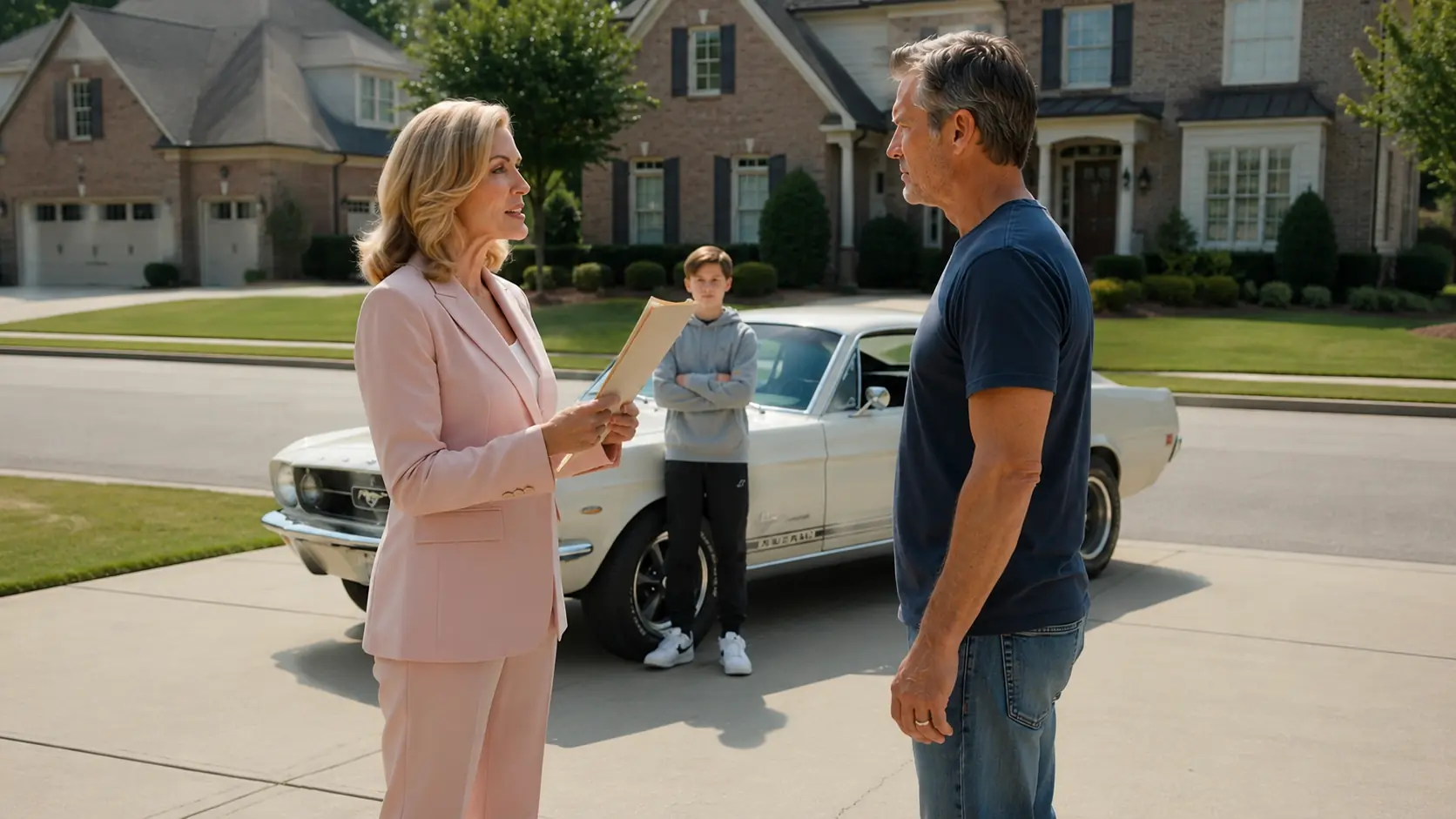
“Move, old man,” the boy said with a smirk. “Mom already won.”
The fifty-five-year-old single father stepped between the child and the workbench. He wore faded jeans, a navy T-shirt, brown work boots, and a worn University of Georgia cap. Silver touched the sides of his short dark hair, and grease marked one forearm from the morning he had spent adjusting the Mustang’s carburetor.
“You forged ownership of my late wife’s car,” he said.
The HOA president raised the papers triumphantly.
“Then call the police and watch them arrest you.”
A patrol cruiser turned into the cul-de-sac.
The single father removed his cap.
“No,” he replied. “Watch them salute their chief.”
The officers stepped out of the cruiser expecting to meet an angry homeowner accused of refusing to surrender a stolen vehicle. One officer approached with a hand near his belt while the second studied the Mustang’s license plate. The HOA president smiled as if the final act of her performance had arrived exactly on cue.
Then the single father turned around.
Both officers stopped.
Their expressions changed instantly.
“Chief,” the senior officer said.
The two men straightened and saluted.
The HOA president’s folder slipped against her hip. Her son slowly lowered his hand from the keys, and the smugness drained from his face.
The Mustang had never been an ordinary car.
The single father’s late wife had found it seven years earlier at a small restoration auction outside Atlanta. At the time, the vehicle was little more than rust, faded paint, and an engine that had not started in nearly a decade. She saw possibility where everyone else saw an expensive piece of scrap metal.
Their own son had been twelve.
The family spent four years rebuilding it together. The father repaired the transmission and engine while his wife chose the pearl-white exterior. Their son selected the cherry-red interior, insisting the color made the Mustang look alive even when it sat still.
His wife added one final detail.
She ordered a small brass plaque and riveted it to the glove compartment herself.
For my two favorite men.
Four months later, she died from a sudden brain aneurysm.
There had been no warning. One morning she was making coffee in the kitchen, and by sunrise the following day, the single father was sitting alone inside the garage, staring at the unfinished Mustang while his son slept upstairs.
After her death, the car became more than a restoration project.
It became the place where father and son could work without discussing grief directly. They sanded panels when neither knew what to say. They rebuilt the engine during the months when the house felt too quiet. Every repaired component gave them something to complete when the rest of their lives seemed permanently unfinished.
By the time the Mustang was ready for the road, the boy was nineteen and preparing to leave for college.
The single father sold their old house and purchased a quieter home in Briarwood Glen, a carefully maintained subdivision north of Atlanta. He wanted fewer memories surrounding him, but he refused to leave the Mustang behind.
He also never told his new neighbors that he was the chief of the local police department.
On weekends, he looked like any other middle-aged homeowner. He wore jeans, drove an old pickup truck, worked in his garage, and kept his badge locked inside the glove compartment. He had spent more than three decades in law enforcement and did not want neighbors treating him differently because of his title.
For several months, the arrangement gave him the privacy he wanted.
Then the HOA president arrived at his door.
She carried a store-bought pound cake on a flowered plate and introduced herself with the polished friendliness of someone who considered hospitality another form of control. She had been president of the homeowners association for nine years and spoke about the neighborhood as though she owned every driveway, fence, flower bed, and person inside it.
Her young son stood behind her in a gray hoodie, staring past the single father toward the open garage.
“Is that Mustang yours?” the boy asked.
“Yes.”
“My mom could get me one.”
The HOA president smiled.
“He loves classic cars.”
The child had never rebuilt an engine, turned a wrench, or learned the difference between restoring something and purchasing it. But the moment he saw the white Mustang, he decided he wanted it.
The HOA president asked whether the vehicle was for sale.
“No.”
“Everything has a price.”
“This doesn’t.”
She studied the car longer than politeness allowed.
“My son’s birthday is coming up.”
The single father looked toward the boy.
“He’s eleven.”
“He has a collection.”
“Then he has enough.”
The smile remained on her lips, but the warmth left her eyes.
Three days later, the first violation notice arrived.
The HOA accused the single father of storing an “unsightly non-operational vehicle” in view of the street. The Mustang was registered, insured, and parked inside his garage. The photograph attached to the complaint had been taken through a narrow window beside the garage door.
The fine was two hundred dollars.
The chief could have challenged it immediately. He knew the association had no right to photograph the inside of his closed garage, and the vehicle clearly did not violate any legitimate community rule.
Instead, he paid.
He had learned during his career that people who abused authority often revealed far more when they believed no one was watching. Challenging the first lie would have warned the HOA president to become careful.
Paying encouraged her.
Two weeks later, the second violation arrived.
It accused him of repeatedly starting a loud engine after neighborhood quiet hours. The Mustang’s battery had been disconnected for more than a month. Security footage showed that the only vehicle leaving his property during the cited time was his ordinary pickup truck at six fifteen in the morning.
He paid the second fine and saved the footage.
The third notice concerned an oil stain in the driveway.
The single father found a small puddle near the curb and an empty plastic oil container hidden behind his outdoor air-conditioning unit. Someone had poured the oil onto the concrete during the night and then photographed it the following morning.
He placed the container in an evidence bag, recorded the date, and stored it inside a locked cabinet.
His patience confused his son.
“You’re letting her do this.”
“No.”
“You paid every fine.”
“I documented every fine.”
“That’s not the same as stopping her.”
“Not yet.”
The young man looked toward the Mustang.
“Mom would have confronted her.”
The single father almost smiled.
“Your mother enjoyed winning arguments.”
“She would have destroyed that woman.”
“She would have made biscuits first.”
They both laughed, but the laughter faded quickly.
The harassment continued.
The HOA president began parking her luxury SUV close to the driveway, never fully blocking it but making entry difficult. She sent unlicensed “community inspectors” to demand access to the garage. She posted messages in the neighborhood group describing an unnamed widower who was emotionally unstable and refusing to follow basic community standards.
The single father declined the inspection and photographed the men.
A quiet records search later revealed that one had an outstanding warrant and another had previously worked for the HOA president’s husband.
The chief still said nothing publicly.
He allowed her to believe she was winning.
Her son became bolder.
Whenever he rode his bicycle or electric scooter past the house, he slowed near the garage and stared at the Mustang. One afternoon, he walked onto the driveway without permission and placed a hand on the hood.
“Don’t touch the car,” the single father said.
The boy left his palm on the paint.
“My mom says it’ll be mine soon.”
“Your mother cannot give you what belongs to someone else.”
“She says you owe the HOA twelve thousand dollars.”
“Your mother says many things.”
“She says if you don’t pay, we can take property.”
The single father approached slowly.
The child removed his hand.
“That car was built by my family,” the father said. “It carries memories you could never purchase.”
“It’s still just a car.”
“Then choose another one.”
The boy stepped back toward the sidewalk.
“I want that one.”
His entitlement did not come from childhood alone. It had been trained into him by a parent who taught that wanting something created a right to possess it. The HOA president had spent years using fines, threats, and manufactured complaints to pressure residents into surrendering property.
The Mustang was simply the first object valuable enough to attract her son’s attention.
The chief asked Internal Affairs to conduct a discreet review of the HOA president’s previous police complaints.
The results were worse than expected.
During the previous six years, she had filed twelve vehicle disputes against residents in the subdivision. Each complaint claimed her family or one of her associates had legally purchased a vehicle that the original owner refused to surrender.
Several residents fought back through attorneys.
Others could not afford the legal costs.
Four homeowners eventually sold valuable vehicles to the HOA president’s family for prices far below market value. The sales were supported by documents notarized by a woman whose license had already been revoked.
The investigation expanded into the association’s finances.
The HOA had collected nearly two hundred thousand dollars in fines over four years, but only a fraction appeared in the official expense reports. Large monthly payments had been transferred to a development company controlled by the HOA president’s husband.
That company purchased homes from residents facing overwhelming association penalties.
The properties were later resold for large profits.
It was not merely harassment.
It was a business model.
The HOA president selected homeowners who appeared isolated, financially vulnerable, or unlikely to fight. She issued escalating violations, created legal pressure, damaged reputations, and then offered a way out through the purchase of their property.
The Mustang dispute was part of the same pattern.
But this time, she had selected the wrong single father.
A major-crimes detective took control of the case because the chief was personally involved. The district attorney approved an investigation into fraud, forgery, false reporting, and conspiracy. County deputies prepared warrants for the HOA president’s home and her husband’s real-estate office.
The chief had only one role.
He would wait.
He announced through a police-community program that his restored Mustang would appear at an upcoming classic-car charity exhibition. A photograph accompanied the announcement, showing the white fastback in front of his garage.
The HOA president saw it within hours.
The public announcement forced her to act sooner than planned. If the Mustang appeared at a police-sponsored event, her claim over the vehicle would become much harder to maintain.
The following afternoon, she sent the chief a formal notice claiming that the HOA had seized the Mustang through a lien and transferred it to her son as partial settlement of unpaid fines.
The document was meaningless.
An association could not privately transfer a resident’s vehicle to a board member’s child. The signature authorizing the supposed sale was a crude imitation of the chief’s handwriting.
His son examined the paper at the kitchen island.
“She actually signed your name.”
“Yes.”
“And put the car in an eleven-year-old’s name.”
“Yes.”
“Is she stupid?”
“She’s comfortable.”
“What’s the difference?”
“A stupid person may fear being caught. A comfortable person believes the rules no longer apply.”
That evening, a teenager from the neighborhood contacted the chief’s son. The boy had been invited to the HOA president’s house and asked to sign a witness statement claiming he saw the Mustang being sold.
He refused.
His sworn statement gave investigators the final evidence they needed.
The next morning, search and arrest warrants were approved.
The chief opened the garage shortly before noon.
He rolled the Mustang halfway into the driveway and lifted the hood. Wearing jeans, a faded navy shirt, work boots, and his old UGA cap, he polished the front grille while his adult son recorded discreetly from an upstairs window.
At one forty-two, the HOA president left her house.
She wore the pastel-pink pantsuit from a recent board meeting and carried a folder thick with forged paperwork. Her eleven-year-old son followed in the gray hoodie, swinging a set of newly purchased Mustang keychains around one finger.
They stopped beside the car.
“You should step away,” the HOA president said.
The chief continued polishing.
“From my own vehicle?”
“It no longer belongs to you.”
Her son moved toward the open driver’s door.
The chief blocked him.
“Move, old man,” the boy said. “Mom already won.”
The father looked down at him.
“Winning is not taking something from a person too patient to fight early.”
The HOA president opened the folder.
“The registration is being transferred into my son’s name. You accumulated more than twelve thousand dollars in unpaid penalties.”
“I paid every legitimate fine.”
“You paid some. The rest grew with late fees.”
“Fines you invented.”
“That is an accusation.”
“It is also documented.”
For one brief second, uncertainty crossed her face.
Then a police cruiser entered the cul-de-sac.
Her confidence returned.
“I called them,” she announced. “You threatened my child and refused to surrender stolen property.”
The boy grinned again.
The officers approached.
The chief placed his cloth on the workbench, removed his cap, and faced them.
Both officers immediately saluted.
“Chief.”
The HOA president froze.
Her son looked from the uniformed men to the homeowner he had just called an old man.
The chief returned the salute.
“At ease.”
The senior officer glanced toward the Mustang.
“Sir, dispatch reported a stolen-vehicle complaint.”
“The vehicle belongs to me. The complainant has presented forged transfer documents and filed a false police report.”
The HOA president stepped forward.
“There has been a misunderstanding.”
The chief looked at her.
“You told my officers to tow my late wife’s car.”
“I relied on association records.”
“You created the records.”
Her son grabbed her sleeve.
“Mom, he’s the chief?”
She did not answer.
A detective arrived in an unmarked vehicle, followed by county deputies. The chief stepped away from the investigation, allowing the detective to handle the arrest professionally.
The HOA president tried to keep her voice steady.
“This is retaliation because I enforced community rules against him.”
The detective opened a folder.
“We have statements showing you attempted to recruit false witnesses. We have evidence connecting you to twelve similar vehicle disputes. We also have banking records tracing HOA funds into a company controlled by your husband.”
Her pink jacket suddenly looked too bright against the quiet street.
“You cannot arrest me over an HOA disagreement.”
“This stopped being an HOA disagreement when you forged a signature and used police dispatch to execute the fraud.”
The detective asked her to turn around.
Her son began crying, not because he understood the harm done to other residents, but because the world had suddenly refused to obey his mother.
“They can’t take you,” he said. “You’re the president.”
She closed her eyes.
For years, she had taught him that her title placed their family above neighbors, rules, and consequences. Now he watched officers secure her wrists in front of the car she promised would become his.
The chief crouched to the boy’s level.
“Listen carefully.”
The child stared at him.
“Your mother’s position never made her the owner of this neighborhood. Wanting my car never made it yours. Learn that now, or someday you will stand where she is standing.”
The boy said nothing.
County deputies executed the search warrants immediately. They recovered forged sale documents, blank HOA forms, invalid notary stamps, financial ledgers, and templates used in previous vehicle disputes. A home safe contained cash connected to association funds.
The HOA president’s husband was arrested at his office that afternoon.
By evening, every board member had resigned.
The HOA president later pleaded guilty to fraud, forgery, filing a false police report, and conspiracy. She received prison time, was ordered to repay the residents she had defrauded, and was permanently barred from holding a position in any homeowners association.
Her husband received a longer sentence for financial crimes and property fraud.
Several families recovered money lost through illegal fines. Two former residents were compensated after being pressured into selling their homes below market value.
The young son was sent to live with relatives.
Months later, he wrote a letter to the chief.
The handwriting was uneven.
He apologized for touching the Mustang and for calling him an old man. He admitted that his mother had repeatedly told him good things belonged to people powerful enough to take them.
The chief read the letter twice.
He did not answer immediately.
His own son found him sitting in the garage beside the Mustang.
“You going to write back?”
“Yes.”
“What will you say?”
“That his mother taught him something dangerous, but he still gets to decide whether he keeps believing it.”
The chief eventually sent a short response.
You are not responsible for every lesson you were given. You are responsible for what you do after learning it was wrong.
The Mustang stayed with the family.
On the first Saturday of every month, father and son drove it to the cemetery where the late wife was buried. They parked nearby, lowered the windows, and sat without music.
Sometimes they spoke about her.
Sometimes they listened to the engine cool.
The chief later established an automotive-restoration scholarship in his wife’s memory. It funded training for young Americans who could not afford technical school and wanted to learn engine repair, bodywork, or classic-car restoration.
Each graduate received a small reproduction of the brass plaque inside the Mustang.
For my two favorite men.
The plaque had once represented one family.
Now it reminded every student that restoration was more than repairing metal. It was the act of refusing to discard something simply because it had been damaged.
The HOA president believed the Mustang was valuable because it was rare.
The single father knew its real value came from grease-covered weekends, his son’s laughter, his wife’s fingerprints beneath the dashboard, and the years when rebuilding the car kept two grieving people from falling apart.
She could forge a receipt.
She could manufacture a fine.
She could call the police and pretend authority belonged to whoever spoke the loudest.
But she could never manufacture the history inside that vehicle.
Her empire did not end because the single father outranked her.
It ended because he remained patient while she created evidence against herself.
He paid the first fines.
He saved every notice.
He recorded every threat.
He allowed her to believe that quietness meant surrender until she finally summoned the very officers who knew exactly who stood in that driveway.
And when those officers saluted, the HOA president learned the lesson she had avoided for years:
The person you are trying to crush may possess more authority than you.
But even when they do not, what belongs to them is still not yours.