She was a poor 70-year-old farmer who barely had food for herself, yet she fed a homeless couple who collapsed near her land. She cleaned their injuries, gave them a bed, and watched them leave before dawn.
A week later, the bank arrived to take everything.
As her belongings hit the dirt, an SUV rolled in. Two familiar figures stepped out.
Eleanor Whitaker woke before the light turned gray and shoved the kettle onto a burner that did not sit flat.
At seventy years old, she moved slowly at first, the way old bones demanded, but there was still discipline in the way she rose.
Her thumbnail picked at a chip on the ceramic mug.
The house held on to the cold from the night before like it was structural.
She wound a wool scarf tight around her neck, rubbed one hand over her aching hip, kicked the door open with the side of her boot, and stepped into a yard where the machinery looked dead rather than sleeping.
The harvester listed to the left, its tires sinking into the mud.
The fuel drum let out a hollow wheeze when she tapped the gauge.
Her late husband, Walter, had wanted to scale up.
He had bought the big green tractors, the pivot irrigation, and the dryer that was supposed to pay for itself in two seasons.
The sickness moved faster than the loan terms.
The day he died, the debt cemented itself to the land.
The promissory notes totaled numbers Eleanor did not like to say out loud.
Interest accumulated in the dark.
She shoved the collection letters under a heavy flower tin and put a cast iron skillet on top to keep them down.
She primed the yard pump, watching the water spit and cough through a line that had needed taping months ago.
Her knees complained when she knelt to dig out a clogged nozzle.
She winced when a shard of gravel sliced her cuticle.
She pressed the cut against her apron until the sting dulled.
Then she got back to work.
She wrote yield estimates in a spiral notebook, then copied them onto the back of a grocery receipt.
The banker’s voice from the phone call yesterday was still stuck in her ear.
“Final liquidation review next Tuesday. Bring the books.”
She had books.
They just were not the kind the bank wanted.
She had seed weights scribbled in the margins of a church bulletin, diesel receipts stuffed in a jelly jar, and a calculator that did not register the number two unless she hit it twice.
She rubbed her wrist and walked to the dryer.
It groaned once, spun half a rotation, and quit.
She held the starter button down until she smelled burning wiring, then let go.
At seventy, she knew when a machine was only being stubborn and when it was warning her not to push.
This one was warning her.
A pickup truck dragged past on the road, slowing down just enough to look, then speeding up.
Eleanor walked the fence line, testing the posts with her boot.
She moved carefully over the uneven ground.
There had been a time when she could cover all sixty acres before breakfast.
Now she stopped more often, not because the land was larger, but because her lungs had gotten smaller and her knees had begun keeping records of every year.
At the cedar tree where Walter used to sharpen the mower blades, the wood was worn smooth.
She placed her palm there for one second.
Then she took a breath that tasted of dust and kept walking.
By noon, she had spliced a broken wire.
She heated up a tin of beans, tore off a heel of stale bread, and ate standing over the sink because sitting down too long made it harder to stand back up.
Traffic was heavy on the road.
Neighbors passed by slowly.
A woman in a clean white SUV slowed down and rolled the window halfway.
“You ought to let the South Forty go, Mrs. Whitaker,” she called out.
From a sedan behind her, someone said, “Heard the auctioneers are coming.”
Eleanor wiped her hands on her jeans and gave a sharp nod.
The cars moved on.
The afternoon wind stripped the moisture right out of the dirt.
She tied a bandana over her face and dragged a toolbox across the gravel.
The toolbox used to feel light.
Now it bumped against stones and pulled at her shoulder.
At the harvester, she found a belt hanging by a thread.
She laid her hand on the cold steel.
She cranked a wrench on a rusted bolt until the muscle in her shoulder seized up.
She stopped, breathed through her nose, counted to ten, then tried again.
Inside, she spread paperwork across the kitchen table.
She tried to make a ledger out of the scraps.
The phone vibrated against a dinner plate.
“Ma’am, we need to finalize the asset list,” the voice said.
She listened.
She did not argue.
When the line went dead, she wrote the inventory list out twice.
Darkness dropped fast.
She threw salt on the concrete steps so the frost would not make them slick, the same spot where Walter had slipped that one winter and cursed loud enough for the chickens to scatter.
She washed her hands in a dented metal bowl, watching the water turn cloudy with dirt and grease.
She checked the padlock on the shed and the hook on the chicken coop.
A hen ruffled its feathers and went still.
Eleanor stood in the doorway until the crickets started their noise.
The house smelled of lye soap and old diesel.
She folded the bank notice and slid it back under the flower tin.
One week.
The clock was already running.
She killed the light and sat at the table in the dark, palms pressing into the wood, keeping the room from spinning.
Morning brought the same gray frost.
Eleanor got up, cracked her back, and walked through the house, avoiding the squeaky floorboards out of habit, though there was no one left to wake.
Outside, dew coated the dead stalks like varnish.
She bent down slowly, ripped up a thistle, and wiped the dirt on her pants.
A flatbed truck braked at the gate, paused, then rolled on.
She did the grunt work first, the tasks that did not require thinking.
She threw grain to the birds, tightened a valve, and stacked two wooden crates she figured she could sell for firewood.
Each crate made her arms tremble, but she stacked them anyway.
A neighbor across the road shouted something about the bank officers being in town.
She heard it, categorized it as noise, and kept working.
By ten o’clock, the gossip had drifted into her yard.
Two women leaned on the fence down the way.
One said the place was finished.
The other said it was a shame, but that was what happened when old people refused to sell out early.
They laughed.
The sound drifted away as the wind turned.
Eleanor loaded a sack of feed into her truck.
She could not lift it clean anymore, so she dragged it to the tailgate, braced it against her knee, and shoved it in a little at a time.
Then she drove to the supply depot.
The clerk at the register stared at her raw knuckles.
“Forgot your gloves, Mrs. Whitaker?” he asked.
She gave a tight smile.
He rang up the cheapest bag of feed.
Outside, a man she knew from the co-op asked if the auction date was set.
“Not yet,” she said.
He shrugged, said, “Tough break,” and walked away.
Back at the house, she tried the pump again.
Water surged.
Then the pressure died.
She knelt in the mud, cleared the grit, and got a thin stream going.
Getting back up took longer.
She filled the bucket.
She told herself she needed to document the maintenance.
Banks liked documentation.
The afternoon was heavy and hot.
She fixed what broke and marked what she could not fix with red tape.
A note went on the fridge.
Price out combine parts.
Another went on the door.
Lock the tool chest.
As the sun dipped, a noise came from the ditch line.
Not a machine.
A scraping sound.
Then a low grunt.
Eleanor stopped in the yard.
She listened.
There it was again.
A weak sound.
Human.
She walked past the fence, one hand on the rail to steady herself.
Two figures were tangled in the tall grass near the drainage pipe.
A man gripped his arm, his face gray.
A woman held him up, looking around wild-eyed.
They were both dirty, soaked, and shaking.
The man’s sleeve was torn.
The woman had blood dried along one temple.
Eleanor looked back at her house, then at them.
She did not ask what happened.
She did not ask where they came from.
Questions could come after breathing, heat, and clean water.
She got under the man’s good arm and took what weight she could.
At seventy, she could not haul him the way a younger farmer might have.
So she told the woman, “You take his belt. I’ll take his arm. We move when I say move.”
It was a slow, ugly walk to the porch.
Every few feet, the man’s knees buckled.
Every time, Eleanor planted her boots and held on.
By the time they reached the door, sweat had gathered under her scarf despite the cold.
Inside, she dropped them on the rug near the wood stove.
She put water on to boil.
She crushed up aspirin with the back of a spoon and washed the cut on the man’s arm with harsh soap.
The woman hissed in sympathy.
The man bit down on his sleeve and said nothing.
Eleanor cleaned the blood off the floor without saying a word.
They ate the beans she had left over.
She gave them the last of the stale bread too.
She watched their hands stop shaking.
When the man passed out from exhaustion, the woman muttered a thank you and cried quietly into her collar.
Eleanor did not offer comfort in any soft, sentimental way.
She just placed a quilt over the woman’s shoulders and kept wiping down the counters.
That was comfort enough.
They were gone before sunrise.
Eleanor found the rug folded neatly near the stove and the cups washed in the sink.
They left a piece of notebook paper on the table.
No return address.
Just a few words.
You did not ask who we were.
You only helped.
We will not forget.
Eleanor read it once.
Then she folded it into a square and shoved it in a drawer.
The sun came up.
She scrubbed the floor where the mud had dried.
She put the house back to rights.
She did not expect a thing.
Three days went by.
Then four.
The phone rang once, and she let it go to voicemail.
On the seventh morning, three sedans turned into her driveway.
Men in suits got out.
Neighbors appeared at the fence line like they had scented smoke.
Eleanor stood on her porch with both hands wrapped around the railing.
Her kitchen table was carried out into the yard.
Then a chair.
Then two boxes of dishes.
Her late husband’s old toolbox hit the dirt hard enough to make her flinch.
A shadow cut across the gravel.
Tires crunched.
An SUV caked in road dust pulled in behind the bank cars.
The door opened slowly.
The boots that stepped out were expensive, but covered in dried mud.
The man stepped out first, favoring his left arm.
The woman followed, her sleeve pulled up to show a bandage.
They looked at the house, then at Eleanor, then at the repo men holding clipboards.
Eleanor did not speak.
She watched the lead bank agent clear his throat.
He mispronounced her last name.
Then he corrected himself and kept reading from the file.
Outstanding balance.
Immediate forfeiture.
Asset seizure.
Eleanor clamped her hands behind her back so no one would see them shake.
The man from the SUV raised a hand.
He did not yell.
He just told the agent to hang on.
The agent looked annoyed, tapping his pen.
The woman walked up to the porch.
She looked Eleanor in the eye.
“You took us in on a bad night,” she said. “In a ditch.”
The crowd at the fence leaned in.
The woman continued.
“You did not ask our names. You did not ask if we could pay. You cleaned our wounds, fed us, and gave us a floor by the stove when you barely had enough for yourself.”
A murmur went through the neighbors.
“Who are they?”
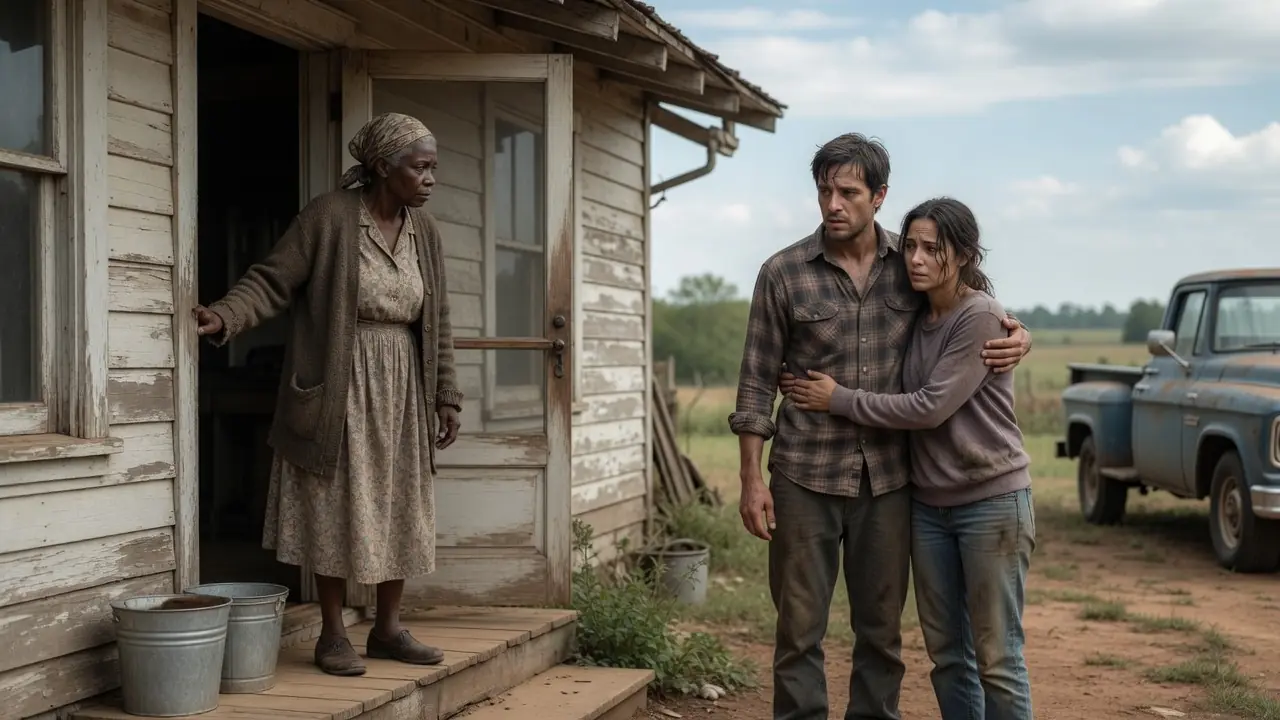
“Is this some kind of scam?”
The man spoke up.
He said they bought distressed commercial paper and rural debt.
They scouted properties quietly.
That night, they had been checking a plot three miles over when they were attacked by men who thought their car carried cash.
No cell service.
No way to call for help.
They crawled through the ditch line until they reached Eleanor’s land.
“She took us in,” the man said. “And if she had not, my wife and I might not be standing here.”
He handed the bank agent a thick manila folder.
Inside was a certified check for the full arrears, late fees, and interest.
The agent looked at the check, then at the man.
His posture collapsed a little.
He mumbled that he would need to print a receipt.
The movers stopped hauling boxes.
A chair was set back down on the grass.
Someone in the crowd laughed, a sharp, nervous sound.
The woman walked around the yard.
She pointed at the harvester.
She asked about the hydraulics.
She asked about the water table.
She asked to see the books.
Eleanor almost laughed.
“The bank didn’t like my books.”
“I’m not the bank,” the woman said.
Eleanor went inside and pulled out the spiral notebook.
The woman did not sneer.
She flipped through the pages carefully.
She asked to see the pump.
At the wellhead, the woman squatted down and felt the taped-up line.
She nodded.
She asked if she could tighten a flange.
Eleanor watched her in silence.
The man was still talking to the agent, discussing terms in a low voice.
The neighbors edged closer.
“She must have known them,” someone whispered.
“Lucky break,” said another.
The agent handed over a stamped paper.
Lien released.
Title restored.
He said, “Congratulations, Mrs. Whitaker,” in a way that sounded like he had swallowed a bug.
The couple did not leave when the crowd dispersed.
They helped carry the kitchen table back inside.
They sat at it with Eleanor while the afternoon light turned thin.
They asked what she needed to make the place run in ink instead of prayers.
Eleanor said she needed the land to pay for itself.
They nodded.
They did not talk about saving the farm like it was a fairy tale.
They talked about capital expenditure, operational drag, and what could be repaired before planting season.
They said they put money where the work was already happening.
Outside, the sun went down.
The kettle whistled.
Eleanor poured three cups of tea.
Nobody was in a hurry.
The night felt heavy, but stable.
They came back the next day in work clothes.
The man rolled up his sleeves and walked the irrigation line, counting paces.
The woman spread spreadsheets on the table and asked for every scrap of paper in the house.
Receipts.
Notes.
The jelly jar.
The grocery receipt with yield estimates.
The church bulletin with seed weights in the margin.
She sorted them by date, stapling them into neat piles.
Trucks showed up two days later.
A mechanic with grease under his nails crawled under the harvester.
He dropped the broken belt on the ground and swore parts were ordered.
The pump line was dug up and replaced with PVC.
Water pressure hit the gauge and held steady.
The woman noted the flow rate in a fresh ledger.
Neighbors watched from the road.
Some set up lawn chairs.
Some just idled their trucks.
A man muttered that things were finally turning around.
Eleanor kept working.
She did not suddenly become young because someone wrote a check.
Her knees still hurt.
Her hands still stiffened in the cold.
Her back still locked if she bent too long.
So the couple hired two local hands for the heavy lifting and made sure Eleanor remained the one who made the decisions.
She checked oil levels, inspected seed, walked the rows, and learned how to read the new inventory sheets.
She listened more than she talked.
Weeks turned into a season.
The couple did not hover.
They set up a system.
A real ledger replaced the notebook.
A laminated calendar on the wall showed planting dates and maintenance intervals.
A cheap tablet sat on the counter with a spreadsheet open.
Eleanor learned which cells to fill in.
When she messed up the formula, the woman just reset it.
No sighing.
No scolding.
No making her feel old.
The first harvest after the repairs was light, but the grain was dry.
The dryer ran without smoking.
The moisture content was acceptable.
A buyer offered a standard market rate.
The man shook hands on the deal.
No speeches.
They paid the work crew on Friday.
In full.
News of that traveled faster than the gossip had.
The repairs kept going.
Fences were pulled tight.
The granary roof was sealed.
Insurance premiums were paid.
The woman asked Eleanor to explain the topography.
Where the frost settled.
Where the deer came in.
Where the wind shear hit the hardest.
Eleanor pointed with a muddy boot.
The woman just watched.
By the second season, the numbers looked like math, not a gamble.
Waste went down.
Fuel usage was tracked to the gallon.
Breakdowns were anticipated instead of feared.
Eleanor stood at the edge of the field one evening and looked at the straight rows.
She exhaled.
She did not count her blessings.
She counted the bushels.
The neighbors changed their tune.
The woman who had told her to sell brought over a casserole.
A man offered a spare hydraulic hose.
Eleanor thanked them and went back to work.
She did not ask why they were being nice now.
At a town hall meeting, the couple spoke to the room.
They said debt killed good operations.
They said liquidity saved them.
They said they were opening a micro-lending pool for local farms with strict audits.
No handouts.
Just bridge loans, oversight, and honest books.
Eleanor signed the sheet last.
She did not look around for approval.
She went home and scrubbed the grease off her arms.
That night, the fields were warm.
The harvester sat ready in the shed.
She locked the door and checked it twice.
Inside, she wrote out the task list for tomorrow.
The pen moved smooth across the paper.
She slept without dreaming.
A year passed.
The farm did not get famous.
It just got solvent.
The rows filled in.
The machines started on the first turn.
The books balanced.
Eleanor learned to trust the ledger.
She kept the habits that paid off and ditched the ones that did not.
The lending pool started small.
Three farms.
Then six.
Every line of debt was reviewed.
Repairs were mandated before planting.
Some farms went under anyway.
No one hid that fact.
Most stayed afloat.
The land responded to the mechanics of the work, not the hope of it.
The neighbors spoke differently now.
Less advice.
More questions about fertilizer ratios.
A few apologized by dropping off tools.
Others stayed away.
Eleanor let them be.
On quiet evenings, she walked the fence line.
Slower than before, but steadier.
At the cedar tree, she touched the old notch where Walter used to sharpen blades.
It was still smooth.
She kept a folding chair on the porch for anyone who looked tired.
She still fed people if they showed up hungry.
She did not ask for names.
One afternoon, a young woman pulled into the drive holding a foreclosure notice and shaking.
Eleanor poured a glass of tap water, pulled out a chair, and said, “Sit.”
She listened.
Then she called the office number the couple had set up.
The young woman wiped her face and stopped shaking.
At harvest time, the trucks lined up.
The checks cleared.
The couple stood by the gate and watched.
They talked about ROI and soil composition.
Eleanor nodded.
She understood the soil.
On the anniversary of the day the bank almost took it, she worked an extra hour, not to honor the memory, but to make sure the work was done.
She oiled a chain.
Sharpened a blade.
Balanced the checkbook.
She did not celebrate.
Late one night, she found the old note from the strangers in the back of the drawer.
No return address.
You did not ask who we were.
You only helped.
We will not forget.
She folded it smaller and put it back.
The land was hers.
Not because she was saved.
But because the help she got met the sweat she put in.
One door opened.
The rest was just walking through it day after day, keeping her hands steady and her eyes on the dirt.