“Hey, leave him alone. That’s enough.”
“Relax. It’s just a joke.”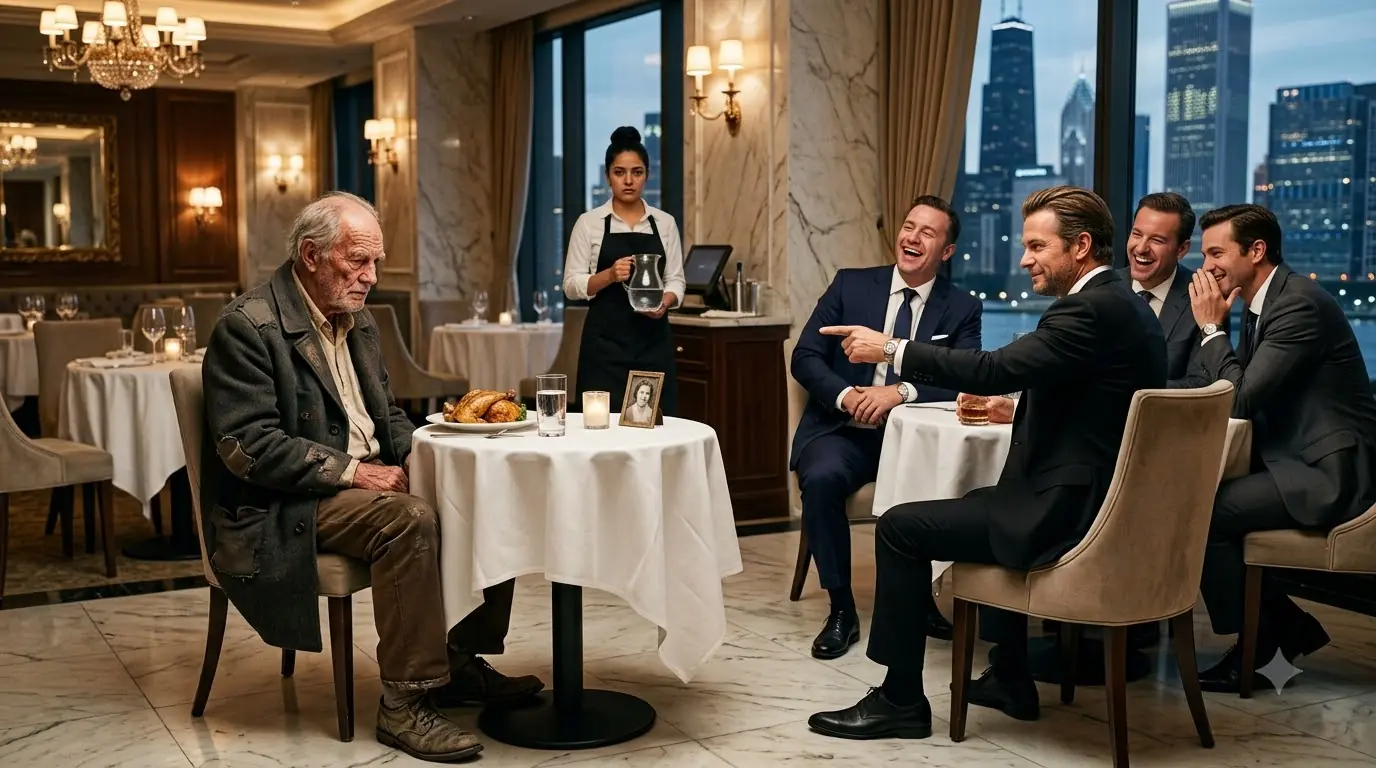
“A joke? That’s my father. I could buy this whole restaurant. Apologize.”
“Whoa. We had no idea.”
“Stop it. Leave him alone.”
“Mind your business, waitress.”
“He’s a customer. Show some respect.”
“What is going on here?”
“Who are you?”
“His daughter. And you’re done here.”
A kind waitress defended an old man being mocked, unaware that his daughter was a billionaire.
The rain had just stopped over the city when the old man pushed open the glass doors of Le Voisin, the most expensive restaurant in the financial district. He did not look as though he belonged there, and everyone in the room seemed to decide that the moment he stepped inside. His coat was patched at the elbows, gray with age and weather. His shoes were split at the seams, and his hands trembled slightly, not from fear, but from years of work, loss, and carrying more than his body could comfortably hold.
His name was Elmore Whitfield. He was seventy-eight years old. And today, of all days, he had come to eat alone.
“Table for one,” he said quietly at the host stand, his voice rough with age.
The young host, a sharp-jawed man in a slim black suit, looked him over from head to toe. His eyes lingered on the torn sleeve, the scuffed shoes, and the frayed collar.
“Sir, I think you may have the wrong address,” the host said, his tone coated in false politeness. “This is a reservation-only establishment.”
“I called ahead,” Elmore replied. “Table for Whitfield. Six o’clock.”
The host’s smile faltered.
He turned toward the computer and checked the reservation list. There it was, exactly as Elmore had said. A reservation under Whitfield, paid in advance and confirmed.
The young man had no choice.
“Right this way,” he muttered.
He led Elmore toward the back of the restaurant, as far from the large front windows and the most visible tables as possible.
Elmore did not complain.
He rarely did.
He simply nodded, thanked the young man, and lowered himself carefully into the chair.
On the table sat a small, unlit candle. Tucked inside Elmore’s coat pocket was a photograph worn soft at the edges from years of handling. It showed a woman with kind eyes and a gentle smile.
Today would have been her sixty-fifth birthday.
His wife, Corinne, had been gone for three years.
Every year on her birthday, Elmore went somewhere special, somewhere she would have loved, and ordered her favorite meal. Roast chicken with rosemary. A glass of red wine that he never completely finished.
It was the only extravagance he allowed himself all year.
He would sit quietly, place her photograph somewhere near him, and imagine that she was across the table again, smiling at something he said.
He did not know that tonight, that private ritual would be shattered.
Twenty feet away, five men in tailored suits were already three rounds of Scotch into a celebration.
They were investment bankers, all of them, celebrating a deal that had closed that afternoon. A deal worth more than most people would earn in several lifetimes.
Their laughter was loud and careless, the kind of laughter that filled a room because the people making it had never once worried about being unwelcome in one.
“Boys, to another record quarter,” said Desmond Cole, raising his glass.
Desmond was the loudest of them. Broad-shouldered, immaculately dressed, silver cufflinks catching the light, a Rolex visible beneath his sleeve.
His friends lifted their glasses.
Whit Hargrove sat beside him, already flushed from the alcohol. Bradley Voss leaned back in his chair with the relaxed confidence of a man accustomed to expensive places and easy access.
It was Desmond who noticed Elmore first.
“What in the world is that?”
He did not even bother lowering his voice.
Whit turned and looked toward the old man.
Then he chuckled.
“I think the health inspector let someone in by mistake.”
The men laughed.
Elmore heard every word.
His hearing, unlike his hands, had never betrayed him.
But he had lived long enough to understand that some battles were not worth entering. He simply lowered his eyes to the menu and pretended he had not heard.
“Seriously, though,” Bradley said, dabbing his mouth with a napkin. “How does somebody dressed like that even get a table here?”
“Maybe he wandered in from the subway,” Whit said.
“Maybe he’s here for the free bread,” Desmond added.
The table erupted again.
At the host stand, a young woman had just started her shift.
Her name was Junie Alvarez.
She was twenty-six years old, with her hair pulled into a low knot and a black apron tied twice around her narrow waist. She had worked at Le Voisin for eight months, ever since her mother’s medical bills had turned every extra shift from a choice into a necessity.
Junie noticed Elmore immediately.
Not because of his clothing.
Because of his eyes.
There was something in them, a quiet dignity that did not demand attention but somehow earned it anyway.
She also noticed the table of loud men.
And she noticed where their laughter kept drifting.
“Table six needs a server,” her manager, Priscilla Danes, said flatly.
She pointed toward Elmore.
“You’ve got it.”
Junie walked toward him with a warm smile already on her face.
It was not performed.
It was simply how she treated people.
“Good evening, sir. Can I start you with something to drink?”
Elmore looked up, surprised by the warmth in her voice.
Most people who looked at him lately did so with pity, irritation, or contempt.
Not Junie.
“Water is fine,” he said. “And do you still make the roast chicken with rosemary?”
“We do. It’s one of my favorites on the menu.”
Junie smiled.
“Great choice.”
“My wife’s favorite,” Elmore said quietly, almost to himself.
Something in his voice made Junie pause.
She did not ask what had happened.
She simply nodded in the gentle way people sometimes did when they recognized that someone was carrying a memory too heavy for unnecessary questions.
“I’ll bring your water right out.”
As Junie turned away, she noticed Desmond’s table watching her.
“Sweetheart,” Desmond called, waving her over with two fingers as if summoning someone beneath his notice. “Come here.”
Junie approached.
Her professional smile remained steady.
“How can I help you, sir?”
Desmond gestured toward Elmore with his chin.
“Is management aware there’s a homeless man eating in here?”
He lowered his voice slightly, though not enough to keep anyone nearby from hearing.
“Some of us are trying to enjoy a meal.”
Junie felt her stomach tighten.
“He’s a paying guest, sir. Just like you.”
“A paying guest?” Whit repeated.
He laughed into his glass.
“With what? Spare change?”
“Maybe he found a twenty on the sidewalk,” Bradley said.
The table roared again.
Junie’s jaw tightened, but her voice remained controlled.
“Is there something else I can bring your table?”
“Yeah,” Desmond replied. “Another round.”
Then he leaned back in his chair.
“And maybe ask your manager why the dress code apparently doesn’t apply to certain people.”
Junie did not answer.
She turned and walked away.
Her hands trembled slightly at her sides, not because she was frightened, but because of how hard she was working to keep herself professional.
She glanced once toward Elmore.
He was staring down at his water glass.
His shoulders had pulled slightly inward, as though he were trying to take up less space in the restaurant than he already did.
Junie’s heart hurt for him.
The evening continued.
And the comments did not stop.
Every few minutes another remark floated from Desmond’s table. A joke about Elmore’s clothing. A joke about begging. A joke about how certain people should know when they were not wanted.
Elmore said nothing.
He ate slowly and methodically.
Occasionally, his eyes moved toward the empty chair across from him.
That was where Corinne should have been.
In his memory, she was still there.
Laughing when he said something foolish.
Telling him not to order dessert and then stealing half of his.
Junie brought his meal personally.
She refused to allow anyone else to handle table six.
She refilled his water before he asked.
Each time she passed, she lingered just enough to remind him that at least one person inside Le Voisin saw him as a human being rather than entertainment.
“Is everything all right, sir?” she asked gently as she set down his plate.
Elmore looked up.
For the first time that evening, warmth crossed his weathered face.
“It’s perfect.”
He paused.
“Thank you. Truly.”
“Of course.”
Junie smiled.
“Enjoy your dinner.”
She still had no idea who he was.
She did not know anything about his finances.
His family.
His past.
She only knew that an elderly man was being treated cruelly and somebody needed to remember that he was human.
She had no idea that her small acts of kindness, pouring water, speaking gently, and treating Elmore with dignity, were about to collide with the careless cruelty of five wealthy men in a way that would change every life around those tables.
Because Desmond Cole was not finished.
He pushed himself out of his chair.
The alcohol made his movement slightly unsteady.
Then he started walking toward Elmore’s table with a smirk stretched across his face.
“Hey, old-timer,” he called loudly enough for most of the restaurant to hear. “Why don’t you do us all a favor and…”
He never finished.
Junie stepped directly into his path.
She planted herself between Desmond and Elmore’s table.
Her chin lifted.
“That’s enough.”
The restaurant went silent.
The words seemed to remain suspended in the air.
Desmond blinked down at her.
For several seconds, he looked as though he could not process what had happened.
People did not speak to Desmond Cole that way.
Not employees.
Not clients.
Certainly not waitresses.
“Excuse me?”
“I said that’s enough.”
Junie’s heart hammered against her ribs, but her voice remained steady.
“He’s a guest here, same as you. He hasn’t bothered anyone. Please return to your table.”
Several nearby diners stopped eating.
Forks hovered halfway to mouths.
Elmore sat motionless behind Junie, his hands gripping the edge of the table.
Desmond laughed once.
It was short and disbelieving.
Then he glanced at his friends, inviting them to share his amusement.
“Is this a joke, sweetheart?”
His smile disappeared.
“Do you know who I am?”
“I know you’re a customer.”
Junie looked directly at him.
“One who’s had enough to drink and one who’s been making an elderly man feel unwelcome for nearly an hour.”
Her voice strengthened.
“I’m not going to stand here and let that continue.”
“You’re not going to let it continue?”
Desmond stepped closer.
Junie could smell the Scotch on his breath.
“You’re a waitress.”
His voice lowered.
“You bring food. You refill water. You don’t get an opinion.”
“I get to be a decent human being.”
Junie’s answer came before fear could stop it.
“Something you might try sometime.”
A ripple of laughter moved through a nearby table.
Not from Desmond’s group.
From strangers.
People who had been watching the cruelty and saying nothing now found themselves watching Desmond become the uncomfortable one.
His face turned red.
Desmond was not accustomed to being laughed at.
He was accustomed to deciding who the joke was about.
“You know what?”
His voice rose.
“Get your manager.”
Junie nodded.
“Gladly.”
But her stomach twisted.
She already knew how this would probably end.
Priscilla Danes arrived less than two minutes later, her heels striking the marble floor in quick, sharp steps. Her expression was already arranged into the apologetic mask of someone preparing to protect an important customer before even learning what had happened.
“Mr. Cole, I am so sorry for any trouble.”
She had not asked a single question.
“What can I do to make this right?”
Desmond pointed toward Junie.
“Your waitress just humiliated me in front of my associates.”
He flicked his hand toward Elmore.
“And frankly, I’d also like to know why a man dressed like that was seated in the same room as your paying clients.”
Priscilla’s eyes moved toward Junie.
Junie saw the decision happen in her face before it was spoken.
She had watched similar choices many times during eight months at Le Voisin.
Inside this restaurant, money usually outranked truth.
“Junie,” Priscilla said tightly, “apologize to Mr. Cole.”
Something inside Junie became very still.
Very clear.
“I won’t do that.”
Priscilla stared at her.
“I didn’t do anything wrong. He and his friends have been mocking an elderly customer for almost an hour. I asked them to stop. I’m not apologizing for that.”
Priscilla’s face paled.
“Junie.”
“It’s okay.”
Junie spoke before her manager could continue.
“I understand exactly what you’re asking me to do.”
She glanced toward Desmond.
“I’m telling you I won’t do it.”
A slow, satisfied smile appeared on Desmond’s face.
The smile of a man who believed he had won.
“Well, then.”
He folded his arms.
“I suppose the question is whether she keeps her job tonight.”
The restaurant had become almost completely silent.
Conversations stopped.
Forks rested against plates.
Every eye in the room was fixed on the confrontation beside table six.
Priscilla stepped closer to Junie.
Her voice dropped to a desperate whisper.
“Please. Just apologize.”
Junie looked past her.
Elmore was staring at her.
The expression on his face was something she would remember for the rest of her life.
Not pity.
Not embarrassment.
Awe.
As if he could not quite believe that a stranger would risk something for him.
Junie made her choice.
“I’m not apologizing for treating a customer with basic human dignity.”
She raised her voice just enough for the room to hear clearly.
“If that costs me my job, then it costs me my job.”
She took a breath.
“But I’m not going to stand here and pretend what happened at that table was acceptable, because it wasn’t.”
Desmond’s smile widened.
“Then I suppose we have our answer.”
He turned toward Priscilla.
“Fire her tonight or my firm pulls every event we have booked here for the next two years.”
Priscilla went pale.
Desmond continued.
“That includes next month’s gala.”
He leaned closer.
“I trust you understand the math.”
Priscilla’s face crumbled.
Junie watched her manager’s hands shake as she reached toward the radio clipped near her waist.
Before Priscilla could speak, a quiet voice interrupted.
“Excuse me.”
Everyone turned.
Elmore had risen from his chair.
He used the table for support, his hands trembling slightly as he steadied himself.
“This young woman has done nothing but treat me with kindness tonight.”
His voice was thin with age, but it carried through the silent restaurant.
“Kindness I have not received from anyone else in this building.”
His eyes moved across the room.
“If she loses her position because of that, then I want it publicly known that she lost it because she chose decency over cowardice.”
Desmond scoffed.
“With respect, old man, this doesn’t concern you.”
“It concerns me entirely.”
Something changed in Elmore’s eyes.
The gentleness remained, but underneath it was something harder.
Unshaken.
“Because it was my dignity she defended.”
He looked toward Junie.
“And I will not sit quietly while she pays the price for it.”
For one strange moment, something flickered across Desmond’s face.
Not recognition exactly.
Something close.
He studied Elmore more carefully.
The shape of his face.
The set of his jaw.
The steadiness in his eyes.
As if somewhere in his memory there was a photograph or a name he almost recognized.
Then he dismissed it.
“Whatever you say, pal.”
Desmond looked back at Priscilla.
“Fire her.”
Priscilla’s eyes filled with tears.
“Junie, I’m sorry.”
Her voice shook.
“I have no choice.”
Junie’s expression remained calm.
“You’re going to need to clock out.”
Junie nodded slowly.
Her chin trembled.
Her spine stayed straight.
She untied her apron with steady hands, folded it neatly, and placed it on the edge of the service station.
“It’s okay,” she said.
It was not okay.
Her mother’s medications flashed through her mind.
The electric bill.
The rent due in nine days.
Groceries.
Transportation.
All of it arrived at once.
But Junie kept her expression controlled.
“I’d make the same choice again.”
Before leaving, she turned toward Elmore.
Her eyes softened.
“It was an honor serving you tonight, sir.”
She managed a small smile.
“I hope the rest of your evening is peaceful.”
Elmore reached forward and took her hand gently between both of his.
“Young lady.”
His voice was thick with emotion held tightly under control.
“You have no idea what you’ve just done.”
Junie looked at him.
“But you will.”
He squeezed her hand once.
“I promise.”
Junie gave him a tired smile.
She assumed he was simply an old man trying to comfort her during one of the worst moments of her life.
Then she walked out of Le Voisin without a job, without a paycheck, and without any idea that the elderly man she had defended was about to change everything.
As Junie moved toward the entrance, Elmore quietly slipped a folded piece of paper into the outer pocket of her coat without her noticing.
She stepped into the cool night air.
Her old sedan was parked three blocks away in the least expensive parking lot she could find.
Inside the restaurant, Elmore waited until she disappeared.
Then he removed a sleek phone from inside his coat.
He made one call.
“It’s me.”
The voice on the other end answered immediately.
“I need you to find someone.”
Elmore looked through the glass toward the sidewalk.
“Her name is Junie Alvarez.”
He paused.
“I need you to find her tonight.”
The woman on the other end had a sharp, commanding voice, the kind used to giving instructions that moved enormous amounts of money.
But when she heard Elmore, the voice softened immediately.
“Dad?”
A pause.
“What happened? Are you all right?”
“I’m fine.”
Elmore continued watching the street where Junie had disappeared.
“But I just met someone who reminded me exactly who your mother was.”
His expression hardened.
“And I’m not going to let this go unanswered.”
Three days passed.
Junie Alvarez had not found another job.
She sat at the small kitchen table in her apartment with a stack of bills spread in front of her like a losing hand of cards.
She did the math once.
Then again.
Then a third time.
The numbers never changed.
Her mother, Rosalind, stood in the doorway of her bedroom, leaning against a cane.
Her face was lined with concern.
“You’ll find something, mija.”
Rosalind smiled gently.
“You always do.”
“I know, Mama.”
Junie forced a smile she did not feel.
“I have two interviews this week.”
That was not entirely false.
She had arranged two interviews.
What she had not told Rosalind was that both restaurants had already called back afterward to say the position had been filled.
The speed of those rejections bothered Junie.
One manager had seemed interested right up until he reviewed her references.
Then something changed.
His voice became distant.
The conversation ended quickly.
Junie could not prove anything, but part of her wondered whether someone had contacted Le Voisin.
Or whether Desmond Cole’s influence extended farther than she had imagined.
She did not tell her mother about Desmond.
Or Priscilla.
Or being fired.
Rosalind’s heart condition was fragile, and stress was exactly what her doctor had told her to avoid.
So Junie carried the situation herself.
She had become good at carrying things alone.
That afternoon, needing air more than answers, Junie walked to Miller’s Park, three blocks from the apartment.
She sat on the same bench she often used when the world felt too heavy.
Pigeons scattered around the fountain.
Children shouted near the playground.
A food truck bell jingled somewhere beyond the trees.
Then Junie noticed someone sitting nearby.
An old man was feeding pieces of bread to the pigeons with slow, patient movements.
Junie blinked.
She thought for a moment that grief and exhaustion were playing tricks on her.
But it was him.
The same worn coat.
The same slight stoop in his shoulders.
The same quiet dignity.
“Sir?”
Elmore looked up.
“Is that you?”
His weathered face broke into a genuine smile.
The first Junie had seen without sadness underneath it.
“Junie.”
She walked closer.
“You remember my name?”
“I remember everyone who shows me kindness.”
He tossed another piece of bread toward the birds.
“There haven’t been enough of them for me to forget.”
Junie sat beside him.
Somehow, despite everything that had happened, sitting beside Elmore felt natural.
“How are you?”
“Better than I’ve been in some time.”
He looked toward her.
“And you?”
His expression became serious.
“I’ve thought about you every day since that night.”
Junie released a breath.
Some of the tension in her shoulders disappeared simply because someone had asked.
“Honestly?”
“Always.”
“Not great.”
She stared toward the fountain.
“I lost the job. I’ve been looking, but nothing has worked out.”
Elmore’s jaw tightened almost imperceptibly.
A flash of something sharp appeared beneath his calm expression.
“I’m sorry.”
“Not your fault.”
“You should never have paid a price for doing the decent thing.”
Junie laughed quietly.
“I don’t regret it.”
She paused.
“I just wish decency paid the electric bill.”
Elmore chuckled.
Low.
Warm.
“A fair complaint.”
He looked at the pigeons.
“The world is upside down that way.”
They sat together quietly.
After a while, Junie spoke again.
“Can I ask something?”
“Of course.”
“That night, you mentioned your wife.”
Elmore’s face changed.
Junie continued carefully.
“Was it a special day?”
His eyes became distant.
“Her birthday.”
Junie waited.
“She would have been sixty-five.”
He looked at his hands.
“We were married forty-one years before I lost her.”
Junie said nothing.
“I go somewhere special every year on her birthday. I order her favorite meal.”
He smiled faintly.
“Roast chicken. Rosemary. Red wine.”
His smile faded.
“Foolish, maybe.”
Junie shook her head.
“That isn’t foolish.”
She looked at him.
“That’s beautiful.”
Elmore studied her for a long moment.
Something unreadable moved through his expression.
“You have a rare kindness in you, Junie.”
Her cheeks warmed.
“The kind that isn’t performed for an audience.”
He continued.
“I noticed it the moment you walked toward my table.”
“I just think people should be treated with respect.”
Junie shrugged.
“It doesn’t seem like that should be rare.”
“It shouldn’t.”
Elmore looked toward the city.
“And yet.”
They began meeting regularly after that.
Not because either made an official plan.
It simply happened.
Around three in the afternoon, Junie would walk toward Miller’s Park after an interview or a shift somewhere temporary.
More often than not, Elmore would already be sitting on the bench.
Feeding pigeons.
Waiting.
Junie told him about Rosalind.
Her mother’s illness.
The endless stream of medical bills.
The way every small emergency seemed to arrive exactly when they had no money left to handle it.
Elmore listened.
He did not interrupt with advice.
He did not look at Junie with pity.
He simply listened in the way very few people truly did.
In return, Elmore told Junie about Corinne.
He told her about the small grocery store they had operated together decades earlier.
How they opened early every morning.
How Corinne remembered almost every regular customer by name.
How she sometimes allowed struggling parents to take groceries and pay later.
The store had been sold long ago.
He spoke about watching his daughter grow into an extraordinary woman.
Brilliant.
Driven.
Powerful.
And increasingly far away.
“Do you have children?” Junie asked one afternoon.
Something moved across Elmore’s face.
Pride first.
Then something more complicated.
“One daughter.”
He smiled.
“Brilliant woman.”
His smile became tired.
“Works entirely too much.”
“Are you close?”
“We used to be.”
Elmore looked toward the ground.
“The last few years have been harder.”
“Because of your wife?”
He nodded.
“Grief does strange things to families.”
His voice softened.
“She buried herself in work after her mother died.”
He paused.
“I understand why.”
Another pause.
“Doesn’t mean it doesn’t hurt.”
Junie reached over almost without thinking and squeezed his hand.
“I’m sure she loves you.”
Elmore looked at her.
“Sometimes people just don’t know how to carry grief out loud.”
He looked down at Junie’s hand resting over his.
His eyes glistened.
“You remind me of her mother.”
Junie blinked.
“Corinne had that gift too.”
“What gift?”
“Seeing through all the noise and finding what actually mattered.”
Junie smiled.
Years later, she would still remember that sentence.
It was the highest compliment Elmore could have given anyone.
What Junie did not know was that their afternoons in Miller’s Park were sometimes being watched from a distance.
A dark sedan regularly sat half a block away.
Tinted windows.
Engine running.
Inside, a woman in her early fifties sat in the back seat, elegantly dressed, sharp-eyed and still.
Her name was Adeline Whitfield Cross.
She was CEO of Cross Capital Holdings, one of the largest private investment firms in North America.
Her name was spoken in boardrooms with equal parts respect and caution.
Financial publications regularly profiled her.
One magazine had called her one of the most formidable minds in modern finance.
Her net worth was estimated above four billion dollars.
She was also Elmore Whitfield’s only daughter.
Almost no one in the business world knew much about her father.
Adeline preferred it that way.
Sitting beside her was Reginald, her head of security.
“He’s been coming here every day for a week,” Reginald said.
“Same bench. Same time.”
Adeline watched through the window as Junie said something that made Elmore laugh.
A real laugh.
Adeline had not heard that sound from her father in three years.
“Should I approach her?” Reginald asked. “Run a full background check?”
“No.”
Adeline kept watching.
“Not yet.”
She leaned back slightly.
“Let it happen naturally.”
Her eyes remained on her father.
“He hasn’t smiled like that since Mom died.”
Reginald glanced at the tablet in his hands.
“And the restaurant incident?”
Adeline’s expression changed instantly.
The softness disappeared.
“What about Desmond Cole?”
“We’ve identified his firm and everyone at the table.”
Adeline’s voice became precise.
“Pull everything.”
Reginald waited.
“Contracts. Personal business interests. Every major deal the firm has touched in the last five years.”
Her eyes hardened.
“I want to understand whether the arrogance I heard about that night is an isolated incident or part of how he operates.”
Reginald nodded.
“And the girl?”
Adeline looked back toward Junie.
Junie was helping Elmore rise from the bench.
She offered her arm without being asked.
“Junie Alvarez.”
Adeline’s voice softened again.
“Learn what you can.”
She looked at Reginald.
“Gently.”
“No intrusive contact?”
“None.”
Adeline returned her attention to the park.
“I want to understand who she really is before she learns who we are.”
Reginald nodded.
Adeline continued watching.
Her father and Junie began walking slowly toward the edge of the park, still deep in conversation.
“He told me she reminded him of Mom.”
Adeline spoke almost to herself.
“I need to see that for myself.”
What Adeline did not yet know, and what none of them could have predicted, was that Desmond Cole’s firm was at that very moment approaching the final stage of a major acquisition agreement with Cross Capital Holdings.
Adeline’s company.
A transaction Desmond had been chasing for eight months.
The consequences of that night at Le Voisin were moving toward him faster than he realized.
Two weeks passed.
The afternoons in Miller’s Park became the steadiest thing in Junie’s life.
She still had no permanent job.
A diner near the highway gave her a few shifts, barely enough to keep the apartment running.
Still, almost every afternoon around three, she found herself returning to the park.
“You look tired,” Elmore said one afternoon.
Junie sat beside him.
“Double shift at the diner.”
She rubbed her eyes.
“Then an interview this morning.”
“How did it go?”
“Nowhere.”
Elmore’s expression changed.
“The manager looked at my references and suddenly got very quiet.”
“Quiet how?”
Junie tried to laugh.
“Like somebody already told him not to hire me.”
She shook her head.
“I know that sounds paranoid.”
It did not sound paranoid to Elmore.
It sounded exactly like the kind of petty punishment someone like Desmond Cole might arrange.
A quiet phone call.
A professional warning.
Nothing anyone could prove.
Just enough to make doors close.
“You let me worry about that.”
Junie turned toward him.
“What does that mean?”
Elmore caught himself.
“Nothing.”
He softened his voice.
“Old man’s grumbling.”
Then he changed the subject.
“How’s your mother?”
Junie was too tired to press him.
“She had a good morning.”
Her face brightened slightly.
“She made arroz con leche.”
“Good?”
“The best.”
Junie smiled.
“Her hands hurt afterward, though.”
Elmore listened.
As always, he listened as if nothing else mattered.
Junie had realized somewhere during those two weeks that this had become the first real friendship she had experienced in a long time.
Between working and taking care of Rosalind, there had never been much room for anything else.
Elmore had entered that empty space so naturally that it almost frightened her how much she looked forward to seeing him.
Across town, Desmond Cole sat in a glass-walled office forty-two floors above the street.
His feet rested casually on the edge of his desk.
He was laughing into his phone.
“No, I’m serious, Whit.”
He leaned back.
“You should have seen her face when Priscilla finally did it.”
He laughed again.
“Fired on the spot.”
Whit Hargrove said something on the other end.
Desmond laughed louder.
“All because she wanted to play hero for some old guy who looked homeless.”
He shook his head.
“Some people never learn their place.”
He ended the call just as his assistant knocked.
“Mr. Cole?”
“Yes?”
“Your two o’clock is here.”
She smiled.
“The Cross Capital team for the acquisition review.”
Desmond immediately straightened.
“Send them in.”
He stood and adjusted his tie.
“This is the deal that makes my year.”
He had spent eight months pursuing Cross Capital.
Their backing would dramatically increase his firm’s assets under management.
His partners had already begun discussing expansion.
Desmond had told his wife that they might finally purchase the house in the Hamptons she had been watching.
He had told friends the transaction was practically done.
He had no idea that the woman about to enter his office already knew what happened inside Le Voisin.
Three members of the Cross Capital team entered first.
Then came Adeline Whitfield Cross.
She wore a charcoal suit that looked simple until one noticed the tailoring.
Understated wealth.
The kind that had no need to announce itself.
Desmond stood quickly.
His smile widened.
“Ms. Whitfield Cross.”
He extended his hand.
“It’s an honor.”
Adeline shook it.
Her grip was firm.
Her smile polite.
Unreadable.
“We’ve been looking forward to this for months,” Desmond continued.
“Mr. Cole.”
Adeline took her seat.
“Let’s get started.”
For the next forty minutes, everything proceeded almost exactly as Desmond had hoped.
Numbers were reviewed.
Projections discussed.
His associates answered questions.
Adeline’s team moved methodically through the proposed structure.
Each passing minute made Desmond more confident.
He could almost feel the deal closing around him.
Then Adeline placed her pen on the table.
“Before we finalize anything, Mr. Cole, I’d like to ask you something unrelated to the numbers.”
“Of course.”
Desmond leaned back.
“Anything.”
“Do you frequent Le Voisin?”
He blinked.
“The restaurant downtown?”
“Yes.”
Desmond smiled.
“I do, actually. Great place. You should join me sometime if you’re ever…”
“I heard there was an incident there a few weeks ago.”
His smile stopped.
Adeline’s voice remained pleasant.
“Something involving a young waitress losing her job.”
Desmond’s posture changed slightly.
“Apparently, she defended an elderly customer from a table of finance executives.”
The room became very still.
Whit Hargrove, who had attended the dinner and was sitting near the far end of the conference table, suddenly became deeply interested in the screen of his phone.
Desmond recovered quickly.
“I’m not sure I know what you’re referring to.”
“No?”
Adeline tilted her head.
“That’s strange.”
She folded her hands.
“My sources were quite thorough.”
Desmond said nothing.
“They described an elderly man being dismissed and mocked because of his appearance.”
Adeline continued.
“They described several men celebrating a deal.”
Her eyes moved briefly toward Whit.
“They described comments suggesting the man did not belong in the restaurant.”
She looked back at Desmond.
“And when a waitress objected, she lost her job at the insistence of that table.”
Desmond’s associates exchanged uneasy glances.
“Ms. Whitfield Cross.”
Desmond chose his words carefully.
“I’m not sure what this has to do with our acquisition.”
“It has everything to do with it.”
Adeline’s voice changed.
Not louder.
Colder.
“Cross Capital does not partner with firms whose leadership treats vulnerable people with cruelty.”
Desmond stared at her.
“That may not appear as a sentence in the contract, Mr. Cole.”
She leaned slightly forward.
“But it is a line I do not cross.”
Desmond’s confidence began slipping.
“With respect, I think this has been exaggerated.”
“Has it?”
“It was one dinner.”
He gave a nervous laugh.
“A misunderstanding.”
Adeline’s eyes remained fixed on him.
“Was it a misunderstanding when you threatened to pull two years of business from the restaurant unless a waitress was fired?”
Desmond said nothing.
“Was it a misunderstanding when the reason you wanted her fired was that she asked you to stop humiliating an elderly stranger?”
Adeline waited.
“Because that is not how misunderstandings usually work in my experience.”
Desmond opened his mouth.
Closed it.
There was no answer that improved his position.
Adeline stood.
Her team followed immediately.
“I think we’re finished here.”
Desmond’s face changed.
“Ms. Whitfield Cross.”
“I’ll have my team issue formal notice that we are declining to move forward with the acquisition.”
The color drained from Desmond’s face.
“Wait.”
Adeline gathered her folder.
“I suggest you use the time you expected to spend celebrating this deal to think carefully about the kind of leader you want to be.”
She moved toward the door.
“The market has a long memory for people who mistake cruelty for power.”
Desmond stood frozen.
Adeline stopped at the doorway.
She looked back.
Her expression was almost gentle.
Almost.
“For what it’s worth, Mr. Cole, the old man you humiliated that evening deserved better.”
Desmond stared at her.
“Far better than what you gave him.”
Adeline walked out.
Desmond Cole remained standing in the center of his own conference room while the biggest transaction of his career disappeared in real time.
He still had no idea how personal the decision had been.
That evening, Elmore waited on the usual bench at Miller’s Park.
The sun was sinking behind the city.
Junie appeared along the path.
The moment Elmore saw her face, he knew.
“What happened?”
She sat heavily beside him.
“The diner let me go.”
His expression hardened.
“They said they’re cutting hours.”
Junie released a bitter laugh.
“But the manager couldn’t look at me.”
Elmore said nothing.
“I’m starting to think somebody really doesn’t want me working anywhere in this city.”
His hands tightened into fists beneath the sleeves of his worn coat.
“Junie.”
She looked at him.
“I need to ask you something.”
His voice had changed.
“And I need you to trust that I have a reason.”
“Okay.”
“If someone offered you a position, a real one, stable, well paid, would you consider it?”
Junie stared at him.
“Even if it came from somewhere unexpected?”
“Elmore.”
She turned toward him.
“What are you talking about?”
He opened his mouth.
Before he could answer, his phone rang.
Junie had never seen that phone before.
It was sleek.
Expensive.
Far newer than anything else Elmore carried.
He looked at the screen.
His expression changed instantly.
The familiar warmth disappeared.
Something sharp and focused replaced it.
“I need to take this.”
He stood and walked several steps away.
Junie watched.
Suddenly, all the small details she had ignored began arranging themselves differently.
The phone.
The dark sedan she had occasionally noticed near the park.
The way Elmore sometimes spoke with an authority that did not quite fit the picture of a lonely old man feeding pigeons.
She could hear fragments of his conversation on the evening breeze.
“I don’t care what it costs the firm.”
Junie sat straighter.
“Cancel the deal entirely.”
Her breathing slowed.
“No. I want the decision public.”
She stared at him.
“She has been through enough already.”
Elmore’s voice hardened.
“And I will not allow that man’s arrogance to cost her anything else.”
Junie’s breath caught.
The firm.
The deal.
Public.
Who exactly was Elmore Whitfield?
He ended the call.
Then he turned back toward the bench.
His expression returned to something gentler.
But it was too late.
Junie was already standing.
Her arms crossed.
Confusion and hurt mixed in her eyes.
“Who was that?”
“Junie…”
“Cancel what deal?”
He stopped.
“What firm?”
“Sit with me.”
“No.”
She looked at him.
“Tell me.”
Elmore released a long, tired breath.
It was the breath of someone finally lowering a weight he had carried too carefully for too long.
“Please.”
He gestured toward the bench.
“I owe you the truth.”
Junie slowly sat.
Elmore joined her.
“My full name is Elmore Whitfield.”
Junie gave him a confused look.
“I know.”
“There’s more.”
He stared toward the fountain.
“Years ago, Corinne and I owned a small grocery store.”
Junie waited.
“We built it from almost nothing.”
His expression softened.
“When she became ill, I sold nearly everything I had.”
“The store?”
“The store.”
He nodded.
“The house too.”
Junie’s eyes widened.
“Almost everything.”
His voice became quieter.
“I thought if I gave up enough, maybe I could buy more time.”
He looked at his hands.
“I couldn’t.”
Junie did not interrupt.
“But years before that, I had made a small investment.”
He smiled faintly.
“Something I barely thought about.”
Over time, the investment grew.
Then grew again.
Elmore had little interest in spending the money.
By the time Corinne died, he possessed far more wealth than he had ever imagined.
“And none of it mattered.”
He looked at Junie.
“Because none of it could buy back one day with her.”
Junie stared at him.
“I stopped caring about appearances after that.”
Elmore touched the sleeve of his coat.
“Suits. Watches. Cars.”
His eyes became distant.
“It all felt hollow.”
He continued.
“So I lived simply.”
Junie said nothing.
“Eventually I learned something.”
“What?”
“People are very honest around someone they believe has nothing to offer them.”
Elmore smiled sadly.
“They show exactly who they are.”
Junie’s expression changed.
“You were testing people?”
“No.”
He shook his head.
“I was living.”
He looked toward her.
“But people tested themselves.”
A long silence passed.
“You showed me exactly who you were, Junie.”
His voice softened.
“And you did it without knowing anything about me.”
“The dinner.”
Junie finally understood.
“That’s why you let them think…”
“That I had no money?”
He nodded.
“I didn’t correct them.”
“And the firm?”
Elmore hesitated.
“My daughter runs one of the largest investment firms in the country.”
Junie frowned.
“Who?”
“Adeline Whitfield Cross.”
Junie went pale.
Everyone in finance, business, or even casual financial news knew that name.
“Cross Capital?”
“Yes.”
Junie stared at him.
“She’s your daughter?”
“My only daughter.”
Junie looked away, overwhelmed.
Elmore continued.
“Her company was in the final stages of a major acquisition involving Desmond Cole’s firm.”
Junie slowly turned back.
“I asked her to walk away.”
Her eyes widened.
“You did what?”
“I will not stand quietly while a man who humiliated a stranger and cost a good woman her livelihood continues forward as though none of it matters.”
Junie stared.
“And she agreed?”
“She had already reached the same conclusion.”
Elmore smiled slightly.
“You would like her.”
Junie sat silently, trying to rebuild everything she thought she understood about the man beside her.
“You could have told me.”
There was no anger in her voice.
Only exhaustion and disbelief.
“I know.”
Elmore lowered his eyes.
“And I’m sorry.”
He looked toward her.
“But after years of being surrounded by people who knew what my family had, I needed to know something.”
“What?”
“That you cared about an old man because he was worth caring about.”
His voice thickened.
“Not because of what he might someday give you.”
Junie’s eyes filled.
“I would have cared either way.”
She looked directly at him.
“Rich or poor.”
“I know.”
Elmore smiled.
“I know that now.”
He gently touched her hand.
“And that is why I trust you completely with what I’m about to ask.”
Three days later, the story broke across financial news outlets.
Cross Capital Holdings had officially terminated its proposed acquisition agreement with Cole Capital.
The explanation used careful corporate language, but the meaning was unmistakable.
The decision followed concerns over executive conduct and leadership judgment.
The incident at Le Voisin became part of the story.
An elderly customer had been mocked for his appearance.
A waitress who defended him had been fired after a powerful customer threatened to withdraw business.
Cross Capital publicly stated that its leadership standards were incompatible with what had occurred.
Desmond Cole’s phone barely stopped ringing for three days.
Clients called.
Partners called.
Reporters called.
Several important relationships suddenly became uncertain.
His partners, frightened by the reputational damage and the collapse of the Cross Capital transaction, called an emergency board meeting.
By the end of the week, Desmond Cole no longer held the chief executive role at the firm that bore his name.
Whit Hargrove and Bradley Voss did not escape the consequences either.
Their names had been connected to the dinner.
Within finance circles, people remembered who had laughed and who had remained silent.
Their careers did not disappear overnight, but calls became harder to return.
Opportunities became less automatic.
The incident followed them in quiet professional conversations.
Priscilla Danes eventually wrote Junie a long letter.
The apology was handwritten.
Several pages.
Priscilla explained the financial pressure she had felt that night.
She admitted that she knew Junie had done the right thing.
She admitted that she chose the restaurant’s business relationship over the dignity of both Junie and Elmore.
Near the end, Priscilla offered Junie her old job back.
Junie thanked her.
Then declined.
Because by then, she had received a very different offer.
“I don’t understand.”
Junie sat across from Adeline Whitfield Cross inside a conference room so elegant that it made Junie feel as though she should apologize for touching anything.
Elmore sat nearby.
Adeline placed a folder on the polished table.
“Why would you offer me this?”
Junie looked between them.
“I have no experience in finance.”
Adeline smiled slightly.
“I’m not hiring you to manage an investment portfolio.”
“Then what?”
“You have something rarer than experience.”
Adeline slid the folder toward her.
“Integrity that doesn’t disappear when standing up for someone becomes expensive.”
Junie looked down.
“I have spent much of my career trying to identify people with that quality.”
Adeline folded her hands.
“It is difficult to measure in interviews.”
She glanced at Elmore.
“Most people know what answer they are supposed to give when somebody asks about ethics.”
Her eyes returned to Junie.
“You were actually tested.”
Junie swallowed.
“In public.”
Adeline continued.
“At significant personal cost.”
She paused.
“And you didn’t move.”
Junie opened the folder.
Inside was an employment offer.
Director of Community Impact Initiatives.
Cross Capital Holdings.
She read the salary twice.
Her hands began trembling.
Full benefits.
A structured training program.
Resources.
A mandate to develop programs supporting service workers and low-income employees facing unfair treatment, sudden job loss, medical emergencies, and retaliatory workplace practices.
Junie looked up.
“I don’t know how to do this.”
“You’ll learn.”
Adeline spoke calmly.
“The technical parts can be taught.”
She leaned forward.
“I want you helping us build something for people like the woman you were that night.”
Junie’s eyes filled.
“People who do the right thing and sometimes pay for it anyway.”
Adeline’s voice became firmer.
“That should not be ignored.”
Junie stared at the folder.
“This is more than I ever…”
Her voice disappeared.
“You don’t have to decide today.”
Elmore reached across and squeezed her hand.
The same gesture she had once offered him on a park bench.
“But I hope you say yes.”
He smiled.
“Not because of who I am.”
He looked directly at her.
“Because of who you are.”
Junie laughed through her tears.
“You already know my answer.”
Six months later, Junie Alvarez stood in the sunlit lobby of Cross Capital Holdings.
She was no longer the frightened new employee who worried every time an executive said her name.
She was a director.
Her first programs were already operating.
Emergency assistance grants for service industry workers.
Temporary support for employees who lost income after reporting misconduct.
Anonymous reporting channels.
Worker advocacy resources.
Medical assistance partnerships.
Several other companies had begun studying the programs as potential models.
Rosalind’s medical situation had also improved.
Junie’s new benefits and income allowed her mother to receive care from a specialist who finally stabilized her heart condition.
Rosalind, healthier than she had been in years, occasionally visited the Cross Capital lobby in the afternoon.
She told almost anyone willing to listen that her daughter worked upstairs.
Junie pretended to be embarrassed.
She secretly loved every second.
And every Sunday, without fail, Junie ate dinner with Elmore.
Sometimes they ate at his modest apartment.
Sometimes Adeline joined them.
Slowly, something repaired itself between father and daughter too.
Adeline began leaving the office earlier.
Not every night.
Not even most nights at first.
But more often.
She began calling Elmore for reasons that had nothing to do with business.
Elmore began telling stories about Corinne again without always going quiet afterward.
Junie found herself sitting between them during meals, watching a family shaped by loss slowly learn how to exist together again.
The relationship was difficult to name.
Junie was not replacing anyone.
Corinne could not be replaced.
Neither could the years Adeline had lost inside work and grief.
But something new was growing.
Something shaped by unexpected kindness.
On the anniversary of Corinne’s birthday, the three of them returned to Le Voisin.
The restaurant had changed ownership.
The old management was gone.
This time, Elmore was seated at the best table in the house, beside the window.
A candle burned softly against the white tablecloth.
Junie sat on one side of him.
Adeline sat on the other.
Elmore ordered the roast chicken with rosemary.
And the glass of red wine he still would not finish.
When the meal arrived, he lifted his glass.
“To Corinne.”
Junie raised hers.
“To Corinne.”
Adeline did the same.
Her eyes shone.
“To Mom.”
Elmore held the glass for another moment.
Then he looked toward Junie.
“And to kindness.”
Junie smiled.
“The kind that still finds its way through a world that sometimes forgets to look for it.”
He lowered his glass.
Junie thought about the first night she saw him.
The patched coat.
The trembling hands.
The cruel laughter from Desmond’s table.
The water glass she refilled without being asked.
The apron she folded before walking out without a job.
At the time, Junie thought she had simply chosen between keeping quiet and defending a stranger.
She had not known that the choice would reshape her life.
She had not known Elmore.
Had not known Adeline.
Had not known anything about Cross Capital or Desmond’s acquisition.
That had never been the point.
The point was that she saw an old man being treated as though he mattered less than everyone around him.
And she refused to accept it.
Elmore had spent years learning that people often revealed their character most honestly when they believed the person in front of them had nothing to offer.
Desmond Cole revealed himself that night.
So did Priscilla.
So did the men who laughed.
And so did Junie Alvarez.
Not because she knew someone powerful was watching.
Because she believed nobody powerful was.
Outside the restaurant window, the city moved as it always had.
People hurried beneath streetlights.
Cars moved through wet intersections.
Waiters carried trays.
Office towers glowed above the financial district.
Somewhere, someone was being overlooked.
Somewhere else, someone had an opportunity to notice.
The world still contained careless laughter.
Cruel assumptions.
People who confused money with importance.
But it also contained small, nearly invisible moments of grace.
A glass of water offered with warmth.
A hand placed between cruelty and an old man.
A waitress willing to lose something rather than pretend something wrong was acceptable.
Junie understood now that kindness did not always arrive with immediate rewards.
Sometimes it cost something first.
Sometimes it looked foolish.
Sometimes nobody applauded.
Sometimes it left you walking alone through the night wondering how you would pay next month’s rent.
But that did not make it wasted.
Elmore looked at the photograph of Corinne resting beside the candle.
Then he looked at Junie.
Then at Adeline.
For the first time in years, the chair across from him did not feel quite so empty.
Corinne was gone.
Nothing would change that.
But the kindness she had once carried into his life had somehow returned through a stranger in a black apron.
Not as a replacement.
As an echo.
As proof that goodness could continue moving through people long after the person who first taught it was gone.
Elmore raised his glass once more.
Junie and Adeline followed.
And outside, the city continued forward, filled with hurried people, careless judgments, unexpected friendships, and quiet acts of grace waiting for someone brave enough to choose them.
The end.