Arthur Whitaker opened his little bakery every morning at 4:30, long before the rest of Maple Falls, Ohio, had decided whether it wanted to wake up.
At seventy-three, his bones complained before his mouth did. His knees cracked when he stepped out of bed, his fingers stiffened in the cold, and his back bent a little more each winter. But the moment he unlocked the front door of Whitaker’s Bakery and stepped into the smell of flour, yeast, cinnamon, and old wood, he felt young enough to keep going.
The bakery had belonged to his father before him, and to his grandfather before that. It sat on the corner of Linden Street and Grace Avenue, tucked between a barber shop with a striped pole and an empty hardware store whose windows had been papered over for nearly three years.
The sign above the bakery was faded now. The gold letters had chipped around the edges, and one corner of the wooden board sagged after a storm had loosened the bracket. Arthur kept meaning to fix it. He kept meaning to paint the front door, replace the cracked tile behind the counter, repair the small leak in the ceiling near the back oven.
But every month, there was something more urgent.
The flour supplier raised prices. The electric bill arrived higher than expected. The old mixer needed a new belt. The property tax notice came in with numbers that made him sit quietly at the kitchen table for ten minutes before folding it away.
Still, every morning, Arthur came in.
He tied his white apron around his waist, rolled up his sleeves, washed his hands, and began.
Bread first. Always bread.
His wife, Margaret, had loved the sound of bread coming out of the oven. She used to say it made the bakery feel like a home with a heartbeat. She had been gone for six years, but Arthur still found himself turning toward the front counter sometimes, expecting to see her arranging muffins in the display case, humming some old radio tune under her breath.
The bakery had been busier when Margaret was alive.
Maybe people came for her smile more than his sourdough. Maybe the town had changed. Maybe the younger families preferred drive-thru coffee, plastic-wrapped pastries, and apps that delivered breakfast without making them speak to anyone.
Arthur didn’t blame them.
But he missed the old mornings, when construction workers stood in line before sunrise, teachers bought apple turnovers for the break room, and children pressed their hands to the glass, deciding which cookie looked largest.
Now, most days, the bell above the door rang only a handful of times before noon.
Arthur survived on regulars.
Mrs. Ellison came every Tuesday for rye bread. Mr. Cooper bought two blueberry muffins on Fridays, one for himself and one for his wife at the nursing home. A young mail carrier named Ben sometimes stopped in for coffee, always apologizing when he only had enough change for a plain roll.
Arthur always gave him two.
“Second one’s yesterday’s,” Arthur would lie.
Ben never believed him, but he always smiled.
That February morning began like any other, with snow piled gray along the curb and wind slipping under the bakery door. Arthur had just pulled a tray of cinnamon rolls from the oven when he noticed someone standing outside.
At first, he thought it was a customer waiting for him to open.
Then he looked closer.
It was a young woman.
She stood beneath the bakery awning, wearing a thin green coat that was not made for Ohio winter. Her hair was tucked messily under a knit hat, and she had a duffel bag at her feet. She kept rubbing her hands together, blowing into them, then looking up and down the quiet street as if she wasn’t sure where to go.
Arthur checked the clock.
5:12 a.m.
The bakery did not officially open until six.
He watched her for another minute. She wasn’t looking at the display window. She wasn’t waiting with the small impatience of someone craving coffee. She looked exhausted in the way people looked when they had run out of choices.
Arthur walked to the door, unlocked it, and opened it halfway.
“You waiting for someone?” he asked.
The young woman startled and took a quick step back.
“No, sir. Sorry. I didn’t mean to stand here. I’ll move.”
“You don’t have to move,” Arthur said. “It’s cold enough to make a statue shiver. Come inside.”
She hesitated.
Arthur opened the door wider.
“I’ve got coffee. It’s terrible coffee, but it’s hot.”
That earned the smallest smile.
“Thank you,” she said quietly.
She picked up her duffel bag and stepped inside.
The warmth hit her first. Arthur saw it in the way her shoulders dropped, just slightly, as if her body had been holding itself together by force. She stood near the entrance, careful not to drip snow onto the clean floor.
Arthur pointed to a small table by the window.
“Sit there. Heat works better by that vent.”
“I don’t want to bother you.”
“You’re already doing a poor job of that,” Arthur said, turning toward the counter. “Sit.”
She obeyed.
Arthur poured coffee into a thick white mug, added cream without asking, and placed a cinnamon roll on a plate. He brought both to her table.
Her eyes moved first to the cinnamon roll, then to him.
“I can’t pay for that.”
“Didn’t say you could.”
“I mean, I don’t want charity.”
Arthur nodded as if she had said something very reasonable.
“Good. Then consider it a professional opinion. A person standing outside a bakery in February has to eat something, or it reflects poorly on the bakery.”
She looked down, fighting a smile and something sadder.
“What’s your name?” Arthur asked.
“Lena.”
“Lena what?”
“Lena Brooks.”
“Arthur Whitaker.”
“I know,” she said before she could stop herself.
Arthur raised an eyebrow.
She nodded toward the wall behind the counter, where an old newspaper clipping hung in a crooked frame.
“Your name is there.”
Arthur glanced back. The article was nearly thirty years old. A local paper had written about Whitaker’s Bakery after Arthur and Margaret had donated hundreds of dinner rolls to families after a flood ruined half the town’s basements.
Margaret had insisted on framing it.
Arthur had never taken it down.
“You read fast,” he said.
“I like reading,” Lena replied, wrapping both hands around the mug. “And bakeries.”
“Bakeries specifically?”
“My grandmother had one,” she said.
Something changed in her voice when she said grandmother. It softened, but it also cracked around the edges.
Arthur heard it.
He had heard grief in a hundred forms: in customers buying birthday cakes for people who were no longer there, in widowers ordering the same anniversary pastry because they didn’t know how not to, in his own voice when he answered people who still asked how Margaret was doing because they had forgotten she was gone.
“What kind of bakery?” he asked.
“Small one,” Lena said. “In Kentucky. She made honey biscuits, peach hand pies, molasses bread, things like that. Nothing fancy. Just good.”
“That’s the best kind.”
Lena looked at the cinnamon roll again.
Arthur pushed the plate a little closer.
“Eat before it gets cold.”
She picked up the fork with hands that trembled.
For a few minutes, the bakery was quiet except for the hum of the refrigerator, the tick of the wall clock, and the soft scrape of Lena’s fork against the plate. Arthur went back behind the counter and pretended not to watch her eat too quickly.
When she finished, she sat back with one hand pressed lightly to her stomach.
“Thank you,” she said.
“You passing through?”
Her expression tightened.
“Trying to.”
“Bus station is eight blocks east.”
“I know.”
“But you were standing outside my bakery instead.”
Lena looked toward the window. Snow had begun falling again, light and dry.
“I missed my bus last night.”
Arthur wiped his hands on his apron.
“Where were you headed?”
“Cleveland.”
“Family there?”
She did not answer right away.
“Maybe,” she said.
Arthur recognized the shape of that word. It meant hope had become too dangerous to say plainly.
He didn’t push.
Instead, he walked back toward the oven. “You know anything about baking?”
Lena looked up.
“A little.”
“That means yes, but you don’t want to sound proud.”
This time, she smiled for real.
“My grandmother taught me.”
Arthur nodded toward a large bowl of dough resting beneath a cloth.
“Then come tell me if that looks overproofed.”
Lena froze.
“I don’t work here.”
“Didn’t say you did.”
“I’m not dressed for it.”
“Dough doesn’t care.”
She stood slowly, unsure whether he was joking. Arthur stepped aside as she walked behind the counter. She put down her duffel bag carefully by the back wall, washed her hands at the sink without being asked, and approached the bowl.
Arthur watched her lift the cloth.
She didn’t poke the dough right away. She looked at it, leaned closer, smelled it, then pressed two fingers gently into the surface. The dough sprang back slowly.
“It’s close,” she said. “Not ruined. But I wouldn’t wait much longer.”
Arthur tried not to show he was impressed.
“Your grandmother taught you properly.”
“She was strict.”
“Good bakers usually are.”
For the next hour, Lena helped Arthur shape loaves.
At first, she moved cautiously, as if expecting him to scold her. Then muscle memory took over. Her hands knew what to do. She folded dough with quiet confidence, pinched seams, dusted flour lightly instead of burying everything in white, and handled each loaf like it was alive.
Arthur found himself watching her the way a tired man watches a forgotten song being played well.
By six, the first customers arrived.
Mrs. Ellison came in for rye bread and stared openly at Lena behind the counter.
“Arthur, you finally hired help?”
“Don’t start rumors,” Arthur said.
Mrs. Ellison smiled. “Too late.”
Lena blushed and turned toward the bread rack.
Arthur noticed how she kept herself half-hidden whenever customers entered. Not lazy. Not rude. Just wary.
By nine, the snow had stopped. Lena wiped the counter, washed bowls, and restocked napkins without being asked. When Arthur offered her another coffee, she accepted. When he wrapped two rolls in paper and handed them to her, she tried to refuse.
“I really can’t pay,” she said again.
Arthur sighed.
“You keep saying that like I asked.”
She looked down at the wrapped rolls.
“I should go.”
“Where?”
“To the bus station.”
“You have money for a ticket?”
Her silence was answer enough.
Arthur glanced toward the back room, where the old ovens gave off steady heat.
“I’ve got a cot in the storage room,” he said. “Margaret used to nap there during holiday rushes. It’s not much.”
Lena’s head lifted sharply.
“No. I can’t.”
“You can.”
“You don’t know me.”
“I know you know dough.”
“That’s not enough.”
Arthur held her gaze.
“Sometimes it is.”
Her eyes filled so suddenly that she turned away.
“I’m not trouble,” she whispered.
“Didn’t say you were.”
“I just need a few days. I can work. I’ll clean. I’ll bake. I’ll do anything.”
Arthur nodded.
“Then we’ll call it a trade. Work for food and a place to sleep until you get your feet under you.”
She wiped her cheek quickly with the heel of her hand.
“Why would you do that?”
Arthur looked toward the framed newspaper clipping, but he wasn’t seeing the article. He was seeing Margaret, standing beside him in a flour-dusted apron, telling him that kindness was only expensive when people measured it wrong.
“Because somebody should,” he said.
That was how Lena Brooks came to stay at Whitaker’s Bakery.
At first, Arthur told himself it would be temporary. A few days, perhaps a week. She would rest, save enough for a ticket, and move on. People like Lena were always moving on, not because they wanted to, but because life had never given them a place where staying felt safe.
But days became weeks.
Lena slept on the cot in the back room under two old quilts Arthur brought from home. Each morning, she rose before him, washed up in the small bathroom, and had coffee ready by the time he unlocked the front door. She never took more than she needed. She folded the quilts tightly every morning. She kept her duffel bag zipped and tucked beneath the cot, as if ready to disappear before anyone could change their mind about letting her stay.
Arthur paid her what he could, which wasn’t enough, and she accepted it with gratitude that made him uncomfortable.
“You’re working,” he told her one Friday, pressing cash into her hand. “Don’t look like I’m handing you a crown.”
“It feels like more than work,” she said.
“It’s not. You scrubbed the back freezer. That was not an emotional experience.”
She laughed.
Arthur liked making her laugh. Not because it sounded cheerful, exactly, but because every laugh seemed to surprise her, as if she had forgotten she was allowed.
Under Lena’s hands, the bakery began to change.
Not all at once. Nothing dramatic. Just small things.
She rearranged the front display so the pastries looked fuller. She wrote the daily specials on a chalkboard in neat, looping letters. She suggested adding honey biscuits on Saturdays, using her grandmother’s recipe.
Arthur resisted.
“This town eats what it knows,” he said.
“This town might know something new if you let it.”
“I’ve been here longer than you’ve been alive.”
“And that’s why people trust you enough to try something.”
He grumbled for three days.
On Saturday, he let her make two dozen honey biscuits.
They sold out before ten.
Arthur acted annoyed for the rest of the morning, but Lena caught him writing “honey” on the supply list.
The next week, she made peach hand pies. Then molasses bread. Then a brown sugar oat loaf that made Mr. Cooper close his eyes after the first bite and say, “Arthur, if you made this, I owe you an apology for underestimating you.”
Arthur pointed at Lena.
“Blame her.”
Word began to spread.
A young mother started stopping in after school drop-off. A group of high school students came for hand pies and took pictures by the front window. The barber from next door began sending customers over by saying, “Get the biscuit before it’s gone.”
Lena never took credit unless Arthur forced her to.
“This is her recipe,” he would say.
“It was my grandmother’s,” Lena would correct.
“Then your grandmother had better sense than most people.”
By spring, the bakery felt alive again.
Arthur noticed the bell ringing more often. He noticed the cash drawer closing with a little more weight. He noticed himself sleeping better, waking with less dread over bills.
He also noticed Lena changing.
Her face filled out. The hollowness beneath her cheekbones softened. She bought herself a warmer coat from a thrift shop and a pair of black work shoes with decent soles. She stopped flinching when the door opened. Sometimes she sang quietly while washing pans.
But she still avoided questions about her past.
Arthur learned pieces gradually.
Her grandmother had raised her after her mother left and her father vanished into his own disappointments. The bakery in Kentucky had closed after her grandmother got sick. Medical bills swallowed the savings. A cousin had promised Lena a job in Cleveland, but when Lena called from the bus station, the number had been disconnected.
There had been other things too, Arthur sensed. People who had taken advantage of her. Rooms where she had not felt safe. Employers who paid late or not at all. A life spent apologizing for needing help.
He never asked for the full story.
He gave her work. He gave her routine. He gave her silence when she needed it and conversation when silence became too heavy.
In return, Lena gave the bakery something Arthur had not realized it was missing.
A future.
By summer, they were opening six days a week again.
Arthur let Lena create a “Grandmother’s Table” section in the display case, featuring old family-style baked goods. She wrote small handwritten cards for each item.
Honey Biscuits — Soft, Sweet, And Made For Sharing.
Peach Hand Pies — Best Eaten With Both Hands.
Molasses Bread — Not Pretty, Just Honest.
Customers loved them.
One afternoon in July, a man in a gray suit came into the bakery during a slow hour. He had polished shoes, a leather folder, and the practiced smile of someone who knew how to deliver unpleasant information politely.
Arthur recognized the type before the man introduced himself.
“Mr. Whitaker?” the man asked.
“That depends on what you’re selling.”
The man gave a short laugh.
“My name is Daniel Price. I represent Harlan Development Group.”
Arthur’s jaw tightened.
Lena, who was wiping the coffee machine, glanced over.
“They bought the old hardware store,” Arthur said.
“Yes, sir. And several adjacent properties.”
“I’m aware.”
Daniel Price opened his folder.
“We’re planning a renovation project for this block. Mixed-use retail, upper-level apartments, updated storefronts. It could bring significant traffic to the area.”
“Sounds expensive.”
“It is an investment,” Daniel said. “And we’re offering generous purchase terms to current property owners.”
“My property isn’t for sale.”
Daniel’s smile did not fade, but it cooled.
“I understand your attachment. This bakery has history. But old buildings require maintenance. From what I’ve seen, this one may need substantial repairs soon.”
Arthur’s hand tightened around the edge of the counter.
Lena saw it.
Daniel placed a card on the counter.
“Just consider it. Our initial offer is strong. Better than you may receive later.”
Arthur didn’t touch the card.
Daniel nodded and left.
The bell above the door rang behind him, cheerful and cruel.
For a long moment, Arthur said nothing.
Lena picked up the card and read it.
“Can they force you to sell?”
“No.”
But his voice lacked certainty.
That evening, after closing, Arthur pulled a folder from beneath the counter. Lena saw tax forms, repair estimates, overdue notices, and a letter from the bank.
She stood in the doorway of the back room, not wanting to intrude.
Arthur noticed anyway.
“You might as well come in,” he said. “You’re already worrying loudly.”
She sat across from him.
“How bad is it?”
Arthur leaned back.
“The roof needs work. The front masonry’s cracking. Oven repairs are coming. Insurance went up. Taxes went up. Everything goes up except the height of old men.”
Lena did not smile.
“Can the bakery survive?”
Arthur looked around the room.
At the flour bins. The scarred wooden table. The old clock Margaret had bought at a flea market. The wall where children’s thank-you drawings had once been taped in messy rows.
“I don’t know,” he said.
It was the first time Lena had heard him sound truly tired.
Something in her chest tightened.
“You helped me when I had nothing,” she said.
Arthur waved a hand.
“Don’t make this into a sermon.”
“I’m serious.”
“So am I. Helping you didn’t fix a roof.”
“No. But maybe we can fix it.”
“We?”
“Yes.”
Arthur shook his head.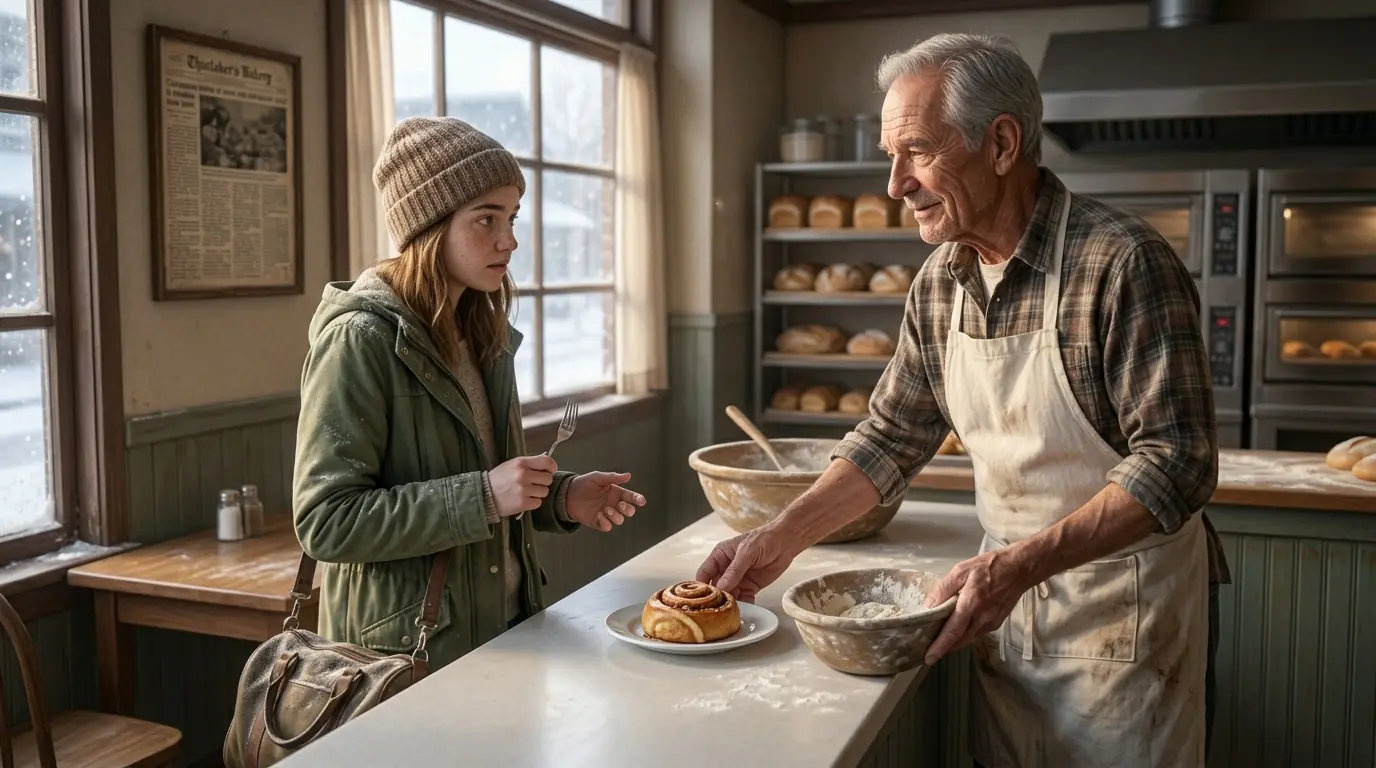
“You’re young. Don’t chain yourself to an old bakery because an old fool gave you a cot.”
Lena’s eyes sharpened.
“Don’t make my gratitude sound small.”
Arthur looked at her then.
She stood.
“I’m not staying because I owe you. I’m staying because this place matters. Because people walk in here and feel like they belong. Because you act grumpy, but you remember who likes extra raisins and who lost a husband and who needs a second roll but won’t ask.”
Arthur looked away.
Lena continued, softer now.
“And because when I was freezing outside, you opened the door.”
For once, Arthur had no joke ready.
The weeks that followed were difficult.
Harlan Development Group increased its offer. Then increased it again. Other shop owners sold. The barber retired and accepted a buyout. Construction crews began measuring sidewalks and marking walls. New signs appeared in windows.
Coming Soon.
Luxury Living.
Fresh Retail Opportunities.
Arthur hated those signs.
He hated the phrase opportunities most of all.
The bakery’s customers worried, but worry did not pay repair bills. Some promised to come more often. Some did. Others forgot. Life had a way of making good intentions weak.
Lena refused to give up.
She created flyers for weekend specials. She made a simple website with help from Ben the mail carrier’s teenage daughter. She started taking small catering orders: church lunches, office birthdays, baby showers, teacher appreciation breakfasts.
Arthur complained about every new idea.
Then he helped execute them perfectly.
One Saturday in September, Lena organized a “Memory Bread Day.” Customers could bring in a recipe or describe something a parent or grandparent used to make. She and Arthur would choose a few and recreate them.
Arthur thought no one would come.
By noon, the bakery was packed.
Mrs. Ellison brought a recipe for caraway rolls written in her mother’s handwriting. Mr. Cooper described a cherry bun his wife used to buy when they were dating. A young father asked if they could make something like the sweet bread his late grandmother baked every Christmas, though he didn’t know the name.
Lena listened to every story as if it were precious.
Arthur watched her behind the counter, flour on her cheek, pencil tucked behind her ear, smiling gently at customers who handed her memories disguised as recipes.
For the first time in months, he allowed himself to hope.
But hope, he knew, was not the same as money.
In November, the roof leaked badly during three days of rain.
A brown stain spread across the ceiling near the front window. Arthur placed a bucket beneath it and tried to make a joke.
“Indoor water feature. Very modern.”
Lena didn’t laugh.
The repair estimate was worse than expected.
Two days later, Daniel Price returned.
This time, he did not smile as much.
“Mr. Whitaker, I’ll be direct. The offer expires at the end of the month. If you wait too long, you may find yourself with repair obligations that exceed the property’s value.”
Lena stood beside Arthur behind the counter.
Arthur looked at the business card Daniel placed down.
“And if I sell?”
“You walk away with enough to retire comfortably.”
“Retire where?”
“That would be your choice.”
Arthur glanced toward the back wall, where Margaret’s old apron still hung on a hook.
“My wife died in this building,” he said quietly. “Right there by the prep table. Heart gave out while she was kneading dough. She went fast. I suppose that’s mercy.”
Daniel shifted uncomfortably.
“I’m sorry.”
“She loved this place more than any house we ever lived in.”
“I understand.”
“No,” Arthur said. “You don’t. But that’s all right. Understanding isn’t your job.”
Daniel closed his folder.
“End of the month,” he said.
After he left, Arthur stood very still.
Lena wanted to say something brave. Something certain.
Instead, she whispered, “What are you going to do?”
Arthur exhaled slowly.
“I don’t know.”
That night, Lena did not sleep.
She sat at the small desk in the back room, searching online, making notes, adding numbers that refused to become enough. Grants. Loans. Community funds. Small business programs. Crowdfunding.
She wrote a long message, deleted it, wrote it again.
By dawn, her eyes burned.
Arthur found her asleep at the desk, cheek against a notebook filled with figures and half-formed plans.
He covered her with one of Margaret’s quilts and stood there for a moment, looking down at her.
“You foolish girl,” he murmured, but his voice broke slightly.
The next morning, Lena launched the fundraiser.
Save Whitaker’s Bakery.
She hated the title, but Ben’s daughter said clear was better than clever.
The first day brought in $312.
The second day, $489.
By the end of the week, the total reached $4,600.
It was more than Arthur expected and far less than they needed.
Still, something beautiful happened.
People began sharing stories.
Under the fundraiser page, comments appeared from customers Arthur had not seen in years.
My dad took me here every Saturday after Little League.
Mrs. Whitaker made my wedding cake in 1998.
Arthur gave my family bread for free when my father lost his job. He pretended it was extra.
I had my first date here.
My mother’s last birthday cake came from this bakery.
Lena printed some of the comments and taped them to the back wall.
Arthur read them when he thought no one was watching.
On Thanksgiving morning, the bakery opened for preorders only. Arthur and Lena worked from 3 a.m. until noon, boxing rolls, pies, biscuits, and loaves. Just before closing, a woman in her forties walked in.
She wore a camel-colored coat and carried herself with quiet confidence. Her hair was dark, streaked lightly with gray at the temples. She looked around the bakery with an expression that made Arthur pause.
Not nostalgia, exactly.
Recognition.
“Can I help you?” Lena asked.
The woman turned to Arthur.
“Are you Mr. Whitaker?”
“I am.”
“My name is Naomi Brooks.”
Lena dropped the roll of twine she was holding.
The woman looked at her.
“Lena.”
For a second, no one moved.
Then Lena whispered, “Aunt Naomi?”
Naomi’s face crumpled.
“Oh, honey.”
Lena stood frozen as Naomi crossed the room and pulled her into her arms. At first, Lena was stiff with shock. Then she broke. She clung to her aunt and cried like someone who had been holding her breath for years.
Arthur quietly turned away and busied himself with wiping an already clean counter.
Later, over coffee, the story came out.
Naomi had been searching for Lena for months. After Lena’s grandmother died, family tensions and old misunderstandings had scattered everyone. Naomi had moved to Columbus for work, changed phone numbers, and lost touch. When Lena disappeared from Kentucky, no one knew where she had gone.
Then someone had shared the bakery fundraiser online.
Naomi had seen a photo of Lena standing beside Arthur, holding a tray of honey biscuits.
“I knew it was you,” Naomi said, holding Lena’s hand tightly. “You look just like your grandmother when you bake.”
Lena cried again.
Arthur pretended not to.
Naomi was not wealthy, but she was an accountant. A practical woman. The kind who understood numbers and did not get scared by paperwork. Over the next week, she reviewed Arthur’s finances, the repair estimates, the development offer, and the fundraiser.
“This place can be saved,” she said finally.
Arthur stared at her.
“Don’t say that kindly if it isn’t true.”
“I don’t say kind things when numbers are bad,” Naomi replied. “I say bad things. These numbers are difficult, not impossible.”
Lena leaned forward.
“How?”
Naomi tapped her pen against the table.
“You need three things. First, emergency roof repair before winter gets worse. Second, restructuring the business debt. Third, a real expansion plan based on what’s already working.”
Arthur groaned.
“Expansion plan sounds like something that wears a tie.”
“It can wear an apron,” Naomi said.
Lena smiled.
With Naomi’s help, they applied for a small business preservation grant. They organized financial statements properly. They contacted a local historical society, which confirmed the bakery’s building was old enough to qualify for a restoration program. They turned the fundraiser into a community campaign, not charity.
Then came the article.
A regional food writer discovered the story online and visited the bakery. She wrote about Arthur’s decades of service, Lena’s grandmother-inspired recipes, and the fight to keep an old neighborhood bakery alive in the face of redevelopment.
The article spread farther than anyone expected.
Orders poured in.
Not enough to solve everything overnight, but enough to matter.
A contractor whose mother used to buy bread from Arthur offered a reduced rate for roof repairs. A retired sign painter volunteered to restore the front sign. The high school art club painted temporary holiday window displays. Customers formed lines on cold mornings, bundled in scarves, waiting for honey biscuits and molasses bread.
Arthur found it embarrassing.
Lena found it miraculous.
By Christmas Eve, the bakery was so busy that Naomi worked the register, Ben delivered preorders after finishing his route, and Mr. Cooper sat near the door handing out numbered tickets as if he had been appointed to an important office.
Arthur stood at the ovens, overwhelmed and trying not to show it.
Lena came beside him.
“You okay?”
“No,” he said. “There are too many people in my bakery.”
“That’s a good problem.”
“I prefer bad problems. Quieter.”
She laughed.
At noon, Daniel Price arrived.
He stood just inside the door, looking at the line of customers, the restored sign, the fresh paint on the front door, and the donation thermometer taped to the window, now filled past its original goal.
Arthur wiped his hands and approached him.
“If you’re here for a cinnamon roll, line starts outside.”
Daniel smiled faintly.
“I heard the news.”
“What news?”
“The historical society filed paperwork. The building may receive protected status.”
“So I’ve been told.”
“That complicates redevelopment.”
“Does it?”
Daniel nodded.
“My firm is adjusting plans. Your building will remain.”
Arthur looked at him for a long moment.
Then he said, “Good.”
Daniel glanced around the bakery.
“You’ve built something rare here.”
Arthur’s expression softened, but only slightly.
“No. I kept something rare. There’s a difference.”
Daniel accepted that with a small nod. Before leaving, he bought a box of honey biscuits.
“Those are hers,” Arthur said, pointing at Lena.
Daniel looked at her.
“Then she saved your bakery.”
Arthur shook his head.
“No. She reminded it how to live.”
Lena looked down quickly, blinking hard.
That Christmas Eve, after the bakery finally closed, Arthur and Lena sat at the small table by the window. Snow drifted gently outside. The streetlights glowed over the newly painted sign. Inside, the bakery smelled of sugar, yeast, coffee, and pine from the little wreath Naomi had hung on the door.
Arthur handed Lena a small envelope.
She frowned.
“What’s this?”
“Open it.”
Inside was a key.
Not the front door key. She already had that.
This one was tied with a red ribbon.
Lena looked up.
Arthur cleared his throat.
“I spoke with Naomi. Papers aren’t final yet, but they will be. I’m making you a partner.”
Lena stared at him.
“No.”
“That’s an odd response to good news.”
“Arthur, no. I can’t take that.”
“You can.”
“This is your family bakery.”
“Yes,” he said. “And family is not always blood.”
Her face changed.
Arthur looked out the window because looking directly at her made his chest hurt.
“I’m old, Lena. Not dead, but old. I need someone who loves this place after I can’t stand at those ovens anymore. Someone stubborn enough to argue with me and foolish enough to care about old recipes.”
Lena pressed the key between both hands.
“I don’t know what to say.”
“Say you’ll stop moving your duffel bag like you’re leaving tomorrow.”
She gave a broken little laugh.
“I haven’t done that in weeks.”
“I noticed.”
She wiped her eyes.
“Then yes.”
Arthur nodded once, as if approving a business decision, though his own eyes were wet.
“Good.”
A year passed.
Then another.
Whitaker’s Bakery became something Arthur had not dared imagine: not just preserved, but renewed.
The front sign gleamed again. The roof no longer leaked. The display case was expanded. The back room was converted into a proper office, though Arthur insisted on keeping the old cot folded in the corner.
“For emergencies,” he said.
“What kind of emergency?” Lena asked.
“The kind where an old man needs a nap.”
Lena’s aunt Naomi moved to Maple Falls and handled the bookkeeping twice a week, though she claimed she was only staying “until things stabilized.” Everyone knew she had no intention of leaving.
Lena created baking classes on Sunday afternoons. Children learned to shape rolls. Widowers learned to bake the pies their wives used to make. Teenagers came in pretending they only wanted part-time jobs and stayed because Arthur taught them how to knead dough and complain properly.
Arthur became something between a boss, grandfather, and town landmark.
He still grumbled. He still hated online orders. He still said “in my day” at least twice before breakfast.
But he smiled more.
Three years after the morning Lena first stood under the awning, Whitaker’s Bakery hosted its largest event yet.
The town closed half of Linden Street for the bakery’s eightieth anniversary. Tables lined the sidewalk. Musicians played near the corner. Children decorated cookies under a tent. The restored hardware store next door had become a community art shop instead of luxury apartments, partly because the development company had changed its plans after the bakery campaign brought public attention to the block.
Arthur wore a clean white shirt, suspenders, and the stubborn expression of a man who disliked being celebrated.
Lena wore a blue dress beneath her apron and had flour on her wrist before the event even began.
At noon, Naomi tapped a spoon against a glass.
“Speech,” she called.
Arthur shook his head immediately.
“No.”
The crowd chanted his name.
“Arthur. Arthur. Arthur.”
He glared at Lena.
“You arranged this.”
“I would never,” she said.
“You are lying badly.”
“Speech,” she whispered.
Arthur stepped onto the small platform someone had set near the bakery door. He looked out at the crowd: customers, neighbors, children, old friends, new faces, people who had come because the bakery had fed them, comforted them, employed them, or simply given them somewhere to belong.
For a moment, he could not speak.
Then he saw Lena standing near the front, eyes bright, smiling with the same expression she had when the first batch of honey biscuits sold out.
Arthur took off his cap.
“My wife, Margaret, used to say bread teaches patience,” he began. “You mix what you have, you work it with your hands, and then you wait. You can’t shout dough into rising faster. You can’t rush what needs time.”
The crowd quieted.
Arthur looked down at his rough hands.
“I thought, after she passed, that this place was only getting older with me. I thought maybe its best days had already happened. Then one winter morning, a young woman stood outside my door with nowhere to go.”
Lena lowered her eyes.
“I gave her coffee,” Arthur continued. “A cinnamon roll. A cot in the back. Thought I was helping her.”
He paused.
“But the truth is, she gave me back my bakery.”
Lena covered her mouth.
Arthur’s voice grew thicker.
“She gave me back mornings I wanted to wake up for. She gave these ovens new recipes. She gave this town a reason to walk through that door again. And all of you gave me something I didn’t know an old man could still receive.”
He looked over the crowd.
“A future.”
No one spoke for a second.
Then the applause came.
Loud, long, and full.
Arthur stepped down quickly, embarrassed, but Lena reached him before he could escape. She wrapped her arms around him, and this time he did not pretend to be annoyed.
“You saved me first,” she whispered.
Arthur patted her shoulder.
“Don’t argue during my anniversary.”
She laughed through tears.
That evening, after the celebration ended and the street was quiet again, Arthur sat alone inside the bakery.
The chairs were stacked. The counters were wiped clean. The ovens were cooling. A few crumbs remained on the floor, proof of a good day.
Lena came from the back carrying two mugs of coffee.
“Terrible coffee?” she asked.
“The tradition continues,” Arthur said.
She sat across from him.
For a while, they watched snow begin to fall outside, soft and silver under the streetlights.
“Do you ever think about that morning?” Lena asked.
Arthur nodded.
“I think about how close I came to not opening the door.”
She looked at him.
“Why did you?”
Arthur turned the mug slowly in his hands.
“Because Margaret would have haunted me if I didn’t.”
Lena smiled.
Then Arthur added, “And because you looked like someone who had been turned away too many times.”
Lena’s eyes softened.
“I was.”
“Not anymore.”
“No,” she said quietly. “Not anymore.”
Outside, the restored sign creaked gently in the winter wind.
Whitaker’s Bakery glowed at the corner of Linden and Grace, warm behind the glass, alive with the memory of everyone who had ever needed a place to stand, sit, work, cry, eat, heal, or begin again.
Arthur had helped a young woman when she had nothing but a duffel bag, frozen hands, and a fading hope that someone might still be kind.
Years later, what he received was not just a repaired roof, a saved business, or his name preserved above the door.
He received laughter in the back room again.
He received family at a table where grief had once sat alone.
He received the comfort of knowing that when his hands could no longer shape the morning bread, someone else’s hands would continue the work with love.
And every Saturday, when the honey biscuits sold out before ten, Arthur would grumble beneath his breath, write “honey” on the supply list, and smile when he thought no one was looking.