Late in the afternoon in New Orleans, a single mother, exhausted and starving, went everywhere looking for work but was rejected every time.
She was insulted and driven away, even when she only asked for a little food to bring home for her sick daughter.
At her lowest moment, a lonely older street vendor suddenly handed her a warm meal and offered to help care for the child.
Over time, they became each other’s only support.
But no one knew their lives were about to change forever when a man suddenly returned after disappearing for years.
Late in the afternoon, on a cracked sidewalk in one of New Orleans’ forgotten neighborhoods, Emily Carter walked with the slow, shaky steps of someone who had run out of strength days ago.
Her blonde hair was tangled, her cheeks hollow, her coat too thin for the cold wind pushing through the narrow street.
Every few minutes, she swallowed hard, fighting the dizziness creeping up her spine.
She hadn’t eaten since yesterday.
She had tried.
God knows she had tried, but every door she knocked on had slammed shut.
Earlier that morning, she stood outside a diner, hands clasped, asking the manager if he needed help washing dishes.
He looked her up and down, saw her messy hair, the dark circles under her eyes, the backpack she carried like a lifeline, and said flatly,
“We don’t hire people who look unstable.”
Emily walked out without arguing.
She went to a motel on Claiborne Avenue, hoping for a cleaning shift.
“No address, no ID? I can’t help you,” the clerk said, turning his back before she even finished speaking.
At a small cafe near the corner, she asked if she could bus tables.
The owner shook her head and muttered,
“You need to get yourself together first.”
By noon, Emily wasn’t begging for money.
She was begging for work.
But here, if you didn’t look like you already had a life, nobody gave you a chance to rebuild one.
As the sun dropped lower, her hunger hit like a punch.
She tried asking a man outside a gas station,
“Sir, do you have anything? Anything at all?”
He recoiled as if she carried disease, waved her off, and climbed into his truck.
A woman holding a toddler hurried past her, pulling the child close and whispering,
“Don’t look, honey.”
Someone else muttered,
“Get a job.”
They did not know she had tried all morning until her voice nearly gave out.
The shame of it burned in her throat.
Emily pressed a hand against her stomach, more to calm herself than anything else, and kept walking.
She didn’t want food for herself.
She just needed something she could take back to her daughter.
One little meal.
One reason for the child to smile.
But she could feel her legs trembling, as if they no longer trusted her to stand.
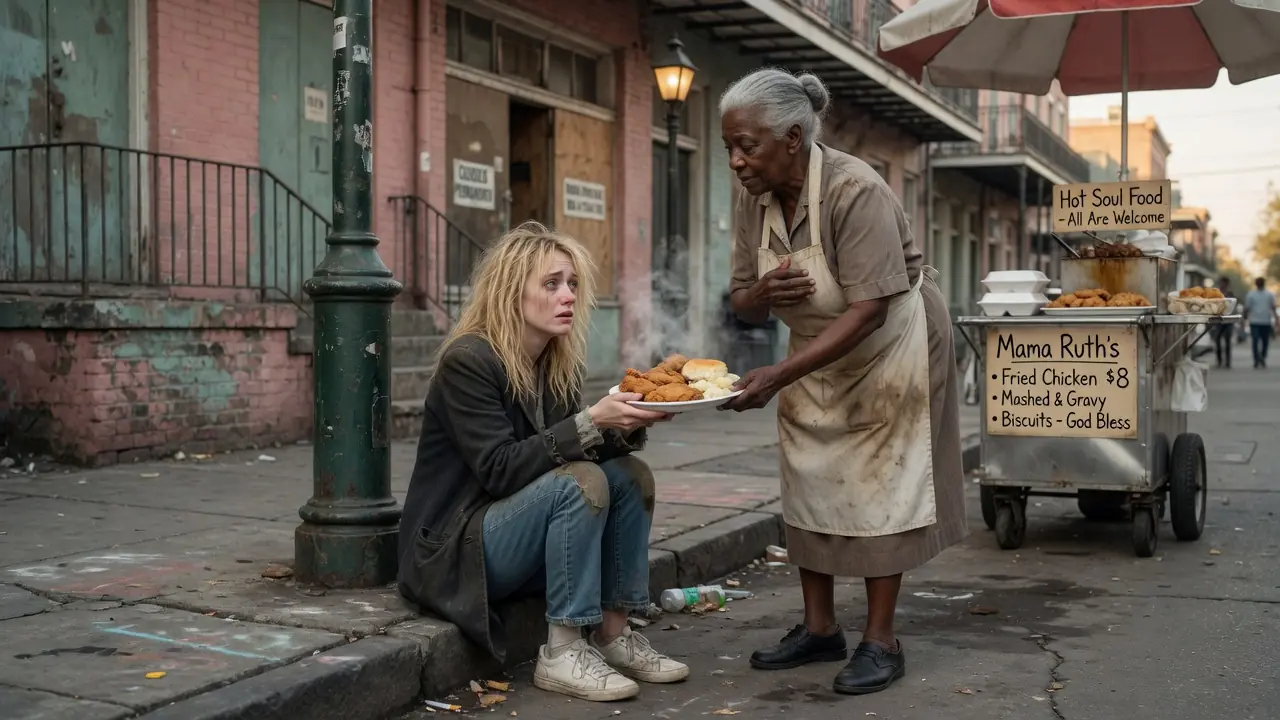
When she reached the corner of a small street lined with old street lamps and cracked pavement, she saw a food cart sitting under a fading striped umbrella.
Smoke drifted from a small fryer.
The smell of fried chicken and warm gravy hit her like a memory of a life she no longer had.
She slowed down, afraid to get closer, afraid to be told no again.
She moved to the side of the cart and lowered herself until she was sitting on the curb.
She didn’t ask for anything.
She didn’t look up.
She just sat there, shoulders shaking, hands tucked into her sleeves to hide the trembling.
From behind the cart, Mama Ruth Johnson watched.
She was a 70-year-old woman with deep brown skin, silver hair tied in a neat bun, and hands shaped by decades of work.
She had spent the whole day serving the neighborhood from her old metal cart.
She wiped her palms on a faded apron, looked up, and saw Emily sitting there, too still, too tired, too quiet.
It wasn’t the first hungry person she had seen in her life, but something in the woman’s posture hit her deeper than usual.
Her head hung low, not in manipulation, not fishing for pity, but in pure exhaustion.
Her fingers were curled inward as if she was trying to hold herself together.
And her eyes, red, swollen, and glossy, told a story of someone who had run out of places to go.
Mama Ruth stepped out from behind the cart, her knees aching as she walked closer.
She bent just enough to see Emily’s face.
“Baby,” she said gently. “Have you had anything to eat today?”
Emily shook her head once.
Just once.
Her lips parted, but no words came out, and tears welled up without warning.
She looked away, embarrassed by her own weakness.
Mama Ruth didn’t ask for her name.
She didn’t ask why she was out there.
She didn’t ask what went wrong.
She just turned, reached for a warm plate she had been saving for herself, filled it with fried chicken, mashed potatoes, and a biscuit, then placed it into Emily’s trembling hands.
“Here,” she whispered, steady and kind. “Eat and listen to me, sugar. You don’t have to apologize for being hungry.”
Emily clutched the warm plate in both hands, the steam rising into her face like a tiny mercy she wasn’t ready for.
The smell alone made her knees weak.
At that moment, she immediately thought of Amara, her only little daughter, who hadn’t eaten anything since yesterday.
Emily looked up at Mama Ruth, eyes shining with gratitude and panic mixing together.
“Thank you. Thank you so much,” she whispered, voice trembling.
But before the old woman could respond or ask a single question, Emily stood up fast, almost stumbling.
She pressed the plate close as if protecting it from the wind, gave Mama Ruth one last desperate nod, and took off down the street.
Her steps were quick, uneven, almost frantic.
Mama Ruth blinked, surprised by the sudden urgency, watching the thin woman disappear around the corner like someone running toward a fire only she could see.
The old woman frowned softly, a hand lifting halfway as if to call her back.
But Emily was already gone, vanishing into the dying light.
Emily walked fast, almost too fast for someone who had barely eaten.
She held the warm plate from Mama Ruth close to her chest, protecting it from the cold wind as she crossed the empty lot behind the abandoned gas station.
The sky was turning the color of old bruises, and the street lights flickered like they were fighting to stay alive.
She kept whispering to herself,
“Hold on, baby. Mommy’s coming.”
As if Amara could somehow hear her from a distance.
When she reached the old motel, a long two-story building with busted windows and doors boarded up with uneven planks, she slipped inside through the broken side entrance.
The hallway smelled of mildew and wet carpet, and each step creaked beneath her like the floor was tired of carrying secrets.
Emily pushed open the door to room 12, their room, and the air inside was colder than outside.
A thin mattress lay on the floor with a faded blanket thrown over it.
A couple of empty pill bottles rolled near the wall, and a small flashlight sat beside them.
On the wall above the mattress were pencil marks.
Amara’s height, year by year, growing slowly until one line simply stopped.
That was the year the sickness began.
Amara lay curled on the mattress, her skin a shade too pale.
Her curls pressed flat against her damp forehead.
Her breaths were shallow, almost cautious, as if each one cost her something precious.
When Emily knelt beside her, Amara opened her eyes just enough to whisper,
“Mommy.”
Emily brushed her fingers against her daughter’s cheek.
“I’m right here, sweetheart. Look what I got.”
At first, Amara didn’t react.
She blinked slowly, as if waking from a heavy sleep.
But when the smell of fried chicken and mashed potatoes drifted toward her, her eyes snapped open wider, glowing with a sudden spark Emily hadn’t seen in months.
The little girl lifted her head, confused, like she couldn’t trust her senses.
“Mommy, is that real food?” she whispered, voice trembling with disbelief.
Emily smiled softly.
“Yes, sweetheart. Warm food.”
Amara pushed herself up on her elbows, slow and shaky, but driven by pure excitement.
Her lips parted in a small gasp.
“It smells so good,” she said, almost laughing, almost crying, her eyes shining with a joy too big for her frail body. “It smells like the dinners we used to have.”
She pressed a hand to her chest as if to steady herself, then looked up at her mother with wide, glowing eyes.
“Mommy, can I really eat this?”
The shock in her voice cut right through Emily.
She nodded, blinking fast before her own tears could fall.
“Of course you can, baby. Here.”
She scooped a small bite of mashed potatoes and lifted the spoon.
Amara leaned forward eagerly, opening her mouth with a tiny, breathless hum of excitement.
“It’s warm.”
As if warmth itself was a miracle.
“I forgot what warm food tastes like.”
Emily’s throat tightened.
“There’s more,” she murmured. “Eat as much as you want.”
After the second bite, Amara stopped and looked up.
“Mommy, did you eat?”
Emily smiled the kind of smile that hides hunger.
“Yeah, I ate earlier. You don’t worry about me.”
It was a lie she told every day.
Amara nodded and took another bite.
Emily watched her eat with a kind of desperate relief.
Amara smiled, a real smile, bright and soft, the kind she hadn’t had strength for since before the sickness.
For a moment, the peeling walls and moldy ceiling didn’t matter.
For a moment, the motel felt less like a place people abandoned and more like a home glowing with one small, precious moment of happiness.
As Amara chewed quietly, Emily’s mind drifted back to the life she used to have.
The life she never imagined could fall apart so brutally.
She once wore clean scrubs, her name badge clipped neatly to her pocket.
Emily Carter, patient care tech.
She liked the steady rhythm of the hospital, the beeping monitors, the rolling carts, the soft conversations in the hall.
She wasn’t rich, but she paid rent on time, kept the fridge stocked, and held her head high.
Back then, she was in love, too.
Marcus Reed was tall, calm, soft-spoken, with a mind full of dreams.
He was a young man studying computer engineering, always sketching ideas for an app he wanted to build.
One day, Emily believed in him so much she used her savings, every extra shift she worked, every holiday she skipped, to help him buy a laptop and pay for the program that sent him to California for a tech internship.
She remembered the night before he left, when he promised,
“When I make it, I’m coming back for you. I’ll build us a life.”
Then two weeks later, the calls stopped.
Emily tried messaging, emailing, calling again.
Nothing.
She didn’t know that Marcus had been mugged on a dark street in Oakland.
His phone was smashed, his contacts lost, his life flipped upside down.
All she knew was he was gone.
And then she found out she was pregnant.
She stood in her tiny bathroom staring at the test, hand over her mouth, tears running down her wrist.
She waited weeks, hoping Marcus would call, hoping she could tell him.
But no call ever came.
So she made a choice.
She would raise her child alone.
And she did.
For years, Amara was bright, sweet, full of joy until the sickness came like a thief in the night.
First swelling in her legs.
Then the headaches.
Then the vomiting.
Emily remembered sitting across from the doctor, the fluorescent lights buzzing overhead, as he explained,
“Her kidneys are failing. She’ll need treatment, possibly a transplant.”
Emily nodded at every word, even though her ears were ringing.
Then he showed her the cost.
Her knees almost buckled.
She couldn’t breathe.
She worked double shifts, sold furniture, pawned jewelry, begged her landlord for more time.
But medical bills multiply faster than hope ever could.
When she fell behind on payments, the hospital changed its tone.
When she fell behind on rent, her landlord changed the locks.
One afternoon, Emily found herself on the curb with two trash bags, holding Amara close and realizing she had no place left to go.
That was how they ended up here, in a motel the city forgot.
Emily blinked back to the present when Amara leaned her head into her chest, whispering,
“Thank you, Mommy.”
Emily kissed her forehead.
“You’re welcome, baby. Always.”
She put the plate aside, knowing Amara needed the rest more than the food.
She tucked the blanket around her daughter’s small shoulders, then sat beside her, hugging her knees, staring at the wall where the growth chart ended.
That line stopped the year Amara got sick.
And Emily had spent every day since trying to keep her daughter alive on nothing but grit, tired hope, and whatever kindness she could find.
Tonight, that kindness had come from a woman she barely knew.
Mama Ruth.
And Emily knew she would walk through the whole city again tomorrow, starve again tomorrow, fight again tomorrow, as long as it meant her daughter would eat.
On another street corner, the old woman was also struggling to make a living.
Mama Ruth locked her cart for the night long after the last customer had gone, the sounds of the street settling into a tired hush.
She wiped her hands on her apron, feeling the familiar ache that spread from her lower back up to her shoulders, the kind of pain that never truly left, only quieted down until morning.
She glanced at the corner where Emily had been sitting the first day, the memory still sitting heavy in her chest.
For a moment, she just stood there, letting out a long breath.
Then she began the slow walk home, pushing her empty cart down the cracked sidewalks of New Orleans.
Her neighborhood was quieter than most.
Old shotgun houses, peeling paint, dim porch lights.
When she reached her front door, she paused the same way she did every evening, fingers resting on the key, listening to the silence waiting for her inside.
There was a time decades ago when someone waited behind that door.
Her husband, Leonard.
Tall, soft-spoken, the kind of man who could make her laugh by raising one eyebrow.
She lost him in an accident at the shipyard when she had just turned 32.
She remembered the knock on the door.
The way her knees gave out when she heard the words.
The way the world suddenly felt too big for one person to carry.
They never had children.
They had been trying, dreaming quietly about it.
But life had made that decision for them.
And after Leonard passed, the years rolled on, one by one, steady and quiet, until she realized she had spent almost 40 years coming home to an empty house.
Inside, she set her bag on the little dining table and pulled out her wallet.
She opened it gently, as if it were fragile, and slipped out the picture she carried everywhere.
Leonard’s smile stared back at her, the corners of the old photograph soft and worn, the edges protected by a layer of clear tape she had replaced many times.
She touched his face with her thumb.
“You’d tell me I’m working too hard,” she murmured. “You’d be right.”
She slid the picture back into its slot, then reached for the small jar sitting on the counter.
It was a glass pickle jar she’d washed years ago and turned into her just-in-case savings.
Every night, she dropped whatever spare change she had inside, listening to the soft clink as if it were a promise.
She didn’t have much, but she had what she had earned.
She always believed in saving a little for the time sickness came knocking because nobody else would be there to help her stand.
As she sat down, she found herself thinking about Emily again.
She had seen the young woman walking past her cart for days, always quiet, always looking over her shoulder, always asking to carry food home instead of eating on the spot.
There was something about the way Emily held herself, like she was hiding a wound she didn’t want the world to see.
Mama Ruth had seen that kind of pain before.
In her own mirror.
In the eyes of women who had been abandoned by luck, by people, by life.
She noticed the way Emily rushed off after receiving the meal that first day, clutching the warm package like it was gold.
That wasn’t hunger for herself.
That was hunger for someone she loved.
The next morning, before sunrise, Mama Ruth woke as she always did, the room still dark, the air cold.
She tied her headscarf, turned on the dim kitchen light, and began cooking.
Seasoned chicken simmered in an old cast-iron pan, steam fogging the window above the sink.
As she stirred the pot, she found her mind returning to Emily, and that little flash of joy she had seen in the woman’s tired eyes.
It had been a long time since Mama Ruth had felt needed by anyone.
A long time since her kindness actually changed something for somebody.
Maybe that was why she noticed Emily more than others.
Maybe it was because after losing so much herself, she understood how it felt to be left behind.
Maybe loneliness recognizes loneliness.
Whatever the reason, she felt something shift inside her.
A small tug.
A quiet responsibility.
And as she packed her cart and stepped into the cold morning air, she whispered to herself,
“Lord, let me find her again today.”
She wasn’t sure why she said it, only that she meant it.
Only that for the first time in a long time, going to work didn’t feel like just another day.
It felt like the beginning of something.
Something important.
Something she didn’t want to miss.
Emily came back the next morning, not to ask for food, but simply to thank Mama Ruth.
She walked with small, careful steps, the early breeze pushing loose strands of hair across her face.
She clutched the edges of her old coat, rehearsing the words in her head.
Thank you.
You saved us yesterday.
I don’t know how to repay you.
But when she reached the cart, Mama Ruth was not standing upright like she always was.
She was gripping the side of the cart with one hand, her other hand pressed to her forehead.
Her breath was shallow, her eyes unfocused.
Before Emily could speak, Mama Ruth swayed.
“Ma’am!” Emily rushed forward. “Mama Ruth, are you okay?”
The older woman tried to smile, but her knees buckled.
Emily caught her just in time, holding her up with both arms.
“I’m fine, baby. Just a little dizzy,” Mama Ruth whispered, but her voice was thin, trembling.
“No, you’re not fine,” Emily said, panic rising in her throat. “Sit down, please.”
She guided her to a plastic crate near the cart, helping her lower herself carefully onto it.
Mama Ruth leaned forward, elbows on her knees, breathing slow and heavy.
Emily grabbed a cold bottle of water from the cooler and pressed it gently into her hands.
“Drink,” she urged. “Take slow sips.”
Mama Ruth obeyed, closing her eyes as she took shallow breaths.
Emily wiped her forehead with a napkin, watching anxiously.
“Do you want me to call someone? A family member?”
Mama Ruth chuckled weakly.
“Baby, I ain’t got nobody to call. Closest thing I got is this old cart.”
Emily’s chest tightened.
“You don’t have kids? Or someone checking in on you?”
Mama Ruth shook her head.
“No children. Lost my husband long, long time ago. Been taking care of myself ever since.”
Emily swallowed, feeling the echo of loneliness she herself knew too well.
“Let me help you today,” she said suddenly. “Just sit down and rest. I can handle the cart.”
“Oh, honey, I can’t ask you to.”
“You didn’t ask. I’m offering.”
For a second, Mama Ruth simply stared at her, eyes softening.
Then she nodded.
“All right, baby. Just for today.”
Emily quickly tied the apron around her waist and moved behind the cart.
She took orders, handed out plates, wiped down the counter, awkward at first but determined.
Customers smiled at her effort, confused but entertained.
Some even tipped more than usual.
Mama Ruth watched from the crate, a hand over her heart, half proud and half emotional.
By late afternoon, when the crowd slowed and the sun dipped behind the buildings, Emily finally sat down beside her, the exhaustion settling into her bones.
They shared a quiet moment, breathing in the warm smell of soul food lingering in the air.
“You did good today,” Mama Ruth said softly.
Emily shrugged.
“You helped me yesterday. It was the least I could do.”
Mama Ruth looked at her for a long moment.
“Why don’t you tell me about that little girl of yours?”
Emily’s eyes widened.
“How?”
“I saw the way you ran home with that food. People who only think of themselves don’t run like that.”
And just like that, the walls between them broke.
Emily told her everything.
Amara’s sickness.
The motel.
The bills.
The jobs she lost.
The father who never came back.
And Mama Ruth told her about Leonard, the accident, the 40 years of waking up alone, pushing that cart down the same cracked sidewalks.
Two women from different lives, both holding on by threads, somehow found comfort sitting shoulder to shoulder on an old crate at sunset.
When it was time to pack up, Mama Ruth filled two warm containers, bigger portions than usual, as she spoke quietly.
“Consider this my thank you for saving me from falling flat on my face today.”
Emily shook her head, overwhelmed.
“You don’t have to.”
“Baby, hush. Now, I made up my mind.”
She placed the containers into Emily’s hands.
“From now on, every day, I’m putting two meals aside. One for you, one for that sweet baby girl of yours.”
Emily blinked hard, her eyes stinging.
“Mama Ruth, I don’t know what to say.”
“Just come back tomorrow,” the older woman replied with a tired, warm smile. “That’s all the thanks I need.”
And as Emily walked away into the cool evening air, hugging the warm food to her chest, she realized something.
This wasn’t just kindness.
This was the beginning of something that felt almost like family.
The day after Emily helped her at the cart, Mama Ruth showed up with her cart freshly cleaned, her apron tied neatly, and a small paper bag tucked under her arm with the handwritten words “For my girls” across the front.
When Emily approached to pick up the two meals, Mama Ruth didn’t hand them over right away.
Instead, she looked at her with quiet seriousness and said,
“Baby, I want to meet that little one of yours.”
Emily instinctively stiffened, unsure and embarrassed about the motel.
The smell.
The darkness.
The sickness.
“It’s not a good place,” she whispered. “We’re fine, really.”
Mama Ruth shook her head gently.
“If she’s part of your heart, then she’s part of mine now. Let me see her.”
Emily hesitated for a long moment, but something in the older woman’s steady eyes made her finally nod.
“Okay, but don’t be scared. It’s not pretty.”
“I’ve seen worse in my life,” Mama Ruth said. “Lead the way.”
They walked through the quiet back streets of New Orleans, passing rusted fences, empty lots, and flickering street lamps.
When they reached the abandoned motel, Mama Ruth paused, taking in the cracked walls and boarded windows.
“You live here?” she asked softly.
Emily nodded, shame creeping up her spine.
“It’s all we have.”
Inside room 12, the air was thick with humidity and the lingering scent of old carpet.
The light barely reached the corners.
Amara lay curled on the mattress, her breathing shallow, her small hand resting on her stomach.
When Mama Ruth saw her, she froze.
Not out of judgment, but out of heartbreak.
“Lord have mercy,” she whispered. “This baby shouldn’t be breathing air like this.”
Amara opened her eyes slowly, confused by the unfamiliar voice.
Emily knelt beside her.
“Sweetheart, this is Mama Ruth, the lady who helped us.”
Amara blinked up at the older woman.
Her voice was thin but curious.
“Hi.”
Mama Ruth’s entire face softened.
She lowered herself beside the mattress, knees cracking slightly, and held out the small paper bag.
“I brought something for you, sugar.”
Emily watched as Amara reached inside and pulled out a small container of fresh fruit, strawberries and grapes, bright and colorful, nothing like the canned food she was used to.
Amara sat up straighter, a small smile forming.
“For me?”
“For you,” Mama Ruth said, patting her leg. “You need real vitamins, not those cheap snacks your mama be skipping meals for.”
Emily looked down, embarrassed.
But Mama Ruth touched her arm gently.
“Ain’t no shame here. Just love.”
As Amara ate slowly, taking careful bites like she didn’t want the moment to end, Mama Ruth scanned the room.
The peeling wallpaper.
The buckets catching water from the ceiling.
The thin blanket.
Her eyes filled with tears she tried to blink away.
“You’ve been carrying this weight all alone, haven’t you?”
Emily nodded silently.
“I’m trying,” she whispered.
“I know you are,” Mama Ruth replied. “But nobody should have to fight a war with no help.”
After Amara finished half the fruit, she looked at Mama Ruth with wide, tired eyes and said,
“Are you Grandma?”
The word hit the room like a small, fragile miracle.
Emily covered her mouth, stunned.
Mama Ruth’s lips trembled.
She wiped her cheek with the back of her hand and managed a shaky smile.
“If you want me to be, baby, then yes. I can be your grandma.”
Amara leaned toward her, resting her head lightly on Mama Ruth’s arm.
The older woman froze for a moment, then placed her large, warm hand on the girl’s back, gentle, protective, full of a tenderness she thought she had lost decades ago.
When it was time for Mama Ruth to leave, she stood at the doorway.
Looking back one more time, she saw Emily sitting beside her daughter, brushing hair off her forehead.
She saw the dim light, the cracked walls, the fight in Emily’s tired eyes, and she broke.
A tear slipped down her cheek.
She wiped it quickly, whispered,
“My girls deserve better.”
Then she stepped into the hallway.
Before Emily could thank her again, Mama Ruth pressed the two warm containers into her hands.
“For dinner,” she said softly. “And tomorrow. And the next day. And as long as y’all need. I’ll be keeping two meals aside, no questions asked.”
Emily’s voice shook.
“Mama Ruth, you don’t have to do this.”
“Oh, yes, I do,” the older woman said. “Because family ain’t always blood. Sometimes it’s the ones we choose.”
She touched Emily’s cheek just for a moment, then walked away, her silhouette small but strong against the fading evening light, carrying nothing but her empty cart and a heart suddenly fuller than it had been in 40 years.
As the door of room 12 closed behind her and her footsteps faded down the hallway, Emily sat with Amara’s tiny fingers resting against her arm, soaking in the warmth Mama Ruth had just left behind.
Meanwhile, across the city, high above the familiar skyline of New Orleans, a private jet sliced through the clouds and began its slow descent toward the runway.
Inside that jet sat a man who had built an empire with his hands, but never managed to piece back together the one thing that mattered most.
Marcus Reed stared out the small oval window, watching the soft gray drizzle blur the lights below.
His reflection looked older than he remembered.
Sharper jawline.
Neatly trimmed beard.
Eyes that carried a quiet exhaustion money could never soothe.
The world knew him as the founder of Reed Biotech, a multi-billion-dollar company revolutionizing kidney treatment and early detection diagnostics.
Headlines called him the miracle mind, the system breaker, the man who changed American healthcare.
But none of those headlines mentioned the truth buried beneath the success.
Marcus had spent years trying to outrun the memory of a woman he once loved and the life he lost with her.
He reached into his coat pocket and pulled out a small velvet pouch.
The fabric was worn thin from being carried everywhere he traveled.
Inside it was a braided bracelet, pink, white, and gray threads woven carefully together.
Emily had made it for him during their early years, when they had everything except money.
She tied it on his wrist the night before he left for California.
“So you don’t forget me,” she whispered.
The next morning, his phone was stolen, his wallet taken, his luggage lost, and just like that, his entire connection to her vanished.
He tried to rebuild it.
He tried contacting their old apartment complex.
He tried calling anyone who might know her.
But poverty had a way of making people disappear, and he learned too late that heartbreak didn’t come with instructions.
Today, though, he was back.
Not as the broke young man chasing a dream, but as a wealthy man desperate to rebuild what he had destroyed.
The jet landed with a soft jolt.
Marcus exhaled slowly, placing the bracelet back into the pouch.
“Home,” he murmured. “God, it’s been so long.”
His driver, a tall man in a suit, met him at the bottom of the steps.
“Welcome back, sir. The car is ready.”
Marcus nodded and slid into the back seat of a sleek SUV.
The rain tapped lightly against the windows as they pulled out of the airport and headed toward the neighborhood he once knew so well.
He didn’t recognize it at first.
New businesses had sprouted.
Old ones were gone.
Apartment buildings he remembered as falling apart had been painted over.
But when they turned onto Claiborne Avenue, a strange familiarity crept in.
The same cracked sidewalks.
The same leaning telephone poles.
The same sense that people here were fighting every day just to stay afloat.
“Stop here,” Marcus said suddenly.
The driver pulled over near an old weathered apartment complex with fading green paint.
Marcus stepped out, inhaling a sharp breath as memories swept over him.
Nights spent studying on the front steps.
Emily leaning against his shoulder.
The two of them dreaming big because dreaming was free.
He walked through the rusted gate and approached a woman sitting on a folding chair by the stairwell.
She was older, wrapped in a thick cardigan, watching the rain pool in the cracks of the pavement.
When she spotted Marcus, she straightened.
“Can I help you, young man?”
Marcus removed his hat respectfully.
“Ma’am, I’m looking for someone who used to live here. Emily Carter.”
The woman’s expression shifted, not surprised, but cautious.
“Emily, that sweet girl.”
She narrowed her eyes.
“You look familiar. Weren’t you the boy she used to talk about? The one who went off to California?”
Marcus felt his throat tighten.
“Yes, ma’am.”
The woman sighed and gestured toward an empty corner of the courtyard.
“She lived here until life got real hard. Poor thing. She had a baby girl, beautiful child, brown-skinned, curly hair. She named her... what was it?”
Marcus leaned forward unconsciously, heart pounding.
“Named her what?”
The woman frowned, trying to recall.
“Amamira. No. Amaya. No.”
She snapped her fingers.
“Amara. That’s it. Little Amara.”
Marcus felt the world tilt beneath him.
The bracelet slipped from his fingers and landed in the shallow puddle at his feet.
He didn’t hear the rain.
He didn’t hear the cars.
He only heard one sentence replaying in his mind.
She had a child.
She had a child.
Emily had a child.
The woman kept talking, unaware of the earthquake happening inside him.
“Emily got sick. Or maybe the little one did. I can’t remember. Something with the kidneys. I think they vanished one night. Just packed up and left. Some say they moved to cheaper housing. Some say they ended up in one of those abandoned motels.”
She sighed.
“Life’s cruel like that.”
Marcus swallowed hard, voice barely steady.
“Do you know where she went?”
The woman shook her head.
“If I did, I’d tell you. She didn’t deserve what happened. She loved that baby.”
Marcus nodded, unable to speak.
He stepped back slowly, the weight in his chest growing heavier by the second.
He got into the car and closed the door, gripping the bracelet so tightly his knuckles turned white.
The driver looked at him through the mirror.
“Are you all right, sir?”
“No,” Marcus whispered. “But I need you to drive.”
The SUV pulled away.
Rain rolled down the windows in long streaks, distorting everything outside.
Marcus stared at the city as it blurred past, each raindrop echoing the guilt building in his chest.
Amara.
Nine years.
A child who would be nine.
A little girl who looked like Emily, but might also look like him.
Marcus closed his eyes, his voice cracking as he whispered into the quiet car.
“I should have found them sooner. I should have never stopped looking.”
He pressed the wet bracelet to his forehead, trying to steady his breath.
But the memories hit harder.
The nights he waited by his phone.
The mornings he checked for messages that never came.
The guilt he buried under work.
Success, money, all the inventions, the research grants, the awards.
They meant nothing now.
He thought of Emily in the hospital waiting room alone.
Thought of her holding a sick child.
Thought of her losing everything while he was building a company designed to save people in her exact situation.
Irony had never felt so cruel.
He whispered the name again, like a prayer he was afraid to say too loud.
“Amara.”
That single word changed everything.
Marcus leaned his head back against the leather seat, chest rising and falling in uneven breaths.
The world outside blurred into a storm of gray and white.
And for the first time in years, the man who had conquered the tech world felt helpless.
“Find every motel,” he told the driver, his voice suddenly sharp, determined. “Every shelter, every abandoned complex. Anyone who might know a woman named Emily Carter. Start tonight.”
“Yes, sir,” the driver replied immediately.
Marcus didn’t look up.
His eyes were fixed on the rain, watching each drop slide down the glass like the seconds he had lost.
Seconds he could never get back.
People said time healed guilt.
But Marcus knew better.
Time didn’t heal guilt.
It sharpened it.
And tonight, as the SUV disappeared into the storm-soaked streets of New Orleans, Marcus Reed vowed to do the one thing he should have done nine years ago.
Find Emily.
Find the child.
And finally face the love and the mistakes he left behind.
Marcus spent that entire night driving through the storm-soaked streets of New Orleans, moving from one run-down building to another, stopping by motels that barely had roofs, shelters with flickering lights, and clinics that looked too tired to help anyone.
He went in personally.
No assistance.
No PR team.
No entourage.
Just him, soaked in rain, heart pounding, asking the same question in a trembling voice.
“Have you seen a woman named Emily? Emily Carter, early 30s, and her daughter, Amara, nine years old?”
Everyone shook their heads.
A few looked like they wished they had an answer.
Most didn’t have the energy to care.
By dawn, Marcus returned to his hotel, exhausted, shivering, and carrying a guilt so heavy it settled in his bones.
He entered the penthouse suite, a place lined with marble floors and soft lighting, and it felt obscene, like luxury was mocking him.
He sat on the edge of the couch, soaked clothes clinging to him, staring at the floor until the city outside turned from gray to gold.
His phone buzzed with messages from investors, board directors, and executives needing approvals.
He ignored them all.
Then, with a slow exhale, he opened his laptop.
He typed one sentence into the search bar.
New Orleans pediatric kidney failure cases.
Hundreds of results filled the screen.
Reports, community articles, medical research, and names.
Names of children.
Ages.
Diagnoses.
Kidneys failing.
Kidneys dying.
Struggling to afford treatment.
Struggling to stay alive.
Marcus scrolled slowly, each name hitting him like a slap.
Alyssa, age seven.
Jamal, age nine.
Trinity, age twelve.
Every child listed with symptoms he recognized from his research.
Every story describing families who lost homes to medical debt.
He saw Emily and Amara in every line.
He saw himself in every missing father.
He pressed his thumb into the corner of his eye, trying to blink away the sting.
But the guilt only sharpened as he scanned through the statistics.
His own technology, the one that saved thousands, still wasn’t reaching the poorest neighborhoods fast enough.
Kids were dying in the same city where he grew up because life had never been fair to them.
And maybe, just maybe, one of those children was his.
He whispered into the empty room,
“God, what have I been doing?”
He opened a new document, the cursor blinking like a heartbeat.
Without thinking, he typed a note to himself.
If I find Emily and Amara, I will not fail them again. And until I do, I will protect every child like her.
He stared at the words for a long time, reading them over and over.
Then he picked up the phone.
“Dr. Hayes,” he said when his chief medical director answered groggily. “I need pediatric kidney failure data for the last five years, New Orleans only. And I need contacts for local clinics, free hospitals, and community health workers.”
“Sir, it’s five in the morning.”
“I know,” Marcus said quietly. “Please.”
The doctor heard something in his voice, something fragile, something urgent, and simply said,
“I’ll have my team gather everything.”
Marcus ended the call and exhaled shakily.
He opened the pediatric list again, stopping at each name.
He imagined each one as Amara.
His Amara.
A daughter he had never met.
A daughter who might carry his smile or Emily’s eyes.
A daughter who might be dying right now.
He swallowed hard, fingers trembling as he hovered over a name.
Kayla, age nine.
“That could be her,” he whispered.
The guilt pressed down harder.
All those years building a company meant to save lives, and he couldn’t save the two lives that mattered most.
He shut the laptop softly, stood up, and walked to the window.
Rain streaked down the glass like tears he refused to let fall.
His reflection stared back.
Successful.
Powerful.
Respected.
And yet so undeniably broken.
He whispered to himself,
“I can’t change the past, but I sure as hell can change the present.”
His phone rang again.
Dr. Hayes.
“Marcus,” the doctor said, voice more awake now. “I reviewed the early data. The rates are high, especially in the poorest neighborhoods. You were right. These kids need intervention fast.”
Marcus breathed in sharply.
“Good. Set up a field visit. No PR, no announcements. Just us, the medical team, and the equipment we need. Portable dialysis units, diagnostic scanners, whatever helps. And listen, while we’re there, ask around. We’re looking for a nine-year-old girl named Amara, mother named Emily Carter.”
Dr. Hayes paused.
“Are they patients of ours?”
Marcus closed his eyes.
“No. They’re personal.”
“Understood.”
The call ended.
Marcus felt a shift inside him.
Fear turning into purpose.
He made more calls to board members, to logistics teams, to warehouse managers.
Portable dialysis units were ordered, donation funds approved, and a temporary grant for low-income families set in motion.
Then he called the hospital administrator.
“I’m sending a memo,” he said. “I want every doctor in our network to keep an eye out for a child named Amara. And if she shows up, I want to know within seconds.”
“Yes, Mr. Reed.”
He hung up, shut his eyes, and let out a heavy breath.
He wasn’t just searching for Emily anymore.
He was fighting for every mother who was in Emily’s shoes.
He wasn’t just searching for Amara.
He was fighting for every child who could be her.
And somewhere deep inside, he hoped God would count this as a step toward redemption.
Two days later, the field visit was arranged.
A convoy of vans carried portable dialysis units, diagnostic kits, and trained staff through the narrow streets of New Orleans.
Marcus rode in the front van wearing simple clothes, a gray shirt and dark jacket.
Nothing that hinted he was the billionaire behind the operation.
As they drove deeper into the poor districts, the buildings became smaller.
The paint chipped.
The sidewalks cracked.
He saw kids playing with makeshift toys, mothers carrying grocery bags from corner stores, men sitting on stoops watching the world go by.
He felt something like a fist tighten in his chest.
“This is where Emily lived,” he murmured. “She raised a child here, alone.”
The van turned onto a smaller road, one lined with small shops and food carts.
Marcus glanced out of the window and froze, not because he recognized the place, but because of what he saw.
A small soul food cart stood at the corner, old but clean.
A handwritten menu.
A stack of containers neatly arranged.
And behind it stood an older woman with silver hair in a bun, hands steady, face kind.
She smiled at a young man buying food, her movements gentle and practiced.
Marcus felt something stir inside him.
Not recognition.
Just curiosity.
A feeling that this corner held a story.
“Stop the van,” he said.
The driver pulled over slowly.
Marcus stepped out, the medical team trailing behind him, carrying clipboards and kits.
The morning sunlight hit the pavement, reflecting off puddles left from the night’s rain.
He glanced at the soul food cart again and watched the older woman, Mama Ruth, wipe down the counter with care.
She didn’t know her world was about to collide with his.
And he didn’t know that the woman he was searching for lived just three blocks away at the motel he hadn’t reached yet.
He looked down at his clipboard, seeing the name Amara written in bold in the center of his search notes.
“We’ll start here,” he told the team quietly. “This neighborhood, this corner. Let’s ask the clinics nearby.”
As he stood there, the wind carrying the smell of soul food and city dust, Marcus Reed felt, for the first time in nine years, not just regret, but direction.
A chance.
A beginning.
A step toward the redemption he had promised himself.
And somewhere not far from that corner, in a dim motel room with peeling wallpaper, a little girl whispered through a cough,
“Mommy, is Grandma Ruth coming today?”
Emily brushed her curls gently.
“Yes, baby,” she promised.
Neither of them knew that the man who had once broken Emily’s heart was now only a few streets away.
Searching for the daughter he had never met.
Searching for the family he had lost.
Searching and determined not to fail again.
The morning air was heavy with leftover humidity when Marcus and the medical survey team stepped out near the corner where Mama Ruth’s cart stood.
The neighborhood was waking slowly.
Shop doors creaking open.
A bus sighing at the stop.
A few locals sweeping their porches.
The convoy of medical vans behind him looked already out of place.
But then the main escort arrived.
Four SUVs glided around the corner like silent shadows.
They stopped in a clean, practiced line right in front of the small soul food cart.
The contrast was violent, almost impossible to ignore.
Polished chrome against rusted metal.
Tinted windows against peeling paint.
Wealth against survival.
Heads turned.
Conversations died mid-sentence.
Someone across the street muttered,
“Lord, who they coming for?”
Mama Ruth froze with a container in her hand, her eyes narrowing.
She had lived long enough to know trouble when she saw it.
But she also knew that not all trouble wore the same colors.
Emily, who had just arrived to help after leaving Amara resting at the motel, stiffened instantly.
Her breath hitched.
Her eyes darted toward the alley, already calculating the nearest escape route.
She whispered,
“Mama Ruth, who are they?”
“Don’t move, baby,” the older woman murmured, stepping forward just enough to shield her with her body. “Let’s see what this is.”
The back door of the first SUV opened slowly.
Marcus stepped out.
He looked nothing like the broke young man Emily once loved, but nothing like the polished billionaire from magazine covers either.
He wore simple clothes, no jewelry, no ego, just a quiet heaviness carried in his shoulders.
People stared.
A man in a work uniform whispered,
“That’s Marcus Reed, the tech man, the hospital man.”
Marcus didn’t hear any of it.
His eyes were fixed on the small cart.
On Mama Ruth.
On the corner he felt strangely pulled toward.
The medical team approached behind him, but he lifted a hand, stopping them a few steps back.
He wanted to do this as a person, not a CEO.
He stepped closer to the cart.
“Good morning, ma’am,” he said gently. “Food smells amazing.”
Mama Ruth blinked, taken aback by the softness in his voice.
“Morning, sir. What can I get you?”
Marcus glanced at the menu, then at the older woman’s hands, noticing the slight tremble.
“Whatever you recommend,” he said. “A plate, if you have it.”
She nodded and turned to prepare it.
Emily kept her head low, washing metal trays in a dishpan behind the side of the cart.
She hoped, prayed, he would not notice her.
Men in expensive cars meant danger.
Men with bodyguards meant separation.
Men with power meant the system.
And the system only knew how to take.
She swallowed hard and scrubbed faster.
Marcus’s eyes drifted across the cart, and he noticed someone working behind it.
A blonde woman, thin, hunched, moving too quickly, like she was afraid of being seen.
Something about her posture tugged at him, but he couldn’t see her face.
“You run this cart alone?” he asked Mama Ruth.
She chuckled once.
“Most days, yes, but I got an extra pair of hands helping me sometimes.”
She handed him a warm plate full of fried chicken, collard greens, and cornbread.
“Here you go. This is the special today.”
Marcus smiled.
“Thank you. I’ll take care of the cost.”
Mama Ruth shook her head.
“Ain’t about the money. It’s about who needs what.”
He studied her with quiet admiration.
“You feed a lot of people around here.”
“I try,” she said simply. “Especially the ones life done knocked down.”
Something in her tone made him ask softly,
“Can I ask who she is?”
He nodded toward Emily.
Mama Ruth hesitated.
Emily’s shoulders tensed.
“She’s just someone who needed a hand,” Mama Ruth said. “A good woman trying her best.”
Marcus nodded, gentle.
“You’re kind to help.”
Mama Ruth took a breath, then added,
“She got a little girl. Name’s Amara. Sweetest thing. Sick though. Real sick.”
The plate nearly slipped from Marcus’s hand.
His entire body stiffened.
His heartbeat slammed against his ribs so hard he felt dizzy.
The world around him blurred.
The noise.
The people.
The cars.
Only two sounds echoed clearly in his skull.
Amara.
Emily.
His throat tightened.
“What? What did you say her name was?”
“Amara,” Mama Ruth repeated. “And her mama’s name is Emily.”
Marcus’s vision tunneled.
The air thinned.
His fingers dug into the styrofoam plate.
“Do you...” His voice cracked. He tried again. “Do you know where they live?”
Before Mama Ruth could answer, Emily accidentally clattered a metal tray to the ground.
The sound sliced through the air.
Marcus turned sharply toward her.
She froze, hand hovering over the fallen tray.
Their eyes met.
Time stopped.
Her breath caught in her chest, her mouth falling slightly open.
His face went white, shock, recognition, and disbelief flooding all at once.
The blonde hair.
The tired eyes.
The face he had searched for across two continents.
“Emily,” he whispered.
It wasn’t loud, but she flinched like he had screamed.
“No,” she breathed, stepping back. “No, no, no.”
Mama Ruth instantly moved in front of her, arms slightly out as if protecting a child.
“Sir,” she said firmly. “Whatever this is, you need to slow down.”
Marcus lifted both hands, palms out, desperate, trembling.
“I’m not here to hurt her. Please, just please let me talk to her.”
Emily shook her head violently.
“I don’t know you. I don’t know anything. I didn’t do anything wrong.”
Her voice cracked mid-sentence, panic spilling over into her words.
The kind of fear born from years of being stepped on by systems bigger than her.
“Emily,” Marcus said again, voice breaking. “It’s me. It’s Marcus.”
She froze.
Her lips parted in disbelief.
Her chest rose and fell rapidly, eyes wide, searching his face for lies.
Mama Ruth glanced between them, confusion giving way to intuition.
Something deep.
Something old.
Something painful.
Marcus stepped forward once, just once, and said the name so quietly it felt like a prayer.
“Amara.”
Emily staggered backward as if struck.
Tears welled instantly in her eyes.
One hand flew to her mouth, the other pressed against her stomach as if trying to hold herself upright.
“How? How do you know her name?”
Marcus swallowed hard, voice shaking.
“Because she’s my daughter.”
Gasps rippled through the small crowd that had gathered.
Someone whispered,
“Lord have mercy.”
Emily’s knees buckled.
Mama Ruth caught her under the arms instantly.
“Baby, I got you,” she whispered.
Marcus moved closer, but Mama Ruth’s hand shot up, stopping him.
“Not another step,” she warned. “Not till she can breathe.”
Marcus nodded, eyes shining wet.
“Okay. Okay.”
He rubbed a hand over his face, trying to steady himself.
“I didn’t know. I didn’t know about her. I lost everything when I left. My phone, my numbers, everything. I searched. I swear I searched.”
Emily pressed both hands over her face, sobbing silently behind her fingers.
Years of fear, anger, and heartbreak rolled through her in waves.
“You left,” she whispered. “I waited, and you never came back.”
Marcus’s voice cracked.
“I never stopped thinking about you or what we had. I came back the minute I could. I’ve been looking for you for days.”
Then he looked at Mama Ruth with gratitude and desperation tangled together.
“Then she said the names.”
Emily wiped her cheeks with shaking hands.
“Why are you here now?”
Marcus struggled for air.
“To make it right.”
The crowd didn’t speak.
Even the street seemed to hold its breath for a moment.
Only three people existed in that corner of New Orleans.
The billionaire who lost everything but money.
The mother who lost everything but her child.
And the grandmother in heart, standing between them like a shield made of love.
Mama Ruth took Emily’s hand.
“Baby, do you want to sit?”
Emily nodded weakly.
Marcus stepped back, giving her space, giving her air, giving her whatever she needed just to keep standing.
For the first time in years, he finally understood.
The moment life changes isn’t loud or glamorous.
It is a single second.
A single breath.
A single name.
And as Emily lowered herself onto the small plastic crate Mama Ruth used as a seat, Marcus whispered to himself with a trembling sorrow sharpened by hope.
“This is my moment. I won’t lose them again.”
The moment Emily whispered,
“I need to get back to my daughter,”
something inside Marcus cracked wide open.
He didn’t wait for permission.
He didn’t ask another question.
He simply said, voice low but trembling with urgency,
“Take me to her, please.”
Mama Ruth squeezed Emily’s hand gently, encouraging without words.
Emily hesitated for half a second.
Fear.
Confusion.
Exhaustion.
Then she nodded faintly.
“She’s at the motel,” she said. “She was too weak to come with me.”
Marcus didn’t need to hear more.
He turned sharply toward the lead SUV.
“Open the door,” he ordered.
His security team scrambled instantly, doors swinging wide as if they had rehearsed this moment a hundred times.
But inside Marcus, nothing was rehearsed.
Everything was raw, real, terrifying.
Emily got in hesitantly, still clutching the fear that someone might snatch her child if she trusted too easily.
Marcus climbed in beside her, not across, not diagonal, but close enough that when the car door shut, she heard the way he exhaled her name like a broken confession.
“Emily, I didn’t know. I swear to you, I didn’t know.”
She kept her eyes forward, her nails digging into her palms.
“We can talk later,” she whispered. “Right now, she needs help.”
Marcus nodded once, fast and trembling.
“Where?”
“The old Blue Cypress Motel, room 12.”
He gave the driver the address.
“Go fast.”
The SUV lunged forward.
Streets blurred past.
Marcus clenched and unclenched his hands the entire ride, a silent storm gathering behind his ribs.
His mind replayed every moment of the last hour.
Seeing Emily behind the cart.
Hearing the name Amara.
Realizing the truth he had begged God to let him find.
Emily kept her arms wrapped around herself, holding in fear, holding in hope, holding in everything she had carried alone for years.
When the SUV screeched to a stop in front of the motel, Marcus was out before the vehicle fully halted.
The building looked worse than he imagined.
Boards splitting.
Neon sign flickering.
The kind of place life pushes you to only when every lifeline has snapped.
Emily led the way up the broken concrete steps, her breath quickening with every stride.
She slid her door key into the lock with shaking hands, pushed the door open, and whispered,
“Baby, Mommy’s here.”
The room smelled of medication, mold, and quiet suffering.
There, curled under a thin blanket on a sunken mattress, lay Amara.
The little girl’s skin was pale gray, her breathing shallow, eyes half-open but unfocused.
And yet, she tried to smile when her gaze found Emily.
“Mama.”
Emily rushed forward and knelt beside her.
“I’m here, sweetheart. I brought food. Mama’s here.”
Marcus walked in slowly, softly, as if one wrong breath might shatter him.
The moment he saw the child, his child, something in his chest detonated.
Amara’s face.
The shape of her nose.
The way her hair curled lightly at the ends.
A mirror of his sister when she was small.
A mirror of his own baby photos.
His voice fell to a whisper.
“My God.”
Emily glanced back, eyes red.
Marcus dropped to his knees beside the bed, not caring about the dirty floor, not caring about the onlookers.
His voice broke on first contact.
“Amara.”
The child blinked, too weak to understand, but she stared at him with quiet curiosity.
Emily smoothed her daughter’s hair.
“Baby, this is...” Her voice faltered. She swallowed. “This is your father.”
A single tear slipped down Marcus’s face.
Amara stared, confused, but reached out a trembling hand.
Marcus caught it instantly, both his hands swallowing her tiny fingers.
“Hi, sweetheart,” he whispered. “I’m here now. I promise. Daddy’s here.”
Emily looked away, pressing a hand over her mouth.
The pain of the past and the hope of the present collided in her chest.
Marcus turned to Emily, urgent.
“She needs a hospital now. Not tomorrow. Not tonight. Now.”
Emily nodded, voice cracking.
“She’s been getting worse.”
Marcus scooped Amara gently into his arms.
She was shockingly light, terrifyingly frail.
He carried her outside while his team cleared a path.
The SUVs peeled out from the motel lot, speeding toward the nearest major medical center.
Nurses rushed forward the moment they saw the entourage.
Doctors were called immediately.
Amara was whisked into emergency pediatric assessment.
Marcus stayed on her heels until security physically stopped him at the operating room doors.
Emily collapsed into a chair, trembling violently.
Marcus crouched in front of her.
“Emily,” he said, voice shaking. “I lost my phone my first week in California. I got jumped behind a bus depot. Everything was gone. I didn’t know your number by heart. I tried calling your job, your building, but you’d already moved. I wrote you. I searched social media. Nothing. I thought you were angry with me. I thought you’d moved on.”
Emily squeezed her eyes shut.
“I waited, Marcus. I waited for months. Then I found out I was pregnant. And when I tried to reach you, there was nothing. Not one word.”
Marcus swallowed hard.
“I’m so sorry. I didn’t leave you. I didn’t abandon you. I thought I’d come home, finish school, and fix everything.”
She opened her eyes, voice shaking.
“And instead, I raised her alone.”
He didn’t defend himself.
He nodded, tears slipping freely down his cheeks.
“I know, and that’s on me. But I’m here now, and I’m not leaving again.”
A doctor approached them, chart in hand.
“Ms. Carter?”
Emily stood instantly.
“Yes. Is she?”
“Your daughter’s labs are severe. She’s in late-stage kidney failure. She needs a transplant as soon as possible.”
Emily’s knees wobbled.
Marcus stepped beside her, steadying her with a hand at her elbow.
“Test me,” he said. “Right now.”
The doctor blinked.
“Sir.”
“Now.”
Tests were rushed.
Blood drawn.
Samples processed.
Every minute felt like two hours.
Emily sat gripping the edges of her chair.
Marcus paced like a caged storm.
When the doctor finally returned, he held the chart with a strange softness.
“Mr. Reed, you’re a match.”
The room tilted.
Emily burst into tears, her hands flying to her mouth.
Marcus closed his eyes, exhaling a shuddering breath of relief.
“Schedule it,” he said. “As soon as possible.”
The doctor nodded.
“We’ll prep for surgery tonight.”
Hours later, Emily stood outside the double doors to pre-op, clutching the consent forms with trembling fingers.
She read the line “Potential risks to donor” four times, her eyes blurring.
Marcus placed a hand over hers.
“Sign it,” he said softly. “Let me do this, please.”
Her hands shook so violently she could barely write her name.
In pre-op, Marcus lay on a gurney, IV lines already in place.
A nurse adjusted his monitors while he stared across the hall, where another team prepped Amara.
They pushed her bed slowly toward the operating room.
She spotted Marcus and lifted a weak hand.
“Sir,” she whispered. “You don’t have to.”
Marcus’s voice cracked wide open.
“I’m your dad, baby girl. I’d give you both kidneys if I could still stand afterward.”
Emily wept against the wall.
Marcus kept his gaze on Amara until the moment she disappeared through the white double doors.
Then the nurse rolled him toward his own operating room.
“Keep her safe,” he whispered before drifting under anesthesia.
Hours passed like years.
Emily waited alone, unable to sit, unable to breathe.
Mama Ruth arrived halfway through, wrapping Emily in her arms and praying softly into her hair.
Finally, the surgeon emerged.
“Both surgeries were successful. The kidney is functioning. She’s stable.”
Emily sagged, knees buckling.
Mama Ruth held her up.
The surgeon added,
“Mr. Reed is waking up soon. He keeps asking for his daughter.”
Emily laughed through tears.
“That sounds like him.”
In recovery, Amara blinked weakly awake.
Her hand drifted to her side, feeling the thick surgical bandage.
Then she turned her head, noticing the man in the next bed, pale and exhausted, but awake enough to smile at her.
“Hey, sweetheart,” Marcus whispered.
Amara’s voice was small and raspy.
“Does it hurt?”
He smiled faintly.
“A little, but not as much as losing you would have.”
She reached her hand across the small gap between their beds.
“Daddy.”
Marcus’s breath broke.
He took her tiny hand in his much larger one.
“Yeah, baby. I’m right here.”
And for the first time in her life, Amara fell asleep with her father holding her hand.
And Emily stood at the foot of their beds, finally breathing again.
Not because the nightmare was over, but because the first real miracle had begun.
When Amara finally drifted into a steady sleep, her tiny hand still resting in Marcus’s palm, something shifted in the room.
A quiet understanding that nothing would ever be the same again.
Emily stood between their hospital beds, watching them breathe, watching the gentle rise and fall of two chests patched with new scars and new beginnings.
For the first time in years, she wasn’t alone in this fight.
She wasn’t the only adult holding the entire world together with shaking hands.
She wasn’t the only one staying awake at night, wondering how many tomorrows her daughter had left.
She looked at Marcus, drained, pale, stitched up, but smiling through the pain just because Amara was breathing easier.
A softness washed over her chest.
A release.
A knowing.
“You did this,” she whispered, her voice fragile, but full of something she hadn’t felt in a long time.
Trust.
Marcus blinked tiredly, meeting her eyes with a depth that carried years of regret and a promise stronger than any apology.
“We did this,” he corrected. “All three of us.”
The doctors recommended a few weeks of hospital recovery for both Marcus and Amara.
During that time, Emily became a bridge between them, helping nurses adjust Marcus’s pillows, brushing Amara’s hair, holding spoonfuls of broth for both patients, and whispering stories of how they first met, sometimes laughing softly at memories Marcus didn’t know he missed.
Mama Ruth visited daily.
She walked into the hospital room with homemade soups, socks she knitted herself, and the kind of warmth that made the coldest ICU hallways feel like someone’s kitchen.
She wasn’t related to them.
Not by blood.
Not by law.
But the love she gave them was something deeper, older, chosen.
One evening, while Emily helped Amara practice walking slowly down the hallway, Marcus watched them from his wheelchair.
His voice was low, soft, full of awe when he spoke to Mama Ruth.
“I thought I lost everything,” he said. “Turns out I was just late finding what mattered.”
Mama Ruth patted his shoulder.
“Life’s funny like that, baby. It don’t care who you used to be. It cares who you choose to be now.”
And Marcus chose every day.
In every small way, he chose to show Emily and Amara with actions, not promises, that he intended to stay.
When they were finally cleared for discharge, Marcus insisted they leave the hospital together.
Not in separate cars.
Not split up by circumstance.
But as a unit.
His SUV pulled up to the exit, and Emily froze when she saw the massive, beautiful home awaiting them at the end of the ride.
“Marcus, this is too much,” she whispered as the gates opened. “We don’t need—”
“You do,” he cut in gently. “A safe place. A real bed for Amara. A home that won’t disappear at the end of the month.”
Emily trembled slightly, overwhelmed.
“Are you sure?”
Marcus stepped closer, lowering his voice.
“I’m not buying you a house,” he said. “I’m giving our daughter a future.”
It wasn’t a grand declaration.
It wasn’t a proposal.
It was just truth.
And the truth was enough for her to nod.
That night was their first dinner together at the long wooden dining table Marcus once ate at alone.
Emily helped Amara cut her food into tiny pieces.
Marcus watched them both, silently memorizing every moment.
When dessert arrived, Amara whispered,
“Daddy, is this what normal feels like?”
Marcus swallowed hard.
“No, sweetheart,” he said. “This is what love feels like.”
Emily’s breath caught, and she looked away quickly, trying not to cry in front of them.
Over the next few months, the three of them learned how to be a family in the quiet, unremarkable ways that mattered more than grand gestures.
Marcus took Amara to every follow-up appointment, holding her hand through every blood draw, promising that this time she didn’t have to be brave alone.
Emily slowly allowed herself to heal.
Not just from poverty.
Not just from fear.
But from the years of carrying everything on her back.
She found her laugh again.
Soft at first, then fuller, warmer, like the version of herself she used to be.
Amara grew stronger.
She walked further, played longer, and slept without pain for the first time in years.
She started drawing again.
Her first picture was of four people holding hands.
Her, her mom, her dad, and Mama Ruth.
When Marcus saw it, he smiled.
“Looks right to me,” he said.
And he meant it.
Because every few days, Mama Ruth visited with bags of groceries and her famous collard greens, fussing over Amara like she was her own grandchild.
“You got color in your cheeks again,” she’d say proudly. “That’s how a baby’s supposed to look.”
One morning, after dropping Amara off at her new tutoring program, Marcus asked Emily if she would ride with him for an errand.
She agreed, trusting him more easily now.
They drove to a quiet neighborhood with older homes, big trees, and a warm, lived-in feel.
When the SUV stopped in front of a small yellow house with white shutters, Emily frowned.
“What is this place?”
Marcus smiled.
“Someone’s new home.”
Emily’s eyes widened.
“Marcus, who?”
He turned to her, gentle but firm.
“Mama Ruth.”
Emily’s hand flew to her mouth.
“What?”
Marcus nodded.
“She saved you. She saved our daughter. She saved our family long before I showed up.”
Emily’s voice cracked.
“But she never asked for anything.”
“That’s why she deserves everything,” he said.
He walked up the pathway and knocked.
Mama Ruth opened the door, confused, wiping flour from her hands.
“Marcus, baby, what are you doing at my—”
She paused when she saw the sold sign on the lawn.
“Lord, no you didn’t.”
Marcus grinned softly.
“Welcome home, Mama.”
She covered her face with both hands, shoulders shaking as emotions overtook her.
“Oh, my God. I don’t know what to say.”
“Then don’t,” Marcus said softly. “Just live here. Rest here. Cook here if you want. Grow old here.”
Emily hugged her, crying, too.
That night, to celebrate, Marcus took them both to a small brick building on a corner not far from Mama Ruth’s new home.
The sign out front was covered with a tarp.
Inside, the smell of fresh paint lingered, and neat rows of tables filled the space.
A brand-new kitchen gleamed through a serving window.
“Marcus,” Emily whispered, eyes wide. “What is this?”
He walked to the front doors, grabbed the rope hanging from the covered sign, and pulled.
The tarp dropped.
The letters glowed in warm red neon.
Mama Ruth’s Kitchen.
Mama Ruth gasped, both hands flying to her chest.
“No. No, Marcus. I can’t.”
“You already did,” he replied. “This place is just the world catching up.”
She stared at the sign through tears, her voice trembling.
“Why? Why would you do all this for me?”
“Because one good woman changed the future of three people,” he said. “Now it’s our turn to change a whole neighborhood.”
And they did.
Within weeks, Mama Ruth’s Kitchen became the brightest place in an otherwise forgotten corner of the city.
The line outside stretched around the block.
People came for the food, but stayed because the place felt like home.
Warm.
Loud.
Kind.
Marcus hired locals who needed second chances.
He funded meal programs for hungry families.
Emily helped design menus.
Amara handed out cookies at the front counter, telling every customer,
“My grandma made these.”
One evening, months after surgery, after stability had become their new normal, after the family photo was hung proudly above the restaurant’s entrance, Marcus called Emily and Amara outside at closing time.
Mama Ruth followed, too, wiping her hands on her apron.
The neon sign hummed above them, casting warm light across the sidewalk.
Marcus inhaled deeply, dropped to one knee, and took Emily’s trembling hands in his.
“Emily Carter,” he said, his voice steady, but shining with emotion. “You carried our daughter through storms I never helped you weather. You loved her with strength I can never repay. You held on when life tried to break you, and you let me back in when you had every reason not to. I don’t want to miss another day. Not one.”
Emily covered her mouth, already crying.
Marcus reached into his pocket and opened a small velvet box.
“Will you marry me?”
Mama Ruth sniffled loudly.
Amara bounced excitedly, whispering,
“Say yes, Mama. Say yes.”
Emily laughed through her tears, nodding again and again.
“Yes,” she whispered. “Yes, Marcus. Yes.”
The crowd inside the restaurant burst into applause.
Marcus stood, pulled Emily into his arms, and Amara wrapped herself around both of them.
Mama Ruth wiped her eyes with her apron, shaking her head, but smiling wider than she had in years.
“Look at y’all,” she murmured. “My little family.”
And under the glowing sign of Mama Ruth’s Kitchen, surrounded by people who once lived on the edge of forgotten streets, three lives, once broken, once lost, finally became whole.
All because one hungry woman sat on a sidewalk.
All because one elderly vendor asked,
“Have you eaten, baby?”
All because kindness, once given, always finds its way home.
In the end, Marcus said it best during their first official family dinner after the engagement.
He lifted his glass, looked at the three people who changed his life, and said,
“Everything started with one kind meal.”
And it did.
It truly did.