A weary autumn afternoon swept through the small town as Mama Rose sat knitting in her old armchair, listening to the rain tapping on the roof like fading memories. When thunder rumbled, a lost little boy suddenly appeared on her porch, soaked to the bone, shivering, his lips turning blue. Startled, she dropped her yarn, rushed to the door, and pulled the child inside, quickly warming him up and fixing him a bowl of hot soup. What she didn't know was that the boy she saved that day would become her destiny. The wooden house at the end of Willow Street had stood for 40 years, its front porch sagging just slightly under the weight of time and memory. The paint had faded from white to a soft cream, and the shutters bore the marks of countless Georgia summers, hot, relentless, unforgiving. But inside, the house was always warm. It smelled of cornbread on Tuesdays, pecan pie on Sundays, biscuits whenever the mood struck, and it always smelled like home.
Mama Rose Bellamy had lived in that house since she was 32. Now 50, she still moved with the quiet confidence of someone who knew every creak in the floorboards. Her hands were strong from years of work, her smile steady and kind. The neighborhood called her the saint of the front porch. Every afternoon without fail, she would be out there in her wooden swing chair, knitting needles clicking softly, a glass of sweet tea sweating on the small table beside her. Children running home from school would wave, delivery drivers would honk and smile, and anyone who looked like they needed a kind word or a warm slice of cornbread would find themselves drawn to that porch like moths to a flame.
Her husband, Marcus, had passed 11 years ago, heart attack. Quick and clean, the doctor said, as if that made it easier. Her three children had scattered across the country, one in Atlanta, one in Chicago, one somewhere in California she could never quite remember the name of. They called on holidays, sent cards at Christmas, but they had their own lives now, their own families, their own problems. Mama Rose understood. She didn't hold it against them. "Chicks got to leave the nest," she'd say with a smile that didn't quite reach her eyes. That's just the way of things. But she wasn't lonely. She refused to be. "As long as I've got breath in my body and fire in my stove," she'd tell anyone who asked, "loneliness doesn't stand a chance in this house."
The house itself had three bedrooms, a small kitchen with a gas stove that hissed when you turned the burner on, a living room with a couch that had seen better days but was comfortable as heaven itself, and a bathroom with tiles that were cracked but spotlessly clean. It wasn't much, but it was hers. And more importantly, it was open. Open to the neighbor who needed a cup of sugar, open to the teenager who needed advice about college, open to the old man down the street who just needed someone to sit with him in silence while he drank his morning coffee. Mama Rose believed in open doors. She believed in warm food and cold lemonade and the kind of conversation that made you feel seen. She believed that kindness wasn't some grand gesture; it was showing up. It was paying attention. It was seeing people when the rest of the world looked right past them like they were invisible.
On a rainy Thursday night in late October, that belief would change two lives forever. The rain began just after sunset—not a gentle drizzle that whispered against the windows, but a heavy, relentless downpour that pounded the roof and turned the street into a flowing river. Thunder rumbled in the distance, low and menacing. Mama Rose sat in her worn armchair by the window, knitting, the soft click of her needles blending with the sound of the storm. A small lamp cast a warm glow around her, and the air smelled faintly of lavender and old wood. The radio on the side table played low gospel music, Sister Rosetta Tharpe singing about strange things happening every day. Mama Rose hummed along, her voice gentle and off-key, the way she always sang when she was alone. Outside, the wind howled, the trees bent and swayed like weary dancers, the streetlights flickered once, twice, then steadied. But inside number 47 Willow Street, everything felt still. Everything was safe. Everything was as it should be. And then, three soft knocks at the door. Not loud, not urgent, just three faint knocks almost swallowed by the rain, the thunder, and the gospel melody. But Mama Rose heard them. She paused mid-stitch, her needle suspended in midair. The clock on the wall ticked softly. Almost eight. Late for visitors, especially on a night like this. She set her knitting aside, pushed herself up from the armchair, and walked down the narrow hallway toward the front door.
She unlocked the deadbolt and pulled it open. And there, standing on her porch in the pouring rain, was a boy. He couldn't have been more than 10 years old, maybe younger. It was hard to tell. His clothes were soaked completely through, clinging to his thin frame like a second skin. His hair was plastered to his forehead, water dripping down his face and into his eyes. He was shivering so hard, his teeth chattered, his whole body trembling like a leaf in a storm. His eyes were red and swollen from crying. And when the porch light hit him just right, Mama Rose saw the bruises—dark purple rings around both wrists like someone had grabbed him too hard and held on too long, a faint shadow along his jaw, a cut on his lower lip that had scabbed over but looked fresh enough to still hurt. The boy looked up at her with those red swollen eyes and in a voice barely above a whisper, a voice that shook with cold and fear and something that sounded like desperation, he said four words, "Please, don't make me go back."
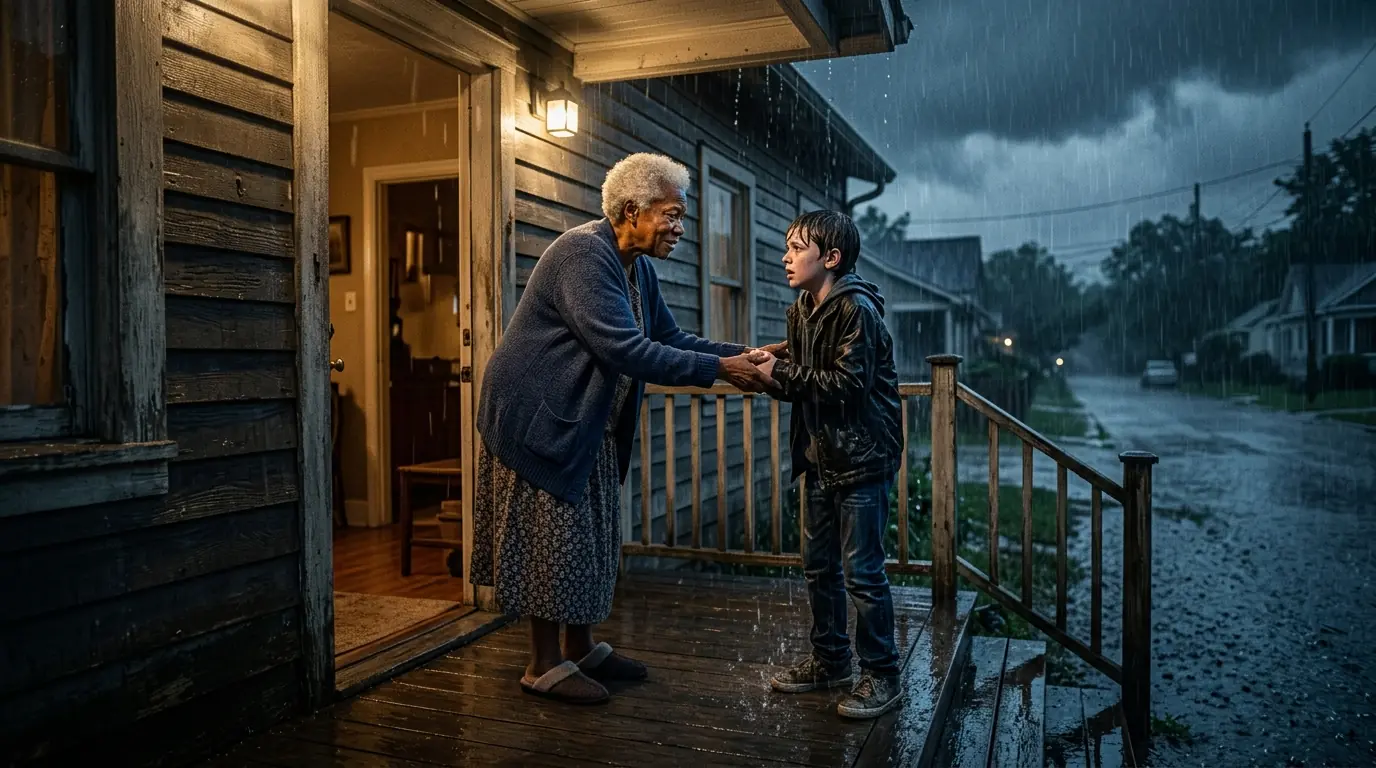 Mama Rose didn't ask questions. She didn't demand to know who he was or where he'd come from or what had happened to put those bruises on his skin. She didn't call out to see if anyone was with him. She didn't hesitate for even a single heartbeat. She just reached out her hand, warm and steady and sure, and said, "Come inside, child. Nobody's making you go anywhere. Not tonight. Not ever."
The boy stared at her outstretched hand for a long moment as if he couldn't quite believe it was real, as if he thought it might be some kind of trick. His eyes searched her face, looking for the lie, looking for the trap, looking for anything that would confirm what he'd learned to expect from adults who made promises they never kept. But all he saw was kindness. All he saw was truth. All he saw was a weathered brown hand reaching out to him in the darkness. Slowly, carefully, as if he were touching something precious that might break, the boy took her hand. His fingers were ice cold, so cold they almost burned. Mama Rose closed her fingers around his gently but firmly, and she pulled him across the threshold into the warm, dry safety of her home. She closed the door behind him, shutting out the rain, the wind, the thunder, and whatever darkness he'd been running from.
In the kitchen, the warmth wrapped around the boy like a blanket. Steam rose from the pot on the stove, carrying with it the rich, spicy smell of gumbo—a smell that promised comfort, safety, and fullness. Mama Rose guided him to the small wooden table by the window, the one with the checkered tablecloth and the salt and pepper shakers shaped like roosters, and she pulled out a chair. "Sit down, baby," she said softly. The boy sat. Water pooled on the floor beneath him, dripping from his soaked clothes. He kept his eyes down, his shoulders hunched, his whole body curled in on itself as if trying to take up as little space as possible.
Mama Rose didn’t say anything. She just went to the stove, ladled a generous portion of gumbo into her biggest bowl, the blue one with the chip on the rim, and set it in front of him. Then she cut a thick slice of cornbread from the pan on the counter, still warm, butter already melting into the golden surface, and placed it on a small plate beside the bowl. She poured a glass of cold milk and set that down, too. Then she sat across from him, her hands folded on the table, and waited.
The boy stared at the food. His hands trembled as he picked up the spoon. He took one small bite, then set the spoon down as if testing to see if it was real, if it would disappear, if someone would snatch it away and tell him he didn't deserve it. When nothing happened, when Mama Rose just sat there watching him with those kind, patient eyes, he picked up the spoon again. He took another bite and then another. And then, as if a dam had broken inside him, he began to eat faster, hungrily, desperately, like someone who hadn't had a real meal in days or weeks or maybe even longer than that.
Mama Rose watched him quietly. She didn't speak. She didn’t press. She just let him eat. She noticed the way his hands shook. She noticed the way he kept glancing at the door, as if expecting someone to burst through it at any moment. She noticed the way he flinched slightly every time the thunder rumbled. She noticed everything, because noticing was what Mama Rose did best. When the bowl was empty, scraped so clean it looked like it had just come out of the dishwasher, the boy finally looked up at her. His shoulders were still tense, his breathing still shallow and quick, but the violent shivering had stopped. The color was starting to come back into his face. The fear in his eyes had softened just a little, like a door that had been locked tight was starting to crack open.
Mama Rose leaned forward slightly, her voice gentle as a lullaby. "What's your name, sweetheart?" The boy hesitated. His gaze dropped back to the empty bowl. His hands clenched into small fists in his lap. For a moment, Mama Rose thought he might not answer at all. But then, in a voice so quiet she had to lean in to hear it, he whispered, "Henry."
Mama Rose repeated the name softly, as if she were tasting it, rolling it around in her mouth, making it real and solid and important. "That's a good name, a strong name. My grandfather's name was Henry. He was the kindest man I ever knew." The boy, Henry, didn’t respond. He kept his eyes fixed on the table, on his clenched fists, on anything but her face. Mama Rose studied him for a long, long moment. Then she said, "Henry, I need to ask you something, and I need you to be honest with me. Can you do that?"
Henry nodded, just barely. "Are you safe where you came from?" Henry's jaw tightened. His eyes filled with tears, but he blinked them back hard, as if crying was something he’d been punished for before. "No, ma’am." "Do you have somewhere else to go? Someone else who can take care of you?" He shook his head. Mama Rose nodded slowly, as if this confirmed something she'd already suspected. "All right then. Here's what we're going to do. You're going to stay here tonight. You're going to sleep on that couch in the living room, and you're going to be warm and dry and safe. And tomorrow morning, we're going to figure things out together. We're going to get you help from people who know how to handle situations like this. But tonight," she reached across the table and placed her warm hand over his cold, clenched fist, "Tonight, you don't have to be afraid. You hear me, Henry? In this house, you're safe."
Henry looked up at her then, really looked at her, his eyes searching her face for any sign of a lie, any hint of the cruelty he'd come to expect from the adults in his life. But all he saw was truth. All he saw was warmth. All he saw was a promise that felt like it might actually be kept. "Do you promise?" His voice cracked on the words. "I promise." Henry's shoulders sagged. The tears he'd been holding back finally spilled over, silent and hot, streaming down his cheeks. He didn't make a sound. He just cried, his whole body shaking with the force of emotions he'd been holding in for too long.
Mama Rose stood up, walked around the table, and pulled him into her arms. He stiffened at first, his whole body going rigid with instinct and fear. But then something inside him broke completely. He collapsed into her embrace, his small body shaking with sobs, his tears soaking into her shoulder. She held him. She didn’t shush him, or tell him it was okay, or make empty promises about how everything would be fine. She just held him and let him cry, one hand rubbing slow circles on his back, the other cradling his head. And she whispered the only words that mattered right then. "I got you, baby. I got you."
After a while, when the sobs had quieted to hiccups, and the hiccups had faded to shaky breaths, Mama Rose led Henry down the hallway to the bathroom. She gave him a clean towel, soft and blue and smelling like lavender fabric softener, and a pair of old sweatpants that used to belong to her grandson Michael, along with a soft gray T-shirt that was too big but would do just fine for sleeping. "You go ahead and get changed," she said gently. "Take your time. There's soap and shampoo in the shower if you want to warm up. I’ll be in the living room when you're ready." Henry nodded and closed the bathroom door.
Mama Rose went to the linen closet in the hallway and pulled out her favorite quilt, the one she’d made herself years ago—blue and cream with hand-stitched flowers along the edges, soft from years of washing and use. She carried it to the living room and spread it carefully over the old couch, then fluffed the pillows and made sure everything was comfortable. She could hear the shower running. She stood there for a moment, hands on her hips, and thought about the bruises on that child's wrists, the cut on his lip, the terror in his eyes. Her heart ached with a familiar pain, the pain of knowing there were children in this world who suffered, who were hurt by the very people who were supposed to protect them. Not this one, she thought fiercely. Not anymore.
When Henry emerged from the bathroom 15 minutes later, his hair was damp and sticking up in odd directions. His face was scrubbed clean. The too-big T-shirt hung off his thin shoulders, and the sweatpants pooled around his bare feet. He looked small and young, impossibly vulnerable, standing there in the doorway like he wasn't sure if he was allowed to come in. "Come on, baby," Mama Rose said, gesturing to the couch. "Lay down and get comfortable." Henry walked slowly across the room and climbed onto the couch. He pulled the quilt up to his chin and lay there stiffly, as if he were afraid to relax, afraid to believe this was real. The quilt smelled like lavender and something else he couldn’t quite name, something warm, safe, and permanent.
Mama Rose settled into the armchair nearby and picked up her knitting, an Afghan blanket she’d been working on for months, all blues and browns with crooked stitches that gave it character. The rhythmic click, click, click of the needles filled the quiet room, a sound that was somehow soothing, like a heartbeat or a rocking chair or rain on a tin roof. "Mama Rose," Henry’s voice was small in the dim light. "Yes, baby." "Thank you." Mama Rose set her knitting in her lap and looked at him. "No need to thank me, Henry. You’re exactly where you’re supposed to be." "But why?" The question came out barely above a whisper. "You don’t even know me." Mama Rose was quiet for a moment, considering her words carefully. "Maybe I don’t know your whole story yet, but I know what I need to know. I know you needed help, and you had the courage to ask for it. That tells me everything important about who you are."
Henry’s eyes filled with tears again. "What if they try to make me go back?" "They won’t," Mama Rose said firmly. "I won’t let them. Tomorrow we’ll talk to people who can help make sure you’re safe. But tonight, all you need to do is rest. Can you do that for me?" Henry nodded, though his eyes were still wide with worry. "Then close your eyes, baby. I’ll be right here."
Within minutes, exhaustion overtook fear. Henry’s breathing deepened and slowed. His body finally relaxed into the cushions, his hand clutching the edge of the quilt like an anchor. For the first time in longer than he could remember, he slept without nightmares. He slept without listening for footsteps in the hallway, or the sound of a belt being pulled from loops, or angry voices rising like a tide that would drown him. He just slept. But Mama Rose stayed awake. Once she was certain Henry was deeply asleep, once his breathing had that deep, steady rhythm that meant he was truly gone, she quietly set down her knitting and walked to the kitchen. She picked up the phone hanging on the wall and dialed a number she knew by heart. It rang three times before someone answered. "County Sheriff’s Office, Deputy Miller speaking." "Tom, this is Josephine Bellamy on Willow Street." "Evening, Miss Rose. Everything all right?" "I need you to send someone from Child Protective Services to my house first thing tomorrow morning. But Tom, listen to me carefully. No uniforms, no sirens, no patrol cars with lights flashing. There’s a child here who needs help, but he’s already scared half to death. What he needs is calm people who know how to handle this kind of situation with gentleness. Can you do that for me?"
There was a pause. Tom Miller had been a deputy in this county for 15 years, and he’d worked with Mama Rose before. She had a reputation—not just as the nice lady who baked cookies for the police station at Christmas, but as someone who genuinely cared about the people in her community, especially the ones who fell through the cracks. When Mama Rose called, you listened. "Yes, ma’am," Tom said. "I’ll make sure Eleanor Raymond gets the message tonight. She’ll come by around 9:00 tomorrow morning. Unmarked car, plain clothes, just like you said." "Thank you, Tom." "Miss Rose, the kid okay?" Mama Rose looked toward the living room, where Henry was sleeping peacefully for the first time in who knew how long. "He will be," she said softly. "He will be." She hung up the phone and stood there in the kitchen for a long moment, her hand still resting on the receiver. Then she bowed her head and whispered a prayer into the quiet. "Lord, I don’t know what this child has been through. I don’t know what horrors he’s seen, or what pain he’s carrying. But I know he’s here for a reason. I know you brought him to my door on purpose. So I’m asking you, help me be what he needs. Give me the wisdom to know what to say and what not to say. Give me the strength to protect him. And please, please, keep him safe."
She stood there in the yellow glow of the kitchen light, feeling the weight of responsibility settling on her shoulders like a familiar shawl. It was a weight she’d carried before, for her own children, for her grandchildren, for the neighborhood kids who showed up at her door looking for a safe place to exist. But this felt different. This felt bigger. This felt like the beginning of something that would change both their lives in ways she couldn’t yet imagine. Finally, she walked back to the living room and settled into her armchair. She picked up her knitting again, the blue and brown Afghan blanket with its crooked, imperfect stitches, and she kept watch. The needles clicked softly in the darkness. Outside, the rain had softened to a gentle patter. Inside, a boy slept without fear for the first time in a very long time. And in that small wooden house on Willow Street, something sacred was taking root.
The next morning arrived with pale sunlight filtering through the lace curtains, soft and golden like honey. Henry woke slowly, confused at first about where he was. The couch beneath him was soft, the quilt over him was warm, and the air smelled like coffee brewing and something else, something sweet and buttery, that made his stomach growl immediately. He sat up carefully, looking around the unfamiliar room, and then he remembered the rain, the knock on the door, Mama Rose, the gumbo, and the promise that he was safe. For just a moment, he allowed himself to believe it might be true.
He heard soft humming coming from the kitchen, a gospel song he didn’t know the words to but recognized the melody. He stood up, folding the quilt carefully, the way he’d been taught to do in the last place he’d stayed, and he walked toward the sound. Mama Rose was at the stove, flipping pancakes in a cast-iron skillet. When she heard his footsteps, she turned and smiled, a warm, genuine smile that reached all the way to her eyes. "Good morning, Henry. I hope you like pancakes." Henry nodded, not trusting his voice yet. "Well, good, because I made enough to feed an army. Go on and wash your hands, then sit yourself down at that table."
Henry did as he was told. When he came back from the bathroom, there was already a plate at his spot, a stack of three golden-brown pancakes, butter melting into the layers, syrup in a little pitcher beside it. There was also a glass of orange juice, cold and pulpy, and two strips of bacon that were crispy just how he liked them, though he couldn’t remember ever telling anyone how he liked his bacon. He sat down slowly, almost reverently, as if the plate might disappear if he moved too fast. Mama Rose poured herself a cup of coffee and sat across from him, watching with quiet satisfaction as he picked up his fork and took the first bite. The pancakes were perfect, light and fluffy on the inside, slightly crispy on the edges, with just a hint of vanilla. Henry had to force himself to eat slowly, to savor each bite instead of shoveling the food into his mouth like he had last night.
As he ate, Mama Rose sipped her coffee and didn’t press him with questions. She just let him be, let him eat, let him exist in this small pocket of peace before the day had to really begin. Finally, when Henry had eaten every last bite and wiped his mouth with the napkin Mama Rose had set beside his plate, he worked up the courage to ask the question that had been burning in his chest since he woke up. "Are you going to send me back?" Mama Rose set down her coffee cup with a gentle clink. She looked at him with those warm brown eyes that seemed to see right through him to the scared little boy underneath. "Henry, I called some people last night, people whose job it is to help children in situations like yours. They’re going to come talk to us this morning, but I want you to listen to me very carefully, because I need you to understand this." She reached across the table and took his hand in both of hers. "Nobody, and I mean nobody, is going to make you go back to a place where you’re being hurt. Do you understand me? That’s not how this works. That’s not what these people do. They’re going to help us figure out the next steps to keep you safe, but going back to where you were, that’s not one of the options. I promise you that."
Henry’s eyes filled with tears for what felt like the hundredth time since he’d arrived. "What if they don’t believe me? What if they think I’m lying?" Mama Rose squeezed his hand. "Then I’ll make them believe. I saw those bruises, Henry. I saw the fear in your eyes. I believe you, and I’m not going to let anything bad happen to you, not if I have any say in it." "But what if—" "No what ifs," Mama Rose said gently but firmly. "We’re going to take this one step at a time, okay? The lady who’s coming to talk to us, her name is Mrs. Raymond, Eleanor Raymond. I’ve known her for years. She’s good people. She cares about kids like you. You can trust her, and I’ll be right here with you the whole time. I’m not going anywhere." Henry nodded, though his stomach was churning with anxiety. He wanted to believe her. He wanted to trust that things could actually be okay, but trust was a luxury he’d learned not to afford.
Mrs. Eleanor Raymond arrived at exactly 9:00, just like Tom Miller had promised. She pulled up in front of the house in an unmarked silver sedan, no flashing lights, no official insignia, nothing that would draw attention or create alarm. She was a woman in her mid-50s, with kind eyes behind wire-rimmed glasses, gray and brown hair pulled back in a neat bun, and a soft face that had seen its share of heartbreak but hadn’t let it harden her. Mama Rose met her at the door and ushered her in quietly. "Eleanor, thank you for coming." "Of course, Rose." Mrs. Raymond’s voice was calm and professional, but warm. She looked past Mama Rose to where Henry stood in the living room doorway, half hidden behind the frame, watching her with wide, wary eyes. "And you must be Henry." Henry didn’t answer. He just looked at Mama Rose, checking to see if this was okay, if this person was safe. Mama Rose gave him a small, encouraging nod. "It’s all right, baby. Come on in and sit down."
They all settled in the living room, Mama Rose and Henry on the couch, Mrs. Raymond in the armchair. Mrs. Raymond didn’t immediately pull out a notebook or start asking rapid-fire questions like Henry had feared she might. Instead, she set her bag down beside her chair and folded her hands in her lap. "Henry," she said gently, "I know this is probably scary, having a stranger come into the house, not knowing what’s going to happen next, but I want you to know that I’m here to help. That’s my whole job—to help kids who are in tough situations, and I’m really good at my job, not because I follow a bunch of rules, but because I actually care. Does that make sense?" Henry nodded slightly. "Good. Now, I need to ask you some questions. Some of them might be hard to answer, but I need you to know that whatever you tell me, I’m here to help, not to judge, not to punish, just to help. And Miss Rose is going to stay right here with you the whole time. Is that okay?" Another small nod.
“Can you tell me where you were living before you came here?” Mrs. Raymond asked. Henry’s hands clenched into fists on his lap. His voice came out barely above a whisper. “With my mom and her boyfriend.”
“What’s your mom’s name?”
“Linda. Linda Patterson.”
“And the boyfriend?”
Henry’s jaw tightened. “Ray. Ray something. I don’t know his last name.”
Miss Raymond nodded, making mental notes without writing anything down yet, knowing that the act of writing could feel official and scary to a child who was already terrified. “How long have you been living with them?”
“About two years, since my dad died.”
“I’m sorry about your dad, Henry.”
Henry didn’t respond. “Can you tell me what it was like living there? What was a normal day like?”
Henry stared at his hands. The room was quiet, except for the soft ticking of the clock on the mantel. Mama Rose reached over and placed her hand on his knee, a silent reminder that she was there, that he wasn’t alone. Finally, Henry spoke, his voice flat and emotionless, as if he were reciting facts from a history book instead of talking about his own life. “Ray drinks a lot. When he drinks, he gets mad. He yells. He throws things, and sometimes he hits.”
“Does he hit your mother?”
“Sometimes.”
“Does he hit you?”
Henry nodded, still staring at his hands.
“How often?”
“I don’t know. A lot. Whenever I do something wrong, or sometimes even when I don’t. Sometimes he’s just mad and I’m there.”
Mrs. Raymond’s expression didn’t change, but Mama Rose saw the way her hands tightened slightly in her lap. “Henry, when Ray hits you, what does he use? His hands? His fists? Something else?”
Henry’s voice dropped even lower. “His belt, mostly. Sometimes his fists. One time he pushed me into the wall and I hit my head pretty bad. What about your mother? Does she try to stop him?
“For the first time, emotion crept into Henry’s voice—not anger exactly, but something close to it, something wounded and bitter. “She tells him to stop sometimes, but then he gets mad at her too, and she just… she just leaves. She goes to her room and closes the door and pretends it’s not happening.”
“Is that why you left, because it got too bad?”
Henry nodded. “Two nights ago, he came home really drunk. I’d left a glass in the sink, forgot to wash it. He grabbed me by the wrists.” Henry held up his arms, showing the purple bruises that were already starting to yellow at the edges. “And he said if I couldn’t do something as simple as washing a dish, then maybe I needed to learn a lesson. He was pulling his belt off when mom finally said something. They started fighting, screaming at each other, and I just… I ran. I grabbed my jacket and I ran out the back door, and I just kept running.”
“Where did you go?”
“I hid in the woods behind the grocery store for a while. Then it started raining. I walked around for hours, trying to figure out what to do. I was so cold and scared, and I didn’t know where to go. And then I saw this house with the lights on, and I could smell food cooking, and I just… I knocked. I didn’t know what else to do.”
Mrs. Raymond’s eyes had gone soft with a sadness that came from years of hearing stories like this, stories that should never have to be told by children. “You did exactly the right thing, Henry. You were incredibly brave.”
“It doesn’t feel brave,” Henry whispered. “It feels like I’m a coward who ran away.”
“No,” Mama Rose’s voice was firm, cutting through the shame in Henry’s words like a knife through butter. “You listen to me, Henry. Leaving a place where you’re being hurt is not cowardice. It’s survival. It’s strength. You did what you had to do to protect yourself, and there is nothing, nothing wrong with that.”
Mrs. Raymond nodded in agreement. “Miss Rose is absolutely right. What you did took more courage than most adults have. And now we’re going to make sure you don’t have to go back there. But I need to be honest with you about what happens next. Are you ready to hear that?”
Henry looked at Mama Rose, who gave him an encouraging nod. Then he looked back at Mrs. Raymond. “Yes, ma’am. Okay.”
“I’m going to file a report with the state about what you’ve told me. The police are going to investigate what’s been happening at your mother’s house. And in the meantime, we need to find you a safe place to stay while all of that gets sorted out.”
Henry’s face went pale. “I can’t stay here.”
The desperation in his voice nearly broke Mama Rose’s heart. She looked at Mrs. Raymond with pleading eyes.
“Henry, Miss Rose isn’t an approved foster home. In order for you to stay here long-term, she would have to go through a whole process—background checks, home inspections, training. That takes time. And right now, we need to make sure you’re somewhere safe immediately.”
“But I am safe here!” Henry said, his voice rising with panic. “Please, please don’t make me leave. I’ll be good. I won’t be any trouble. Please.”
Mama Rose pulled him close, wrapping her arms around him as he started to cry again. She looked at Mrs. Raymond over the top of his head. “Eleanor isn’t here anyway. Let me make some calls.”
Mrs. Raymond, her professional composure cracking just slightly, said, “I might be able to arrange for emergency temporary placement here while we expedite the process. It’s not standard procedure, but given the circumstances…” She trailed off, looking at the sobbing boy in Mama Rose’s arms. “Let me make some calls.”
Mrs. Raymond spent the next hour on the phone, first from her car, and then from Mama Rose’s kitchen. There were forms to fill out, procedures to follow, supervisors to convince. But Eleanor Raymond was good at her job, and she knew when to push and when to bend the rules just enough to do what was right instead of what was easy.
By noon, it was settled. Henry could stay with Mama Rose on an emergency basis for up to 30 days while the investigation proceeded and while Mama Rose completed the abbreviated foster certification process. There would be regular check-ins. There would be home visits. But for now, Henry could stay.
When Mrs. Raymond delivered the news, Henry’s relief was so profound, he actually sagged against Mama Rose like his strings had been cut. But Henry, Mrs. Raymond said gently, “I need you to understand that this is temporary. Miss Rose has agreed to start the process to become a certified foster parent, and I believe that will go through without any problems. But if for some reason it doesn’t, we’ll need to find you another placement. Do you understand?”
Henry nodded, though he was barely listening to the caveats and conditions. All he heard was that he could stay, that he didn’t have to leave, that he was at least for now safe.
After Mrs. Raymond left, Mama Rose made grilled cheese sandwiches for lunch, and they ate in comfortable silence. Henry was exhausted, emotionally wrung out from reliving his trauma—the fear, the relief, the uncertainty of the morning. After lunch, Mama Rose suggested he rest, and he didn’t argue. He went back to the couch, pulled the quilt up over himself, and fell asleep almost instantly. While he slept, Mama Rose sat in her armchair and thought about what she had just agreed to. Taking in a traumatized child wasn’t something to be done lightly. There would be challenges ahead: nightmares, behavioral issues, trust problems, the complicated process of healing from abuse. But as she looked at Henry’s sleeping face—so young and so worn out—she felt a deep certainty settle in her bones. This was right. This was where he was supposed to be. And she was going to do everything in her power to make sure he knew he was wanted, that he was safe, that he mattered. She picked up her knitting, that crooked blue and brown Afghan blanket, and went back to work, the needles clicking softly in the afternoon light.
The days turned into a week, and the week turned into two. Henry began to settle into a routine at Mama Rose’s house. He had his own space on the couch, which Mama Rose made up for him every night with fresh sheets and the quilt that was quickly becoming his favorite possession. He helped with small chores: setting the table, taking out the trash, sweeping the front porch. Mama Rose enrolled him in the neighborhood elementary school, and though he was quiet and kept mostly to himself, his teachers reported that he was bright and well-behaved.
But the trauma didn’t just disappear because he was somewhere safe now. The nightmares came almost every night. Henry would wake up gasping, sometimes crying out, sometimes just lying there in the dark with his heart racing and his body covered in sweat. And every time, Mama Rose would hear him. She seemed to have some kind of sixth sense for when he needed her. She would appear in the living room doorway, her silhouette backlit by the hallway light, and she would sit on the edge of the couch and rub his back until his breathing slowed and the terror receded. “It’s all right, baby,” she would murmur. “You’re safe. You’re here with me. Nobody’s going to hurt you.” She never made him talk about the nightmares unless he wanted to. She just provided the comfort of her presence, steady and unwavering, until he could fall back asleep.
One night, about three weeks after Henry had arrived, he woke from a particularly bad nightmare, one where Ray had found him, dragged him back to that house, and locked him in a closet where no one could hear him scream. Henry sat up, gasping, his hands clutching the quilt like a lifeline. “Don’t let them take me back,” he said when Mama Rose appeared, his voice high and frightened like a much younger child. “Please, Mama Rose, don’t let them take me back.”
Mama Rose sat down and pulled him into her arms. “Nobody’s taking you anywhere, Henry. You hear me? Nobody.”
“But what if they do? What if the judge says I have to go back to my mom? What if they don’t believe me about Ray?”
“Henry, look at me.” Mama Rose cupped his face in her hands, making him meet her eyes. “I have lived in this world for 72 years, and I have seen a lot of things. I’ve seen injustice, and I’ve seen cruelty, and I’ve seen the system fail people who deserve better. But I’ve also seen good people stand up and fight for what’s right. And I promise you on everything I hold sacred that I will fight for you. I will stand in front of any judge, any social worker, any person who tries to send you back to a place where you’re not safe, and I will fight. Do you believe me?”
Henry nodded, tears streaming down his face.
“Good. Now lay back down. I’m going to sit right here until you fall asleep.”
“Will you sing?” Henry asked quietly, like he did that first night.
Mama Rose smiled. She began to hum softly, an old spiritual her own grandmother had sung to her when she was small. Hush, little baby, don’t say a word. Mama’s going to buy you a mockingbird. The melody was sweet and low and full of love. Henry’s eyes grew heavy. The nightmare began to fade, and wrapped in the warmth of Mama Rose’s presence and the sound of her voice, he drifted back to sleep.
Henry’s first weeks with Mama Rose were a mix of healing and adjustment. The investigation into Ray and Linda Patterson took six weeks. During that time, Mrs. Raymond came by regularly to check on Henry and update Mama Rose on the progress. The news was both vindicating and heartbreaking. The police had found evidence of abuse: photographs documenting the bruises on Henry’s body when he’d first arrived at the hospital for a mandatory examination, testimony from neighbors who’d heard screaming and crashing from the Patterson apartment, and a teacher from Henry’s old school who reported that he frequently came to class with unexplained injuries.
Linda Patterson was interviewed multiple times. She admitted that Ray had a temper and that he’d been physical with Henry, but she insisted it wasn’t that bad, that Henry was exaggerating, that he’d always been a difficult child who needed discipline. She seemed more concerned with keeping Ray than with getting her son back. That hurt Henry more than anything Ray had ever done to him physically. The realization that his own mother cared more about a man who hurt them both than she cared about her child’s safety—that was a wound that wouldn’t heal quickly.
Ray Patterson was arrested and charged with child abuse. He was currently out on bail, awaiting trial. The court issued a restraining order keeping him away from Henry, and Linda was only allowed supervised visitation—a right she exercised exactly once before deciding it was too much trouble and stopping altogether. When Mrs. Raymond delivered that news, Mama Rose watched Henry’s face carefully, ready to comfort him if he fell apart. But Henry just nodded slowly and said, “I figured.” The flatness in his voice broke Mama Rose’s heart more than tears would.
That night, as they sat on the porch swing together, watching the sunset paint the sky in shades of orange and pink, Mama Rose said gently, “You know it’s not your fault, right? What your mama did—choosing him over you—that’s on her. That’s her failing, not yours.”
Henry didn’t respond for a long time. Then he said quietly, “Why doesn’t she love me?”
“Oh, baby,” Mama Rose pulled him close. “I can’t answer that. I don’t know what’s going on in your mama’s head or her heart. But I can tell you this: the fact that she couldn’t see how special you are, how worthy you are of love and protection, that’s her blindness. That’s her loss. Because you, Henry, you are something precious.”
“How do you know?” His voice was small and wounded.
“Because I see you. Really see you. And what I see is a brave, kind, smart boy who deserves so much better than what he’s been given. And I’m going to spend every day making sure you know that.”
Henry leaned into her, and they sat there in silence as the light faded and the fireflies began to blink in the yard like tiny fallen stars.
The process of Mama Rose becoming a certified foster parent moved forward. There were home inspections, background checks, and hours of training on trauma-informed behavioral management. Mama Rose passed everything with flying colors. In fact, the inspector noted in his report that he’d rarely seen a home environment as warm and nurturing as the one Josephine Bellamy had created. At the end of the 30-day emergency placement, there was a hearing to determine Henry’s future.
Mama Rose and Henry sat together in a small courtroom, both dressed in their Sunday best. Mrs. Raymond was there, along with a state attorney and a family court judge named Judge Patricia Morrison. Judge Morrison reviewed the case file, asked Henry a few gentle questions about how he was doing, and then looked at Mama Rose.
“Mrs. Bellamy, you understand that if I approve this placement, you’re taking on significant responsibility. This isn’t a short-term situation. If I place Henry in your care, it will be with the intention of this being a long-term stable placement, possibly leading to legal guardianship if parental rights are terminated. Are you prepared for that?”
Mama Rose sat up straight, her voice clear and strong. “Your Honor, I understand completely and yes, I’m prepared. This boy walked up to my door asking for help and I gave it to him. But somewhere along the way, it stopped being about obligation and became about love. He’s not just a foster child to me. He’s my child, and I will take care of him, protect him, and love him for as long as he needs me to, which I hope is forever.”
Judge Morrison’s stern expression softened slightly. She looked at Henry. “Henry, do you want to stay with Mrs. Bellamy?”
Henry nodded emphatically. “Yes, ma’am. More than anything.”
“Do you feel safe there?”
“Yes, ma’am. The safest I’ve ever felt.”
Judge Morrison nodded and made a note. Then she looked up and said, “Then it’s my ruling that Henry Patterson will remain in the custody of Mrs. Josephine Bellamy as a certified foster placement. We’ll review the case in six months to assess progress and determine next steps. Court adjourned.”
She struck her gavel once. Henry and Mama Rose hugged right there in the courtroom, both of them crying happy tears. Mrs. Raymond smiled from her seat, feeling that rare and precious satisfaction that came from knowing she’d helped place a child exactly where he needed to be.
Life settled into a new normal. Henry thrived under Mama Rose’s care. He did well in school, made a few friends, and slowly began to believe that good things could happen to him, that not all adults were dangerous, that the world could be safe if you were lucky enough to find the right corner of it. Mama Rose gave him his own room, the smallest bedroom, which had been used for storage, but she cleared it out, painted it blue, and got him a real bed, dresser, and bookshelf.
Henry stood in the doorway the first time he saw it, completely overwhelmed. “It’s yours,” Mama Rose said. “You can decorate it however you want. We’ll get you some posters or whatever kids your age like these days.”
Henry just hugged her and whispered, “Thank you.”
Even with his own room, Henry still preferred to sleep on the couch most nights, especially when the nightmares were bad. He felt safer there, closer to Mama Rose, able to hear her moving around the house, able to call out if he needed her. And Mama Rose never pushed him. She understood that healing didn’t happen on a schedule.
She started a tradition. Every Sunday morning, they would make breakfast together—pancakes, waffles, or biscuits and gravy. And while they cooked, Mama Rose would tell him stories about her life, about her own children when they were young, about her husband Marcus, and the adventures they’d had. She talked about hard times too—losing her mother young, struggling financially, and about the ways life could be difficult even when you were loved.
“The point,” she said one Sunday as they flipped pancakes together, “is that life is going to throw things at you, hard things, painful things. But you don’t have to face them alone. Having people who love you, who are in your corner, that makes all the difference.”
“Like you,” Henry said.
“Like me,” Mama Rose agreed. “But not just me. You’re going to find other people too, Henry. Teachers and friends, and maybe someday a family of your own. People who see you the way I see you.”
“How do you see me?”
Mama Rose set down her spatula and looked at him seriously. “I see a survivor. I see someone with a big heart and a sharp mind. I see someone who’s been knocked down but keeps getting back up. I see somebody, Henry. You are somebody. Don’t you ever forget that.”
Those words became Henry’s anchor. On bad days, when memories got too heavy, or when he missed the mother who’d failed to protect him, he would repeat them to himself like a prayer: I am somebody. I am seen. I am safe.
One afternoon, about three months after he’d first arrived, Mama Rose called Henry into the kitchen. She had a gift for him, a small journal with a blue leather cover.
“What’s this for?” Henry asked.
“For your thoughts,” Mama Rose said. “Sometimes the things we carry inside get too heavy if we don’t find a way to let them out. You can write in here about your day, about your feelings, about anything you want. And it’s private. I won’t read it unless you want me to.”
Henry ran his fingers over the smooth leather. On the first page, Mama Rose had already written something in her careful handwriting: You are seen. You are safe. You are somebody.
Henry looked up at her, his eyes shining. “I’ll never forget this,” he said. “Everything you’ve done for me, I’ll never forget.”
“I know you won’t, baby,” Mama Rose said, pulling him into a hug. “But you don’t owe me anything. Loving you isn’t a debt you have to repay. It’s just what I do.”
A few days later, it was time for what Mama Rose called the conversation. Henry had been with her for four months now, and Mrs. Raymond had been suggesting it was time to talk about what came next. The state was building a case to terminate Linda Patterson’s parental rights. Ray had been convicted and was serving an eighteen-month sentence. Linda had made it clear she wasn’t interested in fighting for custody, which meant Henry needed a permanent home.
They sat on the front porch, the place where so many important conversations happened. Mama Rose had made lemonade, and they sipped it slowly while the sun set, turning the sky purple and gold.
“Henry,” Mama Rose began carefully, “I want to talk to you about something important.”
Henry set down his glass, immediately alert. “Am I leaving?”
“No, baby. No, the opposite, actually. I want you to stay, not just as a foster child. I want to make it permanent. I want to adopt you, if that’s something you’d want.”
Henry stared at her, not quite believing what he was hearing. “Adopt me? Like you’d be my real mom?”
“I’d be your legal mother, yes. Now, I know I can’t replace the mother you lost.”
“You’re not replacing her,” Henry interrupted. “She left. She chose Ray over me. But you, you chose me. You chose me when you didn’t have to. You chose me when I was just some scared kid on your porch. You kept choosing me every single day after that. You’re more of a mom to me than she ever was.”
Mama Rose’s eyes filled with tears. “Then let’s make it official. Let’s become a family on paper and in every way that matters.”
“Yes,” Henry said without hesitation. “Yes, I want that more than anything.”
They hugged there on the porch, both of them crying happy tears. And in that moment, Henry felt something he’d never felt before—the absolute certainty that he belonged somewhere, that he was wanted, that he had a home, not just in a building, but in someone’s heart.
The adoption process took another six months. There were more hearings, more paperwork, more waiting. But finally, on a cold January morning, they stood in front of Judge Morrison again. This time, there was no anxiety, no fear, just joy. Judge Morrison smiled as she read the final order.
“Henry James Patterson, from this day forward, you will be known as Henry James Bellamy. Mrs. Josephine Bellamy, you are now his legal mother in every sense of the word. Congratulations to you both.”
She brought down the gavel, and it was done. Henry and Mama Rose hugged right there in the courtroom, both of them crying. When they finally pulled apart, Henry said, “Hi, Mom.”
Mama Rose laughed through her tears. “Hi, son.”
They celebrated quietly, just the two of them, with dinner at Mama Rose’s house and a cake Henry had ordered from the bakery in town. It was chocolate with buttercream frosting, and on top it said simply: Family.
That night, as they sat on the porch watching the stars come out, Henry said, “I got you something.” He pulled out a small wrapped box and handed it to her. Inside was a delicate silver necklace with a pendant in the shape of a house.
“It’s number 47,” Henry explained, “our home. I wanted you to have something to wear that reminds you that you gave me a home when I had none, that you built something beautiful here, that this place and you changed my life.”
Mama Rose held the necklace to her chest, crying. “Help me put it on.” Henry fastened the clasp around her neck, and Mama Rose touched the pendant with trembling fingers. “I’ll never take it off,” she promised.
“There’s one more thing,” Henry said. He pulled out his phone and showed her a picture. It was a small wooden sign, beautifully carved and painted. It read: The Bellamy Home, Judge Henry Bellamy and Mama Rose.
“I had it made,” Henry said. “I want to hang it on your porch, our porch, because this is our home, together, the way it always should have been.”
Mama Rose couldn’t speak. She just pulled him close and held on tight, and they sat there on the porch swing together as the night grew dark and the crickets started
their song.
The months that followed were some of the happiest of both their lives. Henry spent every free moment at Mama Rose’s house. They cooked together, worked in the garden together, sat on the porch together. Henry told her about his cases carefully, respecting confidentiality, and she would offer her perspective, her wisdom earned from seven decades of living, loving, and paying attention to people.
“You’re doing good work,” she would tell him. “Really seeing people the way I always knew you would.”
Henry brought over old photos, and together they created a new album that told their story from that rainy night forward: pictures of his first day of school in the new neighborhood, pictures of him helping in the garden, pictures of him and Mama Rose on the porch. They became fixtures in the neighborhood again. People would wave as they drove by. Kids would stop to talk, and Mama Rose would offer them cookies just like she used to.
The Bellamy Home, people called it, and it felt right.
One Sunday afternoon in spring, as they sat on the porch watching the azaleas bloom, Mama Rose said quietly, “Henry, I need you to promise me something. Anything. When I’m gone—and don’t interrupt, baby, we both know it’s coming—I need you to promise me that you’ll keep this house, keep this porch, keep offering kindness to people who need it. That’s what this place is meant for. That’s its purpose.”
Henry’s throat tightened.
“Mama, promise me,” she insisted.
“Promise me you’ll turn this into something that helps people—kids like you were, people who need a safe place. Promise me this house will keep being a home.”
“I promise,” Henry said, tears streaming down his face. “I promise.”
Mama Rose squeezed his hand. “Good. That’s all I needed to hear.”
Mama Rose passed away peacefully in her sleep on a warm June morning. She was seventy-nine years old. Henry found her when he came over to make breakfast. She looked peaceful, like she’d simply drifted off and decided not to wake up. On her nightstand was a letter addressed: my Henry.
He sat on the edge of her bed and read it with shaking hands:
"My dearest Henry, if you’re reading this, then I’ve gone on ahead. Don’t be sad, baby. I’ve had a full life, a blessed life, and you’ve been the greatest joy of it. I want you to know that loving you was never a burden or an obligation. It was an honor. Watching you grow from that scared little boy into the incredible man you’ve become, that’s been my life’s greatest accomplishment. Keep your promise. Turn this house into something beautiful. Help other kids who need what I gave you. Let love win, Henry. Always let love win, and remember what I told you that very first night: You are seen. You are safe. You are somebody. You always have been. You always will be. I love you forever, Mama Rose."
Henry sat there holding the letter and cried until he had no tears left.
The funeral was small but beautiful. The whole neighborhood seemed to come. Mrs. Raymond was there, older now, still working with foster kids. Reverend Thomas spoke about Mama Rose’s kindness, her generosity, her open door and open heart. Henry gave the eulogy, though he could barely get through it without breaking down.
“She saved my life,” he said simply, “and then she showed me how to live it. That’s all. That’s everything.”
They buried her next to Marcus in the church cemetery, under an old oak tree. Henry had them engrave her tombstone with the words she’d written in his journal: You are seen. You are safe. You are somebody.
After the funeral, Henry stood in number 47 Willow Street, surrounded by Mama Rose’s things, and had to make a decision. He could sell the house, move on, let it become someone else’s home, or he could keep his promise. The choice was obvious.
Over the next six months, Henry worked with architects and contractors to convert it into a safe home for foster children in crisis placement. It would be a place where kids could stay temporarily, safe and seen, treated with dignity while the system figured out their long-term placement. He hired a live-in house parent named Maria, a warm woman in her fifties who had been a foster parent herself for years. He filled the house with comfortable furniture, books, games, and art supplies. He painted the bedrooms in warm, welcoming colors. He kept Mama Rose’s kitchen table, her porch swing, her garden full of flowers, and above the front door he hung the sign: Rose House, a home of hope.
On the day Rose House officially opened, Henry stood on the porch and looked at what he had created. Inside were three children: two brothers who’d been removed from an abusive home, and a girl who had run away from a foster placement that wasn’t working. They were scared and uncertain, but Maria was making them dinner, and the house smelled like cornbread and safety.
Henry thought about Mama Rose, about that rainy night fifteen years ago, about the door that had opened and changed his entire life.
“I kept my promise, Mama,” he whispered. “This is your legacy. This is your love still changing lives.”
A few days later, he was in his chambers at the courthouse when he got a call from Maria.
“Judge Bellamy, I thought you’d want to know. One of the boys asked if it was okay to sit on the porch swing. I told him of course it was, and he said it felt like being hugged. I thought you’d like that.”
Henry smiled through his tears. “Thank you, Maria. Thank you for telling me.”
That evening, Henry went to Rose House for dinner. He sat at Mama Rose’s old kitchen table with Maria and the three kids, passing around bowls of gumbo and plates of cornbread. The brothers were starting to relax, starting to smile. The girl was quiet, but watching everything carefully, starting to believe maybe this place was safe.
After dinner, Henry sat on the porch swing with the younger brother, a boy named Marcus, the same name as Mama Rose’s late husband.
“Is it scary?” Marcus asked, being in foster care.
Henry thought about lying, about saying it would all be fine, but Mama Rose had taught him better than that. “Sometimes it is,” he said honestly. “Sometimes it’s really scary, but there are good people in the world, Marcus—people who will see you and care about you, and make sure you’re okay. You just have to let them help you.”
“How do you know?”
Henry smiled. “Because someone did that for me once, and it saved my life.”
They sat there on the swing as the sun set and the fireflies came out, and Henry thought about how love moves through the world—not in grand gestures, but in open doors, warm meals, and someone saying, You’re safe here.
Years passed. Rose House became a fixture in the community, helping dozens of children over the years. Henry continued his work as a federal judge, presiding over cases with the compassion and wisdom Mama Rose had taught him. He never married, never had children of his own in the traditional sense, but he had Rose House. He had the kids who came through those doors and found safety there. He had the knowledge that he was honoring Mama Rose’s memory every single day.
On the anniversary of her death each year, Henry would sit on the porch swing at Rose House and read her letter again—the one she had left for him—and he would remember. He would remember a rainy night and a knock on a door. He would remember the smell of gumbo and the warmth of a quilt. He would remember a woman who saw a scared little boy and said, You’re safe here.
He would remember that family isn’t always about blood. Sometimes family is about choice. Sometimes family is the hand that reaches out in the darkness. And sometimes that hand holds on forever, even after it’s gone, even after the person who extended it has passed on.
The love remains, changing lives, opening doors, offering hope to those who need it most. Mama Rose was gone, but her love remained, and it always would.