The winter storm had arrived without warning, blanketing the small town of Winterbrook, New Hampshire, in a thick layer of snow. By late afternoon, the streets were impassable, the wind slicing through coats as though it carried its own bite. Most residents had retreated to their homes early, leaving the town nearly deserted, except for the occasional flicker of headlights struggling through the blizzard.
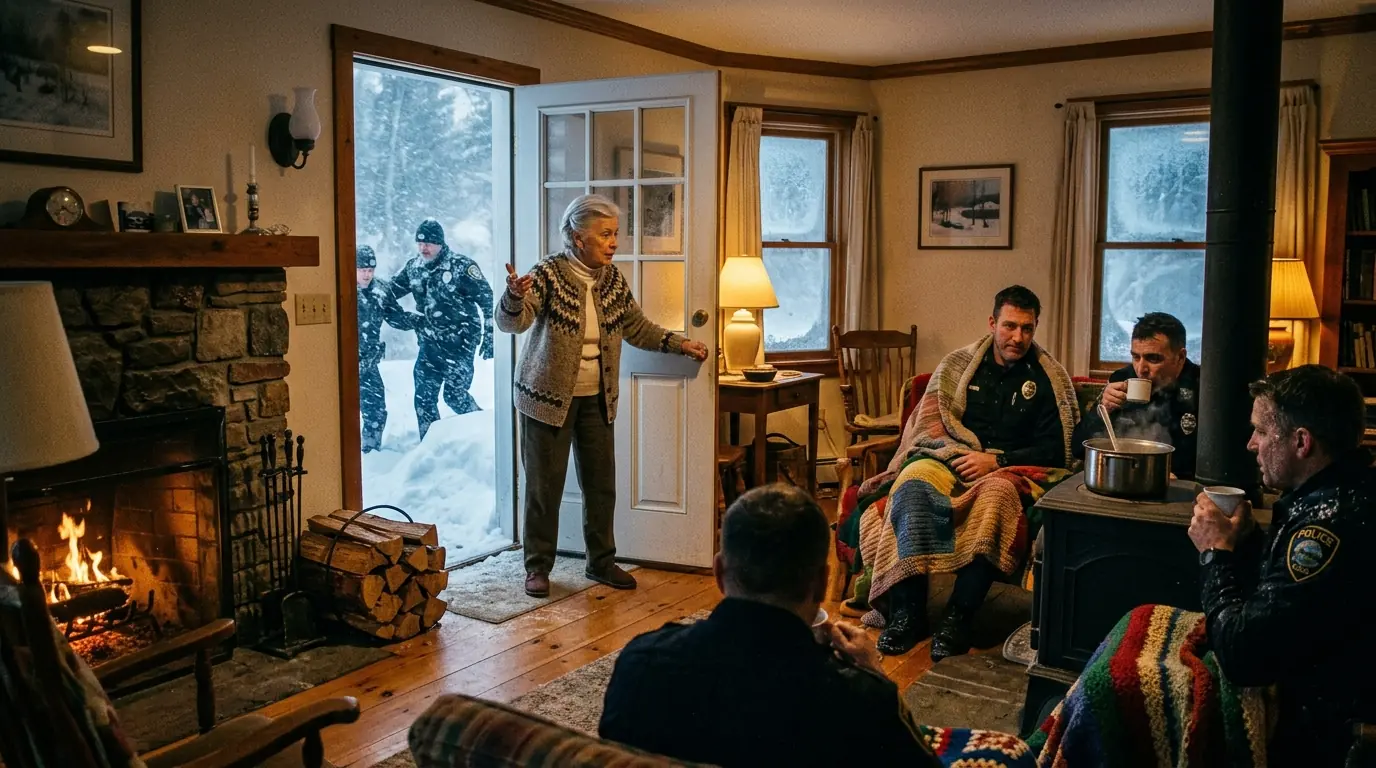 Eleanor Harper, an elderly woman in her late seventies, had lived in the same cozy, weathered home at the edge of town for over forty years. Her silver hair was neatly pinned back, and her sharp green eyes still carried a spark that belied her age. Eleanor had always preferred the quiet life—her husband had passed decades ago, and her children had moved to far-off cities. Her small house, tucked between towering pines and the frozen creek, was filled with warmth and careful order: knitted blankets folded over chairs, wood stacked neatly in the shed, and a stove that always emitted the comforting aroma of simmering stew.
That evening, Eleanor had just settled near the fire with a cup of chamomile tea when a loud, urgent knocking echoed through the blizzard. She frowned, her heart skipping a beat. Visitors were rare, and at this hour in the storm, no one should be out. She opened the door, the icy wind gusting in, and peered into the white chaos. A group of uniformed police officers, nearly a dozen of them, were struggling through the snow, their cars having become trapped along the main road.
One of the officers, a young man with freckles and a weary expression, shouted over the wind, “Ma’am! Please! Our vehicles are stuck. We can’t get to the hospital—people need us!” Eleanor hesitated only a moment, assessing the situation. She could see frost biting their exposed faces, their fingers numb, uniforms soaked through. “Come in,” she called. “Quickly. You’ll freeze out here.”
The officers moved in, sliding across the ice, their boots leaving prints in the soft snow inside her doorway. Eleanor guided them toward the living room, where the fire burned brightly. “Sit. Get warm,” she instructed, handing blankets to the officers whose teeth were chattering violently. Her voice was steady but kind, her movements practiced and deliberate. “We need to get dry, get circulation back before we do anything else.”
Among the group was Captain Thomas Greene, a tall man in his mid-forties, whose normally authoritative demeanor was tempered by exhaustion. He nodded at Eleanor, appreciation flashing in his eyes. “Thank you, ma’am. We didn’t expect to get stranded out here.” Eleanor merely nodded, setting down a pot of hot broth she had been preparing for dinner. She ladled it into cups and handed them out carefully.
The officers ate in silence, the storm howling outside, muffling the usual noises of the small town. Eleanor moved among them, adjusting coats, fetching blankets, quietly instructing them on how to sip the broth without burning themselves. “Slow,” she reminded one of the younger officers. “You’re shaking too much. Take it slow.”
Outside, the wind was relentless, whipping snow against the windows, rattling the old frame of the house. Eleanor didn’t flinch. Her experience with storms and isolation had taught her patience and resilience. She had seen winters worse than this one, and she had learned to prepare, to act decisively when emergencies arose.
Hours passed, and Eleanor’s home became a temporary shelter for the stranded officers. She directed them to set up cots in the spare rooms, while others took mats near the fireplace. She kept the stove stoked, monitoring the temperature and the officers’ conditions. One of the older officers, a man named Harold Miller, whose coat had split in the storm, shivered uncontrollably. Eleanor quickly removed her own heavy wool sweater and draped it over him. “You’ll warm up,” she assured him softly.
The storm outside raged through the night, snow piling higher against the windows, the blizzard’s howling voice seeming to challenge anyone daring enough to stand against it. Yet inside, Eleanor’s house was a haven. She moved with grace and purpose, ensuring each officer had warmth, food, and rest. When one of the officers woke from a restless sleep, shivering, she lifted him gently and helped him change into dry clothes she had laid out earlier. Her movements were precise, almost surgical, born of years of caring for others—children, neighbors, anyone who had ever knocked on her door seeking shelter.
Captain Greene approached Eleanor as she worked near the stove. “Ma’am, you’ve saved us,” he said quietly. “We were trapped. I don’t know what we would have done without you.” Eleanor looked up, her expression calm, eyes reflecting the firelight. “You would have managed. But not tonight. Not in this storm. Come, sit. Eat something.” She handed him a steaming cup of broth. He accepted it with a nod, the weight of gratitude pressing against his tired frame.
By midnight, all ten officers were accounted for and safely settled. Eleanor moved through the house one last time, checking doors, ensuring that blankets covered the shivering shoulders, and that the fire would keep burning through the cold hours. She paused at the window, watching the snow swirl in the moonlight, and felt a quiet satisfaction. This was what she had lived for: moments where her skills, her experience, and her heart could make a real difference.
Morning arrived pale and silent. The blizzard had passed, leaving the town buried in white. Eleanor stirred from her sleep, listening to the quiet creak of the house and the faint sounds of the officers moving around. She dressed quickly, pulled on her heavy coat, and stepped outside. The world was transformed—snow glittered under the pale sun, icicles hung like crystal from the eaves, and the main road was nearly invisible beneath the pristine white.
She didn’t have to wait long. One by one, the officers emerged, brushing snow off their uniforms, carrying their gear. Captain Greene stepped forward, saluting her in a gesture that felt more heartfelt than formal. “Ma’am,” he said, “we owe you everything. Truly.” Eleanor shook her head gently. “You’d have done the same for someone in need,” she replied.
Before she could turn back, the sound of engines echoed through the street. One by one, police cars began to line her lane, their lights flashing softly in the morning light. It wasn’t a show. It wasn’t ceremony. It was respect, acknowledgment, a quiet celebration of her courage and generosity. Neighbors peeked out from their windows, some stepping onto their porches, nodding in silent admiration.
Eleanor felt something stir in her chest—a mixture of surprise, pride, and deep relief. She had acted out of instinct, out of compassion, without thought for recognition. And yet, seeing the cars, hearing the polite greetings, witnessing the officers bow their heads in appreciation, she realized that her efforts had not gone unnoticed.
The officers gathered briefly in front of her house. Captain Greene cleared his throat, speaking on behalf of the group. “Mrs. Harper, you didn’t just keep us safe. You reminded all of us why we do this job—the care, the humanity, the courage it takes to step in when others can’t. We can never repay you fully, but we hope this is a start.”
Eleanor smiled faintly, the corners of her eyes crinkling. “Start?” she asked softly. “There’s nothing to repay. I just did what needed doing.” She gestured toward the snow-covered landscape. “And now,” she added, “you all go home. Warm up. Eat something that doesn’t have to be hurried.”
Captain Greene nodded, his face reflecting gratitude and humility. “Yes, ma’am. Thank you,” he said again, the words carrying weight. One of the officers stepped forward and handed her a small envelope. “For you,” he said. “Just a token, on behalf of all of us.” Eleanor accepted it without opening it, tucking it carefully into her coat pocket.
As the officers departed, Eleanor watched them leave, their footprints gradually disappearing in the fresh snow. The street returned to quiet, save for the soft rustle of wind through the pines. She took a deep breath, feeling the cold air fill her lungs, and let it out slowly. Inside, her house was warm, the stove still crackling, and the memory of the storm and the night’s events settled around her like a protective blanket.
It was a moment she would carry with her—not for recognition or thanks, but for the knowledge that even in the harshest conditions, human kindness could make a difference. Eleanor Harper had lived a long life, filled with quiet days and simple routines, but that night had reminded her—and, unexpectedly, the town of Winterbrook—of the extraordinary courage hidden in ordinary people.
And as she stepped back inside, closing the door behind her, she allowed herself a small, private smile. Cedar Hollow, she thought, or in this case, Winterbrook, was full of quiet heroes. Tonight, she had been one of them.
The snow continued to shimmer in the early light, the town slowly awakening, and for the first time in years, Eleanor felt an unexpected warmth—not from the fire, not from the stove—but from the knowledge that even the smallest acts of courage and compassion could ripple outward, leaving a mark on the world that could never be erased.
In the days that followed, Winterbrook carried a different energy. The streets, usually quiet after dawn, buzzed softly with whispers of Eleanor Harper’s courage. People glanced at her home with new respect, some lingering just a moment longer before hurrying along. The officers she had helped checked in daily, though none overstayed their welcome, maintaining a respectful distance as Eleanor had always expected.
Captain Greene, however, found reasons to linger. He often stopped by under the pretense of administrative follow-ups for the stranded vehicles or to deliver supplies, but Eleanor saw through it. His visits were as much about making sure she was well as anything else. One afternoon, he arrived with boxes of food and blankets, the snow having softened into a gentle, persistent drizzle. Eleanor accepted them silently, stacking the items neatly in her kitchen. “You don’t need to keep coming,” she said, though her voice lacked any sharpness.
“I know,” Greene replied, shifting uncomfortably. “But it feels wrong not to. You saved us. You saved all of us.” His green eyes mirrored the same gratitude and disbelief she had seen the morning after the storm. Eleanor nodded slowly, letting the moment pass without forcing words.
That evening, a knock came at her door. She opened it to find Officer Miller standing there, a small, homemade basket of cookies cradled in his hands. “Thought you might like these,” he said sheepishly. Eleanor smiled faintly. “Come in,” she said. Together, they sat near the stove, the warmth and smell of burning wood filling the room. Miller spoke quietly, telling stories of his fellow officers, their families, and how the night of the storm had left a lasting impression on each of them. Eleanor listened, adding occasional nods, comments, and gentle laughter. For the first time in decades, her living room felt full not just with heat, but with life.
The bond that formed between Eleanor and the officers was subtle but profound. When snowstorms returned over the next few weeks, officers checked on her routinely, bringing groceries, clearing her driveway, and sometimes just sitting quietly for a few moments, sharing the calm between the chaos. Eleanor had never asked for assistance, but she accepted it now, understanding that community and trust were not weaknesses.
One particularly bitter night, a severe ice storm hit the town. Eleanor had her fire going, the wind howling outside, when a frantic banging came from the back door. She opened it to find a young officer, breathless and shivering. “Ma’am! The creek’s overflowed, the bridge—people are stranded! We need more hands!” Eleanor’s eyes flickered to the window, where snow and ice covered the landscape in treacherous beauty. She nodded once, grabbed her coat, and followed him out into the storm.
The two of them worked tirelessly through the night, clearing paths, helping stranded drivers, and assisting anyone trapped by the treacherous conditions. Eleanor moved with a surprising agility, her years of managing her farm and household translating seamlessly into quick, effective action. Captain Greene arrived mid-shift with additional officers, and together, they coordinated efforts, saving several families and ensuring that no one was left in danger. Eleanor’s leadership emerged naturally; her voice carried authority tempered with compassion, and the officers listened.
By dawn, the storm had passed, leaving Winterbrook coated in a brittle, sparkling frost. The streets were lined with grateful residents and curious neighbors who had witnessed the efforts from their windows. Eleanor returned home exhausted but satisfied, her body aching in ways she hadn’t felt in years. Greene stayed behind, helping her secure her porch and check on the safety of her property.
That morning, the sight that greeted Eleanor took her breath away. Police cars lined her street, ten in total, engines silent, lights off, each officer standing by their vehicle, saluting. Some residents had come out, faces lit with admiration and respect. Greene stepped forward. “Eleanor Harper,” he said, voice steady but emotional, “the town and the department wanted to ensure you know how much your courage means to all of us. You saved lives. Ten officers, dozens of civilians. We can’t thank you enough.”
Eleanor blinked, overwhelmed. “I did what anyone would do,” she said softly, though she felt the weight of every word. She had acted instinctively, not seeking recognition, and yet the gesture meant more than she had anticipated.
Officer Miller handed her a small, neatly bound certificate. “From the department,” he said, “for extraordinary bravery in the line of civilian assistance.” Eleanor accepted it carefully, placing it on her mantle later, not as a display, but as a quiet reminder of what had been possible when courage met compassion.
The officers lingered, sharing small stories, offering her support, and assuring her that her safety and well-being were now priorities for the entire force. Eleanor’s home, once a solitary refuge, now felt alive in a new, profound way. She realized that her acts, though quiet and often unnoticed, had rippled outward in ways she could never have imagined.
In the weeks that followed, Winterbrook treated Eleanor differently—not as an eccentric widow on the outskirts of town, but as someone whose kindness and bravery had saved lives. Letters of gratitude arrived from residents who had been rescued, small gifts appeared at her door, and even children waved to her with newfound respect.
Eleanor continued her routines, her house warm and orderly as ever, yet there was a shift within her. She moved with purpose, now aware that her actions had a tangible impact beyond the walls of her home. Captain Greene and the officers remained a steady presence, sometimes helping, sometimes visiting, always respectful, always grateful.
Months passed. Eleanor’s small home continued to stand resilient against the winter storms, but it no longer felt isolated. She had found a family of sorts in the officers, a bond forged not by blood, but by shared hardship, trust, and courage. The certificate remained on the mantle, and she would glance at it occasionally, allowing herself a small, private smile. It symbolized more than recognition—it symbolized the enduring power of empathy, of action taken without hesitation, and the strength of a single individual to change the course of many lives.
Winterbrook remembered that night forever. The story of Eleanor Harper spread quietly through the town and the department, not as gossip, but as a lesson: that bravery does not always roar, sometimes it breathes quietly, moves silently, and acts decisively when it is needed most. Eleanor Harper, the old woman at the edge of town, had reminded them all that courage and kindness could endure, even in the harshest winter storms.