At the family dinner, I was lifting my glass when I heard it. My father's voice cutting through the chatter like a blade.
"Nobody needs your money or you."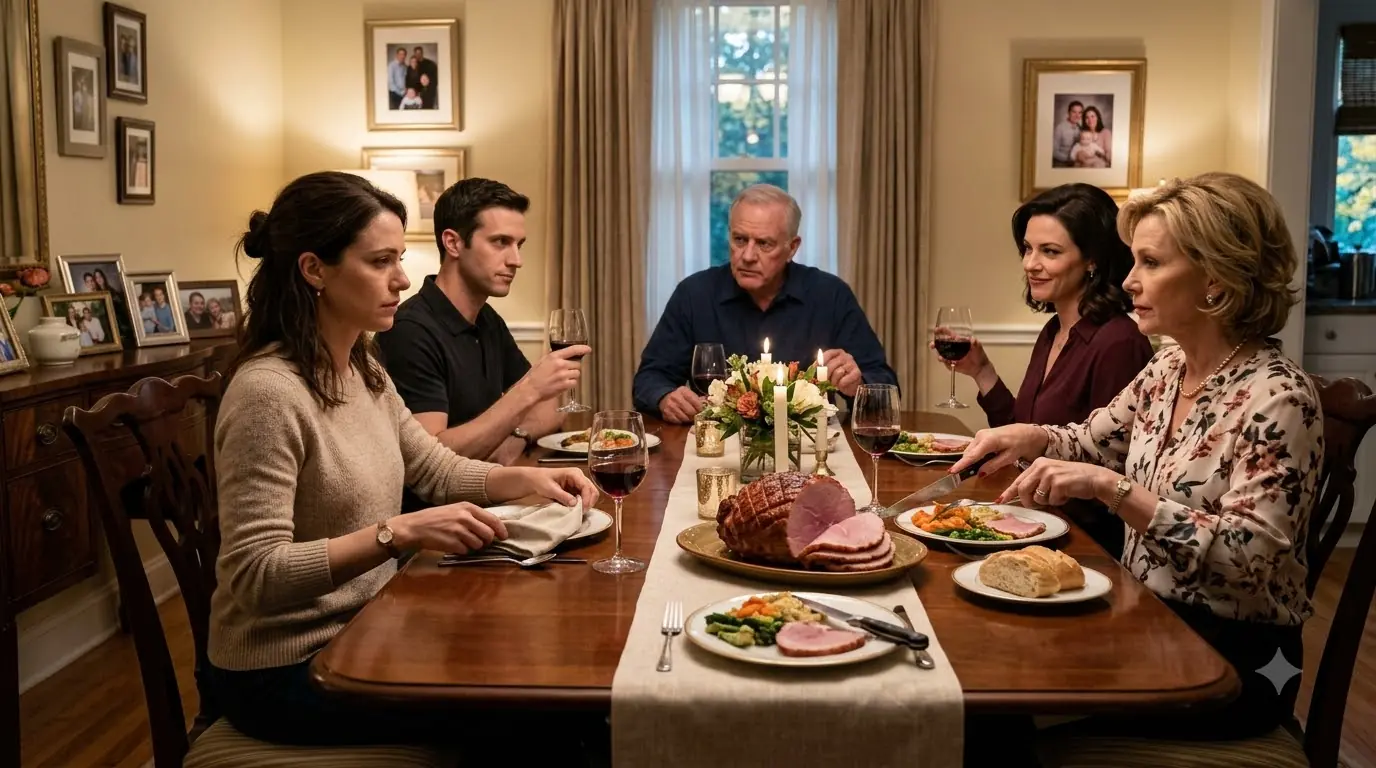
The room didn't even flinch. My sister nodded, almost amused, as if she'd been waiting to say it out loud for years.
Heat crawled up my neck, but I kept my face steady, my smile small, my silence sharper than anything they threw at me. They thought I'd swallow it the way I always did, but sitting at that table, surrounded by people who only valued what I provided, I knew something they didn't.
Their downfall had already begun.
I grew up in that house believing silence was the price of belonging. My parents never said it outright, but it lived in the pauses between their sentences. Those tiny, sharp moments where I learned my value came from what I could give, not who I was.
Even as a kid, I filled the gaps. If Sarah forgot her homework, I ran it to school. If Dad needed someone to stay home with Grandma, I canceled my plans. And when Sarah hit adulthood and her bills started piling up, somehow they all ended up in my hands, too.
They called it being the reliable one, but reliability turns into servitude fast when no one asks how you're doing.
On the outside, my family looked warm, tight-knit, loud in a good way. Holiday photos, matching sweaters, my mom's famous sweet potato casserole sitting in the middle of the table like a trophy. People always said we were lucky, but the kind of luck they meant was the pretty kind, the kind you can frame, not the kind that keeps you safe.
Grandma was the only person who ever looked at me and didn't see utility. I still remember her tiny kitchen, the smell of peppermint tea and old books, the way her hands would rest on mine when she said, "You don't have to save the whole world, honey."
Back then, I didn't realize she meant my world, my family.
After she passed, that kitchen became my sanctuary. I kept the key. I kept the memory of someone who saw me.
Back at the dinner table, the same table I'd spent decades setting, clearing, cooking for, I sat between people who had rewritten me in their heads. Not Maya the project manager, not Maya who paid her own rent and built her own life, but Maya, the one who fixes things. The one who always shows up. The one who covers the bill. The one who doesn't complain.
Dad didn't even look up when he said the words. Mom just kept slicing the ham. Sarah smirked into her wine.
And somehow, in that moment, everything clicked into place like a door finally shutting.
That house wasn't mine. Never had been.
Maybe that's why their words didn't crush me the way they expected. It hurt. God, it hurt. But it didn't break me.
It clarified things.
It made the air sharp. It made the path forward clean.
I realized something no one at that table had ever imagined.
I didn't need them either.
Not their approval, their guilt, their rules, or the seat they thought they had the right to take away.
And for the first time in my life, the silence didn't feel like surrender.
It felt like a beginning.
The dinner kept going as if nothing had happened. Plates scraped, glasses clinked. Someone laughed at a joke I didn't hear.
But inside my head, everything went still. Like the world had dropped into slow motion.
I watched my family the way you watch strangers on a train. Curious, detached. Wondering how you ever thought you belonged among them.
Sarah leaned back in her chair, swirling her wine like she'd won something.
"Mom's right," she added casually. "You take things too seriously, Maya. No one needs all that you do. Not really."
She said it like a kindness, like she was easing a burden off my shoulders.
But what she really meant was, "You're only useful when we want you to be."
I glanced at her, at the sister whose late bills I'd paid, whose kids I'd bought school clothes for when she was between jobs, whose emergencies somehow always landed in my lap.
She never remembered the details, only the convenience, only the expectation.
Mom finally looked up from the ham she was slicing.
"You work so much anyway," she said. "It's not like you have a family of your own to worry about. We don't want you burning yourself out for nothing."
For nothing.
That one stung more than I'd admit. As if every hour I spent climbing my career, every quiet effort to build a life by myself, was worthless because it wasn't serving them.
Dad didn't even glance my way when he muttered, "Let's not make this dramatic. It's just the truth. You take things personally."
It was gaslighting with a coat of polite varnish. They had long mastered the art.
I looked around the table, the candles, the holiday centerpiece, the empty chair Grandma used to sit in. I used to think her absence left a simple ache, but now it felt like a warning I hadn't listened to soon enough.
Sarah dropped her fork, annoyed by my silence.
"Come on, Maya, say something."
But I didn't trust my voice. Not because I was afraid of what they'd think, but because anger, like that quiet, precise, razor-sharp anger, doesn't want to be spoken.
It wants to be acted on.