The auction barn went silent when twelve-year-old Leland Tanner raised his hand.
A moment earlier, nearly every man inside had been laughing at Lot Seven, a weathered 1967 John Deere 4020 tractor parked along the south wall beneath fluorescent shop lights. Its green paint had faded almost gray, the seat was split, the tires were cracked, rust climbed around the fittings, and according to the auction listing, the engine had been seized for nearly twenty years.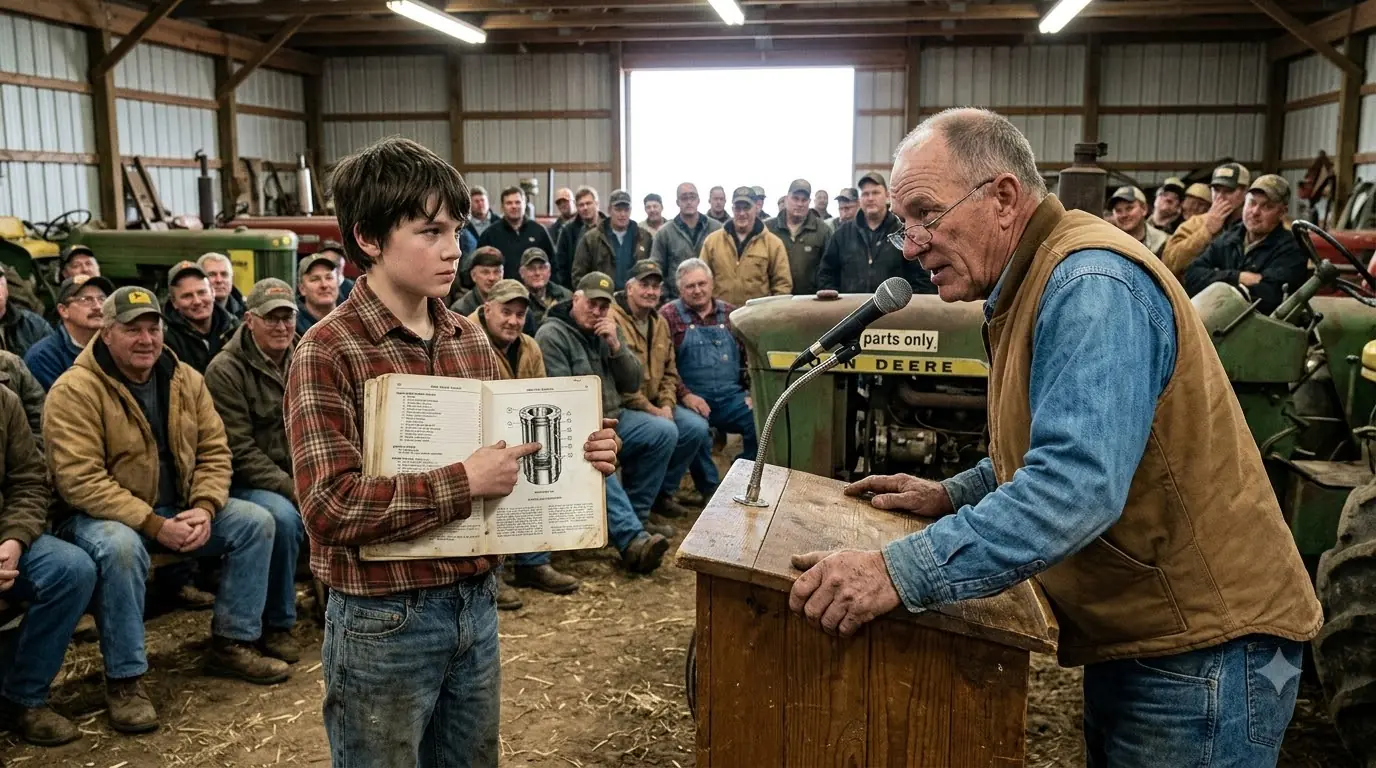
The auctioneer, Hollis Dunar, had introduced it with the tired humor of a man trying to move useless property.
“Parts tractor,” he announced. “Engine locked tighter than a bank vault. Who wants to start me at two hundred?”
Several farmers laughed.
Grover Weathersfield laughed louder than everyone else.
Then Leland said, “Two-fifty.”
Every head turned.
He stood near the center of the barn in a faded red-and-brown flannel shirt, worn jeans, and work boots still carrying dust from his grandmother’s farm. His dark hair fell over his forehead, and one hand held a cloth bag containing the savings he had accumulated over three years.
He did not smile.
Hollis stared at him.
“Son,” the auctioneer said slowly, “you understand this thing does not run?”
“Yes.”
“You understand it may never run?”
“Yes.”
Grover shook his head.
Somewhere behind Leland, a farmer chuckled.
Hollis leaned over the podium.
“What makes you think you can do anything with a seized 4020?”
Leland set the cloth bag at his feet and pulled an old service manual from his backpack.
The spine was worn soft from use.
He opened it without searching, turned directly to a diagram of the engine block, and pointed at the cylinder assembly.
“Two cylinders are seized,” he said. “Not four.”
The laughter stopped.
“I checked the flywheel this morning. It still moves. Resistance is localized.”
Hollis narrowed his eyes.
“The injector pump?”
“Corrosion from moisture. Housing looks intact.”
A few men in the crowd shifted their weight.
Leland continued.
“The sleeve liners will need replacement. Fuel system needs cleaning. I have not opened it yet, so I cannot know the full damage.”
That last sentence caught Hollis’s attention.
The boy had not claimed certainty where he had none.
That mattered.
Hollis asked him a technical question about the reassembly sequence.
Leland answered correctly.
Then he added, “The last page of my manual is missing. It covers part of the compression verification procedure. I have not figured that part out yet.”
Grover laughed again.
“There,” he said. “Even the boy admits he does not know what he is doing.”
Leland looked at him.
“My grandfather taught me not to lie when I don’t know something.”
The room became even quieter.
Hollis looked down at the manual, then back at the boy.
“I have two-fifty,” he said. “Do I hear three hundred?”
Grover raised his paddle.
“Three hundred.”
Leland looked at him.
“Three-fifty.”
Grover answered immediately.
“Three seventy-five.”
A few men exchanged glances.
Everyone in the barn knew Grover did not need the tractor.
Grover owned hundreds of acres, multiple working machines, and enough newer equipment that an abandoned 4020 meant nothing to him.
This was no longer about the tractor.
It was about the boy.
Leland understood that too.
“Four hundred,” he said.
Grover smiled.
“Four twenty-five.”
Leland lowered his eyes toward the cloth bag.
Inside it was every dollar he had saved since he was nine years old.
Money from feeding livestock for neighbors.
Money from hauling tools.
Birthday money.
Cash his grandfather had paid him for real work because Harlon Tanner believed a boy learned the value of money only if it had first cost him something to earn.
Four hundred fifty dollars.
That was all of it.
Leland looked toward the rear wall.
His grandmother, Mabel Tanner, stood there with her arms crossed.
Her face gave him nothing.
But that morning, inside the truck, she had told him exactly what he needed to know.
“If Grover pushes it beyond what you have, you walk away.”
She had not said to win.
She had not said to prove anything.
She had said to know the limit.
Leland lifted his chin.
“Four-fifty.”
The barn held still.
Grover kept his paddle raised.
Five seconds passed.
Then eight.
Then twelve.
Hollis waited.
Grover’s eyes remained on Leland.
Finally, the older man lowered his paddle.
“Sold.”
The gavel struck the podium.
For one second, nobody moved.
Then a slow clap sounded from the far corner.
A lean, weathered man named Aldis Kettleworth stood there with both hands just coming apart.
Another clap followed.
Then another.
A few farmers joined.
Grover turned and walked toward the door.
Before leaving, he stopped.
He looked back at Leland for two long seconds.
It was not embarrassment on his face.
It was not simple anger either.
Leland remembered that look.
He would understand it later.
Eight months before that auction, Leland had lost the man who had taught him how to understand machines.
Harlon Tanner had farmed ninety-five acres in Harmon County for almost his entire adult life.
The property was not large by local standards, but it had supported the Tanner family because Harlon approached farming the same way he approached machinery.
Carefully.
He hated waste.
He respected documentation.
He avoided debt whenever possible.
And he believed that before a person could repair anything, he first had to learn how to observe it without pretending.
His favorite question was simple.
“What do you see?”
Not, “What is it?”
Not, “What do you think happened?”
What do you see?
Leland first began serious mechanical lessons at nine.
Harlon started with a lawn mower engine.
Then a generator.
Then a chainsaw.
Each machine was disassembled across a sheet of oil cloth on the workbench inside the Tanner shop.
Parts came out in order.
They went back in order.
If Leland made a mistake, Harlon rarely corrected him directly.
Instead, he asked another question.
“What changed?”
“What should move here?”
“What happens if that surface is dry?”
“What do you see?”
At first, the questions irritated Leland.
He wanted answers.
Harlon wanted understanding.
By the summer before his death, Harlon believed the boy was ready for something more difficult.
He introduced Leland to the service manual for the John Deere 4020.
The tractor was not one the family owned.
Harlon chose it because the machine had been common enough that its repair history was well documented and its mechanical systems were complicated enough to teach useful thinking.
Two evenings a week, grandfather and grandson sat together at the workbench.
They studied the fuel system.
Sleeve liners.
Compression.
Injector timing.
Cooling.
Lubrication.
Harlon demonstrated seizure using a piece of metal pipe exposed to moisture and temperature changes.
He showed Leland how corrosion could create resistance that looked catastrophic from the outside but was actually localized.
“A machine can be broken,” Harlon said one evening.
“Or?”
“Or it can be left behind.”
Leland waited.
Harlon tapped the engine diagram.
“Those are not always the same thing.”
Near the end of the summer, Harlon gave Leland the manual.
Leland noticed the final technical page had been torn out.
“This page is missing.”
Harlon looked at him steadily.
“You will find what belongs there when you need it.”
Leland frowned.
“That doesn’t make sense.”
“It will.”
Three weeks later, Harlon died.
He suffered a heart attack while working alone in the north field.
The paramedics said it had happened quickly.
Neighbors came with casseroles.
Farmers came to the funeral.
Men shook Mabel’s hand and promised they would help if she needed anything.
Leland stood beside her and listened.
He noticed that nearly everyone said the same kinds of things.
Harlon was a good man.
He would be missed.
Call if you need anything.
Leland also noticed that nobody talked about the machinery.
The harvest.
The debt still attached to some equipment.
Or the simple fact that Mabel Tanner was now sixty-eight years old and trying to keep ninety-five acres operating without her husband.
That was when Leland began understanding another one of Harlon’s lessons.
Words and work were different things.
Eleven days after Harlon died, their Case tractor failed.
Leland turned the key and heard a sound Harlon had warned him about years earlier.
He stopped immediately.
He did not try again.
The repair estimate came back at $3,400.
Mabel had roughly $400 available in the farm account.
She tried to hide the numbers from Leland.
He found them anyway.
Three days after the funeral, Grover Weathersfield arrived.
He drove up the Tanner gravel lane faster than visitors usually did, parked his diesel pickup, walked to the house, and entered without waiting long at the screen door.
Grover owned hundreds of acres nearby.
He was respected by many farmers because he was successful, and feared by others because his idea of opportunity often appeared exactly when someone else became vulnerable.
He sat in Harlon’s chair.
That bothered Leland more than anything else.
Grover placed a folded sheet of paper on the kitchen table.
“I want to make things easier before they get complicated.”
Mabel looked at him.
“What things?”
“The farm.”
He offered to buy forty acres.
The number was well below recent comparable land prices.
Mabel knew it.
So did Leland.
“You’re without a working tractor,” Grover said. “Harvest is coming. You’re doing this alone.”
Mabel folded the offer.
She slid it back.
“No.”