“I pay you double if you have a balance—because men dressed like you don’t belong at my counter.”
The words carried across the polished lobby of Regional First Bank so clearly that conversations stopped near the teller windows. Several employees looked up from their monitors, while two customers waiting beside the velvet queue ropes turned toward the wooden service counter. The man being insulted did not shout, flinch, or step backward.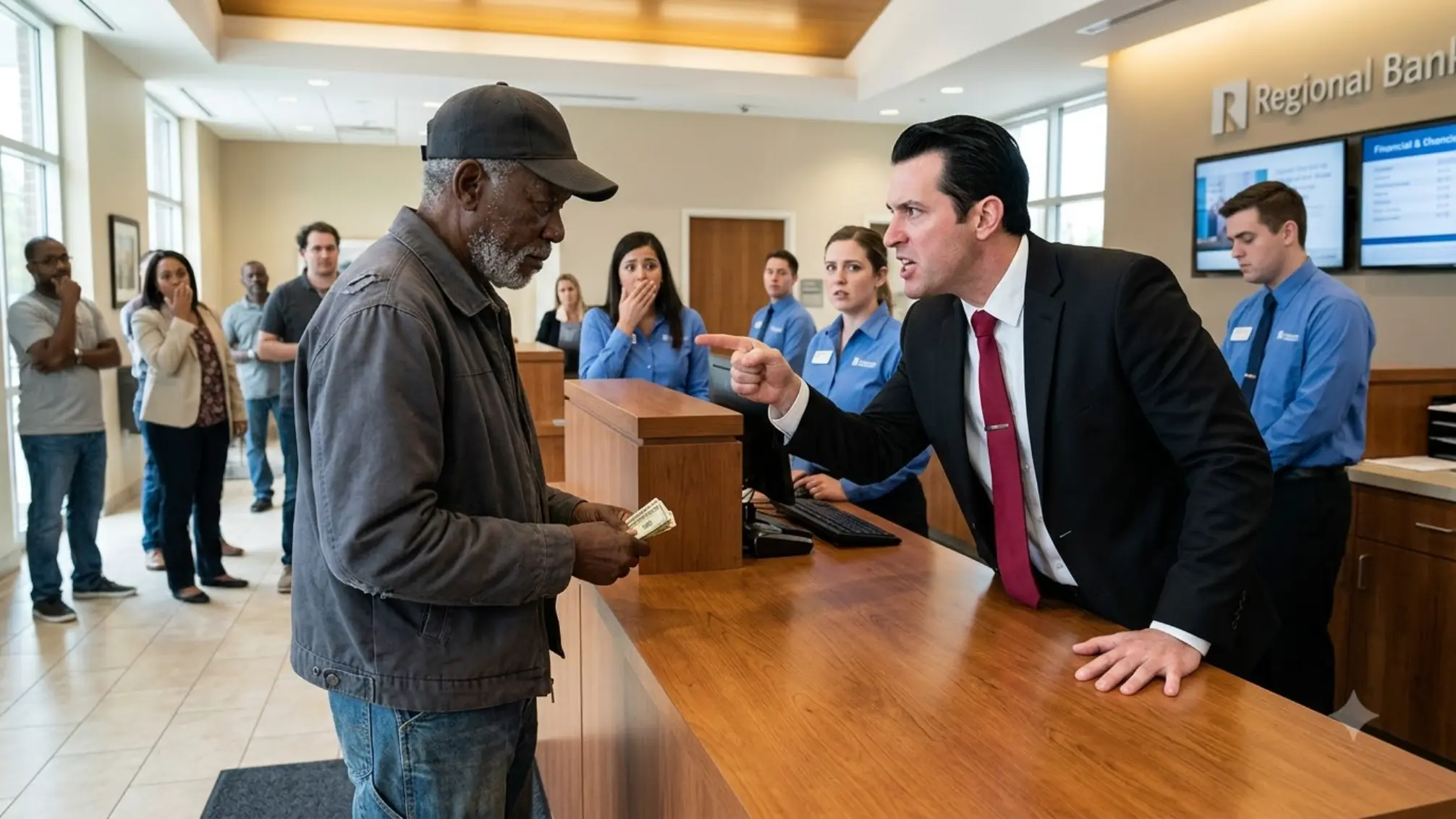
He simply lifted his eyes.
“Check the account before your mouth costs you your job.”
Bank manager Victor Salazar planted one hand against the counter and leaned closer. His dark navy suit looked freshly pressed, his bright red tie perfectly centered, and his expression held the confidence of a man who believed every person in the building answered to him.
“I’ll call security, dump you on the sidewalk, and close every account tied to your name.”
The elderly Black man slowly placed the folded bills in his hand on the counter.
“Do that—then explain to the board why you just threatened the Black CEO standing in your lobby.”
Silence swallowed the entire branch.
Victor stared at him.
Then he laughed.
It was short, sharp, and almost relieved.
“You?”
The man said nothing.
Victor looked him over again as though the clothes alone were evidence.
The old straw hat.
The faded gray T-shirt beneath an open black-and-white plaid shirt.
Work jeans stained with dirt near the knees.
Scuffed boots.
Gray beard.
Weathered hands.
Nothing about him resembled the executives Victor had met at annual conferences.
“You’re the CEO?”
Another laugh escaped him.
“Of what? A lawn service?”
A few employees shifted uncomfortably.
The elderly man reached into the inside pocket of his plaid shirt.
Victor immediately raised a hand.
“Don’t reach for anything.”
The man stopped.
His eyes hardened.
“Then ask your assistant to remove the envelope from my left pocket.”
Victor hesitated.
Behind him stood Assistant Branch Manager Monica Ellis, a thirty-four-year-old Black woman who had been watching the confrontation with an increasingly troubled expression.
Victor turned.
“Monica.”
She did not move.
“Get it.”
Monica stepped around the counter cautiously.
The older man raised both hands slightly to show he posed no threat.
“Left pocket.”
She removed a thin white envelope.
Victor snatched it from her fingers.
Inside was a black executive identification card.
Victor read the name.
His smile disappeared.
MARCUS REED.
Below it appeared the title:
CHIEF EXECUTIVE OFFICER — REGIONAL FIRST FINANCIAL GROUP.
Victor stared.
Then looked at Marcus.
Then back at the card.
His face lost color.
“That could be fake.”
Marcus almost smiled.
“Good.”
Victor blinked.
“Good?”
“You finally want verification.”
Marcus nodded toward the teller terminals.
“That is all I asked you to do when I walked in.”
No one laughed now.
Victor looked toward Monica.
“Run it.”
She took the card.
Her fingers moved across the keyboard.
The internal directory opened.
Marcus Reed’s photograph appeared.
So did the executive authorization marker reserved for the bank’s highest corporate officers.
Monica stopped breathing for a second.
“Oh my God.”
Victor leaned toward the monitor.
His eyes widened.
Marcus Reed.
Age sixty-two.
Founder of Reed Capital Services before its merger with Regional First.
Chief executive of a financial group controlling eighty-three branches across six states.
Board member.
Largest individual voting shareholder.
Victor slowly straightened.
Every employee behind the counter understood the problem at precisely the same time.
The old man had not lied.
More importantly, he had not arrived accidentally.
Marcus slipped his hands into his pockets.
“Now,” he said calmly, “check my balance.”
Victor swallowed.
“Mr. Reed, I—”
“You seemed interested a minute ago.”
“I think there has been a misunderstanding.”
Marcus looked toward the employees.
“Did anyone misunderstand what he said?”
Nobody answered.
Victor forced a nervous smile.
“Sir, perhaps we should speak privately.”
“No.”
Marcus's answer came immediately.
“You made it public.”
Victor glanced around the lobby.
“I was only trying to protect the bank.”
“From what?”
Victor paused.
Marcus pointed toward himself.
“Be specific.”
“You came in carrying cash.”
“Banks generally accept cash.”
“You looked—”
Victor stopped.
Marcus waited.
“Go ahead.”
Victor's jaw tightened.
“You looked suspicious.”
Marcus nodded slowly.
“That is an interesting word.”
He walked toward the customer waiting area and removed his straw hat.
“Especially considering I entered through the front door, stood in line, presented a valid account number, and asked to deposit four hundred and eighty dollars.”
Victor opened his mouth.
Marcus continued.
“I did not raise my voice. I did not threaten anyone. I did not refuse identification.”
He looked at Monica.
“Is that correct?”
She nodded.
“Yes, sir.”
Victor stepped forward.
“Mr. Reed, I sincerely apologize.”
Marcus looked at him.
“For what?”
Victor hesitated.
“For the way I spoke.”
“Why did you speak that way?”
Victor's face tightened again.
Marcus waited.
The question was simple.
The answer was not.
Finally Victor said, “I made an assumption.”
“Based on?”
Victor remained silent.
Marcus looked toward the lobby.
Five employees were watching.
Nine customers.
Two security cameras.
One microphone above the counter.
Marcus put his hat back on.
“That is why I came here.”
Victor froze.
Marcus had received the first complaint seven months earlier.
A retired teacher named Gloria Watkins had written directly to Regional First’s customer relations department after visiting Victor’s branch to withdraw twelve thousand dollars for a home renovation. She claimed Victor had demanded additional identification not required by policy, questioned where she had obtained the money, and refused the withdrawal until her son arrived.
Gloria Watkins was Black.
Her complaint had been marked resolved.
Marcus never saw it.
The second complaint came from a Latino landscaping contractor named Daniel Ortega.
He deposited checks from three commercial clients every Friday.
One afternoon Victor ordered an employee to place an extended hold on nearly eighteen thousand dollars even though Daniel’s company had maintained its account for nine years without a returned check.
Daniel said Victor told him, “Businesses like yours produce strange deposits.”
That complaint disappeared too.
Then came Evelyn Carter.
Seventy-one years old.
White.
Retired nurse.
She entered the branch wearing old gardening clothes and tried to purchase a cashier’s check to help her granddaughter with tuition.
Victor made her wait nearly forty minutes while customers dressed in business clothes were served ahead of her.
Her complaint contained one line Marcus could not forget.
Your manager decides who deserves dignity before he decides who deserves service.
That complaint reached Marcus because Evelyn mailed a copy directly to a member of the board.
Marcus ordered an internal review.
The review found nothing.
That bothered him.
Three unrelated customers.
Different races.
Different transactions.
Different months.
Same manager.
Same branch.
Same complaint.
Appearance changed treatment.
Yet the internal audit concluded there was no pattern.
Marcus had spent thirty-six years in banking.
He had learned that when evidence looked obvious but paperwork said nothing happened, the paperwork deserved more attention.
He asked Chief Compliance Officer Rachel Bennett to quietly retrieve customer complaints from the original intake servers.
The first discrepancy appeared within hours.
Twenty-seven complaints had been filed against Victor Salazar's branch over twenty-two months.
Only six appeared in the branch-level review database.
Twenty-one had been recategorized.
Some became “general inquiries.”
Others became “customer education issues.”
Several simply disappeared from the local dashboard after someone changed their resolution codes.
Victor's administrator credentials appeared repeatedly in the access logs.
Marcus did not fire him.
Not yet.
A bad manager could explain insults.
It did not explain how the records had passed two regional reviews.
Marcus wanted to know how far the problem went.
So he created a test.
Not a complicated one.
No actors.
No hidden television crew.
No dramatic trap.
Marcus simply dressed the way he often dressed when working on his brother’s small property outside the city.
Old hat.
Work shirt.
Jeans.
Boots.
Then he walked into his own bank carrying four hundred and eighty dollars.
The account number he provided belonged to an internal test account created by compliance.
The balance was deliberately substantial.
$8,704,221.16.
Nothing about the account itself should have triggered suspicion.
Only Marcus's appearance could.
He reached the teller line at 10:17 that morning.
A young teller named Lily Chen greeted him politely.
“Good morning, sir. How can I help you?”
Marcus handed her the cash.
“Deposit, please.”
She smiled.
“Of course.”
Then Victor appeared.
Marcus never learned what first attracted the manager’s attention.
Perhaps the straw hat.
Perhaps his worn jeans.
Perhaps his skin.
Perhaps all three.
Victor interrupted before Lily completed the transaction.
“What account is that going into?”
Marcus gave the number.
Victor looked at him.
“Your account?”
“Yes.”
Victor held out his hand.
“Identification.”
Marcus provided a driver's license.
Victor examined it.
Then he asked for another form.
Marcus gave him one.
Victor still refused the deposit.
“Where did the cash come from?”
Marcus looked at the four hundred and eighty dollars.
“Work.”
“What kind?”
“Does that affect whether the bank accepts it?”
Victor's expression changed.
That was the moment Marcus knew the complaints were probably true.
Victor had not asked the businessman standing at the neighboring teller where his money came from.
He had not demanded two forms of identification from the woman depositing a check moments earlier.
He had singled Marcus out.
Marcus remained calm.
“Check the account.”
Victor laughed.
“There’s no point.”
“Why?”
“I've done this long enough to know what real account holders look like.”
That sentence would later appear word for word in the investigation report.
Marcus asked him again.
“Check the balance.”
Victor leaned over the counter.
Then made his mistake.
“I pay you double if you have a balance.”
Within fourteen minutes, the test was over.
But Marcus did not leave.
He asked Victor to take him into the branch conference room.
Monica followed.
So did the branch's operations supervisor, Daniel Price.
Victor shut the door.
His confidence was gone.
“Mr. Reed, I want to apologize.”
Marcus sat at the head of the table.
“Sit.”
Victor obeyed.
Monica and Daniel remained standing.
Marcus looked toward them.
“You too.”
When everyone settled, Marcus placed a small digital recorder on the table.
Victor stared at it.
“Is that necessary?”
“Yes.”
Marcus pressed record.
“Victor Salazar, did you instruct your staff to deny my deposit?”
Victor swallowed.
“Yes.”
“Why?”
“I believed the transaction presented risk.”
“What risk?”
“Possible fraud.”
“What indicator?”
Victor hesitated.
Marcus waited.
“No account alert existed,” Monica said quietly.
Victor shot her a look.
Marcus noticed.
“Continue, Monica.”
She looked nervous.
“The identification matched. The transaction amount was below reporting thresholds. There were no account restrictions.”
Marcus turned to Victor.
“So again, what indicator?”
Victor looked down.
“I used judgment.”
Marcus leaned back.
“That word interests me almost as much as suspicious.”
Victor began talking quickly.
“Mr. Reed, every branch manager has discretion. We see fraud every week. Elder scams. Synthetic identities. Stolen checks. People pretending to be account holders.”
“Correct.”
Marcus folded his arms.
“Which is why we have procedures.”
Victor's voice tightened.
“Procedures do not replace instinct.”
“No.”
Marcus nodded.
“They prevent instinct from becoming prejudice.”
Victor looked toward the window.
Marcus continued.
“You had two forms of valid identification. You had a valid account number. You had no system alert.”
He tapped the table once.
“You ignored all three because of how I looked.”
Victor's lips tightened.
“That is your interpretation.”
Marcus almost smiled.
“Fortunately, interpretation will not decide this.”
He opened the conference room door.
Two people entered.
Rachel Bennett, Chief Compliance Officer.
And Thomas Avery, Regional First's General Counsel.
Victor's eyes widened.
They had been waiting in a nearby office since before Marcus entered the branch.
Rachel placed a laptop on the table.
“Mr. Salazar.”
Victor looked at her.
“Rachel.”
She did not return the familiarity.
“We need your system credentials.”
Victor stared.
“My credentials?”
“Immediately.”
“Why?”
Thomas Avery answered.
“You are being placed on administrative leave pending investigation.”
Victor stood.
“This is absurd.”
Marcus remained seated.
“Sit down.”
Victor's face flushed.
“I made one bad comment.”
Rachel opened the laptop.
“No.”
Victor looked at her.
She rotated the screen.
A spreadsheet appeared.
Twenty-seven customer complaints.
Dates.
Transaction types.
Names.
Original complaint classifications.
Altered classifications.
User IDs.
Victor stopped breathing normally.
Rachel scrolled.
“Twenty-one complaints were modified using your administrator credentials.”
Victor shook his head.
“My assistant has access.”
Monica's face changed.
“No, I don’t.”
Victor glanced at her.
“You've logged into my system before.”
“When you ordered me to print reports while you were standing beside me.”
Rachel interrupted.
“Access logs include device signatures.”
She tapped the screen.
“Seventeen changes came from your office workstation. Three came from your assigned laptop. One came from your home VPN.”
Victor sat down slowly.
“What are you accusing me of?”
“Nothing yet,” Thomas said.
“We are preserving evidence.”
Victor looked toward Marcus.
“You planned this.”
Marcus nodded.
“Yes.”
“You came here dressed like that to provoke me.”
“No.”
Marcus's voice remained steady.
“I came dressed like someone you believed you could mistreat.”
Victor's face tightened.
“That is entrapment.”
Thomas almost laughed.
“It is not.”
Victor slammed his palm against the table.
“I built this branch!”
Monica flinched.
Marcus did not.
Victor pointed toward the lobby.
“Those numbers out there? Mine. Deposits? Mine. Commercial accounts? Mine. This branch was mediocre before I took over.”
Marcus watched him carefully.
“And that gave you permission to decide which customers deserve respect?”
“I protected profitable clients.”
There it was.
Rachel's fingers stopped over the keyboard.
Marcus leaned forward.
“What does that mean?”
Victor realized too late what he had said.
“Nothing.”
“You said you protected profitable clients.”
“I meant—”
“From whom?”
Silence.
Marcus looked toward Monica.
“Did the branch use customer tiers when determining service priority?”
She hesitated.
Victor stared at her.
Marcus saw the fear.
“Monica.”
She looked at him.
“You will not be punished for telling the truth.”
Victor spoke immediately.
“Careful.”
Marcus turned toward him.
“One more word directed at her and security removes you.”
Victor leaned back.
Monica took a breath.
“Yes.”
Marcus waited.
“We had an internal list.”
Rachel frowned.
“What list?”
Monica looked ashamed.
“Victor called it the Priority Desk.”
“Explain.”
“Customers with high balances, business relationships, investments, mortgages, or connections to local companies received priority service.”
Marcus's expression hardened.
“And everyone else?”
Monica swallowed.
“We were told not to waste too much time.”
Victor interrupted.
“That is standard customer segmentation.”
Rachel shook her head.
“Not like that.”
Monica continued.
“If someone looked like they might create problems, we were supposed to send them to one specific teller or make them wait for manager review.”
“What does ‘looked like’ mean?”
Monica's eyes filled with embarrassment.
“Work clothes. Homeless appearance. Heavy accents. Customers who needed help reading forms.”
She paused.
“And sometimes minorities.”
Nobody spoke.
Marcus felt anger rise through him.
He kept his voice controlled.
“Sometimes?”
Monica nodded.
Victor stood again.
“She is lying to save herself.”
This time Daniel Price spoke.
“No, she isn't.”
Everyone turned.
Daniel had been silent.
He removed his phone from his pocket.
“I have something.”
Victor stared.
“What?”
Daniel placed the phone on the table.
Three audio files appeared.
Victor's face changed.
Daniel looked at Marcus.
“I started recording staff meetings three months ago.”
“Why?”
“Because I thought he was going to blame us if compliance ever came.”
Victor stepped toward him.
“You son of a—”
Thomas stood immediately.
“Sit down.”
Victor stopped.
Daniel pressed play.
Victor's recorded voice filled the room.
“Stop treating every walk-in like they matter equally. They don’t. Learn who has money before you waste half an hour.”
Another recording.
“If they come in looking broke, verify everything twice. I’m not taking a fraud loss because someone wants to be politically correct.”
Then the third.
Monica's recorded voice asked, “Shouldn't we apply the same verification to everyone?”
Victor answered.
“No. Use your eyes. That’s what God gave them to you for.”
Marcus closed his eyes for one second.
When he opened them, Victor was staring at the table.
The branch manager had not made one mistake.
He had created a culture.
By noon, Victor's access was disabled.
His office was sealed.
His laptop, phone, and company files were preserved.
He was escorted from the branch without handcuffs, without shouting, and without public humiliation.
Marcus insisted on that.
Accountability did not require spectacle.
But the investigation had only begun.
The compliance team discovered Victor had manipulated more than complaint classifications.
He had also pressured employees to avoid opening low-balance accounts because they reduced branch profitability metrics.
Customers using disability benefits, Social Security, or small payroll deposits were sometimes told appointments were unavailable.
Meanwhile, wealthy clients received exceptions.
Fee reversals.
Immediate appointments.
Personal calls.
After-hours assistance.
The pattern became worse when auditors compared race and service outcomes.
Black customers were significantly more likely to have legitimate transactions escalated to manager review.
Latino customers experienced longer holds.
Customers wearing visibly worn work clothes waited longer regardless of race.
The misconduct had operated for nearly three years.
Yet Marcus knew Victor could not have hidden it alone.
The question became who had protected him.
The answer appeared inside regional emails.
Victor's direct supervisor was Regional Director Harold Kline.
Harold had received quarterly complaint summaries.
Each time a complaint threatened Victor's performance record, Harold returned it with instructions.
“Resolve locally.”
“Reclassify service issue.”
“No discrimination finding without direct evidence.”
One email made Marcus stop reading.
Victor had written:
Some customers simply do not fit the branch profile we are building.
Harold replied:
Understood. Keep numbers strong and keep noise low.
Rachel Bennett stared at the email.
“That is going to be a problem.”
Marcus shook his head.
“No.”
He closed the laptop.
“It already was a problem.”
The company had simply refused to see it.
Harold was suspended the next morning.
A third-party law firm was hired to perform an independent review.
Marcus instructed them to report directly to the board's risk committee, not to him.
He wanted no accusation that the CEO controlled the result.
The investigation lasted eleven weeks.
More than two hundred customers were interviewed.
Forty-three current and former employees provided statements.
Security footage was reviewed.
Account hold decisions were compared.
Complaint databases were reconstructed from backup servers.
The conclusions were worse than Marcus expected.
Victor had discriminated.
Harold had enabled him.
But the system itself had rewarded both men.
Branch managers received bonuses tied heavily to deposit growth and profitable account relationships.
Customer complaints reduced performance scores.
That created an incentive to make complaints disappear.
Marcus had approved portions of that compensation model years earlier.
The realization hit harder than Victor's insult ever had.
One evening Marcus sat alone in his office on the thirty-second floor of headquarters.
Rachel entered carrying the final report.
She found him looking through the city windows.
“You should go home.”
Marcus smiled faintly.
“So should you.”
She placed the report down.
“You've been reading that page for twenty minutes.”
Marcus knew which one.
Executive responsibility.
“I built part of this.”
Rachel sat across from him.
“You did not tell Victor to discriminate.”
“No.”
“You did not tell Harold to bury complaints.”
“No.”
“But?”
Marcus looked at the report.
“I helped create incentives where a complaint became something managers wanted erased instead of understood.”
Rachel remained silent.
Marcus continued.
“You know what Victor said when he thought I was poor?”
“Yes.”
“He said people dressed like me did not belong at his counter.”
Marcus looked at her.
“But the real failure happened before he said it.”
Rachel understood.
“We gave a man like him room to believe the bank belonged to him more than it belonged to the customer.”
Marcus nodded.
That became the basis of the reforms.
Regional First eliminated branch bonuses based on complaint suppression.
Complaint handling moved to an independent customer advocacy unit.
Branch managers could no longer close discrimination complaints involving their own staff.
Every decision involving extended account holds required a documented policy reason.
Random transaction audits compared customer treatment across demographic and economic categories.
Employees received protections for reporting misconduct.
But Marcus rejected one popular proposal.
Mandatory scripted greetings.
A consultant argued that standardized language would reduce biased interactions.
Marcus disagreed.
“You cannot train dignity by teaching people to memorize sentences.”
Instead, training centered around consistent rules.
Same identification requirements.
Same transaction standards.
Same escalation criteria.
Same respect.
Monica Ellis was cleared of wrongdoing after investigators confirmed she had repeatedly challenged Victor's orders and documented concerns.
She was offered the branch manager position.
She almost refused.
Marcus asked why.
“I don't want people thinking I got it because of what happened.”
Marcus looked at her.
“Then earn it after you get it.”
She smiled.
“I can do that.”
“I know.”
Daniel Price became the branch's operations manager and later joined a companywide employee ethics council.
Lily Chen, the teller who had originally attempted to accept Marcus's deposit without judging him, received recognition she found slightly embarrassing.
Marcus kept it simple.
“You followed procedure.”
Lily laughed nervously.
“That doesn’t sound heroic.”
“It shouldn't be.”
That was exactly the point.
Treating someone fairly should not require heroism.
Victor Salazar was terminated after the independent review.
Harold Kline was terminated two days later.
The bank also referred evidence involving falsified compliance documentation to regulators.
Regulatory examinations followed.
Regional First paid penalties related to inadequate complaint oversight and agreed to enhanced monitoring.
Marcus did not fight the findings.
At the board meeting, one director complained that admitting failure publicly would hurt the company.
Marcus responded with a question.
“Did the failure happen?”
“Yes.”
“Then hiding it won't make us more trustworthy.”
The director frowned.
“It could cost millions.”
Marcus nodded.
“So did allowing it.”
The bank began contacting customers whose complaints had been altered.
Gloria Watkins received a personal letter.
Daniel Ortega had improper holds reversed and fees reimbursed.
Evelyn Carter was invited to speak with the customer advocacy team.
She accepted.
When Marcus met her, she was wearing gardening clothes again.
He smiled.
“I like your outfit.”
She looked at his suit.
“I liked yours better in the straw hat.”
Marcus laughed.
Evelyn became one of twelve customers invited to advise the bank on service reforms.
She refused payment beyond travel expenses.
“I complained because something was wrong,” she told Marcus. “Not because I wanted a consulting career.”
He respected that.
Three months after the confrontation, Marcus returned to the branch.
This time he wore a charcoal suit.
Monica greeted him near the entrance.
“You look suspiciously expensive today.”
Marcus smiled.
“I was told clothes matter around here.”
She laughed.
The branch felt different.
Not perfect.
Marcus did not trust perfect.
But different.
A construction worker stood at one teller window depositing a check.
An elderly woman sat with an employee reviewing paperwork slowly.
A young man wearing a restaurant apron was opening his first checking account.
No one appeared rushed out.
No one was treated like an inconvenience.
Marcus walked toward the counter where the confrontation had occurred.
Monica followed.
“You know,” she said, “people still talk about that morning.”
“I was hoping they would stop.”
“Not likely.”
“What version are they telling?”
“That Victor bet the CEO he didn't have a dollar.”
Marcus sighed.
“That isn't what happened.”
“Stories improve themselves.”
“He said he'd pay double if I had a balance.”
“See? Less interesting.”
Marcus shook his head.
Monica smiled.
Then she reached beneath the counter.
She placed something in front of him.
Four hundred and eighty dollars.
Marcus stared.
“What is that?”
“Your deposit.”
He raised an eyebrow.
“You never completed it.”
Marcus laughed.
Three months of investigations.
Two executives fired.
Eighty-three branches reviewed.
A new compliance system.
And he had forgotten the reason he entered the building.
Monica slid a deposit slip toward him.
“Identification, please.”
Marcus stared at her.
She kept a perfectly straight face.
He slowly reached into his jacket.
“One form or two?”
“Let's not get carried away.”
He handed over his license.
She processed the deposit.
Then turned the screen slightly toward him.
The account still showed more than eight million dollars.
Monica glanced at it.
“So technically Victor lost the bet.”
Marcus looked at her.
“Don't.”
“He promised double.”
“No.”
“You're owed nine hundred sixty dollars.”
“Monica.”
She started laughing.
Marcus did too.
A few employees looked over.
For the first time, the memory of that counter no longer made him angry.
It made him alert.
There was a difference.
Anger wanted one man punished.
Attention wanted the problem prevented.
That afternoon Marcus addressed branch managers across the company through a live internal broadcast.
He did not mention Victor by name.
He did not show the security footage.
He did not tell them to fear undercover executives.
Instead, he held up the same weathered straw hat.
“This is what I wore when one of our managers decided I didn't belong in our bank.”
The room remained quiet.
Marcus placed the hat on the table.
“The lesson is not that you should treat people in old clothes well because they might secretly be wealthy.”
He looked directly into the camera.
“That would teach exactly the wrong lesson.”
Managers across six states listened.
“You treat them well if they have five dollars.”
He paused.
“You treat them well if they have five million.”
Another pause.
“You treat them well if they are closing their account because they have nothing left.”
Marcus's voice softened.
“A person should not need to surprise you with wealth before you regret disrespecting them.”
That sentence later appeared in employee training materials.
Marcus initially objected.
Rachel ignored him.
A year after the incident, independent customer surveys showed complaints about unequal branch treatment had fallen substantially.
Internal reports increased.
Some executives saw that as bad news.
Marcus saw it differently.
Employees were reporting problems before customers had to.
That meant people trusted the system enough to speak.
Monica's branch became one of the strongest-performing locations in the region.
Not because she chased only wealthy clients.
Because customers returned.
Small businesses grew.
Young customers opened first accounts and later applied for mortgages.
Workers depositing modest paychecks became business owners.
A bank, Monica reminded her staff, could not know who someone would become.
Marcus corrected her during one visit.
“That still isn't why we respect them.”
Monica smiled.
“I knew you were going to say that.”
“Then why did you say it?”
“To see if you were listening.”
Years later, the old straw hat remained in Marcus's office.
Visitors occasionally asked about it.
Some assumed it belonged to his father.
Others guessed it was a souvenir from a ranch.
Marcus never gave a long explanation.
He simply said it reminded him of an expensive lesson.
Not the lesson Victor learned.
The lesson Marcus learned.
A company could publish values on walls.
It could train employees.
It could celebrate diversity.
It could write policies with perfect language.
But none of those things mattered if the system quietly rewarded people for ignoring them.
The morning Victor pointed across that counter, he believed he was judging a powerless man.
He believed Marcus's clothes told him how much patience he deserved.
He believed a worn hat meant a small account.
And when Marcus revealed he was CEO, Victor finally became afraid.
But Marcus never considered that the real victory.
If Victor only regretted insulting a billionaire, he had learned nothing.
The victory came later, when a customer walked into that branch wearing dirty boots, carrying thirty-seven dollars, and received exactly the same greeting as the man walking behind him with a portfolio worth millions.
Nobody took a photograph.
Nobody applauded.
No CEO revealed himself.
The teller simply smiled.
“Good morning, sir. How can I help you?”
And that ordinary moment was worth more to Marcus Reed than the eight million dollars sitting quietly in the account Victor had once refused to check.