The bright marble lobby of Magnolia Heritage Bank fell silent when branch manager Adrian Valdez leaned across the counter and pointed directly at Isaiah Boone’s chest. Isaiah stood beneath the recessed lights wearing a faded straw hat, an old plaid work shirt, dusty jeans, and work boots still carrying Mississippi soil in their cracked soles. His weathered hands held a stack of cash wrapped in paper bands beside a brown leather wallet softened by decades of use. Behind Adrian, a young teller covered her smile while several customers turned to watch the humiliation unfold.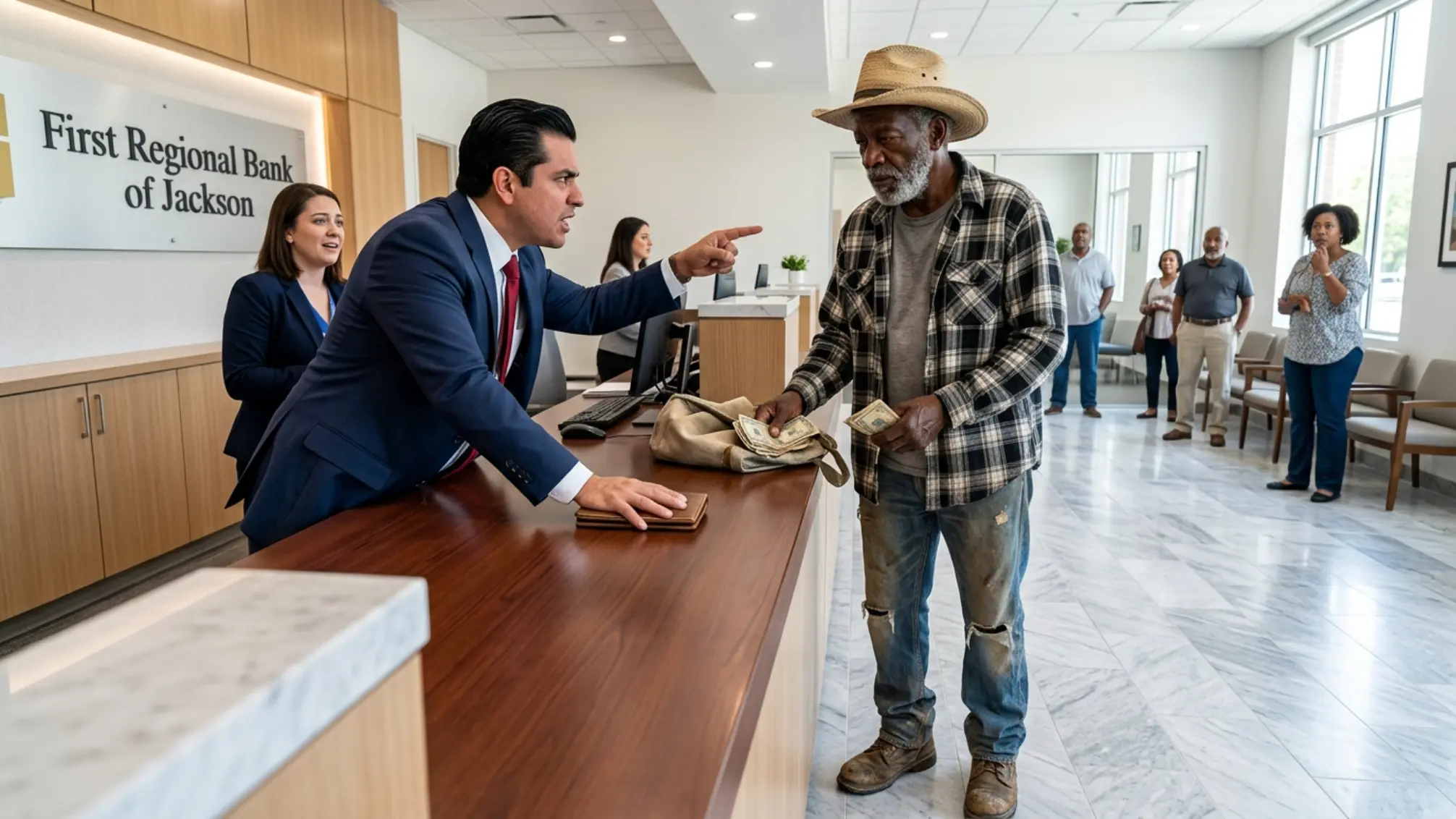
Adrian laughed loudly enough for everyone to hear. He was thirty-eight, sharply dressed in a navy suit and red silk tie, with black hair combed perfectly away from his forehead and a gold watch flashing beneath his cuff. During his eighteen months managing the Jackson branch, he had built a reputation for knowing which customers deserved immediate attention and which ones could be made to wait. In his mind, Isaiah belonged to the second group.
The bank’s wealthy clients entered through a side lounge where fresh coffee, leather chairs, and private account officers waited. Isaiah had entered through the main doors carrying no briefcase, no assistant, and no visible sign of influence. The dirt on his boots offended Adrian more than the money interested him.
“I asked to make a deposit,” Isaiah said.
“And I told you we cannot accept unexplained cash from someone who refuses to provide proper documentation.”
“I gave the teller my driver’s license, account card, cattle-sale receipt, and tax identification.”
Adrian glanced toward the documents without picking them up. “Those papers prove nothing.”
“They prove the money came from Boone Family Farms.”
The teller behind Adrian whispered something to another employee and laughed. Isaiah heard the words family farm spoken as though they were part of a joke.
Adrian folded his arms. “You expect me to believe that struggling little farm produced this much cash?”
Isaiah looked down at the bundles. “Forty-eight thousand six hundred dollars.”
“Exactly my point.”
“What point is that?”
“That people who legitimately handle that kind of money do not walk into a financial institution looking like they just climbed out of a ditch.”
A few customers shifted uncomfortably, but no one intervened. One older white woman lowered her eyes toward her handbag. A young man waiting near the brochure rack lifted his phone and quietly began recording.
Isaiah had spent sixty-eight years learning how contempt moved through a room. Sometimes it arrived loudly, carried by men like Adrian who believed authority gave them permission to reveal their worst instincts. More often it lived in silence—in the people who looked away because stopping cruelty seemed less convenient than witnessing it.
He placed the cash on the counter.
“My cattle buyer paid part by certified check and part in cash because three sellers requested settlement the same day. The paperwork is there. Your teller can call the auction yard.”
“I will not waste staff time verifying a story that does not make sense.”
“It only fails to make sense because you decided what I was worth before I opened my mouth.”
Adrian’s face tightened. “Security.”
A uniformed guard named Leon Harris approached from beside the elevators. He was a broad-shouldered Black man in his early fifties who had worked at Magnolia Heritage for almost nine years. He looked at Isaiah, then at the money, then at Adrian’s finger still pointed across the counter.
“What happened?” Leon asked.
“This man is refusing to leave after attempting a suspicious deposit.”
“I never refused to leave,” Isaiah said. “I asked him to count my money.”
Adrian snapped, “You were not part of the conversation, Harris. Escort him outside.”
Leon did not move.
“Did anyone verify his account?” he asked.
Adrian’s voice dropped. “Do your job.”
“My job includes preventing unnecessary escalation.”
“And mine includes protecting this institution.”
Isaiah turned toward Leon. “You don’t need to lose your position over me.”
Leon studied the old farmer’s face. Something about him seemed familiar—not personally, but from a photograph he had seen years earlier in the employee training room. Before he could place the memory, Adrian stepped around the counter and reached for Isaiah’s shoulder.
Isaiah moved back.
“Do not touch me.”
“You’ve been warned.”
“I came here to deposit my own money into my own account.”
Adrian grabbed the sleeve of Isaiah’s plaid shirt.
Leon immediately caught Adrian’s wrist.
“Sir, release him.”
The manager stared at the guard in disbelief. “Are you putting your hands on me?”
“You put yours on a customer first.”
The lobby became completely silent.
Adrian pulled free and straightened his jacket. Humiliation burned across his face, but rather than reconsidering his conduct, he redirected his anger toward Isaiah.
“You have ten seconds to leave before I call the police and report suspected money laundering.”
Isaiah slowly removed his straw hat.
Gray hair clung close to his scalp, and deep lines crossed a face shaped by sun, grief, and years of hard work. He looked tired, but not frightened.
“Make the call,” he said.
Adrian smiled. “Gladly.”
He returned behind the counter and lifted the telephone. Before he could press the first number, the private elevator at the rear of the lobby opened.
A silver-haired white man in a charcoal suit stepped out beside two women carrying legal folders. Every senior employee recognized him immediately.
Charles Whitmore was chairman of Magnolia Heritage Bancorp.
He rarely visited branches without notice. When he did, managers stood straighter, employees checked their clothing, and private-account officers emerged from offices eager to be seen.
Adrian set down the phone.
“Mr. Whitmore. We weren’t expecting you.”
Charles ignored him.
His eyes moved across the lobby until they found Isaiah standing beside the counter with his hat in his hands.
The chairman stopped.
Then he crossed the marble floor and extended both hands.
“Mr. Boone,” he said. “I’m sorry we kept you waiting.”
Adrian’s confident expression disappeared.
Isaiah did not accept the handshake immediately.
“You didn’t keep me waiting, Charles.”
The chairman followed his gaze toward Adrian.
“What happened?”
Isaiah placed the hat back on his head. “Your manager decided my clothing was more reliable than my documents.”
Charles looked at the cash, the cattle receipt, and the identification card still lying untouched on the counter.
“Was his account verified?”
The young teller lowered her eyes. “No, sir.”
“Why not?”
Adrian stepped forward. “The deposit raised several concerns. The customer’s appearance, the cash amount, and inconsistencies in his explanation suggested a potential compliance risk.”
Isaiah’s eyes hardened. “What inconsistency?”
“You said the money came from a cattle auction.”
“It did.”
“You described yourself as a farmer.”
“Farmers own cattle.”
Adrian’s mouth opened, then closed.
Charles picked up Isaiah’s account card and entered the number into a teller terminal. The screen changed almost immediately.
The chairman stared at it for several seconds before turning the monitor toward Adrian.
“Read the customer classification.”
Adrian leaned closer.
His face lost color.
On the screen were the words:
BOONE AGRICULTURAL TRUST — FOUNDING SHAREHOLDER / EXECUTIVE REVIEW REQUIRED
Below that appeared several business accounts, land trusts, certificates of deposit, and investment holdings. Their combined value exceeded twelve million dollars.
The lobby seemed to shrink around Adrian.
Isaiah’s faded shirt, damaged boots, and old wallet remained exactly the same. Only the information surrounding him had changed.
“Mr. Boone,” Adrian stammered, “I did not realize—”
“That he was wealthy?” Charles asked.
Adrian swallowed. “That he had a founding relationship with the bank.”
Charles closed the account screen. “Would that have changed how you spoke to him?”
The manager glanced at the recording phones, the silent customers, and the employees standing behind the counter.
“I would have handled the compliance review differently.”
Isaiah gave a tired nod. “There it is.”
“What?”
“You still think the problem was failing to recognize a rich man.”
Adrian’s eyes moved toward him.
“The problem,” Isaiah continued, “is that you believed a poor man deserved what you did.”
No one in the lobby moved.
Charles looked toward one of the women who had arrived with him. “Ms. Sutton, preserve every camera recording from the last hour. Freeze all deletion access.”
The bank’s general counsel opened her folder. “Already requested.”
Adrian stepped back. “Chairman, surely this does not require legal intervention. I was enforcing anti-money-laundering protocol.”
“Protocol requires verification, documentation, and respectful escalation,” she replied. “It does not permit refusing to inspect records, insulting a customer’s clothing, or physically grabbing him.”
Leon spoke from beside Isaiah. “The customer offered his documents several times.”
Charles turned toward the teller. “Is that accurate?”
She nodded reluctantly. “Yes, sir.”
“And the auction receipt included a verification number?”
“Yes.”
“Did anyone call it?”
“No.”
The chairman’s disappointment carried more weight than shouting.
“Mr. Valdez, surrender your access card.”
Adrian stared at him. “You are suspending me because I questioned one cash deposit?”
“I am suspending you because you replaced procedure with prejudice and then attempted to disguise it as security.”
Adrian’s jaw clenched. “This bank has grown under my management.”
Isaiah looked around the shining lobby. “A building can grow while the people inside it become smaller.”
Charles held out his hand.
After several seconds, Adrian removed the access card from his belt and dropped it into the chairman’s palm.
“This is not over,” he said.
“No,” Charles replied. “It is beginning.”
Leon escorted Adrian toward a private conference room rather than the street. The manager walked past Isaiah without making eye contact. The customers who had enjoyed the scene minutes earlier now pretended they had never been watching.
Charles turned back to the old farmer.
“I owe you an apology.”
“You didn’t speak those words.”
“I hired the people who allowed them.”
Isaiah considered that.
“Then you owe the staff an investigation, not me an apology.”
“You will have both.”
Charles gestured toward a private office. “May we speak?”
Isaiah gathered his cash and paperwork.
“I came here to make a deposit, not sit in a leather chair.”
The teller immediately reached for the money.
Charles stopped her.
“Mr. Harris will supervise the transaction.”
Leon joined Isaiah at the counter, called the cattle auction using the number on the receipt, and verified the settlement within three minutes. The cash was counted twice under camera, deposited, and documented according to bank rules.
The entire process took less time than Adrian had spent insulting him.
When the receipt printed, Isaiah folded it into his wallet.
“That was all I asked for.”
Charles nodded. “I know.”
The chairman had not come to the branch because of the deposit. He had arrived for a scheduled meeting with Isaiah that afternoon regarding the future of Magnolia Heritage’s Jackson headquarters.
The bank occupied six acres that once belonged to Isaiah’s father, Elijah Boone.
In 1978, Elijah had owned nearly four hundred acres of farmland on the edge of Jackson. He was not wealthy then. He raised soybeans, cattle, and three children while repairing equipment at night for neighboring farms.
Magnolia Heritage was a small community bank struggling to construct its first permanent headquarters. Larger lenders refused financing after a regional recession, and several investors withdrew.
Elijah offered six acres beside the highway.
He did not sell them.
Instead, he leased the property to the bank for one dollar per year in exchange for shares and a promise written into the agreement: Magnolia Heritage would provide fair agricultural lending to farmers historically excluded from traditional financing.
At the time, Black farmers across Mississippi routinely faced loan denials, delayed applications, and unequal terms. Elijah believed a community bank could survive only if it remembered that people without polished appearances still built valuable lives.
The headquarters rose on Boone land.
The bank expanded.
Its branches spread across three states, and the original shares increased dramatically in value. Elijah never moved from his modest farmhouse. He continued wearing the same straw hats, repairing fences, and entering banks through ordinary doors.
When he died, his shares and land trust passed to Isaiah.
Most employees knew the Boone name only from a plaque mounted in a private boardroom upstairs.
Few recognized the man himself.
Isaiah had requested the meeting because the original lease was approaching renewal. Charles expected discussion about rent, development rights, and expanded parking.
The humiliation in the lobby changed the conversation.
Inside the conference room, Isaiah placed his grandfather’s leather folder on the polished table. Charles, general counsel Miriam Sutton, and two board directors sat across from him.
The original lease rested inside the folder.
Its paper had yellowed, but Elijah Boone’s signature remained firm.
Isaiah opened to a paragraph underlined in blue ink.
“Read this.”
Miriam adjusted her glasses.
“Upon documented evidence that the institution has established, tolerated, or failed to correct discriminatory service practices, the lessor may terminate renewal rights and reclaim possession of the original property at the conclusion of the active lease period.”
One director leaned forward. “That provision was never included in our modern property summary.”
“It was included in the document your bank signed,” Isaiah replied.
Charles closed his eyes briefly.
Without renewal, Magnolia Heritage would lose control of the land beneath its flagship branch, executive offices, records center, and primary parking structure. Relocation would cost millions and disrupt operations for years.
Isaiah had not written the clause.
His father had.
A farmer with dirt beneath his fingernails had anticipated that a bank might one day forget why it had been allowed to stand on his land.
Charles looked toward Isaiah. “Are you terminating the lease?”
“I haven’t decided.”
One director spoke too quickly. “Mr. Boone, surely the misconduct of one branch manager should not jeopardize an institution employing hundreds of people.”
Isaiah turned toward him. “One man shouted. A teller laughed. Customers watched. Another employee had to stop him from laying hands on me. That is not one man standing alone.”
The director fell silent.
“You have a culture problem,” Isaiah continued. “Adrian simply became loud enough for everyone to hear it.”
Charles nodded. “What would correction look like to you?”
“Do not ask the person you humiliated to design your conscience.”
“I’m asking as the trustee who has power to hold us accountable.”
Isaiah looked through the conference-room windows toward the lobby below. Leon stood at the counter completing an incident statement. The young teller sat with her head lowered while another supervisor reviewed procedures.
“My father did not lease this ground so wealthy Black farmers could receive respect after their account balances appeared,” Isaiah said. “He did it so the poorest farmer in this county could walk through those doors and be treated as a human being.”
Charles waited.
Isaiah closed the lease.
“Show me the bank remembers that.”
The investigation lasted six weeks.
Internal auditors reviewed customer complaints from every branch managed by Adrian during the previous five years. They found repeated patterns: accounts delayed without cause, customers from poorer neighborhoods subjected to extra documentation, agricultural borrowers dismissed before applications were completed, and employees pressured to prioritize clients based on visible wealth.
Seven former employees reported that Adrian had instructed them to “protect the atmosphere” of affluent branches.
The phrase meant making certain customers feel unwelcome.
Video from Isaiah’s confrontation spread online after the young customer who recorded it posted a short clip. Public attention focused first on the revelation that the dirty old farmer was wealthy.
Isaiah disliked that version.
During a local interview, a reporter asked how it felt to watch Adrian’s expression change after learning the value of his accounts.
“It felt disappointing,” Isaiah said.
“Why?”
“Because people cheered when he discovered I had money. They should have been angry before that.”
The interview spread farther than the confrontation.
Magnolia Heritage’s board dismissed Adrian for misconduct and policy violations. The teller who laughed received a suspension, retraining, and a final warning. Senior regional managers who ignored earlier complaints were removed from supervisory positions.
Leon Harris was promoted to customer-protection and branch-security director.
When Charles offered him the position, Leon hesitated.
“I’m a security guard.”
“You protected the customer when management failed.”
“I did what anyone should have done.”
Charles nodded. “That is precisely why the role belongs to you.”
The bank established a verification-first rule requiring staff to examine presented documentation before escalating concerns. Anonymous service reviews were expanded, and agricultural loan officers began holding monthly sessions in rural communities rather than expecting farmers to travel into polished urban branches.
Isaiah remained skeptical.
Policies looked clean on paper.
People revealed their truth under pressure.
Three months later, he returned to the same branch wearing the same plaid shirt and boots. This time, no chairman accompanied him, and no employee received advance warning.
A new manager greeted him near the counter.
“Good morning, sir. How may we help?”
“I have cash from a livestock sale.”
“We’ll verify the receipt and process it for you.”
She looked at his muddy boots but did not look twice.
At the counter, a young employee carefully inspected his papers, called the sale barn, counted the deposit, and explained the reporting form without suspicion or condescension.
During the transaction, a poorly dressed white man entered carrying a jar filled with coins. He apologized repeatedly and said he needed to deposit the money before an electric bill was withdrawn.
The employee smiled.
“We can help with that. It may take a few minutes to count, but you are welcome to sit.”
Isaiah watched quietly.
That moment mattered more than his own greeting.
The following week, the Magnolia Heritage board assembled in the upstairs conference room. Directors expected Isaiah to announce whether the land lease would be renewed.
He placed two documents on the table.
The first extended the lease for ten years.
Several directors visibly relaxed.
The second created the Elijah Boone Rural Opportunity Fund, financed jointly by the bank and a portion of the Boone trust’s annual dividends. It would provide low-interest equipment loans, emergency veterinary credit, and financial education to small farms that lacked conventional collateral.
“The lease renews only if the fund operates as written,” Isaiah said. “Annual service audits will be public. Discrimination findings will trigger review.”
Charles signed first.
One by one, the directors followed.
A year after the confrontation, the plaque upstairs bearing Elijah Boone’s name was moved.
Isaiah insisted it be removed from the private boardroom and installed in the public lobby where every customer could see it.
Beneath a photograph of Elijah standing in a cotton field were the words:
He provided the land beneath this bank so no hardworking person would be judged by appearance before being heard.
Adrian Valdez never returned to Magnolia Heritage.
He filed a wrongful-termination claim, but security footage, employee testimony, and years of documented complaints defeated it. The lawsuit forced additional records into public view, revealing that his conduct had not been one bad afternoon.
It had been a method.
Isaiah continued farming.
His twelve-million-dollar holdings did not make the fences repair themselves, the cattle feed themselves, or the seasons obey. He woke before sunrise, wore damaged clothes until they could no longer be patched, and carried cash when country transactions required it.
Customers occasionally recognized him inside the bank.
Some asked for photographs.
He refused politely.
“I came to deposit money, not become part of the furniture.”
Leon sometimes joined him for coffee after transactions. Their conversations rarely concerned the confrontation. They spoke about cattle prices, church repairs, children, and the difficulty of keeping old trucks alive.
One afternoon, Leon asked why Isaiah had remained calm while Adrian shouted at him.
Isaiah considered the question.
“I wasn’t calm.”
“You looked calm.”
“That is different.”
“What stopped you from hitting him?”
“My father’s voice.”
“What did it say?”
Isaiah smiled faintly. “Do not let another man’s ignorance choose your next mistake.”
Years earlier, Elijah had taken Isaiah into the original one-room bank office before the marble floors and private elevators existed. Farmers waited on wooden chairs, and the manager knew every customer’s children by name.
Elijah placed the boy’s hand against the wall.
“This building stands on our dirt,” he said. “That does not make us better than anyone inside it. It means we are responsible for what happens here.”
Isaiah had not fully understood until the day Adrian shoved shame across the counter like a weapon.
The land beneath the bank gave Isaiah power.
What mattered was how he used it.
He could have reclaimed the property, forced the institution to relocate, and watched executives suffer for what happened. Instead, he demanded changes that protected people who would never own shares, land, or accounts worth millions.
That was the difference between revenge and responsibility.
Years later, employees still told the story of the poor-looking farmer whose account balance stunned the arrogant manager.
But the best-trained among them corrected the ending.
Isaiah Boone’s wealth was not the lesson.
The manager should have counted the money, checked the documents, and respected the farmer even if the account contained ten dollars.
The bank did not stand because Isaiah was rich.
It stood because generations of people like him had worked land, honored debts, trusted institutions, and expected dignity in return.
On his final visit before retiring from active farm management, Isaiah entered wearing the same straw hat.
A new teller smiled.
“Good afternoon, Mr. Boone.”
He placed a small deposit slip on the counter.
“You know who I am?”
“Yes, sir.”
“That isn’t the important part.”
The teller nodded. “The important part is that you walked in.”
Isaiah smiled.
“Now you understand.”