The first strip of paper disappeared into the shredder before Darius Cole understood that Evelyn Mercer was actually going to do it.
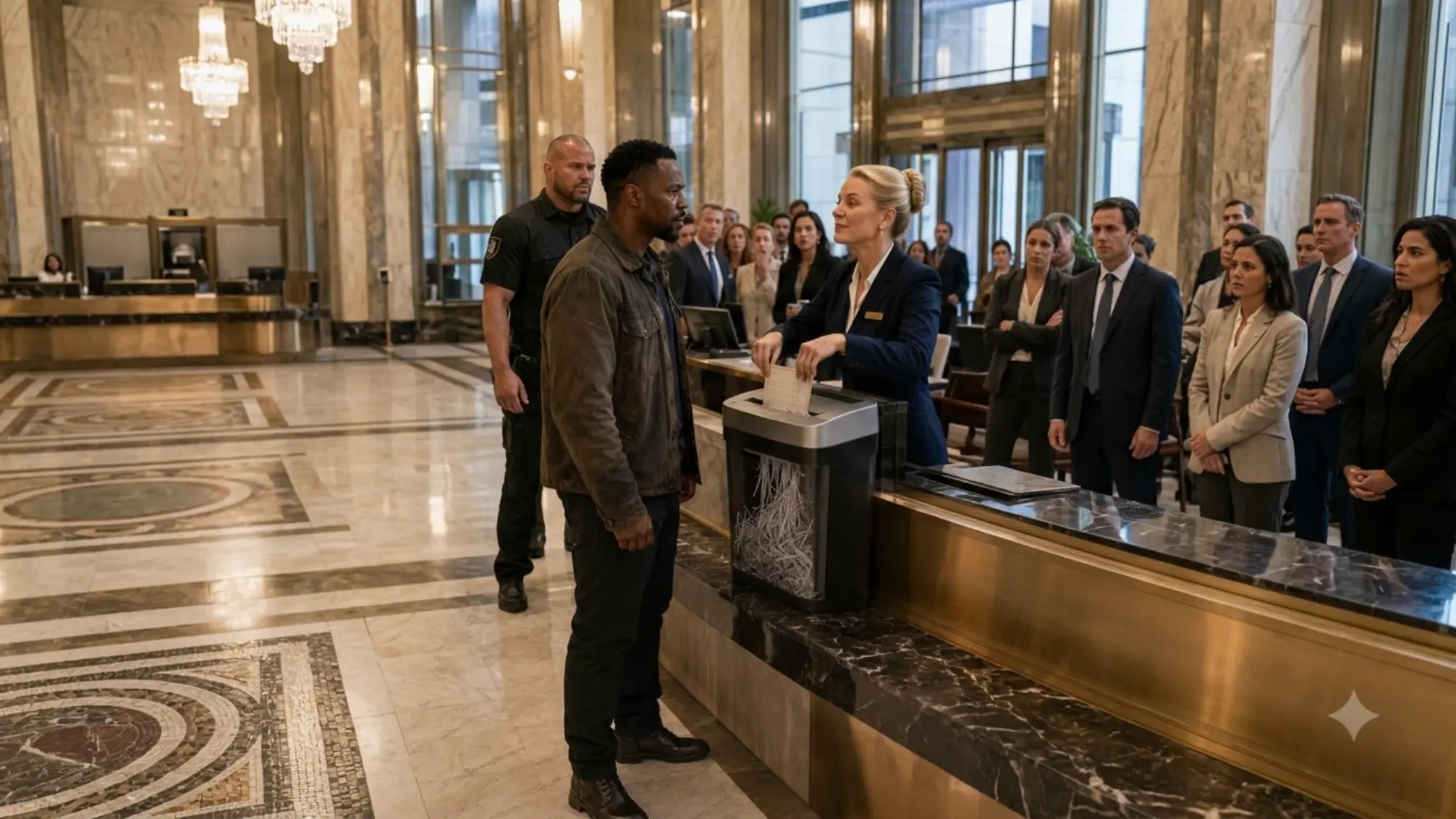
He stood motionless on the customer side of a black marble counter inside the downtown Atlanta branch of Atlantic Crown Private Bank, watching the machine pull in the upper edge of a certified check worth seven hundred fifty thousand dollars.
For half a second, the sound was almost absurdly ordinary.
A mechanical hum.
A faint vibration.
Then paper began emerging beneath the blades in thin white strips.
Darius looked at the woman holding the check.
“Take your hand off that machine.”
Evelyn Mercer smiled.
Not nervously.
Not apologetically.
She wore a tailored navy suit, pearl earrings, and a rectangular gold badge identifying her as branch manager. Her blonde hair was pulled into a tight bun, and every detail of her appearance communicated the confidence of someone accustomed to deciding who belonged in the room.
“You need to lower your voice.”
Darius had not raised it.
Behind him, a large security officer took two steps closer.
Customers near the private-banking desks were already watching.
Darius looked back at the shredder.
Half the check was gone.
“You haven’t verified the issuing bank.”
“I don’t need to.”
“You haven’t called the account officer.”
“I don’t need to do that either.”
“Then what exactly are you basing this on?”
Evelyn tilted her head.
“You walked in without an appointment carrying a check for three quarters of a million dollars.”
“That happens in banks.”
“Not like this.”
Darius’s expression hardened.
“What does ‘like this’ mean?”
Evelyn glanced deliberately at his weathered brown jacket.
His black shirt.
His dark trousers.
Then back at his face.
“People dressed like you don’t walk into my branch with seven-hundred-fifty-thousand-dollar certified checks.”
Several people heard her.
One woman standing near the investment desk stopped pretending not to watch.
Darius stared at Evelyn.
The security officer shifted behind him.
Evelyn pushed the check farther into the shredder.
“Take your scam somewhere else.”
Darius stepped forward once.
The security officer immediately moved.
“Sir.”
Darius stopped.
He looked at the guard.
“Don’t touch me.”
The man was built like a retired linebacker and wore a black security uniform with the name Grant Palmer stitched above his chest.
“Then step back.”
Darius did.
His eyes returned to Evelyn.
“Pull your hand away from that machine before you make the most expensive mistake of your career.”
Her smile disappeared.
“Was that a threat?”
“No.”
His voice stayed controlled.
“It was your last warning.”
Evelyn pushed down.
The final piece of the check vanished.
White strips fluttered into the shredder bin.
Several people gasped.
Evelyn removed her hands.
“There.”
Darius stared at the machine.
Seven hundred fifty thousand dollars had just become several hundred pieces of paper because one bank manager had decided verification was less useful than instinct.
Evelyn folded her arms.
“Threaten me again and security will drag you out before those pieces hit the bottom.”
Darius slowly looked at the phone beside her computer.
It began ringing.
He held Evelyn’s gaze.
“Answer that call.”
She frowned.
“What?”
“It’s your regional president finding out why his new CEO’s check is sitting in your shredder.”
Nobody moved.
Then the phone rang again.
Evelyn stared at Darius.
For the first time, uncertainty entered her face.
Only slightly.
Not enough to overcome arrogance.
She picked up the receiver.
“Atlantic Crown, executive desk. Evelyn Mercer speaking.”
Her expression remained dismissive.
Then it changed.
“Yes, Mr. Hale.”
Darius saw her shoulders stiffen.
“No, sir. We’re dealing with a suspicious customer at the moment.”
A pause.
She looked toward Darius.
Her skin lost color.
“Yes.”
Another pause.
“I’m sorry?”
The room became so quiet that Darius could hear the shredded paper settling inside the plastic container.
Evelyn gripped the receiver.
“Yes, sir. He’s standing here.”
Her eyes lifted toward Darius.
“No, I did not know that.”
She listened.
Then whispered:
“Yes, Mr. Hale.”
Another pause.
“Immediately.”
She lowered the phone.
Nobody needed an explanation.
But Darius gave her one anyway.
“My name is Darius Cole.”
Her mouth opened.
He continued.
“Yesterday morning, Northstar Financial Group completed its acquisition of Atlantic Crown.”
Grant Palmer slowly stepped away from him.
Darius looked directly at Evelyn.
“I became chief executive officer of the combined group at eight o’clock this morning.”
A customer near the teller counter whispered, “Oh my God.”
Evelyn stared at him.
Darius continued.
“This branch was my first unannounced site visit.”
The silence became heavier.
“I wanted to know how our people treated customers when headquarters wasn’t standing over their shoulder.”
His eyes moved toward the shredder.
“Now I know.”
Evelyn’s lips parted.
“Mr. Cole—”
“Don’t.”
The word was quiet.
She stopped.
Darius removed his phone.
Grant shifted again.
Darius noticed.
“You can relax, Mr. Palmer. I’m taking out a phone.”
Grant’s face flushed.
“Yes, sir.”
Darius unlocked the screen.
Evelyn stepped around the counter.
“Mr. Cole, I believe there has been a serious misunderstanding.”
Darius almost laughed.
“Which part?”
She lowered her voice.
“The check looked unusual.”
“It was certified yesterday by Northstar Treasury.”
“I had no way to know that.”
“You had three ways to know that.”
He began counting.
“You could have called the issuing institution.”
One finger.
“You could have checked the certification code.”
Second.
“You could have asked me for identification.”
Third.
“You did none of them.”
Evelyn glanced toward the crowd.
“I was protecting the bank.”
“From what?”
She hesitated.
Darius waited.
Her eyes moved toward his clothing again.
That was enough.
He nodded.
“Exactly.”
Grant looked away.
Darius dialed a number.
Martin Hale answered immediately.
“Darius?”
“I’m here.”
“What happened?”
Darius looked toward Evelyn.
“She shredded the instrument.”
Martin went silent.
“You’re joking.”
“No.”
“The actual certified check?”
“It’s inside a machine in front of me.”
Martin exhaled.
“I’m ten minutes away.”
“Bring legal.”
“Already called them.”
“And internal audit.”
Another pause.
“Darius.”
“Yes?”
“Do you want this branch closed?”
Darius looked around.
Employees were frozen behind computers.
Customers stared.
Grant stood near the lobby entrance, visibly uncomfortable.
“No.”
Evelyn’s expression flickered with relief.
Darius continued.
“I want business to continue.”
Her relief disappeared.
“I want every camera preserved. Every transaction log preserved. Every complaint involving this branch for five years preserved. Every customer-account closure reviewed. Every suspicious-activity referral originating here flagged for audit.”
Evelyn stared.
Martin said, “Understood.”
“And Martin?”
“Yes?”
“Bring Human Resources.”
Darius ended the call.
Evelyn straightened.
“You’re treating this like some conspiracy.”
“No.”
He put his phone away.
“I’m treating it like data.”
She laughed nervously.
“You came in looking intentionally casual.”
Darius looked at his jacket.
“This?”
“You knew employees wouldn’t recognize you.”
“Yes.”
“So this was a test.”
“No.”
His answer was immediate.
“I intended to observe service quality.”
“That is a test.”
“I intended to ask questions, examine workflow, speak with staff, and leave.”
He pointed toward the shredder.
“I did not instruct you to destroy a customer’s financial instrument.”
Evelyn’s mouth tightened.
“You introduced yourself as a customer.”
“I was a customer.”
“You’re the CEO.”
“CEOs have bank accounts.”
A few people in the lobby almost smiled.
Evelyn noticed.
Her embarrassment turned to anger.
“Your check can be replaced.”
Darius’s expression changed.
The sentence bothered him more than the shredding.
“Yes.”
He stepped closer to the counter.
“Mine can.”
Evelyn said nothing.
“That’s why we’re going to find out how many people you did this to who didn’t have a corporate legal department behind them.”
Grant looked sharply toward Evelyn.
She went still.
Darius saw it.
Interesting.
“You have done something like this before.”
“No.”
He looked at Grant.
The security officer immediately focused on the floor.
Darius turned fully.
“Mr. Palmer.”
Grant swallowed.
“Sir.”
“How long have you worked here?”
“Three years.”
“Has she ever ordered you to remove a customer after refusing financial verification?”
Evelyn snapped.
“Grant, you are not required to answer that.”
Darius looked at her.
“You are now instructing an employee not to cooperate with the CEO during an active compliance review?”
She stopped.
Grant took a breath.
“Yes, sir.”
Darius waited.
Grant continued.
“It’s happened.”
“How often?”
“I don’t know exactly.”
“More than five times?”
“Yes.”
“More than ten?”
Grant hesitated.
“Yes.”
Evelyn exploded.
“They were suspicious cases!”
Darius turned.
“Then records will support you.”
That shut her down.
Martin Hale arrived nine minutes later.
He entered through the revolving doors with a company attorney, the head of human resources, and two internal-audit directors.
Martin was sixty, silver-haired, and normally calm.
He took one look at the shredder.
Then at Evelyn.
Then at Darius.
“Tell me that’s not it.”
Darius pointed.
“That’s it.”
Martin rubbed one hand across his face.
“Jesus.”
Evelyn immediately stepped forward.
“Mr. Hale, I need to explain the circumstances.”
Martin turned.
“Did you shred the check?”
“Yes, but—”
“Before verification?”
Evelyn paused.
Martin’s face tightened.
“That’s a yes.”
“It appeared fraudulent.”
“Based on what?”
She looked toward Darius.
“He didn’t present himself as the type of client who normally carries an instrument of that size.”
Martin stared at her.
The attorney beside him slowly opened a notebook.
Martin asked, “What type is that?”
Evelyn realized the trap.
“I mean behavior.”
“What behavior?”
“He was confrontational.”
Darius spoke.
“After you told me the check was fake.”
Evelyn turned.
“You became aggressive.”
“I asked you to verify it.”
“You threatened my career.”
“After you started destroying it.”
The attorney looked toward the security cameras.
“Are those operational?”
A teller nodded.
“Yes.”
“Audio?”
“Lobby cameras have audio coverage near executive desks.”
Evelyn looked toward the ceiling.
Darius watched her face.
A second crack appeared in the confidence.
The human-resources director, Monica Reyes, stepped forward.
“Evelyn, please give me your access card.”
Evelyn stared at her.
“What?”
“Your branch access card.”
“You’re suspending me?”
“Pending investigation.”
“This is insane.”
Monica held out her hand.
Evelyn looked toward Martin.
“After seventeen years?”
Martin said nothing.
She turned toward Darius.
“You walk in here wearing a jacket that looks twenty years old, refuse to explain who you are, carry an enormous check, and somehow I’m the villain because I questioned it?”
Darius looked down at his coat.
“My father gave me this jacket.”
Evelyn stared.
“He wore it for fifteen years before he died.”
The room became silent.
Darius continued.
“I wear it because it reminds me what banking looks like from the side of the counter where nobody knows whether you matter.”
Evelyn’s eyes shifted.
“When my father wanted his first business loan, three banks rejected him before one manager finally read the application.”
He stepped closer.
“He built a trucking company with two trucks.”
Darius’s voice remained calm.
“By the time he died, he employed one hundred twelve people.”
Evelyn said nothing.
“So no.”
He looked at the shredder.
“I do not dress for your comfort.”
Monica repeated:
“Your access card.”
Evelyn pulled it from her blazer and slapped it into Monica’s hand.
“Fine.”
She reached for her purse.
Darius spoke.
“One more thing.”
She stopped.
“Your company phone stays.”
Her eyes narrowed.
“Personal information is on it.”
“Legal will preserve company data and return anything personal according to policy.”
She tossed the phone onto the counter.
Then walked toward the exit.
Grant stepped aside.
For the first time all morning, nobody tried to stop the wrong person from leaving.
The branch remained open.
That decision surprised everyone.
Martin expected Darius to shut it down immediately.
Darius refused.
“One person’s behavior doesn’t automatically prove an entire team is rotten.”
“But?”
“But it proves we need to look.”
They began looking.
The first problem appeared before lunch.
Internal audit pulled complaint logs from the previous twelve months.
Atlantic Crown required every customer complaint to be categorized.
Service delay.
Fee dispute.
Transaction issue.
Employee conduct.
Discrimination concern.
But at Evelyn’s branch, nearly every accusation involving biased treatment had been coded as “general service dissatisfaction.”
That mattered.
Compliance dashboards tracked discrimination complaints separately.
By changing the category, the branch made the cases effectively disappear from executive review.
Monica pointed toward the screen.
“How many?”
The auditor answered.
“Twenty-three in two years.”
Martin stared.
“Twenty-three?”
“That we’ve found.”
Darius looked at the entries.
A Black physician whose cashier’s check had been held for additional verification despite documentation.
A Latino small-business owner repeatedly asked to provide identification beyond bank requirements.
A young Black woman denied entry to private banking despite having an appointment.
An elderly man wearing work clothes sent to a standard teller line even though his account qualified for private service.
Each incident could theoretically have an explanation.
Together they created a pattern.
Darius asked, “Who reviewed these?”
The auditor scrolled.
“Mostly Mercer.”
“Anyone above her?”
“Regional operations received summarized metrics.”
Martin’s expression changed.
“Summarized by whom?”
The auditor clicked again.
“Regional service director.”
“Name?”
“Charles Denning.”
Martin looked toward Darius.
Darius knew the name.
Charles had survived the acquisition because he was considered operationally efficient.
He was supposed to meet Darius that afternoon.
“Cancel my meeting with him.”
Martin nodded.
“Bring him here instead.”
Charles arrived at three fifteen.
He entered confidently.
That lasted approximately thirty seconds.
Then he saw Darius sitting in Evelyn Mercer’s office with complaint reports spread across the table.
“Mr. Cole.”
“Sit.”
Charles did.
Darius pushed a printed report toward him.
“Twenty-three discrimination-related complaints coded as generic service problems.”
Charles looked down.
“I would need context.”
“You’ve had context for two years.”
“I oversee twelve branches.”
“And?”
“I can’t personally review every customer grievance.”
“Correct.”
Darius nodded.
“That is why automated category reporting exists.”
Charles said nothing.
Darius continued.
“Except these complaints never reached the category report.”
“I don’t control branch coding.”
“Your monthly signoff certifies the coding review.”
Charles stared.
Martin sat against the wall.
The attorney remained near the door.
Darius asked, “Did you review them?”
Charles hesitated.
“No.”
“Then why did you certify that you did?”
Silence.
Charles adjusted his tie.
“It was common practice to rely on branch managers.”
Darius looked at Martin.
“Common?”
Martin’s face was grim.
“We’re finding similar signatures elsewhere.”
Darius returned to Charles.
“Did you ever receive direct complaints about Evelyn Mercer?”
Charles looked toward the attorney.
“You can answer,” she said.
“Yes.”
“How many?”
“I don’t remember.”
“More than five?”
“Probably.”
“More than ten?”
Charles exhaled.
“Maybe.”
“What did you do?”
“I discussed customer service expectations with her.”
Darius leaned back.
“That worked beautifully.”
Charles flushed.
“Mr. Cole, Evelyn was consistently one of our highest-performing branch managers.”
“Define performing.”
“Deposits. Wealth-management referrals. Client retention. Revenue.”
“There it is.”
Charles looked confused.
Darius tapped the reports.
“Who was being retained?”
Silence.
“Which clients mattered?”
Charles said nothing.
“Because I’m beginning to think this branch was extremely good at serving people Evelyn wanted inside it.”
He pointed toward the lobby.
“And very efficient at removing everyone else.”
By evening, the investigation had expanded to four branches.
Darius went home late.
His wife, Naomi, was sitting at their kitchen island when he entered.
She looked at his face.
“How bad?”
He dropped the brown jacket across a chair.
“Worse than one manager.”
Naomi had been married to him long enough to know when not to fill silence.
She waited.
Darius opened the refrigerator.
“What happened to the check?”
“Confetti.”
She blinked.
“She actually shredded it?”
“Yes.”
Naomi stared.
Then started laughing.
Darius looked offended.
“I’m glad my trauma is entertaining.”
“I’m sorry.”
She covered her mouth.
“It’s not funny.”
“It clearly is.”
“A little.”
He sat opposite her.
The humor faded.
“She said people dressed like me don’t carry checks that size.”
Naomi’s expression changed.
“She said that?”
“In a full lobby.”
“I assume she knows who you are now.”
“She does.”
“Then she’s terrified.”
Darius shook his head.
“That’s not the part bothering me.”
“What is?”
He looked at his hands.
“If I weren’t CEO, what happens?”
Naomi knew immediately.
“You get removed.”
“Probably.”
“You file a complaint.”
“Maybe.”
“And she codes it as customer dissatisfaction.”
Darius nodded.
“That’s what bothers me.”
Over the next six weeks, Northstar investigators reviewed thousands of records.
The pattern became clearer.
Evelyn Mercer had created an informal list of what she called “elevated verification indicators.”
No corporate policy authorized it.
Her indicators included customers whose clothing seemed inconsistent with transaction value.
Customers making large withdrawals without scheduled appointments.
Customers who appeared unfamiliar with private banking.
Customers who became “defensive” when questioned.
There was no explicit racial category.
There did not need to be.
The results spoke for themselves.
Minority customers were subjected to secondary verification at significantly higher rates.
Complaints from those interactions were disproportionately recategorized.
Security removals showed a similar pattern.
Grant Palmer cooperated fully.
He provided copies of incident reports.
Then he admitted something that bothered Darius.
“I knew some of it was wrong.”
They were sitting in a conference room after closing.
Darius looked at him.
“Why didn’t you say anything?”
Grant stared at his hands.
“I have two kids.”
“That’s not an answer.”
“It is.”
Darius waited.
Grant continued.
“My wife lost her job during the pandemic. This bank contract covers insurance.”
He swallowed.
“Mercer could have me removed from the branch with one phone call.”
“So you followed orders.”
“Yes.”
“Even when you knew?”
Grant nodded.
Darius appreciated the honesty.
He did not excuse it.
“Fear explains behavior,” he said. “It doesn’t erase responsibility.”
Grant looked up.
“I know.”
“Did you ever physically harm anyone?”
“No, sir.”
“Threaten arrest?”
“Yes.”
“How many times?”
“Several.”
“Without an actual crime?”
Grant closed his eyes.
“Yes.”
Darius leaned back.
“Then your employment here is over.”
Grant nodded.
“I figured.”
“But.”
Grant looked up.
“You cooperate with every customer review, every complaint investigation, and every legal inquiry.”
“Yes, sir.”
“And I’ll make sure the record says you cooperated.”
Grant’s eyes reddened.
“Thank you.”
“That isn’t forgiveness.”
“I know.”
“It’s accuracy.”
Grant nodded.
“That’s enough.”
Charles Denning was terminated the following week for repeated compliance certification failures.
Two other managers were disciplined.
One resigned.
Several executives who had ignored the complaint-coding anomalies lost bonus eligibility.
Evelyn Mercer’s hearing came last.
She arrived with an attorney.
Darius did not attend as her judge.
He refused.
Instead, a review panel examined surveillance, customer records, complaint logs, security reports, and her communications.
The footage from Darius’s visit was devastating.
Not because she had questioned a large check.
Banks were allowed to verify unusual transactions.
Expected to, in fact.
Her failure was different.
She had decided verification was unnecessary because she had already decided who Darius was.
Then she destroyed his property.
Then she threatened removal.
Then she attempted to prevent Grant from answering questions.
The panel terminated her employment.
But Darius was not satisfied.
Firing people was easy.
Changing a system was harder.
Northstar announced new verification standards across every branch.
Large transactions could trigger enhanced review.
But the trigger had to be objective.
Amount.
Transaction type.
Fraud indicator.
Account anomaly.
Not clothing.
Not accent.
Not occupation assumptions.
Not whether an employee believed a customer “looked wealthy.”
Every declined or escalated high-value transaction required a documented reason.
Discrimination complaints could no longer be recategorized at branch level without compliance approval.
Security removals required centralized review.
Employees received a new escalation option allowing them to bypass local management when they believed policy was being misused.
Then Darius made one decision several executives disliked.
He published branch-level complaint statistics internally.
Martin Hale objected first.
“You’ll create embarrassment.”
“Good.”
“Managers will compete to have the lowest number.”
“They already compete on everything else.”
“They might discourage complaints.”
“Then we audit that too.”
Martin sighed.
“You’re enjoying this.”
Darius looked at him.
“No.”
That ended the conversation.
Three months after the shredding incident, Darius returned to the Atlanta branch.
This time nobody knew he was coming.
He wore the same brown jacket.
The lobby had changed subtly.
Not dramatically.
The marble remained.
The gold trim remained.
Wealthy clients still moved through private banking.
But a sign near the entrance now explained verification procedures clearly.
Service staff had been rotated.
The new branch manager was Angela Brooks, a forty-one-year-old woman who had spent twelve years in commercial lending.
Darius entered carrying no briefcase.
A young teller looked up.
“Good morning, sir. How can I help you?”
“I need to deposit a check.”
“Absolutely.”
No recognition.
Good.
Darius handed her a replacement certified check.
Seven hundred fifty thousand dollars.
The teller looked at the amount.
Then at Darius.
She did not react to his clothing.
She looked at the check again.
“For an instrument this size, I’ll need to complete enhanced verification.”
Darius nodded.
“Okay.”
“I’ll also need identification.”
He gave it to her.
She entered the certification code.
The computer prompted secondary confirmation.
“I need to call the issuing desk. It should take several minutes.”
“Take your time.”
She called.
Darius waited.
Behind the teller, Angela Brooks walked by.
She noticed him.
Her eyes widened.
Darius placed one finger near his lips.
Do not.
Angela immediately understood.
She continued walking.
Five minutes later, the teller returned.
“Everything is verified.”
She handed back his identification.
“Would you like the funds deposited into your existing Northstar account?”
“Yes.”
She completed the transaction.
Then smiled.
“You’re all set, Mr. Cole.”
“Thank you.”
“You’re welcome.”
Darius stepped aside.
Only then did Angela approach.
“Good morning.”
The teller heard her.
She looked between them.
Angela smiled.
“Rachel, have you met Mr. Cole?”
The teller shook her head.
“No.”
“He’s our chief executive officer.”
Rachel’s face went white.
Darius immediately held up a hand.
“You did exactly what you were supposed to do.”
She stared.
“I made you wait.”
“Yes.”
“I asked for identification.”
“You should have.”
“I verified the check.”
“That’s the job.”
Her shoulders relaxed.
Darius smiled.
“Verification isn’t disrespect.”
He glanced toward the shredder beneath the administrative counter.
“Assumption is.”
Angela walked with him toward her office.
The original shredder was gone.
Darius noticed.
“What happened to it?”
Angela laughed.
“Legal took it as evidence.”
“Probably safer.”
She closed the office door.
“There’s something you should see.”
She handed him a report.
Customer complaints had increased.
Darius raised an eyebrow.
Angela nodded.
“That’s actually good.”
He smiled.
People were reporting issues because they believed someone might read them.
Resolution time had dropped.
Account closures after disputed identity verification had fallen dramatically.
Private-banking enrollment among local small-business owners had increased.
Security incidents had dropped.
Then Darius saw one number.
Customer satisfaction had risen eleven points.
He closed the report.
“That’s better.”
Angela nodded.
“Staff were nervous at first.”
“About?”
“Making mistakes.”
“And now?”
“They understand the rules.”
Darius looked through the glass wall toward the lobby.
“That’s the point.”
Systems should not require good people to guess what fairness looked like.
They should make unfairness harder.
Six months later, Northstar held its annual leadership meeting in Atlanta.
Nearly four hundred managers attended.
Darius stood on stage.
Behind him was no photograph of Evelyn.
No surveillance video.
No destroyed check.
He had refused to turn one woman’s failure into corporate entertainment.
Instead, he displayed two numbers.
$750,000.
And beneath it:
$0.
He looked across the room.
“The first number is the value of the check destroyed in our Atlanta branch last year.”
Everyone knew the story.
“The second is what matters more.”
He paused.
“It is the amount of money a customer should need before we decide they deserve dignity.”
The room remained silent.
Darius continued.
“I happened to have a title powerful enough to make people pay attention after what happened to me.”
He looked across hundreds of managers.
“Most customers do not.”
That sentence stayed in the room.
“Our responsibility is not to treat someone correctly after discovering they are important.”
He shook his head.
“It is to build an institution where discovering someone is important changes nothing about the respect they receive.”
Martin Hale sat in the front row.
He had worked in banking thirty-seven years.
Later he told Darius that sentence embarrassed him more than any audit result.
Darius considered that useful.
A year after the incident, he received a letter.
No return company address.
Only a residential address in Georgia.
It came from Evelyn Mercer.
He almost threw it away.
Instead he opened it.
The letter contained no demand for her job.
No threat.
No excuse about stress.
She wrote that after leaving Atlantic Crown, she had spent months telling herself she had been targeted because of corporate politics.
Then her attorney showed her the full complaint history during preparation for an employment dispute.
She read the customers’ statements.
All of them.
One sentence in her letter stayed with Darius.
She wrote:
I believed I was protecting standards when what I was really protecting was my idea of who deserved access to them.
Darius read that twice.
At the end she apologized.
Not for humiliating the CEO.
For humiliating the man she believed was nobody.
Darius folded the letter.
Naomi found him sitting at the kitchen table.
“What is it?”
“Evelyn.”
She sat opposite him.
“What does she want?”
“Nothing.”
“That’s unusual.”
He handed her the letter.
Naomi read it.
Then looked up.
“You going to answer?”
Darius thought for a long time.
“Yes.”
“What are you going to say?”
He took out a blank sheet of paper.
“I don’t know yet.”
He eventually wrote only four sentences.
He thanked her for acknowledging what had happened.
He told her accountability mattered more when no reward followed it.
He told her he hoped she carried the lesson into whatever came next.
And he told her forgiveness did not erase consequences, but consequences did not require a person to remain forever trapped inside the worst decision they had made.
He mailed it himself.
Two years later, the Atlanta branch became one of Northstar’s highest-rated locations.
Rachel, the teller who had properly verified Darius’s replacement check, became assistant manager.
Angela Brooks moved into regional operations.
The complaint-review system Darius introduced became company policy across eleven states.
And the brown jacket remained in his closet.
He still wore it.
At investor conferences, sometimes.
Branch visits, often.
His executive assistant once suggested replacing it because the elbows were becoming worn.
Darius refused.
“Why?”
He looked at the jacket.
Because his father had worn it while walking into banks asking strangers to believe that two trucks could become a company.
Because there had been a time when no one recognized the Cole name.
Because titles changed faster than character.
Because marble floors, tailored suits, expensive watches, and private-banking desks had a way of convincing people that wealth announced itself correctly.
It did not.
Sometimes a CEO entered wearing an old jacket.
Sometimes a millionaire wore work boots.
Sometimes the person with five dollars deserved exactly as much basic dignity as the person carrying seven hundred fifty thousand.
And sometimes the loudest lesson an institution ever learned began with the soft mechanical sound of a paper shredder pulling in a check that never should have been destroyed.