“I need a husband before dawn.”
“If you marry me before sunrise, every coin is yours.”
“You are offering marriage to a man whose name you do not know.”
“Yes.”
She was supposed to run away with the man who loved her. Instead, she discovered he never did.
So with a handful of gold sovereigns, a heart made of ice, and a future being signed away at sunrise, she stopped a stranger in the snow and made him an offer no sane man would accept.
He was not supposed to say yes. She was not supposed to trust him. And neither of them was supposed to feel anything. But somewhere between the wedding no one planned and the morning she realized she had stopped being afraid of him, something began.
Something neither of them had names for yet.
Something that could cost them everything, because he was hiding a secret that would unravel the very reason they had met. And she had a secret of her own.
The contract was supposed to protect her for a single night. She never anticipated wanting to stay.
The candles in Lord Henry Roberts’s study had burned low.
Lucy stood before her father’s portrait and did not blink. She had stood in this spot a hundred times since his burial. Sometimes in the afternoon, when the light fell golden through the tall windows and made his painted eyes look almost alive. Sometimes at midnight, when the house was still and her grief sat so heavy on her chest she could not breathe.
Tonight, she stood here with a velvet purse of gold sovereigns in one hand and her whole trembling future in the other.
Her father’s face looked down at her from the canvas. Strong jaw, silver temples, eyes that had always been kind, even in the hardest seasons of his life.
Lord Henry Roberts had been many things: a gentleman, a landowner, a man who told Lucy when she was six years old that her laughter was worth more than any fortune.
He had been the kind of father who pressed wildflowers between the pages of her books and left them for her to find, the kind of father who danced with her in the garden when no one was watching.
He was also, as it turned out, a man with debts that could swallow an estate whole.
She had not known the extent of it until after the funeral, when the solicitors arrived with their leather cases and their careful, apologetic expressions.
The Roberts estate was drowning. The land was mortgaged. The accounts were hollow. And the only currency Lady Margaret Roberts had left to bargain with was her daughter.
Lucy pressed her fingers to the cool glass of the portrait frame.
“I’m sorry, Papa,” she whispered. “I’m going to do something tonight that would have frightened you, but I think you would have understood why.”
Footsteps sounded in the corridor.
She stepped back from the portrait just as the door opened. Lady Margaret Roberts entered the study the way she entered every room, with the kind of rigid composure that had once been dignity and had since hardened into something colder.
She was still beautiful in the way winter mornings are beautiful: pale, sharp, and utterly without warmth. Her dark hair was pinned back with the precision of a woman who would not allow even a strand to escape her control.
She wore gray. She had worn gray every day since Henry’s death, but Lucy had stopped believing it was grief. It had become armor.
“You are not in bed,” Lady Margaret said.
“I could not sleep.”
Her mother’s eyes moved to the velvet purse in Lucy’s hand, then away. She said nothing about it.
“Lord Thornton’s solicitor will arrive at first light,” Lady Margaret said. She moved to the desk and straightened a stack of papers that did not need straightening. “The contract will be signed by seven. I expect you to be dressed and presentable.”
Lucy felt the words drop into her chest like stones into still water. She watched the ripples spread.
“And if I am not,” she said quietly, “presentable?”
Lady Margaret turned. Her eyes were the color of storm water, gray, cold, unreadable.
“This is not a matter of what you wish, Lucy. This is a matter of what is necessary.”
“He is fifty-three years old, Mother.”
“He is wealthy, and he is willing. Two qualities that matter considerably more than age when one is staring at ruin.”
Lucy thought of Lord Archibald Thornton. She had met him three times, and three times had been enough to understand everything she needed to understand about the man.
He was broad-shouldered and slow-moving, with heavy-lidded eyes that moved over Lucy the way a landowner surveys a property he has already decided to purchase. He did not speak to her so much as address her, the way one might address a piece of furniture that had been newly acquired.
He smelled of tobacco and something sharper underneath, something that made Lucy’s spine draw tight whenever he stood too close.
The first time he had taken her hand in greeting, his grip had lasted three seconds longer than was proper.
She had counted.
“He looks at me,” Lucy said, keeping her voice even, “like I am something he has already bought.”
“You are something he is considering buying,” Lady Margaret said without a flicker of apology, “which is precisely why you will be gracious and quiet and grateful.”
The silence that followed was the loudest Lucy had ever known.
She looked at her mother. Truly looked at her in a way she had stopped allowing herself to do since the funeral, because looking too closely had always made her want to ask questions she could not bear the answers to.
Lady Margaret was fifty-one years old. There had once been warmth in her face. Lucy could find traces of it sometimes in the small portrait that hung in the east hallway, the one painted when her parents were newly married, when her mother had still looked like someone who believed in something.
Whatever she had once believed in, grief and debt had long since replaced it with strategy.
“I am going to bed,” Lucy said.
She walked past her mother without kissing her cheek.
Lady Margaret did not reach for her.
Lucy climbed the stairs slowly, listening to the house breathe around her. The creak of old floorboards. The hiss of gas lamps in the corridor. The distant sound of wind pressing against the leaded windows.
Somewhere beyond those windows, London was alive and indifferent, full of people who did not know that a girl in a gray townhouse was counting down the hours until her life was signed away.
She reached her room. She locked the door.
Then she pulled the small packet of letters from beneath her mattress and spread them across the coverlet.
Sebastian Clark wrote beautifully. She had to give him that.
His letters had arrived over the course of three months, slipped through the fingers of a sympathetic housemaid, folded small and tucked into the pages of books returned from the lending library.
Each one had been better than the last. Each one had been precisely what a girl who was drowning needed to hear.
He had told her she was brave. He had told her she was extraordinary. He had told her that the life her mother was arranging for her was a cage and that he intended to be the key.
He was the son of a respectable merchant family, which meant Lady Margaret would never have entertained his suit. He was charming and quick-eyed, and he had a way of lowering his voice when he spoke to Lucy in public, as if everything he said to her was a secret the rest of the world did not deserve to hear.
She had believed, with the whole desperate conviction of a girl who had run out of other options, that he loved her.
The last letter had arrived four days ago.
Meet me at the Anchor Inn before dawn. Bring what you can carry. We will be far from London before your mother wakes.
Lucy read it one more time, her lips pressed together. Then she folded it carefully and tucked it back beneath the mattress.
She pulled out the velvet purse. She counted the sovereigns.
Forty-three.
Her father’s emergency reserve, hidden in a false bottom of his writing desk. A hiding place he had shown her once years ago when she was twelve, with the conspiratorial seriousness of a man who believed every woman should have access to a private store of courage.
She had also taken her mother’s pearls from the dressing table, the small ruby brooch that had been her grandmother’s, and her father’s silver pocket watch.
She looked at the watch now, turning it in her hands.
The initials HR were engraved on the back.
Henry Roberts.
Her father’s name.
Her father’s warmth pressed into cold silver.
She closed her fingers around it.
She dressed in her warmest traveling clothes: dark blue wool, practical boots, her heaviest cloak. She braided her chestnut hair back simply and pinned it under a plain bonnet. No curls, no lace, no signet ring of the Roberts family on her finger. Nothing that announced who she was.
She picked up the velvet purse. She picked up her small traveling case. She looked around her room one final time at the rose-sprigged wallpaper she had looked at every morning of her life, at the bookshelves crammed with novels her father had given her, at the small watercolor above the fireplace that she had painted herself at fifteen of the garden at their country house in summer.
She breathed in the familiar scent of it all.
Then she opened the door, slipped into the dark corridor, and walked quietly toward the servants’ passage at the back of the house.
The kitchen was empty at this hour. The fire had died to embers. She passed through it without lighting a candle, her hand trailing the cold stone wall, and found the narrow door that opened onto the servants’ yard.
The bolt was stiff. She worked it free with both hands, the metal biting into her palms.
Snow had fallen while she had been upstairs gathering her courage. It lay in smooth, unbroken sheets across the yard, pale as bone in the darkness, marked only by the faint hollows left by the kitchen cat.
The sky above London was not black so much as deep, bruised purple, the kind of color the night takes on in the last hour before dawn begins to threaten it.
Lucy stepped into the snow. She pulled her cloak tight around her shoulders. She walked toward the street, leaving a line of footprints behind her, small and clear and purposeful.
She did not look back.
She believed at that moment, with her whole frightened and hopeful heart, that she was walking toward love.
She did not know yet that she was walking toward betrayal.
She did not know that she was also, in the strange and ruthless mathematics of fate, walking toward something far greater than either.
She simply walked into the snow, into the dark, into the story that would change everything.
The Anchor Inn sat at the crooked corner of Fell Lane and Carter Street, a place that smelled of burned tallow and damp wool, where the floorboards groaned under the weight of every secret that had ever been whispered inside its walls.
Gas lamps burned low along the exterior, casting yellow circles in the snow. Inside, through the thick panes of glass, Lucy could see the orange flicker of a common room fire.
She stood across the street for a moment, her boots already cold and wet through, her breath coming in white clouds that vanished into the dark air. Her heart was moving too fast. The velvet purse was gripped in both hands now, the coins pressing against her palms through the fabric.
Sebastian was inside. He had said he would be there waiting, and Sebastian Clark had never once broken a promise he put in writing.
He was careful about that.
Careful about everything he committed to paper, she realized now, thinking back. Always elegant, always precise, never a word out of place.
She crossed the street. She pushed open the heavy door and stepped into the warmth.
The common room was not crowded at this hour. A pair of older men sat near the fire with their pipes. A barmaid moved between tables with a tray. At a table in the far corner, partly concealed by a dark wooden partition, two men sat with glasses of something amber.
Lucy recognized Sebastian’s profile immediately. The line of his jaw. The way he held himself, leaning back, one arm draped over the back of his chair, perfectly at ease in a way she had always admired and now looked at differently.
The other man was a stranger, stocky, with a red face and a heavy ring on his right hand.
Lucy did not go forward.
Something stopped her. Some cold instinct that had no name yet, something that lived below thought and moved faster than reason.
She stayed where she was, half hidden behind the doorframe, and she listened.
“Take everything she’s carrying and be on the Portsmouth Road before anyone knows she’s gone,” Sebastian was saying.
He was laughing. She realized that. Easy, familiar laughter. The laughter she had liked so much.
“She’ll be ruined by morning either way. Whether she’s been robbed or simply run off, society will say the same thing. Foolish girl, they’ll say. Followed her heart. Lost everything.”
The other man said something she did not catch.
“No,” Sebastian said, still laughing. “No, I never loved her, Lord. She’s pretty enough, but the Roberts family has nothing left but the name and a crumbling townhouse. What use is that to me? The jewels and the sovereigns, now those I can use. A man can live very comfortably in France on what she’s carrying.”
The room around Lucy did not change.
The fire still burned. The barmaid still moved between tables. The two old men still smoked their pipes.
But something inside her went very, very quiet.
She stood completely still.
She had read about heartbreak in novels. She had always imagined it would feel sharp. A knife between the ribs, quick and clean, something you could point to, something with edges.
This was nothing like that.
This was the slow withdrawal of something she had been leaning her whole weight on. The sudden knowledge that the floor she had trusted was not there. It was falling without falling. It was silence where she had expected sound.
Sebastian Clark had never loved her.
He had read her loneliness like a map and walked straight to the most vulnerable point on it.
The letters, the whispered conversations, the lowered voice that made her feel like a secret. None of it had been real. All of it had been architecture, a carefully constructed passage that led directly to her father’s hidden sovereigns and her mother’s pearls.
Lucy’s fingers tightened around the velvet purse.
She thought, with extraordinary clarity, I will not cry in front of him.
She stepped back from the door, back out into the cold, back into the snow.
The night air hit her like punishment, but she welcomed it.
She walked quickly, not in any direction at first, simply away. Away from the inn. Away from Sebastian’s voice still ringing inside her head. Away from the plan she had built around a man who had been laughing at her from the beginning.
She walked until she reached the end of Carter Street and turned onto a wider road.
Gas lamps flickered here, throwing circles of amber light that made the snow look almost warm. Her boots crunched. Her eyes were dry, hard, deliberately dry, because she would not allow herself the softness of tears until she had a plan.
She had no plan.
She had forty-three sovereigns, a ruby brooch, a pearl necklace, and a silver pocket watch with her father’s initials on the back. She had a velvet purse, a traveling case, and a cloak that was slowly losing the battle against the cold.
She had no husband. She had no rescue. She had, in approximately three hours, the signing of a marriage contract that would deliver her into the keeping of Lord Archibald Thornton.
She kept walking.
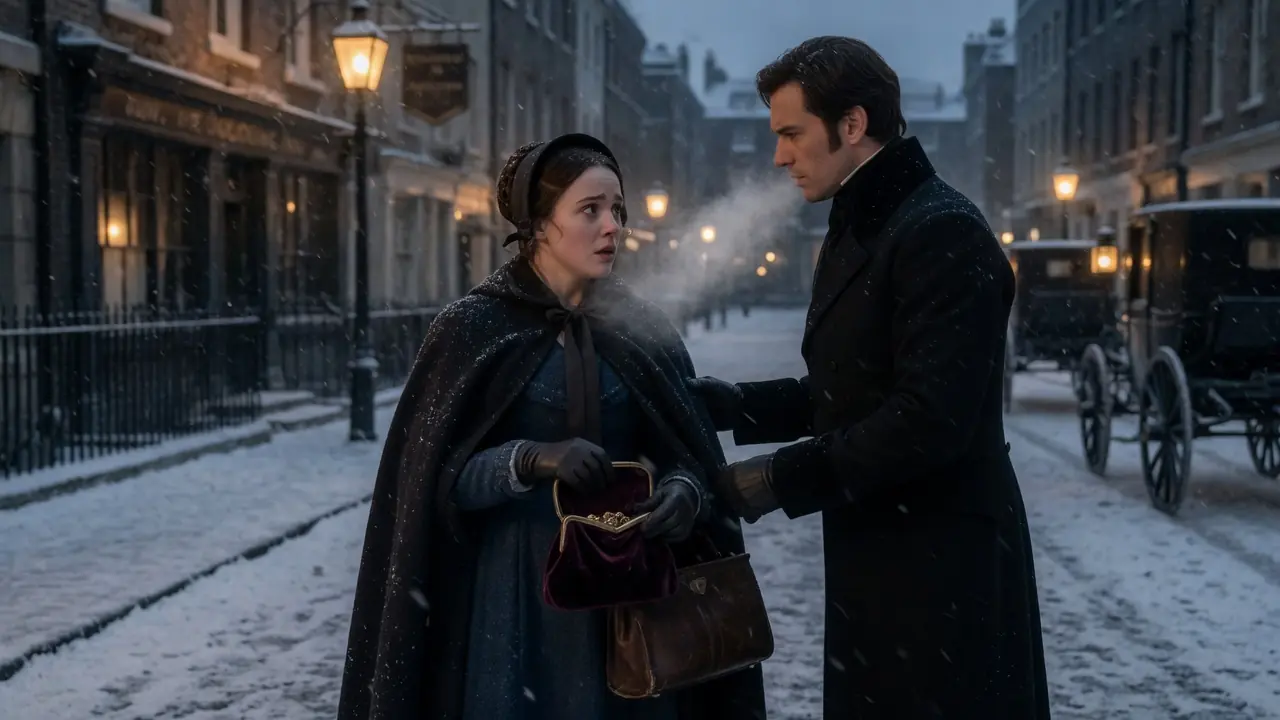
She was not looking at anything in particular when it happened. Her foot caught on an uneven stone beneath the snow. She stumbled forward into the street and collided with something warm, solid, and entirely immovable.
Something closed both hands around her arms before she could fall, steadied her with an efficiency that suggested long practice, and did not let go until she had found her footing.
She looked up.
Far across the city, at that same moment, in a well-appointed private room at Claridge’s Hotel, a man had been sealing a letter with the crest of Ravensmere.
William Sterling, Duke of Ravensmere, had been in London for thirty-six hours and had told exactly two people he was here.
He had not come for social purposes.
He had come because the investigation he had been quietly conducting for the past eight months had reached a point of delicate culmination, and because the subject of that investigation, one Lord Archibald Thornton, was about to make a very large legal mistake in the form of a marriage contract built on falsified debt records and forged letters of endorsement.
William had been gathering evidence against Thornton for a year.
He had done it quietly, with the thoroughness of a man who understood that destroying someone in public required absolute private certainty first.
He had spoken to families Thornton had ruined. He had obtained documents Thornton believed were safely buried. He had built a case that, when he chose to present it, would end Archibald Thornton’s career, his reputation, and quite possibly his liberty.
He had not expected tonight to present him with anything beyond the finalization of certain paperwork.
He folded the letter, pressed the seal, then stood, pulled on his coat, and went out.
He needed the cold air.
He needed, in truth, something to do with his hands, something that was not a glass of brandy and a fire and his own thoughts, which had been company enough for so many years and were beginning lately to feel less like companions and more like a room with too few windows.
He walked out into the snow.
He had not gone two full streets before the woman appeared.
She came around the corner at something approaching a run, and she did not see him at all. She was looking at the ground, or perhaps she was looking at nothing in the particular way of a person who has just had something taken from them and is still working out the dimensions of the absence.
She stumbled on the uneven stone.
He caught her by the arms before she hit the ground.
Her head came up, and he looked into the face of a young woman whose eyes were, he registered this in a single still moment, absolutely extraordinary.
Dark and bright at the same time, the way deep water is dark and bright, holding light and depth in the same space. Not quite crying. Closer to something on the other side of crying. The particular composure of a person who has made a decision not to break.
He looked at her face for approximately two seconds before all of that registered. Then he looked at the velvet purse in her hand, at the traveling case at her feet, at the fine wool of her cloak that was entirely inadequate for the temperature.
“Are you injured?” he asked.
His voice came out lower than he intended.
She shook her head.
“No. I am sorry. I was not watching where I was going.”
She stepped back. He released her arms.
She looked up at him with those impossible eyes, and something passed across her face that he could not name. Something very young and very old at the same time, the particular expression of a person who has run out of moves.
“Forgive me,” she said. “I have had a very poor evening.”
He said nothing.
He was not, under ordinary circumstances, a man who spoke when silence was working.
She looked at him for a long moment. Her chin came up, and he would think about this for a very long time afterward.
She said, “I need to ask you something, and I need you to understand that I am completely serious.”
“Ask,” he said.
She opened the velvet purse. The gold caught the gas lamp light and burned like a small fire in the cup of her hands.
Lucy had not planned this. She had not planned any part of what came after the coaching inn. She had simply walked, and the cold had stripped every other option from her, one by one, until only this one remained.
She looked at the stranger in front of her, tall, dark-coated, gloved hands resting at his sides, a face controlled in the way of a man who had practiced control until it became his natural expression.
He was handsome in a way she barely registered because the urgency of her situation had narrowed the world to essentials.
He had asked her to speak.
So she would speak.
“My mother intends to sign a marriage contract on my behalf at first light,” she said. She kept her voice steady. “The man I am to marry is Lord Archibald Thornton. He is not a man I am willing to marry.”
She did not elaborate on why. She thought the simple weight of the statement would carry it.
“I came tonight to meet someone who had promised to help me. That person proved to be…”
She paused, choosing the word with the precision of someone avoiding something sharper.
“Dishonest.”
She closed her fingers over the coins.
“The law does not give me the ability to refuse the contract my mother signs, but it does give me a right that she cannot take from me. The right to already be married.”
She looked at him directly.
“I need a husband before sunrise. If you will marry me tonight, legally, with a special license and a proper witness, everything I am carrying is yours. The gold, the jewelry, all of it.”
The silence between them was the most complete silence Lucy had ever been part of.
He looked at her, not at the gold.
She noticed that.
He looked at her, at her face, at whatever was written on it, at the small, precise act of courage that had produced this extraordinarily strange sentence in the middle of a snowy London street at four o’clock in the morning.
“You do not know who I am,” he said.
It was not a question.
“No,” she said. “I know what I need. I need a man with enough influence to obtain a special license at this hour. I can see from your coat and your bearing that you are a gentleman. That is sufficient for the law. And you are…”
She paused again.
“Walking alone in the snow at four o’clock in the morning, which suggests to me that you are, at minimum, not committed to another engagement this evening.”
Something moved at the corner of his mouth. She could not tell if it was amusement or something else.
“What is your name?” he said.
“Lucy Roberts.”
She hesitated one breath.
“Daughter of the late Lord Henry Roberts.”
“Roberts,” he repeated.
Something shifted very slightly behind his eyes.
“You knew him,” she said.
“I knew of him,” he said carefully. “And I know of Thornton.”
She stared at him.
“Then you understand what I am asking you to save me from.”
He was quiet for a moment.
The snow was beginning again, light and silent, falling in slow spirals around the lamplight. A flake settled on the shoulder of his dark coat and dissolved.
Lucy was cold now, cold all the way to the bone, and she did not let herself shiver. She stood exactly as straight as she could and looked at this stranger, and she waited.
“The gold,” he said at last, “is not what interests me.”
“Then what?”
“Tell me,” he said, “about your father. About the debt.”
She blinked.
Of everything she had expected him to say, that was not it.
But something in her, the part that had been sitting in her father’s study, staring at his portrait for months, carrying the weight of a story she had never been allowed to fully understand, answered him before she could think about whether to.
She told him.
She told him about the solicitors and the leather cases. She told him about the estate accounts and the mortgaged land. She told him about Lord Archibald Thornton appearing at her mother’s drawing room three weeks after the funeral with a smile that did not reach his eyes and a promise to resolve the debts in exchange for Lucy’s hand.
She told him about the marriage contract and the seven o’clock signing and her mother’s gray dresses, and the way Lady Margaret had looked at her tonight, not with cruelty exactly, but with the particular emptiness of a woman who had already made a decision and had no room left for doubt.
She did not tell him about Sebastian.
That wound was too new. It was not ready for words.
He listened to all of it without interrupting.
He did not look impatient or skeptical. He looked, she searched for the word and found it unexpectedly, attentive, as if what she was saying mattered to him in a way that went beyond the transaction she was proposing.
When she finished, the silence returned.
Then he took off his glove, his right glove, and held out his hand.
“I will need to contact my solicitor,” he said. “There is a special license that can be arranged within the hour if one has the right connections.”
His eyes did not leave hers.
“Give me your hand.”
Lucy looked at his bare hand. His fingers were long, the hand of a man who used it for something other than idleness.
She thought of Lord Thornton’s grip, that three-seconds-too-long grip, and the nausea it had produced.
She thought of Sebastian’s hand in hers, and how she had read trust into every detail of him that had been nothing but performance.
She placed her hand in this stranger’s.
His fingers closed around hers, firm, deliberate, and completely different from either of the others.
There was no possession in it, and no performance. It was simply the grip of a person who had made a decision and meant it.
A warmth moved up through her hand that had nothing to do with temperature.
“Keep the gold,” he said quietly.
She looked up at him.
“I offered it to you.”
“I know what you offered. Keep it.”
His voice was low, and something in it made her chest tighten in a way she did not understand yet.
“What I am accepting is the request, not the payment.”
Lucy opened her mouth and closed it again.
She could not make sense of him.
She had expected a desperate gentleman. She had expected a man who needed something, whose need would make the transaction clean and comprehensible.
This was not that.
This man did not look like he needed anything. He looked like a man who had decided to do something, and that was a very different thing entirely.
“Come,” he said.
He did not release her hand.
He guided her to the street’s edge as a carriage appeared. Black, well maintained, drawn by two horses whose breath steamed in the cold air.
A coachman jumped down. The stranger spoke to him in a low, rapid voice that Lucy caught only in pieces.
“Wake Atticus.”
“Special license.”
“The small chapel on Marsh Street.”
And one other thing, a name perhaps, that she could not fully hear.
He opened the carriage door. He helped her in. He settled onto the seat across from her and rapped twice on the roof.
As the carriage moved, he reached across and tucked the lap blanket from the seat around her shoulders. He did it without asking, without ceremony, with the matter-of-fact care of a person who had noticed she was cold and decided to do something about it.
Then he sat back and said nothing for a long moment.
Lucy sat with the velvet purse in her lap, her father’s watch in her coat pocket, and the strange new warmth of the blanket around her shoulders. She looked at the stranger across from her and thought, I do not know who you are.
She thought, I do not know if I have just made things better or worse.
She thought, He took my hand, and the world did not make me smaller.
That last thought surprised her enough that she pushed it down immediately and looked out the window at the passing snow.
“May I know your name?” she asked.
Her voice was steadier than she expected.
He looked at her.
There was a pause she would not understand until much later.
“William,” he said.
She nodded.
“Thank you, William.”
The carriage moved through London’s dark streets and the snow came down, and the clock was ticking toward sunrise, and Lucy Roberts sat across from a man she did not know and felt, for the first time since her father’s death, that something in the world was leaning in her direction.
The carriage stopped before a small stone chapel set back from the street.
Gas lamps burned on either side of the door. A man was already waiting on the steps, short, bespectacled, carrying a leather case, his coat hastily buttoned over what appeared to be a nightshirt. He had the expression of a man who had been woken from sleep by a message he did not entirely understand, but had long since stopped questioning.
Lucy stepped down from the carriage. She looked at the chapel.
The snow was settling on the old stone roof. A single bell hung silent in the small tower above the door.
William stepped down beside her.
She became, very briefly, aware of him in a way she had not quite allowed herself to be during the carriage ride. The height of him. The particular darkness of his coat against the snow. The steadiness with which he occupied space, as if the air around him had agreed to arrange itself according to his presence.
“Are you certain?” he said.
His voice was quiet, not pressuring, asking as if her answer genuinely mattered.
She thought of her mother’s gray face. She thought of Lord Thornton’s too-long grip. She thought of her father’s pocket watch and the false bottom of his desk, and the particular kind of courage that makes a person show their child where they have hidden their emergency funds.
“I am certain,” she said.
William nodded once. He offered her his arm. She took it.
They walked into the chapel together, into the candlelight and the cold stone silence and the smell of old wax.
The solicitor opened his leather case. The witnesses appeared from some arrangement Lucy did not fully follow. The words were spoken in the hush of a place where words of this kind had been spoken for two hundred years.
Lucy’s voice did not shake when she made her vows.
Neither did William’s.
When it was done, when the register was signed and the solicitor was folding his papers with careful efficiency, Lucy looked at the ring on her finger.
Simple gold.
It had appeared from somewhere she had not tracked.
She looked at it for a long moment. William stood beside her, not speaking, but she felt him there. The quiet, particular warmth of a presence that had, in the space of less than an hour, changed everything.
She almost looked up at him.
The church bell began to toll the hour.
Five o’clock.
Two hours until sunrise.
Two hours until Lord Archibald Thornton arrived at her mother’s drawing room expecting to find an obedient daughter.
Lucy touched the ring with her opposite thumb.
She was, as of this moment, married.
She did not know yet to whom.
The carriage returned to London’s better streets in the gray hour before dawn, when the city was neither sleeping nor awake, but suspended between the two in a cold, quiet breath.
Lucy sat with the blanket still around her shoulders and turned the gold ring on her finger.
Round and round, as if the repetition of the gesture might make it more real.
Across from her, William was reading through the documents his solicitor had produced. Reading them with the focused attention of a man reviewing something important, not celebrating something extraordinary, which was perhaps one of the most bewildering things about him.
She had just married a stranger.
She had just married him.
The vows were real. The register had been signed. There had been two witnesses, a solicitor, and a clergyman who had performed the ceremony with the mild expression of a man who had, over the course of a long ministry, witnessed enough of human extremity to find none of it particularly surprising.
The whole thing had taken less than twenty minutes, and it had changed the entire architecture of her life.
She should feel many things.
She probably did feel many things somewhere underneath the cold and the exhaustion and the strange, still-spreading awareness that Sebastian Clark had tried to ruin her tonight and instead had redirected her toward this.
Whatever this was.
She looked at William.
He had not looked at her in several minutes. He was reading. His profile was sharp against the dark interior of the carriage. Strong jaw, high cheekbone, dark lashes that were entirely wasted on a man of such evident seriousness.
There was a small tension at the corner of his eye that suggested whatever he was reading required concentration.
He had replaced his glove. She noticed both hands were gloved again now, one resting on the papers, one on the seat beside him, fingers spread.
She thought of the moment he had removed the right glove and held out his hand to her. The deliberateness of it. The warmth that had moved through her.
She looked away from him and back out the window.
“You said the gold did not interest you,” she said, not because she had planned to say it, but because the silence had begun to feel like something she needed to name.
He looked up from the papers.
“No,” he said.
“Then what did?”
She kept her voice neutral.
“You do not know me. You had no reason to do what you have done tonight. I would like to understand.”
He was quiet for a moment.
Not evasively quiet. Thoughtfully quiet, the kind of silence that has something inside it.
“You asked honestly,” he said. “You asked for exactly what you needed, for reasons you made entirely clear, with no pretense about what the situation was. In my experience, that kind of honesty is not common.”
She studied him.
“You are saying you married me because I was straightforward.”
“I am saying,” he said, “that you stood in the snow and offered a stranger everything you owned in exchange for your freedom. That is not desperation. That is…”
A pause.
“A particular kind of courage.”
Lucy looked at him for a long moment.
Something moved inside her that she did not quite have language for. Something that lived between gratitude and something warmer, something that pressed against the inside of her chest and reminded her uncomfortably that she had made vows to this man.
“You are a gentleman of influence,” she said. “That much is clear. I should know more about the man I have married. More than your given name.”
Again, that pause.
It was barely a moment longer than normal, but Lucy, who had spent the last year reading every flicker of her mother’s face for information, noticed it.
Before he could answer, the carriage slowed.
She looked out the window and saw that they had stopped before a townhouse on a very fine street.
Grosvenor Square, she realized, and then immediately revised that assessment, because no ordinary man occupied a townhouse on Grosvenor Square.
The building was four stories of pale stone with tall windows framed by carved details and a front door flanked by iron lamps that burned with the confidence of a household that always had oil in them.
Two footmen appeared immediately at the carriage door.
Lucy did not move for a moment.
She watched one footman speak to the other in a low, rapid exchange. Watched the swift, practiced efficiency with which they moved, the quality of the livery they wore, the particular stillness with which they arranged themselves as William stepped down.
She had been in the households of aristocrats before. She knew what the staff of an ordinary gentleman looked like. She knew what the staff of an important man looked like.
She did not yet know what she was looking at.
William turned and offered her his hand down from the carriage.
She took it and stepped down. The two footmen stepped back. From somewhere she did not see, another servant appeared with the door already open, and a housekeeper was in the entrance hall, and there was already a fire lit somewhere warm.
She stepped inside.
The entrance hall was tall, quiet, and absolutely certain of itself, the way all old money is certain, not with decoration, but with quality. Dark wood, good portraits, the kind of marble floor that costs more than most people’s houses, installed two hundred years ago and cared for ever since with an attention that had made it better with age rather than worse.
Lucy stood in the middle of it and turned slowly.
Her eyes went to the coat of arms above the fireplace at the far end.
She was not an ignorant girl. She had grown up in an aristocratic household, been educated in genealogy and heraldry the way all daughters of the gentry were, been taught to recognize the major houses.
She stared at the coat of arms for approximately four seconds.
She looked at William.
She looked back at the coat of arms.
“Sterling,” she said.
Her voice was very quiet.
He had gone to the housekeeper and was giving instructions in a low voice. At the sound of his name, not his title, just his name spoken by her in that particular tone, he turned and looked at her.
His expression was entirely calm, which was, she thought, a remarkable thing for a man who had just been identified.
“William Sterling,” she said.
The words came out very carefully.
“Duke of Ravensmere.”
He held her gaze.
The room was very still.
“Yes,” he said.
The world reorganized itself.
Lucy was not a woman who was easily undone, but she stood in the entrance hall of the Duke of Ravensmere’s London townhouse with a gold ring on her finger and a velvet purse of sovereigns in her hand and the solicitor’s papers in her coat pocket, and she felt the full dimensions of what she had done roll over her like a wave.
She had paid a duke to marry her.
She had stood in the snow with forty-three sovereigns and offered them to England’s most feared nobleman in exchange for his name.
She thought of herself pressing the coins into her palm and announcing her price.
The audacity of it rose up in her so completely that she had to press her lips together for a moment against something that was possibly laughter and possibly something much closer to its edge.
“I offered you forty-three sovereigns,” she said.
“And I declined them,” he said.
His voice contained something she could not quite parse. Not quite amusement. Not quite warmth. Something that was both and neither.
“I did not know.”
“I know you did not know.”
He crossed the hall toward her. He stopped at a respectful distance, not close enough to press, not far enough to dismiss.
“Had you known,” he said, “would you have asked differently?”
She thought about it honestly.
“I do not know. I might have been too frightened.”
“Then it is perhaps as well that you did not know.”
She looked at him.
“Ravensmere,” she said slowly. “They say you are the most feared duke in England.”
“They say many things.”
“They say the Lord Chancellor himself will not take a meeting with you unless he has three days’ notice and a favorable wind.”
Something definitely moved at the corner of his mouth that time.
“The Lord Chancellor is cautious by nature.”
“They say you destroyed the Whitmore family’s business interests in four months because their eldest son insulted a woman at a dinner party.”
“The eldest son did considerably more than insult her,” he said.
His voice was still even, but she heard the edge beneath it, clean and cold and entirely unsentimental.
“And it took four months, not six.”
Lucy stared at him.
She had married William Sterling.
She had pressed her hand into his and made vows in a cold chapel, and she was standing in his entrance hall at half past five in the morning, and she had not known.
She had looked at him and thought, gentleman of influence.
She had thought, connections sufficient for a special license.
She had thought, possible.
She had not thought, England’s most feared duke.
She had not thought, the man every corrupt nobleman in London prays does not look in their direction.
She had not thought about the fact that she had offered Lord Archibald Thornton’s most dangerous enemy forty-three pounds to marry her.
“You are investigating Thornton,” she said.
It came out with certainty because she was replaying the conversation in the carriage and hearing things in it she had not understood at the time.
“Yes.”
“That is why you listened. When I told you about the debt, the estate, the marriage contract. That is why you agreed.”
“Partly,” he said.
Then, after a beat, “Not entirely.”
She heard the not entirely with her whole body. She folded it away carefully because she was not yet in a place where she could examine it.
“What happens now?” she said.
He looked at her steadily.
“At seven this morning, Lord Thornton will arrive at your mother’s house expecting to sign a contract. He will find that the contract has been made void by a prior marriage.”
A pause.
“I intend to be there when he is told.”
Lucy felt something cold and very clear settle through her.
The image of Lord Thornton’s heavy-lidded eyes. His three-seconds-too-long grip. The way he had looked at her like property already purchased.
“I would like to be there too,” she said.
William looked at her for a moment.
Something in his expression, something she could not quite name, something that might have been respect, shifted very slightly.
“Then you will be,” he said.
She nodded.
She looked down at the ring on her finger.
Outside, through the tall windows of the entrance hall, the sky was beginning, very faintly, to lighten at its edges.
Sunrise was coming, and the morning was going to be extraordinarily different from what anyone had planned.
The house on Windham Street looked exactly as it always did at six-fifty in the morning.
The iron gate. The gray stone steps. The heavy brass knocker shaped like a lion’s head that Lucy had touched every day of her life without ever considering what it might mean to approach it from the outside as a stranger would and lift it.
She did not lift it.
She stood beside William on the pavement below, and she watched the door from this different angle, and she thought about all the years she had lived inside those walls and never quite understood that walls could hold a person just as securely as any lock.
William’s solicitor, Atticus Pembroke, sharp-eyed and precise, who had produced the special license at four in the morning without any visible complaint, stood to William’s left with his leather case open.
Behind them, William’s carriage waited, and on the door panel the Ravensmere crest was perfectly, unmistakably visible. The silver stag on black, the ducal coronet above, the motto in Latin beneath.
Fortis et Fidelis.
Strong and faithful.
Two of William’s footmen stood at the foot of the steps.
Lucy had changed in the room the Ravensmere housekeeper had quietly prepared for her. A simple change into clothes that had been retrieved from her traveling case: dark green wool, her hair repinned with care.
She looked, she hoped, like a woman who had made a deliberate choice, not a girl who had fled in the night. Not a runaway.
A wife.
The door opened at five minutes to seven.
The Roberts butler, old Henderson, who had been with the family for twenty years and whose expression could communicate volumes without a flicker of movement, appeared on the step.
He looked at Lucy. He looked at William. He looked at the carriage with the crest on the door.
Something happened in his face that was very small and very significant.
“Miss Roberts,” he began.
“Mrs. Sterling,” William said.
Not loudly. Not harshly. Simply with the flat certainty of a man correcting a fact.
Henderson paused.
“Your pardon, sir. Your Grace.”
He had recognized the crest, or the man, or both.
He stepped back immediately.
“Please come in.”
They were shown into the morning room.
Lady Margaret was already there. She wore gray, as always. She sat at the small writing desk by the window with papers spread before her, her back straight, her expression that of a woman who had not slept and was not admitting it.
Lord Archibald Thornton sat in the wingback chair by the fire with a glass of something. Brandy at seven in the morning, which told Lucy everything about the kind of man he was at his private ease.
His solicitor, a thin man with an unfortunate mouth, stood near the window with his own case.
They all turned when the door opened.
The sequence of recognitions moved through the room like a stone thrown into water.
Lady Margaret saw Lucy first, alive, unharmed, dry, and dressed. Her expression moved from fear to relief to fury in approximately two seconds. Then she saw the man beside Lucy, and the fury paused.
Lord Thornton saw Lucy, and his face did what the faces of men who believe they own things do when those things appear unexpectedly. It sharpened with the automatic calculation of possession.
Then his gaze moved to William, and the calculation stopped.
His eyes moved to the window and the carriage crest visible below, and the color in his face did something notable.
William’s solicitor moved first, crossing to the writing desk with the marriage register open in his hands and laying it before Lady Margaret with a precise economy of gesture.
“The Honorable Lucy Roberts was married at a quarter past five this morning,” Atticus Pembroke said in the pleasant, even tone of a man reading a weather report, “to William Henry Sterling, Duke of Ravensmere. The ceremony was conducted under special license at St. Ambrose’s Chapel on Marsh Street. The register carries two witnesses, the signature of Reverend Duncan Forner, and the seal of the Archbishop’s office.”
A beat.
“The marriage is legal, complete, and entirely binding.”
The room was absolutely still.
Lady Margaret looked at the register. She looked at Lucy. She looked at William. She looked at the register again with the expression of someone trying to locate the seam where a trick had been hidden and not finding it, because there was no seam, because this was not a trick.
Lord Thornton rose from the chair.
He was a large man, and he moved with the particular physical confidence of someone who had never, in his adult life, been in a room where he was not the most powerful person present.
He looked at William Sterling with the assessing expression of one predator taking the measure of another.
Then something changed in his face when he arrived at the correct answer, something that tightened around the eyes and went still around the mouth.
“Sterling,” he said.
William looked at him. Just looked, with the level, unhurried calm of a man who had been waiting for exactly this moment.
“Thornton,” he said.
The weight of those two syllables, the way William said the name, contained something that was not a threat in the legal sense and was absolutely, unmistakably a threat in every other sense.
Lord Thornton turned to Lucy.
His expression shifted, reaching for something. Condescension perhaps, or dismissal, the particular tone of a man trying to reassert authority in a room where he had just lost it.
“I see you have been busy,” he said to her.
His voice was meant to sound amused.
It did not.
Lucy looked at him directly. Her chin was level. Her hands were still.
“I have been married,” she said. “Which means the contract you came here to sign is void.”
A pause.
“You might thank my mother for her time.”
Lady Margaret made a sound that was not quite a word.
Lord Thornton’s solicitor began saying something about legal review and the validity of the document. William’s solicitor responded with the pleasantly firm energy of a man who had already thought of every objection and was mildly disappointed by how few of them were attempted.
The two men talked over each other for approximately forty-five seconds.
William did not look at either of them.
He looked at Lucy.
She was standing in the morning room of her childhood home with the full force of the life she had been running from arranged before her, and she was not running. She was standing in the center of it, straight and still, and she was looking at Lord Thornton with a directness that had not been there in any of their previous three meetings.
Something had changed in her eyes overnight.
Something that had been frightened was not frightened anymore, or had decided that fear was not the primary thing.
He thought, There she is.
He had not expected to think something like that. He filed it away carefully and returned his attention to the room.
“There is another matter,” William said.
The conversation stopped.
He reached into his coat and produced a sheath of papers. He laid them on the writing desk beside the marriage register with the same precision.
“These are copies of documents linking Lord Thornton to the management of debt obligations belonging to seven families in the county of Wiltshire,” he said, “including the Roberts estate. They demonstrate a pattern of falsified debt amplification, a practice of artificially inflating existing debts through fraudulent service charges and forged interest agreements with the specific purpose of increasing the vulnerability of families to coerced financial arrangements.”
He looked at Thornton.
“Including, in several cases, coerced marital arrangements.”
The silence this time was different.
Lady Margaret’s hand had gone to her throat.
Lord Thornton said very quietly, “You have no—”
“I have the standing of a private citizen presenting evidence to the relevant legal authorities,” William said, “which I have already done. The documents you are looking at are copies. The originals are with the Lord Chancellor’s office as of six this morning.”
Another pause.
“The investigation is already open, Thornton. This is not a threat. It is a notification.”
Lord Thornton stared at him.
He stared for a long moment.
And in that moment, the full cost of what he had done, not just to Lucy, but to seven families, perhaps more, was visible in his face.
Because a man who has built his entire sense of himself on never being held accountable has a particular expression when accountability arrives.
Then he straightened his coat, picked up his hat, and walked to the door.
His solicitor gathered his papers and followed.
Neither of them spoke again.
The morning room door closed.
Lady Margaret was still sitting at the writing desk with the marriage register open in front of her. She was looking at it with an expression that had moved past fury into something more complicated, something that had grief in it, and shock, and the particular look of a woman who had been moving very fast in a very determined direction and had just walked into a wall.
She looked at Lucy.
Lucy looked back at her.
William said quietly, “I will leave you to speak privately.”
He looked at Lucy, a single steady look that said, I am here when you are finished.
Then he and Atticus Pembroke withdrew to the corridor.
The door clicked shut.
Mother and daughter looked at each other across the morning room.
Outside on the street, a carriage was leaving. The sound of wheels on cobblestone faded.
The silence left behind was very large.
It had Lucy’s whole childhood inside it.
The weeks that followed moved through London’s drawing rooms and newspapers like a fire through dry paper.
Lord Archibald Thornton’s legal difficulties, once opened, proved far larger than even William had publicly announced in the Roberts morning room. The documents he had gathered were the foundation of a case that, as it was built out by the Lord Chancellor’s investigators, revealed a structure of exploitation that had been operating quietly for nearly a decade.
Seven families in Wiltshire. Three in Kent. Two in the north.
Debt records altered with enough skill to survive casual inspection, but not the kind that came with the full resources of a ducal estate behind it.
Families who had believed themselves ruined. Daughters who had been married off to men of their mother’s choosing because the numbers had appeared to leave no other option. Estates that had changed hands at drastically undervalued prices because the paper burden on them had been artificially impossible.
When the pattern became fully visible, the effect on society was significant.
Sebastian Clark’s role in it was smaller, a sub-scheme rather than the main architecture, a fraud of a more personal and petty kind. But the investigation, once fully underway, found him easily.
He had run a version of his scheme on three young women in the two years before Lucy. The letter of introduction he had used to gain access to the Roberts household proved to have been forged. His family’s merchant business, on examination, had debts of its own that made the inheritance he had implied he possessed entirely fictional.
He left England before the month was out.
Lucy heard the news from Atticus Pembroke’s monthly summary of investigative developments, delivered with the same pleasant evenness with which the man delivered every piece of information, regardless of its emotional weight.
She read Sebastian’s name in the summary and felt nothing in particular. Not triumph, not sadness, not the particular sting of humiliation that had chased her through the first days after the coaching inn.
He had been, she understood now, a story she had told herself when she had needed one.
The story had been wrong, but the need had been real.
The need for escape. For choice. For a future that was her own.
That need had led her through a set of events that still occasionally struck her as improbable.
Here was the townhouse on Grosvenor Square. Here was a garden that she had, over the course of several weeks, begun to walk in during the mornings.
The snow was melting now, giving way to the stubborn first green of an early spring. Grass pushing up through the cold soil, crocuses in pale purple and white along the path, the bare branches of the elm trees beginning to show the tentative swelling of new buds.
She was walking in it on a Tuesday morning in March when she heard his footsteps.
She had learned his footsteps. She would not have said so aloud. It felt like an admission of something she was still measuring.
But she had learned the particular quality of them. The unhurried pace. The weight of them. The way they slowed when he was thinking about something and moved more directly when he had reached a conclusion.
They slowed now as he came around the corner of the box hedge and found her there.
William had not stayed in London for the social reasons most dukes stayed in London.
He had stayed because the investigation required his presence and because she had begun to suspect, with a careful and measured suspicion, that he was not in a particular hurry to go elsewhere.
He appeared in the library in the evenings, reading or reviewing correspondence. He appeared at breakfast with efficient punctuality. He appeared in the garden, apparently, on Tuesday mornings.
He was wearing his coat and gloves, but no hat. His hair was slightly disordered from the wind. He looked, she thought, like a man who had been outside for some time and was only now remembering that the world contained other people.
He saw her.
He stopped.
“Good morning,” he said.
“Good morning,” she replied.
The garden was very quiet. The distant sound of the city reached them, softened by the walls.
They had been doing this, this particular form of careful proximity, for several weeks now. They moved through the same house with a courtesy that was entirely genuine and a restraint that was increasingly effortful, and they spoke to each other every day with a frankness that had, from the very first night, been one of the things Lucy valued most in all of this.
He did not speak to her as if she were fragile.
He did not speak to her as if she were an obligation.
He spoke to her the way one thinks one will always speak to someone, when one has not yet learned how few people in the world actually manage it.
But they had not spoken yet about anything that lived directly in the center of what had happened between them.
She sat on the stone bench near the elm tree.
He came and stood a few feet away, looking at the crocuses.
“The Thornton case goes to formal hearing next month,” he said.
“I know. Pembroke told me.”
A pause.
“The Roberts estate debts have been reviewed. Three of the four outstanding obligations were products of Thornton’s scheme. With those set aside, the genuine burden is…”
He paused, choosing the word.
“Manageable.”
She looked at her hands.
“Manageable with the estate’s own resources?”
“Yes.”
She absorbed that.
She thought of her mother, who had spent the last weeks in a kind of suspended state, not hostile, not warm, something in between, something Lucy recognized as a person slowly working through a very large reckoning.
They had talked. They would talk more. It was not simple, and it was not finished, but it had begun, which was more than Lucy had hoped for in those first mornings.
“I want to ask you something,” Lucy said.
He turned from the crocuses and looked at her.
“The night we met,” she said, “you said you accepted my request for reasons that were partly about the investigation and partly not. I need to understand the not entirely.”
The garden was very quiet.
William looked at her with that particular stillness that she had come to understand was not distance, but its opposite, the stillness of someone paying very close attention.
“I told you,” he said, “that you were brave.”
“You said it was a particular kind of courage.”
“Yes.”
“Tell me what you meant.”
He was quiet for a moment. The elm branches moved overhead, and a single crocus bent in the wind and straightened again.
“I have met many people who were frightened and asked for help,” he said. “The asking is usually shaped. Shaped by what they think the person they are asking needs to hear. There is calculation in it, even when the fear is genuine.”
He looked at her.
“You asked me exactly what you needed in exactly the terms that were true. And then you waited to see what I would do. You did not perform distress. You did not exaggerate. You did not try to make yourself smaller to seem more sympathetic or larger to seem more worthy.”
A pause.
“You simply told me the truth and left it with me.”
Another pause, shorter.
“I have not been offered something like that in a very long time.”
Lucy sat very still.
She thought about what it would cost a man who had spent years surrounded by people who wanted things from him, people who performed toward him, who shaped their approaches to his known preferences, who saw his power before they saw him, to be handed something simple and honest in the dark.
She looked at him and felt the full weight of what he had just said settle in the air between them.
She stood.
She was not taller than him. She came to his jaw, which meant standing this close, she had to look up.
And she looked up, and he was looking down, and the distance between them was something that had been narrowing for weeks without either of them acknowledging it.
“William,” she said.
“Lucy,” he said.
There was something in the way he said her name. Something quiet and careful, the name handled as if it mattered.
That did more to her chest than anything had done in a very long time.
She reached out. She put her fingers, bare and cold from the morning air, against the lapel of his coat.
He looked down at her hand. His own hand, gloved, came up and covered hers. She felt the pressure of it through the leather.
A footstep sounded on the garden path.
They both turned.
Pembroke appeared around the hedge with a folder under his arm and the expression of a man who had an appointment and was about to be very briefly and very professionally oblivious to whatever he had walked into.
“Your Grace,” he said. “The depositions from the Kent families have arrived. There is a discrepancy in the third testimony that requires your review before the hearing.”
William looked at Lucy.
Lucy looked at William.
His hand was still over hers.
After a moment, she smiled, small and private, a smile that lived in the corner of her mouth, and stepped back.
“Go,” she said.
He held her gaze for one more moment.
“This evening,” he said quietly.
Not a question.
“This evening,” she agreed.
He turned and walked with Pembroke toward the house, and Lucy stood in the garden with her hand still warm from the pressure of his.
She looked at the elm tree, and the crocuses, and the first uncertain light of a March morning, and she thought about how strange and exact and ruthless the process of arriving somewhere is.
She had not come here by a straight road.
She had come here through fear and betrayal and a snowy street at four in the morning and a stranger who had not behaved as strangers are supposed to behave.
And she was here.
And something was beginning.
Something real this time.
The letter from her father had been found in the desk at the Roberts estate.
Not the London townhouse desk. The one in the country study, the one at Holley Grange in Somerset, where the family had spent summers when Lucy was small and where most of the furniture had been under sheets for three years.
The letter had been folded into an old copy of Blackstone’s Commentaries, third shelf, which was exactly the kind of hiding place her father had favored, the ones that required a person to already know something in order to look there.
William had arranged for someone to collect the personal effects from the estate after the debt restructuring was formalized.
The letter had arrived with a box of books and small items, and the housekeeper had placed it on Lucy’s desk with the others.
She had not opened it immediately.
She had looked at her name on the front in her father’s handwriting, the particular slant of his H, the way his capital L swept low before rising, and she had held it for a long time before she unfolded it.
My dearest Lucy,
If you are reading this, then something has gone badly wrong with the situation I feared and could not prevent.
I have borrowed more than was wise from men less honest than I believed. And if I am no longer here to hold the consequence of that mistake, I know what Margaret will do.
She is not cruel. You must understand that first. She is frightened, and frightened people make terrible choices in the name of safety.
I made my own. I have no ground from which to judge her.
What I can tell you is this. I never wanted a cage for you. I never wanted you to pay for my failures with your freedom.
I named you Lucy because it means light, and I wanted you to remember that the light belongs to the person who carries it. No one has the right to bargain with it.
Whatever you do, in whatever moment you face, choose yourself. Choose honestly. Choose bravely.
The right choice is often the frightening one, but it is always the one that keeps you whole.
I am sorry I could not protect you better.
Your loving father,
Henry.
Lucy read the letter three times.
Then she folded it along its old creases and pressed it flat between her palms and sat with it for a very long time.
She thought of him pressing wildflowers into her books. She thought of him dancing with her in the garden. She thought of the false bottom of his writing desk and the specific care with which he had shown her where her emergency courage was hidden.
He had known.
He had known, somewhere in the part of himself that planned for the worst while hoping for the best, that she might need it.
She had needed it.
She had used it.
She had stood in the snow and chosen, and the choice had not led her where she had planned, but it had led her somewhere true.
She pressed the letter to her chest for a moment, and then she stood.
The meeting with her mother took place at Holley Grange in April, in the sitting room that overlooked the garden where Lucy and her father had danced.
It was warm enough now that the windows were open, and the smell of turned earth and new grass came in on the light wind.
Lady Margaret sat in the high-backed chair by the window. She was still wearing gray, but the pinned severity of her winter composure had eased slightly, worn down, Lucy thought, by the weeks of consequence that had followed the morning in the Roberts drawing room.
Lucy sat across from her.
She placed her father’s letter on the table between them.
Her mother looked at it. Her eyes moved over the handwriting. A muscle in her jaw worked.
“He told me,” Lady Margaret said very quietly, “about the debt toward the end. He told me more than he should have had to carry alone.”
She looked at the window.
“I was angry. Terribly angry. And then he was gone, and the anger had nowhere to go except forward.”
A pause.
“I believed I was doing what had to be done.”
“I know,” Lucy said.
“I believed…”
Lady Margaret stopped.
“When I was eighteen years old, my father arranged a marriage for the same reasons. Different circumstances. The same arithmetic.”
She looked at her hands.
“I spent thirty years believing that the arrangement had been necessary, that my own suffering had been the cost of survival, that love was a secondary thing, a luxury, something that arrived after security if you were lucky.”
Her voice was level, but it cost her something to make it so.
“I believed I was giving you what I had been given. The thing that endures.”
Lucy looked at her mother.
She looked at the woman who had grown rigid with fear and called it strength. The woman who had dressed in gray since her husband’s death and called it composure. The woman who had looked at her daughter and seen not a person to be protected, but a resource to be allocated.
She also looked at the girl who had been eighteen once and frightened once and had made her own bargain with her own version of Lord Thornton’s world, and had spent the thirty years afterward reconstructing herself around the belief that the bargain had been right.
“You were wrong,” Lucy said, “about what endures.”
Her mother’s eyes were bright.
She did not look away.
“I know,” she said.
“You hurt me.”
“I know that too.”
“And you did it believing it was love.”
A long pause.
“Yes.”
Lucy looked at the letter. She thought about what her father had written.
She is not cruel. She is frightened.
She picked up the letter and held it for a moment.
“I am going to forgive you,” she said. “Not because what you did was right. It wasn’t. Not because it did not hurt. It did.”
She looked at her mother.
“But because you are my mother, and you were frightened. Frightened people make terrible choices, and I will not carry the weight of your fear for the rest of my life.”
She paused.
“What I cannot do is go back to the way things were. You do not have the right to make decisions for me. That is finished.”
Lady Margaret nodded.
It was a small movement, but it was real.
They sat together in the sitting room for a long time after that, not talking about anything particular, just sitting in the same space with the garden smell coming in through the open window and the afternoon light moving across the floor, and the complicated, irreducible fact of being related to each other.
It was not resolution.
It was a beginning.
That was enough.
Lord Archibald Thornton stood before the Lord Chancellor’s hearing on the fourteenth of April and was found to have engaged in fraudulent debt manipulation affecting eleven families over a period of nine years.
His properties were sequestered. His title was not stripped. The law’s reach did not quite extend so far. But his social standing, which had been the real source of his power, was destroyed so completely that the effect was the same.
He left London before the month was out and did not return.
The families affected by his scheme began slowly the process of untangling what had been done to their accounts.
The Roberts estate’s genuine debt, stripped of Thornton’s fabrications, was restructured over eighteen months and managed without the loss of a single piece of land.
Lucy learned all of this in pieces, in the way one learns the resolution of a crisis. Not in a single dramatic announcement, but in quiet updates that accumulated until one day you realized the emergency was over.
The evening in mid-April was warm enough to walk without a heavy coat.
They had been doing this, evening walks in the garden at Grosvenor Square, since the conversation in March. Sometimes they talked about the investigation or about the estate or about books they were reading. Sometimes they walked in a silence that had become, over the weeks, entirely comfortable, the kind of silence that exists between people who do not need to fill it.
Tonight, they had been walking for some time without speaking.
The garden smelled of turned earth and early roses. The sky above London was a deep, clear blue tipping toward dark, and the first stars were appearing.
Lucy had her father’s watch in her coat pocket. She touched it sometimes, a habit she had noticed herself developing. The way a person carries something heavy and real to remind themselves where they are.
William walked beside her, not in front, not behind.
Beside.
She had thought about that a great deal in the past weeks, about the men who had arranged themselves around her in the months before.
Her mother above her. Lord Thornton in front of her like a door she had not opened yet. Sebastian on false ground behind her.
And William beside her.
Simply beside.
With no architecture to it. No hierarchy.
She stopped.
He stopped beside her.
They were standing near the elm tree, the same place she had stood in March when Pembroke had arrived with his folder. The elm was fully leafed now, its branches spreading broad and dark overhead.
“You said something,” she began, “the night we met, that I have been thinking about.”
He waited.
“You said you accepted the request for reasons that were partly about the investigation.”
She looked at him.
“I want to ask about the rest of it. Not the part about courage. I understood that. The other part.”
“What other part?”
“The part,” she said carefully, “that has kept you in London past the point where the investigation required your presence. The part that has you in the garden on Tuesday mornings. The part that said ‘this evening’ in March and kept its word.”
He was very still.
The garden was quiet around them.
“Lucy,” he said.
“I need you to say it plainly,” she said. “I have had enough of men who spoke beautifully and meant nothing. If there is something real here, I need the plain words.”
He looked at her for a long moment.
The lamplight from the house caught the edge of his face. She had looked at that face nearly every day for three months, and it still did things to her that she was only recently allowing herself to acknowledge.
He reached up and removed his right glove.
The same gesture.
The same deliberateness as the first night.
She recognized it with her whole body.
He took her hand.
“When you stood in the snow,” he said, “and told me the truth and offered me everything you had, I did not stay because of the investigation. I could have directed someone else to handle the Thornton matter. I stayed because I could not…”
He paused, as if finding the exact word required care.
“I could not watch you walk away.”
She held his hand and held very still.
“I have spent a great deal of time,” he continued, his voice quieter now, “being the most powerful version of myself in every room I am in. It is not unpleasant, but it is also…”
A pause.
“Solitary, in a way I had stopped thinking about.”
He looked at her.
“You treated me like a person before you knew I was a duke, and then, when you knew, you treated me like the same person.”
He turned her hand over slightly in his.
“I am not accustomed to that.”
Lucy looked at him, at the steadiness of him, the careful precision with which he had just described something that had caused him.
“The gold,” she said. “You never wanted the gold.”
“No.”
“Then what did you want?”
He said it simply, without ceremony or declaration, in the same quiet voice he used for everything that mattered.
“Your trust.”
Three months of mornings and evenings and careful proximity and shared silences pressed in around those two words and gave them the weight of something true.
Lucy stepped forward just half a step, enough to close the remaining distance between them.
She put her free hand against his chest, over his heartbeat, and felt it real, steady, faster than his composure suggested.
He looked down at her.
She looked up at him.
“You have it,” she said quietly. “You have had it for longer than I told you.”
He brought his free hand up and touched her face, just his fingers along her cheekbone, the same precision and care with which he did everything.
Then he bent his head, and she rose to meet him.
The kiss was not rushed, and it was not desperate, and it was nothing like the relief of a thing finally done. It was the recognition of something that had been present from the beginning, moving toward this moment with all the patient certainty of a season turning.
It was earned.
Above them, the elm moved in the spring wind.
The stars were fully out now. Somewhere across London, the city moved through its evening with its ordinary urgency, unaware that in a garden on Grosvenor Square, two people had arrived somewhere important.
The carriage left London on the twentieth of April.
The Ravensmere crest on the door panel caught the morning light. The horses moved at a steady pace through the city streets and out toward the open road, where the spring fields stretched in every direction under a sky that was blue and cloudless and entirely without apology.
Inside the carriage, Lucy sat with her father’s watch in her hand.
She turned it over.
HR.
The initials caught the light.
She thought of him. She thought of the false bottom of his desk and the sovereigns he had hidden there, and the twelve-year-old girl he had taken into his study to show her where they were with the seriousness of a man who believed every woman should know where her emergency courage was kept.
She had used it.
She had stood in the snow and offered it to a stranger, and that stranger had given her back something she had not known she was missing.
She closed her fingers around the watch.
She looked out the window.
The road unrolled ahead of them, pale and straight, through fields turning green and sky going on forever.
Beside her, not across from her, but beside her, because somewhere in the past three months the arrangement had shifted without either of them formally noting it, William was reading.
His shoulder was warm against hers.
His hand, when she opened her palm on the seat between them, covered hers without looking up from the page.
She leaned her head very slightly against his arm.
He turned a page.
The carriage moved forward.
The road ahead was long and clear and entirely hers.
She had paid a stranger for protection. She had stood in the snow with everything she owned and asked for a single night of cover against a world that had been making its arrangements without her permission.
But somewhere between the coaching inn and the cold street, between the chapel and the morning room, between the garden in winter and the garden in spring, she had found something she had not budgeted for and had not known to ask for.
She had found a man who stood beside her.
She had found herself standing straight.
She had found, in the wreckage of every plan that had failed, the life that had been waiting for her on the other side of her own courage.
She looked at the road ahead.
She looked at the sky.
She held her father’s watch and her husband’s hand, and she did not look back.
The future was waiting, wide and particular, and entirely her own.
She went to meet it.