“I don’t shake hands with people like you. Pull your hand back before you contaminate the table.”
Grayson Whitlock sneered as he finally looked up, his eyes raking over her like she had tracked something filthy into the room. One man scraped his chair back, smirking. Another muttered, “Bold of her to forget where she is.”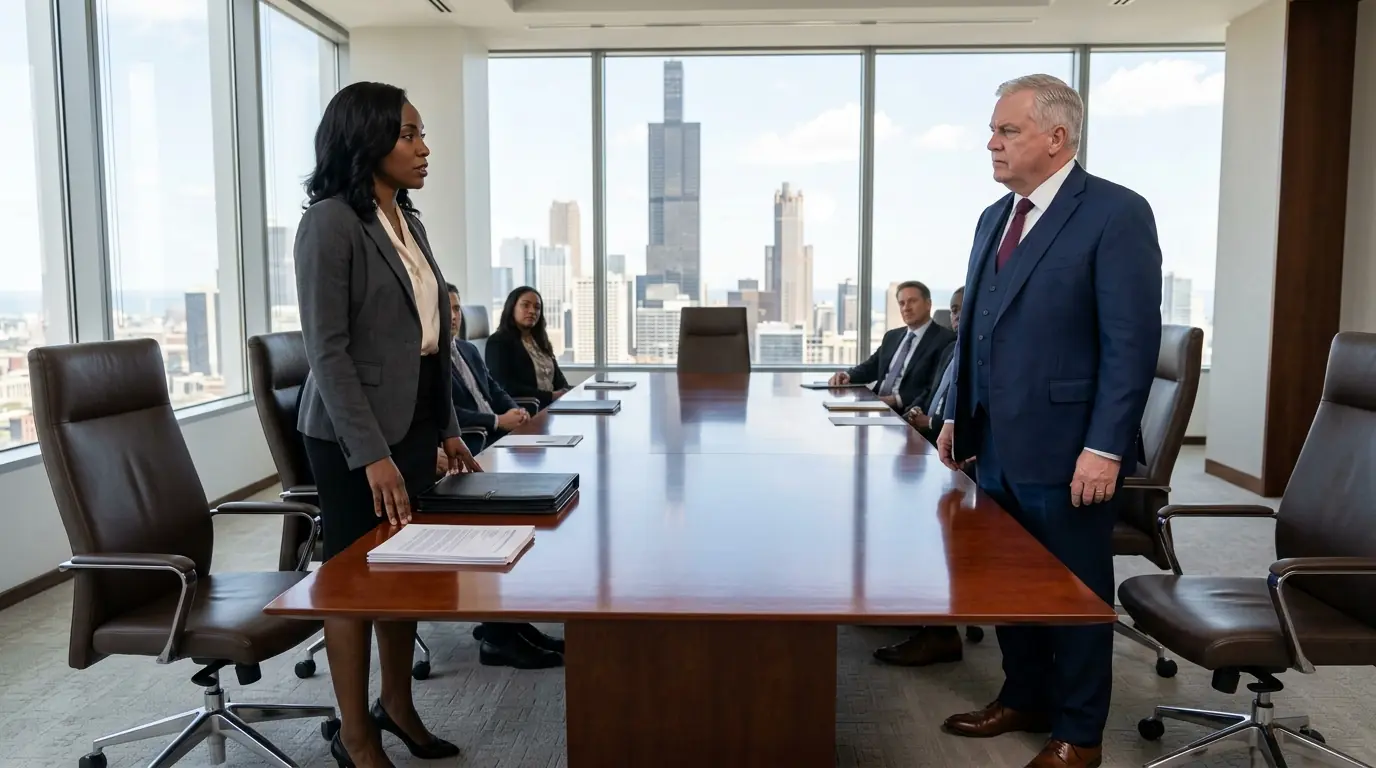
Dr. Althea Rowan did not move. Her arm stayed outstretched, muscles burning, her pulse thudding so loud it drowned out the laughter. She swallowed the taste of humiliation and kept her face still, even as every instinct screamed at her to react.
They had no idea they were ridiculing the woman who controlled three billion dollars, money that would decide whether their empire survived past nightfall.
Dr. Althea Rowan stood at the head of the expansive boardroom, her presentation materials precisely arranged before her. Afternoon sun streamed through floor-to-ceiling windows, casting long shadows across the glossy mahogany table where Whitlock Capital’s board members sat in plush leather chairs. The air felt thick with expensive cologne and unspoken judgments.
She clicked through her final slide with steady hands, concluding an hour of meticulously prepared data.
“As you can see,” she said, her voice carrying the quiet authority earned through decades of academic excellence, “this initiative doesn’t just look good on paper. It transforms lives.”
The screen behind her showed faces of real families, factory workers, small business owners, community leaders, people whose futures hung in the balance of this decision. Her presentation had been flawless. Risk assessments, market projections, and human impact, all woven together with precision.
Grayson Whitlock sat at the far end, his silver hair catching the light. He had not taken a single note during her presentation. Instead, he had spent the hour examining his manicured nails or typing on his phone, his casual dismissal more pointed than any question could have been.
“Thank you for your time,” Althea said, switching off the projector.
The room hummed with silence as she gathered her papers into a neat stack. Years of navigating hostile academic committees and corporate boardrooms had taught her to read these moments, the slight shifts in chairs, the sideways glances, the way a room decided how to respond.
She walked the length of the table with measured steps, her heels clicking against marble floors that probably cost more than her first house. Standing before Whitlock, she extended her hand.
Professional.
Expected.
Correct.
“I look forward to discussing next steps.”
Whitlock did not move to stand. He leaned back in his chair, designer suit pulling slightly across his chest. His eyes dragged over her face, down her carefully chosen blazer, and back up again. It was a deliberate inspection, one that made her skin crawl.
His lips curved into something that was not quite a smile.
“I don’t shake hands with people like you.”
The words landed like ice water.
Precise.
Practiced.
Meant to cut.
For one heartbeat, the room was absolutely still.
Then came the laughter.
It started with a snicker from somewhere to her left. Dane Kesler, Whitlock’s public relations man, sat with his perfectly pressed collar not quite hiding the cruelty in his smile. The sound spread like infection. Nervous tittering came from junior board members relieved that the tension had broken in their favor. Deeper chuckles followed from men who had never had to prove their right to be in the room.
Althea’s hand remained steady in the air between them.
Her face stayed carefully neutral, but her mind was cataloging every reaction, every face, every tell.
Vivian Hart, three seats down, suddenly found her coffee cup fascinating, shoulders tight with discomfort, but mouth pressed shut.
A coward’s silence.
Two younger board members near the window exchanged glances and smirked, clearly enjoying the show. Their names and faces were already committed to memory.
“She should be grateful she’s even here,” someone muttered behind her, just loud enough to be heard and just quiet enough to claim deniability.
Whitlock’s smirk deepened, satisfaction rolling off him in waves. He had done this before. He would do it again. Men like him always did.
Elaine Mercer cleared her throat, rustling papers with manufactured urgency.
“Well,” she said, voice pitched for peacekeeping, “we certainly appreciate your comprehensive presentation, Dr. Rowan.”
Her smile was brittle, professional, complicit.
“Perhaps we should move on to discussing the technical details in a smaller working group.”
The laughter faded to scattered chuckles. Several board members straightened papers or checked phones, already dismissing the moment and her from their minds.
Althea felt the familiar weight settle in her chest.
Not anger.
She had learned long ago that anger was a luxury she could not afford in rooms like this.
Not pain.
She had survived too much to be wounded by such predictable cruelty.
What she felt was recognition, the clear-eyed knowledge of what this moment meant, what it had always meant.
She thought of her father, thirty years in the steel mill, teaching her chess on Sunday afternoons.
“The game isn’t won in the first move,” he would say, setting up the pieces with careful hands. “It’s won in knowing how many moves ahead you’re willing to play.”
She thought of her mother keeping perfect books for their church, showing her how numbers could tell stories if you knew how to read them.
“Truth always balances in the end,” she would say. “The trick is making sure you’re there to see it.”
Whitlock was still watching her, expecting what? Tears, rage, a crack in her professional veneer. His kind always wanted a reaction, proof that they could still wound, still control.
The fluorescent lights hummed overhead. Someone’s phone buzzed quietly. Outside the windows, downtown traffic crawled twenty stories below, the city moving in its endless patterns of power and money.
Althea lowered her hand slowly.
Every movement measured.
She met Whitlock’s gaze directly, her eyes steady and clear.
Let him search for fear or hurt there.
Let him find nothing but his own reflection.
The board’s laughter rippled and faded like waves against a shore, leaving behind the stale taste of shared prejudice. Whitlock’s smirk settled into his face like he owned the very air they breathed, certain in his power, secure in his impunity.
Althea’s heels echoed down the marble corridor as she walked steadily away from the boardroom. Her leather folder pressed against her chest like armor. Her face remained composed, the same expression she had worn through countless moments like this in countless rooms like that. Only the slight tremor in her fingers betrayed the storm beneath her professional veneer.
The floor-to-ceiling windows lining the hallway offered a sweeping view of downtown, but she barely registered the skyline. Her mind replayed each laugh, each smirk, each silent witness to her humiliation.
Twenty years of credentials.
Perfect preparation.
Still, the same old wall.
“Dr. Rowan.”
A hushed voice called from behind.
Althea turned to find Nia Brooks hurrying toward her, clutching a stack of reports. The young analyst’s dark eyes darted nervously between Althea and the boardroom doors as if afraid of being seen.
“I need to tell you something,” Nia said, her voice barely above a whisper.
She glanced over her shoulder again before continuing.
“This morning, before your presentation, I overheard something. Mr. Whitlock already decided to kill your proposal. Two weeks ago.”
Althea’s chest tightened, but her face remained neutral.
“Go on.”
“He told Mr. Kesler to make an example of you. Said something about teaching the rest of them about knowing their place.”
Nia’s hands gripped her papers tighter.
“What happened in there wasn’t just about you. It was a message to everyone.”
Before Althea could respond, a familiar cologne announced Dane Kesler’s arrival. He materialized beside them, all expensive suit and practiced charm.
“Dr. Rowan,” he said, smiling with too many teeth. “I hope you’re not leaving us just yet. Elaine, Ms. Mercer, would like a word to smooth things over.”
His hand hovered near her elbow, not quite touching, but herding her direction all the same.
Nia stepped back, fear flickering across her face.
“I should get back to work,” she mumbled, clutching her papers like a shield.
Kesler guided Althea toward a smaller conference room, his voice dropping to a confidential tone.
“You know how these old-money types can be. Set in their ways. But we’re all professionals here, aren’t we?”
The conference room was half the size of the boardroom, but no less expensive. Elaine Mercer stood by the window, her silver hair and tailored suit a study in corporate polish. She turned as they entered, her face arranged in careful concern.
“Althea,” she said warmly, as if they were old friends. “Please sit down. I feel we need to address what happened.”
Althea took a seat, noting how Kesler positioned himself between her and the door.
Elaine settled across from her, hands clasped on the table.
“First, let me say how mortified I am about Grayson’s behavior,” Elaine began, her words flowing like rehearsed symphony. “He’s from another era. It doesn’t excuse what he said, of course, but I hope you understand. These old institutions take time to change.”
Althea kept her face neutral, waiting.
This was a familiar dance.
“Your proposal has real merit,” Elaine continued. “The numbers are solid. The social impact metrics are impressive. We don’t want to lose that momentum over one unfortunate incident.”
She leaned forward, voice softening.
“What if we started with a smaller pilot program, something more manageable, with Whitlock’s name attached? Of course, his influence could open doors.”
Accept the humiliation.
Surrender control.
Become the smiling face while they claim the credit and keep the power.
“We could announce it next quarter,” Kesler added smoothly. “Position you as a rising star in impact investing. The press would love it. Collaboration across traditional barriers, that sort of thing.”
Althea thought of her father again, his careful hands setting up chess pieces.
Think five moves ahead, he would say.
See the whole board.
“I appreciate the offer,” she said, her voice measured. “You’re right. We shouldn’t let one incident derail important work.”
She saw relief flash across Elaine’s face.
“I’ll need to review the adjusted terms, of course. Perhaps we could reconvene with the full board.”
“Of course, of course,” Elaine said, standing. “I’ll have legal draft something right away.”
Kesler’s smile did not quite reach his eyes.
“Shall we head back? I’m sure Grayson will be pleased we could work this out.”
Althea gathered her folder and stood, every movement deliberate.
In the corridor, Nia was still lingering, pretending to organize papers at a side table. Their eyes met briefly, Nia’s filled with equal parts fear and hope, searching Althea’s face for some sign of what would come next.
Althea straightened her blazer, her breathing steady and controlled.
The boardroom doors loomed ahead, heavy with mahogany and privilege. Behind them, Whitlock would be waiting, secure in his power, certain of her surrender.
She took another measured step forward, her mind already calculating trajectories, seeing moves they could not imagine.
They thought they knew this game.
They thought they knew her role.
They were wrong on both counts.
Althea re-entered the boardroom like a shadow, quiet but impossible to ignore.
The earlier laughter still hung in the air, living in their relaxed shoulders and satisfied smirks. Board members lounged in their leather chairs, some checking phones, others sharing knowing glances.
Whitlock dominated the head of the table, sprawling in his five-thousand-dollar chair like it was a throne. He barely glanced up as Althea took her place at the far end, his attention performatively fixed on his gold fountain pen.
“Well then,” Elaine Mercer’s voice cut through the murmurs, crisp and professional. “Shall we resume our discussion of the proposal’s technical aspects? I believe we were examining the quarterly disbursement schedule.”
“Actually,” Althea said.
Her voice was soft, but it carried effortlessly across the polished table.
“I have a question for the board, if I may.”
Several heads turned, surprised by this deviation from their expected script. Whitlock’s pen paused mid-signature, though he did not look up.
“Of course,” Elaine said, her smile tightening at the corners.
“I’m curious,” Althea continued, her tone conversational. “Does this board fully understand who controls the sovereign impact bonds currently stabilizing Whitlock Capital’s liquidity pipeline?”
The question landed like a stone in still water.
Ripples of confusion spread across faces. Vivian Hart’s perfectly manicured fingers stopped their nervous tapping. Dane Kesler’s pen froze above his notepad.
“I don’t see how that’s relevant to…” Elaine started.
“I represent a coalition,” Althea continued, her voice gaining strength but never losing its professional edge, “a carefully structured alliance of pension funds, labor trusts, and church investment groups. Together with our international partners, we control three billion dollars in committed capital.”
Now Whitlock looked up, his previous smugness cracking slightly around the edges.
“More specifically,” Althea said, reaching for her leather folder, “we control the exact three billion dollars your firm has been using to maintain its position in several key markets.”
She withdrew a single document.
“Including the Henderson merger you announced last week.”
The temperature in the room seemed to drop ten degrees.
A board member near the middle, someone who had laughed particularly loud earlier, shifted uncomfortably in his seat.
“Our coalition,” Althea continued, sliding the document forward, “has very specific requirements for ethical governance and community oversight. Requirements that were clearly outlined in the original agreement.”
Her fingers released the paper, letting it drift across the glossy surface.
“Requirements that recent events suggest this board no longer meets.”
Dane Kesler snatched the document before it could reach Whitlock. His eyes scanned the first page, then widened.
“This is a notice of immediate withdrawal,” Althea finished for him, “already signed by six of our nine principal partners.”
Vivian Hart’s face had gone pale, her hand reaching unconsciously for her water glass. She knew exactly what this meant. They all did.
Without that liquidity backbone, at least three major deals would collapse. The Henderson merger alone would implode, taking millions in fees with it.
“This is absurd.” Whitlock’s voice had lost its earlier smoothness. “You can’t possibly have the authority to—”
“I’m the lead architect of the coalition,” Althea said simply. “I structured the original partnership framework. My signature carries the full weight of our combined positions.”
She kept her hands flat on the table, steady and sure.
“Would you like to see the documentation?”
A younger board member started furiously typing on his phone, probably trying to verify her claims. Elaine’s professional mask had cracked, showing the panic underneath.
“Now, let’s not be hasty,” Kesler attempted to recover, his public relations instincts kicking in. “I’m sure we can—”
“Three billion dollars,” Althea repeated, each word distinct and heavy, “currently backing sixteen active positions across your portfolio. Would you like me to list them?”
The silence in the room grew thick enough to touch.
Gone was the laughter, the comfortable superiority, the casual cruelty. Now there was only the sound of rapid breathing and the faint hum of air conditioning.
“The withdrawal notice takes effect in forty-eight hours,” Althea continued into that silence, “unless specific conditions are met.”
She finally allowed herself to look directly at Whitlock, holding his gaze with the steady patience of someone who had waited decades for this moment.
“Would you like to discuss those conditions now?”
Whitlock’s face had transformed, the smirk replaced by something approaching fear. His complexion had gone from ruddy to ashen. Beads of sweat appeared at his hairline. The hand holding his gold pen trembled slightly.
The boardroom’s windows stretched from floor to ceiling, offering a panoramic view of the city below, but no one was admiring the vista now. Every eye was locked on the document in front of them, the paper that proved their assumed power had been built on borrowed strength.
Vivian Hart was the first to truly understand. She looked at Althea with new eyes, not with respect exactly, but with the dawning horror of recognition.
She saw now what they had all missed.
The quiet woman they had dismissed had been holding the sword over their heads all along.
The silence stretched, becoming louder than any laughter could ever be.
Althea remained still, her breathing calm, her posture perfect.
She did not need to speak.
The numbers spoke for her.
Three billion reasons why no one was laughing now.
The boardroom emptied in waves of panic and hushed whispers. Junior members fled first, clutching phones and tablets. Senior directors huddled in tense clusters, their faces tight with calculation. Through it all, Althea stood unmoved, a center of calm in the storm she had unleashed.
Elaine Mercer’s heels clicked rapidly across the marble floor.
“Dr. Rowan, please.”
Her hand caught Althea’s elbow.
“My office. Now.”
Behind them, Whitlock’s voice boomed.
“Tell her I want to speak to her man-to-man immediately.”
The private office was all glass and chrome, with views that probably cost more than most homes. Elaine shut the door with trembling fingers, her composed facade cracking.
“You have to understand,” Elaine began, pacing behind her desk. “This isn’t just about today. This is thousands of jobs, dozens of projects. Real people will be hurt if you do this.”
Althea sat perfectly still, hands folded in her lap.
“Real people are already being hurt every day by decisions made in that boardroom.”
“We can fix this,” Elaine pressed. “I’ll personally oversee a complete diversity review. Mandatory sensitivity training for everyone, especially Grayson. A new initiative for—”
“No.”
Althea’s voice was quiet but final.
“No more symbolic gestures. No more committees that meet twice and disappear. No more training sessions where people learn new words but keep the same hearts.”
Elaine sank into her chair.
“Then what do you want?”
“Structural change.”
Althea pulled out a document clearly prepared in advance.
“Whitlock removed from all decision-making positions. Full transparency on investment criteria. Community oversight seats with real voting power. Written accountability measures with teeth.”
“That’s…” Elaine’s voice faded. She looked suddenly older, the weight of something heavy settling on her shoulders. “Impossible.”
“Impossible,” Althea finished, “or just uncomfortable?”
“You don’t understand.”
Elaine leaned forward, lowering her voice.
“Grayson isn’t just a board member. He’s…”
She glanced at the door.
“He knows things about everyone. He has connections we can’t afford to lose. The board isn’t loyal to him. They’re afraid of him.”
The door burst open.
Whitlock filled the frame, his face dark with rage. Dane Kesler slipped in behind him like a shadow, tablet already in hand.
“You think you’re clever?” Whitlock’s voice was low and dangerous. “You think because you’ve got some paperwork and borrowed power, you can come in here and threaten me?”
Althea did not stand.
She did not raise her voice.
“This isn’t a threat, Mr. Whitlock. This is consequences.”
“Consequences?”
He barked a harsh laugh.
“Let me tell you about consequences. By tomorrow morning, every financial paper in the country will be questioning your competence. By noon, there will be rumors about mismanaged funds, about radical associations, about your stability.”
Kesler’s fingers flew across his tablet, taking notes.
“A week from now,” Whitlock continued, “three different regulatory bodies will be very interested in your coalition structure. A month from now, every partner you’ve ever worked with will be getting calls about their relationship with you.”
“Are you finished?”
Althea’s calm seemed to infuriate him further.
“I’m just getting started.”
He planted his hands on Elaine’s desk, leaning forward.
“People like you make the same mistake. You think because you’ve learned our words, worn our clothes, sat at our tables, you belong here. But you don’t. You never will. And when we’re done, no one will remember your name except as a cautionary tale.”
Althea stood slowly, smoothing her skirt.
“Mr. Whitlock, I’ve spent my entire career watching men like you mistake your position for power. You think you’re threatening me with destruction?”
She picked up her folder.
“I’m from a place your kind burned down rather than share. We rebuilt. We always rebuild.”
“This isn’t some civil rights moment,” he spat. “This is business.”
“No,” Althea said. “This is justice, and it’s been coming for a long time.”
She turned to Elaine.
“You have forty-eight hours to meet our terms. After that, the withdrawal proceeds. All of it.”
“You’ll regret this,” Kesler spoke up, his polished voice carrying an edge. “When the story breaks—”
“The story broke thirty years ago,” Althea cut him off, “when people like him decided people like me didn’t deserve to be in rooms like this. The only difference is now we own the room.”
She walked to the door, her phone already buzzing with messages from coalition partners. Each text asked the same questions.
What happened?
Are we holding the line?
The elevator ride down was silent. Security guards watched her cross the lobby, their expressions uncertain. Someone had clearly called ahead about her.
Outside, the wind whipped between the skyscrapers, catching her coat.
Her phone chimed with a news alert.
She opened it to see Whitlock’s first attack already launching.
Questions Raised About Radical Element in Impact Investing Sector.
The article quoted anonymous sources concerned about “unstable actors wielding disproportionate influence.”
Althea looked up at the tower of glass and steel, at the boardroom where they had laughed at her not an hour ago. The same window where Whitlock now probably stood, thinking he could still win this fight the old way, with money and fear and carefully crafted lies.
Her phone buzzed again.
More coalition partners asking for direction, asking if they should stand firm.
Dawn crept across Althea’s kitchen, the pale light finding her still at her table, one hand curled around a cold cup of coffee. Her laptop screen glowed with fresh accusations. The headlines multiplied like poison ivy.
Controversial Economist Threatens Major Investment Firm.
Sources Question Radical Activist’s Financial Credentials.
Market Stability at Risk From Politically Motivated Attack.
Althea’s phone had not stopped buzzing since midnight. Each notification brought a new twist of Whitlock’s knife. She clicked through the stories, noting how they all echoed the same carefully crafted phrases. Dane Kesler’s fingerprints were everywhere.
“Sources close to the situation expressed concern about Dr. Rowan’s emotional stability,” she read aloud, tasting the calculated cruelty. “Industry experts question whether personal grievances are being weaponized to manipulate markets.”
Her phone lit up again.
Attorney Lillian Cho’s name flashed on the screen.
“I’ve seen the coverage,” Lillian said without preamble. “They’re following a classic playbook. First discredit, then isolate, then destroy.”
Althea rubbed her temples.
“They’re painting me as an angry B woman with a vendetta.”
“Because that’s the easiest way to make people stop listening,” Lillian said, her voice steady and grounding. “Whitlock’s team will try to provoke you into saying something, anything they can twist. One emotional moment, one angry word, and they’ll blast it everywhere.”
“They already think I’m angry.”
“No,” Lillian corrected. “They need you to show it. Right now, you’re controlled, professional, fact-based. That scares them. They need you emotional, unreasonable, fitting their narrative.”
A text message popped up from Nia Brooks.
They’re telling everyone not to talk to you. HR sending weird emails about protecting company interests. Someone’s going through old files, too. Looking for anything they can use.
Althea forwarded the message to Lillian.
“They’re digging.”
“Let them dig,” Lillian said. “We have nothing to hide, but we need to move fast. I’m drafting protective orders for our coalition partners. We need to—”
Another call beeped through.
Reverend Samuel Price.
“Lillian, I need to take this. Can you send me those drafts?”
“Already on it. And Althea, remember, they want you to break. Don’t give them what they want.”
Althea switched calls.
“Reverend Price.”
“My phone’s been ringing since sunrise,” he said. His deep voice carried decades of fights like this. “Coalition partners worried about their reputations. Board members questioning if we should pull back. I need to know where we stand.”
“The funding is solid,” Althea said firmly. “The mission is clean. Nothing they’re saying changes that.”
“Meet me at the church. Twenty minutes.”
The historic B church stood proud against the morning sky, its brick walls holding generations of resistance. Reverend Price waited in his office, the day’s papers spread across his desk.
“Sit,” he said, pointing to a worn leather chair. “Now tell me what really happened in that boardroom.”
Althea recounted every detail. The presentation, the extended hand, Whitlock’s words, the laughter. With each word, the reverend’s face grew darker.
“That hand wasn’t just your hand,” he said finally. “When he refused to shake it, he was refusing to shake hands with every one of us who ever walked into a room where we weren’t wanted. Every one of us who qualified twice over but got half the respect.”
“I know.”
Althea’s voice was quiet.
“And that laughter,” Reverend Price leaned forward. “That wasn’t just about you. That was about making sure everyone in that room knew their place, knew what side was safe to be on.”
“Which is why they’re trying to bury me now,” Althea said. “They need to show what happens when someone like me stands up.”
“So, what’s your next move?”
Althea pulled out her phone, showing him a document she had been building since dawn.
“Truth. Just truth. Every meeting, every email, every witness. A complete timeline showing the pattern. Not just with me, but with everyone they’ve tried to silence.”
“They’ll call it a personal attack.”
“Let them. The truth is personal. That’s what makes it powerful.”
Reverend Price studied her face.
“You haven’t slept.”
“Can’t sleep. Too much to document.”
He nodded toward his office door.
“Sister May keeps cots in the community room for folks who need rest during hard times. Take an hour. Clear your head. The fight will still be here.”
“I can’t.”
“You can. And you will.”
His tone brooked no argument.
“You’re no good to anyone running on fumes and fury.”
Althea’s phone buzzed again.
More headlines.
More attacks.
Reverend Price gently took it from her hand.
“One hour,” he said. “Then we’ll look at your timeline. Make sure every fact is solid. Every witness is ready. They threw the first punch in public. We’ll answer with truth in public.”
Back at her kitchen table, Althea stared at her laptop screen. The hour of rest had cleared her vision. She opened a new folder on her desktop, labeled it Whitlock Evidence, and began to type.
Each entry was precise, documented, undeniable.
No rage.
No revenge.
Just reality.
Her phone lit up with another call from Lillian. Before answering, Althea looked at the growing file of evidence. They wanted her erased, minimized, dismissed. But she had spent a lifetime preparing for this moment, keeping receipts, building allies, and waiting for the day when truth would be her weapon.
She reached for her phone, ready to coordinate the next phase with her attorney.
The sun climbed higher outside her window, casting long shadows across her kitchen table.
The shadows would fade.
But the truth documented in that growing file would remain.
The press room’s fluorescent lights buzzed overhead as Althea smoothed her navy blazer, standing behind a simple wooden podium. Camera lenses tracked her every movement. Attorney Lillian Cho and Reverend Price flanked her like sentinels, their presence both comfort and shield.
“Good morning,” Althea began, her voice steady. “I’m here to provide clarity regarding recent events at Whitlock Capital.”
She lifted her prepared statement, each word carefully chosen to state facts without inflaming tensions.
“Our coalition represents three billion dollars in community-focused investment funds. From the start, we’ve been transparent about our ethical requirements, community oversight, fair representation, and accountability at all levels.”
She paused, letting the numbers sink in.
“When these terms were dismissed without consideration, we exercised our contractual right to withdraw support.”
Hands shot up immediately.
Althea recognized faces from Dane Kesler’s usual media rotation, reporters known for twisting words into weapons.
“Sandra Mitchell, Financial Daily,” a sharp-faced woman called out. “Isn’t it true you’re using social justice rhetoric to force control of a private company?”
“Our terms were clearly stated in all preliminary agreements,” Althea replied evenly. “This isn’t about control. It’s about responsible investment aligned with community needs.”
Jim Brennan from MarketWatch interrupted from near the front.
“Sources say you rejected a generous compromise that would have funded your project. Why turn down millions unless this is personal?”
Lillian stepped forward slightly, a subtle reminder of their strategy.
Stick to facts.
Avoid defensive responses.
“The proposed pilot program didn’t meet our coalition’s governance standards,” Althea explained. “We maintain consistent criteria for all partnerships.”
A commotion stirred near the back as more reporters pushed in. The questions grew more aggressive, carefully crafted to provoke an emotional response.
“How do you respond to allegations of financial intimidation?”
“Aren’t you worried about destabilizing market confidence?”
“What gives you the right to demand changes in established institutions?”
Each question carried a barb designed to paint her as an angry B woman throwing her weight around. Althea maintained her composure, addressing only the substantive points while letting the loaded implications fall flat.
Then it happened.
A senior market commentator, believing his microphone was off, muttered to his producer, “Another arrogant one who doesn’t know her place. Probably got her position through quotas anyway.”
The insult crackled through the room’s audio system.
A few journalists gasped. Others pretended not to hear.
Reverend Price’s hand tightened on his chair, but Althea did not flinch.
“I’ll address the substance of your question about market stability,” she continued, speaking directly to the commentator as if his words had no power. “Our coalition’s priority is sustainable, ethical investment. That creates true market stability.”
Lillian touched her arm, signaling time for their planned exit.
As they gathered their materials, Althea’s phone vibrated.
Vivian Hart’s name flashed on the screen.
In the hallway, away from cameras, Althea took the call.
Vivian’s voice shook.
“They’re making us sign a statement,” she whispered. “Whitlock’s team has a draft condemning you, calling your actions reckless and self-serving. Everyone has to sign by noon or face consequences.”
“Are you okay, Vivian?”
“Me?” Vivian’s laugh was hollow. “I’m a coward. I’ll probably sign it. But you should know. They’re scared. Really scared. The things they’re saying behind closed doors…”
“Document everything,” Althea said firmly. “Save every email, every text. Forward copies to your personal account.”
“I never meant to be part of this. When they laughed in that boardroom, I didn’t laugh. I want you to know that.”
“Not laughing isn’t enough anymore, Vivian.”
The call ended as Lillian guided Althea toward the parking garage.
In the back of Lillian’s car, they watched the press conference replay on the driver’s screen. Networks were already spinning it, running the commentator’s insult on loop with analysis about rising tensions.
“They’ll release that statement at noon,” Lillian said, checking her watch. “We have ninety minutes to prepare our response.”
“Did you see how they positioned those questions?” Althea asked. “Every single one designed to make me look emotional or irrational.”
“And you gave them nothing,” Lillian nodded. “You kept it professional, fact-based. That’s going to frustrate them.”
The car turned onto the highway as Althea’s phone erupted with notifications.
A new headline crawled across the screen.
Questions Arise About Coalition Fund Management. Fraud Concerns Surface.
Beneath it was her photo, stern, unsmiling, perfectly professional, seemingly chosen to reinforce their narrative of an angry B woman causing trouble. The same image appeared on three different channels, each with a variation of the fraud allegation.
“Right on schedule,” Lillian said grimly. “They’re laying groundwork for the board statement. First discredit you, then present a united front against you.”
“They think if they say fraud enough times, people will believe it,” Althea said, watching her face loop on the screen.
“Standard playbook,” Lillian agreed. “Attack the messenger’s credibility before they can deliver the message.”
She pulled out her tablet.
“We need to get ahead of their noon statement. I have drafts of three possible responses, depending on how hard they come at you.”
But Althea was not listening. She was watching her image on the screen, seeing how they twisted her professional reserve into something threatening.
They wanted her to break, to crack, to give them the angry outburst they could use to destroy her.
The car wound through downtown traffic as Lillian outlined response strategies. Outside, digital billboards flashed financial headlines. Inside, Althea felt a clarity she had not expected.
They thought they were breaking her.
Instead, they were showing everyone exactly why this fight mattered.
The coffee shop buzzed with afternoon chatter, but Althea noticed how Nia’s eyes darted to each new customer entering. They had chosen the corner table strategically, backs to the wall, clear view of both exits.
Nia clutched her laptop bag close, knuckles white against the brown leather.
“I had to use my personal email,” Nia whispered, sliding a USB drive across the table. “They’re monitoring everything internal now, even printer logs.”
Althea palmed the drive smoothly, tucking it into her blazer pocket.
“Are you okay? Are they watching you specifically?”
“They’re watching everyone.” Nia’s coffee sat untouched, growing cold. “Dane Kesler sent an all-staff memo this morning. Anyone with relevant information about past projects should report directly to his office.”
She pulled out her phone, showing Althea the message.
“But look at the attachment name. It’s a tracking file. Opens differently for each recipient.”
“Smart catch,” Althea said softly. “What else?”
Nia glanced around again before continuing.
“They have a spreadsheet. Color-coded targets in your coalition. Green for pressure points identified. Yellow for approach in progress. Red for resistant.”
She swallowed hard.
“There are names next to each entry. Personal details, family connections, financial weaknesses.”
“Did you copy it?”
“Everything I could access. But Althea…”
Nia leaned closer, voice barely audible.
“They’re pulling badge records going back six months, cross-referencing security footage. Anyone who talked to you, met with you, even rode the elevator with you. They want names.”
“Are people coming forward?”
“Some. They’re scared. Marcus in accounting. Remember him? His wife just had a baby. This morning he told Kesler about a lunch meeting you had with the pension fund representatives last year.”
Althea nodded, understanding.
Fear was a powerful tool, and Whitlock’s team wielded it expertly.
The bell above the door chimed.
A man in an expensive suit entered, making a show of checking his phone while scanning the room. His eyes locked onto their table for a beat too long.
“Time to go,” Althea said quietly. “Different exits. Five minutes apart.”
They gathered their things carefully, movements measured.
Althea went first, stepping out onto the busy sidewalk where Lillian waited by a parked car.
She had taken three steps when a shoulder slammed into her hard, spinning her sideways.
The suit-wearing man from the coffee shop sneered down at her.
“You people always want something,” he spat loud enough for nearby pedestrians to hear. “Can’t ever be satisfied with what you’re given.”
Althea steadied herself, recognizing the trap.
A reaction, any reaction, would feed tomorrow’s headlines.
She kept her face neutral and started to step around him.
He shifted to block her path.
“What’s wrong? Not so tough without your lawyers and press conferences?”
“Sir,” Althea said evenly, “you’re blocking my way.”
“Oh, now I’m being oppressive.” He stepped closer, trying to loom over her. “Going to call me racist next? Claim I’m creating a hostile environment?”
Pedestrians slowed.
Phones appeared to record.
Exactly what he wanted.
“Step back.”
Lillian’s voice cut through the tension as she moved between them.
“You’ve committed assault on camera, and you’re currently attempting to provoke a confrontation. Would you like to explain that behavior to the police, or would you prefer to leave?”
“I didn’t assault anyone,” he scoffed. “Maybe your client should watch where she’s walking.”
“My client has multiple witnesses to your intentional physical contact and verbal harassment,” Lillian stated calmly, gesturing to the growing crowd with phones raised. “We can pursue this officially, or you can return to whoever sent you and explain why you failed to get usable footage.”
Color rose in his face. For a moment, it seemed he might escalate further.
Then his phone buzzed.
He checked it, scowled, and shouldered past them, gentler this time.
“Are you all right?” Lillian asked as they walked quickly to her car.
“Fine, but we need to move Nia somewhere safe,” Althea replied. “That wasn’t just a random attempt at provocation. They knew we were meeting.”
“My office,” Lillian nodded. “We’ll secure the documents first, then develop protection protocols.”
Twenty minutes later, they sat in Lillian’s corner office downtown. Nia’s hands shook slightly as she connected the USB drive to a secure laptop.
“Everything’s here,” she said, opening files. “Email chains, tracking sheets, meeting notes, Kesler’s whole playbook for discrediting you.”
“And evidence they’re retaliating against employees,” Lillian added, scanning the badge access monitoring protocols. “This is explicitly illegal.”
Althea watched the files copy to an encrypted drive. Each document was another piece of armor against Whitlock’s attacks. The afternoon sun cast long shadows across the office floor as they worked in focused silence.
A sharp ding cut through the quiet.
Althea checked her phone, then sat very still.
“What is it?” Lillian asked.
“Message from Marcus in accounting,” Althea said. “Your audit firm just got contacted.”
Early morning light streamed through the glass walls of Howard Baines’s corner office. Althea sat straight-backed in the visitor’s chair, Lillian a steady presence beside her. The thick stack of audit documents between them held her future.
Howard adjusted his wire-rimmed glasses, shuffling through the final pages. His methodical movements made each second stretch.
“Dr. Rowan,” he said finally, looking up, “we’ve completed our comprehensive review of your coalition’s structure, funding sources, and governance protocols.”
He cleared his throat.
“I can definitively state we found no irregularities or improprieties whatsoever.”
Althea released a breath she had not realized she was holding.
“The documentation is clean. Impeccable,” Howard confirmed. “Every transaction, every approval, every partnership agreement. They all follow proper procedures. Your ethical oversight framework actually exceeds standard requirements.”
“And the withdrawal triggers?”
“Completely legitimate. Your coalition partners maintain full legal authority to withdraw funds based on documented violations of governance standards.”
Howard straightened a paperclip.
“Including discriminatory behavior by key decision makers.”
Lillian leaned forward.
“Would you be willing to put that in writing, Mr. Baines?”
“I already have.”
He slid a formal letter across the desk.
“My complete findings with supporting documentation, though I should note…”
He hesitated.
“Yes?” Althea prompted.
“I received some strongly worded suggestions about how to frame these results from Mr. Kesler’s office.”
“Threats?” Lillian’s pen appeared, ready to document.
“Let’s call them incentives,” Howard said carefully. “Both positive and negative. But my professional reputation means something to me. Facts are facts.”
Althea’s phone buzzed.
Elaine Mercer’s number flashed on the screen.
She excused herself to take the call in the hallway.
“Dr. Rowan,” Elaine said. Her voice carried an unfamiliar note of deference. “I understand Mr. Baines has completed his review.”
“He has.”
“And?”
“Complete vindication of our structure and standards.”
Althea kept her tone neutral.
“Would you like me to share his findings?”
A pause.
“The board is concerned about recent developments. If you have evidence of attempted interference with proper oversight…”
“I do.”
Althea thought of Nia’s USB drive.
“Would that be relevant to an emergency board review?”
“It would be appropriate to examine such documentation.” Elaine’s voice strengthened with each word, sensing which way the wind was blowing. “I could convene an emergency session tomorrow morning if you’re prepared to present.”
“I am.”
Althea opened her tablet, pulling up selected emails from Nia’s files, enough to prove sabotage without revealing her source.
“I’m sending you a preliminary packet now. Note particularly the highlighted sections about coordinated pressure on financial partners.”
She heard Elaine’s sharp intake of breath.
“This is concerning. Very concerning.”
“I thought it might be.”
“The board will need to address this immediately.” Elaine’s tone shifted to almost conspiratorial. “Between us, Dr. Rowan, Whitlock’s behavior has become a liability. These documents could help us make necessary changes.”
“I’m glad we agree on the necessity of accountability,” Althea said evenly, refusing to be drawn into alliance with someone who had watched her humiliation days ago and said too little.
Back in Howard’s office, Lillian was already scanning financial news on her phone.
“Stocks down four percent on rumors of the audit results,” she reported. “Trading volume spiking.”
Althea nodded.
“Elaine’s calling an emergency board review for tomorrow morning.”
“They smell blood in the water.”
“Speaking of blood,” Lillian said, holding up her phone to show a news site.
On screen, Althea’s press conference played, but chopped and spliced, making her measured statements sound angry and threatening. Dane Kesler’s digital fingerprints were all over it.
“Let them play their games,” Althea said. “We have facts.”
They spent the next hour reviewing documents with Howard, building an airtight presentation for the board. Every number checked, every claim supported, every violation documented.
Howard’s signature carried weight. His reputation for meticulous accuracy was well known in financial circles. By late afternoon, even Bloomberg had adjusted its coverage, running headlines about a power struggle rather than fraud allegations.
The market was betting on change at Whitlock Capital.
Althea and Lillian relocated to a hotel near the board offices to prepare for the morning. They commandeered the dining table, spreading documents in careful order. Audit results, internal emails, partnership agreements, withdrawal authorizations. Each piece positioned for maximum impact.
“Start with the audit,” Lillian advised, arranging papers. “Lead with validated facts before revealing the sabotage attempts. Build credibility before showing teeth.”
Althea nodded, reviewing her opening statement.
“Hit them with numbers first. People like Howard trust math more than morality.”
“Exactly. Make them see protecting Whitlock costs more than removing him.” Lillian checked her watch. “We should order dinner, get some rest before—”
Althea’s phone lit up with a text from an unknown number.
Five words glowed on the screen.
Stop or we bury you.
Althea arrived at Whitlock Capital’s gleaming entrance at 8:45 a.m. sharp. The morning sun caught the glass facade, but inside the lobby felt cold. A security guard she had never seen before held up his hand.
“ID, please, ma’am.”
His tone suggested this was not standard procedure.
She produced her visitor badge from the day before. He studied it with exaggerated care, made three phone calls, and spent fifteen minutes verifying protocols while other people streamed past. Executives who had nodded to her days ago now studied their phones, careful not to meet her eyes.
“Just following procedure,” the guard repeated, watching her like she might cause trouble.
Althea stood perfectly still, her briefcase heavy with Howard’s audit report and supporting documents. She had chosen her clothing carefully, a charcoal suit that meant business, not submission.
Around her, whispers floated between desk workers and cleaning staff.
She caught fragments.
“That woman who…”
“Whitlock’s furious.”
Finally, Elaine Mercer’s assistant hurried down, flustered.
“So sorry for the delay, Dr. Rowan. Security protocols, you understand? Please, the board’s waiting.”
The boardroom felt different today.
Tenser.
None of yesterday’s smug laughter remained.
Board members clustered in small groups, their hushed conversations dying as Althea entered. Vivian Hart offered a tiny nod. Whitlock sat in his usual place, radiating cold fury beneath a practiced smile.
Elaine called the emergency session to order, her voice carefully neutral.
“We’re here to address serious concerns about operational stability and risk management.”
She avoided the words discrimination or racism.
“Mr. Baines’s audit has raised questions requiring immediate attention.”
She began walking through Howard’s findings, softening the edges. Where Howard had written clear violation of ethical governance standards, Elaine said procedural inconsistencies. Where he documented systematic exclusion, she said communication gaps.
Still, the numbers were undeniable.
Three billion dollars in coalition funding.
Sixteen major pension funds.
Twenty-eight community partnerships.
All with clear withdrawal triggers that could collapse Whitlock Capital’s liquidity overnight.
Vivian Hart cleared her throat.
“May I speak?”
Her hands trembled slightly, but her voice held steady.
“Mr. Whitlock’s behavior toward Dr. Rowan was more than unprofessional. It was damaging and discriminatory. Exactly the kind of conduct our ethical governance standards were designed to prevent.”
“Now, let’s not overreact,” Dane Kesler cut in smoothly. “A simple misunderstanding.”
“I was there,” Vivian continued, stronger now. “We all were. There was no misunderstanding.”
She turned to face the other members.
“If we don’t address this, we’re not just failing our ethical obligations. We’re risking everything we’ve built.”
Several board members shifted uncomfortably.
One whispered, “Stocks down six percent since opening.”
Another added, “My phone’s been ringing all morning. Partners asking questions.”
“Perhaps,” said an older member, glaring at Whitlock, “we should consider temporary leadership adjustments while we investigate.”
“I move for an immediate vote,” said another, “to suspend operational authority pending full review.”
Whitlock sat unnaturally still, his face a mask of calm that did not reach his eyes. Dane Kesler leaned in, whispering something that made Whitlock’s mouth curl slightly.
Whatever was happening, they did not look worried enough.
Elaine called for the vote.
“All in favor of temporarily removing Mr. Whitlock from operational decisions pending investigation?”
Hands rose.
Seven.
Eight.
Nine.
A clear majority.
Althea watched Whitlock’s reaction carefully.
He looked satisfied, like a man who had already won.
Something was wrong.
Althea reviewed Howard’s report in her mind, comparing it to Elaine’s presentation. There was a key section missing, the part about systematic interference with previous community initiatives.
Why would Elaine skip the strongest evidence?
“We’ll take a brief recess,” Elaine announced, “to prepare the formal notification.”
Board members filed out, some looking triumphant, others nervous. Whitlock remained seated, examining his manicured nails while Kesler worked his phone.
In the hallway, Althea found a quiet corner and called Howard.
The phone rang four times before he answered.
“Howard, I need to confirm something about page sixteen of your report.”
“Althea?”
His voice cracked with panic.
“They’re here right now.”
“The managing partners?”
“What’s happening?”
“They’re saying we missed critical evidence. That our methodology was flawed. They’re forcing a retraction of the entire audit.”
Althea’s heels clicked against marble as she rushed back to the boardroom. Through the glass walls, she saw board members huddled over phones, faces drawn with fresh anxiety. Elaine paced near the head of the table, one hand pressed to her temple while nodding into her cell phone.
Whitlock lounged in his chair, a vulture’s smile playing at his lips. Dane Kesler worked the room with practiced efficiency, dropping whispered comments that left people pale and shaken.
“If I could have everyone’s attention,” Elaine called out, her voice tight. “We’ve received concerning new information.”
Board members settled into their seats, avoiding Althea’s gaze. Papers rustled. Someone coughed.
“Our independent auditors have contacted us with an urgent update,” Elaine said carefully. “They’ve identified serious methodological concerns that require immediate review. As such, they’re updating their position on their previous findings.”
“Updating?” Althea kept her voice level. “The audit was conclusive this morning.”
“Things change, Dr. Rowan.” Whitlock’s voice dripped false sympathy. “Perhaps if you had been more thorough in your documentation…”
He spread his hands in a gesture of mock helplessness.
“The vote will be suspended,” Elaine continued, “pending full clarification of these new concerns.”
Whitlock rose slowly, buttoning his jacket.
“While we’re discussing concerns, I believe there’s another matter of transparency we should address.”
He nodded to Kesler, who produced an official-looking document.
“In the interest of due diligence,” Kesler said smoothly, “we’ve been made aware of a federal inquiry into certain irregular patterns within Dr. Rowan’s coalition structure.”
The room temperature seemed to drop ten degrees.
Board members shifted in their seats, paper shuffling growing more agitated.
“What federal inquiry?” Althea demanded.
Kesler slid the notice across the table.
“The Securities and Exchange Commission has questions about your coalition’s formation, specifically about potentially coercive practices used to gather vulnerable community partners.”
“That’s absurd,” Althea said, scanning the document.
The language was real but vague, the kind of preliminary fishing expedition that could be triggered by an anonymous tip.
“Is it?” Whitlock’s voice carried to every corner. “You’ve made quite a show of your power over these communities, Dr. Rowan. Threatening to withdraw funding, demanding special treatment.”
He shook his head.
“One might wonder if you’re truly serving their interests or merely using them.”
Several board members were already reaching for their phones, likely calling legal counsel.
Althea recognized the play.
They had manufactured just enough doubt to make everyone fear liability.
“This is what happens,” Whitlock said softly, close enough that only she could hear, “when you overreach.”
Althea gathered her materials with steady hands, refusing to give him the satisfaction of seeing them shake.
As she walked toward the lobby, voices followed her.
“Can’t risk association.”
“Need to distance ourselves.”
The elevator doors opened to reveal Nia Brooks clutching a folder and looking terrified.
She tried to step toward Althea, but two security guards materialized, blocking her path.
“I’m sorry, Ms. Brooks,” one said. “You need to return to your floor.”
Nia’s eyes met Althea’s, wide with panic.
She mouthed two words.
They know.
Before Althea could respond, the guards were steering Nia away.
Through the lobby’s glass front, Althea saw the crowd gathering. Reporters, protesters, people waving signs with twisted versions of her quotes.
The smear campaign had worked fast.
Her phone buzzed.
Lillian Cho.
Don’t engage. Car waiting at side entrance.
Althea turned toward the service corridor, but not before catching Whitlock’s reflection in the glass. He stood on the mezzanine, watching her retreat.
Victory was etched in every line of his face.
The side door opened to chaos.
Someone recognized her and shouted, “There she is.”
Voices rose.
“Fraud.”
“Extortionist.”
“Go back where you came from.”
Lillian appeared at her elbow, guiding her through the press of bodies. Someone threw a coffee cup that splashed against the wall. Security hung back, watching without intervening.
They made it to Lillian’s car just as the crowd surged. Lillian slammed the door and ordered the driver to move.
Through tinted windows, Althea watched the mob recede, their angry faces distorted by the glass.
Hours later, in Althea’s apartment, the city lights cast long shadows across her living room floor. Case files and legal papers covered every surface. Lillian worked her phone, trying to reach coalition partners who had gone suddenly silent.
“Howard’s firm issued the retraction,” Lillian reported grimly. “Their managing partners voted unanimously, probably with guns to their heads. Three more partners have suspended their commitments, citing regulatory concerns.”
Althea nodded, processing.
The strategy was elegant.
She had to admit that.
They had not just attacked her reputation. They had poisoned the very structure of her power base.
“What about Nia?” Althea asked.
“No response to texts. Her work email is bouncing back. Account suspended.”
Althea moved to her kitchen, needing space to think. The city stretched below her window, lights blinking like distant stars. She gripped the counter edge, feeling the cool marble ground her.
After a long moment, she crossed to her laptop and opened the encrypted drive containing her deepest research.
The files she had held back.
The evidence she had gathered over years of watching Whitlock destroy lives.
“Okay,” she whispered, staring at the folders that could burn everything down. “No more restraint.”
The old porch light cast a weak glow across Reverend Samuel Price’s face as he waited in the predawn darkness. Althea’s car pulled into the familiar driveway of her childhood home, gravel crunching under the tires.
The house looked smaller than she remembered. White paint weathered but dignified, like her parents had kept it.
“Your mother would be proud of how you’re standing,” Reverend Price said as Althea climbed the worn steps. His voice carried the same steady warmth that had guided her through Sunday school decades ago.
“I’m not sure about that,” Althea replied, exhaustion seeping through. “Not with what they’re saying.”
Behind them, Lillian Cho’s heels clicked against concrete as she hauled banker’s boxes from the car trunk. Files rescued from Althea’s apartment. Evidence accumulated over years of watching Whitlock’s operation.
“Here, let me help with those,” Reverend Price offered.
Lillian shook her head.
“Chain of custody,” she explained. “I need to document everything myself.”
Inside, the house smelled of lemon polish and coffee. Reverend Price had been waiting a while. The small television in the living room glowed, sound muted, showing Althea’s professional headshot beside scrolling headlines.
Federal Probe Targets Community Fund Leader.
Questions Mount About Coalition Scheme.
Althea stopped, staring at her own face.
Here in the house where her parents had taught her dignity could not be taken, only surrendered, the humiliation cut deeper.
“Mrs. Turner next door called,” Reverend Price said quietly. “Asked if you were really trying to cheat people.”
Althea’s throat tightened.
Mrs. Turner had watched her grow up. She had brought casseroles when Althea’s mother was sick.
“It’s a coordinated attack,” Lillian said, setting down the boxes. “That federal inquiry notice. It wasn’t properly served. No case number, no official channels. It just appeared out of nowhere right when they needed it.”
“You think they forged it?” Reverend Price asked.
“Or had someone leak a preliminary document they triggered themselves,” Lillian replied. “Either way, it’s weaponized, designed to spook partners and create headlines.”
Althea moved through the familiar rooms, past the kitchen where her mother had taught her fractions using recipe cards, past the dining room where her father had helped with homework after long shifts at the steel mill. She touched the walls like they might still hold their strength.
“He’s not just trying to discredit you,” Reverend Price observed. “He’s trying to make an example. Show what happens when people like us demand too much respect.”
“I know.” Althea’s voice was still. “But he made a mistake thinking I’d break.”
She opened her laptop on the kitchen table, the same scratched oak surface where she had studied for the SATs, determined to earn her way into spaces that did not want her.
The encrypted drive hummed to life.
“I’ve been building a backup structure,” she explained, opening files. “A secondary framework for the coalition funds, clean, documented, and locked tight. Even if they manage to freeze my access or push me out, the three billion dollars stays protected.”
Lillian leaned in, scanning the documents.
“You never mentioned this.”
“Because it needed to stay invisible until we needed it.”
Althea pulled up more screens.
“Every partner has a direct channel. Every dollar has a clean path. And it’s all been independently verified by firms Whitlock can’t touch.”
“When did you set this up?” Reverend Price asked.
“The day after I first pitched to their board.”
Althea’s fingers moved across the keyboard.
“I saw how Whitlock looked at me like I was dirt that needed sweeping. I knew then he’d try to bury me if I pushed too hard.”
“So you built a fortress,” Lillian said, admiring the legal architecture.
“I built a shelter,” Althea corrected. “For the communities counting on this funding. For people like Nia, who risked everything to help. The money was never about me. It’s about all the lives Whitlock thinks he can just erase.”
Dawn was beginning to gray the kitchen windows, the same windows where Althea had watched her father leave for work every morning, head high despite the foreman who called him boy.
Reverend Price put a gentle hand on her shoulder.
“Your daddy used to say, ‘Dignity isn’t in how they treat you. It’s in how you carry yourself when they try to take it.’”
Althea nodded, feeling the weight of inheritance.
Not money.
Not property.
Something stronger.
The stubborn grace of people who refused to bend.
She stood and walked to the window, watching the sunrise paint her old neighborhood in gold. Behind her, Lillian sorted files, and Reverend Price started fresh coffee. The television still flickered with accusations, but they seemed smaller now, less frightening in the house that had taught her to stand.
“If he wants a story,” Althea said, her voice carrying the certainty of someone who had been preparing for this fight her whole life, “he’s getting the full one.”
The motel’s neon sign buzzed in the gray morning light as Althea, Lillian, and Reverend Price pulled into the nearly empty parking lot. Room 114 was where Nia had texted she would be waiting.
But something felt wrong before they even reached the door.
“The curtains are open,” Lillian noted, her hand tightening on her briefcase.
Althea knocked anyway, three sharp wraps that echoed down the concrete walkway.
No answer.
She tried again, calling softly, “Nia, it’s Althea.”
A door creaked open two rooms down, just enough for an elderly woman to peek out, then quickly shut it again.
“I’ll check with the clerk,” Reverend Price offered, already heading toward the office.
Althea pressed her palm against the door as if she could feel what had happened through the cheap wood. The room was silent. No television noise, no shower running, no rustling movement.
“Should we call the police?” she asked Lillian.
“Not yet.” Lillian shook her head. “If Whitlock has connections there, it could make things worse. Let’s gather information first.”
Reverend Price returned with the clerk, a young man in a wrinkled uniform shirt who could not quite meet their eyes.
“She checked out,” he said, fidgeting with his keycard scanner. “About three hours ago.”
“Checked out or was made to leave?” Lillian’s voice carried an edge.
The clerk’s eyes darted to the parking lot.
“Look, I just work here, but there were some men in suits. Very professional-looking. Said they were from corporate security.”
“Did they show identification?” Althea demanded.
“I didn’t…” He swallowed hard. “I mean, they seemed official. The young lady left with them voluntarily. She walked out on her own.”
“After they what?” Lillian pressed. “Threatened her career? Her safety?”
“I don’t know anything else.”
The clerk backed away.
“Please, I need this job.”
Althea understood his fear. She had seen it spread through Whitlock Capital like a virus.
But right now, her concern was Nia.
She scanned the empty room through the window. The bed was still made. No sign of a struggle, but a coffee cup had been knocked over on the side table. Dark liquid stained the carpet.
“Over here,” Reverend Price called from the parking lot.
He pointed to a discarded keycard sleeve half hidden under a car, next to a crumpled receipt from the vending machine.
Althea checked the timestamp.
4:17 a.m.
Less than an hour after Nia’s last message.
They know.
Those two words haunted Althea now.
She should have moved faster.
Protected Nia better.
A dark sedan idled at the far end of the lot, its engine a low growl in the morning quiet.
Lillian immediately pulled out her phone and started taking photos, clear shots of the license plate and tinted windows.
The car peeled out, tires squealing on asphalt.
“That’ll be one of Kesler’s watchers,” Lillian said grimly. “He always uses contracted surveillance.”
“We need to move,” Althea decided. “Now.”
They drove back to her childhood home using a winding route, checking constantly for tails. Althea’s mind raced through scenarios, calculating moves and countermoves like the economist she was.
Fear would not help Nia.
Strategy would.
In her father’s old study, Althea powered up her secure laptop. Her fingers flew across the keys, activating protocols she had hoped she would not need.
“What are you doing?” Reverend Price asked, watching strings of code flash across the screen.
“Creating consequences,” Althea replied.
She opened an encrypted channel to Marcus Chen, a former federal investigator who now handled compliance verification for three coalition partners.
His response was immediate.
Standing by.
Next, she accessed the secure escrow server she had set up weeks ago, a digital dead man’s switch. With precise keystrokes, she uploaded Nia’s copied emails along with timestamped documentation of threats and harassment.
If anything happened to either of them, everything would automatically release to multiple oversight bodies.
“Smart,” Lillian approved. “But will it be enough to make them back off?”
Before Althea could answer, her phone lit up with an unknown number.
She put it on speaker.
“Hello?”
“Dr. Rowan.”
Nia’s voice was barely a whisper.
“I’m using… I borrowed a phone. I can’t talk long.”
“Are you safe?” Althea fought to keep her voice steady.
“They followed me from the motel. Kesler and two others cornered me in the stairwell.”
Nia’s breath hitched.
“They wanted the drive. All the copies. Said they knew about my mother’s medical bills, my student loans, that they could make everything easier or much, much harder.”
“Did they hurt you?”
“No. Not physically. But Kesler…”
A shaky inhale.
“He said he owns my future now. That no one would ever hire me after this.”
Lillian was already taking notes, documenting every detail. Reverend Price bowed his head in silent prayer.
“Where are you?” Althea asked.
“A coffee shop downtown. I slipped away when they were arguing about jurisdiction with someone on the phone.”
Nia’s voice cracked.
“I’m scared, Dr. Rowan. I don’t know what to do.”
Althea closed her eyes, listening to the fear in Nia’s breathing. She remembered her own early battles, the times she had felt alone against forces too big to fight.
Never again.
“Stay on the line,” she said firmly. “You’re not alone anymore.”
Nia’s ragged breathing filled the speaker while Lillian stepped into the hallway, phone pressed to her ear. Althea could hear fragments of hushed conversation.
“Secure transport.”
“Federal oversight.”
“Witness protection protocols.”
“They’re watching the exits,” Nia whispered. “Two men in dark suits. I can see them through the window.”
“Stay calm,” Althea said, keeping her voice steady. “Which coffee shop?”
“Meridian Coffee on Fourth Street. I’m in the back corner. There’s a service hallway, but…”
Nia’s voice caught.
“I think someone’s stationed there, too.”
Reverend Price touched Althea’s shoulder and pointed to Lillian, who was returning with purpose in her stride.
“Coalition security team is ten minutes out,” Lillian reported. “And I called Marcus Chen’s contact at the Justice Department, the one who still owes me for the Henderson case. They’re sending plainclothes agents to secure the perimeter.”
“Did you hear that, Nia?” Althea asked. “Help is coming. Just stay where you are.”
“I’m so sorry.” Nia’s voice cracked. “This is all my fault. I should have been more careful. I should have—”
“Stop,” Althea cut in firmly. “You did exactly what was right. What was brave.”
The next twelve minutes stretched like rubber bands about to snap. Lillian coordinated movements through encrypted messages while Althea kept Nia talking about her graduate thesis, her grandmother’s recipes, anything to keep her grounded in the moment.
Finally, Nia whispered, “Something’s happening. The suits are moving. They’re arguing with someone.”
“That’s our people,” Lillian confirmed, reading updates on her phone. “Federal agents are identifying themselves. Coalition security is moving in through the back.”
“I see them,” Nia breathed. “There’s a woman in a blue blazer gesturing for me to come with her.”
“That’s Agent Torres,” Lillian said. “Show her the authentication code I just texted you.”
They heard muffled movement, quick footsteps, then car doors closing.
Ten minutes later, Nia was being ushered into Althea’s childhood home, pale but unharmed. She collapsed into a chair, hands shaking.
“They’re going to destroy everything now,” she said. “The coalition, the funding, all of it. And it’s because I wasn’t strong enough to—”
“No.”
Althea pulled up a chair across from her.
“You just helped us more than you know. Whitlock showed his true methods. That’s not weakness. That’s leverage.”
Nia looked up, confusion crossing her tear-stained face.
“What do you mean?”
Althea shared a look with Lillian, who nodded.
“It’s time to tell her.”
“The coalition didn’t really fracture,” Althea explained. “The partner who supposedly caved to pressure was a shell entity we created six months ago, knowing someone might try to break us apart. We needed Whitlock to believe he was winning so he’d get sloppy.”
“You…” Nia stared. “You planned for this?”
“Not the specifics,” Althea admitted. “But I’ve seen too many reform efforts die because they weren’t prepared for retaliation. So we built in safeguards, trip wires, and honeypots.”
Her phone buzzed.
Howard Baines calling.
She put it on speaker.
“Dr. Rowan,” Howard said, his voice strained. “I’ve documented everything. The threats, the pressure campaign, the specific demands for retraction. I have voicemails, emails through back channels, even a recording of the meeting where they outlined what would happen to my firm if I didn’t comply.”
“Send it all to the secure drop,” Lillian instructed. “We’ll add it to the evidence packet.”
“Already done,” Howard said, then hesitated. “I’m sorry. I should have been stronger.”
“You did exactly what we needed,” Althea assured him. “You created a paper trail of coercion.”
Another call lit up her phone.
Elaine Mercer.
Althea switched lines.
“They’re calling an emergency session,” Elaine said without preamble. “Whitlock wants the board to sign a binding resolution permanently barring you and your coalition from any future involvement with Whitlock Capital or its subsidiaries.”
“When?”
“Tomorrow morning, 9:00 a.m.”
Elaine’s voice dropped.
“He’s unhinged, Althea. I’ve never seen him like this. He’s threatening to destroy anyone who doesn’t sign.”
“Let him try,” Althea said calmly. “In fact, tell him I won’t contest it. Let him believe he’s won completely.”
After ending the call, she saw Nia’s bewildered expression.
“But why? Why let them ban you?”
“Because,” Althea explained, opening her laptop, “we need Whitlock to commit his tactics to paper in a venue he can’t control. Every threat, every abuse of power, every instance of discrimination, it has to be documented where he can’t bury it.”
She pulled up a massive encrypted file labeled Oversight Evidence and began adding Nia’s testimony and Howard’s recordings to the compilation of proof they had been building for months.
“The coalition was never just about money,” Althea continued typing. “It was about exposing a system that runs on intimidation and exclusion. Sometimes you have to let them think they’ve won before you can show the world who they really are.”
Lillian’s phone chimed with updates from their federal contact. Security teams were in position. Witness statements were being processed. The machinery of justice was grinding into motion.
Althea’s cursor hovered over the send button on the evidence packet she had prepared for multiple oversight authorities.
She looked at Nia, still shaken but sitting straighter now, at Lillian, who had fought these battles before, and at Reverend Price, who had taught her that patience was not the same as surrender.
She pressed send and whispered, “Now he walks into the light.”
The oversight hearing room hummed with tension as Althea stepped through the heavy wooden doors. Camera shutters clicked in rapid succession. Behind her, Lillian carried a thick binder of evidence while Reverend Price and Nia followed closely, their faces set with quiet determination.
Whitlock was already seated at the respondent’s table, radiating manufactured charm as he chatted with Dane Kesler. He caught Althea’s eye and smiled, the same dismissive smile from the boardroom now weaponized for the cameras.
“Good morning, everyone,” the committee chair announced, bringing the room to order. “We’re here to address serious allegations regarding Whitlock Capital’s governance and business practices.”
Dane Kesler stood first, straightening his tie.
“If I may, Madam Chair, we’d like to express our deep concern about the financial disruption being caused by Dr. Rowan’s unprecedented actions.”
His voice dripped with rehearsed sincerity.
“Thousands of jobs are at stake. Pension funds are at risk. All because one person chose to weaponize diversity politics for personal gain.”
Whitlock nodded gravely, playing the concerned executive. Several planted supporters in the gallery murmured on cue.
“Dr. Rowan,” the chair turned to Althea. “Would you like to respond?”
“I would prefer to submit evidence in sequence,” Althea said calmly. “Starting with this federal inquiry notice that was used to intimidate our partners.”
She lifted the document.
“You’ll notice several irregularities in the formatting and delivery method. Our legal team has confirmed with multiple agencies that this document did not originate through official channels.”
The committee clerk began distributing copies. Kesler’s performative confidence flickered.
“Next,” Althea continued, “I’d like to submit a series of threatening messages sent to coalition partners, along with voicemail recordings documenting explicit coercion attempts.”
She glanced at Howard Baines in the gallery.
“The former head of our audit firm has provided sworn testimony about the pressure campaign to force a retraction.”
The room’s temperature shifted. Committee members leaned forward, examining the transcripts with growing concern. Whitlock’s smile became mechanical.
“Additionally,” Althea said, “we have internal emails showing systematic attempts to intimidate employees who raised ethical concerns.”
She nodded to Nia, whose hands were steady now.
“Multiple whistleblowers have come forward with documented evidence of retribution against those who questioned discriminatory practices.”
Kesler stood again.
“Madam Chair, these are cherry-picked communications taken out of context.”
“Mr. Kesler,” the chair cut in sharply. “You’ll have your chance to respond. Please do not interrupt again.”
Althea maintained her measured pace.
“Finally, I’d like to submit an audio recording from a Whitlock Capital executive meeting dated March fifteenth of last year.”
She pressed play on the conference system.
Whitlock’s voice filled the room, unmistakable in its casual cruelty.
“Listen, we keep certain people out of these positions for a reason. Make examples. Show them what happens when they don’t know their place.”
Elaine Mercer, seated in the gallery, physically recoiled. She remembered that meeting, remembered her own silent complicity as Whitlock had outlined his vision of power.
More voices came from the recording.
Nervous laughter.
Murmurs of agreement.
The sound of privilege protecting itself.
Then Whitlock again.
“If they push back, bury them. Their careers, their reputations, whatever it takes. That’s how we maintain standards.”
The recording ended in ringing silence.
Whitlock’s face had transformed, fury replacing his calculated charm. He shoved back from the table and stood towering over Althea.
“You manipulative fraud,” he hissed loud enough for the microphones to catch. “You think you can come into my world and expose private conversations? You’ll pay for this. I’ll make sure you never work again.”
Security officers moved toward him, but Whitlock was already advancing, his hand jerking forward toward Althea’s face.
The officers caught his arm mid-motion as gasps erupted from the gallery.
Althea did not flinch.
She did not step back.
She simply looked at him the way one might look at something small and venomous trapped in a jar. All his power, all his cultivated menace, reduced to impotent rage in front of rolling cameras.
“Mr. Whitlock.”
The chair’s voice cracked like a whip.
“You will be seated immediately or removed from these proceedings.”
The security officers firmly guided Whitlock back to his chair. His face was mottled red, decades of unchecked authority crumbling in real time. Kesler frantically whispered in his ear, trying to contain the damage, but the mask had shattered beyond repair.
Committee members exchanged glances, clearly disturbed by the display. Reporters scribbled furiously. In the gallery, Nia gripped Reverend Price’s hand while Lillian took rapid notes.
“Dr. Rowan,” the chair said. “Please continue with your evidence.”
Althea nodded, her voice remaining steady as the light of truth continued to expose decades of darkness.
The cameras captured every moment, not just Whitlock’s fury, but the systemic rot that had enabled him for so long.
In that moment, it was not just one man’s power being dismantled.
It was the beginning of a deeper reckoning.
The lobby erupted into chaos as soon as the hearing broke. Camera flashes strobed through the marble hall while reporters shouted questions over each other. Security officers struggled to maintain order as people pressed forward, hungry for the story’s climax.
Grayson Whitlock pushed through the crowd, his composed mask slipping with each step. Dane Kesler hovered close, phone pressed to his ear, desperately working damage control.
But the tide had turned.
No amount of spin could erase what the cameras had captured.
“Mr. Whitlock, will you respond to the allegations of systemic discrimination?”
“Mr. Whitlock, what about the forged federal notice?”
“Mr. Whitlock, is it true you threatened Dr. Rowan during the hearing?”
He ignored them all, jaw clenched so tight it twitched. His phone buzzed constantly. Board members, investors, politicians, all demanding answers. Each call went unanswered as he jabbed the elevator button repeatedly, as if he could force an escape.
Across the lobby, Althea stood calmly with her growing coalition. Reverend Price greeted arriving community leaders with dignified handshakes. Union representatives nodded respectfully. Church trustees who had trusted her vision smiled in quiet victory.
Nia Brooks stood straighter now, fear replaced by vindication as she watched her copied evidence reshape reality.
“Dr. Rowan,” reporters called. “What happens to the three billion now?”
Before she could answer, new figures entered through the main doors.
Three agents in dark suits approached Whitlock, badges gleaming.
“Mr. Whitlock,” the lead agent announced clearly, “we have a warrant for your arrest on charges of financial coercion, wire fraud, and obstruction of justice.”
The lobby fell silent.
Whitlock’s face drained of color.
“This is ridiculous,” he sputtered. “Do you know who I am? My lawyers will—”
“Your lawyers have been notified,” the agent cut in, producing documents. “The evidence chain is extensive and verified. Please place your hands behind your back.”
Dane Kesler tried to slip toward a side exit, but two more agents intercepted him.
“Mr. Kesler, we have questions about your role in document forgery and witness intimidation as well.”
Lillian Cho stood near Althea, tablet in hand.
“The evidence was structured precisely,” she said quietly. “Every document authenticated, every timeline verified, every witness protected. He never thought we’d build it this carefully because he never thought we could.”
Elaine Mercer approached their group, her usual polish cracked. Her hands shook as she held out a signed statement.
“The board failed,” she admitted, voice unsteady. “We knew. We all knew. And we let it happen. I’m cooperating fully with investigators. Maybe that helps reduce the charges. Maybe not. But I won’t hide anymore.”
Whitlock struggled as the agents secured his wrists.
“This is a setup. She planned this. She trapped me.”
“No, Mr. Whitlock,” Althea said clearly, ensuring the cameras caught her words. “You trapped yourself. Every threat, every insult, every act of retaliation, those were your choices. I simply made sure they couldn’t stay hidden.”
The agents began leading him toward the exit. Photographers surged forward, capturing the moment power lost its grip. Whitlock’s snarl of impotent rage, his perfect suit wrinkled, his carefully crafted image shattered.
Althea turned to her coalition partners.
“Now,” she said, “we build something better.”
She opened her tablet, displaying the new institutional framework they had prepared. Community leaders leaned in as she activated the protected three billion dollars through transparent channels they would help govern. Funding confirmations began arriving instantly for neighborhoods Whitlock had sneered at as not worth saving.
“Nia,” Althea called.
Nia stepped forward, still adjusting to standing tall.
“As our new deputy compliance lead, would you like to process the first community development transfer?”
Nia’s fingers flew across the tablet, authorizing funds with proper oversight and protection. Exactly what she had wanted to see done right from the start.
Reverend Price watched the numbers move, each confirmation representing real change for real people.
“This is what justice looks like,” he said softly. “Not just punishment for wrong, but resources for right.”
Through the lobby’s glass doors, they could see Whitlock being guided into a waiting vehicle.
No more smirks.
No more threats.
No more power to deny dignity to others.
The man who would not shake hands was now unable to touch anything he once controlled.
Althea led her group outside into the bright afternoon. On the courthouse steps, workers and elders from coalition communities had gathered, people whose lives would be directly impacted by the funds now flowing freely.
They reached out to shake her hand one after another.
No power plays.
No conditions.
No cruel reminders of place or kind.
Just human beings connecting as equals, building something new from the ashes of what arrogance had burned.
A union steelworker clasped her hand firmly.
“Thank you for not backing down.”
An elderly church deacon squeezed her fingers.
“You made our voices matter.”
A young community organizer shook with both hands.
“You showed us how to fight smart.”
Behind them, the vehicle carrying Whitlock pulled away from the curb.
Few even noticed its departure.
They were too focused on the future finally opening before them, built on a foundation of justice too strong for old hatred to crack.