“You look homeless—leave before you disturb our real guests.”
Brittany Coleman’s voice cut through the marble lobby of the Grand Meridian Hotel in Manhattan, sharp enough to silence the conversations beneath the crystal chandeliers. She stood directly in front of Zara Washington, pointing toward the service entrance as if removing an unwanted stain from an expensive room. Wealthy guests turned from the registration desk, already lifting their phones to record the confrontation. None of them recognized the breathtakingly beautiful Black woman being ordered out of the building she owned.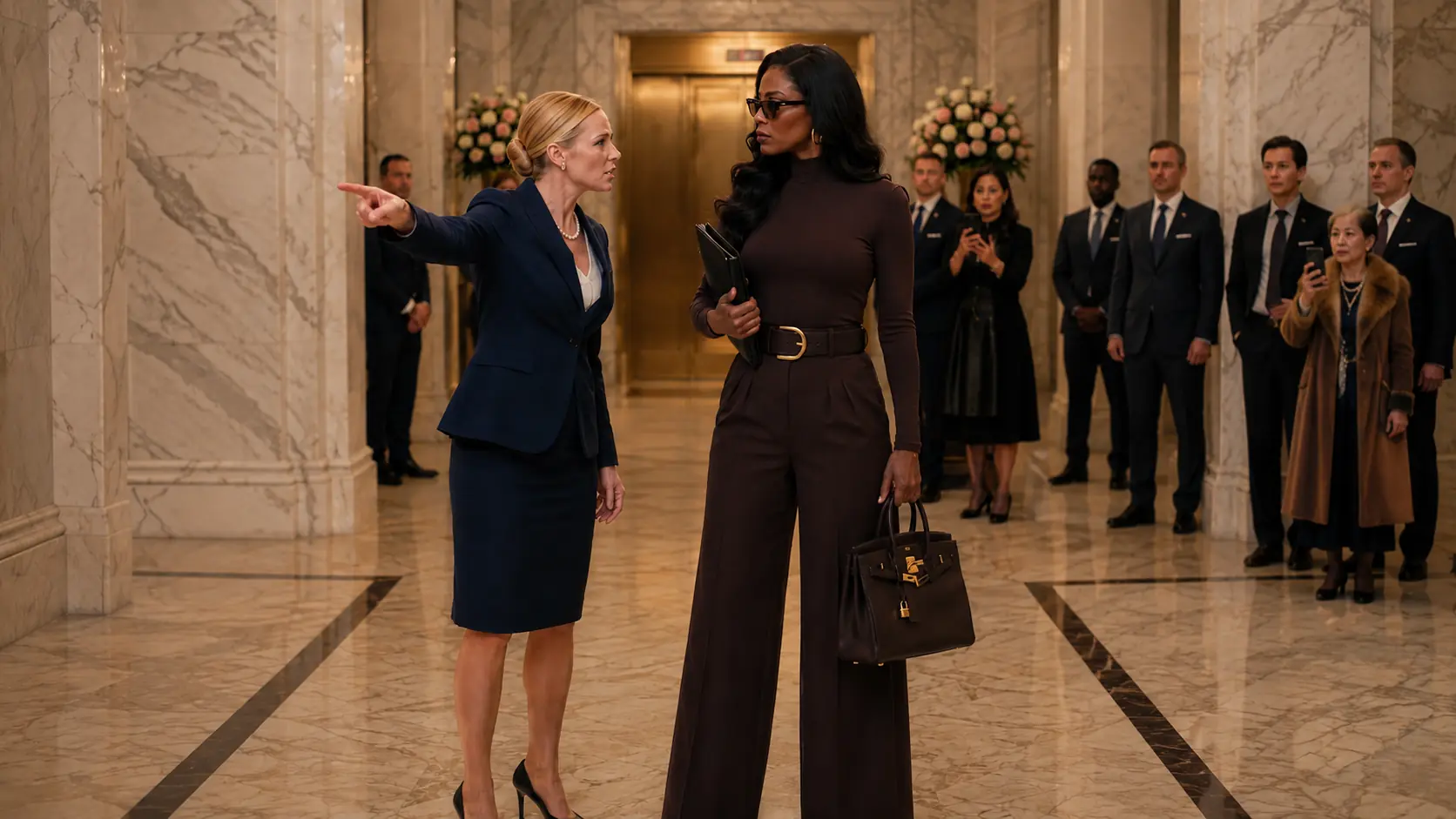
Zara remained motionless beneath the brilliant lobby lights. Her smooth deep-brown skin, sculpted features, and long glossy black hair were partially hidden by an elegant gray beret and oversized black sunglasses. A sharply tailored charcoal coat hugged her graceful figure, cinched at the waist by a burgundy floral belt that matched her leather gloves and structured red designer handbag. A black executive portfolio rested against her chest, while a phone inside it displayed a confidential report containing thirty-seven employee names.
“You’re throwing the owner out,” Zara said coldly.
Brittany laughed, turning slightly so the guests behind her could share the joke. She was forty-five, blonde, immaculately dressed in a fitted navy management suit with a pearl necklace and a gold name badge identifying her as general manager. Everything about her appearance communicated control, from the polished black heels to the rigid set of her shoulders. She had spent six years becoming the most powerful person inside the Grand Meridian’s daily operations, and she believed the title protected her from consequence.
“Security,” Brittany called. “Remove her now—or you’re fired.”
Two guards stepped forward reluctantly.
Zara removed her sunglasses.
“Wrong person,” she said. “You’re all fired.”
For one second, no one moved.
Then the lobby erupted in whispers.
Brittany’s expression remained frozen between amusement and confusion. She looked at Zara’s face more carefully, searching her memory for a guest complaint, a former employee, or a wealthy client she might have offended. Recognition arrived slowly, but when it did, every trace of color vanished from her face.
Zara Washington was the founder and chief executive of Washington Meridian Hospitality, the private company that had acquired the Grand Meridian eighteen months earlier for $420 million. Her photograph appeared in financial publications, investor presentations, and the framed ownership announcement hanging inside the executive offices upstairs. Yet Brittany had failed to recognize her because Zara had not arrived in the expected uniform of wealth.
The security guards stopped several feet away.
One of them, a young Black man named Marcus Reed, lowered his hand from the radio at his shoulder. The other, Daniel Frost, looked toward Brittany for direction, but she no longer appeared capable of giving one. The people recording with their phones edged closer, sensing that the humiliation they expected to capture had reversed.
“Ms. Washington,” Brittany whispered.
Zara looked toward her name badge. “So you do know who owns the hotel.”
“I—I didn’t recognize you.”
“That is not your problem.”
Brittany swallowed. “There has been a misunderstanding.”
“No. You understood the situation exactly as you chose to understand it.”
Zara opened her portfolio and removed a thin black folder. She placed it on the polished concierge desk between them. On the cover was a gold Grand Meridian emblem and beneath it the words: Independent Culture and Conduct Investigation.
Brittany stared at the title.
Zara had not come to the hotel for a social visit. She had come because complaints had reached her private office for nearly eight months. Employees described discriminatory scheduling, retaliatory dismissals, stolen gratuities, fabricated performance reports, and a management culture that treated wealthy white guests with reverence while humiliating everyone else.
The complaints had one name in common.
Brittany Coleman.
Zara had initially ordered a standard internal review, but the results appeared strangely clean. Every department scored highly, staff turnover was attributed to seasonal instability, and Brittany’s leadership ratings seemed nearly perfect. Two weeks later, an anonymous package arrived at Zara’s home containing copies of altered schedules, deleted security footage, payroll discrepancies, and written statements from former employees too frightened to use the company reporting system.
Someone inside the hotel had buried the truth.
Zara hired an independent investigative firm without informing regional leadership. For three months, investigators interviewed housekeepers, kitchen staff, guards, servers, bell attendants, and former employees. They reviewed internal messages and compared official reports with preserved copies secretly retained by workers. The investigation revealed that Brittany had not acted alone.
She had built a protected circle.
Human resources manager Allison Pierce erased complaints and classified many as “interpersonal misunderstandings.” Director of security Thomas Grant selectively preserved footage involving employees Brittany wanted removed while deleting videos that showed her mistreating guests. Front-office supervisor Kevin Lowe changed room assignments based on race, appearance, and perceived income. Several senior staff members divided stolen service charges and punished anyone who questioned the missing money.
Thirty-seven names appeared in Zara’s portfolio.
She had planned to enter quietly, observe the lobby, and proceed upstairs for a private emergency meeting. Instead, Brittany had demonstrated the entire culture before Zara even reached the elevator.
“You came here disguised,” Brittany said, finding enough composure to build a defense. “You deliberately misled the staff.”
Zara glanced at her fitted coat, jewelry, leather gloves, and expensive handbag. “Which part of this outfit says vagrant?”
A few guests lowered their phones.
Brittany’s eyes moved over Zara again. The coat alone cost more than some employees earned in two months, but Zara understood that price was never the true issue. Brittany had seen a Black woman she did not recognize and assumed she lacked power. The clothes had not hidden wealth; prejudice had made it invisible.
“You had no reservation,” Brittany said.
“I did not approach the desk.”
“You were standing near the private elevators.”
“They lead to my office.”
“You refused to explain yourself.”
“You never asked. You announced a ‘vagrant situation’ before speaking one respectful sentence to me.”
Brittany turned toward the crowd. “Everyone makes mistakes under pressure.”
A middle-aged white guest near the registration line spoke first. “You called her diseased.”
Brittany stiffened.
Another woman lowered her phone. “And you said people like her didn’t belong in your world.”
Zara looked around the lobby. “No. She said our world.”
The distinction settled heavily over the room.
Brittany had not simply insulted a stranger. She had claimed ownership over the hotel’s luxury, dividing those present into people worthy of welcome and those required to prove their humanity. The guests who had silently approved minutes earlier now understood that the same arbitrary judgment could eventually be turned against anyone.
Zara looked toward Marcus. “Did Ms. Coleman order you to remove me before asking whether I was a guest?”
“Yes, ma’am.”
“Did she threaten your job?”
“Yes.”
“Would you have used physical force?”
Marcus hesitated. “Only if you became a danger.”
“Was I a danger?”
“No.”
Brittany snapped toward him. “Think carefully before you answer questions about internal security procedure.”
Marcus met her eyes. For two years, he had endured last-minute schedule changes and written warnings for refusing to intimidate homeless people seeking warmth near the entrance during winter. Brittany had repeatedly reminded him that a security guard was replaceable. Now the threat no longer carried the same weight.
“I am thinking carefully,” Marcus said. “You ordered us to drag her out.”
The general manager’s face tightened.
Zara checked the time on her phone. Exactly two minutes had passed since Brittany first called security.
The private elevators opened.
Three people stepped into the lobby: independent attorney Rachel Monroe, regional operations president David Keller, and the lead investigator, a former federal labor attorney named Samuel Ortiz. Each carried matching black folders.
David stopped when he saw the crowd.
Zara handed him the employee termination list. “The lobby incident confirms the findings.”
Brittany moved toward him. “David, thank God. Tell her how impossible this hotel is to manage without firm standards.”
David did not take her side.
He had spent the previous week reading statements from employees who described crying inside supply closets, losing shifts after reporting harassment, and being ordered to lie to guests. He had also learned that several complaints sent to his regional office had been redirected by his own assistant, whose name appeared on the list.
“Brittany,” he said, “you are terminated effective immediately.”
Her mouth opened.
David continued. “Your building access, company accounts, and management authority are revoked. You will surrender your phone, identification card, office keys, and all company property.”
“You cannot do this in front of guests.”
“You humiliated the owner in front of guests,” Zara replied. “Public consequences are the smallest part of what you created here.”
Brittany looked toward Allison Pierce, the human resources manager, who had emerged from a hallway after hearing the commotion. Allison stopped when she saw the black folders and tried to retreat unnoticed.
Samuel pointed toward her.
“Ms. Pierce, please remain in the lobby.”
Allison forced a smile. “I was just going to retrieve the relevant employee files.”
“The records have already been secured.”
Her smile vanished.
One by one, department leaders were summoned. Thomas Grant arrived from the security office with two supervisors. Kevin Lowe stepped from behind the front desk. The food-and-beverage director appeared near the restaurant entrance, adjusting his tie and asking why service had been interrupted.
Each person received the same instruction.
Remain where you are.
Do not access company systems.
Do not contact employees.
Wait for counsel.
Guests watched as Zara’s quiet arrival transformed into the most complete leadership removal in the hotel’s history. The senior staff who had protected one another now stood separated beneath the chandeliers, stripped of the titles they once used to frighten workers.
Brittany looked toward Zara with open hatred.
“You think firing everyone solves anything?” she asked. “These people are loyal to me. Half the staff will walk out when I leave.”
A soft voice came from behind the concierge desk.
“No, they won’t.”
The speaker was a Latina front-desk employee named Elena Morales. She had worked at the hotel for four years and had been denied promotion six times despite consistently receiving the highest guest-service ratings in her department. Kevin Lowe claimed her accent was unsuitable for executive guests, though Elena spoke three languages more fluently than he spoke one.
Kevin glared at her.
Elena stepped out from behind the desk. “Most of us have been waiting for you to leave.”
Other employees began emerging.
A housekeeper stood near the elevators, still wearing blue cleaning gloves. Two bell attendants came from the luggage room. Kitchen workers gathered outside the restaurant doors. Several maintained careful distance, uncertain whether the reversal could be trusted.
Zara turned toward them.
“No hourly employee will lose pay because of today’s management changes,” she said. “Every person who cooperates with the independent review will receive full protection against retaliation. Any stolen gratuities or withheld wages will be repaid with interest.”
The housekeeper raised one hand.
“What about people they already fired?”
Zara looked toward Samuel.
“Former employees affected by falsified reports will be contacted,” he said. “They will be offered review hearings, compensation where appropriate, and reinstatement opportunities.”
A murmur moved through the workers.
Brittany laughed bitterly. “You’re rewarding insubordination.”
Zara faced her again. “You called honesty insubordination because the truth threatened your control.”
“I made this hotel profitable.”
“You made employees afraid.”
“Profits rose twenty-three percent under my leadership.”
Rachel Monroe opened another report. “Partly because service charges intended for workers were diverted into a discretionary management account.”
Several guests reacted audibly.
Brittany looked toward Allison, who stared at the floor.
“That account was approved,” Brittany said.
“It was created using falsified signatures,” Rachel answered. “The matter has been referred to law enforcement.”
The controlled anger left Brittany’s face, replaced by genuine fear.
She understood termination.
She had never considered arrest.
Two uniformed officers entered through the revolving doors, followed by investigators from the district attorney’s financial-crimes unit. Zara had arranged for them to receive the forensic payroll report that morning, but she had not expected their arrival to coincide with her public humiliation.
Brittany stepped backward.
“You planned this.”
“I planned accountability,” Zara said. “You created the spectacle.”
The officers asked Brittany, Allison, and the food-and-beverage director to accompany them for questioning. They were not placed in handcuffs inside the lobby, but every guest saw them escorted toward a private conference room beneath security supervision.
Kevin attempted to slip toward the staff corridor.
Marcus blocked his path.
“You heard the instruction,” he said. “Remain in the lobby.”
Kevin looked at the guard he had once threatened to fire for refusing an illegal order. This time, Marcus possessed both authority and witnesses.
Kevin returned to his place.
Zara picked up her portfolio and walked toward the private elevator. She stopped when Elena approached.
“Ms. Washington,” Elena said, “some of us tried to report this. We thought no one cared.”
Zara’s anger softened.
“I should have learned the truth sooner.”
“You didn’t cause what they did.”
“No. But ownership means I am responsible for the systems that allowed it to continue.”
Elena seemed surprised by the answer. Executives usually separated themselves from wrongdoing by blaming rogue employees. Zara had built Washington Meridian Hospitality from a single struggling motel in Maryland into an international luxury group because she believed leadership meant accepting responsibility before claiming credit.
“My mother cleaned hotel rooms,” Zara said. “She taught me that the person changing the sheets understands a property better than the executive reading reports about it. I forgot to make certain this company still listened that way.”
Elena looked toward the employees gathered nearby. “What happens now?”
“First, we close the hotel to new arrivals for the rest of today.”
A regional executive started to object.
Zara raised one hand.
“Existing guests will remain fully accommodated. Incoming reservations will be transferred to nearby properties at our expense. Every department will meet with investigators privately, and no manager named in the report will participate.”
She turned toward David.
“I want emergency leadership chosen from employees with clean records and the trust of their teams—not from whichever executives hold the highest titles.”
David nodded. “Understood.”
Zara looked at Elena. “Can you stabilize the front desk for four hours?”
Elena blinked. “Me?”
“You already know the reservation system, multilingual service procedures, guest recovery standards, and everything Kevin pretended only he understood.”
“I’ve never managed the whole desk.”
“You have managed it every time he disappeared into his office.”
Several employees smiled.
Elena drew a careful breath. “Yes. I can do it.”
“Then you are acting front-office manager until the formal review.”
Kevin stepped forward. “She isn’t qualified.”
Zara did not even look at him. “Your opinion is no longer part of hotel operations.”
Marcus was appointed acting security supervisor. A veteran housekeeper named Gloria Bennett became temporary director of rooms after employees unanimously recommended her. The executive chef’s assistant, a quiet Korean American woman named Grace Park, was placed in charge of food service because the investigation showed she had maintained safety standards while her director falsified supply costs.
Within thirty minutes, the lobby began moving again.
Guests received letters explaining the operational interruption without exposing private employee testimony. Staff brought coffee and refreshments to those waiting. Elena reorganized arrivals, while Marcus assigned guards to protect restricted offices and preserve evidence.
The hotel did not collapse without Brittany.
It became calmer.
Zara spent the next ten hours listening.
She met housekeepers in the employee cafeteria, where the chairs did not match and one ceiling light had flickered for months. She sat with kitchen workers who described unpaid hours and broken ventilation equipment. Bell attendants explained how Brittany instructed them to ignore guests who looked unlikely to tip. Security officers described being pressured to remove Black teenagers, disabled visitors, and anyone wearing inexpensive clothing from public spaces.
Each story made Zara’s anger colder.
Near midnight, she entered the executive suite Brittany had occupied. The office overlooked Central Park and contained imported furniture, fresh flowers, and a private coffee machine worth more than the entire employee break-room renovation budget Brittany had denied.
On one wall hung a framed statement of the Grand Meridian’s values.
Every guest is welcomed with dignity.
Zara removed it from the wall.
Not because she rejected the words.
Because the hotel had not earned the right to display them.
David stood near the doorway. “The board will want an explanation for terminating nearly the entire senior team without a transition period.”
“They will receive the investigation.”
“They may say we should have removed Brittany quietly and preserved stability.”
Zara turned toward the dark city beyond the windows. “Quiet removals protect institutions from embarrassment. They rarely protect the people who were harmed.”
“Some guests will post the footage.”
“Good.”
He looked surprised.
“Let them show exactly what happened,” Zara said. “But the company statement will not present me as the only victim. Brittany treated me that way because she thought I lacked power. The employees endured worse because she knew they actually lacked it.”
The footage spread online before sunrise.
One video showed Brittany pointing toward the service entrance. Another captured Zara removing her sunglasses and declaring, “Wrong person. You’re all fired.” By morning, millions had watched the reversal.
Headlines focused on the billionaire owner firing a racist manager.
Zara refused interview requests for three days.
When she finally spoke publicly, she stood not in the marble lobby but inside the employee cafeteria beside Elena, Marcus, Gloria, and Grace. She announced repayment of $2.8 million in stolen service charges, independent review panels across every company property, and a confidential reporting system managed outside regional leadership.
She also established a company rule requiring executives to work alongside hourly staff twice each year. Not observe. Work.
They would clean rooms, assist laundry crews, carry luggage, support front desks, and prepare banquet halls. Zara understood that a symbolic day could not erase unequal power, but leaders who never entered employee spaces had become too comfortable believing polished reports.
Three months later, the Grand Meridian reopened under permanent new leadership.
Elena became front-office director.
Marcus became head of security.
Gloria was promoted to director of rooms and received funding to rebuild employee facilities. Grace became executive chef after the former director was formally charged with financial fraud.
Guest satisfaction rose.
Employee turnover fell by more than half.
The lobby still contained marble floors, towering flower arrangements, and crystal chandeliers. Luxury remained part of the hotel’s identity, but it was no longer treated as permission to decide who deserved respect.
Brittany eventually pleaded guilty to wage theft, falsifying business records, and conspiracy. During sentencing, her attorney described her as a dedicated hospitality professional whose judgment had been damaged by pressure.
Several former employees submitted statements describing what her “judgment” cost them.
One had lost an apartment after being fired for reporting stolen tips. Another delayed medical treatment because Brittany removed her health-insurance hours. A housekeeper’s daughter abandoned college plans after her mother’s schedule was cut in retaliation.
The judge rejected probation.
A year after the lobby incident, Zara returned to the Grand Meridian wearing the same charcoal coat, gray beret, burgundy gloves, and oversized sunglasses. She entered without an entourage and paused near the private elevators.
A newly hired concierge smiled.
“Good afternoon, ma’am. Welcome to the Grand Meridian. May I help you find anything?”
The employee did not recognize her.
That pleased Zara.
“I’m meeting someone upstairs.”
“Certainly. May I ask whom you’re visiting so I can assist with access?”
The question was respectful, neutral, and required of everyone.
Before Zara answered, Elena crossed the lobby and smiled.
“Ms. Washington. We’ve been expecting you.”
The concierge looked alarmed. “I’m sorry—I didn’t realize—”
Zara removed her sunglasses.
“You did exactly what you were supposed to do. You welcomed me before asking for information.”
Relief crossed the employee’s face.
Marcus approached from the security desk wearing a tailored suit and a new director’s badge. Gloria waved from near the elevators while speaking with a group of housekeepers. The hotel felt different, not because everyone knew Zara’s identity, but because no one needed to know it before treating her with dignity.
Elena handed Zara a small gold key.
“What is this?”
“The staff wanted you to have it.”
The key opened a new training room created from Brittany’s former executive office. Inside, the imported desk had been removed. The room now contained classroom tables, computers, language-learning software, leadership courses, and scholarship information for employees.
On the wall hung the hotel’s old values statement.
Beneath it, someone had added a second line.
Dignity is not reserved for those whose power we recognize.
Zara read the sentence twice.
She thought about the afternoon Brittany saw a Black woman in an expensive coat and still concluded she was disposable. She thought about the guests who began recording before anyone considered intervening. Most of all, she thought about the employees who had endured years of cruelty without the authority to say four words that could change the room.
You are all fired.
Zara had possessed that power.
The work now was building a hotel where no employee needed a billionaire to appear before basic decency became policy.
She placed the gold key in her handbag and turned toward Elena.
“Who wrote the second line?”
Elena smiled. “The staff.”
Zara looked around the room built where one woman had once controlled fear from behind a closed door.
“Keep it there,” she said.
Then she returned to the lobby, where guests crossed beneath the chandeliers and employees moved confidently through a hotel that finally understood the difference between luxury and worth.
One could be purchased.
The other belonged to everyone.