“Sir, are you sure you do not want me to call somebody for you?”
The old white biker just stared at him.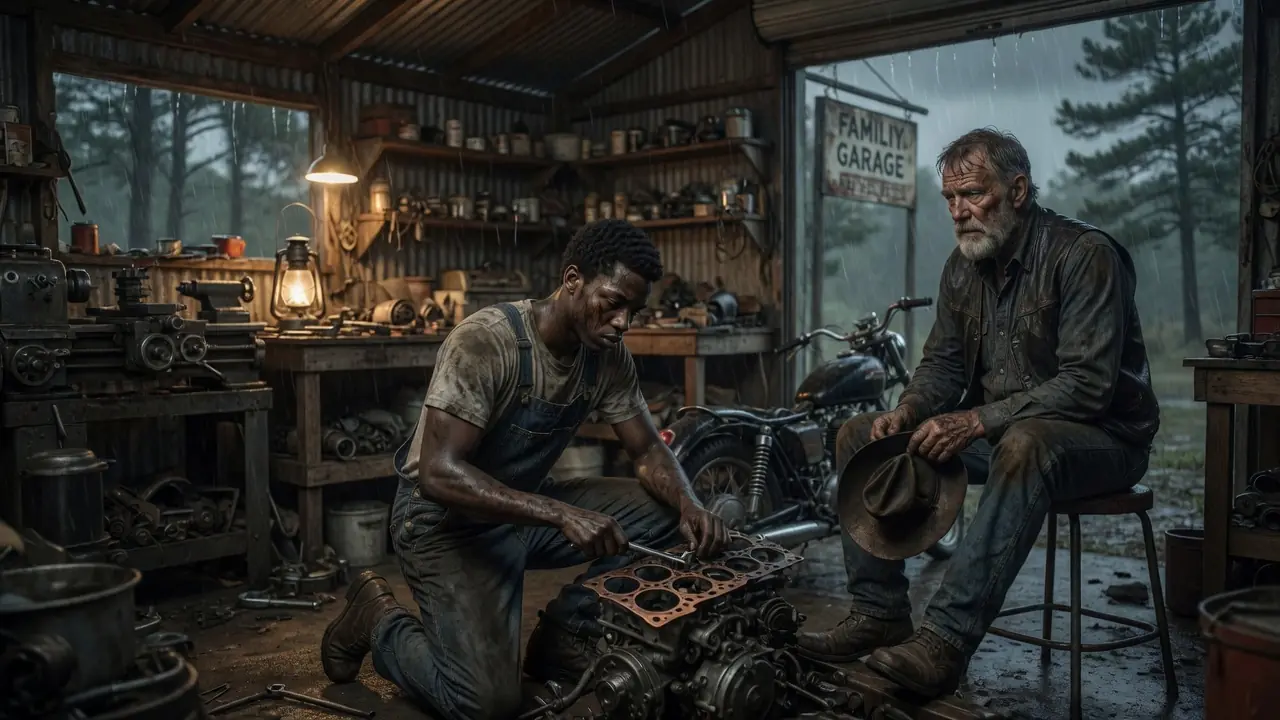
Soaked.
Limping.
His one-of-a-kind 1965 Harley dead in the gravel.
“Son,” the man said, “I got nobody left to call, and I got to be two hundred miles north by sunrise, or I break a promise to a dead man.”
Elijah Sanders, nineteen years old, looked at his grandmother’s foreclosure notice taped to the shop door.
Sixty days left.
No money.
No options.
He looked back at the stranger.
Then he rolled up his sleeves.
“Then you came to the right place, sir.”
Three nights later, two hundred Hells Angels would be standing in his front yard at dawn, and nobody in Pine Hollow, Georgia, was ready for what that biker turned out to be.
But first, it began three days earlier, before the dawn, before the motorcycles, before the whole town learned Elijah Sanders’s name.
Three days before that morning, Elijah Sanders was just a kid who could not sleep.
It was a Thursday morning in Pine Hollow, Georgia.
Population under three thousand.
Two stoplights.
Pine trees as far as the eye could see.
And one small auto repair shop on Route 12 that had been bleeding to death for eighteen months straight.
Sanders and Son Auto Repair.
The sign had been hand-painted by his grandfather back in 1986.
The paint was peeling now.
The wood underneath was soft from the rain.
Elijah’s alarm went off at 5:30 a.m.
It always did.
He pulled himself out of bed, threw on the same gray T-shirt he had worn yesterday, and walked barefoot across the cold linoleum to the kitchen.
The chickens out back were already restless.
He fed them, filled the coffee pot, and set it for his grandmother, Loretta, the way he had every single morning since his father died.
Six years.
Six years of the same routine.
His daddy, James Sanders, had been killed in a paper mill boiler explosion when Elijah was thirteen.
Sole owner of the family shop.
Mama Lo’s only son.
The man whose name was on that sign out front.
Elijah did not talk about that day much.
Nobody in the house did.
But every Sunday morning, without fail, he walked into the garage and dusted off his father’s old workbench.
The coffee mug James had drunk from the morning he died was still sitting there.
The half-rebuilt carburetor he had been working on was still clamped in the vise.
And tucked into the corner, propped against the wall, was an old Iron Horse Custom Cycles parts catalog from the 1990s.
The pages were soft and yellowed from handling.
Once, when Elijah was seven, he had asked his father why he kept that one catalog out of all the others.
His daddy had smiled and said, “Son, I never throw away nothing I’m grateful for.”
Elijah had not understood it then.
He still did not fully understand it now.
But he dusted that catalog every Sunday anyway.
Because his daddy had.
Because some things you keep doing even when you do not know why.
By six in the morning, Elijah was in the shop bay, lifting a hood and checking a fluid line on a 2003 Ford pickup that belonged to one of the last loyal customers Sanders and Son had left.
There were not many.
A chain auto care center had opened ten miles down the highway a year and a half earlier.
Brand-new building.
National advertising.
Coupons in the mailbox every week.
The chain shop had already killed three family garages in the county.
Sanders and Son was the last one standing.
By three that afternoon, Elijah was washed up and out the door, walking the two miles to Marathon Gas at the edge of town.
Nobody knew about that part of his life.
Not even Mama Lo.
He worked the night shift at the gas station from ten at night to two in the morning.
Four hours a night.
Five nights a week.
Cash under the table.
The owner, a quiet man named Mr. Hollis, did not ask questions, and Elijah did not volunteer answers.
Why did he do it?
Because there was a manila envelope hidden under his mattress.
Inside that envelope was an acceptance letter from the Georgia Institute of Technology mechanical engineering program.
Partial scholarship.
The letter was dated two years ago.
He had deferred enrollment three times.
The official deferral letter from Georgia Tech sat right beside the acceptance, freshly received last spring.
It had one line on it that made his stomach drop every time he read it.
Final deferral expires 60 days from this date.
Sixty days.
After that, his spot was gone forever.
He still needed eighteen thousand dollars to cover what the scholarship did not, and the gas station was paying him eleven dollars an hour off the books.
Do the math.
He was never going to make it.
But every morning before Mama Lo woke up, he slipped forty dollars from his cash jar into her purse.
She always pretended not to notice.
He always pretended he did not see her pretending.
That was their dance.
That was their love.
His best friend, Jamal Walker, had left for community college in Atlanta two years ago.
Jamal called every Sunday night.
“Bro, get out of there.”
“Next year, Jamal.”
“You said that last year.”
“I know.”
“Your daddy would want you to go.”
“I know.”
That was where the call usually ended.
Because what Jamal did not understand, what nobody understood, was that Elijah had something Jamal did not have.
He had a grandmother in a tin-roof house.
He had a shop sign with his daddy’s name on it.
And he had a ninety-day foreclosure notice that was getting closer every morning.
Elijah Sanders was not going anywhere until that shop was safe.
Even if it meant losing Georgia Tech.
Even if it meant losing the only future he had ever wanted for himself.
That Thursday afternoon, the radio in the bay was warning about a storm rolling up from the Gulf.
Tornado watch.
Possible road closures.
Elijah barely listened.
He had seen storms before.
What he did not know, what he could not have known, was that this particular storm was carrying a stranger up Route 12.
And that stranger was carrying the rest of Elijah Sanders’s life on the back of a broken-down 1965 Harley.
At 4:15 that afternoon, the sky had turned the color of slate.
The wind was bending the pine trees sideways, and somewhere up Route 12, an engine was dying.
Elijah heard it before he saw it.
A sick, rattling cough.
The kind of sound that tells a mechanic something serious is about to give.
He stepped out from under the bay door, wiping his hands on a rag.
That was when he saw the old man.
A leather-clad figure pushing a motorcycle along the shoulder of the road, limping badly, one hand on the handlebar, the other clutching his hip like it was about to give out.
The bike was beautiful, even from a hundred yards away.
A vintage Harley Panhead.
The kind of machine you did not see outside of museums anymore.
And it was completely dead.
The man pushed it into the gravel lot just as the first hard sheet of rain came down.
He bent over the handlebars, trying to catch his breath.
Elijah jogged out.
“Sir, let me help you.”
The man looked up.
Weathered face.
Gray beard soaked through.
Sixty-five, maybe older.
A faded leather cut covered in patches Elijah could not read through the rain.
Blue eyes that had seen too much.
“Much obliged, son.”
They rolled the Panhead into the dry shelter of the shop bay.
The man collapsed onto an old stool the moment the kickstand dropped.
His leg was shaking.
His breathing was rough.
Loretta appeared in the kitchen doorway.
She took one look at the stranger.
The leather.
The tattoos.
The way he carried himself.
Her shoulders went tight.
“Elijah.”
“It’s all right, Mama Lo.”
The old man stood up slowly, removed his rain-soaked hat, and held it in both hands like he was at church.
“Ma’am, my name is Hank. I am terribly sorry to intrude. I would not have asked unless I had to.”
Loretta’s shoulders dropped half an inch.
Manners cost a man nothing, but they tell you everything.
“Come in out of that rain, Mr. Hank.”
Hank explained while Elijah crouched by the engine.
He had been riding solo three days out of Florida.
The Panhead started running hot near Macon, missing fire south of Albany.
The chain auto care center had been his first stop.
A kid behind the counter had laughed at the bike.
“We don’t service vintage, old man. Try the next county.”
So Hank had pushed his bike a full mile in the pouring rain to get to Sanders and Son.
“Son,” Hank said, “I need to be in Eagle Ridge, North Carolina by tomorrow at sunrise. Two hundred miles north. Or I break a promise I made on a man’s grave.”
Elijah looked up.
“What kind of promise?”
The old biker went quiet.
He stared at his boots.
When he spoke again, his voice was lower.
“It’s the one-year. My brother Eddie passed last June. We made a pact decades back. Whoever went first, the other one rides to Eagle Ridge every dawn on the anniversary. Two minutes of silence. Then back on the road.”
He swallowed.
“Nineteen years, I’ve never missed. I do not intend to start tomorrow.”
The rain hammered the tin roof.
Thunder cracked hard enough to shake the bay doors.
Elijah looked at the bike.
Then at his grandmother.
Then at Hank.
He slid under the Panhead with a work light and started checking.
Two minutes later, he came back out.
His face was tight.
“Sir, I’m going to shoot straight. The head gasket is blown. The ignition coil is dead. There’s a hairline crack in your cylinder sleeve. And your carburetor is gummed up so bad I can smell it from here.”
Hank’s face fell.
“Can you fix it?”
“The parts you need don’t exist in this county. Not for a 1965 Panhead. Every shop within eighty miles closes by five. The roads are about to shut. Even if I ordered them, they would take three days.”
The old man’s eyes went somewhere far away.
His mouth worked, but no sound came out.
He reached slowly into his leather cut, pulled out a crumpled roll of bills, and held it out with a shaking hand.
“Son, I ain’t asking for charity. I will pay whatever it is worth, whatever I have, whichever is less. I am begging you, please.”
Elijah stared at the cash.
Then at the old man.
Hank’s eyes were wet, the kind of wet a man tries to hide.
“Please, son,” Hank said. “Don’t let me fail him. Not tomorrow. Not on that ridge.”
Behind Elijah, Loretta stood very still in the doorway.
In Elijah’s head, his father’s voice came up clear, like he was standing right there.
“When a man’s broke down in the rain, son, you don’t ask his price.”
Outside, lightning split the sky over Pine Hollow.
The rain became a wall.
Elijah looked at Hank’s shaking hands.
Then he rolled up his sleeves.
“Put your money away, sir. Mama Lo, put on a pot of coffee. It’s going to be a long night.”
The old biker covered his face with both hands and let out a sound Elijah would never forget.
A grown man crying with relief in a shop sixty days from being taken away forever.
The next eleven hours, Elijah would later tell his grandmother, were the closest he had ever felt to his father since the funeral.
Like the man was standing right behind him, hand on his shoulder, whispering instructions into his ear.
At 5:02 p.m., Elijah cracked the engine open.
Head bolts off.
Valve cover off.
Carburetor off.
He laid the parts on the bench in the exact order his daddy had taught him to lay them six years before.
Every screw.
Every washer.
Every gasket.
Loretta brought towels.
Then coffee.
Then more towels.
Hank sat on the stool in the corner, his hat in his lap, watching with eyes that did not blink.
At 5:47, the diagnosis was confirmed.
Blown head gasket.
Cracked cylinder sleeve.
Dead ignition coil.
Carburetor caked solid.
None of those parts existed within eighty miles of Pine Hollow.
The hardware store had closed an hour ago.
The roads were shutting down county by county.
Elijah stood up and wiped his hands.
Then he turned to his daddy’s workbench.
He reached underneath, pulled out a steel toolbox, and under that, a cardboard box he had not opened in three years.
Inside was scrap.
Old parts his father had refused to throw away.
Pieces nobody else in the county would have called useful.
Including one chunk of a 1985 Buick 350 engine block.
Elijah lifted it like it weighed nothing.
“What you can’t buy, you build,” he whispered.
Anything a man made, another man can make again.
His daddy’s exact words from a memory ten years old.
He set the Buick block on the lathe.
At 6:30, the power flickered once.
At 7:15, the power cut out completely.
Hank started to stand.
Elijah waved him down.
“It’s fine. Stay there, sir.”
He lit the kerosene lantern off the wall hook, pulled his father’s battery work light from the corner, the same dented, scratched one James had used every night for twenty years, and clamped it to the engine stand.
The bay glowed yellow.
Then he went to work.
He turned the Buick block on the lathe by hand.
Slow.
Steady.
Inch by inch by inch.
He measured the cylinder bore against the Panhead specs.
Adjusted.
Turned again.
Sweat ran down his back and dripped off his chin onto the steel.
The rain hammered the tin roof so loudly he could barely hear his own breathing.
At 8:48, the sleeve fitted clean.
He had torn apart an old riding mower out back the summer before and pulled the ignition coil.
He had set it on a shelf for a rainy day.
He grabbed it now.
Bench-tested it with a multimeter.
The needle jumped clean.
It would work.
At 9:30, Loretta brought Hank a fresh cup of coffee.
The old biker took it with both hands like it was sacred.
“How old is he, ma’am?”
“Nineteen, Mr. Hank.”
“How long has he been working this shop?”
“Since the day his daddy died. Six years this June.”
Hank was quiet for a long time.
His hand was steadier now.
“Where’d he learn that trick with the lathe?”
“James, his father. The best mechanic this county ever knew.”
Hank’s eyes flickered.
He set the cup down on the bench, reached into his vest, pulled out a small worn pocket notebook, wrote something down in slow careful letters, and put it back.
He did not say a word.
At 11:18, Elijah faced the head gasket.
No replacement existed anywhere on that side of the country at that hour.
So Elijah cut one by hand from a sheet of copper he had been saving for a sculpture project he was never going to finish anyway.
He scored the shape with a scribe.
Cut it with tin snips.
Annealed the copper with a propane torch until it glowed cherry red.
Quenched it in a bucket of cold water.
Trimmed it with a file by feel, by touch, the way his father had taught him.
Hank watched the whole time.
He had not moved from that stool in over an hour.
At 12:34 a.m., Elijah began reassembly.
He laid the new gasket in.
Torqued the head bolts down in the cross pattern, three passes, just like his daddy taught him.
Hooked the rebuilt coil up.
Cleaned and reset the carburetor in a coffee can full of gasoline.
His hands were with grease.
His back ached.
The lantern flickered dangerously low.
At 1:47 a.m., he made the final touches.
He bled the lines, checked the timing, set the gap on the points.
Then he stood up.
His shirt was soaked through with sweat.
His arms were trembling.
“You want to do the honors, sir?”
Hank stood up slowly, limped over, sat down on the saddle, took a deep breath, and closed his eyes for one long second.
Then he hit the starter.
Click.
Nothing.
Hank’s jaw clenched hard.
His shoulders dropped half an inch.
Elijah leaned over and checked the spark.
“Try it again.”
Click.
Cough.
Sputter.
Then silence.
The rain on the roof felt suddenly louder than it had all night.
Loretta appeared in the doorway holding the coffee pot, her lips moving in silent prayer.
Elijah’s hands were shaking now.
Not from cold.
From hope.
He reached down and adjusted the carburetor screw by exactly a quarter turn.
“One more time, sir.”
Hank hit the starter one last time.
The Panhead roared to life.
Not coughing.
Not sputtering.
Roaring like it was 1965 again.
The whole shop bay shook with it.
Hank’s face cracked open in a way Elijah would never forget for the rest of his life.
The old biker bowed his head over the handlebars.
His shoulders shook hard.
He did not make a sound.
But the tears came down in streams onto the polished gas tank.
At 2:14 a.m., Elijah stepped back and wiped his hands on a rag.
“She’ll hold the two hundred miles, sir. Probably more. You’ll want a proper sleeve in within a couple thousand.”
Hank looked up.
His eyes were red.
His voice was rough.
“Son, you just resurrected a 1965 Panhead with a lawnmower coil and a Buick sleeve in the middle of a thunderstorm by lantern light. That ain’t mechanic work.”
He swallowed.
“That’s a calling.”
Elijah just looked at the floor.
He had never been good at being praised.
“It’s what my daddy taught me, sir. Nothing more.”
Hank stared at him a long, long time.
“Then your daddy was a damn good man, Elijah Sanders. A damn good man.”
Then Hank reached into his vest one more time.
What he pulled out, and what Elijah did with it, was where the story truly began.
You can tell who somebody really is by what they do when you offer them more than they expected.
Hank Donovan was about to find out exactly who Elijah Sanders was.
The old biker reached into his vest and pulled out the roll of cash again.
This time, it was not crumpled.
This time, it was a thick, banded stack.
Hundreds.
The kind of money no broke biker carries.
Elijah noticed.
He did not say anything.
“How much, son?”
“Twenty dollars for the labor. The scrap was just sitting in the pile.”
Hank laughed once.
Short.
“Twenty dollars? I’d have paid two thousand and called it a bargain.”
He counted out five crisp hundred-dollar bills and pressed them into Elijah’s palm.
“Take it. For the work.”
Elijah pulled his hand back.
“Sir, that ain’t honest.”
Hank’s voice got softer.
“Then take it for your grandmother. For the shop. I saw the foreclosure notice on the door, son.”
The whole bay went quiet.
Elijah stared down at the bills.
Five hundred dollars.
He knew exactly what that could be.
It was the Georgia Tech enrollment deposit.
Two more months of electricity.
Groceries for Mama Lo through the spring.
Five hundred dollars was a door.
And this man was holding it open.
Elijah’s hands were shaking.
He wanted to take it.
God, he wanted to take it.
But then he heard his daddy’s voice again.
Not from a memory.
From somewhere deeper.
“If you take what you didn’t earn, son, you spend the rest of your life paying interest on it.”
Elijah closed Hank’s fingers back around the cash.
“Twenty dollars. And the coffee my grandma made you. That’s what’s honest, sir.”
Loretta stood in the doorway.
She did not speak.
But Elijah could feel her loving him for it.
Hank stared a long beat.
Then he peeled a single twenty-dollar bill off the roll and laid it on the bench.
“What’s your name, son?”
“Elijah Sanders, sir.”
“And your daddy’s name?”
Elijah swallowed.
“James. James Sanders.”
Something passed behind Hank’s eyes, quick, like he had been struck.
He looked away.
Then he pulled out the same worn pocket notebook, wrote the name down, underlined it, and closed it.
He did not explain.
He reached up to his own leather cut and unpinned a small enamel patch from the chest.
A horseshoe and an anvil.
Two letters embossed:
I.H.
He pinned it to the strap of Elijah’s overalls.
“You keep that. It means something where I come from.”
He set a folded card on the bench.
No name.
No company.
Just the horseshoe emblem and a phone number written by hand.
“Anything you need, you call that number. You say your name, and you wait. You hear me?”
“Yes, sir.”
Hank limped back to the Panhead and swung a leg over.
The engine fired clean on the first try.
“What you did tonight, Elijah Sanders, will not be forgot.”
The headlight came on.
The Panhead rolled out into the breaking dawn.
The storm had passed.
Elijah and Loretta stood in the doorway, watching him go.
Loretta put a hand on her grandson’s shoulder.
“Baby, that was the right thing.”
“I know, Mama Lo.”
“Your daddy would be proud.”
“I know.”
He turned to go back inside.
That was when his foot caught on something under the workbench.
A leather satchel.
Worn.
Heavy.
Hank had forgotten it.
Elijah carried it to the kitchen table.
The buckle came loose in his hand.
Inside was a folded map.
Eagle Ridge circled in red ink.
A worn Bible.
And one laminated photograph.
Elijah pulled the photograph out slowly.
A campfire.
Thirty bikers around it.
Two men in the center, arms around each other.
A younger Hank, dark hair instead of gray, and another man.
It was the patches on their cuts that made Elijah’s breath catch.
The horseshoe and the anvil.
And the winged skull.
He had seen that skull before.
Everyone in America had seen that skull before.
Elijah looked up at his grandmother in the doorway.
“Mama Lo.”
“What is it, baby?”
He held up the photograph.
“I don’t think that was just some old biker.”
Loretta’s face went still.
She did not know yet.
But in three days, the entire town of Pine Hollow was about to find out.
For three days, Elijah Sanders did not sleep right.
Every time he closed his eyes, he saw that ring on Hank’s finger.
The horseshoe.
The anvil.
The two letters.
I.H.
Friday afternoon, he opened his cracked laptop in the corner of the garage.
He typed the emblem into the search bar.
The first result loaded.
Iron Horse Custom Cycles.
Founded 1980.
The largest independent American custom build company outside of Harley-Davidson.
Annual revenue in the high nine figures.
He scrolled.
Founder and Chairman: Walter “Hank” Donovan.
He clicked on photos.
Most were old, but one was new.
A charity gala.
Tuxedo.
Gray beard.
The same blue eyes.
The same limp.
Elijah whispered to the empty garage, “No way.”
He did not tell Loretta.
He was scared to be wrong.
More scared to be right.
That same afternoon, Gerald Whitfield rolled up smiling.
The developer parked his SUV and walked up the porch.
“Sixty days left, Loretta. The storm hurt your roof. I dropped my offer. Thirty-eight thousand cash today.”
Loretta met him at the screen door.
“Get off my porch, Gerald.”
He smiled like he had time, because he did.
“You’ll change your mind by next week.”
Elijah watched from the bay.
His knuckles went pale around the wrench.
Saturday morning, he opened the leather satchel one more time.
Sewn into the inside lining was a small faded sticker.
Property of W.H.D.
President, Northern States Nomad Chapter.
He carried it into the kitchen.
“Mama Lo, I got to tell you something.”
He laid out the photograph.
The sticker.
The screenshot.
Loretta sat down slowly.
She did not speak for a long time.
Then she shook her head.
“Baby, don’t build castles. You can’t put your hope in a stranger.”
After James died, she had spent two years getting her hopes lifted by people who never came through.
She had learned to expect nothing.
“Yes, ma’am,” Elijah said.
But that night, lying in the dark, he replayed every moment of those eleven hours.
The catalog on his daddy’s workbench.
Iron Horse Custom Cycles.
The same logo as the ring.
Hank on that satellite phone.
Hold dawn formation tight.
The way he wrote James’s name down twice.
Underlined.
What you did tonight will not be forgot.
Sunday morning.
4:13 a.m.
Elijah was half-asleep when he felt it.
A low rumble in the floorboards, like distant thunder.
But there was no storm.
The rumble got louder and louder.
Loretta sat up in bed across the hall.
“Elijah?”
He was already at the window.
He thought it was a freight train.
But this rumble was not moving past.
It was coming toward them.
Getting closer every second.
Elijah understood in that moment what was rolling up Route 12 at four in the morning.
And it was here for him.
What pulled into the gravel lot of Sanders and Son at dawn that Sunday morning was not a freight train.
It was a promise.
Two hundred of them.
From the bedroom window, Elijah watched headlights pour up the country road.
Not three.
Not thirty.
Two hundred.
Harleys in formation.
Choppers.
Baggers.
Vintage Panheads.
Custom touring rigs.
They filled the gravel lot, the back pasture, and the shoulders of Route 12 for half a mile in both directions.
The morning mist curled around two hundred engines.
Then the engines cut.
All at once.
A silence so loud it rang in his ears.
Loretta’s voice came tight from the hallway.
“Elijah! Get away from that window. Get away!”
Three slow, heavy knocks landed on the front door.
Loretta grabbed James’s old shotgun off the rack.
She did not raise it.
She just held it the way old Southern grandmothers hold things they pray they will never have to use.
Elijah walked to the door.
He opened it.
Standing on the porch was Hank Donovan.
Cleaned up.
Beard trimmed.
Leather cut crisp.
Behind him stood two hundred Hells Angels in colors, standing in perfect formation.
Silent.
Helmets off.
Hands folded.
Hank removed his sunglasses.
“Mrs. Sanders, may we come in? There’s something I owe you and your grandson that I aim to settle this morning.”
Loretta lowered the shotgun an inch.
Then she lowered it all the way.
She stepped aside.
Hank walked in.
Behind him came a man the size of a refrigerator, carrying a leather portfolio under his arm.
He nodded to Loretta once.
“Ma’am, my name is Roy Bradford. People call me Tank. I work for Mr. Donovan.”
The other one hundred ninety-eight bikers stayed outside.
Motionless.
Respectful.
Like a funeral honor guard.
Hank stood in Loretta’s kitchen.
The kitchen with the faded yellow curtains.
The kitchen with the chipped table.
The kitchen where she had raised her son and now her grandson.
He took off his hat, held it in both hands, and looked her in the eye.
“Ma’am, my name is Walter Donovan. People call me Hank. I am the founder and chairman of Iron Horse Custom Cycles. I am also the national president emeritus of the Northern States Nomad chapter of the Hells Angels.”
Loretta sat down hard on the kitchen chair.
“And I owe your grandson and your late husband a debt that I cannot repay with money.”
A long pause followed.
“But this morning, ma’am, I am going to try.”
Elijah stood in the doorway.
He could hear his own heartbeat.
Hank set his hat on the table.
“I made the dawn ride. Two hundred miles. No breakdown. On a Buick sleeve and a lawnmower coil.”
He looked at Elijah.
“The bike got me there, ma’am. Your grandson got me there.”
His voice softened.
“At the memorial, in front of six hundred of my brothers, I told them the story of what happened in this shop on Thursday night. The boy, the storm, the eleven hours, the twenty dollars he would not budge on.”
His voice caught.
“Then I told them something I have not told a soul in twelve years.”
Loretta’s hand went to her chest.
“Mrs. Sanders, twelve years ago, I was riding cross-country alone. My bike threw a rod outside a town called Cedar Bluff, Alabama. I was stranded on the shoulder of a state highway. Two trucks passed me. Three. Five. Nobody stopped.”
He swallowed hard.
“Then a man in coveralls pulled over in a pickup. He had a little boy in the passenger seat. Maybe six, seven years old.”
Hank’s eyes were getting wet.
“That man worked on my engine for four hours on the side of that highway in hundred-degree Alabama heat, with his boy handing him tools. Would not take a single dollar from me. Said his daddy taught him, ‘When a man’s broke down in the rain, son, you don’t ask his price.’”
Loretta let out a sound, small like a wounded animal.
“I asked his name. He told me. James Sanders. From Pine Hollow, Georgia.”
Elijah’s knees almost gave out.
“I tried to find James later that year, ma’am. I had something I wanted to give him. But he had moved jobs by then, and life got loud, and I let it slip. A few years on, I heard through a riding friend in Macon that James Sanders had passed in a paper mill accident.”
Hank’s voice broke.
“I have carried that debt for twelve years, ma’am. Twelve years. And then last Thursday, in the middle of a thunderstorm, his son fixed my engine. Same way his daddy fixed mine. Same words. Would not take my money. Same hands.”
He looked up.
“I knew, ma’am. I knew before you told me his name. The second he refused the five hundred dollars, I knew. I rode out of this shop on Friday morning crying like a child because your husband sent his son to me.”
He took a breath.
“Twelve years late. Right on time.”
Loretta broke.
Both her hands flew to her mouth.
The tears came in waves, silent and shaking her whole body.
“James,” she whispered. “Oh, James.”
Elijah’s chest was so tight he could not breathe.
He looked through the kitchen doorway, across the bay, at his father’s preserved workbench.
The Iron Horse Custom Cycles parts catalog from the 1990s.
The one James had kept all those years.
The one he had said, “I don’t throw away nothing I’m grateful for.”
It had been a gift from a stranger his father had helped on the side of a highway twelve years ago.
His daddy had not kept it as a souvenir.
He had kept it as a memory of being kind.
Hank turned to Tank Bradford.
“Roy, the portfolio.”
Tank stepped forward and laid the leather folder on the kitchen table.
Slow.
Deliberate.
Like something sacred.
Hank looked at Loretta.
“Ma’am, with your permission, there are some things this family is owed.”
Outside, two hundred Hells Angels stood in silent formation.
The sun was beginning to crest the pines.
And what Hank Donovan was about to open on that kitchen table was going to rewrite the rest of Elijah Sanders’s life.
Elijah watched a stranger open a leather portfolio on his grandmother’s kitchen table, and he felt the floor tilt under his feet.
Hank pulled out the first document, laid it flat, and slid it across to Loretta.
“Mrs. Sanders, this is the title to your home and to Sanders and Son. Free and clear. The Iron Horse Foundation paid off your mortgage on Friday. One hundred eighty-six thousand dollars, back taxes, late fees, everything.”
Loretta’s hand went to her mouth.
She did not make a sound.
She just stared at her own name on the deed.
For the first time in twenty years, the house was hers.
Hank pulled out a second document.
“This is a construction proposal. The Iron Horse Foundation will fully fund the rebuilding of your shop into the James Sanders Memorial Restoration Garage. New tooling, hydraulic lifts, climate-controlled paint booth, full parts warehouse. Six hundred forty thousand dollars.”
He paused.
“Your husband’s workbench, his coffee mug, and that 1990s catalog you have been dusting every Sunday, those stay. Under museum glass at the entrance as the heart of the building.”
Elijah’s breath caught.
Hank slid a third document forward.
“And this one is for you, son.”
Elijah looked up.
“I had a call placed to Georgia Tech yesterday morning. To the Dean of Engineering personally. By a name they take seriously.”
Hank tapped the paper.
“Your deferral was set to expire in sixty days. As of yesterday, that deferral has been canceled.”
Elijah’s heart dropped.
“Sir—”
“And replaced.”
Hank slid the document the rest of the way.
“With a full-ride scholarship. Mechanical engineering. Tuition, room, board, books, stipend. Four years. Three hundred twenty thousand dollars.”
Elijah could not move.
He stared at the paper.
His own name was at the top.
“You also have a paid summer apprenticeship every year at Iron Horse headquarters in Milwaukee, mentored by the master builders. The same men who put me in business in 1980.”
Hank looked at him.
“You start in August, son. Pack a bag.”
Elijah’s eyes filled.
For two years, he had counted down the days.
For two years, he had slipped forty dollars into his grandmother’s purse.
For two years, he had worked night shift at a gas station while a deferral letter ate him alive under his mattress.
Sixty days from gone.
Now it was sixty days from beginning.
Elijah covered his face with both hands.
He cried.
Not loud.
Not theatrical.
Just a young man who had been holding the whole world up alone for six years, finally setting it down.
Loretta reached across the table and put her hand over his.
Then Hank laid out a fourth document.
“Ma’am, the Iron Horse Foundation’s annual scholarship, the one I have funded in my brother Eddie’s name for fifteen years, is being formally renamed effective this week.”
He turned the paper around.
“It is now the James and Elijah Sanders Memorial Trust, endowed at one million dollars in starting principal, funded into perpetuity. The mission is to find kids in rural America who want to study engineering, mechanics, and restoration trades.”
He looked at Elijah.
“You hold a permanent seat on the selection board beginning the day you turn twenty-one.”
Elijah was crying openly now.
Hank reached into the portfolio one more time.
He lifted out a small leather frame and set it gently on the table.
Inside, mounted on velvet, was a single cloth patch.
Heavy gold thread.
Three words embroidered across it.
Brother of the Road.
Hank’s voice went very quiet.
“Ma’am, this patch is given by the Hells Angels exactly twice a decade. Sometimes less. It goes to a non-member who has saved a brother’s life or kept a brother’s honor when no one was watching.”
He looked at Elijah.
“You kept my honor on Thursday night. This patch carries lifetime safe passage on any Hells Angels road in North America, and it makes you, at nineteen years old, the youngest person in fifty-two years to receive one.”
Hank stood up.
He stepped over to Elijah and pinned the patch to the chest of the boy’s clean white T-shirt with his own hands.
Then he laid his hand on Elijah’s shoulder.
“You are family now, son. Wherever you go for the rest of your life, you are family.”
Loretta tried one more time.
“Mr. Donovan, this is too much. We can’t—”
“Ma’am, with all respect,” Hank said, turning to face her, “your husband paid this debt forward twelve years ago. Your grandson paid it forward last Thursday. The interest is on us. Do not insult those two hundred men standing in your yard by refusing what we owe.”
Loretta closed her eyes.
She nodded slowly.
“And one more thing for you, ma’am.”
Hank laid down the last document.
“Director of Operations, James Sanders Memorial Restoration Garage. Full salary. Full benefits. Health insurance. For the first time in your life, ma’am, you will never work a chain-store register again.”
Loretta covered her face.
Hank walked to the front door and stepped onto the porch.
Then he called across the gravel lot in a voice that carried for half a mile.
“Brothers, caps off for James Sanders.”
Two hundred Hells Angels, in absolute silence, removed their caps and bowed their heads.
The morning sun crested the pines.
A rooster crowed down the road, oblivious.
Loretta stepped onto the porch.
Elijah followed.
They stood in their pajamas and bare feet, holding each other.
One Iron Horse photographer raised a camera.
He took one shot.
A nineteen-year-old boy in a white T-shirt with a gold Brother of the Road patch on his chest.
His grandmother in his arms.
Two hundred bikers behind him in silent salute.
That photograph would be on the front page of three national papers within thirty-six hours.
And Pine Hollow, Georgia, would never be the same town again.
Three months later, nobody would have recognized Pine Hollow.
The local paper picked up the story first.
Then the AP wire.
Then CNN ran a six-minute morning segment.
The headline on every front page was the same.
The Boy, the Biker, and the Debt Twelve Years Late.
The photograph went viral within thirty-six hours.
The hashtag was simple.
#BrotherOfTheRoad.
Letters arrived at the shop by the sack.
One came from a grandmother in Mississippi who wrote on the back of a grocery receipt:
Your grandson reminded me there are still good men.
The old Sanders and Son sign came down on a Tuesday.
Six bikers in leather cuts carried it into the lobby of the new building like pallbearers.
The new sign went up on a Wednesday at sunset.
James Sanders Memorial Restoration Garage.
Hand-forged ironwork.
People drove from two counties over just to see it.
The new shop was an eight-bay restoration outpost.
Climate-controlled paint booth.
Hydraulic lifts.
Vintage parts warehouse.
And right at the entrance, under polished glass, sat James’s original workbench.
The chipped coffee mug.
The half-rebuilt carburetor.
The 1990s Iron Horse catalog.
A small brass plaque read:
This bench is where it started, twice.
Grand reopening was on the first Saturday of May.
Two hundred forty Hells Angels rolled into Pine Hollow that morning.
Hank cut the ribbon.
The mayor stepped up to the microphone.
“By unanimous vote of the council, this stretch of Route 12 is hereby renamed James Sanders Memorial Way.”
The crowd cheered.
Loretta cried.
Elijah held her.
Across the street, in a SUV, Gerald Whitfield watched through binoculars.
His jaw was working.
Two weeks later, his rezoning application was quietly withdrawn.
He sold his other Pine Hollow holdings and moved to Atlanta.
Not because anyone punished him.
Just because the market had moved around honest men.
The chain auto center saw its traffic drop forty percent in six months.
The manager, a decent man named Robert Hill, drove over with his resume in hand.
Loretta hired him on the spot.
“You’re a good mechanic. That’s what matters here.”
Elijah left for Georgia Tech on a Tuesday morning in August.
Loretta packed him a lunch big enough for four men.
He drove four hours to Atlanta in his daddy’s old truck.
He cried in the cab for the first thirty minutes.
Then he turned on the radio.
By Thanksgiving, his GPA was 3.94.
By the end of his first year, he was invited into the Engineering Honor Society.
A professor asked where he had learned to turn a lathe like that.
Elijah just smiled.
“My daddy.”
His first summer apprenticeship in Milwaukee was hard and dirty and beautiful.
Hank’s master builders worked him fourteen hours a day.
By his sophomore year, Elijah built his first ground-up custom motorcycle, a tribute to his father.
He called it The James.
Iron Horse auctioned it at a charity ride.
It sold for forty-eight thousand dollars.
Every dollar went into the Sanders Memorial Trust.
Three local kids were hired as junior apprentices.
One was Jamal Walker, Elijah’s best friend, who left Atlanta and came home as lead apprentice.
Hank handed him an engraved toolbox at his welcome ceremony.
Loretta ran the front office.
She also took in a young woman named Tasha, recently aged out of foster care, with nowhere to sleep.
Loretta gave her the guest room.
Then a job.
Then a grandmother in the only way that counts.
But the biggest ripple started in Milwaukee.
The Iron Horse Foundation launched the Rural Garage Program.
Find small family shops on the brink of foreclosure.
Pay the debt.
Rebuild.
Hire the family back.
In the first eighteen months, twenty-six shops were saved across twelve states.
Over five hundred jobs.
Twelve towns given another chance.
The first three recipients of the James and Elijah Sanders Memorial Trust were announced that spring.
Two young women from rural Mississippi.
One young man from rural West Virginia.
All three were the first in their families to attend college.
On a quiet Saturday morning that fall, Elijah drove home from Georgia Tech and visited his daddy’s grave.
He wore his Brother of the Road patch on a clean jacket.
He laid a small object on the headstone.
A hand-tooled miniature replica of his father’s old work light.
He sat in the grass a long time.
He did not cry.
He just spoke quietly.
“You were right, Daddy. About the rain. About the strangers.”
Hank visited Pine Hollow four or five times a year.
He stayed in the guest room and ate Loretta’s biscuits at sunrise.
The boys at the Memorial Garage took to calling him Uncle Hank.
And he answered to it.
Every single time.
One year after the storm that changed everything, on the exact anniversary, Elijah Sanders did something his grandmother said she had been waiting for.
It was a Thursday night in late spring.
Another summer storm was rolling up over the Georgia pines.
Elijah, now twenty, was home from Georgia Tech for the summer.
He was alone in the Memorial Garage at eleven at night, cleaning the last bay.
That was when he heard a soft knock at the side door.
Standing in the doorway was a young woman.
Early twenties.
Soaked through.
Mascara running.
She was pushing a stalled-out scooter.
Her voice cracked.
“Somebody at the gas station said this shop helps people who can’t pay. I need to get home to my baby. I don’t have any money.”
Elijah did not blink.
“Come on in out of that rain, ma’am. My grandma’s still up. She’ll bring you a coffee.”
The young woman started to cry.
Elijah wheeled the scooter into the bay.
Fouled fuel line.
Dirty spark plug.
Twelve-minute fix.
He worked in silence, the way his daddy used to.
The way he had on a different night, in a different storm, one year earlier.
The scooter was running clean.
The young woman pulled out a wrinkled five-dollar bill.
“It’s all I have.”
Elijah looked at it.
Then at her.
He smiled his daddy’s smile.
“Twenty dollars for the labor, ma’am, and the coffee my grandma made you.”
“I don’t have twenty dollars.”
“Then nothing today. Just listen real careful. One day, somebody you don’t owe a thing to is going to need help. And when that day comes, you help them. That’s the only payment I take.”
She covered her mouth.
The tears came down hard.
She hugged him.
Then she got on her scooter and disappeared into the rain.
Elijah locked up.
He paused by the museum glass at the entrance.
His daddy’s workbench.
The chipped coffee mug.
The 1990s Iron Horse catalog.
The framed Brother of the Road patch.
He laid one hand flat on the glass.
“I see it now, Daddy.”
As he stepped outside, he heard the rumble of a single touring rig pulling up Route 12.
Hank.
Just passing through, on his way to a rally in the Carolinas.
The big man rolled to a stop and lowered the window.
“You good, son?”
“I’m good, Uncle Hank.”
Hank nodded slowly.
Saluted.
Then he rolled on north into the night.
Twelve years ago, James Sanders fixed a stranger’s engine in the rain and refused the money.
Twelve years later, his son did the same thing for the same stranger.
One year after that, the cycle started over with a young mother and a broken scooter.
That is how it works.
That is how it has always worked.
They will tell you the world is loud and cruel.
They will tell you nobody stops for strangers in the rain anymore.
They will tell you a kid like Elijah Sanders should not have to fix a broken engine at three in the morning just for a chance to be seen.
And maybe they are right.
But maybe, just maybe, they are missing something.
The world tells us to expect the worst from strangers.
Elijah proved the world wrong.
Quiet kindness is still out there.