Jamal had $8.50, his last money, his only meal for the day.
The elderly couple’s credit card was declined again.
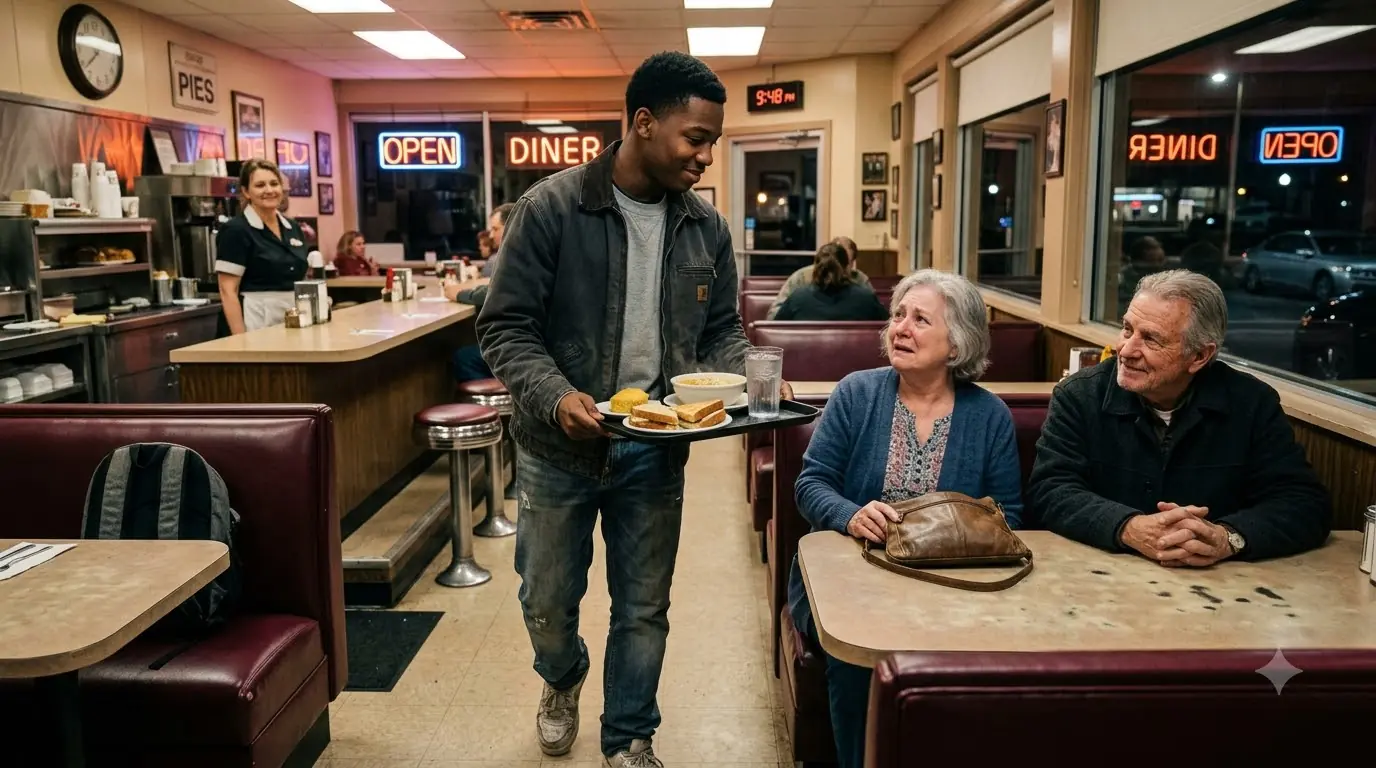
The woman started crying. They had not eaten since breakfast.
Without thinking, Jamal walked to the counter.
“Put their meal on my tab.”
$20.50.
Everything he had was gone.
The old man tried to protest.
“Son, we can’t let you.”
“It’s okay,” Jamal said quietly. “We all need help sometimes.”
He had no idea who they really were.
No idea the man’s expensive watch meant anything. No idea that tomorrow morning, they would be standing at his door.
No idea that giving up his last dollar would bring him a fortune he never dreamed of.
Because sometimes, when you sacrifice everything for strangers, the universe has a way of rewarding that kindness.
But first, you need to understand just how much that $8.50 meant to Jamal.
Every morning at 5:00 a.m., Jamal Williams woke up in a cramped apartment on Maple Street. The first thing he did was not check his phone. It was check on his grandmother, Ruby.
“Morning, Grandma. Time for your medicine.”
Ruby was seventy-two and diabetic. Her insulin cost $200 every month. Without insurance, every injection was a small fortune slipping away.
“Baby, you look tired,” she said, watching him prepare her shot. “Have you been sleeping?”
Jamal forced a smile.
“Plenty, Grandma.”
It was a lie.
He had been awake since three, calculating numbers in his head.
Rent: $850.
Three months overdue.
The eviction notice was still taped to their door.
Utilities: $120.
Also overdue.
Ruby’s medication: $200.
Groceries: whatever was left.
After taxes, Jamal made about $1,100 a month. They were always short, always behind.
At 6:00 a.m., he was at Murphy’s Auto Parts, earning $9 an hour, doing heavy lifting in oil-stained uniforms.
His supervisor, Dave, was decent enough.
“Jamal, you’re the most reliable kid I’ve got,” Dave often said. “I wish I could pay you more.”
But reliability did not pay the bills.
The work was hard. Jamal lifted engine blocks, loaded trucks, and carried parts that left his back aching constantly. Still, he never complained.
He never missed a shift.
Even when Ruby was hospitalized last month, he worked.
At 2:30 p.m., he clocked out and rushed to East Side Grocery. There, he earned $8.50 an hour bagging groceries, collecting shopping carts from the parking lot, and dealing with impatient customers who looked right through him.
“Cleanup spill on aisle three,” his manager called.
“Yes, sir.”
Always yes, sir.
Always polite.
Always invisible.
At 10:30 p.m., he was finally done. Sixteen hours, two jobs, and his feet throbbed in his worn sneakers. The soles had holes he had tried to patch with duct tape.
This was Jamal’s life.
Every day.
No weekends.
No breaks.
Ruby had raised him after his parents died in a car accident ten years ago. She had worked two jobs herself back then, cleaning offices at night and babysitting during the day.
Now it was his turn to take care of her.
She never complained about the pain. She never mentioned how the apartment was too cold in winter and too hot in summer. She never talked about the medications she skipped to save money.
“Baby, you got your daddy’s heart,” she told him. “Too big for this small world sometimes.”
Jamal’s dream sat in a notebook under his mattress.
Page after page of car designs, engine modifications, and fuel-efficiency improvements.
He used to study mechanical engineering at community college. He had made the dean’s list.
But when Ruby’s diabetes got worse, the choice was simple.
School or survival.
He chose her.
The $8.50 dinner at Rosie’s Diner was not just food. It was his one luxury every few days, a hot meal that reminded him of family dinners before everything fell apart.
Before his parents died.
Before the world became about counting every dollar.
Tonight, Tuesday, October 15, was supposed to be one of those nights.
He had calculated carefully.
$8.50 for the meatloaf special.
Exactly what he had after setting aside money for Ruby’s medicine refill tomorrow.
The walk to Rosie’s took fifteen minutes. His stomach had been growling for hours. He had coffee for breakfast and a granola bar someone left in the break room for lunch.
That was it.
The October air was cold, the first real chill of autumn. His jacket was thin, but it was all he had.
He pushed through the diner’s door, and the warmth hit his face like a blessing.
Diane, the night waitress, waved from behind the counter. She knew him, knew his order, and knew he counted his money carefully before ordering.
“The usual, honey?”
“Yes, ma’am. Meatloaf special.”
He found a booth near the window and pulled out his crumpled bills.
Eight ones.
Two quarters.
He counted them twice.
Perfect.
In a few minutes, he would have a hot meal. Mashed potatoes, green beans, cornbread. It would be the first real food he had eaten in two days.
He did not know that in the corner booth, an elderly couple was about to change everything.
But what he was about to do next would prove that Ruby was right.
His heart really was too big for this small world.
And sometimes, that was exactly what the world needed.
Sitting twenty feet away, Harold and Margaret Peton were about to learn what true character looked like. They were about to reward it in ways Jamal never imagined possible.
But first, they needed help.
Desperate help.
And they were about to discover that help could come from the most unexpected places.
That Tuesday night, something was different at Rosie’s.
Something that would test Jamal’s character when he had nothing left to give.
Jamal settled into his booth, stomach cramping with hunger. The meatloaf special smelled incredible from the kitchen.
$8.50.
Worth every penny he did not have.
That was when he noticed them.
An elderly couple sat in the corner booth. The man wore a heavy winter coat that had seen better days. The woman clutched a worn leather purse against her chest.
They were whispering urgently over a single menu.
Harold looked to be in his early seventies, with gray hair and weathered hands. Margaret appeared slightly younger, with kind blue eyes that reminded Jamal of his grandmother.
They ordered carefully.
One bowl of soup.
One sandwich.
“We’ll split it,” Margaret said quietly to Diane. “That’ll be enough.”
Twelve dollars total.
A modest meal for two people.
Diane brought their food. Steam rose from the bowl of chicken soup. The sandwich looked thick with turkey and cheese.
Harold reached for his wallet with confident hands. He pulled out a credit card and slid it to Diane.
A moment later, Diane returned.
“I’m sorry, sir,” she said gently. “This card was declined.”
Harold’s face reddened slightly.
“Oh. Let me try another.”
Second card.
Same result.
“Declined again, sir.”
Margaret’s hands started shaking. She opened her purse and searched frantically through the contents.
Harold leaned across the table, whispering urgently.
“Check the account balance. There should be…”
“Harold,” Margaret interrupted, her voice strained. “We spent the last of it on gas to get here.”
Other customers began to notice.
A man at the counter turned to stare. A family with young children glanced over with curious eyes.
Margaret pulled crumpled bills from her purse.
Three one-dollar bills.
That was it.
“Ma’am,” Diane said gently, “the total is twelve dollars.”
Harold’s confident demeanor crumbled. His hands shook as he searched through his wallet again.
Credit cards.
An old insurance card.
No cash.
“We’re here to see our granddaughter,” Margaret explained, tears forming. “She’s in the hospital, critical condition. We drove forty miles, and…”
Her voice broke.
“We haven’t eaten since breakfast yesterday,” Harold admitted quietly. “We used our last cash for gas. Visiting hours end at eleven p.m.”
Jamal glanced at the clock.
9:40 p.m.
Twenty minutes to get to the hospital.
“Maybe we should just go,” Margaret whispered. “Little Emma will understand.”
“No,” Harold said, his voice cracking. “She’s been asking for us all day. The doctor said this might be our last chance to see her awake.”
Margaret started crying softly.
“I’m getting dizzy, Harold. I need to eat something.”
The weight of their situation hit everyone nearby.
An elderly couple stranded forty miles from home. No money, no food, a dying granddaughter waiting for them.
Diane shifted uncomfortably.
“I’m sorry, folks. I wish I could help, but…”
“We understand,” Harold said with dignity. “Come on, Margaret. We’ll figure something out.”
They started to stand.
Margaret swayed slightly, weak from hunger. Harold steadied her with a gentle hand.