Snow had been falling over Pine Ridge since before sunrise when Hannah Stoltzfus struggled across the settlement carrying a flour sack almost as wide as her chest. At twenty-four years old and weighing close to three hundred kilograms, she had long ago become accustomed to people turning their heads when she passed, though she had never grown accustomed to what they said after turning them. Her gray dress dragged through the snow, her white apron was dusted with flour, and the cold had painted both of her cheeks crimson beneath the edge of her bonnet. She kept walking because stopping meant hearing the laughter more clearly.
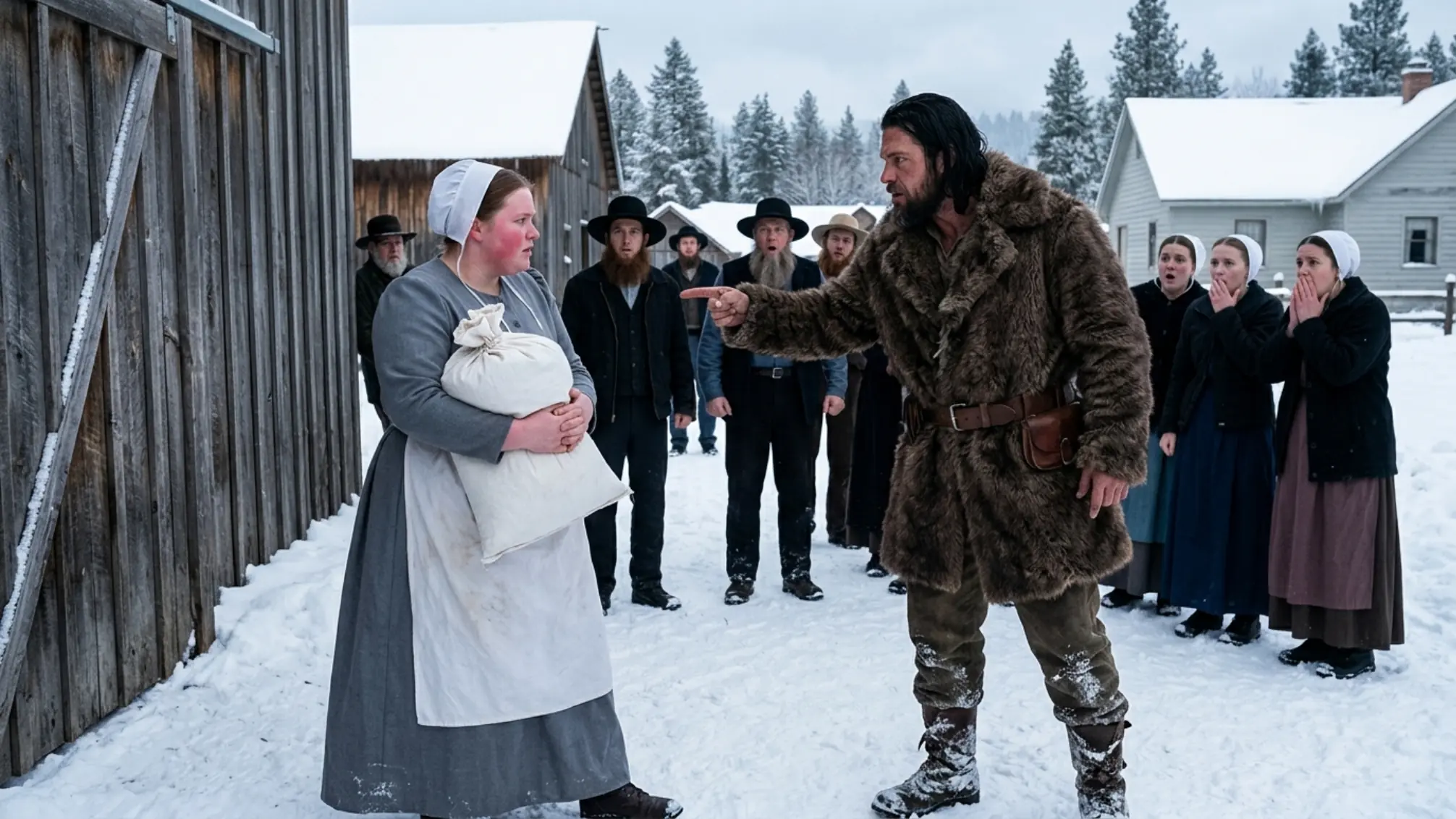
Three young men stood outside the cooper’s workshop watching her approach. One whispered something about the wooden bridge having survived another test, and the others laughed loudly enough that Hannah knew the cruelty was meant to reach her. She tightened her arms around the flour sack and stared toward her father’s house at the far end of the street. Another hundred yards, she told herself, and she could disappear inside.
A horse suddenly stepped between Hannah and the men.
The animal was enormous, black as coal, with frost clinging to its mane. Its rider was even more imposing, a broad man wrapped in layers of dark wolf and elk pelts, his shoulders so wide they nearly concealed the saddle beneath him. He had shoulder-length black hair, a heavy beard marked with streaks of frost, and piercing blue eyes set inside a weathered face that looked carved rather than born.
Everyone in Pine Ridge knew the stories about Caleb Montgomery.
He lived somewhere high in the Bitterroot Mountains where ordinary settlers rarely traveled. Some claimed he trapped wolves with his bare hands, others said he owned enough gold to buy half the valley, and a few insisted he had spent so many years alone that he had forgotten how to speak to women. What nobody disputed was that Caleb avoided Pine Ridge whenever possible.
Yet that morning he dismounted directly in front of Hannah.
She froze.
Caleb looked at the flour sack, then at Hannah.
Without asking permission, he took the sack from her arms as though it weighed nothing.
“I can carry it,” Hannah said.
“I know.”
His answer confused her.
Behind them, one of the young men snickered. “Careful, Montgomery. She might think you’re courting her.”
Caleb turned slowly.
The smile disappeared from the man’s face.
Caleb carried the flour sack toward Hannah’s father’s wagon and placed it inside. Then he returned until he stood directly in front of Hannah, his heavy fur coat moving in the winter wind. Villagers began emerging from shops and houses, sensing that something unusual was happening.
Hannah looked up at him.
Caleb raised one scarred hand and pointed directly toward her.
“By spring you’ll birth me three sons.”
The entire street went silent.
Hannah stared at him in disbelief.
“I will not.”
Someone in the crowd gasped.
Caleb stepped closer, apparently unable to understand why his declaration had failed.
“You will. It’s your duty.”
Hannah’s humiliation instantly transformed into anger.
She had spent years enduring comments about her body from men who believed marriage gave them permission to evaluate women like livestock. She had been rejected by every unmarried man her father approached, had heard whispers that no husband would ever want her, and had watched younger women disappear into new homes while she remained behind. She would not trade one kind of humiliation for another simply because this man was large enough to frighten everyone else.
Hannah stepped closer to Caleb.
“If you want me, Caleb Montgomery, learn the difference between a wife and property.”
Several villagers made nervous sounds.
Nobody spoke that way to Caleb.
He stared at Hannah for several long seconds.
Then something extraordinary happened.
The mountain man nodded.
“All right.”
Hannah blinked.
Caleb turned toward the young men who had mocked her.
“She said no.”
His eyes hardened.
“So no man here will speak of her as if she has no choice again.”
The statement quieted the street more effectively than a gunshot.
Hannah watched Caleb walk toward his horse, wondering whether the strangest confrontation of her life had just ended. Instead, he removed a leather pouch from one saddlebag and headed toward her father’s house. Hannah followed partly from curiosity and partly because she no longer trusted anyone in Pine Ridge to discuss her future without her presence.
Her father, Abraham Stoltzfus, opened the door reluctantly.
Caleb placed the leather pouch on the kitchen table.
Raw gold pieces spilled across the wood.
Abraham’s mouth opened.
Hannah’s stomach tightened.
“I came for permission to court your daughter,” Caleb said.
Abraham looked at the gold rather than Hannah.
“You can marry her.”
Hannah felt something inside her break.
Her father had not asked whether she wanted Caleb. He had not asked what kind of man Caleb was or where he intended to take her. The gold had answered every question that mattered to him.
Caleb noticed.
He slowly pulled the pouch back toward himself.
“I asked permission to court her.”
Abraham frowned. “I said you may have her.”
“She isn’t yours to give.”
Hannah looked sharply at Caleb.
Her father’s face reddened.
“In this house—”
Caleb stood.
The entire kitchen suddenly seemed smaller.
“I came here because I was told your customs mattered to Hannah.”
He pushed the gold back into the pouch.
“I won’t buy her.”
Hannah had expected many things from the mountain man.
That was not one of them.
Caleb turned toward her.
“I have a cabin four days into the mountains. Land, livestock, food, enough wood for ten winters, and no woman there telling me when my manners are terrible.”
Despite herself, Hannah nearly smiled.
“They are terrible.”
“So I’ve learned.”
Caleb looked uncomfortable for the first time.
“Come with me if you want.”
Hannah looked at her father.
Abraham had already turned toward the gold pouch, clearly disappointed it was leaving.
That decided more than Caleb ever could.
“I’ll go.”
They left Pine Ridge the following morning.
Hannah packed two dresses, her mother’s Bible, sewing needles, a wooden comb, several family photographs, and the quilt her grandmother had made before Hannah was born. Her father gave her no embrace. Her youngest sister Ruth secretly slipped bread into Hannah’s bag and whispered that perhaps the mountains would be kinder than Pine Ridge.
Hannah climbed onto Caleb’s large freight sled.
The people who watched them leave expected her to return within days.
Some even wagered on it.
The first day was deceptively easy. The sled followed a logging road through open valley country while Caleb drove the horses and Hannah watched Pine Ridge disappear behind them. He spoke little, but whenever they stopped he checked that she had enough blankets and brought hot coffee from a metal pot.
The road became increasingly difficult on the second day.
Snow covered the trail.
Sometimes Caleb walked ahead, guiding the horses through drifts while Hannah remained on the sled. Other times fallen trees forced them to continue on foot.
Hannah struggled.
Her weight made every climb harder, and years of being protected from difficult physical work by relatives who considered her incapable had left her endurance lower than she wished to admit. By afternoon she was breathing painfully, and after slipping twice she finally collapsed against a pine trunk.
“I can’t.”
Caleb stopped.
Hannah expected impatience.
Instead, he knelt in the snow.
“We rest.”
“You’ll lose daylight.”
“Daylight comes back tomorrow.”
She looked at him.
“I’m slowing you down.”
“Yes.”
The answer stung.
Caleb continued before she could look away.
“So?”
Hannah frowned.
“You’re not angry?”
“Why?”
“Because I’m a burden.”
His expression changed.
“Who told you that?”
She laughed bitterly.
“Everyone.”
Caleb sat beside her in the snow.
“You carried a hundred-pound flour sack through town while three healthy men laughed instead of helping.”
“It wasn’t a hundred pounds.”
“Ninety?”
“Perhaps.”
“You carried it.”
Hannah looked down.
Caleb touched the frozen ground.
“Mountains don’t care whether somebody is pretty.”
She looked at him.
“They care whether you keep moving.”
His voice softened.
“You’re not a burden, Hannah.”
No one had ever said those words to her.
She turned away because tears embarrassed her more than exhaustion.
Caleb pretended not to notice.
The cabin they reached on the fourth evening could hardly be called a cabin. It was a large two-story lodge built from thick pine logs, surrounded by barns and enclosed pasture beneath towering peaks. Smoke curled from a chimney, and several horses approached the fence when Caleb called.
Hannah stepped from the sled.
“This is yours?”
“Ours, if you stay.”
The answer warmed her despite the freezing air.
Inside, the lodge smelled of cedar and smoke. Caleb showed Hannah a bedroom with a large wooden bed, quilts, a stove, and a window overlooking the valley. His room was across the hallway.
Hannah looked between the doors.
“We aren’t sleeping together?”
Caleb nearly dropped her trunk.
“You told me I don’t understand the difference between a wife and property.”
Hannah waited.
“I’m learning.”
For the first time since leaving Pine Ridge, she laughed.
Life on Montgomery Mountain was unlike anything Hannah had known.
Caleb never measured her portions at meals. He never watched what she ate or suggested that hunger was a moral failure. When she struggled with stairs or long walks, he neither mocked nor pretended not to notice; he simply found practical ways to make things easier while encouraging her to become stronger.
Hannah began managing the cabin almost immediately.
Caleb could hunt, trap, repair roofs, shoe horses, build furniture, and survive weather that would kill ordinary men. He could not bake bread properly, keep financial records organized, or remember that vegetables existed. Within two weeks Hannah had transformed the kitchen.
Caleb gained weight.
Hannah teased him relentlessly.
“You’ll be the one Pine Ridge laughs at next.”
He looked at his stomach.
“Worth it.”
Their affection grew in small ways.
Caleb brought her branches of winter berries because flowers were buried under snow. Hannah repaired the torn lining inside his fur coat and embroidered a tiny pine tree where the stitching had been. They spent evenings beside the fireplace while he carved animals and she read aloud.
One night Hannah finally asked about the three sons.
Caleb almost choked on his coffee.
“You remember that?”
“The whole valley probably remembers it.”
He rubbed his beard.
“I had been alone too long.”
“That explains very little.”
Caleb looked toward the fire.
“My father had three sons.”
Hannah knew Caleb had no brothers.
He explained that both had died young during a fever outbreak. His mother never recovered from losing them, and after his parents died, Caleb had remained alone on the mountain for nearly eleven years. He had always imagined rebuilding the family his parents had lost.
“But why tell me I would give you three?”
Caleb looked genuinely embarrassed.
“I thought declaring intentions clearly was respectful.”
Hannah stared at him.
Then she laughed until tears ran down her face.
Caleb eventually laughed too.
Weeks passed.
Their marriage became official through a small ceremony performed by a traveling minister who occasionally crossed the mountain route. Caleb did not speak about children again until Hannah told him she wanted a family too. This time he asked rather than declared.
Winter deepened.
Then the first warning arrived.
Caleb discovered unfamiliar tracks near an old mine entrance two miles above the lodge. The prints belonged to at least four horses. Hannah watched him examine them before asking why anyone would climb that far into the mountains during a storm.
Caleb hesitated.
“Gold.”
She remembered the pouch he had shown her father.
“How much gold?”
“Enough to attract stupid men.”
He explained that his grandfather had discovered several gold deposits beneath Montgomery Mountain. Caleb mined only small quantities when necessary, preferring trapping, timber, and livestock because gold attracted exactly the kind of trouble his family had spent decades avoiding. Few people knew the location of the tunnels.
Someone in Pine Ridge had apparently started talking.
The likely source revealed himself a week later.
Jonas Beiler, the bishop’s eldest son, arrived at the lodge accompanied by two men.
Hannah knew Jonas well.
He had once told her father that marrying Hannah would require more sacrifice than God expected from any man. Now he stood smiling outside her new home as if that insult had never happened.
“We came to see whether Hannah is safe.”
Caleb stood in the doorway.
“She is.”
Jonas looked past him.
Hannah appeared.
Jonas’s eyes moved across the lodge interior, clearly calculating its value.
“You’ve done well for yourself.”
Hannah immediately understood.
He was not there for her.
“You saw the gold.”
Jonas smiled.
“Your husband flashed enough wealth around Pine Ridge to interest people.”
Caleb stepped outside and closed the door behind him.
“My property isn’t for sale.”
“We didn’t ask to buy it.”
“That concerns me more.”
Jonas’s smile vanished.
Caleb ordered them off the mountain.
They left.
But Hannah knew they would return.
That night, she asked Caleb whether they should leave.
He looked surprised.
“Do you want to?”
Hannah walked to the window.
Below them, moonlight covered the valley where she had begun to feel like a human being rather than an inconvenience. The kitchen was hers, the bedroom was hers, the horses recognized her voice, and the man standing behind her had never once asked her to become smaller so he could love her.
“No.”
Caleb came beside her.
“Neither do I.”
Three nights later, the dogs began barking shortly after midnight.
Caleb was out of bed before Hannah understood what was happening.
A window shattered downstairs.
Gunfire followed.
Caleb pushed Hannah behind the stone fireplace as bullets tore through the front wall. Men shouted outside, demanding the mine maps and threatening to burn the lodge.
Jonas had returned with six armed men.
Caleb fired through a broken window.
One attacker fell into the snow.
Another shot struck Caleb in the shoulder.
Hannah screamed.
Caleb dropped behind the table, blood immediately soaking through his shirt.
“Upstairs,” he ordered.
“No.”
“Hannah!”
For once she ignored him.
A man smashed through the kitchen entrance.
He was smaller than Caleb but carried a revolver.
When he saw Hannah standing beside the fireplace, he laughed.
“Look at that.”
Hannah recognized him as one of the men who had watched her leave Pine Ridge.
“The mountain giant bought himself a shield.”
He stepped toward her.
Caleb tried reaching for his rifle.
The attacker kicked it away.
“Stay down.”
Then he turned toward Hannah.
“Move, woman.”
Hannah did not.
He grabbed her arm.
Years earlier Hannah would have frozen.
Years of insults had taught her to retreat, apologize, and make herself smaller whenever someone became angry. But Caleb’s blood was spreading across the floor behind this man.
Something inside her changed.
Hannah seized his wrist with both hands.
The man’s expression shifted.
He tried pulling free.
He could not.
Hannah had spent months hauling wood, carrying water, kneading heavy dough, feeding livestock, and climbing mountain trails. Beneath the body everyone mocked was strength the man had never considered.
She drove her shoulder forward.
The attacker crashed backward into the kitchen table.
The table collapsed.
His revolver slid across the floor.
Hannah kicked it toward Caleb.
Caleb grabbed it with his uninjured hand.
“Out.”
The attacker froze.
Caleb pointed the weapon toward the door.
“Now.”
The man ran.
Outside, Jonas heard the commotion and ordered his remaining men forward.
Hannah barred the kitchen door.
Caleb staggered to his feet.
“You were supposed to go upstairs.”
“You were supposed to avoid getting shot.”
“Fair.”
Another bullet struck the wall.
Hannah looked toward the wood stove.
Beside it sat a large iron pot filled with boiling water they had prepared for washing the following morning.
She and Caleb looked at each other.
He understood immediately.
When two men forced the kitchen door partly open, Hannah threw the steaming water across the floor directly in front of them. The men stumbled backward, shouting, giving Caleb enough time to fire into the ceiling above the doorway.
“Next one isn’t a warning!”
Silence followed.
Jonas shouted from outside.
“You can’t stay in there forever!”
Hannah opened a narrow window.
“Neither can you.”
Jonas laughed.
“What are you going to do?”
Hannah looked toward the barn.
A lantern hung beside stacked hay.
Then she noticed something better.
Caleb followed her gaze toward the ridge above Jonas’s men.
Earlier that afternoon, snow had begun cracking along the steep slope.
Caleb’s face changed.
“Hannah.”
She understood.
The attackers had positioned their horses directly below an unstable snow shelf.
Caleb fired his rifle toward a dead pine on the upper slope.
The first shot missed.
The second shattered a heavy branch.
It crashed into the snowpack.
A deep crack rolled across the mountain.
Jonas looked upward.
The snow shelf broke.
It was not a massive avalanche capable of destroying the lodge, but several tons of loose snow thundered down the narrow slope directly toward the attackers’ horses. Men scattered in panic as animals tore free from their reins.
Within seconds, Jonas’s carefully planned assault became chaos.
Two men fled downhill.
Another surrendered.
Jonas ran toward the trees.
Caleb could barely remain standing.
Hannah caught him before he fell.
“You are not dying after making me climb this mountain.”
Caleb managed a weak smile.
“That sounded like an order.”
“It is.”
She helped him onto the bed.
The bullet had passed through the upper shoulder without striking bone.
Hannah cleaned and bandaged the wound using supplies Caleb kept for hunting accidents. By sunrise, three attackers had abandoned Jonas entirely and returned asking for shelter because their horses were gone.
Caleb wanted to send them downhill.
Hannah gave them breakfast first.
That decision proved important.
One of the men confessed everything.
Jonas had promised them a share of Montgomery gold. He possessed a stolen map showing the entrance to one of Caleb’s oldest tunnels and intended to kill Caleb, claim he had disappeared during winter, and present forged papers suggesting Caleb had sold him the property.
Hannah listened carefully.
“Where are those papers?”
The man pointed outside.
“Jonas carried them.”
Searchers from Pine Ridge arrived two days later after the surrendered attackers reported what had happened. Jonas was captured near a logging camp suffering from frostbite and carrying both the forged deed and Caleb’s stolen mine map. Even the bishop could not protect his son after witnesses testified to attempted murder.
Jonas eventually faced territorial charges for armed robbery, attempted murder, forgery, and conspiracy.
Pine Ridge reacted differently to Hannah’s return.
When she accompanied Caleb into town several weeks later, conversations stopped.
The men who once laughed at her now stepped aside.
One asked whether the story was true that she had thrown a grown outlaw across a table.
Hannah looked at Caleb.
“He slipped.”
Caleb nodded solemnly.
“Very slippery floor.”
Their laughter followed them into the general store.
Spring arrived slowly.
Snow melted from the lower valley, rivers swelled, and the first green shoots appeared beside the lodge. Caleb’s shoulder healed, though Hannah continued ordering him away from heavy work long after he insisted he was perfectly capable.
Then Hannah began feeling ill.
At first she blamed preserved meat.
Then exhaustion.
Finally Caleb rode nearly two days to find a midwife.
The older woman examined Hannah while Caleb paced outside like a trapped bear.
Eventually the bedroom door opened.
Caleb stood immediately.
The midwife stared at him.
“You made some kind of prediction, I hear.”
Caleb’s face reddened.
Hannah began laughing from the bed.
The midwife shook her head.
“Three heartbeats.”
Caleb stopped breathing.
“Three?”
“Three.”
Months later, after a difficult pregnancy carefully watched by the midwife, three small boys were born safely at Montgomery Lodge.
Caleb cried openly when the first child was placed in his arms.
Hannah never allowed him to forget it.
“You cried harder than I did.”
“I had smoke in my eyes.”
“In the bedroom?”
“Terrible chimney.”
She laughed and kissed him.
They named the boys Samuel, Benjamin, and Eli.
Word reached Pine Ridge within days.
Nobody believed it until the midwife personally confirmed the story.
The joke that had begun in the frozen street became a legend repeated throughout the valley.
Yet Hannah disliked the version people preferred.
They said Caleb Montgomery had looked at a woman nobody wanted and somehow known she would give him three sons.
That was not what mattered.
The important part was what happened after Hannah told him no.
Caleb listened.
He changed.
He learned that loving Hannah did not mean rescuing her from herself. It meant respecting the person who had survived years of ridicule without becoming cruel.
Hannah changed too.
For most of her life she believed strength belonged to other people, particularly people whose bodies looked nothing like hers. The mountain taught her otherwise. Strength was carrying water when your legs hurt, standing between danger and someone you loved, surviving humiliation without surrendering your kindness, and finally believing you deserved a life that did not require apology.
Years later, Pine Ridge children would stare whenever the Montgomery family descended from the mountain.
Caleb remained enormous and intimidating.
Hannah remained a very large woman and never tried hiding it.
Three boys usually ran around them like wolves freed from a cage.
Whenever someone asked Caleb whether he had truly predicted the triplets that first winter, Hannah answered before he could.
“No.”
Caleb looked offended.
“I had confidence.”
“You had terrible manners.”
“They improved.”
“Eventually.”
Then Caleb would place one arm around his wife.
The people who had once called Hannah too big to love eventually learned that her size had never been the tragedy.
Their cruelty had been.
Jonas Beiler believed Hannah was helpless because everyone had trained him to see her body before seeing the woman inside it.
Caleb made the opposite mistake at first, believing strength gave him the right to decide her future.
Hannah corrected both men.
One learned too late.
The other listened in time.
And every spring, when the last snow melted from Montgomery Mountain, Caleb brought Hannah to the porch where they could watch their three sons racing through the grass below.
Sometimes he reminded her of the first words he ever spoke to her.
Hannah always rolled her eyes.
Then Caleb would smile, kiss her forehead, and admit what Pine Ridge never understood.
His impossible prophecy was never the moment their story truly began.
Their story began with Hannah’s answer.
“I will not.”
Because that was the first moment Caleb Montgomery realized the woman everyone called unwanted did not need a man to command her.
She needed one strong enough to respect her.