“Sir, can I sit with you just until my leg stops shaking?”
Jacob “Jake” Morrison said it like a prayer he was not sure he deserved to say out loud. His voice did not crack because he was being dramatic. It cracked because he was nine years old and running on fumes.
The place was called Penny’s Harvest Diner, a little off the highway outside Marshfield, Missouri. It was clean enough to feel safe, busy enough to disappear inside, and loud enough that a kid could ask for help without drawing a spotlight.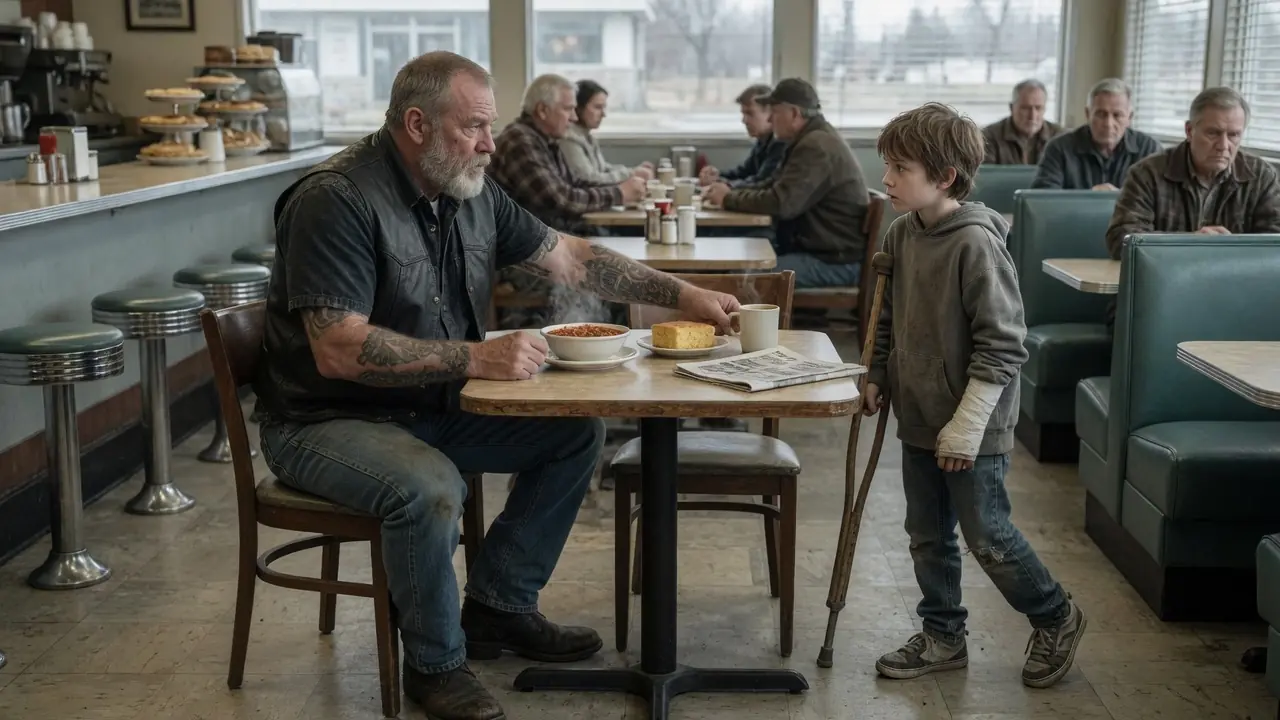
That was the plan, anyway.
Jake’s limp was not the kind a child could fake. One side of his body moved like it was carrying a secret weight. His right arm sat inside a faded, grimy cast covered in old signatures.
Names written months ago by kids who thought a cast was something fun. Not something that became a cage when nobody took you back to the doctor.
His sneakers were split at the toes and held together with strips of duct tape. His hoodie was two sizes too big. His face looked like a kid who had stopped expecting good news.
He stepped inside and froze for half a second. His eyes darted around the room, counting exits, adults, and threats.
Because the first ten seconds mattered.
If someone recognized him before he found the right table, he would be dragged back like a runaway dog.
Ten seconds. That was all Jake gave himself. Ten seconds to pick the safest stranger in the room.
He tried the nearest booth first. Two men in work shirts sat over plates of food, laughing loud enough to pretend nothing bad ever happened in the world.
Jake took one careful step closer, opened his mouth, and one of them turned his shoulder like a door shutting.
“Not today, kid,” the man said without looking him in the eye.
Jake nodded like he understood, like rejection was just weather.
At the second booth sat an older woman with a bun and a grandchild across from her, crayons scattered across the table. The child looked up, curious.
The grandmother saw Jake’s cast, saw his limp, and her smile faded into something guarded.
“Sweetheart, we’re waiting on somebody,” she lied quickly, pulling the child’s coloring page closer as if it needed protecting.
At the third table were three church ladies with iced tea and bright smiles that turned hard the second Jake approached.
One of them did not even whisper.
“Where are his parents?”
She said it like Jake was a nuisance someone had forgotten to supervise.
His cheeks heated. His fingers curled around the small thing in his pocket: a brass motel key tag stamped with a room number, heavy and cold, like it did not belong to a child at all.
He did not pull it out.
Not yet.
That key tag was his proof, his panic button, his last card, and he did not know who had earned the right to see it.
Then he turned toward the back corner.
That was when the room changed, and most people did not even notice they were the reason.
The corner table was not a booth. It was a small square table meant for two, occupied by one man who looked like trouble in a leather vest.
Big shoulders. Short gray beard. Tattoos crawling up his arms like old stories nobody asked him to tell. A scar ran along one knuckle like he had once hit something harder than bone.
His name was Marcus “Bull” Davidson, though the diner did not know that. They only knew his presence made people choose different seats.
Bull was not doing anything wrong. He was eating chili and cornbread, sipping coffee, and reading a folded local paper like a man trying to be invisible on purpose.
But the patch on his vest, Iron Angels Motorcycle Club, made polite people forget their manners.
Jake did not walk toward him because he wanted danger.
He walked toward him because danger was honest.
The other tables had smiled first and then shut him out. Bull looked like he would never bother smiling for show.
Jake stopped beside the table, close enough that Bull could see the grime at the edge of the cast, the faint bruise on Jake’s neck, and the way the boy’s knee trembled like his body was begging to sit before it gave out.
Jake swallowed hard.
“Sir, can I sit with you? Nobody else will.”
Bull did not do the thing adults do when they pause to measure the social cost of kindness. He did not scan the diner for witnesses. He did not look away and pretend he had not heard.
He reached down with his boot and nudged the empty chair out gently, like he was sliding a lifeboat across water.
“Sit,” he said, his gravel voice soft. “You’re okay right here.”
Jake’s shoulders dropped like someone had cut a rope.
But when he tried to lower himself into the chair, his bad hip caught. Pain flashed through him, and his balance slipped.
His crutch clattered to the tile.
Heads snapped up across the diner like a flock of birds.
In that instant, Jake’s eyes widened with the oldest kind of panic. What he did not know was that the sound of that crutch hitting the floor had just bought him attention he could not afford.
Bull stood so fast the chair legs scraped the tile. He caught the crutch, set it upright, and steadied Jake with one hand at his elbow.
“You’re good,” Bull murmured low enough that only Jake could hear. “Nobody’s touching you.”
Bull sat again, slower this time, and Jake finally eased into the chair like it was made of glass.
A waitress in her sixties hovered near the counter, pretending to wipe the same spot twice. Her name tag said Darla. Her eyes kept flicking from the kid to Bull like she did not know which part was more dangerous: the biker, or the fact that the biker was about to care.
Bull lifted two fingers in a small signal.
“Ma’am,” he called, polite as Sunday. “Bring him something he can actually eat. Not a snack. A meal.”
Darla approached cautiously, but not rudely.
“What do you have, honey?”
Jake stared at the laminated menu like it was written in a foreign language.
Bull did not look at the menu.
“Grilled cheese, fries, and a chocolate shake. Fast, please.”
Darla nodded and disappeared.
Jake kept his hands in his lap, shoulders tight, eyes flicking toward the windows like he expected someone to burst in at any second. He was counting time again.
Before 5:30. Before his uncle sobered up. Before somebody noticed he was gone. Before the wrong phone call got made.
Bull watched him the way soldiers watch a quiet road: still, alert, reading everything.
“Name?” Bull asked.
Jake hesitated.
“Jake. Jacob Morrison.”
Bull nodded once, like he was filing it somewhere permanent.
“I’m Bull.”
Jake’s lips parted like he almost asked if that was a joke. He did not. He looked down instead.
Bull’s eyes landed on the cast.
“How long you been in that thing?”
“Long,” Jake whispered.
“Long like two weeks, or long like somebody stopped taking you places?”
Jake did not answer.
He did not have to.
That was when Bull noticed the wrist. Not the bruises first. The grip marks. Fading fingerprints around the left wrist, like someone had held him too hard and too often.
Bull’s jaw tightened once.
The food came fast, like Darla had been waiting for an excuse to do the right thing. Jake stared at the plate as if it might vanish if he blinked.
“Eat,” Bull said simply. “It’s not a trick.”
Jake took one bite. Then another. Then the kind of bite you take when you do not know when you will be allowed to eat again.
He was not messy. He was fast, controlled, quiet.
Survival had taught him how to make food disappear without making noise.
Bull did not push yet. He let the kid’s hands stop shaking first.
When the shake arrived, Jake wrapped both hands around the glass like it was warmth.
Then finally, Jake said the sentence that did not belong in a diner at all.
“I’m not supposed to be here.”
Bull leaned in slightly.
“Where are you supposed to be?”
Jake’s eyes glistened. He tried to swallow it back, but it did not go.
“At home,” he said. “With my uncle.”
Bull did not react big. No cursing. No theatrics. Just a steady look that said, keep going.
Jake’s voice dropped into a whisper that felt like it had claws in it.
“I can’t go back. He’s trying to make it look like I won’t make it.”
The air around their table felt thicker.
A fork paused somewhere behind them. A laugh died halfway through. People heard enough to understand, and suddenly their pancakes did not taste the same.
Bull kept his voice calm.
“Tell me why you believe that.”
Jake reached into his hoodie pocket with his good hand and pulled out the brass motel key tag. The number stamped into it caught the light.
“I took this,” Jake said, trembling. “Because he said it on the phone in that room, and I heard it.”
Bull did not touch the key tag yet. He just looked at it like it was a warning placed on the table.
Jake’s words came faster now, like once the door cracked open, the truth shoved through.
“He hurt my hip,” Jake said. “He said I fell. He locks the pantry. He locks my door from the outside. He took me out of school. Said he was homeschooling, but he doesn’t teach me. He just leaves me there.”
Bull’s eyes stayed on Jake’s face. Not the diner. Not the people listening. Not the judgment.
Only the kid.
Jake’s lower lip shook.
“I heard him say, if I don’t make it through the winter, he gets the money.”
Bull’s voice stayed level, but something inside it sharpened.
“What money?”
Jake squeezed the key tag until his knuckles went white.
“My parents died,” he whispered. “Car wreck last year. There’s insurance. Trust money. My uncle gets some now and controls the rest.”
Bull nodded slowly.
“And he spent it,” Jake added, like he had learned to recognize adult desperation. “He’s always mad about money. Always on the phone. And he said, if it looks natural, nobody asks questions.”
Jake’s eyes finally met Bull’s.
There was a kind of pleading there that did not ask for pity.
It asked for belief.
“The police came once,” Jake said. “He smiled at them. They looked at me like I was lying. Everybody believes him.”
Bull exhaled carefully, like he was holding a storm behind his ribs.
“How long since you ate a full meal?”
Jake blinked, ashamed.
“I don’t know. Maybe three days. Four.”
“And your room?” Bull asked. “Is it warm?”
Jake shook his head once.
“It’s the garage. The heater doesn’t work.”
Bull’s chair shifted as he stood, slow and deliberate, so Jake would not panic.
Jake still panicked.
His hand shot out and grabbed Bull’s wrist like a lifeline.
“Don’t leave,” Jake whispered. “Please.”
Bull immediately lowered himself until he was eye level with the boy. His big hand did not grab Jake’s. It covered it. Steady, gentle, definite.
“I’m not leaving,” Bull said. “Hear me? Not you. Not today.”
Jake’s breath hitched.
Bull’s voice turned even quieter.
“You were brave enough to sit at my table. Now I’m going to be brave enough to do what the rest of the world didn’t.”
Bull looked at the key tag again, then at Jake.
“You keep eating. You keep breathing. I’m going to make one call.”
Bull stepped outside into the parking lot, where the wind had teeth. He pulled out his phone and scrolled to a contact labeled Stone.
Dean “Stone” Mercer, the Iron Angels chapter president, picked up on the second ring.
“Bull,” Stone said. No greeting. Just presence. “You okay?”
Bull’s voice was flat with focus.
“Got a kid inside. Nine years old. Hurt. Hungry. Says his guardian is setting him up to die for a payout.”
A beat of silence.
Then Stone asked the only thing that mattered.
“Where are you?”
“Penny’s Harvest Diner off the highway.”
Stone did not ask for the whole story on the phone. He did not ask if Bull was sure. He did not ask if this was their business.
“How many minutes do you need?”
Bull looked through the diner window. Jake was still eating, eyes darting, trying to believe.
“Ten.”
Stone’s voice hardened like cooled steel.
“You’ll have headlights in five.”
Bull ended the call and stood there in the wind while the sky dimmed toward evening.
That was when the rumble started.
Not loud at first. Just a low vibration you felt more than heard.
Because what Jake did not know yet was that the moment Bull made that call, the waiting was over.
The first bike rolled in like a low growl under the diner’s neon sign. Then a second. Then a line of headlights pulled in smooth and steady, not showing off, just arriving like men who knew how to create order without making chaos.
Stone Mercer came in last, not because he was late, but because leaders do not rush the door.
He killed the engine, took off his gloves, and scanned the windows once, taking inventory the way a man scans a room for exits and threats.
Inside Penny’s Harvest Diner, people suddenly became very interested in their coffee.
Forks slowed. Conversations lowered.
Not because the bikers looked angry.
Because they looked capable.
Bull was already waiting near the counter, half turned so he could see Jake’s table and the front door at the same time.
The kid sat with his shoulders tucked in, gripping his chocolate shake like it was proof the world could still give him something sweet.
Stone stepped in and did not make a speech. He did not have to.
The patch on his vest said Iron Angels, but his eyes said something else entirely: this is getting handled, and nobody needs to get hurt for it to happen.
Bull met him halfway.
“He’s the one,” Bull said quietly, nodding toward Jake. “Name’s Jacob Morrison. Says his uncle is Rick Holloway.”
Stone’s face did not change much, but his gaze sharpened.
“That the same Holloway who runs his mouth at council meetings?”
Bull gave a small, grim nod.
“The same.”
Stone did not walk straight to Jake and tower over him. He took a slow angle, stopped short, and lowered his body slightly.
It was subtle, but it mattered to a kid who flinched at fast adult movements.
“Jake,” Stone said, voice calm and grounded. “I’m Stone. Bull called me because he trusts me with hard things. Is it okay if I sit for one minute?”
Jake glanced at Bull first.
Bull did not nod dramatically. He just held Jake’s eyes and gave the smallest yes.
Jake swallowed and nodded once.
Stone sat with his hands visible.
“You did something brave today,” he said. “Now we’re going to do something smart. We’re going to keep you safe, and we’re going to make it stick.”
Jake’s lips trembled.
“People always…”
He stopped, like he did not want to sound like a kid complaining.
Stone finished it gently.
“People always believe the grown-up with the clean shirt.”
Jake looked at him.
“Yeah,” Stone said. “I know.”
That was when Jake pulled out the brass motel key tag again and held it out with shaking fingers like it weighed fifty pounds.
Stone did not take it yet.
“Tell me what that is.”
Jake’s voice went thin.
“He had it. I heard him in the hallway. He was in a motel. He said names. He said, when I’m gone, it gets split.”
The word gone landed heavy in that little diner.
Stone finally took the key tag carefully, like evidence, like a symbol, like a child’s trust being handed over.
He turned it over in his fingers.
Larkspur Motor Lodge. Room 12.
Bull murmured under his breath, more to Stone than to Jake.
“We’ve been hearing Larkspur come up lately.”
Stone did not react big, but his eyes slid to Bull.
“Gambling?”
Bull’s jaw tightened.
“And debt.”
Stone nodded slowly.
“Okay,” he said. “We’re not playing hero. We’re playing proof.”
He stood and motioned to two men who had entered behind him.
One was broad-shouldered with kind eyes and a medical bag slung over his shoulder. The other looked like someone who had worn a badge for a long time and missed it for exactly zero minutes.
“Doc,” Stone said. “Mason.”
Doc gave Jake a soft smile.
“Hey, buddy. I’m not here to poke you. I’m here to make sure you don’t get ignored again.”
Mason’s voice was steady and professional.
“Jake, I’m going to ask you questions the way a good investigator should have asked you the first time. You can say I don’t know. You can say stop. You’re in charge of your words.”
Jake blinked hard like he had never heard an adult say that to him.
Stone looked at Bull.
“Where are we on time?”
Bull checked his phone.
“About eighteen.”
Stone’s gaze flicked to the window, the parking lot, the highway beyond it.
“We’ve got a narrow window,” he said. “If Holloway realizes he can’t control the story, he’ll run to the nearest authority figure and paint the kid as unstable. We need to be first with facts.”
Then he leaned toward Bull and said the sentence that changed how the day would end.
“I want law enforcement arriving to us, not us chasing them.”
Bull nodded.
“Already called the sheriff’s non-emergency. Dispatch said a unit’s in the area.”
Stone’s mouth pressed into a line.
“Not good enough. Make it unavoidable.”
Mason took out his phone and stepped aside.
“I’m calling the state hotline and the county prosecutor’s office,” he said. “And I’m doing it on speaker.”
Doc crouched beside Jake’s chair.
“Can I look at your arm? Just look.”
Jake flinched, then glanced at Bull.
“He’s safe,” Bull said. “He’s checking. Not hurting.”
Jake nodded.
Doc examined the cast edges without pressing too hard. His expression stayed calm, but his eyes sharpened when he saw the irritated skin near the seam.
“This cast should have been changed a while ago,” Doc said softly.
Jake’s throat bobbed.
“He said it costs money,” he whispered.
Doc nodded like he had heard that line before from kids who did not know adults were lying.
“You did nothing wrong.”
Darla hovered again, wringing her hands in the way older women do when their hearts want to help but their lives have taught them to be careful.
Stone turned toward her.
“Ma’am, what’s your name?”
“Darla,” she answered cautiously.
“Darla,” Stone said. “We’re going to need the diner’s security footage from today, and we’re going to need you to tell an officer what you saw when this boy walked in.”
Darla’s eyes widened.
“I don’t want trouble,” she whispered.
Stone nodded once.
“Neither do we. We want safety. Trouble is already here. We’re just turning the lights on.”
Darla looked at Jake. Saw the cast. Saw the hunger. Saw the way his shoulders stayed braced like he expected pain.
Her chin lifted a fraction.
“Manager’s in the back,” she said. “I’ll get him.”
Mason’s call clicked on speaker.
Missouri child abuse and neglect hotline.
A voice answered.
Mason gave his name and credentials without bragging.
“I’m reporting imminent danger,” he said. “Nine-year-old male, Jacob Morrison. Suspected severe neglect and physical abuse. Guardian is Richard Holloway, forty-seven. There is an alleged financial motive involving life insurance and a trust.”
Jake’s eyes went wide at the word danger. He looked like he expected adults to laugh or dismiss it.
Instead, the woman on the hotline asked, “Is the child with you right now?”
Mason answered, “Yes.”
“Is the alleged abuser aware of the child’s location?”
“Not yet,” Mason said. “But he will be.”
That was when Stone glanced toward the window again.
Bull followed his eyes.
A clean black Ford F-150 rolled into the lot and stopped for half a beat, like the driver was checking for something. Then it pulled forward slowly, confidently, like it owned the place.
Bull’s voice went quiet in a way that carried threat without saying a threatening word.
“That’s him.”
Jake saw the truck through the window and went pale so fast it looked like the color had drained from his skin.
“He found me,” Jake breathed. “He found me.”
Stone did not move fast.
He moved certain.
“Bull,” Stone said, “stay with Jake.”
Then Stone stepped outside with Mason and two others. Not in a mob. Not in a wave. Just four men walking like they belonged to gravity.
Rick Holloway climbed out of the truck wearing pressed jeans and a clean pullover, the kind of outfit that screamed respectable man having a frustrating day.
He put on his smile before he even shut the door.
Stone noticed something else.
Rick’s eyes did not go to the diner sign first.
They went straight to the windows. Straight to the back corner. Straight to Jake.
That tiny detail was the first crack in Rick’s story.
Rick started toward the entrance like he intended to stroll in and collect his property. He barely made it three steps before Stone shifted one foot into his path.
Not aggressive.
Just present.
“Afternoon,” Stone said pleasantly. “Can I help you?”
Rick’s smile tightened.
“I’m here for my nephew,” he said, voice loud enough to sound concerned but not loud enough to make a scene. “He ran away. He’s confused. He has issues.”
Stone nodded slowly.
“What’s his name?”
Rick blinked, not because he did not know, but because he did not like being questioned.
“Jacob,” he said quickly. “Jake. Jacob Morrison.”
Stone did not argue.
“You’re his legal guardian.”
“Of course,” Rick snapped, then softened immediately. “Yes. Since his parents passed. Poor kid’s troubled.”
That was when Mason spoke, calm and professional.
“Sir, we’ve made reports. An officer is on the way. You can wait right here.”
Rick’s smile returned, but it did not touch his eyes.
“Reports,” he said, like the word was ridiculous. “This is absurd. He tells stories. He lies. He wants attention. He’s been through trauma.”
Stone nodded like he agreed with the concept of trauma.
“Yeah,” Stone said. “Trauma leaves marks.”
Rick’s gaze flicked down to Stone’s vest and back up. His mouth twitched, the first sign that his control was not perfect.
“You people,” Rick started, then caught himself. “Gentlemen, with all due respect, you’re not family. You’re not law enforcement. Step aside.”
Stone did not step aside.
“With all due respect,” Stone replied, “you don’t get to remove a terrified child from a public place while reports are active.”
Rick’s jaw flexed.
“Active reports?” he repeated louder. “Who filed?”
Then Rick did the one thing he never should have done in public.
He pointed at the diner door and said, “He belongs with me.”
Belongs.
Not, he is safe with me.
Not, I am worried about him.
Belongs.
Stone kept his face neutral, but his eyes went cold.
“A child isn’t a belonging,” Stone said softly.
Rick stepped closer, trying to intimidate with proximity.
“Move,” he said through his teeth.
Stone lifted his phone slightly. Not like a weapon. Like a mirror.
“Just so you know,” Stone said, “this is recorded.”
Rick froze for half a second.
That half second mattered, because it meant Rick understood the game had shifted from control to consequences.
He recovered fast.
“Fine,” he said. “Record all you want. I have nothing to hide.”
Stone did not argue. He simply held the space between Rick and the entrance.
“Wait right there,” Stone said. “Deputy will be here any minute.”
Rick’s nostrils flared. Then he tried a new tactic.
Sadness.
“My nephew is sick,” Rick said louder, making sure anyone walking by could hear. “He needs medication. He can’t be out in public.”
Stone glanced toward the truck.
“Where’s the medication?”
Rick blinked again.
“In the house,” he said too fast.
Stone nodded.
“So it’s not with the child. Interesting.”
Rick’s eyes flicked back to the windows again.
He was not worried about medication.
He was worried about time.
Inside, Bull had Jake pressed gently into the corner of the booth so the kid did not feel exposed.
“Listen to me,” Bull said. “You’re not going back out that door with him. Not today.”
Jake’s breathing went shallow.
“He’ll make them believe him.”
Bull’s eyes stayed locked on Jake’s.
“Not this time,” Bull said. “Because this time there are too many eyes open.”
Darla returned with the manager, a stocky man in his forties who looked like he wanted none of this until he saw Jake’s cast and the way the kid shook.
“We have cameras,” the manager said quietly. “Footage saves for thirty days.”
Stone stepped back inside long enough to call it clearly.
“Please save today’s footage and make a copy. Do not let anyone delete it.”
The manager nodded.
“Already doing it.”
Then a patrol car turned into the lot.
Rick’s smile came back like a mask snapping into place.
“Thank God,” he said loudly. “Officer, my nephew has been taken.”
The deputy stepped out, looked at the bikers, and his posture tightened automatically. His gaze slid to Stone’s vest, then to Rick’s clean clothes, then toward the diner.
Stone did not posture. He did not talk over anyone.
“Deputy, we have a child inside with visible injuries. He is alleging abuse and a financial motive. Reports are filed. We have a key item that may relate to a motel meeting. We have camera footage. We need a supervisor and a child advocate on scene.”
Rick opened his hands like he was the victim.
“This is insane,” he said smoothly. “He makes things up. He’s mentally unwell. He needs to come home.”
The deputy hesitated for just a flicker.
That was when Mason stepped forward.
“Deputy,” Mason said calmly, “if you let that child leave with him without checking the injuries, without a medical evaluation, and without documenting the environment he’s describing, you’re taking responsibility for the next outcome.”
The deputy’s jaw tightened.
“All right,” he said. “We’re doing this properly.”
Rick’s mask slipped again for one blink.
In that blink, he realized he was not in control anymore.
The diner door opened, and the deputy walked in to meet Jake Morrison.
Nine years old. Limping. Hungry.
And finally not alone.
The deputy did not start with the uncle’s smile.
He started with the boy’s eyes.
Jake sat frozen in the corner booth like the seat might disappear if he moved. When the deputy crouched to his level, Jake’s whole body flinched on instinct, then tried to pretend it had not happened.
“Jake,” the deputy said, steady and plain. “I’m not here to take you anywhere you don’t feel safe. I just need to understand what’s going on, okay?”
Jake’s gaze slid to Bull like a reflex.
Bull did not speak over him. He just stayed there, solid as a post.
“Tell the truth,” Bull said. “That’s all.”
Jake nodded once.
Outside, Rick Holloway kept talking like volume could turn a lie into fact. He insisted Jake was confused, that the bikers were influencing him, that he needed to come home.
But the deputy had already watched the diner manager pull up camera footage. He had seen Jake limp in like he was carrying pain in his bones.
He had seen Rick in the parking lot lock onto that back corner table like a hunter finding the only thing he came for.
And he had heard Rick say it clearly enough.
He belongs with me.
The deputy stepped outside, radioed for a supervisor, and said the sentence Rick Holloway did not expect to hear in public.
“Sir, you’re going to stand right here while we sort this out.”
Rick’s smile twitched.
“I haven’t done anything wrong.”
“Then you won’t mind waiting,” the deputy answered.
What Rick did not know was that the moment a supervisor came on route, the situation stopped being a misunderstanding and started becoming a case.
Inside, Doc kept his tone gentle while he looked at Jake’s cast and the irritated skin around it.
“We’re going to get you checked out tonight,” he told him. “Not later. Not next week. Tonight.”
Jake’s throat worked like he was trying not to cry in front of strangers.
“Is he going to be mad?” he whispered.
Bull’s answer came fast. It did not sound like a threat. It sounded like a fact.
“He doesn’t get a vote anymore.”
A social worker arrived within the hour. Then another deputy. Then a supervisor who walked in with the expression of someone who had seen too many kids swallowed by paperwork.
She sat near Jake, asked permission before she spoke, and listened without interrupting while he told the story in short bursts.
Because kids do not narrate pain like adults do.
They drop the pieces they can carry.
The garage room. The locked door. The pantry padlocks. The cold nights. The homeschooling that was really isolation. The cast that never got changed. The marks that came and went like weather.
And finally, the brass motel key tag.
Stone held it out to the supervisor like it was made of glass.
“He says he took this from Holloway’s pocket,” Stone explained. “Room number is on it. He overheard a call in the hallway.”
The supervisor did not dismiss it as imagination. She nodded, wrote it down, and asked Jake, “Do you know the name of the motel?”
Jake’s voice came out tiny.
“Larkspur. The tag says Larkspur.”
That small piece of metal changed everything.
It was not a feeling.
It was not a suspicion.
It was a thread they could pull.
The supervisor turned to the deputy.
“I want a welfare check and a scene assessment at the residence tonight. I want photographs. Proper ones.”
Rick heard that through the open door and lost his calm for the first time.
“No,” he snapped. “You can’t just— That’s my house.”
The deputy stepped closer.
“Sir, lower your voice.”
Rick tried to recover.
“He’s unstable,” he insisted, turning toward the supervisor like he could charm her too. “He lies. He wants attention.”
The supervisor did not look impressed.
“Then we’ll find out,” she said.
An ambulance arrived without drama, and Jake’s whole body tensed like sirens meant punishment.
Doc leaned close.
“This ride is for you,” Doc said. “Not because you did something wrong. Because you deserve medical care like any other kid.”
Jake stared at him like that idea was new.
Bull walked with Jake to the ambulance doors, not touching him unless Jake reached first.
When Jake climbed in, he hesitated and looked back down at Bull with wet eyes.
“Are you going to disappear?”
Bull shook his head once.
“Not tonight. I’ll be right behind you.”
At the hospital, the fluorescent lights made everything feel too bright and too exposed.
Nurses asked questions. A doctor examined Jake’s hip and arm, ordered X-rays, and did not talk down to him.
They cut the old cast off carefully. Jake winced through it, teeth clenched, trying to be brave in the way only kids who have had to be brave know how.
When the cast finally came off, Jake stared at his arm like he could not believe his own skin had been trapped for so long.
Doc sat beside him while the nurse cleaned the irritated skin.
“You did the right thing by leaving,” Doc said quietly.
Jake’s voice broke.
“I didn’t know where to go.”
Doc nodded.
“You found a table.”
Back at the diner, the manager saved a copy of the security footage for law enforcement. Mason provided his report. The key tag was logged as evidence.
Two deputies drove to 412 Oakwood Lane with a supervisor and a child protective investigator.
They did not need bikers to kick in doors. They needed documentation, photographs, and someone willing to actually look.
The investigator photographed the garage room, the lack of heat, the lock on the outside of the door, the thin blanket folded like it was rationed, the pantry with padlocks, and the “Bless This Home” sign on the porch that suddenly felt like a cruel joke.
Inside a desk drawer, they found paperwork that made the room go quiet.
A life insurance trust statement with Jake’s name. A guardian control document. A recent accidental death policy form.
The kind of form that does not prove intent by itself, but does not belong in a loving home either.
What happened next was not loud.
It was procedural.
Rick Holloway was detained that night, not because bikers demanded it, but because a supervisor saw enough to protect a child immediately and a deputy documented enough to justify it.
Jake was not told every legal detail. He did not need the adult words for it.
He just needed the one outcome that mattered.
He did not go back.
Emergency protective custody placed him in a safe temporary setting while the paperwork moved. A judge signed a no-contact order within days. A child advocate was assigned.
A caseworker scheduled follow-up appointments the way a normal parent would have: orthopedic consult, physical therapy, nutrition evaluation, counseling intake.
And because Jake’s limp was not just pain, but months of untreated injury, his recovery became a plan instead of a hope.
Bull did not pretend he could fix a kid with one brave moment.
He showed up for the unglamorous parts.
He drove behind the caseworker to hospital follow-ups. He sat in waiting rooms without making it about himself. He learned the difference between a guardian and a foster placement.
He learned what training was required, what a background check meant, and what the system needed from adults who wanted to help the right way.
He did not complain once, because he understood something most adults forget.
Kids do not need speeches.
They need consistency.
Stone and the Iron Angels did not take over. They did what steady men do when they want real change.
They supported the system the right way and refused to let the case drift into neglect again.
They helped Jake get a winter coat that fit. They bought sneakers that did not need duct tape. They made sure the caseworker had rides, witness statements, diner footage, and the motel thread investigators could follow.
Because that brass key tag did not solve everything like a movie.
It did something more important.
It proved Jake had not imagined the danger.
When investigators pulled motel records and verified Rick’s presence at the Larkspur Motor Lodge, it gave professionals leverage. It gave the case weight. It gave Jake’s words support.
Weeks later, Jake stood in a school hallway again with a new backpack and a limp that was still there, but lighter, like hope had taken some weight off it.
He still startled when doors shut too fast. He still slept with a light on. He still ate like tomorrow was not guaranteed sometimes.
Healing does not erase overnight.
It rebuilds.
One afternoon after physical therapy, Jake sat on a bench outside the clinic with Bull beside him and asked a question he had probably been carrying since the diner.
“Why did you let me sit?”
Bull looked at him for a long second, then shrugged like the answer should have been obvious.
“Because you asked.”
Jake frowned.
“Nobody else did.”
Bull’s voice went softer.
“Yeah,” he said. “That’s the part we’ve got to fix.”
Because the real villain in Jake’s story was not only one man with a clean shirt and a rotten plan.
It was every adult who saw a child limping past them and decided it was safer to look away.
It was every moment someone chose comfort over curiosity. Every time someone said, “Not my business,” and let a kid carry the cost.
Jake did not need a hundred people to be brave.
He needed one table that said yes.
You do not have to be a biker to be that table. You do not have to be big. You do not have to be tough.
You just have to be the person who does not turn away when a child is quietly asking for help.
Sometimes the smallest question changes everything.