“Can I sit with you?”
“Please.”
Seven words spoken barely above a whisper from a child who weighed forty-seven pounds and had not eaten a real meal in eleven months.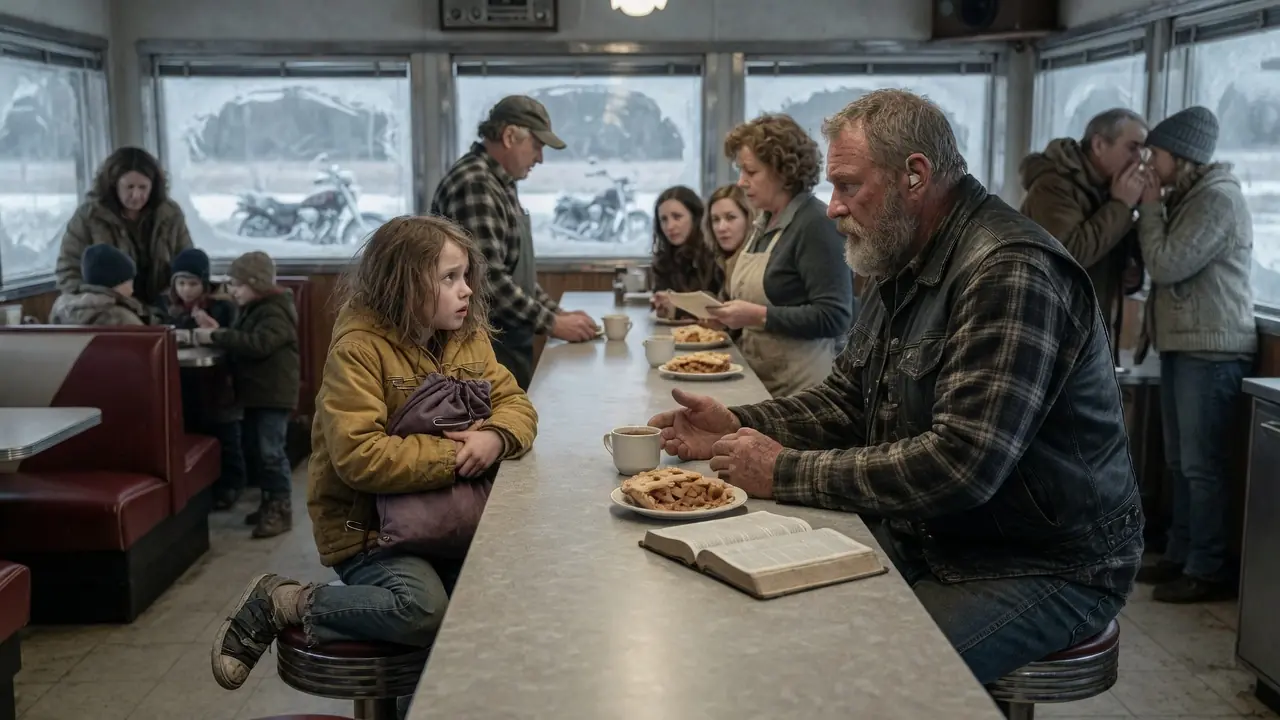
A child who had been turned away by four separate adults in the last twenty-three minutes.
A child who had exactly nineteen days left before the man who controlled every door in her life reached the end of his timeline for her.
She had not walked up to just any table. She had crossed twenty-three feet of linoleum floor, step, drag, step, drag, the soft rubber of her sneaker catching with each step. Her yellow jacket was two sizes too small and held at the zipper with a single safety pin.
She had approached the one person in that diner nobody else had spoken to since he walked in.
For eleven months, Lillian Mercer had been trying to survive inside a system that had looked directly at her and decided she was not its problem.
Until a Saturday afternoon in late January, in a cold truck stop town near the Canadian border, she placed every last chip she had on a man in a black leather cut with a gray beard and a Bible open on the counter in front of him.
What happened in the next four hours would bring hundreds of motorcycles to northern Montana. And the contents of a worn purple drawstring bag would expose a plan so deliberate that the word premeditated would not feel strong enough.
This is Lily’s story, and it does not end the way you think.
“I just needed to be somewhere warm with people.”
That was the first thing Lily said.
Not about the leg. Not about the locked room. Not about the scratched silver MP3 player buried in the bottom of her purple bag.
Just that.
Somewhere warm with people.
She had been walking for a long time before she reached the Huckleberry Flats Truck Stop on Highway 2 East. Outside, the temperature had dropped to twenty-eight degrees and was heading for seventeen by nightfall.
The wind came out of the northwest, the kind of flat, relentless Montana wind that does not howl. It just presses.
Three toes on Lily’s right foot were already showing the early white puffiness that a paramedic would later describe very quietly to Ray as the beginning of something they needed to address that night.
But inside the diner, there was country radio playing low from the kitchen, the smell of black coffee and bacon grease and pine cleaner, and nineteen people who had their own warm booths and their own very good reasons not to notice an eight-year-old girl standing alone by the coat rack near the entrance.
Lily noticed all of them first.
That was something the trauma counselor would later explain as survival behavior. Lily’s eyes swept every room in full before she stepped inside.
She had been doing it for months.
You learn to find the exits before you need them.
She tried four times before she reached Ray Holloway.
The first time, she approached a family of five in the corner booth. A mother, a father, and three children. About the safest-looking configuration in the room.
The mother made eye contact with Lily across the diner floor. Then she quietly pulled her own children closer and gave one small, firm shake of her head.
No words.
Just a wall.
Lily had been rejected before by people who meant nothing to her. Being rejected by a mother figure landed differently.
The second time, she tried a trucker at the counter. Mid-fifties, coffee at his elbow. He looked Lily up and down and said, “Kid, I got nothing for you,” before she had even opened her mouth.
Then he turned back to his mug like she had already left.
She had not even asked yet.
She had been prejudged as a problem before she had spoken a syllable.
The third time, she approached two women sharing pie in the middle booth. One leaned toward Lily with a soft voice.
“Sweetie, where are your parents?”
When Lily hesitated for just a moment, the woman waved the waitress over and asked her to handle it.
Lily was passed off like unclaimed luggage.
The fourth rejection was the one that nearly finished her.
Three women near the window, each wearing a fundraiser pin on her coat that said Serve Others in white letters. One knelt to Lily’s level, studied her face carefully, then stood up and said, loud enough for two nearby tables to hear, “She’s probably just wandering. These children need structure, not handouts. Her parents need to do their job.”
These were precisely the people whose entire identity was built around compassion.
And they had just delivered the final proof to an eight-year-old girl that no adult in the world was going to help her.
Lily had been counting ceiling tiles.
She got to eleven.
Then she turned and saw the man at the far end of the counter.
Big.
Bigger than anyone else in the diner.
Gray beard. Black leather cut with a patch she could not read from that distance. A hearing aid in his right ear. He was reading a Bible, pages worn soft at the corners, open somewhere in the middle.
His coffee was untouched.
A slice of apple pie sat pushed to the side, half eaten.
Everyone else in the diner had moved their eyes away from him when he walked in.
Lily had noticed that, too.
She picked up her purple bag and held it against her chest with both arms crossed over it, the way she always carried it.
Always.
Then she started walking.
Step, drag, step, drag.
Twenty-three feet.
She stopped twice.
Almost turned back twice.
Each time, something pulled her forward.
Maybe it was the Bible. Maybe it was the fact that he was the only one in the room who had not looked at her like a problem to be managed.
She reached the counter.
He did not look up immediately, but she could tell somehow that he already knew she was there.
“Can I sit with you?” she whispered. “Please.”
Ray Holloway closed his Bible.
Not quickly.
Slowly. Deliberately.
He set it aside and rotated his entire body on the stool to face her.
Not a glance. Not a half turn.
A full rotation, giving her everything.
His complete attention before he said a single word.
His eyes moved from her face to the yellow jacket with its safety pin, to her hands crossed over the purple bag, to the sneaker with its electrical-tape sole, to the left leg she was holding slightly off the floor even standing up.
Then back to her face.
He opened his hands, palms up on the counter, empty and visible.
“Sit down, sweetheart,” he said. “I’m not going anywhere.”
He lifted two fingers toward the waitress without breaking eye contact with Lily.
“Whatever she wants. Everything on the menu if she needs it.”
What he did not know yet, what none of them in that diner knew, was that the worn purple bag pressed against Lily’s chest contained the only evidence on earth that a man in Havre, Montana, had already planned her death in careful, deliberate detail.
Ray Holloway was fifty-seven years old.
He had served eighteen years in the Marine Corps, three combat tours, retired as a staff sergeant, and came home with a hearing aid in his right ear from an IED outside Fallujah in 2004 and a slight forward lean in his walk that never quite corrected itself.
On his left forearm was a tattoo in block letters: Psalm 34:18.
He was the road chaplain for the Sons of Thunder Motorcycle Club, Havre chapter, ordained since 2009, and he had not missed a Monday night soup kitchen at the clubhouse in six years.
Inside his cut, in the chest pocket, he carried a photograph.
Her name was Claire.
She had been nine years old when a drunk driver took her in 2019.
Ray had been the one to identify her.
He never talked about it, but the photograph never moved from that pocket.
He knew, the way some people simply know from having lived close to enough grief, that something was different about this child.
Not just the limp. Not just the jacket that had been bought two sizes ago for a girl who had since stopped growing.
It was the way she ate.
He had ordered her a grilled cheese sandwich, tomato soup, and a glass of milk. He watched her carefully unwrap the paper from the straw and set it to the side like it might be needed later.
He watched her take the first sip of soup and go completely still.
Not from the temperature.
From something else entirely.
From the fact that no one was going to take it away.
She ate slowly.
He did not rush her.
He just let her be warm.
When she had gotten halfway through the sandwich, she set it down and looked at her hands for a moment.
“I just needed to be somewhere warm,” she said again, quieter. “With people.”
“You are,” Ray said. “Take your time.”
He gave her three more minutes before he asked anything.
“Is your leg hurting right now?”
She looked at her left foot.
“Always,” she said.
Flat. Factual. Like it was the most ordinary thing in the world.
“How long?”
“Since I fell. Eleven months ago.”
Ray kept his face calm. He kept his hands open on the counter.
“My stepdad says it’ll heal by itself,” she added, still not looking up. “He says I exaggerate.”
“And what do you think?”
A pause.
The radio played something about a highway and coming home.
“I think it’s crooked now,” Lily said. “I think it healed wrong.”
He let that sit.
What she said next, he would repeat verbatim to five law enforcement officials before the night was over.
“He locks my door at night from the outside. I can’t get out.”
Her voice had the careful flatness of someone who had trained all the feeling out of her words because feeling drew attention.
“I’m in the room off the garage. There’s no heat vent. He gives me food once a day, usually. I ate peanut butter and bread this morning, but not the whole piece because he was watching.”
Ray’s jaw tightened, one small controlled movement, then stillness.
He did not reach for her.
He had understood something in the way she flinched when a man’s voice rose at a table three booths over. Just a laugh, just an ordinary loud laugh, but it told him she needed his hands to stay exactly where they were.
“Lily,” he said, “my name is Ray, and I had a daughter once. She was nine years old, and she died, and I didn’t get to keep her safe.”
He said it evenly, without performing grief.
“So when I sit here with you, I need you to understand something. Whatever you tell me, I’m not going to hand you off to someone else. I’m not going to look at you like a problem. I’m not going anywhere until you are safe. Both of those things are true right now.”
She looked up at him for the first time since she had sat down.
And whatever thin, fragile thread of desperate hope she had been carrying for eleven months, the kind of hope a child does not let go of even when every adult in the world suggests they should, he saw it.
“There’s something else,” she said. “Something I’ve been carrying.”
She reached into the bottom of the purple bag, past what looked like a bundled sock, and pulled something out.
She set it on the counter between them.
A scratched silver rectangle, no bigger than a book of matches.
On the bottom was a piece of pink electrical tape with a name written in careful child’s handwriting.
Lily.
She had put it there when she was six, when the device had still belonged to her mother.
“I recorded him,” Lily said. “Three weeks ago. He was on the phone in the kitchen. He thought I was asleep.”
Ray looked at the MP3 player.
Then he looked at Lily.
“He said Montana winter finishes what he started,” she said.
Her voice stayed flat, controlled, the voice of someone who had rehearsed staying calm in the dark.
“He said I won’t make it to February.”
A pause so small it barely existed.
“And then he said the same thing that happened with my mom.”
The diner kept moving around them.
Radio.
Boots on linoleum.
The cook calling something to the waitress.
A completely ordinary Saturday afternoon in an ordinary town.
Ray did not move for three full seconds.
He sat completely still.
Then he reached into his jacket pocket and checked the date on his phone.
January 26.
Nineteen days.
He stepped outside.
The cold snapped against his face immediately.
Twenty-eight degrees and dropping fast.
He could see his breath.
He dialed Gerald Cobb, and the line picked up on the first ring.
“Ironside, it’s Preacher.”
“Go ahead.”
“I need every brother within two hours of Havre at the Huckleberry Flats lot on Highway 2. Now.”
A pause.
Not hesitation.
Just the weight of understanding settling in.
“What’s going on?”
“Eight-year-old girl recorded proof of a murder plan. Nineteen days on the clock. We’re not waiting for the county to take their time on this one.”
“Say no more. We’re coming.”
The line went dead.
That was it.
No debate about jurisdiction.
No questions about whether the evidence would hold.
No discussion of liability or exposure or what happened if they were wrong.
Just brothers, a direction, and motion.
Because that was what the Sons of Thunder had meant since Bill Schaefer founded the charter in 1987.
You do not argue when a child needs help.
You move.
Ray walked back inside.
Lily had eaten three-quarters of the grilled cheese. She was holding the milk glass with both hands like something precious.
He sat down.
“I made a phone call,” he said. “Some friends of mine are going to come. Good men. They’re going to help make sure you’re safe. Is that okay?”
She thought about it.
Genuinely thought about it.
Then she asked, “Are they like you?”
“Most of them are better,” he said.
Something very faint crossed her face.
Not quite a smile.
But the nearest her face had come to one in a long time.
He had one more question.
He needed the answer before the brothers arrived.
“Your mom. What was her name?”
“Rebecca.”
“And before the accident, did she ever seem scared in the weeks before?”
Lily looked at the counter.
The soup was mostly gone.
“She texted my Aunt Carol that she was scared. Aunt Carol still has the messages.”
A pause.
“Dale won’t let me talk to Aunt Carol anymore. He filed a restraining order.”
Ray’s expression did not change, but something behind his eyes did.
Because what he had just heard was not a story about one man and one child.
It was a pattern.
And the thing about patterns was that they had a beginning, which meant they had happened before.
They also had an intended end.
And the end Dale Pruitt had planned was nineteen days away.
Twenty-three minutes after Ray’s call, the first four Harleys turned into the Huckleberry Flats lot.
By the forty-minute mark, eleven motorcycles were parked in the overflow section.
By the time the sun had dropped and the temperature hit twenty-one degrees, there were thirty-one bikes, with more on their way from Billings, Great Falls, and Missoula.
The statewide call was already rolling.
Now, you might think you know what thirty-one bikers showing up to a truck stop on a winter night looks like.
You might picture something loud. Something chaotic. Maybe the kind of scene that gives people in small towns reasons to pull their curtains.
That was not what happened.
They parked in organized rows, quiet and deliberate, the kind of tight formation that comes from years of riding together and knowing exactly where everyone belongs.
They did not cluster at the door.
The four Ray had asked for specifically came inside.
The rest stayed near the bikes in twenty-one-degree cold without a single complaint.
Gerald “Ironside” Cobb walked in first. Sixty-three years old, six feet even, with the wide, steady bearing of a man who had spent twenty-eight years as a Hill County sheriff’s deputy and had seen enough genuine evil to know the difference between a real threat and theater.
He had been Ray’s right hand for nine years in the Sons of Thunder.
When Ray said move, Ironside’s first question was always, Which direction?
Never why.
Behind him came David Reyes, road name Corpsman, fifty-eight, former Navy combat medic, Gulf War and Bosnia. He had spent more time stabilizing people in crisis conditions than he could count, and he carried a first aid kit in his saddlebag that most EMTs would have respected.
He took one look at the way Lily was holding her right foot slightly off the floor, even while seated, and his face did a quiet, very professional thing.
Then came Tom Birdsell, Chalk, fifty-two, retired middle school guidance counselor. He had spent twenty-four years sitting across from kids who were hurting, and he had learned exactly how much space a frightened child needs before a stranger starts to feel safe.
He took the stool one seat down from Lily.
Not too close.
He ordered coffee. He did not say anything for a while.
He just existed near her, calmly allowing her to get used to another adult presence that was not going to do anything alarming.
And then came Marcus Webb, Pixel, thirty-four, the youngest in the immediate group by twenty years. He had an IT forensics background and had done cybersecurity contracting before finding the club.
He carried a small evidence documentation kit in his jacket pocket: chain-of-custody forms, two certified USB drives, and a compact extraction tool.
When Ray had called Ironside, Ironside had called Marcus within ninety seconds.
They ordered coffee.
They sat at two booths.
Nobody in the diner paid them particular attention.
Four large men in leather, but they were quiet, and they were seated, and they were behaving exactly like customers.
What seventeen of those nineteen people in the diner did not understand was that they had just watched the first operational element of a rescue effort arrive and deploy.
Ray made introductions quietly. He kept it brief for Lily.
“These are my brothers. They’re here to help us figure out the next steps. Is it okay if David takes a look at your foot while we talk?”
Lily studied David Reyes for a moment.
He sat with his hands folded on the table, unhurried, not reaching.
“It won’t hurt,” he said. “I’m just going to look. You can stop me anytime you want.”
She thought about it.
Then she nodded.
He crouched down slowly and looked at her right foot without touching it.
Just looked for about seven seconds.
Then he looked up at Ray with two words in his expression that neither of them said out loud in front of Lily.
Meanwhile, Marcus had the MP3 player.
One earbud in, face neutral, logging the audio file’s timestamp and metadata on his phone. Chain of custody began the second Lily gave permission.
And Tom was talking to Lily.
Not about Dale.
Not about the recording.
Not about any of it.
He asked her what her favorite subject in school had been back before she was pulled out.
“Math,” she said without hesitating.
“Good taste,” Chalk said with complete sincerity.
It was the first time in three and a half hours that Lily’s face did something other than stay careful.
The system had failed her three times before anyone in this room had ever heard her name.
Eleven months ago, a teacher had noticed Lily’s hunger and reported it up the chain. Dale Pruitt had come into the school, spent forty minutes with the principal, and talked his way through the conversation with the unhurried warmth of a man who had nothing to hide.
The case was closed the same afternoon.
The teacher was told, gently but unmistakably, not to escalate.
Eight months ago, Lily’s maternal aunt Carol had filed a welfare concern with child protective services. A home visit was conducted. Dale had cleaned, prepared, and coached Lily beforehand.
Sandra Klink, who had been a Havre First Baptist Church member at the time, had watched him doing it in the church parking lot one Sunday morning, running through what Lily should say like they were rehearsing lines for a play.
The home visit came and went.
The case was marked unsubstantiated.
Five months ago, the school nurse noticed Lily’s weight loss and filed a formal report with the school administrator.
Within six days, Dale had pulled Lily from enrollment and filed a homeschool declaration with the state.
The last institutional pair of eyes on her life was gone.
Carol’s private investigator, hired with Carol’s own savings, received a formal cease-and-desist from Dale’s attorney within thirty days of starting work.
The investigator dropped the case.
Every door the system had built to catch exactly this situation had been either charmed shut or papered over by a man who knew exactly how those doors worked.
He was, after all, an insurance adjuster.
He understood documentation.
He understood processes.
He understood that if you could make a system see what you wanted it to see, the system would file its paperwork and move on.
And Lily had walked twenty-three feet across a linoleum floor with a leg that had healed wrong, in a jacket held together with a safety pin, with nineteen days left on a countdown she had overheard in the dark.
“We’re going to count down,” Ray said when the others had moved slightly away and it was just the two of them for a quiet moment.
He said it like it was not a large thing.
Just a fact.
“Nineteen days sounds like a lot. We’re going to make it feel very short.”
Lily looked at him.
“Can you be brave for a little while longer?” he asked. “Not forever. Just tonight.”
She considered this like it was an actual operational question worth thinking through.
“I’ve been brave for eleven months,” she said.
Ray Holloway, who had survived Fallujah, who had identified his daughter’s body, who had not cried in front of another human being in the years since, sat very still for a moment.
“Yeah,” he said. “You have.”
He placed his hand flat on the counter between them.
Not reaching for her.
Just there.
Present.
“Tonight should be easy,” he said. “Tonight, you’ve got help.”
And armed with seventy-three seconds of scratchy audio, a child’s name written in pink electrical tape on the back of a silver rectangle, and every brother Gerald Cobb could reach before midnight, Ray Holloway was about to make sure Dale Raymond Pruitt ran out of time before Lily did.
By 9:47 p.m., there were 118 motorcycles in the Huckleberry Flats overflow lot and spilling onto the gravel shoulder along Highway 2.
More were coming from Billings.
Two Wyoming chapters had confirmed.
One Idaho chapter had already crossed the state line and was forty minutes out.
Lily was no longer at the diner counter.
Chalk had arranged for her to rest in a back booth with a blanket that a waitress had retrieved from a storage closet. He sat beside her, unhurried and steady, while she slept in twenty-minute increments that were more collapse than rest.
Corpsman had made two quiet calls, one to a pediatric physician he knew in Havre, one to the Hill County sheriff’s dispatcher he had worked alongside for years before his Navy service.
He had not filed anything officially yet.
He was laying the groundwork so that when they did file, the right hands were already reaching for the right phones.
Pixel had spent ninety minutes with the MP3 player, a laptop, and a set of forensic audio tools that would have impressed a federal examiner.
The voice was confirmed as a single male speaker throughout.
The timestamp on the original file matched the metadata embedded in the device.
He produced a chain-of-custody document in triplicate, signed it himself, logged it, and placed the MP3 player in a sealed evidence bag.
The original stayed sealed.
The authenticated digital copy went onto two separate certified drives.
“Seventy-three seconds,” Marcus told Ray quietly. “Voice is clear enough for a transcript. I can have it typed and timestamped in another twenty minutes. If they challenge this in court, they’re going to lose.”
Now, you might be imagining what comes next.
A hundred-plus bikers roaring up to a house on Sycamore Hollow Road. Fists and noise and chaos. That is the scene your mind builds when you hear those numbers.
A mob.
A reckoning by force.
That was not what happened.
That was not what these men were.
What Gerald Cobb organized in the parking lot of Huckleberry Flats that night was not a mob.
It was a measured, sequenced operation assembled by a man who had spent twenty-eight years wearing a badge and who knew with absolute precision what evidence would hold up in a Montana courtroom and what would get thrown out because the chain of custody had been contaminated by someone who let anger get ahead of judgment.
“We do this right,” Ironside told the assembled brothers before they moved. “We do not touch Dale Pruitt. We do not threaten Dale Pruitt. We gather, we document, we protect, and we make it impossible for this county to look away. Any brother who can’t hold that line stays in this lot. No shame in it.”
Not a single man stayed.
They staged in three groups.
The first, four bikes, would circle and hold the perimeter of 214 Sycamore Hollow Road, visible, present, a statement without a word spoken.
The second group would go door to door on that block asking questions. Neighbor conversations. Civilian conversations. Nothing coercive. Just people with time and the ability to knock on doors.
The third group held at a secondary staging point two blocks out, ready to receive what the first groups gathered.
Four Harleys rolled first, quiet and deliberate, running in pairs.
The rumble started low on Highway 2 as the formation organized itself.
Disciplined rows. Smooth. Practiced. The choreography of men who had ridden together through weather and distance and years.
By the time the first units turned onto Sycamore Hollow Road, the sound had grown into something that carried through the winter air and reached the lit windows of half a dozen homes before anyone could have said what it was.
They parked without ceremony at the four corners of the block.
Engines cut.
The silence that followed that much engine noise felt heavy and deliberate and full.
Dale Pruitt’s truck was in the driveway of 214. Lights on inside. Two windows lit. A blue television flicker behind the living room curtain.
The neighbor conversations started within ten minutes.
This was where the story of one community’s silence began to come apart.
Louise Amberly was seventy-one years old and had lived at 218 Sycamore Hollow for nineteen years.
When one of the brothers knocked on her door, respectfully, in a normal voice, hat in hand, she opened it, took one look at the leather cut and the patient face, and said, “I’ve been waiting for someone to ask me about that house.”
She had seen Dale’s truck on six consecutive nights in January.
She had heard something she could not identify, a banging from the direction of the garage, on at least four separate occasions over the past several months.
She had seen Lily once through the fence the previous September. The child had been standing in the driveway in a short-sleeve shirt in forty-four-degree weather and looked, Louise said, like she was trying to be invisible.
“I called the number on the county welfare page,” she added.
Her hands were shaking slightly as she said it.
“They said someone would follow up. Nobody came to my door. Nobody called me back. I convinced myself she was fine.”
She could not meet the brother’s eyes on that last sentence.
“I knew she wasn’t fine.”
Frank Devereaux, sixty-seven, had been a fishing partner of Lily’s maternal grandfather. He had known Rebecca Mercer since she was a teenager.
Three weeks before Rebecca’s car went off Route 2 on a dry road on a clear night with no skid marks, Rebecca had called Frank from her cell phone.
The conversation had lasted eleven minutes.
She had told him she was scared of Dale.
She told him she did not know what to do.
She asked if Frank thought she was being dramatic.
Frank had said he was sure she was fine.
He had told himself people did not do those things in real life. Not in Havre. Not to someone like Rebecca.
He broke down when he said it.
The brother sitting across from him at his kitchen table waited without hurrying him.
“I should have done something,” Frank said. “I should have driven over there.”
“You’re doing something now,” the brother said. “Can I have the dates you remember? As many as you can give me.”
Sandra Klink, fifty-eight, had been a member of Havre First Baptist until she left two years earlier. Partly, though she had not said this out loud to many people, because of the discomfort she felt watching Dale Pruitt be celebrated by that community while she knew what she knew.
She had watched him in the church parking lot coaching Lily before the child welfare visit.
She described it in specific, sequential detail.
What he said.
How Lily’s face looked while he said it.
What Lily did with her hands.
She had reported what she saw to the church administrator.
The administrator had told her that Dale was a deeply good man going through a period of grief, and that she should pray for charitable interpretation.
Sandra Klink had the kind of steady eyes that come from having made a decision about guilt a long time ago and choosing to live inside it honestly.
“I knew what I saw,” she said. “I just didn’t know who would believe me over a deacon.”
Three witness statements.
Three people who had seen and stayed quiet and lived with it.
Every one of them was ready now to say everything on record.
Ironside had been on the phone with the Hill County sheriff for forty-five minutes while the door-to-door work was happening. He knew the sheriff. He had worked alongside this man for years.
He laid out what they had methodically.
The recording.
The medical observations.
The financial timeline.
The witness accounts.
The insurance policy on Lily taken out four months after Rebecca’s death.
Then he read the text from Dale’s phone, the one Pixel had surfaced during the audio documentation process, which Lily had not known about.
Policy clears clean if natural cause. Winter does the work.
The line was quiet for a moment.
“You have chain of custody on all of this?” the sheriff asked.
“Documented from the moment the child handed us the device,” Ironside said. “Our tech lead has twenty years of forensic IT background. It’ll hold.”
Another pause.
“I’ll have two units on Sycamore Hollow in twelve minutes. I’m calling the DA at home.”
“Appreciate it,” Ironside said. “One more thing. He took out a life insurance policy on that girl through his own employer. Two hundred and seventy-five thousand dollars, issued four months after his wife died. He named himself beneficiary.”
This time the silence lasted five full seconds.
“I’ll call the DA right now,” the sheriff said.
At 11:38 p.m., when the two patrol units arrived on Sycamore Hollow Road, they found Dale Pruitt in his living room watching a college basketball game.
He was in a flannel shirt and pressed khakis, a bottle of domestic beer on the side table beside him, reading glasses resting on the bridge of his nose.
A bag of pretzels sat open on the cushion next to him.
He looked up when the knock came.
The four hard knocks that mean something specific, the kind no one confuses for a neighbor.
His expression was one of mild, genuine confusion, like a man interrupted in the middle of a perfectly normal evening.
Because to him, this was a perfectly normal evening.
He opened the door.
He saw the two officers.
He saw the man beside them, the one he recognized from somewhere.
Tall. Gray beard. Leather cut.
His mind was already sorting through his options before the first word was spoken, and by the time the first word landed, all the familiar machinery was already running.
He smiled.
Shoulders dropped from whatever defensive set they had taken to something rehearsed and open.
Hands came up, palms visible.
“Officers. Ray, is it? Ray from the Sons of Thunder? Dale Pruitt. I think we met at the Rotary luncheon.”
Warm. Unhurried. Making eye contact.
“Whatever happened, I’m sure we can sort it out. Come in out of the cold.”
He talked for four minutes.
He referenced his position at Northstar.
He mentioned the Rotary Club and three people in the county by first name.
He brought up the Toys for Tots drive twice.
He spoke about grief. His grief. Lily’s grief. The difficulty of navigating a traumatized child’s needs as a single parent.
His voice had a texture to it that certain people spend years developing.
Warm. Reasonable. Self-deprecating.
Designed to make you feel that whatever concern brought you there was probably a misunderstanding, and that the mature thing to do was to accept his very reasonable explanation and leave.
Then Ray asked one question.
“Dale?”
Quiet. Flat.
“What’s the combination to the padlock on the kitchen refrigerator?”
The charm slipped.
Not fully. Not yet.
But for exactly one second, behind the warm eyes and the open hands, something shifted.
The kind of micro-expression that a man with eighteen years of reading people in difficult situations does not miss.
One second was enough.
Dale recovered.
He started to explain that the padlock was a security measure after a break-in.
He started to construct the sentence.
Then Ray said one more word.
“FBI.”
Something changed in the room.
The word landed differently than anything Dale had prepared for.
He had prepared for the county sheriff.
He had prepared for child protective services.
He had prepared for concerned neighbors and church people and even a room full of bikers.
He had not prepared for the scale that one word implied.
His legal threat came next.
“You are holding me unlawfully. My attorney will bury this.”
He had a relationship with the county commissioner. One phone call.
It went into the wall of four people standing in his doorway who did not move or flinch or look at each other.
“You’re welcome to call your attorney,” Ray said. “The FBI is going to want to speak with them anyway.”
Dale’s last play was sympathy.
He had been under so much pressure. The grief of losing Rebecca had been something nobody in this town had truly acknowledged. He had taken on Lily out of love, purely out of love, and the way she struggled had been heartbreaking for him personally.
He wanted people to understand how much he had sacrificed.
Ray’s response was seven words, quiet and absolute.
“She’s not interested in your reasons. Neither am I.”
The performance stopped.
Not gradually.
It stopped.
And what was underneath was not defiance or rage.
It was a kind of blankness, the expression of a man whose every social tool had failed in sequence and who had not yet found what existed underneath those tools.
His hands, which had been open and gesturing, came together.
Clenched once.
Then went still.
“I was careful,” he said quietly, to no one in particular. “I was so careful.”
The officers moved.
Miranda rights were read on the driveway of 214 Sycamore Hollow Road at 11:53 p.m., barely four and a half hours after an eight-year-old girl had whispered seven words to a man reading a Bible at the far end of a diner counter.
As they led Dale Pruitt toward the patrol unit, he asked once, quietly, whether someone could call his neighbor about his mail.
He had a package coming.
He wanted to make sure it was brought inside.
As if that were the thing that needed handling.
As if the world he had built and the world he had systematically destroyed could pause while he sorted out his correspondence.
Charges were logged that night: felony child endangerment, criminal mistreatment of a dependent, fraud in the first degree, and one count pending review by the DA’s office that would not be officially named until the following morning, when what Pixel found in the war room would change the scope of everything.
The front door of 214 Sycamore Hollow Road had been standing open for less than five minutes after Dale Pruitt was placed in the patrol unit when Marcus Webb touched Ray’s sleeve.
“You need to see something.”
He held up his phone.
Not the MP3 audio.
Something else.
During the document sweep authorized by the sheriff’s deputy on scene, Marcus had been photographing every paper surface in Dale’s home office.
Standard evidence preservation.
Nothing touched.
Only documented.
Forty-three photographs in eleven minutes.
And in the forty-first photograph, on the bottom shelf of a filing cabinet whose drawer had been left three inches open, was a folder.
The label on the folder tab, written in Dale’s precise handwriting, read RM Estate Resolution.
RM.
Rebecca Mercer.
It was not the folder itself that made Marcus show Ray the photo immediately.
It was what was visible behind it, pushed to the back of the shelf.
A second folder.
Thicker.
Older.
The label on that one read NP.
Different initials.
Different folder.
Same filing system.
“He’s done this before,” Marcus said. “And not with Rebecca.”
Ray looked at the photograph for a count of three.
“Ironside,” he said.
They regrouped at the Sons of Thunder clubhouse on the east side of Havre at 1:15 a.m.
The main room, with long tables, mismatched chairs, and a whiteboard usually used for ride coordination, had been converted into something between a command center and an evidence room.
Fourteen brothers were present in the room.
More stood outside.
Marcus opened his laptop and pulled the photographs onto the screen one at a time, narrating in real time.
Layer one: Dale’s bank statements photographed from his home office desk.
Thirteen months of outflows.
Pediatric medical: zero.
Children’s clothing retailers: zero.
School supply purchases: zero.
The one meal a day he gave Lily cost him, by Marcus’s estimate, less than forty dollars a month.
Meanwhile, there was an ATV purchase, four trips to Las Vegas, a property down payment on Flathead Lake, and more than one hundred thousand dollars in visible discretionary spending over thirteen months while the child in his utility room received forty dollars’ worth of peanut butter and bread.
Layer two: a second insurance document found in the photographed filing cabinet.
This one was not in the RM folder. It was in Dale’s personal insurance portfolio, cross-filed under his Northstar employee benefits records.
A policy on Lillian Mercer, issued through Northstar Claims Services four months after Rebecca’s death.
Face value: $275,000.
Beneficiary: Dale Raymond Pruitt.
Signed on a Tuesday afternoon, two weeks after he had filed the homeschool declaration for Lillian and eliminated the last institutional set of eyes on her life.
And layer three: the second folder.
NP.
Marcus pulled it up.
Naomi Pruitt, Dale’s first wife, not widely known in Havre. He had been in Great Falls before he relocated.
She had died of what the death certificate listed as cardiac event secondary to respiratory illness.
She had been thirty-one years old.
The insurance policy in the folder had been issued nine weeks before her death.
Face value: $210,000.
Beneficiary: Dale Raymond Pruitt.
Payout date: six weeks after the death certificate was filed.
The refrigerator hummed in the clubhouse kitchen.
Somewhere outside, a motorcycle idled briefly and cut off.
The heater ticked.
Nobody spoke for a long moment.
Ironside set down his coffee mug with a precision that suggested if he did not give his hands something deliberate to do, they would do something else.
“Three victims,” he said. “A pattern beginning with Naomi Pruitt, repeated with Rebecca Mercer, and currently in progress with Lily.”
He looked at Marcus.
“Dollar total across all three policies?”
Marcus ran the numbers.
“Six hundred seventy-two thousand in insurance payouts already collected. Two hundred seventy-five thousand pending if Lily didn’t survive February. Plus the one hundred forty-three thousand trust fund under his guardianship. Total target: one million ninety thousand.”
“Timeline on all three,” Ironside said.
“Naomi, 2017. Rebecca, 2022. Lily, currently active.”
“Five years between the first two,” Ironside said.
He waited.
“He relocated,” Marcus said. “Rebuilt his community standing. Found another family.”
Ironside looked at Ray.
Ray looked at the whiteboard, where someone had written Lily’s name at the top with a timeline running from October of last year to February 14 of this year.
“He’s not a man who snapped,” Ray said.
It was not for the room’s benefit.
It was a thing a person says when they need to hear it clearly.
“He’s a man who made a business out of it.”
“That’s going to matter to the DA,” Ironside said. “Pattern evidence across three victims. Two prior payouts. Identical financial structure each time. This isn’t one charge. This is a pattern prosecution.”
“Who knew?” Ray asked.
Marcus had an answer for that, too.
There was a man named Gregory Felt.
He was fifty-one years old, a licensed insurance broker at a regional firm in Great Falls, and he had processed the paperwork on Naomi Pruitt’s policy in 2017.
He had also, five years later, processed the first inquiries on Rebecca Mercer’s policy when Dale relocated to the Havre area.
Gregory Felt had not issued either policy.
He was a broker, not the underwriter.
But he had been present at both initial consultations, and he had flagged something internally in both cases because it made him uncomfortable.
In both cases, his flag had gone nowhere.
He had been told by his regional manager that the policies were standard products issued within normal parameters, that there was no irregularity on the underwriting side, and that if he had concerns about a client’s character, those concerns were not actionable under insurance regulations.
He had not filed a report.
He had not gone to law enforcement.
He had convinced himself that his discomfort was professional paranoia, not moral obligation.
Ironside reached Gregory Felt by phone at 2:08 a.m.
He did not waste time.
“Tell me everything from the beginning,” Ironside said. “Or I make one call in the morning, and you explain your silence to a federal insurance fraud examiner.”
Gregory Felt broke before the sentence was complete.
He talked for twenty-two minutes.
He confirmed the pattern.
He confirmed that the same financial structure, isolation of victim, policy issuance, policyholder as sole beneficiary, escalating isolation in the months before death, had appeared in both prior cases.
He confirmed that he had documentation in his own files that could corroborate the timeline.
He confirmed that he had not reported it.
And he confirmed one additional piece that the brothers did not yet have.
During the initial consultation for Rebecca’s policy, Dale Pruitt had mentioned, casually, as though it were unremarkable, that he was good at handling loss and that he found the process easier each time.
Ironside wrote that down word for word.
He set the pen down afterward and sat with the quiet of that for a moment.
This part needed to be said plainly.
Gregory Felt was not a predator.
He was a coward.
And that distinction mattered enormously.
A predator makes a decision to harm.
A coward makes a decision not to act, and tells himself that the absence of action is not a decision.
Gregory Felt had seen the shape of this thing twice. He had documentation that could have raised an alarm. He had chosen professional comfort over moral obligation.
And while he made that choice, Rebecca Mercer went off Route 2 on a clear night, and an eight-year-old girl spent eleven months in an unheated room eating peanut butter bread once a day.
The world is not only failed by villains.
It is failed consistently, quietly, structurally, by the people who see and choose not to inconvenience themselves.
The FBI agent’s name was Carol Shan.
She arrived at the clubhouse at 3:41 a.m. in a gray fleet sedan, plain clothes, no performance of authority.
She was forty-four years old and had the face of someone who had been chasing this particular shape of financial predation long enough that the exhaustion had settled below the level coffee could reach.
The room did not welcome her warmly.
She did not expect it to.
“Carol Shan,” she said. “Billings Field Office. I’m told you have material relevant to an open federal investigation.”
Ray looked at her from across the table.
“Depends what you’re investigating.”
“Dale Raymond Pruitt. Insurance fraud, wire fraud, and one count of suspected homicide in connection with the death of Naomi Pruitt in 2017. We’ve been building since 2023.”
Ray looked at Ironside.
Something passed between them.
Not words.
Barely even a gesture.
A decision made by men who had known each other long enough that agreement did not require language.
“How long has your office known about him?” Ray asked.
The agent’s jaw tightened slightly.
“Since a Great Falls broker named Gregory Felt filed a delayed report in November 2023. We’ve been building the financial case carefully. The wire fraud charges require a specific documentation threshold under federal statute.”
“November 2023,” Ray said.
He let that sit in the room.
“Yes,” Agent Shan said.
“We got her out in four hours. You’ve had fourteen months.”
Agent Shan had no good response to that.
She knew it.
She did not try to construct one.
Ray stood.
He placed the certified evidence drive on the table.
Then he set down the chain-of-custody documentation.
Then the printed transcript of the MP3 recording, time-stamped and initialed.
Then the insurance policy photographs.
Then the bank statement photographs.
Then the NP folder documentation.
One item at a time, each one placed flat and deliberate on the table.
Agent Shan reviewed each item in sequence.
When she reached the bank statements and the NP folder documentation, she stopped writing.
She set her pen down.
She leaned forward slightly.
“The Naomi Pruitt policy documentation,” she said. “We had the 2017 death record and the payout confirmation. We didn’t have the original application with his handwriting and the broker’s consultation notes. If this is authenticated…”
She stopped herself.
“When this is authenticated, it closes the evidentiary gap on the pattern prosecution.”
Ray sat back down.
“One condition for full cooperation,” he said.
“Name it.”
“Lily gets a victim advocate assigned before her first interview. She does not face anyone in an official capacity, sheriff, FBI, prosecutor, without someone in that room whose only job is her. Not the case. Her.”
Agent Shan looked at him for a moment.
“Done,” she said. “That’s standard victim services protocol.”
“Then you have everything we found.”
The agent gathered the documentation carefully.
At the door, she paused.
“Agent Shan,” Ray said.
She turned.
Ray’s voice was even.
“You do right by her.”
A beat.
“That’s the job,” she said.
The door closed.
The room was quiet.
Here was what was true.
The system had not been broken.
That was the thing that was easy to miss.
A broken system could be identified and repaired. This one had functioned exactly as designed. Built to move carefully, to require evidence beyond reasonable doubt, to protect the rights of the accused even when every minute of procedural caution was one more minute inside a utility room.
Nobody had built it to fail Lily.
They had built it to be careful.
And careful, when a child is running out of time, can look identical to indifferent.
The brothers had not replaced the system.
They had bought the time the system needed to reach the truth.
Four hours against fourteen months.
And now both were working toward the same end.
By 5:00 a.m., the full scope was assembled and written on the whiteboard in blue marker.
Three victims across eight years.
$672,000 in insurance proceeds already collected.
$418,000 targeted in the current active plan: Lily’s policy plus the trust fund.
Total financial operation: $1.09 million over eight years.
Charges to be filed, as confirmed by the Hill County DA in a 4:30 a.m. call with Ironside: felony child endangerment, criminal mistreatment of a dependent person, insurance fraud in the first degree, wire fraud, federally coordinated with Agent Shan’s office, financial exploitation of a minor, and, pending review of the Naomi Pruitt documentation by the State Attorney General, one count of suspected homicide for the 2017 death, to be filed as the investigation completed.
Six charges.
Three victims.
Eight years of a system that had looked at this man and seen a Rotary Club member, a deacon, a youth baseball umpire, a man organizing Toys for Tots drives at his office.
Ironside looked at the whiteboard for a long time.
“For eight years,” he said.
He did not finish the sentence.
He did not need to.
Justice had been served.
But justice was not the ending.
It was only the beginning.
Corpsman had made the call to Dr. Erin Patricia Hale at 10:15 the previous night, before Dale was even arrested.
Because that was how David Reyes operated.
You did not wait for the crisis to resolve before beginning care.
You began care while the crisis was still happening.
Dr. Hale was a pediatric physician at Northern Montana Health, fifty-seven years old, with a particular combination of clinical precision and human warmth that takes decades to calibrate.
She agreed to meet them at the clinic at 7:00 a.m.
When David walked Lily through the door, Chalk on Lily’s left side, Ray two steps behind, Dr. Hale did not say anything alarming.
She said good morning.
She showed Lily the examination room first without asking her to go in. She let Lily look at it from the doorway on her own terms for as long as she needed.
It took about forty-five seconds.
Then Lily walked in.
David Reyes sat in the waiting room with a paper bag of breakfast items he had picked up on the way.
A blueberry muffin, a small orange juice, a packet of crackers.
Because he had thought ahead about the fact that a child going through a medical examination should have something specific and gentle waiting for her when she came out.
He did not make a statement of it.
He just set the bag on the chair beside him and waited.
The examination took an hour and twenty minutes.
Dr. Hale came to the waiting room afterward and spoke to Ray and David in a low, measured voice.
She had a notepad with specific numbers.
Lily’s weight: 47.2 pounds.
BMI: 11.8.
Significantly below the critical threshold for her age and height.
Early-stage frostbite on three toes of her right foot, not yet progressed to tissue damage, but requiring immediate treatment and monitoring.
The stress fracture on her left leg had healed incorrectly, requiring orthopedic evaluation and likely corrective intervention. A referral was being made that day.
Signs of prolonged nutritional deficiency.
Pale gum tissue.
Brittle nails.
Early hair thinning consistent with chronic caloric restriction over eight to eleven months.
Refeeding protocol to begin immediately.
Not normal meals. Not yet.
A carefully managed nutritional progression to prevent refeeding syndrome, which could itself cause organ stress if food was reintroduced too quickly to a severely malnourished child.
Dr. Hale looked at David when she finished reading the numbers.
Then she looked at Ray.
“Thank you,” she said quietly, “for getting her here when you did.”
David took one slow breath and nodded once.
“What’s her timeline to stable?” he asked.
“With consistent care and proper nutrition, we expect significant improvement within six to eight weeks. The orthopedic issue will take longer. Three to five months minimum, possibly a surgical consult.”
She paused.
“She’s resilient. That’s real. Whatever she’s been carrying, she’s been carrying it with intention.”
A beat.
“She kept herself alive.”
Ray thought of the MP3 player, the pink electrical tape, the name written in careful child’s handwriting when she was six.
“Yeah,” he said. “She did.”
When Lily came out of the examination room, she was holding a small stuffed animal. A gray rabbit, soft and rounded, the kind Dr. Hale kept in a basket for children who needed something in their hands during difficult visits.
Lily carried it with one arm.
Not clutching it to her chest with both arms crossed over it, the way she had carried the purple bag.
A small thing.
The kind of small thing that means everything.
“Muffin for you,” David said, nodding at the paper bag.
She sat down beside him.
She looked at the muffin for a moment.
“It’s blueberry,” he said. “I guessed.”
“Okay,” she said.
Then she picked it up and ate it without watching the door.
Without watching anyone.
Just ate it because it was there, and it was hers, and no timer was running.
The black coffee smell of the diner on Highway 2 had been the first warm thing Lily had walked toward.
This, the waiting room at Northern Montana Health, pale light coming through the east window, David Reyes reading something on his phone two feet away, a gray stuffed rabbit in her hands, was what warmth actually felt like.
Not temperature.
The presence of people who were not going to do anything alarming.
She had been counting things for eleven months.
Ceiling tiles.
Floor tiles.
The number of times Dale’s truck door closed before he came inside.
The number of steps from the utility room door to the garage exit.
She had counted them in the dark because counting was the thing she did when she was frightened, the way some people hum, the way some people pray.
She did not count anything in that waiting room.
The housing question had been solved by 6:00 a.m. before the medical visit, in a phone call between Ironside and a woman named Patricia Voigt, sixty-four, a retired schoolteacher who had been hosting Sons of Thunder charity fundraisers out of her home for eleven years, and who said yes before Ironside finished the second sentence.
By the time Lily’s medical visit concluded, Patricia’s spare room had fresh linens, a space heater set to seventy degrees, and a window Lily could open or leave closed entirely based on her own preference.
Patricia had also, without being asked, placed a small lamp on the nightstand, the kind with a soft bulb, nothing harsh, so Lily would not need to sleep in either full light or full darkness if she did not want to.
The Hill County Sons of Thunder chapter had made calls overnight.
By 9:00 a.m., the donation pool across all nine participating chapters, Montana, Wyoming, and Idaho, stood at $41,800.
A dedicated account had been opened at First National Bank Havre, co-administered by Ironside and a local attorney named Jean Caswell, who specialized in child welfare law and had agreed, upon hearing the full situation at 7:30 that morning, to take Lily’s case on a full pro bono basis.
Jean Caswell had also, within her first ninety minutes on the case, filed for emergency protective custody on Lily’s behalf, moved to have the restraining order against Carol Mercer vacated, given that it had been obtained through demonstrated fraud, and contacted the Hill County Probate Court regarding the $143,000 trust fund currently under Dale’s guardianship.
The trust was now, pending the criminal proceedings, frozen and under court supervision.
Attorney Caswell was forty-nine years old and had a road name among the brothers.
They called her Gavel, a name she had not asked for and had decided she did not mind.
When she met Lily for the first time in the clinic waiting room that morning, she sat down at Lily’s level, introduced herself as Jean, and said, “My job is to make sure every decision made about your life from this point forward is made with you in the room. Is that okay?”
Lily thought about it.
“Yeah,” she said. “That’s okay.”
The key to Patricia Voigt’s spare room was handed to Lily that afternoon.
It was a plain key on a simple ring. No keychain. Nothing decorative.
When Patricia pressed it into Lily’s palm, Lily stood in the doorway of the room for a long moment.
The window faced west.
The afternoon light came through it at a low angle, pale and winter gold.
There was a space heater.
There was a soft lamp.
There was a bed with real blankets, not a mat on a concrete floor with a bare bulb controlled by a switch on the outside of the door.
Lily stood in the doorway for eleven seconds.
Then she stepped inside.
She still had the gray rabbit.
The brothers said goodbye in the early afternoon, in twos and threes, the way people leave when they have done something that does not need witnessing.
Marcus, Pixel, came to Lily last among the younger members.
He crouched down to her level, which was something she had noticed all the brothers did.
Nobody loomed.
“You know that recording you made?” he said.
She nodded.
“That was the bravest thing I’ve ever personally documented,” he said. “And I’ve documented a lot of things.”
He held out a folded piece of paper.
On it was a phone number.
“Anytime, for anything. I mean that in a boring, practical way. If something’s wrong or confusing, or you just want someone to talk to who isn’t going to make it a big deal. Okay?”
“Okay,” Lily said.
He stood and left without ceremony.
Bill Schaefer, Timber, was seventy-one years old and had founded the Sons of Thunder in 1987 with four other men in a shared conviction that the patches on their backs meant something real.
He was the one who had made the statewide call the night before.
When Timber called, everyone came.
That was the long-standing truth of the club, spoken in tones that were not quite reverence and not quite myth, but somewhere between.
He did not say very much to Lily.
He pulled a chair up and sat across from her at Patricia’s kitchen table while Patricia was in the next room.
He looked at Lily the way very old men look at things they have waited a long time to see.
“You did good,” he said. “Every single part of it. The recording. The walking. The asking.”
He leaned forward slightly, elbows on the table.
“You hear me?”
She looked at him.
“Every single part,” he said again.
Lily picked up the gray rabbit and held it with one hand.
“I thought about not going into the diner,” she said. “I almost didn’t.”
“But you did.”
A pause.
“I counted to five and went in.”
Timber nodded slowly.
“That’s the whole thing right there,” he said. “That’s all courage ever is. You count, and you go.”
He pushed back his chair, stood with the deliberateness of a large man who had been sitting in the cold for most of a January night, and walked to the door.
He put on his jacket.
He put on his helmet.
He started the engine, and the sound of it, low, particular, unmistakable, carried through the window of the room where Lily was sitting.
She listened until she could not hear it anymore.
Then she went to look out the west-facing window at the winter light.
She stood there for a while.
And she did not count anything.
This story was not really about a diner in Montana or a man in a leather cut or hundreds of motorcycles in January cold.
Those were the facts.
But beneath the facts was the thing the story was actually about: what it costs a child to ask for help when every adult in her world has already taught her not to.
What it takes to walk twenty-three feet across a linoleum floor and say seven words to a stranger.
What it requires of a person, of any person, to answer.
Three weeks after that January night, Ray drove by Patricia Voigt’s house on a Tuesday evening for no specific reason he could have clearly articulated.
He told himself it was on the way.
It was not particularly on the way.
The light was on in the west-facing window.
He parked across the street and sat for a moment.
Through the window, he was not close enough to make out details, just shapes and light. He could see movement at what was probably the kitchen table. A small shape and a larger shape sitting together.
The smaller shape had something in its hands, moving. From the angle, he thought she might be doing a puzzle or drawing.
The larger shape, Patricia most likely, was leaning forward slightly in the way a person leans when they are looking at something someone else made.
He sat there for about four minutes.
What he felt in those four minutes was not what most people would expect.
It was not satisfaction, though satisfaction was part of it.
It was not pride, though that was present, too.
It was something more specific and harder to name.
The particular weight that lives alongside relief when you understand fully what the alternative had been. When you hold in your mind simultaneously the thing that happened and the thing that would have happened.
Nineteen days.
The way a calendar entry had read State Review.
February 14.
In the handwriting of a man who had already done this twice and had every reason to believe he would not be caught.
Ray thought of Claire.
He did that less now than he used to. Thought of her with the acute, airless grief that had defined the years after 2019.
Now it was different.
More like carrying something.
You learn eventually that you do not put the weight down. You get stronger, or you find the right way to distribute it, or both.
You learn to carry it while also doing other things.
While starting an engine.
While asking a child if you can look at her foot.
While sitting in a parking lot in twenty-one-degree weather.
While watching a light in a window.
He put his helmet on.
He started the engine.
He rode.
Six months is both a long time and no time at all, depending on what you are measuring.
Lily had stopped counting ceiling tiles.
She noticed it herself in April, lying in bed in Patricia’s spare room, which was now, in every functional sense, her room.
She looked at the ceiling in the way a person looks at a ceiling when they are just lying there.
Not counting.
She recognized the absence of the counting the way you recognize the absence of a sound you have become so accustomed to that you stopped hearing it.
She was eating four meals a day now.
The refeeding protocol had been completed in the first eight weeks, carefully and successfully, with Dr. Hale checking weight and blood work every ten days.
By March, her BMI had moved out of critical range.
By May, she had gained eleven pounds.
The orthopedic surgeon, a careful man named Dr. Wellston who operated out of Great Falls, had noted with restrained professional pleasure that her bone density was responding better than the aggressive end of his projections.
The corrective procedure on her left leg had been a success.
She walked without the drag now.
The step-drag-step rhythm that had carried her twenty-three feet across a linoleum floor in January was gone.
It had been replaced by an ordinary walk.
An eight-year-old’s walk.
Uneven in the way all children’s walks are uneven.
Not from injury.
Just from the particular rhythm of being nine years old and not particularly worried about how you move.
She started school in September.
Third grade, Haigler Elementary, in the same building where a teacher named Mrs. Kowalski had reported her hunger eleven months before and been told not to escalate.
Mrs. Kowalski was still there.
When she saw Lily in the hallway on the first day, she stopped walking, and her face did something complicated.
“It’s really good to see you, Lily,” she said.
“Hi, Mrs. Kowalski,” Lily said.
Then she went to her classroom.
Her aunt Carol drove from Missoula in August, the weekend the restraining order was vacated by court order.
She brought a box of things Rebecca had kept.
Photographs.
A few books.
Two of Lily’s old drawings from first grade that Rebecca had saved.
Carol sat at Patricia’s kitchen table and cried for about ten minutes without apologizing for it.
Lily brought her a glass of water and sat beside her.
She had stopped counting how long it had been since January.
She had started counting different things.
The days until winter break.
The days since she started math club.
The number of problems she had gotten right on the last practice sheet.
Forty-one out of forty-three.
She asked Tom Birdsell, Chalk, if that was good when he stopped by to check on her in September, the way he did every two or three weeks, showing up with something practical and leaving without making it a production.
“Forty-one out of forty-three?” he said, deadpan. “On a fourth-grade practice sheet in third grade?”
He looked at her.
“You’re going to make me look slow.”
She laughed.
Not covering her mouth.
Just laughing.
It was the first time Chalk had heard her laugh.
He drove home that afternoon and sat in his driveway for a few minutes before going inside.
The Hill County Sheriff’s Department, in partnership with the Montana Department of Family Services, implemented a new protocol in October.
The Lily Protocol, formally titled the Coordinated Juvenile Welfare Response Standard.
Under the new standard, any home from which a child was removed from school enrollment within thirty days of a welfare complaint would trigger an automatic mandatory follow-up visit.
No discretion.
No ability for a school administrator or social worker to close the case without a second independent review.
The protocol was named in Lily’s case file, not publicly with her full identity. Her records remained sealed.
But the legislators who drafted the language knew whose story had made it necessary.
Three neighboring counties were studying its implementation.
Jean Caswell called it, in a court filing, the most structurally significant child welfare reform in Hill County in a generation.
She was not prone to overstatement.
Four years later, Lily Mercer was thirteen years old and in her first year of middle school in Missoula, where she had moved to live with Carol full-time.
She was in a peer support program at her school, a voluntary student group that paired older students who had navigated difficult situations with younger students who were struggling.
It was not a clinical program.
It was not supervised by administrators in any heavy-handed way.
It was mostly just kids sitting in a room together after school on Wednesdays, talking.
Lily had been the one to propose the program to her school counselor. She had written the proposal herself in a three-page document that was better organized than most adult grant applications.
The counselor took one read through it and called the principal from her desk phone before Lily had even left the office.
On a Wednesday in November, a girl named Maya walked into the Wednesday room.
She was ten years old, in fifth grade, and she had been brought by an older student who had noticed something and, unlike every adult in a Montana truck stop four years earlier, had not looked away.
Maya sat in the back.
She held her backpack on her lap, both arms crossed over it.
She swept the room with her eyes before she stepped fully inside.
She sat in a chair beside the wall rather than in the middle of the room.
Lily recognized the look.
She had worn it for eleven months.
She knew what it felt like from the inside.
That particular combination of terror and hope and exhaustion.
The face of someone who had been failed enough times to stop expecting anything, but had not quite given up yet.
Lily crossed the room.
She sat down one chair away from Maya, not too close.
“I’m Lily,” she said.
Maya looked at her hands.
“You don’t have to say anything,” Lily said. “You can just be here. That’s enough for today.”
Maya did not say anything.
But she did not leave.
After the session, Lily stayed until the last student was gone.
Then she took out her phone.
She had a number saved under the name Chuck.
Anytime.
She texted one line.
I think there’s a kid who needs some help. What do I do first?
The response came in four minutes.
You already did the most important part. You noticed. I’ll call you tonight.
Lily put her phone in her pocket and walked out of the school into the November air, which was cold in the particular way Missoula cold differed from Havre cold.
Less flat.
More present.
Carrying the smell of wood smoke from somewhere up the hill.
She pulled her jacket closed.
It fit.
It zipped all the way up.
She walked home.
Ray Holloway still ate at the Huckleberry Flats Truck Stop on Highway 2 East roughly once a month.
He did not plan it that way. It was simply the route he traveled most often from Havre to the eastern reaches of his regular ride.
And the coffee was reliable.
And the apple pie had never changed in the nine years he had been coming.
He still sat at the far end of the counter.
Same stool.
The Bible he had opened that January was worn worse now. The spine had been re-taped once. The pages at Psalms were permanently soft with handling.
He still ordered coffee he sometimes forgot to drink.
He still pushed the apple pie aside half-eaten, not because it was not good, but because he ate about half of most things these days and did not worry about it.
He had a folder on his phone labeled Why We Ride.
He started it the February after Lily’s case, when a woman from Billings tracked down the Sons of Thunder Havre chapter through a Facebook post and sent a message that read, Your chapter helped pay my nephew three years ago, and I never got to say thank you. I wanted to say thank you. He just started college.
Ray screenshotted the message and put it in the folder.
The folder had thirty-four entries now.
Some were messages.
Some were photographs.
Birthday parties he had not attended.
Graduations he had received pictures of from people he had never met.
Some were just names, the ones he carried.
Claire was still in the chest pocket.
He thought sometimes about what it meant, not in a philosophical sense that required language, but in the practical sense that shapes a life.
He had spent eighteen years in the Marine Corps learning that the thing you do when the mission is unclear is return to the reason you took the mission in the first place.
The reason had not changed since the night a girl in a yellow jacket had walked twenty-three feet and said seven words.
The reason was simple and inconvenient and completely sufficient.
Some people needed someone to answer.
That was the whole thing.
You answered.
You did not wait to be certain or comfortable or officially authorized.
You answered.
Then you did right by the person in front of you, and you trusted that the rest could be built from that.
Ray had been called scary-looking his whole adult life.
Big man.
Leather cut.
Gray beard.
Quiet intensity.
People moved their eyes away from him in diners, crossed the street without knowing why, made assumptions the way all people make assumptions, quickly and below the level of deliberate thought.
And every Monday night, he ran a soup kitchen out of the Sons of Thunder clubhouse.
He had never missed a week.
He did not mention it unless someone asked.
He paid for his coffee.
He put on his helmet.
He thought briefly about Lily, not in the acute way of the early months, but in the ongoing way of someone who had become part of the permanent count of reasons.
One of the ones he kept.
He started the engine.
He rode.
This was a story about who answers.
Not who is qualified to answer.
Not who is officially designated to answer.
Not who answers when the situation is clear and the path is obvious and no one will look at them sideways for getting involved.
Who answers when a child in a yellow jacket walks twenty-three feet across a floor that feels like a mile, asks the simplest possible question in the smallest possible voice, and waits to find out whether the world is worth the risk of hoping.
The last image is this.
A diner on Highway 2 East, northern Montana, January cold pressing against the glass.
A small yellow shape moving through a room full of adult backs.
Hesitant.
Diagonal.
Slowing twice.
Almost turning back.
Left foot dragging slightly.
A worn purple bag held against her chest with both arms.
And a man at the far end of the counter closing a Bible slowly, rotating his full body on the stool, turning all the way toward her.