The rain came down in sheets that Tuesday evening, turning the sidewalks of downtown into rivers of neon reflection, blurring the headlights of the gridlocked cars into long amber smears across the wet asphalt. It was the kind of rain that arrived without warning.
The kind that soaked through a coat in 30 seconds and made the whole city feel smaller, closer, more human somehow, as if the weather had conspired to press everyone together beneath the same darkening sky.
Sarah Whitmore stood on the corner of 5th and Madison, her phone pressed to her ear, her driver telling her what she already knew.
The traffic wasn’t moving, wouldn’t move for another hour at least, and the black car that was supposed to carry her back to her penthouse apartment on the Upper West Side was parked uselessly six blocks away. She thanked him, hung up, and stood very still for a moment in the downpour.
Her dark blazer was already ruined, and her heels clicked against the sidewalk grate as she shifted her weight. Around her, strangers rushed past with newspapers over their heads, umbrellas turning inside out in the wind, eyes down, phones out.
Everyone was moving with the specific urgency of people who had somewhere to be and no patience for the interruption of weather. Sarah watched them and felt, for the first time in what seemed like weeks, completely anonymous.
She was 36 years old. Her name was on the cover of three technology magazines that year alone.
The company she had built from a rented studio apartment and a maxed-out credit card, a data infrastructure platform called Whitmore Systems, was now valued at just over $4 billion. She had given keynote speeches in Zurich and Singapore.
She sat on two nonprofit boards. Her assistant managed a calendar so dense that finding a free Tuesday afternoon felt like locating a rare mineral.
And yet, standing in the rain outside a city she had conquered by most definitions of that word, Sarah Whitmore felt the particular hollowness that no amount of valuation or press coverage or board approval could fill. The meetings that day had been long and corrosive.
A dispute with her legal team over an acquisition, a tense video call with her lead investor, a performance review that had ended with someone crying quietly in the hallway outside her office. She had kept her composure through all of it, the way she always did.
The way she had trained herself to do since she was 19 years old and composure was the only currency she actually had, but composure was exhausting. Holding yourself together for long enough eventually felt indistinguishable from being held captive.
She walked two blocks before the lights of a small coffee shop caught her attention, warm and yellow behind a fogged plate-glass window, with a hand-painted chalkboard sign outside that read simply “Open.” It was the kind of place she never went to anymore.
No logo she recognized. No reserved table for someone like her.
She pushed open the door and stepped inside. And the noise and warmth wrapped around her immediately.
The hiss of an espresso machine, the low murmur of a dozen conversations, the smell of dark roast and cinnamon and damp wool from the jackets hanging by the door. Nobody looked up.
Nobody recognized her. No one rushed over with a menu and a practiced smile shaped by the knowledge of who she was.
Sarah stood at the edge of the room and breathed. And the sensation was so unfamiliar, it almost made her dizzy.
She scanned the room for a seat. Every table was full.
Every chair was occupied. Except one.
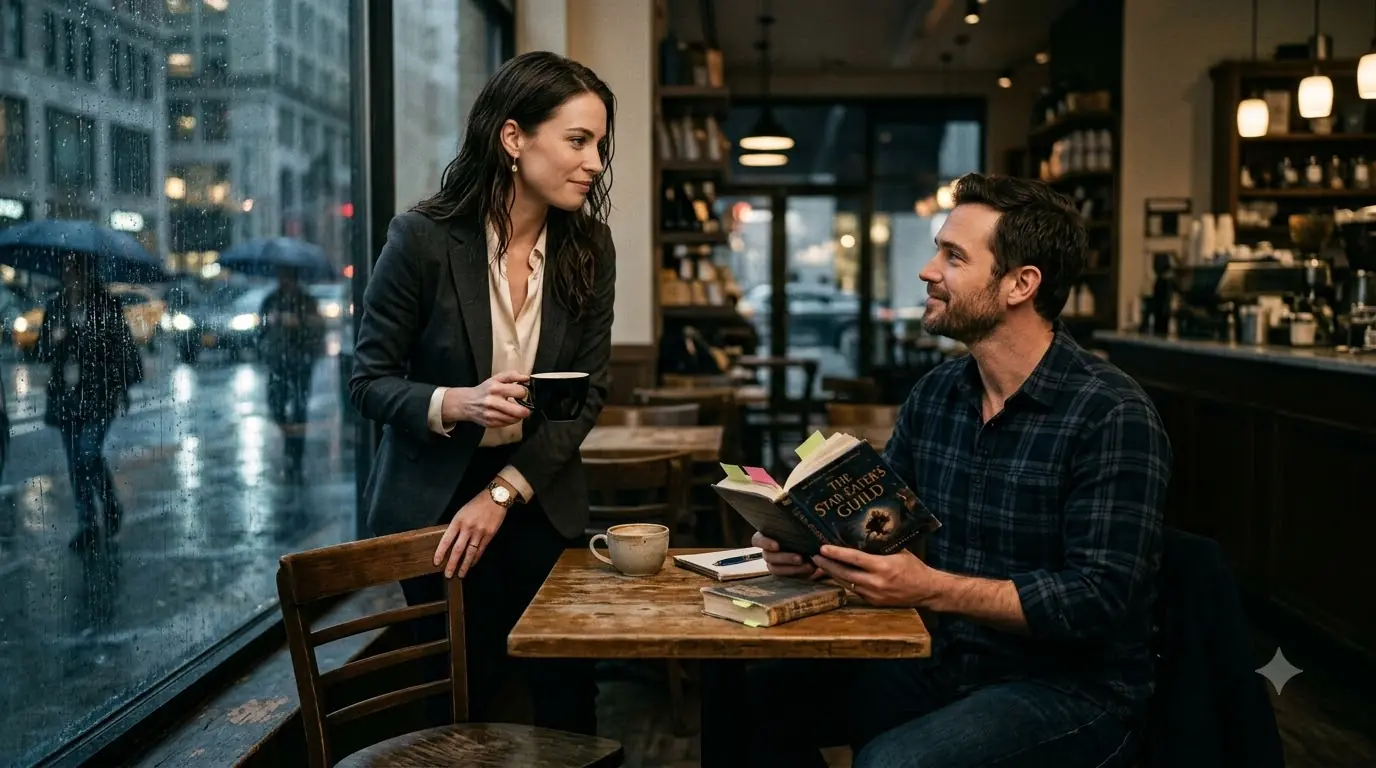
In the far corner, beside the tall window streaked with rain, a man sat alone at a table for two. He was reading a book, his coffee untouched and cooling beside his elbow.
One hand resting flat on the open page as though he were keeping the words from escaping. He had the kind of stillness about him that people only have when they are genuinely comfortable being alone, not performing solitude, not staring at a phone to avoid it, just sitting inside his own quietness like it was a room he knew well.
Sarah crossed the cafe, weaving between chairs and bags and the outstretched legs of college students with laptops. She stopped at the edge of his table and he looked up.
“I’m sorry to bother you,” she said.
“Is there any chance I could sit here? It’s a little packed.”
He smiled a simple, unhurried smile and closed the book with his thumb still marking the page. “Of course,” he said.
“Go ahead.” His name was Daniel Carter, and he was 39 years old, though he looked a little older in the way that men who work with their hands tend to: not tired, exactly, but weathered in a way that suggested a life lived close to physical things, to machinery and effort and the specific satisfaction of fixing something broken and making it run again.
He was wearing a flannel shirt in a dark blue plaid, slightly faded, and his hands resting on the table were calloused at the fingertips and across the base of the palm. Sarah noticed the hands first.
The way she noticed details about people from years of reading rooms full of negotiators and investors and people who said one thing while their bodies communicated something else entirely. His hands said that he worked, really worked, not metaphorically.
Sarah sat down across from him and ordered a black coffee from the passing server and then she looked at the book he had set aside to make room for her. It was a children’s chapter book, the third installment of a popular middle grade fantasy series, the kind with a dragon on the cover and gold foil on the title.
A strip of yellow sticky notes bristled from the top marking several pages. Sarah nodded toward it.
“Is that for a student?” she asked.
Because she was trying to be polite.
And it was an honest question. He glanced at the book and smiled again.
A warmer version of the first one. “My daughter,” he said.
“She’s been asking me to read it so we can talk about it together. I’m trying to finish it before she does.”
He tapped one of the sticky notes. “I’ve been marking the parts she’s probably going to want to discuss.”
“She has opinions,” he said, the last two words with a kind of affectionate helplessness that made Sarah smile before she realized she was doing it.
They talked the way strangers sometimes do when the weather outside is bad enough to make everyone inside feel briefly allied about the rain, about the neighborhood, about whether the city had gotten worse, or whether they had simply gotten more impatient with it. Daniel had an easy manner of speaking, unhurried.
His speech had pauses that weren’t awkward, but felt more like breathing room. They gave the conversation space to settle before moving again.
He told her he was a repair technician, industrial and commercial machinery, mostly. He worked for a mid-size service company that sent him to warehouses and distribution centers around the metro area.
He described what he did with the kind of quiet competence that people use when they genuinely love something without needing anyone else to validate that love. He talked about the logic of mechanical failure, about how a machine breaking down always tells you something specific if you know how to listen for it.
He talked about the satisfaction of returning something to its intended function. Sarah, who had spent the afternoon surrounded by people speaking entirely in abstractions, found it unexpectedly grounding.
She told him she worked in technology, which was true enough, and he didn’t press her for more, which she appreciated. They talked about the city, about routines that had changed over the years, about the strange way that finding an ordinary coffee shop on a rainy evening could feel like a discovery.
And then, somewhere in the easy back and forth of the conversation, Daniel mentioned, without fanfare and without any apparent awareness of what he was setting in motion, that he had spent much of his 20s supporting students he didn’t know. He phrased it plainly, almost offhandedly, the way someone might mention that they used to volunteer at a food bank.
It was just a thing they had done, a way they had chosen to spend some of what they had when they didn’t have very much of it. Sarah’s coffee cup paused halfway to her lips.
“What do you mean, supporting them?” she asked.