She was a mail-order bride who arrived on a Wednesday and was abandoned on the platform before the hour was over.
The coach from the railhead arrived at half past two.
She was the last passenger to step down, carrying one bag and wearing a dress that had been carefully pressed before the journey but had not survived it. 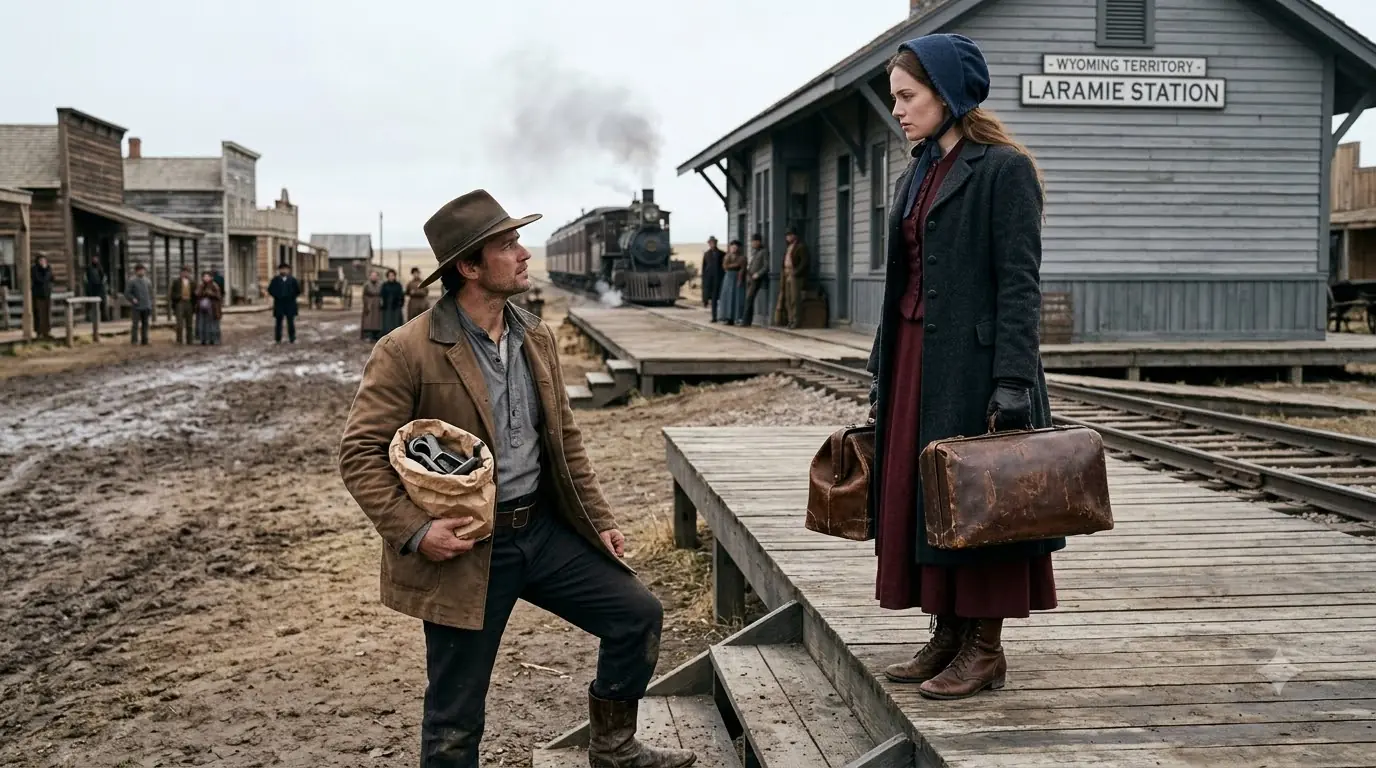
Her hands rested loosely at her sides, and her chin remained level in the manner of a woman who had decided in advance that she would not fall apart.
Albert Pugh waited at the far end of the platform with a folded paper in one hand and the expression of a man who had rehearsed bad news so many times that the rehearsing had only made it worse.
He had filed the marriage contract with the agency eight months earlier. During the months that followed, he changed his mind, but he never wrote to tell her. Writing a letter would have required a kind of courage he did not possess until witnesses were standing nearby.
Willa had spent three years working at the orphanage where she had grown up. She remained there after reaching adulthood, taking in mending, saving whatever she could, and waiting for some possibility beyond its walls.
When Albert’s solicitation arrived, she read it twice. Then she signed her name and spent the last of her money on the journey west.
Albert told her he could not go through with the arrangement.
He said it loudly enough for everyone on the platform to hear, which was the full measure of the cruelty. By supper, half the town would know. By the following morning, the rest of it would.
Willa stood and allowed him to finish.
Her hands remained at her sides. Her face did what she required it to do.
Albert raised the agency papers once.
They were not a deed. Everyone on the platform understood that a woman was not land and could not be claimed as property. Still, Albert held the papers as though he wanted their weight behind him.
Then he returned them to his coat and walked away without looking back.
The platform slowly emptied around Willa.
She remained where she was, her bag resting beside her feet. The town stretched before her, and she had no clear answer for what came next.
Across the street, a man stepped out of the hardware store carrying a paper bag filled with metal fittings. He stopped on the boardwalk step and looked toward the platform.
He was thirty-two years old, broad through the shoulders, with a carpenter’s hands and sawdust still clinging to one sleeve from the morning’s work.
He looked like a man who had carried too much for too long, long enough that he no longer noticed the weight.
From the hardware store steps, he read the scene before him.
The single bag.
The straight back.
The empty space where another man had recently stood.
Then he crossed the street.
He stopped at the bottom of the platform steps and looked up at her.
“Seth Callan,” he said. “I have two children and a house that needs keeping.”
Willa watched him without speaking.
“I do carpentry work three days each week, so you would have the house to yourself during the mornings.”
He held her gaze.
Willa studied him for a moment, measuring his face and the way he stood.
“Can you cook?” Seth asked.
“I can,” she answered. “And I am not afraid of hard work.”
She picked up her bag.
“Then let us go.”
They walked away from the platform together. Behind them, the town watched and stored the moment away for later.
Seth’s cabin stood near the edge of town. A horse occupied the side pen, and one porch step had been waiting a long time for someone to repair it.
Willa noticed the loose board but said nothing.
Inside, the front room was clean in the way a house managed by a man alone was clean.
Functional.
Orderly.
Without softness.
A workbench stood along the far wall. The stove performed its steady work near the kitchen, and above the window rested a small sewing basket with a wooden lid.
It looked like something nobody had touched in a very long time.
Something everyone inside the house had silently agreed to leave alone.
Seth showed Willa the room beside the kitchen.
“It is yours,” he said. “Your own door and your own space.”
He explained that the children ate at six. He ate whenever he returned from work.
Jack appeared from the rear of the house with the timing of a boy who had been listening from somewhere he was not supposed to be.
He was ten years old and already carried his father’s build across the shoulders. His face kept its own counsel.
Jack looked at Willa the way a person looked at something he had seen another version of before and was not prepared to feel differently about.
Then he looked at his father.
Without speaking, he turned and returned the way he had come.
The silence said enough.
Mary did not enter so much as appear.
She was six years old, with one ribbon tied properly and the other hanging loosely from her hair. She stood beside the bedroom doorway with the open and unguarded attention of a child who had not yet learned to want things quietly.
Mary looked at Willa with her entire face.
Willa returned the look steadily. She performed nothing and offered no false cheerfulness.
“Are you hungry?” Willa asked.
Mary considered the question seriously.
“A little.”
“Come help me see what is in the larder.”
Mary followed her without hesitation.
Supper that first evening consisted of beans, cornbread, and a broth that had no business smelling as good as it did, considering what little the larder contained.
The aroma reached the front room before anyone sat at the table.
Seth entered from the yard and stopped just inside the door. Something passed across his face, but he put it away before anyone could study it.
Jack ate quietly.
Mary divided her attention between her bowl and Willa, looking back and forth with steady fascination.
Partway through the meal, Mary placed her spoon down.
“The last woman who kept house for us burned everything she touched.”
“Mary,” Seth warned.
The girl continued looking at Willa.
“She did, though.”
Willa kept her eyes on her plate.
“Burned beans are a serious matter. I do not take them lightly.”
Jack looked up.
One corner of his mouth moved briefly before returning to its usual place.
He said nothing more, but after supper ended, he remained at the table longer than necessary before going to bed.
Seth noticed and did not comment.
The following morning, Seth stepped from the porch.
The loose board remained solid beneath his boot.
He stopped and pressed his weight against it again.
For a moment, he simply stood there.
Then Seth returned inside, poured two cups of coffee, and left one on the counter near where Willa was working.
He said nothing about the repaired step.
Willa said nothing about the coffee.
They drank together in the quiet of early morning while the cold settled around the cabin.
Jack tested her on the fifth day.
He simply refused to do what she had asked and settled back to wait for her reaction.
Willa appeared in the doorway of the rear room.
“Jack, the firewood.”
He looked up slowly.
“I was getting to it.”
“I know.”
She held his eyes.
“Get to it now, please.”
Jack studied her. He held her gaze and found whatever he had been searching for.
Then he rose and carried the wood inside without arguing.
Willa thanked him plainly and returned to the kitchen.
Seth had heard the entire exchange from his workbench.
He put his hand plane down and remained in the silence for a while before picking it up again.
The days gradually found their shape.
Jack began staying at the table after meals. Sometimes he whittled a scrap of wood. Other times he read, but he remained present in a way he had not before.
Mary followed Willa from room to room with the devotion of a small shadow. She helped wherever she could reach and watched carefully whenever she could not.
Seth began returning from his carpentry work at the same hour every evening.
One night, Willa read from the storybook on the shelf.
She performed each voice without embarrassment. Mary pressed against her side with the complete trust of a child who had made a decision and saw no reason to reconsider it.
Jack sat at the opposite end of the room with something in his hands.
He did not look up.
He did not leave.
By the time frost had permanently settled into the mornings, Mary had stopped following Willa like a visitor and begun following her like a child at home.
It happened on a gray and otherwise unremarkable morning.
Mary moved through the kitchen wearing only her socks, still warm from sleep and absorbed in some private purpose. Her foot caught against the threshold between the kitchen and hallway.
She fell hard onto both palms.
The sound she made was one of surprise, the sound that came before a child decided whether an injury justified tears.
Mary decided it did.
Willa was on the floor beside her before the crying fully began.
She took both small hands and examined the palms. Then she held them between her own, warm and steady, without creating alarm and without going anywhere.
Mary looked at her.
Without planning to speak at all, she said the word that had simply become true.
“Mama.”
The word entered the cabin and did not leave.
Willa’s hands remained exactly where they were.
She drew one breath, no more.
Then she gathered Mary into her arms and held her until the crying exhausted itself.
Willa remained calm and certain. She gave no outward indication of what the word had done to the room.
Seth stood in the bedroom doorway.
He had heard it.
One hand rested against the wooden frame while he looked toward the hallway floor without moving.
Something was happening inside him, and he kept his eyes turned away from it.
Some things changed the moment a person looked directly at them.
At the table, Jack had become completely still.
He was ten years old, old enough to understand exactly what he heard and precisely what it meant.
Something in his face that had remained closed for a long time began moving slowly toward open.
Seth returned to his room.
He sat on the edge of the bed with one hand resting flat on his knee and stayed there while the morning continued quietly around the house.
On a Friday afternoon, Abigail Cutler came to stand beside Willa at the general store counter.
She carried the warm and practiced manner of a woman delivering concern she had carefully prepared at home.
Abigail spoke about appearances.
She mentioned what people in town were saying and the natural shape a situation might take if it were allowed to continue.
Then she spoke about the confusion created when children were given the wrong understanding of what an arrangement truly was.
Abigail chose her words the way a craftsperson selected tools, according to what they were meant to do.
She left without purchasing anything.
Willa placed her coins on the counter one by one and walked home.
She was twenty-five years old and had been measured by women with carefully prepared voices in enough rooms to develop a durable patience for it.
It was the patience of someone who understood that another person’s judgment did not become truth simply because it was delivered politely.
At home, Willa stood beside the kitchen window.
Her hands rested against the sill while she looked across the yard, the line of pines beyond it, and the cold flat sky.
She stood longer than necessary.
Then she began preparing supper.
That evening, Seth tended the stove while Willa finished washing the dishes.
Without turning away from the fire, he spoke.
“Are you all right?”
Willa kept her hands inside the basin and considered the question honestly.
“I am.”
Seth nodded once toward the fire.
Willa returned to the dishes, and the room held its silence comfortably around them both.
Almost one month later, Dale Marsh sat inside the saloon on a Tuesday evening.
He had no intention of creating trouble.
Dale was simply talking in the relaxed way men talked after a long day. He said the Callan house looked different lately.
Smoke rose from the chimney at the proper hours.
The children seemed steadier.
The woman Albert had abandoned on the platform in front of half the town had changed something inside the place.
“There is something about her,” Dale said.
He explained that the children had taken to Willa in a way he had not seen before.
Jack was beginning to come around.
Mary had started calling her Mama.
Dale reached toward his glass.
At the far end of the bar, Albert Pugh had become still.
Dale continued speaking because he had not noticed.
He said it was good to see life inside the Callan house again.
Albert stared at the line of bottles across from him.
The agency papers remained inside his coat.
His pride had sat badly within him since the day at the platform.
Now an image formed inside his mind.
Warm light in the windows.
Children who had settled.
Smoke rising at the proper hours.
A woman the younger child already called Mama.
Albert placed several coins on the bar and stood.
“Where does Callan live?”
The confrontation came on a cold and clear Thursday morning.
Seth and Willa emerged from the post office together. He had gone to collect a notice concerning timber, and Willa accompanied him because the children were at school and the morning had unfolded that way.
Albert stepped into the middle of the street.
He held the agency documents in one hand and pitched his voice loudly enough to carry.
“The fare was paid,” he said. “The contract was signed.”
People began turning toward him.
“An obligation does not disappear because a woman has found somewhere more comfortable to stay.”
Albert raised the papers as though they were a deed, although everyone on the street understood what they were.
Then he used the word his.
The street heard it land.
Everything slowed.
A woman near the dry goods store stopped walking.
Two men outside the feed store turned toward the scene.
The cold air seemed to hold everything in place.
Willa stood beside Seth.
She did not step backward.
She did not look at Albert.
She carried herself exactly as she had on the platform, still, straight, and unbroken.
There was one important difference.
This time, someone stood beside her, and everyone on the street could see that he had not moved away.
Seth looked at the documents.
Then he looked at Albert.
Finally, he turned toward Willa.
“Stay here.”
It was not a command.
It was the way someone spoke when he intended to return.
Seth crossed the street and entered the bank.
He remained inside for four minutes.
When he came back, he carried the money he had kept beneath his floorboards for two years.
It was everything he had saved toward purchasing land and returning to the life of a proper rancher.
Two years of slow and patient work.
Two years spent rebuilding from the ground upward.
Seth crossed the street.
He pressed the money into Albert’s hand and held it there until Albert’s fingers closed around it.
“That settles the fare, the agency fee, and every excuse you brought into town.”
Seth’s voice was flat and final.
“It does not purchase her.”
He held Albert’s eyes.
“It frees her from you.”
Seth released the money.
“Now leave.”
Albert looked down at the money.
Then he looked at the townspeople watching him.
Finally, he turned toward Willa.
Whatever Albert found inside her expression was not what he had ridden into town expecting to see.
He walked toward his horse.
Albert mounted and rode away.
The cold morning closed behind him.
For another moment, the street held its breath.
Seth turned away from the crowd and faced Willa.
She was already looking at him.
Her hands remained at her sides.
The exhaustion she had carried since the platform was gone from her eyes. Something steadier had replaced it.
She looked like a woman standing on ground that would hold her.
Seth stood before her while wind came down from the hills, clean and cold.
He had crossed the street toward her before consciously deciding to do so.
He had left coffee beside her on the counter and made nothing of it.
He had just surrendered two years of savings without hesitation because standing quietly while someone claimed her was not something he was capable of doing.
Seth was not a man who decorated the truth until it sounded finer than it was.
He did not intend to begin now.
“I would like you to stay,” he said.
Willa waited.
“As my wife, if that is what you want.”
She looked at him.
Willa allowed herself the full space required to choose.
Nobody hurried her.
The cold street waited.
“Yes,” she said quietly and completely, holding nothing back. “That is what I want.”
Seth released a long, slow breath.
His hand found hers and closed around it.
Around them, the town returned to itself.
Boots sounded against the boardwalk.
A nearby door opened and closed.
Wind continued moving from the hills beneath the pale winter sky.
The ranch would have to wait.
For the first time in years, waiting did not feel like losing.
Later, Jack sat at the kitchen table with a short length of wood and his father’s smallest plane.
He worked the edge smooth by touch, the tip of his tongue resting between his teeth in concentration.
Mary sat on the floor with her rag doll, deeply occupied by some matter of considerable importance that required no adult assistance.
From the stove came the smell of something made with molasses.
It was a new recipe Willa was still discovering, adjusting as she worked.
It was the kind of smell that entered the walls of a kitchen and remained there for years.
The front door opened.
Cold air entered first, followed by the sound of Seth’s boots against the step.
It was the sound of a man who knew his return was expected and had stopped taking that knowledge for granted.
Mary lifted the rag doll briefly in his direction as a greeting, then returned to her business.
Jack looked at his father standing in the doorway.
Then he lowered his eyes and continued working with the plane.
Something had passed through the look between them that had not existed at the beginning.
Seth removed his coat and crossed toward the stove.
He stood beside Willa and studied what simmered inside the pot.
Without speaking, she held the spoon toward him.
Seth tasted the mixture.
He considered it quietly and did not rush his judgment.
Then he looked at her.
Willa took the spoon back.
“I know,” she said. “More molasses.”
One corner of Seth’s mouth moved.
He went to hang his coat properly and left her to continue.
Above the kitchen window, the sewing basket remained on the shelf where it had always sat.
Late afternoon light entered through the glass and settled warmly across its wooden lid.
Outside, wind traveled through the pines at the edge of the property.
The horse shifted inside the pen.
Somewhere beyond the tree line, a bird called once, long and unhurried.
The cabin held its warmth.
It was not waiting for anyone.
Not anymore.
Willa had arrived with nothing except one bag and the strength to remain standing.
She had found a house that needed keeping, two children who needed someone willing to stay, and a man who had nearly forgotten what it meant to come home to a place expecting him.
In return, they gave her something no contract could provide and no agency could arrange.
A choice.
A family.
A home that was hers because she had been asked to stay and had freely answered yes.