The day the cannery trucks rolled up Willa Hartley’s gravel drive, the whole town of Brier Glenn decided her story was already over.
By sunset, seventy tons of oversized pumpkins lay across the north pasture in a sprawling mountain of orange, green, cream, and dull yellow.
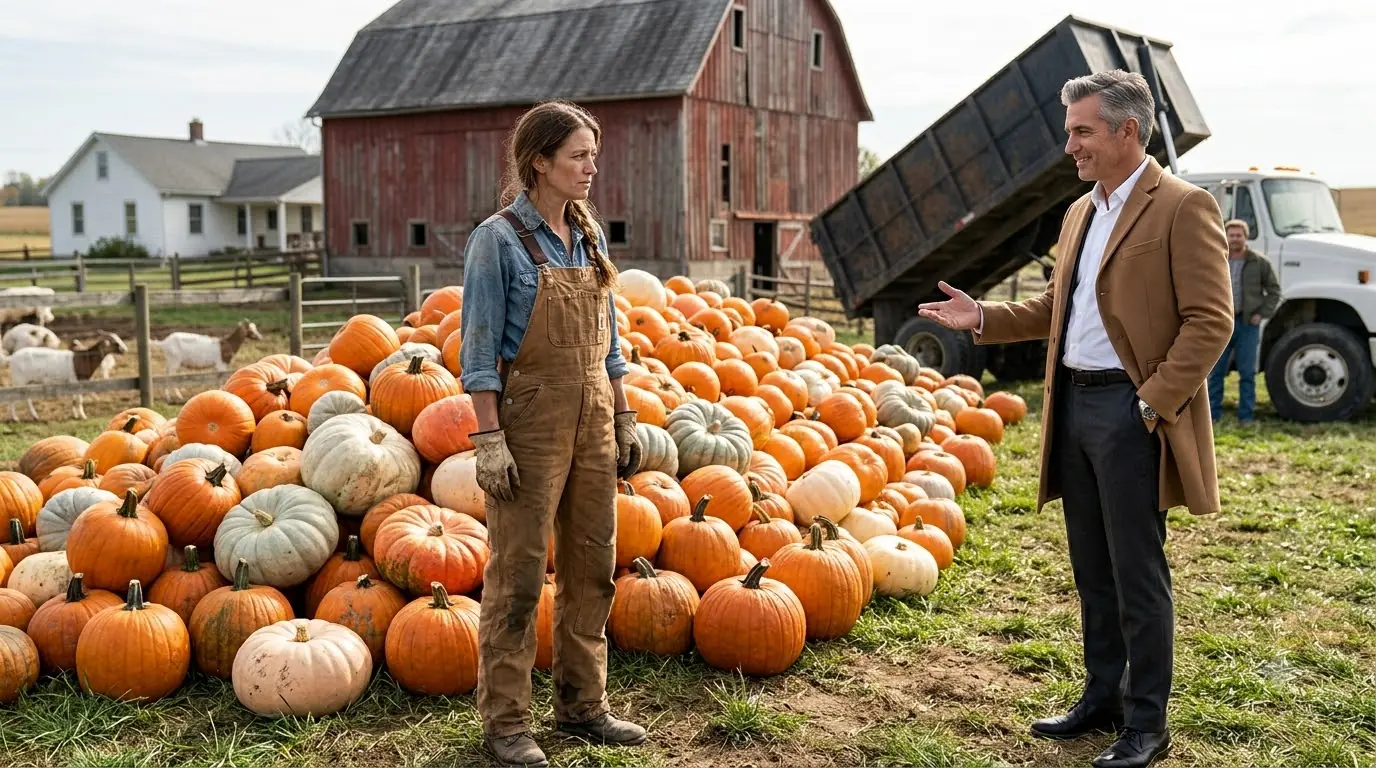
Some were larger than tires.
A few had flattened beneath the weight of the loads above them and split open when they hit the ground, exposing dense orange flesh and pale seeds.
Cars slowed on the county road.
People took photographs.
By the following morning, someone had posted one online with the caption:
HARTLEY HOLLOW OFFICIALLY BECOMES THE COUNTY DUMP.
People laughed.
Everett Blackstone laughed too.
He owned Blackstone Valley Cannery, the company that had spent nearly twenty thousand dollars over the previous three seasons disposing of produce that could not fit through its automated processing equipment.
To Everett, those pumpkins were not food.
They were not feed.
They were not raw material.
They were a logistics problem.
And Willa Hartley, a struggling single mother with a failing goat farm and a barn roof she could not afford to repair, had just agreed to remove that problem for him.
Free.
Everett told his operations director that desperate people rarely read contracts closely when they believed somebody was giving them something.
Six months later, three black luxury cars would idle outside Willa’s gate while chefs argued over allocations of a pale ivory goat cheese aged beneath a roasted pumpkin-seed-oil rind.
Two years later, restaurants would reserve production before the goats had even been bred for the season.
Six years later, the waiting list would stretch beyond anything Willa considered reasonable.
And when Everett eventually returned insisting that Blackstone Valley Cannery deserved a percentage of what she had built, Willa would place one sheet of paper between them.
The transfer agreement his own company had drafted.
The one Everett had signed without reading carefully because he believed the material covered by it was worthless.
But on the morning the first truck arrived, none of that existed yet.
There was only a mountain of pumpkins.
A leaking roof.
Forty-six hungry goats.
A frozen credit line.
And Willa Hartley standing in mud wondering whether she had just made the most expensive mistake of her life.
Hartley Hollow Farm sat three miles outside Brier Glenn, tucked between low limestone hills and fields that rolled toward a shallow river valley.
The farm had belonged to Willa’s grandmother first.
Then her father.
Then, after a series of family deaths, refinancing agreements, and one marriage that ended more suddenly than it began, it belonged to Willa.
Mostly.
The bank technically owned a meaningful opinion about the matter.
The property totaled fifty-eight acres.
Twenty-six were usable pasture.
Eleven were wooded.
The rest included the farmhouse, barn, equipment shed, two small paddocks, a spring-fed pond, and enough uneven ground to make every fence repair more difficult than it should have been.
Willa was thirty-eight.
She wore her brown hair tied behind her neck most days because goats did not care about appearance and machinery cared too much about loose hair.
Her hands were rough.
Her boots had been repaired twice.
She owned exactly one coat that looked respectable enough for meetings.
Her daughter, June, was eleven.
June had inherited her mother’s dark eyes and her father’s height, though Willa tried not to think about the second part too often.
Her ex-husband, Colin, lived two states away.
He sent child support when it was convenient.
He also sent birthday cards late and promises early.
Willa had stopped building any part of the farm’s financial plan around either.
She and Colin had married when she was twenty-four.
At the time, Willa still believed her future involved laboratories.
Food science.
Product development.
Maybe quality assurance for a dairy company.
She had studied three years at a state university before leaving when her father became ill.
Temporary, she told herself.
One semester.
Maybe two.
Her father recovered enough to work again, but by then the farm needed help, money was tight, and Colin had entered her life with the kind of certainty that made postponing one dream feel like choosing another.
He liked the farm at first.
The open land.
The idea of raising animals.
The photographs.
What he disliked were the actual hours.
Frozen pipes.
Birthing season.
Invoices.
Repair costs.
Feed prices.
Mud.
The way a farm could consume an entire Saturday without producing anything suitable for social media.
By the time June was five, Colin had begun spending more time away.
By the time she was seven, he left.
He did not steal anything.
Did not empty bank accounts.
Did not create some dramatic betrayal Willa could explain cleanly.
He simply decided the life they had built demanded more of him than he wanted to give.
That kind of abandonment was harder to hate.
It arrived in paperwork.
Separate checking accounts.
A rented apartment.
Weekend schedules.
A sentence at the kitchen table:
“I don’t think I can do this anymore.”
Willa had looked around the room.
At unpaid bills.
June’s school backpack.
A milk pail beside the back door.
Then she asked:
“Do what?”
Colin did not answer well.
Three months later, the divorce was filed.
Six months after that, he moved.
The farm stayed with Willa because it had come through her family.
The debt stayed too because debt is loyal in ways people are not.
For years she survived by reducing everything.
Reduce herd size.
Reduce equipment purchases.
Reduce repairs.
Reduce personal expenses.
Reduce expectations.
At its peak, Hartley Hollow had kept 112 dairy goats.
By the time the pumpkins arrived, forty-six remained.
Mostly Alpine and Nubian crosses.
Good milkers.
Hardy enough for the local climate.
Every animal had a name because June insisted numbers were rude.
There was Alice.
Ruby.
Mabel.
June Bug, named before June objected.
Martha.
Pepper.
Dot.
Louise.
Old Bea, who was thirteen and had stopped producing enough milk to justify herself economically years earlier.
Willa kept Bea anyway.
“You always say farms can’t run on feelings,” June once told her.
“They can’t.”
“Then why is Bea still here?”
“Management exception.”
“That sounds like feelings.”
“Go finish your homework.”
Willa’s main income came from fresh chèvre sold to two local grocers, milk delivered through a cooperative, occasional breeding stock, and a small seasonal farm shop.
It was enough.
Then feed prices rose.
Hay climbed.
Commercial supplement climbed faster.
Fuel rose.
Veterinary costs followed.
Everything expensive on a farm seemed to know when everything else had become expensive too.
The week before Blackstone Valley called, Willa stood at Wade Ror’s feed store staring at an invoice.
Wade was fifty-four.
Broad stomach.
Permanent red cap.
A voice that could carry from one end of the building to the other even when he claimed to be speaking privately.
He had supplied Hartley Hollow for years.
Sometimes fairly.
Sometimes because he knew Willa had no closer option.
“You’re thirty-eight days out on the last balance,” Wade said.
“I know.”
“And you want another load.”
“Yes.”
He tapped the invoice.
“Willa, I’m not a bank.”
“I’m asking for ten days.”
“You asked for ten last month.”
“The milk cooperative pays Friday.”
“That check covers the old bill.”
“It covers most.”
Wade leaned against the counter.
Two men stood several feet away pretending to compare fencing staples.
Willa knew they were listening.
Wade knew too.
“You need to think seriously about whether this farm is working.”
She said nothing.
“I’m not trying to be cruel.”
That sentence usually introduced cruelty.
“You’re down more than half your herd.”
“I know.”
“Roof leaks.”
“Yes.”
“Your truck has been making that sound for a year.”
“It still moves.”
Wade sighed.
“This place isn’t failing fast enough for you to make a decision.”
Willa looked at him.
“What?”
“It’s failing slowly.”
He lowered his voice slightly.
“One season at a time.”
That sentence followed her home.
Not because Wade was entirely wrong.
Hartley Hollow was not collapsing.
Collapse might have been easier.
Insurance event.
Foreclosure.
Auction.
Something with an obvious date.
Instead, the farm was shrinking invisibly.
One postponed repair.
One sold animal.
One depleted savings account.
One expensive winter.
Then another.
Willa drove home beneath a flat gray sky.
Her truck heater rattled without producing much heat.
In the glove box sat a small black notebook.
Expenses.
Every one.
Fuel.
Feed.
Minerals.
Medicine.
Hardware.
Electricity.
Packaging.
Cheese cultures.
Cleaning supplies.
Nothing escaped.
Food science had trained that habit into her.
Measure first.
Assume later.
At home, she opened the barn roof fund.
Balance:
$1,840.
The repair estimate was $6,700.
She transferred $1,500 into checking.
Ordered feed.
Roof fund:
$340.
Then rain started that night.
Willa placed three more buckets beneath leaks.
June watched.
“Are we fixing it soon?”
“Yes.”
“When?”
“Soon.”
Children know when adults lie kindly.
June nodded anyway.
Two days later, Willa’s neighbor Cal Mercer called.
“You want pumpkins?”
Willa was repairing a gate hinge.
“What?”
“Pumpkins.”
“For what?”
“Feed.”
“How many?”
Cal laughed.
“More than you think.”
He explained.
Blackstone Valley Cannery processed pumpkin puree, soup bases, pie filling, and seasonal specialty products.
That year, one contracted grower produced an unusual crop.
Weather conditions created oversized pumpkins.
Healthy.
Mature.
Enormous.
The cannery’s automated cutting equipment accepted a specific size range.
Anything too wide jammed the feed system.
Workers tried hand-cutting some.
Labor costs made it pointless.
The cannery had seventy tons sitting in its yard.
Willa stopped working.
“Seventy tons?”
“Yep.”
“Why are you calling me?”
“Guy at the cannery said maybe livestock farms would take them.”
“For free?”
“They want them gone.”
That was when Willa’s education stirred.
Pumpkin could be used as livestock feed under appropriate conditions.
Not as a total ration.
Not casually.