The auctioneer did not bother trying to make the carrots sound valuable.
That was what Della Vickers remembered most.
He stood beside the battered farm wagon outside Viroqua, Wisconsin, on a cold October morning in 1971, one hand tucked into the pocket of his brown jacket while forty or fifty farmers gathered around the remaining equipment from the Holmgren place.
“Lot thirty-seven,” he called.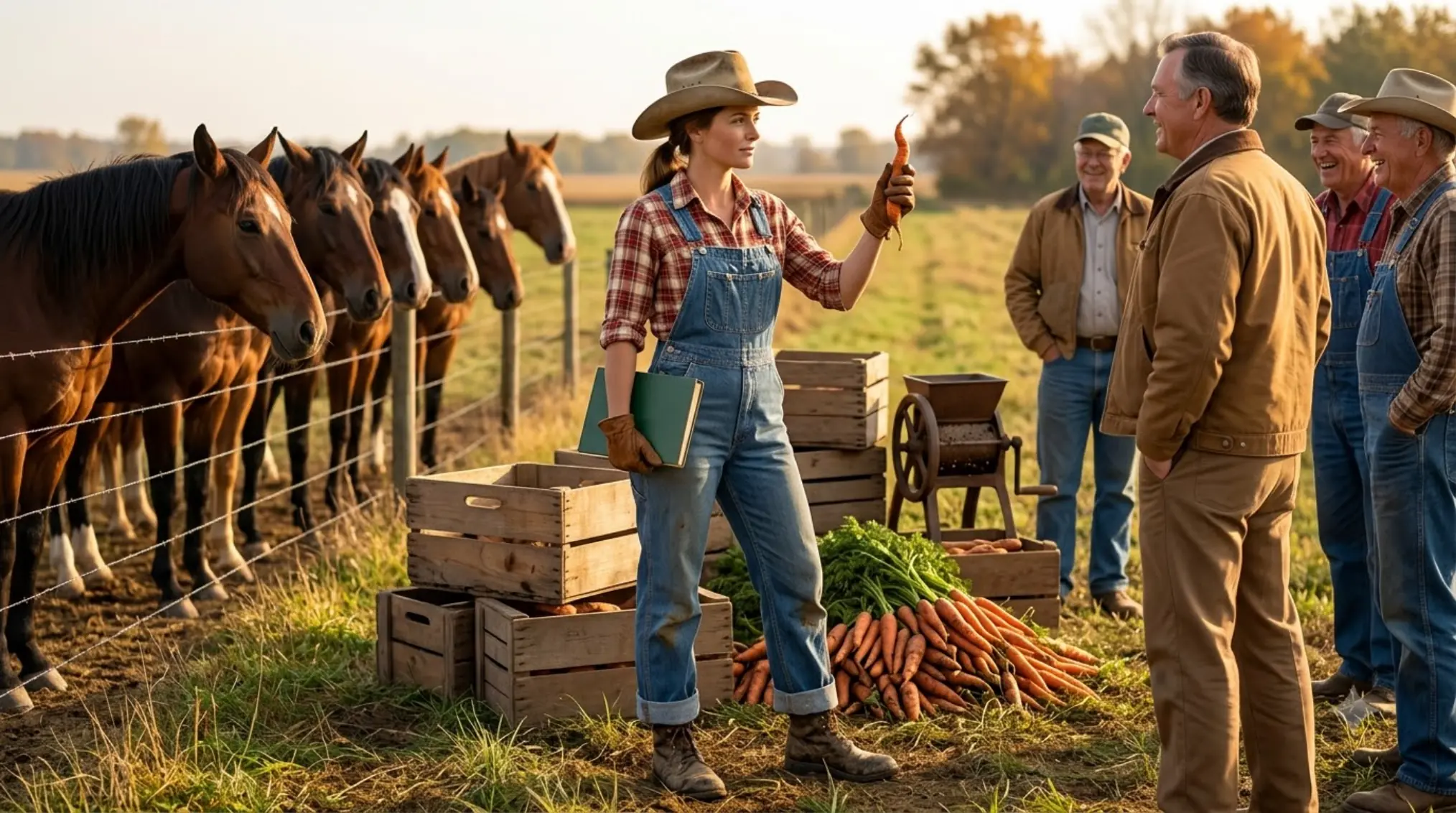
People turned.
“Forty-seven wooden produce crates, one hand-cranked root washer, and whatever carrots remain in the back six acres.”
Someone laughed.
The auctioneer smiled.
He knew what everyone knew.
The crates were warped.
Several were missing slats.
The root washer had a crack running through the metal drum and brush rollers worn nearly to the steel.
And the carrots?
Nearly forty tons of them still sat underground because the regional cannery had rejected the entire harvest.
Too crooked.
Too forked.
Too irregular.
Commercial peeling equipment was designed for predictable shapes. The Holmgren carrots caught in the guides, jammed the machinery, and slowed production until the cannery decided they were worth less than the labor required to process them.
To the cannery, that was the end of the discussion.
To most farmers standing at the auction, it was the end too.
The auctioneer cleared his throat.
“Who’ll give me fifty dollars?”
Nobody moved.
Della stood near the back wearing faded denim overalls over a red-and-cream plaid shirt, work gloves tucked through her belt and a weathered tan hat pulled low against the wind.
Thirty-one years old.
Widowed.
Four hundred ten acres under her management.
No mortgage.
No operating note.
No partner.
She held a small green ledger against her side.
Her brother-in-law Gene Vickers stood several feet away.
He noticed when Della raised her hand.
“Fifty.”
The auctioneer pointed.
“Fifty dollars. I have fifty. Who gives sixty?”
A man near the truck laughed.
“Hell, somebody ought to pay her to haul that mess away.”
Della looked toward the back field.
Six acres.
Black Vernon County loam.
Thousands upon thousands of carrots beneath it.
The auctioneer tried again.
“Sixty?”
Della raised her hand.
Gene turned sharply.
She had just bid against herself.
The auctioneer looked surprised but recovered quickly.
“Sixty dollars.”
Nobody challenged her.
He counted once.
Twice.
“Sold.”
The hammer fell.
Several men laughed.
Della did not.
Gene waited until the crowd moved toward the next lot before approaching.
“You know you just paid sixty dollars for forty tons of carrots nobody wants.”
Della looked toward him.
“No.”
Gene frowned.
“You didn’t?”
“I paid sixty dollars for forty tons of horse feed, forty-seven crates, and a repairable washer.”
He stared at her.
“Cannery says those carrots can’t be sold.”
“To the cannery.”
“What’s the difference?”
Della opened her ledger.
Inside were three months of notes.
Feed costs.
Winter hay prices.
Horse-boarding rates.
Transportation.
Root vegetable values.
Potential customers.
Gene stared.
“You’ve been planning this.”
“Since August.”
He looked back toward the carrot field.
Then at her 1963 Ford F-100.
“That truck can’t haul forty tons.”
“I know.”
Gene sighed.
“You want my flatbed.”
“I was hoping you’d offer.”
He shook his head.
“You’re impossible.”
“Are you lending it?”
“Yes.”
That was the last time Gene Vickers laughed at the carrots.
Della had learned numbers before she learned horses.
Her father, Raymond Mayes, believed every farm told the truth eventually, but only to people willing to write things down.
He kept a green ledger at the kitchen table.
Every dollar entered.
Feed.
Fuel.
Seed.
Repairs.
Veterinary bills.
Sale prices.
Taxes.
Fence wire.
Everything.
When Della was nine, Raymond put the ledger in front of her.
“You know addition?”
“Yes.”
“Subtraction?”
“Yes.”
“Then you know farming.”
She looked at him.
“That’s all farming is?”
“No.”
Raymond smiled.
“That’s the part most people ignore until it kills them.”
Della never forgot it.
Raymond ran Hereford cattle across two hundred eighty acres of rough Vernon County hills.
Some land was good.
Some tolerated farming only because Raymond knew better than to demand too much from it.
He also kept four horses.
Two Belgian drafts for work.
A mare named Pepper.
And Pepper’s foal, Biscuit.
Della loved the horses immediately.
She did not love them sentimentally.
She watched.
How weight shifted through the shoulder.
How ears changed before a horse resisted.
How one animal accepted pressure while another panicked.
At thirteen she broke Biscuit herself using a library book and patience.
Raymond watched from the fence.
He never interfered.
That evening he told Della’s mother, “Girl’s got a feel for horses.”
His wife replied, “I know.”
Raymond frowned.
“I mean a real feel.”
“I know that too.”
Della could have gone to college.
She had the scholarship letter.
The bus ticket.
The dormitory assignment.
She stayed.
Raymond’s health was failing.
The farm needed another pair of hands.
One year became another.
She married Carl Vickers in 1964.
He farmed nearby.
Steady man.
Good farmer.
No particular horse sense, but enough sense to respect hers.
Raymond died in 1967.
Carl died two years later from a heart attack while working a field.
Della was twenty-nine when she became responsible for everything.
Two farms.
Four hundred ten acres.
Cattle.
Horses.
Equipment.
The ledger.
People expected her to sell.
She did not.
She hired seasonal help when needed and did the rest herself.
By 1971, she had almost twenty thousand dollars saved and no debt.
That did not happen because she was lucky.
It happened because every purchase had to survive the ledger first.
The crooked carrots had survived it months before the auctioneer ever said “sold.”
In August, Della had driven to a horse-boarding operation outside La Crosse.
The owner, Frances Oberlin, had managed horses for two decades.
Della spent two hours asking questions.
“How much hay per horse?”
Frances told her.
“Grain?”
She answered.
“Supplements?”
Another number.
“Root vegetables?”
Frances paused.
“What about them?”
“Do horses eat them?”
“Carrots? Beets? Turnips? Sure.”
“How much?”
“As supplemental feed?”
“Yes.”
Frances explained that root vegetables were useful through winter, especially when horses spent months on dry hay.
“Why don’t you use more?”
“Price.”
Della leaned forward.
“What price works?”
Frances gave her a number.
Della wrote it down.
Then she asked how many horses Frances boarded.
“How many pounds of carrots would you buy if they were half your current supplier price?”
Frances laughed.
“Enough to make whoever sold them very busy.”
Della drove home.
That evening she opened the ledger.
She did the arithmetic.
Then again.