The bright fluorescent lights hummed overhead as an elderly woman stepped toward the checkout counter, her hands trembling slightly as she searched through her purse.
She had lived through countless decades and experienced things most people around her could only imagine, yet something about this ordinary moment made her feel unexpectedly vulnerable.
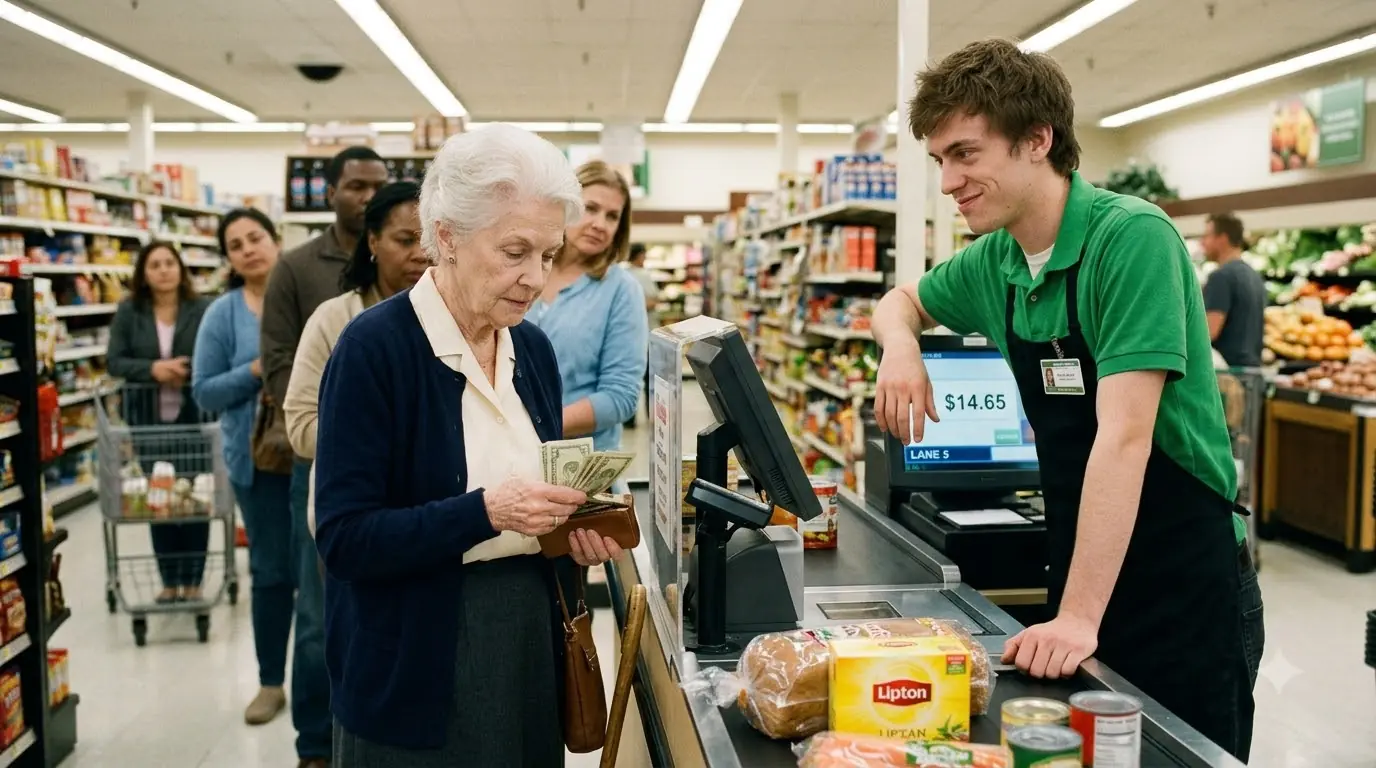
Behind the register, a young cashier watched her slow, deliberate movements with an unimpressed smirk. His mocking tone carried across the checkout area as he made a careless remark about her age.
What he did not know was that the elderly woman standing in front of him was not just another customer. Her life, her history, and the influence she quietly carried would soon force him to reconsider almost everything he believed about age, success, and human worth.
It was a typical Thursday morning in a busy suburban grocery store. The shelves were neatly arranged with colorful cereal boxes, canned goods, household supplies, and fresh vegetables, creating the familiar rhythm of everyday life.
Customers moved in and out while cash registers beeped, shopping carts rolled across the tile, and strangers exchanged casual pleasantries while waiting in line. Nothing about the morning suggested that one small encounter at a checkout counter would change two lives.
Marlene Harper walked slowly through the aisles, her cane tapping lightly against the cold tile floor. Her white hair was neatly pinned back, and a navy-blue cardigan hung loosely around her frail shoulders.
At seventy-five, her age showed in the deep lines across her face and in the care with which she moved, but the spark in her eyes hinted at a life filled with resilience, experience, and strength. She moved deliberately not because she had surrendered to weakness, but because she had learned long ago that there was no reason to rush through every moment.
Marlene had experienced a great deal during her lifetime. She had grown up in a small town, raised children of her own, built a life with a husband she deeply loved, and eventually endured the sadness of losing him years earlier.
She had faced hardship without allowing hardship to become her identity. Now, in her later years, she appreciated simple pleasures such as quiet walks, afternoon tea, and mornings when there was nowhere important she needed to be.
That Thursday, she had come to the grocery store for only a few essentials. There was nothing unusual about the trip. She expected to pick up what she needed, pay, return home, and continue with her day.
Behind one of the registers stood Adam Sullivan, a twenty-two-year-old cashier finishing a transaction with the customer ahead of Marlene. Adam embodied a kind of restless youthful arrogance.
His messy hair fell into his eyes, his uniform sat slightly crooked on his frame, and a faint smirk seemed permanently attached to his face. He had been working at the store for several months, mostly because it paid his bills while he tried to decide what he wanted to do with his life.
Adam did not particularly enjoy the job. He found many customers irritating, but elderly shoppers tested his patience more than most. Their careful movements, questions, stories, and occasional difficulty with cards or coins made him feel as though they were slowing down a world that should be moving faster. In his immature view, older people belonged to another era and were somehow out of place in the fast-paced life he thought mattered now.
As Marlene approached his register, Adam looked up. He saw an elderly woman with slightly trembling hands holding her purse close as she moved slowly into position. A small, condescending smile appeared on his face.
“Well, aren’t we in a hurry?” he said sarcastically. “Don’t worry. I’ve got all day to wait for you, Grandma.”
Marlene paused.
The comment stung more than she expected, but her expression barely changed. She had encountered cruelty before, and one impatient young cashier was hardly the worst challenge she had survived. Instead of reacting angrily, she offered him a small smile.
“I’m not in a hurry, dear,” she said calmly. “Just taking my time, as we should all do sometimes.”
Adam rolled his eyes.
He began scanning her groceries, moving each item quickly across the barcode reader.
“This is why old people shouldn’t shop alone,” he muttered loudly enough for her to hear. “Everything takes forever.”
Marlene looked at him but said nothing.
Adam continued scanning while Marlene carefully opened her purse and began counting the money she intended to use. Her fingers shook slightly as she separated the bills and coins. Behind her, the checkout line slowly grew, and a few customers began shifting impatiently.
Adam looked toward the clock.
He tapped his fingers against the counter in an exaggerated rhythm.
Marlene continued counting.
Adam sighed.
“Are you sure that’s all?” he asked sharply. “We’re not running a charity here.”
Marlene lifted her eyes.
For the first time, her gaze became noticeably sharper.
She looked beyond Adam’s sarcasm and noticed something she had seen in many people throughout her life. Beneath his confidence was insecurity. His arrogance felt less like genuine strength and more like armor worn by someone who had not yet decided who he wanted to become.
“No, dear,” Marlene said softly. “You’re right. This isn’t a charity.”
Adam waited.
“But kindness costs nothing.”
His tapping stopped.
Adam blinked.
He had expected irritation, embarrassment, maybe even anger. He had not expected an answer delivered with such quiet certainty.
For a second, he had nothing sarcastic to say.
Then he cleared his throat and returned his attention to the register.
The remaining coins dropped into the drawer with small metallic clicks. Adam finished the transaction quickly, almost as though he wanted the encounter over before the elderly woman could say something else that made him uncomfortable.
Marlene gathered her change.
Yet she did not immediately leave.
She stood there quietly for a moment.
Something about her calmness made Adam uneasy. She was not demanding an apology. She was not raising her voice or complaining to a manager. She did not even look particularly angry, and that somehow bothered him more than if she had shouted.
Adam wanted to regain control of the interaction.
“You know,” he began, forcing the familiar smirk back onto his face, “I think I’ve seen you around here before.”
Marlene waited.
“You’re probably one of those people who’s always talking about the good old days, right?” he continued. “Everything used to be better, people had manners, the world made sense, all that stuff.”
Marlene considered the question.
She had heard younger people mock that phrase many times. In truth, she had never believed the past was perfect. Every generation carried its own joys, mistakes, prejudices, victories, and struggles.
“No, dear,” she said. “I don’t speak about the good old days because I want to live in the past.”
Adam looked at her.
“I remember the past because it reminds me what matters. The present disappears faster than people realize. You should value it before it becomes something you can only remember.”
Adam chuckled dismissively.
But his smirk weakened.
He did not fully understand why her answer affected him, only that it did. It felt like a challenge to the simple way he divided the world into people who mattered now and people whose time had already passed.
He handed her the receipt.
“Well, here’s your change. Have a nice day, Grandma.”
Marlene accepted it.
Her fingers brushed lightly against his hand.
She looked at him for another moment, as if trying to see past the attitude he showed everyone.
Then she smiled.
Not mockingly.
Not triumphantly.
Simply kindly.
She turned and began walking toward the exit.
Adam watched her go.
For reasons he could not explain, the interaction stayed with him.
He had been rude to plenty of customers before. Some complained. Some insulted him back. Others demanded his manager. None of them had made him feel the strange uncertainty Marlene left behind.
Outside the store, Marlene passed a small group of teenagers gathered near the entrance. They glanced at her as she walked by, but she paid little attention. Seeing them reminded her briefly that she had once moved through the world with the same confidence and energy.
Time had changed her body.
It had not diminished her gratitude.
She did not resent growing older. She considered the years a privilege.
Still, as she walked toward her car, her thoughts returned to Adam.
Something about the young man bothered her.
Not simply because he had been rude.
She had known many rude people.
It was the emptiness beneath the rudeness that troubled her. He seemed like someone who had mistaken cynicism for intelligence and impatience for importance. Marlene had lived long enough to know that people like that sometimes changed only after life forced them to see themselves clearly.
She wondered whether Adam would ever get that chance.
Back inside the store, Adam continued working.
He rang up the next customer, a middle-aged man with a basket of groceries, but his concentration kept drifting toward Marlene’s words.
Kindness costs nothing.
The present disappears faster than people realize.
He could not understand why those sentences bothered him.
He was so distracted that he failed to notice his manager, Sarah, approaching from behind.
“Adam.”
He straightened.
“Yeah?”
Sarah folded her arms.
“Can you keep it together today? You’ve seemed off for the last ten minutes.”
“I’m fine.”
Sarah studied him.
“You didn’t look fine with that woman.”
Adam frowned.
“What woman?”
“The elderly customer you just checked out.”
“Oh, her.”
Sarah lowered her voice.
“She’s been here before.”
“So?”
“I’ve heard things about her.”
Adam’s expression changed slightly.
“What things?”
Sarah glanced toward the entrance.
“Some of our regular customers know her. Apparently, she’s connected to some very important people.”