The corner office on the eighth floor of Holloway Distribution looked out over Burlington under a pewter sky.
Claire Holloway stood behind the walnut desk, both palms flat on the wood, her chin lifted half an inch.
“Mr. Reeves,” she said, her voice measured, “the company cannot tolerate repeated tardiness. Your contract ends today, effective immediately.”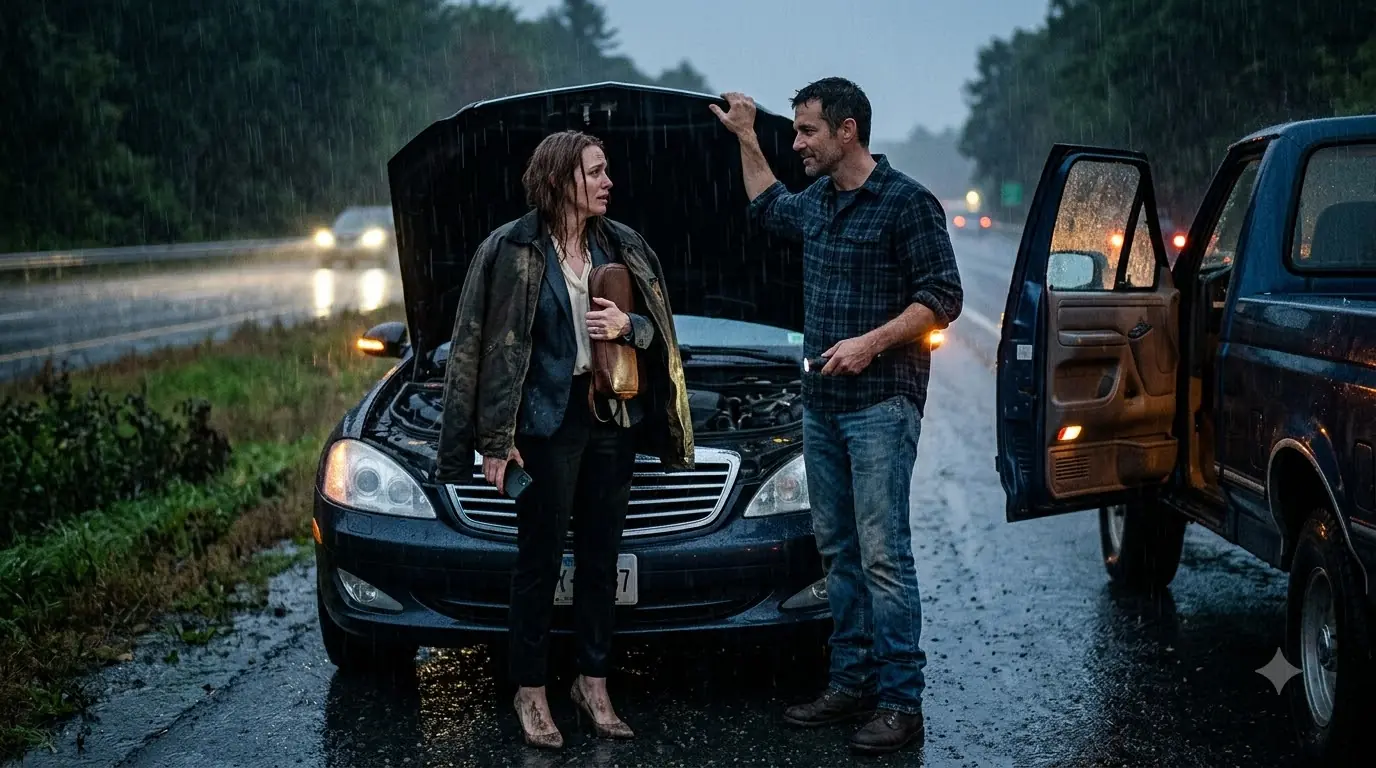
Daniel Reeves stood three steps from her desk.
Dark blue flannel. Sleeves rolled. Wide shoulders. A back that had learned to stay straight.
He did not defend himself.
He did not ask why.
He looked at her for exactly three seconds.
No anger. No wounded pride. Only something quieter, the way a man marks a thing so he will not forget it.
Then he nodded once, turned, and walked out.
The door clicked shut.
Claire stood very still, and for the first time that morning, her fingers tightened against the wood for reasons she could not name.
To understand why he did not say a word, we have to go back seven hours.
At 5:50 in the morning, the kitchen of a two-bedroom apartment in South Burlington was warm with the smell of toast and coffee.
Daniel stood at the counter in a freshly pressed flannel shirt, spreading butter on a slice of bread.
Emma was eight. Her hair was the soft brown of her mother, who had been gone three years. She came out of her bedroom holding an old stuffed bear.
“Daddy,” she said, very small, “Madison says her house has a mom and a dad. Ours only has you.”
Daniel knelt and tied a red ribbon into her hair.
“I am going to stay long enough today for every kid in your class to see that your dad exists. Okay?”
Emma nodded and put her arms around his neck.
At 7:15, Burlington Elementary’s gym was loud with donut boxes and the laughter of thirty fathers.
Daniel sat beside his daughter, splitting a glazed donut. Miss Patterson came over and seemed surprised by how tall he was up close.
Emma walked him from table to table, introducing him to every girl in her art group, smiling without trying.
Daniel had planned to leave at 7:40.
He stayed an extra twenty minutes because when he stood up, Emma reached for his hand and would not let go.
Seven miles north, Claire was already chairing the third-quarter executive meeting.
She was thirty-six. Charcoal blazer. Hair pulled into a low knot.
Eighteen months earlier, she had buried her father and inherited the company he had built from a single warehouse on Pine Street.
The board was watching her like a hawk watches the second-smallest bird in a field.
The chief operating officer was Richard Vance.
Fifty-two. Gray suit. The kind of smile that arrived before the words.
He had expected Holloway Distribution to be his twenty years ago.
Halfway through the meeting, he slid a printed spreadsheet across the table.
“A small matter before we discuss the restructuring,” he said. “One of our operations supervisors has logged fourteen late arrivals in the past three months. Daniel Reeves. If we cannot enforce discipline at the warehouse floor, I am not sure how we expect to convince the board on the larger restructuring plan.”
He did not look at Claire when he said the last sentence.
Every other person at the table did.
Claire glanced at the spreadsheet. The signature at the bottom was Vance’s own.
“I will handle it today,” she said.
At 9:42 in the morning, Daniel pulled his Ford pickup into the employee lot.
Frank Delaney, the senior forklift operator, was already standing in the warehouse bay doorway.
Sixty-seven years old. A slight limp he had owned since 2004.
He looked at his wristwatch.
He looked at Daniel.
He nodded once.
Daniel nodded back.
Neither said a word.
Daniel walked to his office.
On his monitor was a message.
Ms. Holloway would like to see you on the eighth floor.
He picked up the small framed photograph of Emma on his desk and put it in his coat pocket.
Then he turned off his computer.
At 10:00, Daniel sat across from Claire and accepted the dismissal without flinching.
Three seconds.
A nod.
The door clicking shut behind him.
When the door clicked, Claire reached for the glass of water on her desk and noticed her hand was shaking.
“This is discipline,” she said quietly to the empty office. “This is what the board needs to see.”
She poured the water anyway.
She did not drink it.
At eight minutes past 10:00, Daniel was at his desk packing a small cardboard box.
The photograph of Emma.
A small flashlight from the bottom drawer.
Four minutes.
He did not look at the walls.
The security officer who came to escort him out was a twenty-three-year-old named Tyler Boyd.
Tyler had a wife at home seven months pregnant and a truck Daniel had helped him fix the month before.
He looked at the floor.
“Sir, I am sorry. It is procedure.”
“You are doing your job, Tyler,” Daniel said. “Do not carry it home with you.”
They walked through the lobby.
Frank Delaney stood near the reception desk in his green coveralls.
He had not been there ten minutes before.
When Daniel passed, Frank did not move. He stood at something not quite attention, but very close to it.
His eyes met Daniel’s for the length of three steps.
Then Daniel was out the door.
By 11:30, Daniel sat in his pickup in the corner of the lot with the engine off.
He took a napkin from the glove compartment and wrote three numbers on it.
Eleven thousand dollars in savings.
Three months of rent.
Emma’s art class through June.
He folded the napkin into his wallet and drove to Lake Champlain.
He sat on a bench at the waterfront for two hours.
The lake was flat and gray.
He did not cry.
He had cried out everything he was going to cry three years ago, when the hospice nurse touched his shoulder at three in the morning.
He called his mother-in-law in Stowe and asked her to keep Emma for the night.
He said he had paperwork at the old office.
He had no old office anymore.
At 1:15, Richard Vance walked into Claire’s office and clapped his hands once.
“Well done, Claire. The board will see you have backbone.”
Claire nodded without looking up.
At 6:30, she sat through dinner with two board members in Shelburne.
The rain started before the entrees came.
By 7:30, it was coming down in sheets.
She drove north alone on Route 7, the wipers working hard.
At 7:52, the check engine light came on.
The engine coughed once, twice, and died.
She coasted onto the shoulder under a streetlight that had burned out the previous winter and never been replaced.
She tried the ignition.
Nothing.
Roadside assistance, ninety minutes.
Her phone said fourteen percent.
One bar.
She stepped out and waved at the headlights coming north.
A white Toyota passed.
A pickup with a kayak.
A family SUV.
A semi.
She counted without meaning to.
Twenty-three vehicles.
Her hair stuck to her neck. Her Christian Louboutins had sunk an inch into the mud. The wool of her blazer had stopped being wool an hour earlier.
For the first time in many years, Claire Holloway felt completely invisible.
At 8:11, a Ford pickup slowed from the south.
It stopped on the gravel five meters from her.
The driver’s door opened.
The man who stepped out wore a dark blue flannel shirt. The headlights caught the shape of his shoulders before they caught his face.
Daniel saw her first.
She saw him half a second later.
Neither moved.
Three seconds on the shoulder of Route 7 that stretched as long as the entire morning.
The same look.
The same three seconds.
But this time, she was the one who could not speak.
He walked toward her through the rain.
He did not hurry.
The walk of a man who had been through worse nights than this.
He stopped two steps away.
“How long has it been off, ma’am?”
“Twenty-five minutes.”
Her voice came out flatter than she wanted.
“Roadside assistance?”
“Ninety more.”
He nodded.
He walked around to the hood, propped it open, and stood under it for a minute and a half with his own phone flashlight.
Not hers.
“Fuel pump. Cannot fix it on the shoulder. I will take you back to the city. Get a tow in the morning.”
“I can call an Uber.”
“There is no Uber on this stretch, ma’am. Trust me.”
He shrugged off his Carhartt jacket, the only thing he wore over his flannel, and held it out to her.
She did not take it.
“Daniel…”
“You do not have to put it on, ma’am. You are soaked through.”
He did not look at her when he said it. His eyes stayed on the headlights passing in the other lane.
She put the jacket on.
It was still warm.
She climbed into the back seat.
The front passenger seat was already occupied.
A child, eight years old, cheeks flushed with a low fever, a fleece blanket printed with small horses pulled to her chin. Her head rested against the window glass.
On her lap, folded once, was a piece of construction paper.
Three figures in a garden.
A tall man.
A woman with long hair.
A small girl holding sunflowers.
“This is Emma,” Daniel said as he climbed in. “She is a little warm. I picked her up from her grandma’s an hour ago.”
Claire did not answer.
She looked at the sleeping child through the gap in the seats. A strand of hair had fallen across the girl’s cheek.
This child should be asleep at her grandma’s right now.
If this morning I had not—
Claire stopped the thought.
She turned her face to the window.
For eighteen minutes, Daniel drove more carefully than the road required.
Five miles under the limit.
No hard stops.
No sharp turns.
The radio was off.
There was only the sound of rain on the windshield and the steady rhythm of the wipers.
Claire sat in the back and held the collar of the Carhartt jacket against her face.
It smelled like fabric and a faint trace of motor oil and the deep, honest smell of a man who worked for a living.
None of the closets in her apartment held a coat that smelled like anything at all.
She did not cry.
She sat with a question growing larger in her chest.
What did I do this morning?
Who is this man?
At 8:38, he stopped the pickup outside her building on Battery Street.
He did not turn off the engine.
Emma was still sleeping.
Claire opened the door and reached for the jacket.
“Keep it for now, ma’am. Give it back next week if you have time.”
He said the last sentence without realizing what he had assumed.
That there would be a next week.
That there would be a time.
She nodded.
She stepped out.
Before she shut the door, she said the only sentence she had said the entire ride.
“Thank you, Daniel.”
He nodded once.
He drove away.
The taillights of the pickup dissolved into the rain.
Claire stood on the granite steps of her building with the Carhartt jacket dripping.
She did not go inside.
She stood there watching the corner where the pickup had turned for twenty seconds.
Then she did something she had not done in the eighteen months since her father’s funeral.
She sat down on the wet stone steps in a thousand-dollar blazer.
And she cried.
She did not know it yet, but when she walked into her office in the morning, everything she thought she understood about that man would collapse.
She did not sleep.
At 6:00 in the morning, she was already in the elevator going up to the eighth floor.
The Holloway Distribution Advisory Board met four times a year. Today was the second-quarter session.
The first member to arrive was a retired three-star general named Howard McKinley, who had served on the board since 1999.
He was seventy-four. White hair cut close to the scalp. A walk that did not bend.
He stepped out of the elevator and paused at the digital staff directory mounted by the reception desk.
The screen rotated through recent updates.
New hires.
Promotions.
And a card that read:
Contract terminated: Daniel Reeves, Operations.
The general stood and looked at the screen for ten seconds.
He did not move.
Then he turned to the receptionist.
“Young lady, does Ms. Holloway know who this man is?”
The receptionist blinked.
“I am… I am not sure I follow, sir.”
“That will be the answer,” he said. “Please tell her I would like to see her before the board meeting. In private.”
Six miles south, Daniel sat at his kitchen table with a mug of coffee that had gone cold.
Emma was at the small desk by the window drawing.
He had not told her yet that he had lost his job.
He would tell her that evening.
He had decided.
He just had not figured out the words.
Twenty minutes later, in the corner office where she had fired Daniel the day before, Claire sat across from General Howard McKinley.
He did not take coffee.
He folded his hands on his knee.
“Ms. Holloway, the man whose name was on your termination screen this morning is Lieutenant Colonel Daniel Reeves, United States Army, Logistics Corps. I personally signed two commendations on his record. In three years of operations at Bagram, the units under his command did not lose a single supply convoy. Not one.”
Claire’s mouth opened, then closed.
“He volunteered for a tour nobody asked him to take because his wife was dying and he wanted to finish his service before she ran out of time. I am certain you had reasons for terminating him. I would like to understand them.”
“General, I had attendance records.”
“I would like to see them.”
She slid the spreadsheet across her desk.
Richard Vance’s signature sat at the bottom.
The general looked at it for a long moment.
He did not say anything about it.
He set it down.
“Ms. Holloway, I served forty-one years. I have learned to recognize the difference between a man who is late because he is careless and a man who is late because he was somewhere doing the right thing. I would suggest, before this board meeting, that you verify these numbers yourself. Not through your chief operating officer.”
He stood.
He buttoned his jacket.
At the door, he paused.
“Your father hired me for the same reason he hired Reeves. He could read a man’s posture. He trusted what he saw. I would encourage you, Ms. Holloway, to trust what you saw last night.”
He left.
Claire sat alone with the words last night turning over in her head.
A slow, cold understanding climbed her spine.
She buzzed her assistant.
“Get Margaret Doyle from HR. Tell her I need every raw attendance record for Daniel Reeves. Not the summaries. The raw data. Now.”
Margaret Doyle arrived eleven minutes later.
She was fifty-eight. Reading glasses. The kind of stillness that came from twenty-two years of watching everything and saying nothing.
She set a small unmarked USB drive on Claire’s desk.
“I have been holding this,” Margaret said, “for a while.”
The data did not lie.
For three months, Daniel Reeves had arrived at the warehouse at an average of 7:55 in the morning.
Three minutes before the shift opened.
Not once in those three months had he arrived after 8:10.
Except one day.
The day she had fired him.
9:42.
Fourteen late arrivals.
That was what Vance’s summary had said.
The raw data showed exactly one.
Claire pulled up the system access log.
Richard Vance had signed into the attendance database fourteen times in the past three months.
Each time, within twelve hours of submitting his summary report to her office.
He had been editing the file directly.
She stood and walked to the window.
Below her, eight stories down, the warehouse loading bays were lit in pale fluorescent.
She watched a forklift move a pallet of boxes toward a truck.
She watched the operator step down.
She could not tell from that height whether it was Frank Delaney.
Six miles south, in the small kitchen of a two-bedroom apartment, Daniel was warming a can of tomato soup.
Emma sat at the counter on a stool with her drawing pad.
She had drawn the three of them, Daniel, herself, and the woman with long hair, every day for three years since the funeral.
The drawing she was working on now showed Daniel and Emma standing under a maple tree.
He did not ask her why.
He set a bowl of soup in front of her and kissed the crown of her head.
He had decided he would tell her about the job that evening after dinner.
He had not figured out the words.
Twice that afternoon, he had picked up the phone to call his cousin in Plattsburgh and ask if there was any work at the boatyard.
Twice, he had set the phone back down because Emma had walked into the room.
In her office, Claire opened the bottom drawer of her desk.
Inside was an envelope addressed to Daniel Reeves containing his final paycheck and a typed letter of termination.
She had signed it the previous afternoon.
She had not yet sent it.
She held the envelope in her hand for a long time.
Then she set it back in the drawer and closed it without sealing.
Margaret Doyle was still standing in the office, watching her quietly.
“Margaret, how long have you known?”
The older woman took off her reading glasses and folded them carefully into her cardigan pocket.
“About what specifically, Ms. Holloway?”
“That Vance was editing the records.”
Margaret thought about her answer for a long moment.
“I knew the records had been edited. I did not know by whom. I kept the raw data because your father once told me, when I was twenty-six years old and I had just made an honest mistake on a payroll calculation, that the difference between a good company and a bad company is whether the truth is recoverable. So I learned to make truth recoverable.”
Claire nodded slowly.
“I owe him an apology, don’t I?”
“You owe several people several things, Ms. Holloway. But yes. Him first.”
Margaret left.
Claire sat at her desk until 8:00 that evening.
The office lights low.
The envelope in the drawer.
The rain just beginning to start again outside.
She thought she understood the truth now.
But there was one person in the building who had been holding evidence for eighteen years, waiting for the day someone asked.
Frank Delaney knocked on the door of Claire’s office at 6:50 the next morning.
She had not gone home.
She was wearing yesterday’s blazer.
“Ma’am, may I come in?”
He held a small leather-bound notebook in his right hand. The cover was the color of bourbon, and the edges had been worn pale by twenty years in a back pocket.
He laid it on her desk and opened it to the first marked page.
Each line was a date and a time handwritten in a steady square print.
December 4, 7:53.
December 5, 7:50.
December 6, 7:55.
December 7, 7:48.
Page after page.
Three months without a gap.
“Colonel Reeves’s arrival times at the loading bay,” Frank said. “I keep a notebook on every man who clocks in at my dock. Habit I picked up in the service. The colonel taught me eighteen years ago that a leader who shows up five minutes before his soldiers makes the whole company show up on time. I have kept the practice since.”
“Frank.”
Claire’s voice was unsteady.
“How long have you known who he was?”
“Since his first week on the floor. I served under him in 2007. He pulled me out of a wrecked Humvee outside Mosul on a road I should not have been driving on. He recognized me on his first day at Holloway. He asked me to keep his record to myself, ma’am. He did not want the men on the floor treating him different.”
Claire closed her eyes for a second.
Frank pointed at three entries on the notebook page.
“These three days, the 14th, 15th, and 17th of last month. He took my night shifts because my knee had gone out again. Each one of those days, I worked the morning shift in his place, and he worked all night and then stayed for the morning audit. Those three days are in Mr. Vance’s summary as late arrivals.”
He paused.
“He did not arrive late, ma’am. He arrived twelve hours early.”
He closed the notebook and set it on her desk.
“Ma’am, I have been ready to give that testimony for eighteen years. I just needed someone to ask.”
He turned to leave.
At the door, he stopped.
“Ma’am, one more thing. The colonel never told me his wife had passed. I only learned because his daughter wore a butterfly pin to the company Christmas party. Same pin her mother used to wear in the photographs he keeps in his office. He saw me notice it. He did not say anything. He just nodded.”
Frank looked down.
“That was the only conversation we have had in three years that was not about work.”
He let himself out without waiting for a reply.
Claire reached for her phone.
“Howard Schultz,” she said when the family lawyer answered. “I need to see you this morning.”
By 10:00, the IT director had confirmed the access log.
Vance had been editing the attendance file for ninety-six consecutive days.
By 11:00, corporate counsel had a list of disclosures Vance had failed to make about his eight percent stake in the third-party logistics contractor.
He had been quietly arranging to take over Holloway’s restructuring contract.
At noon, Claire took her phone to the window and dialed a number she had pulled from Daniel’s employee file.
He picked up on the third ring.
“This is Reeves.”
“Daniel, it is Claire Holloway. I… I would like to come by your apartment this afternoon. There are things I need to say to you in person. If that is all right.”
A pause.
Three seconds.
The pause she was beginning to recognize as the way he thought before speaking.
“Yes, ma’am. Emma is home from school by 3:30.”
He hung up.
Claire held the phone for a moment after the line went silent.
Then she sat down on the edge of her desk.
And for the first time in eighteen months, she allowed herself to smile.
At 3:45 that afternoon, Claire stood on the small concrete landing outside the apartment on Maple Street in South Burlington.
She was holding a manila envelope.
Inside were a reinstatement contract, a letter of personal apology written by hand, and the family lawyer’s confidential report on Richard Vance.
The door opened before she could knock.
Emma stood in the doorway in a sweatshirt with a fox on the front.
Her eyes went wide.
“You are the lady from the back of Daddy’s truck.”
Claire opened her mouth.
No words came out in time.
Emma reached up, took her hand, and pulled her inside.
The apartment was small and warm and exactly clean.
A couch with a folded blanket.
A kitchen table with two chairs.
A row of framed school photographs on a shelf.
On the refrigerator, held by magnets, were thirty children’s drawings in a neat grid.
Twenty-nine of them showed three people.
A man.
A woman with long hair.
A small girl.
The thirtieth, taped just that morning to the very center of the door, showed two figures under a maple tree.
Daniel came out of the kitchen drying a dish with a towel.
He saw her.
He did not look surprised.
He folded the towel over his shoulder.
“Miss Holloway.”
“Claire.”
“Claire.”
He gestured at the small dining table.
She set the envelope down.
She sat.
Emma sat on the floor with her drawing pad and began coloring without looking up.
“Daniel, the records were falsified. All of them. Vance was editing the database personally. He has also been planning to route the restructuring contract to a logistics firm he owns eight percent of. I have a board meeting Monday morning. He does not know yet that I know.”
She slid the envelope across the table.
Daniel did not pick it up.
“I came here,” she continued, “not because the board is going to demand I clean this up, not because General McKinley is watching me. I came because you deserve to hear the apology from the person who did it, in your home, without an audience.”
Daniel looked at her for a long moment.
He did not pick up the envelope.
“I will make tea,” he said.
He went to the kitchen.
Emma looked up from her drawing pad and patted the carpet next to her.
Claire, who had not sat on a floor in fifteen years, who had attended dinners at the governor’s mansion and the World Economic Forum and once, briefly, the White House, slid out of her shoes and sat down on the floor of a small apartment in South Burlington.
Emma showed her each drawing in order.
The man was Daddy.
The woman with long hair was Mommy, who lived in heaven now.
The small girl was Emma.
She had been drawing all three of them every day until last month.
Last month, she had started drawing only two.
She had not told her father why.
“Why did you stop?” Claire asked quietly.
Emma considered the question with the seriousness of an adult.
“Mommy is still real. She is just not here. I did not want Daddy to be sad.”
Claire’s eyes filled.
She blinked them clear.
From the kitchen came the small, ordinary sound of a man pouring boiling water into two cups.
Then Daniel was standing in the doorway with the tea and his shoulder against the frame, watching them sit on the floor together.
He did not say anything.
He just stood there for a moment, holding the two cups.
Then he set one down on the table beside the manila envelope he still had not opened.
He sat down on the floor next to his daughter.
And the three of them stayed there until the tea went cold.
When Emma finally fell asleep on the carpet with her cheek on her drawing pad, Daniel lifted her without a sound and carried her down the hallway to her room.
Claire stayed on the floor.
She listened to him close the door and turn on a nightlight.
He came back and stood in the doorway, looking at her sitting there with the empty teacups at her knees.
“You did not have to apologize in person,” he said. “I would have read the letter.”
“I know,” she said.
He nodded.
He did not say anything else.
He did not have to.
The boardroom on Monday morning was full at 7:00.
The nine members of the Holloway Distribution board sat around a long oval table of polished oak.
General Howard McKinley sat at the far end.
Richard Vance sat at Claire’s right hand in a charcoal suit with a new pocket square.
He smiled at her as she took her seat.
She did not smile back.
“Before we discuss the third-quarter restructuring,” Claire said, “I have a personnel and disclosure matter I would like to bring to the board’s attention.”
She nodded to the projector operator.
The first slide came up.
Raw attendance data.
Three months, sorted by day.
The second slide, the system access log.
Ninety-six edits.
All from one administrative account.
The third slide, the badge number of that account.
Richard A. Vance.
“That is a forgery,” Vance said. “Anyone in IT could have made those edits and assigned them to my account.”
The fourth slide came up.
A scanned page from a leather-bound notebook in careful square handwriting.
The fifth slide showed Vance’s holdings in a Delaware-registered logistics firm.
Eight percent.
Undisclosed for fourteen months.
The firm currently bidding on the restructuring contract.
“Lies,” Vance said.
He was no longer smiling.
“The testimony of a warehouse worker has no legal standing.”
The door at the back of the boardroom opened.
Daniel walked in first, wearing a dark blue flannel shirt and the same Carhartt jacket Claire had returned to him an hour earlier.
Behind him came Frank Delaney in a green coverall, freshly pressed.
Behind him came General Howard McKinley, who had stepped out to the hallway five minutes before for what he had said was a phone call.
The general did not sit.
He remained standing at the back of the room.
“Ladies and gentlemen of this board,” he said, his voice quiet, “Sergeant First Class Frank Delaney served twenty-two years in the United States Army. The testimony of Sergeant Delaney concerning Lieutenant Colonel Daniel Reeves, under whom Sergeant Delaney served in combat, is to me a legal document. I will sign an affidavit to that effect before I leave this building today.”
Vance stood up to speak.
Two board members on his left motioned for him to sit down.
The vote took four minutes.
Eight to one.
Termination for cause.
Corporate counsel rose, walked to Vance, and asked him for his badge.
Vance stood.
He looked at Claire.
He opened his mouth to say something.
Then he closed it.
He set his badge on the table.
He walked out.
Margaret stood in the doorway as Vance passed her.
She did not look at him.
She walked into the room with a folder under her arm and set it on the table in front of Claire.
The complete personnel record of Daniel Reeves.
Every page.
Every commendation.
Every redacted detail Margaret had quietly safeguarded for the day someone with authority finally asked.
Daniel did not watch Vance go.
He had remained standing against the back wall the entire time, his hands clasped behind his back in a posture he had carried since he was twenty-two years old.
He did not look triumphant.
He did not look anything in particular.
When the room had emptied, he looked at Claire.
Across the room, she looked back at him.
She nodded once.
He nodded back.
No one else in the boardroom saw it.
They were busy gathering their papers.
The two of them did not move.
They did not speak.
They did not need to.
Vance was gone.
But the real story between Claire and Daniel had only just begun.
And Emma would be the one who, without meaning to, would change everything.
Six weeks passed.
The first snow came to Burlington in early November.
Then a second storm came in mid-November and pushed the leaves off the last of the maples.
Daniel was reinstated as director of operations, a step up from his previous position.
He kept driving the same Ford pickup.
He kept eating lunch in the warehouse break room with the forklift drivers.
Frank Delaney’s notebook sat in a glass case in the hallway outside Claire’s office now, with a small brass plaque she had ordered without asking permission from anyone.
On a Saturday in mid-November, Emma Reeves had her first art exhibition at the small community center on the Lake Champlain waterfront.
The exhibition was for the third-grade after-school program.
Twelve drawings hung on the gymnasium wall.
Three of them were Emma’s.
Emma had sent the invitation herself. She had used the printer at school. She had hand-addressed the envelope in pencil to Claire Holloway, care of Holloway Distribution, eighth floor.
She had written, Please do not tell my dad, at the bottom in small letters.
Claire arrived ten minutes early.
She wore the camel-colored blazer she had worn the night of the rain, dry-cleaned now, the lining replaced.
Daniel saw her across the gymnasium.
His face did the small thing it did.
The slight pause that was not surprise, but acknowledgment.
He nodded at her.
He did not walk over.
Emma did.
Emma took Claire’s hand and led her to the wall where her three drawings hung.
The first two were ordinary.
A house.
A cat.
The third was new.
Three figures standing under a maple tree.
A man.
A small girl.
And a woman with brown hair standing slightly apart from the other two, her hand reaching out.
Emma did not say who the woman was.
Claire did not ask.
After the exhibition, they walked along the boardwalk together.
Daniel kept his hands in his pockets.
The lake was steel-colored and very still.
They walked for forty minutes, and they spoke perhaps eight sentences in total.
Most of those were about the weather and the boats that had not yet been pulled out of the water for the winter.
At one point, Emma ran ahead to look at the geese on the water.
She came back with her hands cupped together, certain she had seen something rare.
Daniel knelt down and admired what she had not actually found.
Claire watched him do it with the small, impossible patience of a man who had practiced grief and chosen to be gentle anyway.
Near the end of the walk, a single mallard flew low over the water.
Daniel said, half to himself, “Sarah liked the geese in the fall.”
Then he did not say anything else for a long time.
Claire did not ask him anything.
The only sound was the boards under their shoes.
At the end, by the parking lot, Claire opened her bag and took out the Carhartt jacket, freshly washed and folded.
Daniel looked at it.
He looked at her.
He took the jacket.
Then he put it back in her hands.
“Keep it, Claire. Vermont is going to get colder.”
She did not argue this time.
Emma ran past them toward the pickup, calling something over her shoulder about hot chocolate.
Daniel followed his daughter with his eyes.
Then he turned back to Claire.
For one second, he almost said something.
He did not.
He just nodded once.
The same small nod he had given her in her office the morning he had been fired.
And on the side of Route 7.
And across the boardroom on the morning Vance was terminated.
Then he walked away.
Claire watched him go.
She stood on the boardwalk with the Carhartt jacket folded over her arm for a long time after the pickup pulled out.
The lake stayed steel-colored.
The sun went down behind Adirondack ridges across the water.
She did not move.
By March, the snow was melting into the gutters of South Burlington, and the maple trees along Maple Street were beginning to push their first red buds.
Daniel had moved out of the old apartment into a small three-bedroom house with a fenced backyard where Emma could plant a garden.
He fixed the back fence himself on Sunday afternoons.
On the second Sunday in March, Claire arrived at 3:00 with a small potted sugar maple sapling in the passenger seat of a new white Subaru that had replaced the Range Rover.
Emma had asked her by text message the previous Wednesday.
Could you bring a small tree we can plant, the kind that turns red in the fall? Dad says you know about trees.
Claire did not know about trees.
She had spent an hour at the nursery in Williston that Saturday, and she had asked the man behind the counter to pick the sturdiest sapling he had.
She and Emma planted it in the corner of the backyard against the south fence.
Emma patted the soil down around the trunk with both small palms.
Daniel watched them through the kitchen window as he washed the lunch dishes.
In six months, no one had given the thing they had a name.
There had been no date.
No declaration.
No kiss.
Claire arrived on Sundays.
Sometimes she stayed for dinner.
Sometimes she helped Emma with her reading homework.
Once, on a Saturday, Daniel had fixed a misaligned cabinet door in Claire’s apartment, and Claire had made spaghetti for them in his kitchen, and Emma had set three plates without being asked.
General Howard McKinley had retired from the board in February.
At his retirement dinner, he pulled Claire aside in a quiet corner of the dining room and put a hand briefly on her elbow.
“Your father would be proud of you. And of your choices.”
That afternoon, when Emma had finished patting down the soil, she stood up, looked at Claire, and asked a question with the directness of a child who had been thinking about it for several weeks.
“Are you staying for dinner?”
Claire looked toward the kitchen window.
Daniel was standing inside, drying his hands on a dish towel.
He met her eyes through the glass.
He gave a small nod.
She nodded back.
That evening, the three of them sat around the small round table in the kitchen of the small house in South Burlington.
Daniel cut a loaf of bread.
Emma told a story about a girl in her class who had brought a turtle for show and tell.
Claire reached over and passed the butter dish.
There was a candle on the table that Daniel had not lit on purpose.
Emma had lit it before dinner because she said the table looked too bare.
The light was yellow and ordinary.
The three of them ate.
Halfway through dinner, Emma asked Claire if she knew how to braid hair.
Claire said she had not braided anyone’s hair in twenty years.
Emma climbed down from her chair, stood in front of her, turned around without negotiating, and waited.
Daniel watched from across the table without smiling and without looking away, his bread knife resting on the edge of his plate.
Claire braided her hair.
It was uneven.
Emma did not care.
She turned around, inspected her reflection in the dark window over the sink, and pronounced it good.
No one said the word love.
No one said the word family.
No one said anything in particular.
Daniel poured a second glass of water for his daughter.
Claire reached for the salt.
Emma laughed at something the candle did.
Outside, in the corner of the yard, a small sugar maple stood in soft dirt and waited for April.
Neither of them had been looking.
That was the only reason they could trust that it was real.