“Who let him sit in a first-class seat meant for real customers?”
Ashley Morgan’s voice cut through the first-class cabin.
Bradley Whittaker smirked from the aisle, his loyalty tag dangling from his carry-on.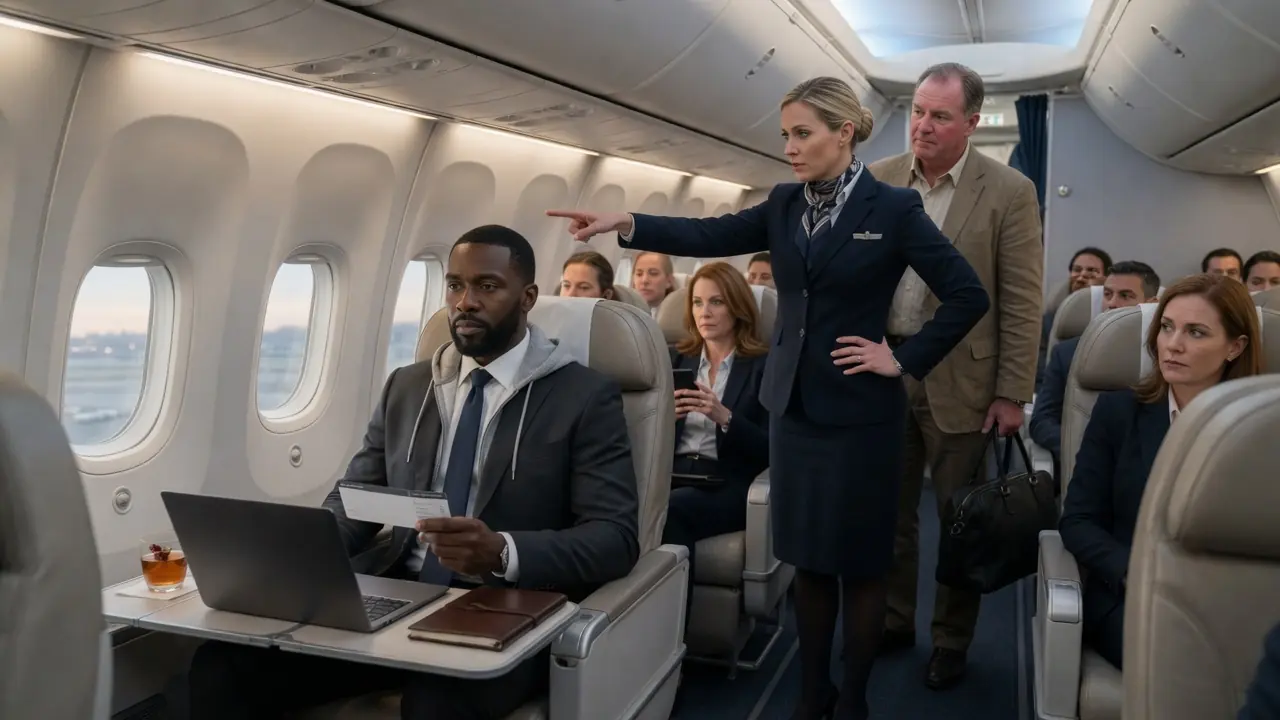
“You hear her,” he said. “This gentleman is taking 1A.”
Caleb Grant, forty-four, wearing a charcoal suit beneath a dark hoodie, did not move.
“Ma’am,” Caleb said calmly, “I paid for this seat.”
Ashley’s smile tightened.
“Sir, people like Mr. Whittaker belong up here. You need to move.”
She snapped her fingers in front of his face.
“Now. Before I have you removed in front of every passenger on this plane.”
Bradley’s smirk widened.
“Go on,” he said. “Don’t make this harder than it has to be.”
A phone lifted in row three.
Another in row fourteen.
Nobody said a word.
But by sundown, one call from seat 34E would make sure they never forgot Caleb Grant’s name.
She had picked the wrong passenger.
And she was about to find out the hard way.
It was 4:40 in the morning in Atlanta, the kind of dark where the city had not decided whether it was still last night or already tomorrow.
Caleb Grant stood in front of a bathroom mirror in a modest Buckhead condo, tying a navy tie with the muscle memory of a man who had done it ten thousand times.
On the wall behind him, three photographs told a whole life in three frames.
A handshake with the governor of Georgia.
A Morehouse diploma from 2003.
And the oldest one: a skinny boy in church clothes standing next to his father, a mechanic in a grease-stained uniform.
Atlanta, 1986.
Caleb kissed that last photo, same as every morning.
Then he grabbed his laptop bag and walked out.
Caleb Grant was the founder and CEO of Grantford Hospitality Group.
Thirty-one boutique hotels across the South.
Revenue north of four hundred million dollars a year.
Most people who stayed in his hotels had never heard his name, and he liked it that way.
Today, he was flying to Denver to finalize a one-hundred-twenty-million-dollar partnership with Meridian Vale Hotels, the biggest deal of his career.
And he had chosen this flight on purpose.
AltaView Airlines, Flight 1202.
Because AltaView was Meridian Vale’s preferred carrier.
And because Grantford was quietly considering AltaView for a massive corporate travel contract of its own.
He wanted to see with his own eyes the kind of company he was about to climb into bed with.
At the gate, the agent scanned his boarding pass, paused, then scanned it again.
She looked up at him, at his charcoal suit, at the hoodie he had pulled over it against the morning chill, and asked politely if she could just verify his ID one more time.
He handed it over without a word.
She handed it back, then asked for it a second time.
He handed it over a second time.
He did not sigh.
He did not roll his eyes.
He simply reached into his jacket, pulled out a small leather notebook, and wrote one line.
Then he walked down the jet bridge.
Behind him, a man was already shouting into a phone.
Bradley Whittaker, mid-fifties, flushed red, rumpled blazer, AltaView loyalty tag dangling from his carry-on.
“Yeah. Supposed to be first class. They bumped me. I’m going to fix it. These people always try something.”
His eyes tracked Caleb’s back the whole way down the tunnel.
In the first-class cabin, Ashley Morgan was already working.
Eleven years of service.
It said so right on her name tag.
She greeted every passenger in 1A through 2D by name.
“Mr. Whittaker, lovely to see you again.”
“Mrs. Harrington, welcome back.”
“Champagne or orange juice?”
“Warm nuts or no warm nuts?”
She knew them.
She smiled at them.
Except for 2A.
Caleb sat down.
Ashley set a welcome drink on his tray without looking at him.
He said, “Thank you.”
She was already walking away.
Next to him in 2B, a quiet white woman in her forties was reading a thick internal report.
Caleb caught the logo on the cover.
Two linked mountains.
Navy and gold.
Meridian Vale Hotels.
He almost smiled.
Small world.
He did not introduce himself.
Not yet.
He opened his laptop instead.
On his screen was a draft press release.
Grantford-Meridian Vale Strategic Partnership, $120 Million.
Below that, a second document.
An unsent email addressed to AltaView’s corporate partnerships team.
Subject line:
Preferred Carrier Agreement, Final Review.
His finger hovered over the send button.
He had decided to send it from the air.
Symbolic.
A signature delivered at thirty-six thousand feet.
He did not send it yet.
Bradley Whittaker came storming up the aisle before the doors even closed.
“Excuse me, miss. This man is in my seat.”
Ashley turned.
She did not check a manifest.
She did not ask for a boarding pass.
She simply looked straight at Caleb.
“Sir, there has been a mistake. We need you to move to the back.”
Caleb calmly held up his boarding pass.
“Ma’am. Seat 2A. Checked in eleven hours ago.”
Ashley barely glanced at it.
“The system says otherwise. Please do not make this difficult.”
In 2B, the woman with the Meridian Vale report slowly closed her folder.
Her eyes narrowed.
Her hand drifted toward her pocket.
Toward her phone.
And nobody on that plane had any idea what she was about to record.
Ashley did not lower her voice.
If anything, she raised it.
“Sir, I have asked you once. I am not going to ask you again. This seat belongs to Mr. Whittaker. Stand up.”
Caleb kept his voice level.
“Could you please check the manifest again? My name is Caleb Grant. G-R-A-N-T. Seat 2A.”
Bradley snorted behind her.
“Buddy, I fly this route every week. I know this crew. I know this airline. You do not belong up here, and you know it. Just move.”
He leaned down, close enough that Caleb could smell coffee and cologne on him.
“Save yourself the embarrassment.”
The sentence landed in the cabin like a dropped glass.
A woman in 1D actually winced.
But nobody said anything.
Ashley leaned in, too, close enough that her perfume mixed with Bradley’s cologne into something sour.
And then she said it.
The line that would, within twenty-four hours, end her career.
“Sir, I do not know how you got this ticket, but first class is not for people like you.”
She pointed down the aisle.
“Move. Now.”
The cabin went silent.
The kind of silence you only hear on an airplane, where even the hum of the engines seems to politely step aside so humiliation can take center stage.
In 2B, Katherine Ellis pressed record.
Her phone was angled down into her lap, screen dimmed, microphone open.
She did not say a word.
She just recorded.
Caleb’s jaw tightened.
One flex.
Then it released.
He looked up at Ashley.
Then at Bradley.
Then past them into the cabin, where twelve first-class passengers were suddenly very interested in their phones, their magazines, the stitching of their seatbacks, anything except his face.
He thought for one long second about the email sitting open on his laptop, the one with the send button.
Then he thought about his father.
And then Captain Donald Hughes came out of the cockpit.
Hughes was tall, gray at the temples, the kind of captain who still ironed his own uniform shirts.
Ashley had already briefed him on the intercom.
He did not ask Caleb a single question.
He did not look at the boarding pass.
He did not even look at the manifest tablet the purser was holding out to him.
He looked at Ashley.
Then he looked at Caleb.
“Sir, my crew has made a determination,” the captain said. “You can comply, or I can have you removed. And if I have you removed, you will be on the federal no-fly list by noon. Your choice.”
Caleb nodded once, slowly.
“Captain, could I ask your name, please?”
Hughes blinked.
“Hughes. Captain Donald Hughes. Why?”
“Just wanted to make sure I spelled it right.”
Hughes’s eyes narrowed.
He did not understand.
He would later.
Much later.
Caleb stood.
He gathered his laptop, his notebook, and his contract folder.
He set his unopened welcome drink gently back on Ashley’s serving tray, as if he were returning something that did not belong to him.
Then he walked.
All the way down the aisle.
Past 2B, where Katherine Ellis’s phone was still recording.
Past row seven.
Past row fourteen.
Past row twenty-two.
Past the curtain.
Past the overhead bins stuffed with backpacks and winter coats.
All the way to the very last row of the aircraft.
Seat 34E.
Middle seat.
Last row.
Back of the plane.
Right next to the lavatory, where the smell of disinfectant hit him before he even sat down.
A child in 3C whispered, “Mommy, why is that man moving?”
His mother shushed him and pretended to look out the window.
Ashley muttered, loud enough for first class to hear, “Finally.”
Caleb folded himself into 34E.
To his right, a young woman in scrubs, early twenties, had a textbook open on her lap and a highlighter between her teeth.
She looked up.
Her eyes went wide.
Then wider.
“Mr. Grant?” she whispered. “Aren’t you… aren’t you the guy on the cover of Forbes Atlanta? My professor made us read your case study last semester.”
Caleb put one finger gently to his lips.
Then he smiled at her.
“Not today, I’m not. What’s your name?”
“Jasmine. Jasmine Brooks.”
“Nice to meet you, Jasmine. Nursing?”
“Second year. Emory.”
“Your parents must be proud.”
Her eyes filled up, just a little.
“My mom… yes, sir.”
Caleb nodded.
He opened his laptop.
Then he opened his notebook.
And he started writing.
On the notebook page, the one from the gate, there was already one line:
04:41. Agent Rivera. Gate B12. ID verification requested twice. No stated reason. Log.
He added three more in careful, steady handwriting.
05:38. Flight attendant Ashley Morgan. Seat 2A. Welcome service skipped. Eye contact refused.
05:51. Flight attendant Morgan stated verbatim, “First class is not for people like you.” Witness: passenger seat 2B. White female, mid-forties. Meridian Vale report on lap.
05:53. Captain Donald Hughes threatened federal no-fly list placement without reviewing manifest or boarding documentation.
05:57. Passenger reassigned to 34E. No refund offered. No explanation provided.
He closed the notebook.
Then he opened his laptop.
The draft email was still sitting there.
Subject line:
Preferred Carrier Agreement, Final Review.
He deleted it.
Retyped one word.
Withdrawn.
His finger hovered over send.
Then he stopped.
“Not yet,” he murmured, barely moving his lips. “Not until I have everything.”
Up front, Bradley Whittaker was laughing into his champagne, calling his wife.
“Yeah, babe. Told you I’d fix it. These people always try stuff. Nah, the crew handled it. Guy did not even fight back. Classic.”
Ashley refilled his glass and laughed along with him.
In 2B, Katherine Ellis stopped recording.
She had enough.
The flight was three hours.
Caleb worked the whole way.
He answered emails.
He reviewed the Meridian Vale contract one final time, line by line.
Every margin note.
Every clause.
Every dollar figure.
At hour two, Jasmine shyly offered him her bottle of water.
She had not touched it.
He thanked her by name.
Asked about her textbook.
Asked who her professor was.
Small kindness.
The kind a man gives a stranger when he has nothing else to give.
She would remember it for the rest of her life.
Somewhere over Kansas, Katherine Ellis got up from 2B.
She walked the entire length of the plane under the pretense of using the rear lavatory.
On her way back, she slowed beside 34E.
She slid a business card under the corner of Caleb’s tray table.
Then she kept walking.
She did not look back.
Caleb picked it up.
He read the front.
Katherine Ellis
Regional Vice President
Meridian Vale Hotels
He turned it over.
I saw everything. I have video. Call me when we land.
K.
He read it twice.
Folded it once.
Slid it into the back of his notebook.
Then, for the first time since Atlanta, he let himself exhale.
Outside the window, the sun was climbing over the Rockies.
Inside 34E, a very quiet man was quietly building a very loud case.
And three feet away in 34D, Jasmine Brooks was watching him and starting to understand that she was sitting next to something she did not fully recognize yet.
The wheels kissed Denver asphalt at 9:18 in the morning.
The seatbelt sign chimed off.
And Ashley Morgan, like clockwork, took her position at the front of the cabin to perform her ritual.
“Bye-bye.”
“Bye-bye.”
“Thank you, Mr. Whittaker. See you next week.”
“Bye-bye.”
Every passenger in first class got a smile.
A name.
A little touch on the shoulder.
Bradley Whittaker got an extra bright one.
She even leaned in and murmured something that made him laugh.
Then economy started filing out.
Ashley’s smile went on autopilot.
When Caleb Grant passed her in the galley, she did not look at him.
She did not see him.
He was already air to her.
Caleb stopped.
Just for a second.
Just long enough to turn his head and speak very quietly.
Very clearly.
“Ashley. Eleven years. I will remember that.”
She rolled her eyes.
“Sir, please keep moving.”
He kept moving.
At the end of the jet bridge, Katherine Ellis was waiting.
She had hung back on purpose, letting the first-class passengers clear out, letting Bradley Whittaker disappear into the terminal with his rolling suitcase and his loud phone call.
Now she stood with her arms crossed, a Meridian Vale lanyard around her neck, watching Caleb walk toward her like she was watching a man walk out of a burning building.
“Mr. Grant.”
“Ms. Ellis. I believe we had a meeting scheduled for eleven.”
“We still do.”
“But first, I need to make a phone call.”
She nodded once.
She did not ask questions.
She just pointed toward a quieter corner near the windows.
Caleb dialed his chief of staff, Monica Davis.
She picked up on the first ring.
“Monica, I need three things. Pull the AltaView preferred carrier agreement. Do not send the termination yet. Hold it. Get me the CEO’s office, Gregory Hollister. Tell his assistant I will be at their Denver regional hub by 10:30, and I would like twenty minutes of his time. Tell her it is about Flight 1202. Tell her I have a witness. Tell her I have a video.”
Monica did not hesitate.
“Sir, are you all right?”
“I’m fine, Monica. Clear my morning. And get legal on standby.”
He hung up.
Then he turned to Katherine.
“I’m sorry. You did not sign up for this.”
“Mr. Grant.”
She tilted her head.
“I sat in seat 2B for three hours and watched a grown man get told his skin color meant he did not belong in a paid seat. Whatever I signed up for, I am in it now.”
She paused.
“Where are we going?”
He smiled very faintly.
“You’re coming with me?”
“I would like to. Yes.”
“Why?”
“Because if Meridian Vale is about to be your business partner, I want to see how you handle this. And because I think whoever is at the end of this morning deserves to see the face of the person who recorded it.”
Caleb looked at her for a long moment.
Then he nodded.
“All right. Let’s go.”
The Meridian Vale car service was waiting at the curb.
A SUV.
A driver in a suit.
Katherine slid in first.
Caleb followed.
As soon as the doors closed, she pulled out her phone.
“Do you want to see it?”
“Please.”
She played the video.
Forty-seven seconds.
Crisp picture.
Audible voices.
Ashley’s words came through like a gunshot in the leather silence of the car.
“First class is not for people like you.”
Caleb watched the whole thing without blinking.
Then he watched it again.
“Can you send me a copy?”
“Already done.”
His phone buzzed.
He opened the file.
Saved it to three different cloud folders.
Forwarded it to Monica.
Forwarded it to his general counsel.
Forwarded it to himself.
Then he looked up.
“Katherine.”
“Yes?”
“I owe you an honest answer before we walk into any room together. Our contract, the partnership we are signing today, has a preferred carrier designation clause. AltaView was the carrier.”
Katherine stayed still.
“That clause is dead,” Caleb said. “It died in seat 34E. Meridian Vale did not do anything wrong, and the deal itself is still on. But if you were counting on that carrier clause for anything, anything at all, I need you to tell me now.”
She thought about it for a long moment.
She looked out the window at the Denver skyline.
“Mr. Grant, I am the regional VP of a hotel company that talks about dignity in every marketing deck we make. If you sign that clause after what I just watched, I would have resigned by Friday.”
She looked back at him.
“Tear it up.”
“Thank you.”
“Do not thank me. Just do it right.”
The SUV pulled up in front of a seven-story glass building.
AltaView Airlines Regional Operations Center, Denver.
The logo, a white wing over a mountain, gleamed in the morning sun.
Caleb stepped out, straightened his tie, took a breath, and walked through the front door of a company he owned more of than anyone else on Earth.
The receptionist behind the front desk was a young woman with a corporate smile already half formed.
She glanced up and saw Katherine’s Meridian Vale lanyard first.
Her smile widened.
Then she saw the name on Caleb’s business card as he slid it across the marble.
The smile did not just fall.
It evaporated.
“Mr… Mr. Grant. Sir, we were not expecting you until next quarter for the board visit.”
Katherine’s eyebrows lifted one careful millimeter.
“Board visit?”
Caleb did not answer.
He just said, very politely, “Could you let Mr. Hollister know I’m here? And a conference room with a screen, please. Whichever one is closest.”
The receptionist was already dialing.
Her hand was shaking.
Four minutes later, Gregory Hollister came around the corner at something just short of a run.
CEO of AltaView Airlines.
Fifty-eight years old.
Silver hair.
Good suit.
Tie slightly crooked because he had tied it in an elevator.
Two senior vice presidents trailed behind him, one of them still pulling on a blazer.
“Caleb!” Hollister’s voice was too bright. “Caleb, we… I did not know you were in town. What a surprise. What can I help you with?”
Katherine watched this with her arms folded, face completely blank.
In her head, she was already rearranging everything she thought she knew about the last four hours.
Caleb shook Hollister’s hand.
Firm.
Brief.
“Gregory, thanks for making time. This is Katherine Ellis, regional VP at Meridian Vale Hotels. She is here as my witness. Could we sit down?”
The conference room was glass on three sides.
A long table.
A screen on the wall.
Hollister sat at the head out of habit.
Then, realizing something, he shifted one seat to the side.
Caleb took the head.
He set down his notebook.
Then his phone.
He looked at Katherine.
Then at Hollister.
“Gregory, before we start, Katherine, I owe you a proper introduction. I have not been entirely straight with you about who I am.”
He turned his body to face her.
“Grantford Hospitality Group is not just a hotel company. Three years ago, we acquired, quietly, a nineteen-percent stake in AltaView Airlines through our parent holding company, Grantford Capital. Last month, we closed on an additional fourteen percent.”
He paused.
“As of last Monday morning, I am, personally, the single largest shareholder of AltaView Airlines. And I have a confirmed seat on this company’s board of directors effective at the next shareholder meeting in eighteen days.”
Katherine did not move.
She just stared at him.
Caleb kept going.
“Gregory already knew. That is why he came down the stairs so fast.”
Hollister’s face had gone the color of old paper.
“Caleb, please. Whatever happened, we will handle it internally today. You have my word.”
“Gregory, I am going to tell you exactly what happened. And then we are going to handle it together. Katherine is going to watch every second of it because Meridian Vale deserves to know who it is about to climb into bed with.”
He opened the notebook, thumbed past the first page, and stopped at the second.
“I flew your Flight 1202 this morning. Seat 2A. Paid fare. Booked under my own name through my own corporate account. I wore a charcoal suit and a hoodie because it was cold at four in the morning in Atlanta.”
He turned the page.
“I was seated for forty-six minutes before a passenger named Bradley Whittaker, who, based on what I heard him say on the phone, was not entitled to that seat, informed your flight attendant, Ashley Morgan, that the seat was his.”
He turned another page.
“Ms. Morgan, in a cabin of thirteen witnesses, without consulting a manifest, without consulting a boarding pass, without consulting a single document, looked me in the face and said, and Katherine, please correct me if I misquote: ‘First class is not for people like you.’”
Katherine’s voice was soft and steady.
“That is verbatim.”
Caleb continued.
“Your captain, Donald Hughes, came out of the cockpit, did not ask me for my side, did not check the manifest, and threatened me with the federal no-fly list by noon. I was moved to seat 34E, middle seat, last row, next to the lavatory.”
Hollister closed his eyes for just a second.
“Here is what I want you to hear, Gregory,” Caleb said. “I was not on that plane by accident. I chose that flight because AltaView is Meridian Vale’s preferred carrier. Because Grantford was finalizing a corporate travel contract with your airline this week. And yes, because I wanted to see.”
He paused.
“Not a report. Not a focus group. Not a quarterly DEI slide in a boardroom. I wanted to see, in my own seat, how your airline treats a man in first class when nobody in that cabin knows who he is.”
The room went still.
“Your airline failed the test, Gregory. In front of a witness who is now the regional vice president of the hotel company I am about to sign a one-hundred-twenty-million-dollar partnership with.”
He slid his phone across the table and pressed play.
Ashley’s voice came through the conference room speakers.
“First class is not for people like you.”
Hollister flinched.
One of the senior vice presidents put her hand over her mouth.
Caleb let the video play all the way through.
He did not speak over it.
He did not narrate.
He just let it breathe in the glass room.
When it ended, he looked at Hollister.
“The preferred carrier clause in our Meridian Vale partnership was worth one hundred twenty million dollars to AltaView over four years. It was going to be the anchor contract for your Denver hub after the merger.”
He tapped the table once.
“That clause is gone, Gregory. I deleted it on the jet bridge. Katherine signed off in the car.”
Hollister sat down very slowly.
His hands were flat on the table in front of him, like a man bracing for a wave.
“Caleb, what do you want?”
Caleb closed the notebook.
“I want to fix your airline, Gregory. From the inside. Starting today. Because I own enough of it now to force the door open. And most of the people your crew treated the way they treated me this morning cannot. That is the part we are going to change.”
The conference room was very, very quiet.
Outside, somewhere over the hub, a plane was taking off.
Hollister tried to stand.
“Caleb, let me get HR down here. Let me get the union rep. Let me—”
“Sit down, Gregory.”
He sat down.
“Here is what is going to happen,” Caleb said. “I do not want Ashley Morgan fired by a press release tomorrow morning. That is cheap. That is theater. It lets this company pretend one bad apple fell off the tree and the tree is fine.”
He leaned forward.
“The tree is not fine.”
Caleb turned to the senior vice president on his left.
“What is your name?”
“Rebecca Moore, sir. Senior Vice President of In-Flight Operations.”
“Ms. Moore, I want four things on this table within one hour. One, Ms. Morgan’s full employment file. Two, Captain Hughes’s file. Three, every formal passenger complaint filed against either of them in the last twenty-four months. Four, your chief data officer on a video call with access to your reseating and upgrade logs. Not next week. Today. Now.”
“Yes, sir.”
She was already on her phone.
Caleb looked at Hollister.
“I am also bringing in an independent DEI auditor, paid out of Grantford’s pocket, not yours. I do not want anyone in this building able to say later that the audit was cooked. Her name is Dr. Yvonne Washington. She will be on the ground in Denver by two o’clock. She will have full access. No NDAs. No redactions.”
Hollister nodded.
He did not argue.
He had no cards left to play, and he knew it.
Forty minutes later, AltaView’s chief data officer came up on the wall screen.
A woman named Patricia Anderson.
Glasses.
No makeup.
The face of somebody who had been pulled out of a meeting and told to run a query that was going to break her week.
“Mr. Hollister. Mr. Grant. I ran the preliminary pull you asked for.”
She hesitated.
“I need to give a caveat. This is twenty minutes of work. It is not a full analysis.”
“Understood,” Caleb said. “What did you find?”
Patricia took a breath.
“Across all AltaView flights in the last twenty-four months, in first-class cabins, passengers are 4.3 times more likely to be asked to verify their ticket after being seated.”
No one spoke.
She continued.
“They are 6.1 times more likely to be involuntarily relocated from a confirmed first-class seat than white passengers with the same fare class and frequent flyer status.”
The room stayed silent.
Patricia kept going because she was a professional, and professionals finish the briefing.
“I also pulled Ms. Morgan’s individual record because it was flagged. Over the last two years, Ashley Morgan has granted fourteen off-book complimentary first-class upgrades to white frequent flyers. Six of those upgrades displaced a paid passenger.”
She paused.
“All six of the displaced passengers were .”
Hollister put his face in his hands.
Caleb did not.
He just wrote it down.
“Thank you, Patricia. Stay available, please.”
The screen went dark.
Katherine, who had been silent for twenty minutes, finally spoke.
“Mr. Hollister, how did this not get caught?”
Caleb answered for him softly.
“Because the people it happened to either did not complain, or when they did, nobody believed them. I am only standing in this room because I could afford to document it, and because I own enough of this airline to force the conversation.”
He looked at Hollister.
“Most people cannot. That is the part we are going to fix.”
At 11:40, they brought Ashley Morgan up from crew rest.
She walked into the conference room still in uniform.
Pressed slacks.
Silk scarf.
Wings pin on her lapel.
She had clearly been told nothing about why.
She saw Hollister first.
Then Rebecca Moore.
Then, as her eyes swept the table, she saw Caleb.
She stopped walking.
Her face did three things in the space of a breath.
Confusion.
Recognition.
Then something that looked almost like nausea.
“You,” she whispered. “You were a passenger.”
“Sit down, Ms. Morgan.”
She sat very carefully, like the chair might not hold her.
Caleb did not raise his voice.
Not once during the entire conversation.
He did not need to.
“Ms. Morgan, before we start, I want you to understand something. I am not angry at you. I am sad.”
Her eyes were already filling.
“I am sad because eleven years ago, this company handed you a uniform and a set of wings and a tremendous amount of power over complete strangers. And somewhere in those eleven years, you decided that power was a weapon you got to use.”
“Sir, I… I thought he was in the wrong seat. I—”
Caleb slid his boarding pass across the table.
Crisp paper.
Dated that morning.
Name clearly printed.
Seat 2A.
“Ms. Morgan, did you check this at any point before you told a paying passenger that he did not belong in the seat he paid for?”
Silence.
“Did you check, Ms. Morgan?”
“No, sir.”
“Why not?”
She opened her mouth.
Closed it.
The tears spilled.
“I did not think I needed to.”
The room did not move.
Katherine closed her eyes.
Hollister looked at the table.
Caleb let the sentence sit there in the middle of the conference room, like the body of something small and honest she had just laid down on the carpet.
“Ms. Morgan, thank you for telling me the truth. That is the first honest thing anyone at this airline has said to me today.”
He held her gaze.
“I want you to hold on to that. You are going to need it in the days ahead.”
They brought Captain Hughes in next.
He came in with his shoulders squared, already defensive, already rehearsing.
“Mr. Grant, with respect, my crew made a judgment call under operational pressure, and—”
Caleb pressed play on Katherine’s video.
Hughes watched himself at thirty thousand feet, in uniform, threatening a sitting passenger with the federal no-fly list without having looked at a single document.
The speech he had rehearsed died on his tongue.
Caleb stopped the video.
“Captain, one question. Did you check the manifest before you threatened to end a man’s ability to fly commercially in this country?”
Hughes’s jaw worked.
“No, Mr. Grant. I should have.”
“Yes, Captain,” Caleb said. “You should have.”
Bradley Whittaker was harder.
They located him through his AltaView loyalty account, which pinged his hotel check-in downtown.
When AltaView corporate security called his room and politely asked him to come in, he arrived yelling about lawyers.
He stopped yelling the moment he saw Caleb at the head of the table.
“Mr. Whittaker,” Caleb said, “your complimentary first-class upgrade on Flight 1202 was not authorized by the booking system. It was granted off-book by Ms. Morgan in direct violation of AltaView policy. Your diamond loyalty status is suspended pending review. You are welcome to fly with us again in economy. Good day.”
Bradley opened his mouth.
Closed it.
Then left.
At two o’clock, Dr. Yvonne Washington walked into the building with a team of three.
By four, she had preliminary findings.
By six, she had a framework.
She sat down across from Caleb and Hollister and laid out six reforms.
Caleb adopted every single one on the spot.
One: mandatory manifest verification on a handheld tablet with a digital signature before any passenger in any cabin can be involuntarily reseated.
No exceptions.
No captain override without written documentation.
Two: audio capture in every first-class galley, retained for thirty days and reviewable by the passenger experience team.
Three: a quarterly third-party bias audit of reseating and upgrade patterns, public, published, comparable year over year.
Four: an anonymous passenger reporting line routed entirely outside AltaView corporate through Dr. Washington’s firm, with a guaranteed seventy-two-hour response.
Five: mandatory retraining for every flight attendant and captain in the company, tied to annual recertification.
No recertification, no wings.
Six: a restitution fund seeded at twelve million dollars for every passenger identifiable in Patricia’s data as having been improperly downgraded or removed over the last twenty-four months.
Checks plus written apologies, signed by Hollister personally.
Caleb did not smile.
He did not celebrate.
He just turned to Hollister.
“Gregory, you announce this in forty-eight hours with Dr. Washington standing next to you. Not behind you. Next to you. If a single reporter asks whether this was forced on you by a shareholder, you answer yes. You do not lie. Are we clear?”
“We’re clear.”
Katherine quietly slid a pen across the table.
It was two minutes past seven in the evening when Caleb finally walked out of that conference room.
Denver was gold behind the glass.
The building was mostly empty.
He found Jasmine Brooks’s study planner in his bag. She had dropped it somewhere between the jet bridge and the SUV.
He made a mental note to mail it back to her.
Plus something else.
Forty-eight hours later, at nine in the morning Mountain Time, Gregory Hollister walked into the briefing room of AltaView’s Denver headquarters and stood at a podium next to Dr. Yvonne Washington.
Not behind her.
Next to her.
Just like Caleb had told him.
He did not read from a crisis communications script.
He had thrown that out the night before.
“Two days ago,” Hollister began, “a paying passenger on AltaView Flight 1202 was removed from his confirmed first-class seat and told by a member of our crew that first class was not for people like him.”
The reporters went still.
“That passenger was . The crew member did not verify a manifest. The captain did not verify a manifest. Nobody on that aircraft in a position of authority treated that passenger as a customer. They treated him as a problem.”
He paused.
“And I am here this morning to tell you that AltaView Airlines failed that passenger.”
He looked down once.
Then back up.
“The investigation is not ongoing. It is concluded. Here is what we found, and here is what we are doing.”
The room of reporters went very still.
This was not the statement they had been expecting.
He named the reforms.
All six of them.
He named the twelve-million-dollar restitution fund.
He named Dr. Washington and gave her the microphone.
Ashley Morgan received a certified letter at her apartment in Atlanta that same morning.
Termination for cause.
Eleven years of service ended in a single paragraph.
The letter did not call her names.
It did not editorialize.
It simply cited policy, the policies she had, in her own words, not thought she needed to follow.
Captain Donald Hughes received a ninety-day unpaid suspension, mandatory bias retraining, and a demotion from senior captain status.
He would never sit left seat on a transcontinental flight again.
Two mid-level managers, the ones whose names surfaced in Patricia Anderson’s data as having buried earlier complaints against Ashley, were separated from the company that same afternoon.
Bradley Whittaker’s loyalty account was closed permanently.
His name went on an internal watchlist.
He would fly AltaView again only as a last resort, and only in coach.
The Department of Transportation opened a parallel civil rights review within a week.
AltaView did not fight it.
AltaView opened its books.
On the fourth day after the flight, in a quiet office in Midtown Atlanta, Caleb Grant and Katherine Ellis signed the Grantford-Meridian Vale partnership.
One hundred twenty million dollars over four years.
Full value.
Full stop.
The preferred carrier clause, where AltaView’s name used to be, was blank.
Katherine noticed it as she signed.
She did not say anything.
She just tapped the empty line twice with her pen.
Caleb smiled.
Very small.
“They will earn it back,” he said. “Or they won’t.”
Eighteen days later, Caleb walked into his first AltaView board meeting.
He did not give a speech.
He did not lecture.
He pulled one object out of his briefcase and slid it across the polished table toward Gregory Hollister.
A framed photograph.
and white.
A skinny boy in church clothes standing next to a mechanic in a grease-stained uniform outside an Atlanta terminal.
“My father,” Caleb said.
The room quieted.
“He was refused service at an airline lounge in this very city. The gate agent told him he must have had the wrong ticket. He kept the boarding pass his whole life. I keep it in my desk drawer.”
He let that sit for a moment.
“I am not telling you this to make you feel guilty, gentlemen. I am telling you this because I do not ever want an AltaView board to hear a story like mine and think it is rare.”
He looked around the table.
“It is not rare. It is just rarely documented. That is the part we change now.”
Nobody spoke.
A few people nodded.
One senior director cleared his throat and said quietly, “Understood, Mr. Grant.”
In a small one-bedroom apartment in Atlanta, Ashley Morgan sat on the edge of her couch watching the AltaView press conference on the local news.
She did not cry this time.
She just watched.
The reporter asked Hollister toward the end whether the reforms had been forced on him.
Hollister paused.
Then he said very clearly, “Yes, they were. And they should have been forced on me a long time ago.”
The camera cut away before anyone could follow up.
Ashley turned off the television, looked at her wings pin on the coffee table, and sat in a silence nobody in this story gets to eavesdrop on.
Two weeks after the flight, a plain envelope arrived at Emory University addressed to a second-year nursing student named Jasmine Brooks.
Inside was a letter from a small foundation she had never heard of, informing her that the remainder of her tuition, all three years, had been covered in full by an anonymous donor.
At the bottom of the letter, in blue handwritten ink, were eight words:
Thank you for the water.
A fellow passenger.
She read it three times.
Then she called her mother.
And they both cried.
Caleb Grant did not win because he was rich.
He won because he was prepared.
Because the moment a gate agent in Atlanta asked for his ID a second time, he opened a notebook.
He did not shout.
He did not threaten.
He wrote down a time and a name.
And he kept writing all the way to the last row of a Denver-bound airplane.
He had lived long enough in his own skin to recognize the pattern as it was happening to him.
He won because a woman in seat 2B, a woman who had every reason to look away, every reason to mind her business, every reason to pretend she had not heard, decided instead that her phone camera was a civic duty.
One quiet tap of a record button.
Forty-seven seconds of footage.
A business card slid under a tray table somewhere over Kansas.
That was the mechanism.
That was the machine.
The reforms at AltaView were real in this story.
Mandatory manifest checks.
Audio in the galleys.
Quarterly audits.
An anonymous reporting line that did not answer to the people being reported.
A restitution fund with real checks and real apologies.
A board that, for the first time in its history, had a member in the room whose father was once turned away from one of its lounges with a perfectly valid boarding pass in his pocket.
Ashley Morgan had eleven years to become somebody different from the woman who snapped her fingers in Caleb Grant’s face.
She did not.
Captain Donald Hughes had thirty seconds standing in the aisle to ask one simple question.
“May I see your boarding pass, sir?”
He did not ask it.
Those were not complicated failures.
They were small, daily, human failures.
The kind a system tolerates until somebody with enough leverage refuses to let it.
That was what changed that morning.
Not the world.
Just one airline.
Just one boardroom.
Just one scholarship fund for one nursing student who offered a stranger a bottle of water.
But one is how it starts.