It was 11:43 at night when the woman in the tailored charcoal suit threw the invoice onto the concrete floor of a small garage on the edge of town and laughed.
A short, cold laugh that echoed off the steel shelving and the half-lit fluorescent tubes above her.
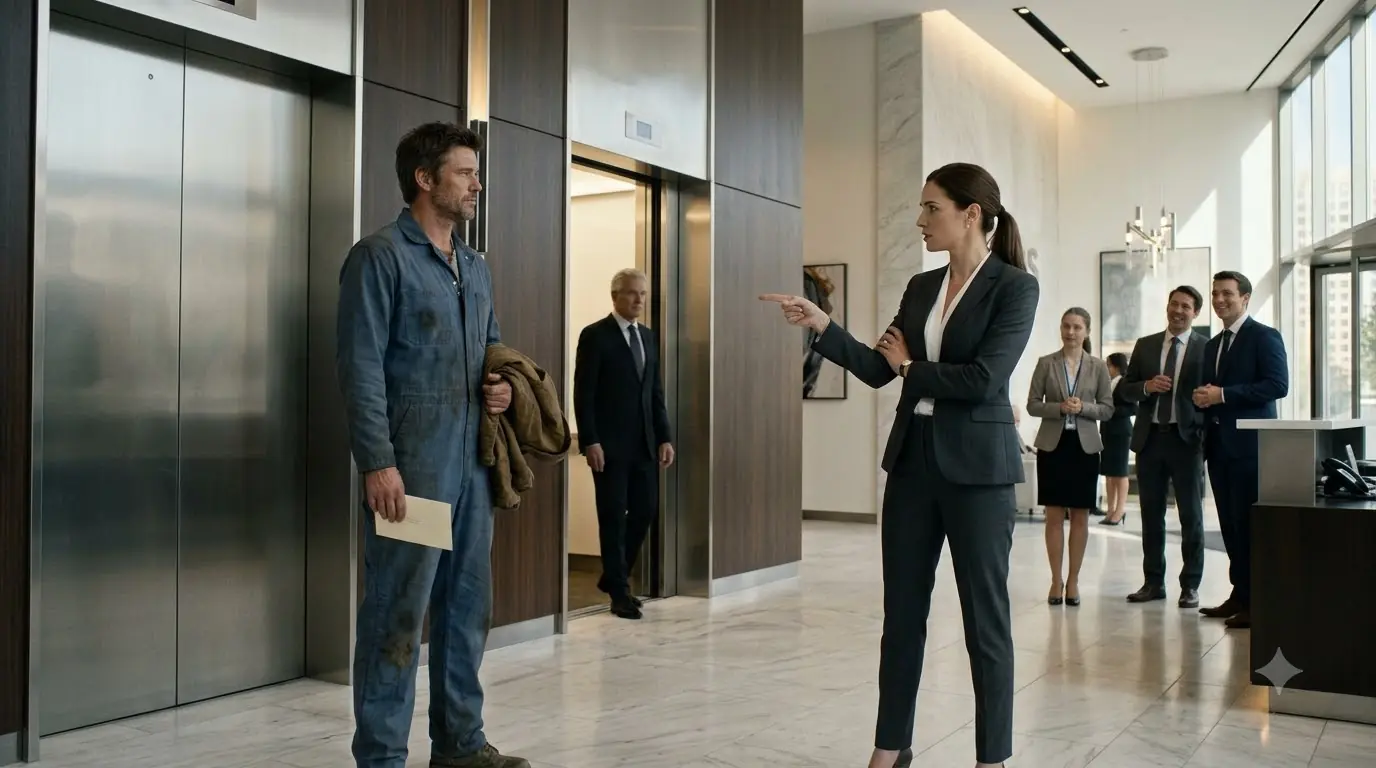
She looked at the man standing across from her, a man in a faded blue jumpsuit with grease under his fingernails and quiet patience written across his face, and told him flatly that he would not see a single cent of the $1,212 written on that piece of paper. The man did not argue.
He did not raise his voice, and he did not bother to reach for the invoice lying crumpled near her shoe.
He simply unpinned the small metal name tag from his chest, folded it once in his palm, thanked her for her time in a voice so calm it almost unsettled her, and walked back toward the workbench as if nothing of any consequence had just happened at all.
12 hours later, the entire executive floor of Helios Automotive would be thrown into chaos because the company's retired founder, a man whose name still opened doors in boardrooms across three continents, would walk through the front doors flanked by two lawyers and a driver who looked like he had not slept in a day.
He would walk straight past the reception desk, straight past the startled assistants clutching their coffee cups, and straight up to that same mechanic holding a check for $12 million folded neatly in his hand, and in front of the entire leadership team gathered under the pretense of an emergency meeting no one had actually called, he would say that the money had nothing to do with any car repair.
It was payment, he would say, his voice low and unwavering, for the single biggest mistake his daughter had ever made in her life. The garage belonged to a man named Silas Rowan, 41 years old, a widower who had buried his wife 6 years earlier and had never remarried, never spoken much about the loss, and never let the grief show on his face in front of strangers who had no reason to carry it with him.
His shop sat at the edge of a quiet industrial road lined with warehouses and shuttered storefronts, unmarked by any sign, unlisted in any directory, the kind of place a person only ever found because someone else had whispered the address to them first, usually in hushed and almost reverent tones. There were no flashing lights outside his gate, no glass showroom filled with polished vehicles, no salesman's smile waiting behind the counter to greet whoever walked through the door.
There was only a single roll-up gate that groaned when it lifted, a concrete floor stained by decades of spilled oil and hard work, and a man who moved through his shop with the quiet precision of someone who had once built engines for a living and had chosen, for reasons entirely his own, to walk away from every part of that life except the work itself. His clients were never advertised and never announced to the world.
They arrived by referral only, by a single name passed quietly from one trusted mouth to another, the way certain valuable secrets are passed only among people who understand what they are worth. On an ordinary morning, gray and unremarkable in every way, a flatbed truck rolled slowly up to that gate carrying a hypercar worth more than $4 million, one of only a handful ever produced anywhere in the world.
Its paint was the color of wet obsidian beneath the overcast sky. Vivian Ashcroft stepped out of the black sedan that followed close behind it, dressed as though she were walking into a shareholder meeting rather than a mechanic's garage tucked away on a forgotten street, her heels clicking sharply against the concrete with obvious and visible irritation.
The car had already passed through the hands of three separate authorized dealerships, each one charging astronomical fees for diagnostics that led nowhere, and each one returning the vehicle no better than it had arrived, still stalling without warning, still throwing cryptic warning lights across its dashboard, still refusing to perform the way a machine of its price and pedigree was supposed to perform without complaint. Silas walked around the vehicle once, slowly, his eyes tracing every line of the chassis before he ever touched a single tool.
And then he popped the hood and said almost nothing at all. He plugged in a diagnostic reader that looked considerably older than the car itself.
Its casing was scratched and worn from years of use as he watched the numbers scroll past on its small screen with the patience of a man reading something written in a language only he still remembered fluently. Within 18 minutes, he told her exactly what was wrong, speaking plainly and without a trace of showmanship.
The onboard computer system, the very brain of the vehicle, had been misprogrammed at the factory itself, a flaw so specific and so deeply buried in the code that none of the dealership technicians had ever thought to look for it because none of them had ever built engines the way Silas once had, back when he still carried a title and an office and a name that mattered in rooms full of powerful men. Vivian did not believe him, not at first.
And she said so plainly, arms crossed tightly over her chest, her tone that of someone who had grown up believing without question that money bought certainty and that certainty in turn commanded respect. But she had already spent weeks and tens of thousands of dollars chasing a problem no one else seemed capable of solving.
So, despite her doubts, she let him work, standing near the doorway of the garage with her phone in hand, checking messages every few minutes as though the outside world might collapse without her constant attention. Silas spent the next several hours with his head under the hood, rewriting what needed to be rewritten line by line, adjusting what needed to be adjusted with the same quiet focus a surgeon might bring to delicate and unforgiving work, testing the engine again and again until it ran exactly the way its original designers had intended from the very beginning before greed and shortcuts had found their way into the assembly line.
By the time the sun dipped low over the industrial road, painting the warehouses in long orange shadows, the car started on the first try, idled without a single shudder, and roared to life with the kind of sound that made even Vivian pause for half a second before catching herself and forcing her expression back into indifference. Silas wiped his hands slowly on a rag that had clearly seen better decades.
He walked to the small metal desk tucked into the corner of the garage and handed her a single piece of paper without a word of ceremony. On it was written one number, plain and unadorned. $1,212.
Vivian looked at the invoice, looked at him, and began to laugh. A laugh calculated and deliberate.
The kind of laugh a person uses specifically to make someone else feel small and foolish in front of witnesses. She asked him, loudly enough for the driver waiting near the sedan to hear every word, whether he truly believed that tightening a few bolts and plugging in a machine for 18 minutes was somehow worth more than a thousand dollars of her time and her money.
Silas said nothing in response to the question, offering no defense and no explanation because he had long ago stopped believing that his worth needed to be argued for in front of people who had already decided not to see it. He only watched, silent and unbothered, as she folded the invoice once, then twice, and slid it into her coat pocket without another word.
The sound of her laughter still hanging in the cold garage air long after the engine itself had gone quiet and the last light outside had faded to a deep and unremarkable blue. By the time Vivian returned to the gleaming glass tower that housed Helios Automotive's headquarters downtown, she had already turned the morning's events into a story worth telling, polishing it in her mind the way she polished every anecdote before delivering it to an audience.