"Sir, that meal isn't for you. We don't serve steak to passengers who clearly can't appreciate it."
Diana Blackwood's voice cut through the gentle hum of the first-class cabin like a blade through silk.
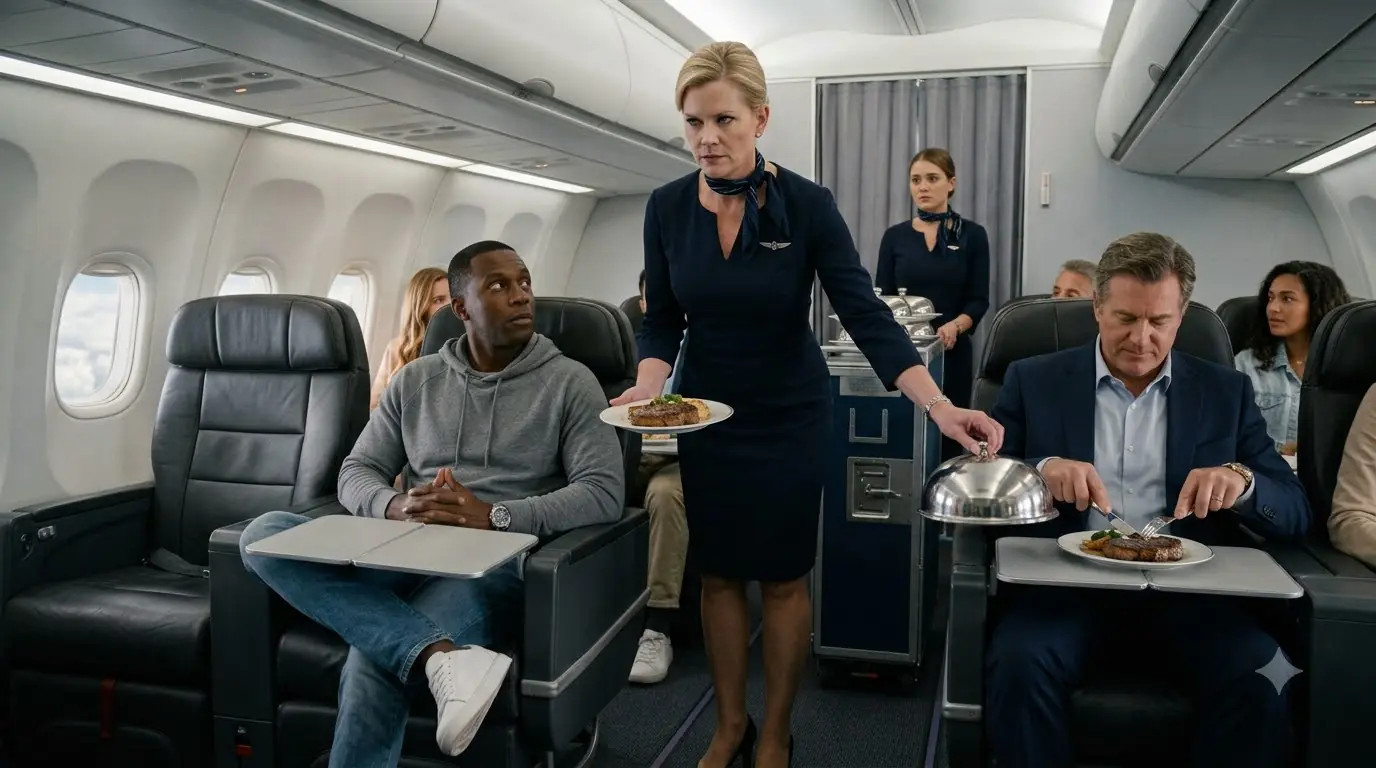
Her words hung in the recycled air of Atlas Airlines Flight 447, heavy with contempt and dripping with the kind of casual cruelty that comes from years of unchecked authority. The man standing quietly beside seat 1A didn't flinch.
Jonathan Rivers, dressed in faded jeans, a simple gray hoodie, and worn white sneakers, simply looked at her with calm, dark eyes that held depths she couldn't fathom.
He had been waiting patiently for his meal service, the same filet mignon that every other first-class passenger had received without question, without interrogation, without insult. But Diana had made her calculation in less than three seconds: Black man, casual clothes, wrong neighborhood.
"I ordered the steak," Jonathan said quietly, his voice measured and professional. "It's what I selected during booking."
Diana's smile was sharp as broken glass. "I'm sure you did, sir, but we're experiencing some inventory challenges today. I can offer you the chicken instead. I think you'll find it more suitable."
Behind him, Richard Coleman, a loud real estate mogul in an expensive navy suit, was cutting into his perfectly prepared filet mignon. The meat was pink and tender, exactly as it should be. His wife was doing the same. So was the woman in 1F, the businessman in 2D, and every other passenger in the premium cabin. Every passenger except one.
Isabella Cruz, the young flight attendant with kind eyes and trembling hands, stood frozen by the galley, watching this unfold. She had seen Diana do this before, subtle, plausible, always with an excuse that sounded reasonable until you noticed the pattern. Until you realized that the inventory challenges, system errors, and special circumstances always seemed to affect the same kind of passengers.
"Ma'am," Isabella whispered, approaching Diana. "We have three steaks left. I just checked the..."
"Ms. Cruz," Diana interrupted, her voice ice-cold. "I need you to handle the beverage service in economy. Now."
Isabella's face flushed. She glanced at Jonathan, then at Diana, then back to Jonathan. Her mouth opened as if to speak, but no words came. She was 26 years old, supporting her mother and younger brother on her flight attendant salary, and she had learned in her two years with Atlas Airlines that challenging Diana Blackwood was career suicide.
She walked away, her shoulders slumped with shame. Jonathan watched it all unfold with the patience of a man who had seen this performance many times before. What Diana didn't know, what none of them knew, was that when this Boeing 787 touched down at JFK International Airport, every person who had participated in this moment would be facing consequences.
Because the man they were humiliating, the man they had decided wasn't worthy of the service he had paid for, was Jonathan Rivers, founder and CEO of Pinnacle Aviation Holdings, with a net worth of $8.2 billion. As of 72 hours ago, he was also the new owner of Atlas Airlines. But they didn't know that yet.
They saw the hoodie, the worn sneakers, the lack of flashy jewelry or designer luggage, and they made their assumptions. They looked at his skin color and decided he didn't belong in their first-class cabin, regardless of what his ticket said. They were about to learn the most expensive lesson of their professional lives.
"The chicken will be fine," Jonathan said finally, settling into his seat with the calm dignity of a man who knew exactly how this story would end.
Diana's smile widened, satisfied with her victory. She had put him in his place, maintained the standards of her cabin, protected the comfort of the real passengers. She turned on her heel and walked away, her head held high, completely unaware that she had just destroyed her own career with a single devastating sentence.
In the seat across the aisle, Elena Rodriguez, a freelance journalist with 800,000 TikTok followers, had heard every word. Her phone was already in her hand, camera angled discreetly, finger hovering over the record button. The plane hadn't even finished climbing to cruising altitude, and the story that would make headlines around the world was already beginning to write itself.
Atlas Airlines Flight 447 was a modern Boeing 787 Dreamliner, one of the most advanced aircraft in the sky. The first-class cabin featured just 12 seats, each a throne of buttery leather and polished wood trim, with enough space for a passenger to fully recline into a flat bed. Soft blue LED lighting created an atmosphere of exclusive luxury, while the gentle whoosh of advanced air filtration kept the cabin comfortable and quiet.
This was premium travel at its finest, where passengers paid upwards of $4,000 for a round-trip ticket and expected service that matched the price tag. Every detail was designed to make travelers feel valued, respected, and welcome. Every detail except the attitudes of some of the crew.
The flight from Los Angeles to New York would take just under six hours, crossing three time zones and carrying 247 passengers from all walks of life. In economy, families squeezed into narrow seats, business travelers worked on laptops, and young people traveled on savings they had been accumulating for months. But in first class, the expectations were different.
Here, passengers were treated like royalty: champagne before takeoff, multicourse meals prepared by award-winning chefs, warm towels, premium bedding, and service that anticipated every need before it was expressed. Unless, apparently, your name was Jonathan Rivers and you didn't look like Diana Blackwood thought you should.
The irony was crushing. This aircraft, this route, this entire airline now belonged to the man she had just insulted. Every seat he had been told he didn't deserve, every meal he had been denied, every moment of discrimination he was experiencing, it was all happening inside a company he now owned.
Atlas Airlines had been struggling for years, hemorrhaging money and losing market share to more innovative competitors. That's why Pinnacle Aviation Holdings had been able to acquire it for $3.7 billion, a fraction of what it would have been worth a decade earlier. Jonathan wasn't flying Atlas today merely as a passenger. He was conducting what his business school professors would have called a ground-level diagnostic, experiencing his new acquisition from the customer's perspective and identifying problems that spreadsheets and board reports couldn't reveal.
He had expected to find operational inefficiencies, outdated technology, maybe some training gaps among the crew. What he hadn't expected was to become the target of overt discrimination from an employee who had somehow survived 28 years in the industry while harboring attitudes that belonged in a different century. But here they were at 39,000 feet above the American heartland, and Jonathan Rivers was getting a masterclass in everything that was wrong with the company he now controlled.
Jonathan Rivers hadn't always been a billionaire, but he had always been invisible. Growing up in Detroit, the son of an auto worker and a schoolteacher, he had learned early that the world made assumptions about him based on his appearance. As a boy, store clerks followed him through aisles. As a teenager, teachers were surprised when he earned the highest grades in calculus.
As a college student at MIT, classmates assumed he was there on athletics rather than academics, despite the fact that he stood just 5'9" and had never played organized sports. Each incident had been a small cut, barely noticeable on its own. But over the years, those cuts had formed scars, and those scars had hardened into armor.
Jonathan learned to navigate a world that constantly questioned his right to exist in spaces of wealth, education, and power. Now, at 42, he was worth more than most small countries. Pinnacle Aviation Holdings was his fourth major company, following successful ventures in software development, renewable energy, and commercial real estate.
Forbes had profiled him three times. The president had sought his advice on economic policy. Harvard Business School taught case studies based on his acquisition strategies. But success hadn't erased the memories. If anything, it had sharpened them.
The laptop resting on his tray table looked unremarkable, a five-year-old Dell with a worn keyboard and a screen that flickered occasionally. Most tech billionaires carried the latest MacBook Pro or custom-built machines that cost more than most people's cars. Jonathan kept this old laptop for sentimental reasons. He had coded the original algorithm for his first billion-dollar company on this machine, working 18-hour days in a cramped apartment in Palo Alto, surviving on ramen noodles and pure determination.
The fitness tracker on his wrist was a $99 model from Target, not the luxury smartwatch that other executives favored. His backpack was a simple black canvas bag he had owned for eight years. His sneakers were clean but clearly well-worn, the kind of shoes that spoke of countless miles and careful budgeting.
To anyone looking, he appeared to be exactly what Diana had assumed, someone who had lucked into a first-class seat through an upgrade, a contest, or perhaps a gift from someone with real money. They couldn't have been more wrong.
Jonathan had booked this ticket under his own name precisely because the Atlas reservation system wasn't integrated with the new Pinnacle ownership structure. He wanted to experience the airline as a regular customer without the red-carpet treatment that came with being recognized as the new owner. This was his standard practice.
When he acquired a service company, he always spent time as an anonymous customer first. He had worked undercover shifts at his hotel chain, stood in line at his retail stores, and called his own customer service departments with fake complaints. Every time, he had discovered problems that never appeared in board reports or consultant studies: rude employees who drove away customers, inefficient processes that wasted time and money, cultural issues that poisoned the entire operation from within.
But this felt different. This wasn't about efficiency or profits. This was personal.
At 24, fresh out of MIT with dual degrees in computer science and economics, Jonathan had been denied entry to a private investment club dinner in Boston. The hostess had looked at his discount suit and assumed he was there to deliver food. "Service entrance is around back," she had said, not even looking at the invitation he was holding.
He had stood on the sidewalk for 10 minutes, invitation in hand, watching through the windows as venture capitalists and tech executives worked inside. The humiliation burned worse than the cold November wind. That night, he had made a promise to himself: he would never again be denied entry anywhere because of his clothes, his age, or his race. He would build enough wealth and power to own the building, not just enter it.
At 28, he had tried to book a table at an exclusive restaurant in San Francisco for a business dinner with potential investors. The hostess had quoted him a six-month waiting list, then immediately seated a white man who had arrived after him and made a reservation the same day. Jonathan had eaten at McDonald's that night and spent the rest of the evening working on the business plan that would eventually make him his first hundred million.
At 35, he had been questioned by security at a luxury hotel in Manhattan, where he was attending a conference as a keynote speaker. The guards had insisted on seeing his room key three times, convinced that a Black man in jeans and a polo shirt couldn't possibly be a guest at their five-star establishment. Each incident had added another layer to his determination.
He didn't seek revenge. He sought ownership. He bought the investment club that had rejected him and turned it into a diversity-focused networking organization. He purchased a stake in the restaurant chain that had discriminated against him and mandated sensitivity training for all staff.
The hotel company became part of his real estate portfolio, and its discriminatory security practices became grounds for immediate termination. Power, he had learned, wasn't about making people pay for their prejudices. It was about making sure those prejudices couldn't hurt the next person who came along.
Now, sitting in seat 1A of Atlas Airlines Flight 447, wearing the same kind of casual clothes that had marked him as other for most of his life, Jonathan was about to conduct the most important undercover assessment of his career. He hadn't expected to become the target himself.
The laptop screen flickered as he opened a document titled "Atlas Assessment: Initial Observations." So far, he had noted the outdated interior design, the inconsistent service standards, and the need for technology upgrades throughout the cabin. Now he was adding a new section: cultural issues and discrimination protocols.
Diana Blackwood had no idea that her interaction with him was being documented by the future owner of her company. She couldn't have known that her casual racism was about to become the catalyst for the biggest transformation in Atlas Airlines' 70-year history. But that was about to change.
Jonathan closed the laptop and leaned back in his seat, watching Diana serve champagne to every other passenger in first class while studiously avoiding his row. She was professional with the others, warm, even asking about their destinations and making small talk about the weather. When she reached his row, she walked past without making eye contact. The pattern was clear, undeniable, and about to become very expensive for Atlas Airlines.
Diana Blackwood had joined Atlas Airlines in 1996, when the company still commanded respect in the industry and first-class service was an art form. She had been 20 when she started, fresh-faced and eager to see the world, convinced that she was joining an exclusive club of professionals who maintained the highest standards of luxury travel. Twenty-eight years later, she was the senior flight attendant on the most prestigious route in the Atlas network, and she wore her authority like armor.
The airline industry had changed dramatically during her career. Budget carriers had democratized air travel, making it accessible to people who had once considered flying a luxury beyond their reach. The internet had transformed booking, allowing anyone with a credit card to purchase premium seats that had once required connections or insider knowledge to obtain.
Diana viewed these changes as a degradation of standards. In her mind, first class was meant for a certain type of person, the kind who understood the unspoken rules of luxury service, who dressed appropriately for the privilege, who belonged in spaces of refinement and elegance. She had developed an unofficial screening process over the years, a quick visual assessment that determined how much attention each passenger deserved.
Business attire earned full service. Designer accessories warranted extra consideration. The right shoes, the correct luggage, the proper bearing. These details told her everything she needed to know about who deserved her best efforts.
And then there were passengers like the man in seat 1A. Hoodie, jeans, worn sneakers, no visible signs of wealth or status. Probably an upgrade passenger, someone who had lucked into first class through miles or a last-minute airline mistake.
These passengers, in Diana's experience, didn't understand the etiquette of premium service. They ordered multiple drinks, asked too many questions, and generally disrupted the refined atmosphere she worked so hard to maintain. It was her responsibility, she believed, to maintain standards, protect the experience for passengers who truly belonged in first class, and ensure that Atlas Airlines continued to attract the kind of clientele that justified the premium prices.
She had mentored dozens of flight attendants over the years, teaching them her methods: how to identify upgrade passengers, how to provide minimum service without appearing discriminatory, how to encourage certain types of travelers to choose other airlines in the future.
Isabella Cruz was proving to be a challenging student. The young woman had been with Atlas for two years, and she still insisted on treating every passenger equally, regardless of appearance or demeanor. She served the same champagne to everyone. She smiled at passengers in wrinkled clothes with the same warmth she showed to those in designer suits.
She acted as if the price of someone's ticket was the only qualification they needed for respectful service. It was admirable in theory, Diana supposed, but impractical in reality. The airline industry was built on class distinctions, on making passengers aspire to better service by demonstrating what they could achieve with higher status.
If you treated everyone the same, what incentive was there for customers to pay premium prices? Diana had tried to educate Isabella subtly, pointing out which passengers required special attention and which ones could be served with standard efficiency. She had explained the importance of managing passenger expectations and ensuring that first-class service remained exclusive and desirable.
But Isabella remained stubbornly idealistic. She seemed to believe that every passenger who had paid for a first-class seat deserved first-class treatment regardless of how they looked or where they came from. Like now, watching Diana handle the situation with the passenger in 1A.
Isabella had actually questioned her decision about the meal service, had tried to intervene on behalf of a passenger who clearly didn't understand the standards expected in premium cabins. It was exactly the kind of bleeding-heart thinking that Diana had been trying to correct.
The man in 1A hadn't complained when she denied him champagne, claiming they were low on inventory. He hadn't demanded to speak to a supervisor when she informed him that the steak was unavailable. He had simply accepted her explanations with quiet dignity, as if he was accustomed to receiving substandard service, which Diana assumed he probably was.
She had dealt with passengers like him before. They usually fell into one of several categories: lottery winners who didn't understand luxury travel, athletes or entertainers whose managers had booked their flights, or corporate employees flying on company expense accounts without any personal investment in the experience.
Occasionally, they were what the industry called points passengers, frequent travelers who had accumulated enough airline miles to book premium seats without paying premium prices. These passengers were particularly troublesome because they felt entitled to service they hadn't truly earned. The man in 1A seemed to fit this profile perfectly.
No designer luggage, no expensive watch, no signs of the kind of wealth that justified first-class treatment. He was polite enough. She would give him that. But politeness didn't change the fundamental reality of who belonged in her cabin and who didn't.
Isabella approached her again as Diana prepared the meal service. Her young face was creased with concern. "Diana, I checked the inventory again. We have plenty of steak meals. I think there was a miscommunication about..."
"Ms. Cruz," Diana interrupted, her voice sharp enough to cut through Isabella's good intentions. "I've been doing this for 28 years. I know how to manage meal service. Please focus on your assigned duties."
Isabella's face flushed, but she didn't back down. "I just think that passenger deserves the same service as everyone else. He paid for first class just like the others."
Diana studied the younger woman for a moment, recognizing the stubborn set of her jaw. Isabella was from a working-class family, the first in her line to work in the airline industry. She brought a perspective that Diana found both naive and dangerous. She didn't understand the delicate social dynamics that governed premium service.
"Isabella," Diana said, her voice taking on the tone she used for training new employees, "there are aspects of this job that you don't understand yet. Service isn't just about following policies. It's about reading passengers, understanding their expectations, and managing the experience for everyone on board."
She gestured toward the passenger in 1A, who was reading something on his laptop, seemingly unaware of their conversation. "Some passengers require careful handling. They may not be accustomed to first-class service, and if we don't manage their expectations properly, they can become disruptive. It's kinder, ultimately, to provide them with service that matches their background and comfort level."
Isabella stared at her for a long moment, and Diana could see the wheels turning in the young woman's mind. She was trying to process what Diana was really saying, to understand the coded language that experienced flight attendants used to navigate sensitive situations.
"I think I understand," Isabella said finally, her voice quiet.
Diana smiled, satisfied that her mentoring was finally taking effect. "Good. Now let's focus on providing excellent service to our premium passengers."
As Isabella walked away to prepare the beverage cart, Diana felt confident that she had handled the situation appropriately. She had maintained standards, protected the first-class experience, and educated a junior employee about the realities of luxury service. She had no idea that she had just created a witness to discrimination who would soon find the courage to speak up.
The first-class cabin of Atlas Airlines Flight 447 was a microcosm of American wealth and privilege. Twelve seats filled with 12 very different stories about success, status, and the complex social hierarchies that governed modern air travel. Richard Coleman occupied seat 2D, his massive frame filling the space like a declaration of ownership.
At 55, he had built a real estate empire across the Southwest, specializing in luxury developments that transformed desert landscapes into exclusive communities. His expensive navy suit cost more than most people earned in a month, and his gold Rolex caught the cabin lighting every time he gestured, which was often. Richard was the kind of passenger Diana Blackwood loved to serve: obviously wealthy, appropriately dressed, and completely comfortable with the privileges that money could buy.
He had boarded with the casual confidence of someone who flew first class several times a month, nodding at Diana like she was hired help who existed solely for his convenience. "Champagne immediately," he had commanded upon settling into his seat, not as a request but as an expectation. "And make sure the steak is medium rare. Last time it was overcooked, and I won't tolerate that again."
Diana had practically glowed with approval. This was how first-class passengers were supposed to behave: demanding, entitled, absolutely certain of their right to premium treatment. It made her job easier when passengers understood their role in the luxury-service ecosystem.
Across the aisle from Richard, Elena Rodriguez sat quietly in seat 2F. Her appearance was carefully crafted to blend into the first-class environment while concealing her true purpose. At 29, she was one of the most successful freelance journalists in the country, specializing in social justice stories that exposed inequality and discrimination in unexpected places.
Her 800,000 TikTok followers knew her as someone who found injustice hiding in plain sight: corporate boardrooms that excluded qualified candidates, restaurants that provided different service based on customer appearance, retail stores where shopping while Black meant constant surveillance. Elena had booked this flight as part of a larger investigation into bias in the travel industry.
She had heard whispers about Atlas Airlines complaints from passengers who felt they had received substandard service despite paying premium prices. The airline's customer-review patterns showed troubling disparities in satisfaction scores that seemed to correlate with passenger demographics rather than service quality. She wasn't looking for a story when she boarded Flight 447, but her journalistic instincts were already tingling as she watched Diana's interactions with different passengers.
The warm welcome for Richard Coleman. The professional but distant greeting for the elderly white couple in row one. The barely concealed disdain for the man in the hoodie who had taken seat 1A. Elena's phone was charged and ready.
Her followers were always hungry for content that revealed how discrimination operated in supposedly enlightened spaces. If Atlas Airlines was providing different levels of service based on passenger appearance, her audience would be very interested to see the evidence.
In seat 1F, Margaret Chen was absorbed in a legal brief, her reading glasses perched on her nose as she reviewed documents for a case that would be argued before the Supreme Court the following month. As a senior partner at one of Washington's most prestigious law firms, she was accustomed to first-class travel as both a necessity and a symbol of professional achievement.
Margaret had noticed the interaction between Diana and the passenger in 1A, but she was trying to focus on her work rather than involve herself in whatever drama was unfolding across the aisle. She had learned over the years that airline service could be inconsistent, and she preferred to avoid confrontations that might delay her flight or complicate her travel experience.
Still, something about the exchange bothered her. She had paid attention when Diana claimed to be out of steak, but she could clearly see multiple meal options in the galley. As someone who had built her career on identifying inconsistencies and false statements, she found Diana's explanation suspicious.
Behind them in row three, Dr. James Patterson was already working on his laptop, preparing for a medical conference in New York where he would present research on cardiac-surgery innovations. At 62, he was one of the most respected surgeons in Los Angeles, someone who had performed operations on celebrities, politicians, and business leaders.
Dr. Patterson had been flying first class for decades, and he had seen enough airline service to recognize quality when he experienced it. Diana had been professional and courteous when she welcomed him aboard, offering champagne and asking about his destination with genuine interest. The contrast with how she had treated the passenger in 1A was stark and troubling.
Dr. Patterson prided himself on treating all his patients with equal respect regardless of their background, and he found Diana's behavior professionally disappointing.
In the window seat of row four, tech entrepreneur Sarah Kim was livestreaming to her business-coaching audience, sharing insights about travel strategies for busy executives. Her 200,000 Instagram followers looked to her for advice on everything from productivity hacks to investment opportunities.
Sarah had built her company from nothing, starting as a first-generation immigrant whose parents worked in a dry-cleaning shop in Queens. She understood what it felt like to be underestimated, to have people assume she didn't belong in spaces of wealth and power. Watching Diana's treatment of the passenger in 1A brought back memories of her own experiences with discrimination disguised as customer service.
She was already considering whether the interaction warranted documentation for her audience. The remaining passengers in first class represented a cross-section of American success: a retired judge, a pharmaceutical executive, a Broadway producer, and a venture capitalist. Each had paid thousands of dollars for the privilege of premium service, and each expected to be treated with the respect that their ticket price demanded.
What they were witnessing instead was a masterclass in how bias operated in supposedly neutral service environments. As the meal service approached, tension in the cabin was building. Multiple passengers had noticed the discrepancies in Diana's treatment of the man in seat 1A.
Some, like Elena, were actively documenting the situation. Others, like Dr. Patterson and Margaret Chen, were mentally preparing to intervene if the situation escalated. Richard Coleman remained oblivious, focused primarily on his own comfort and completely unaware that his enthusiastic endorsement of Diana's preferential treatment was about to become evidence in a discrimination case.
The stage was set for a confrontation that would transform not just this flight, but the entire culture of Atlas Airlines. Multiple witnesses were watching, several were recording, and one passenger was quietly taking notes for what would become the most expensive corporate transformation in aviation history. None of them knew that the man being discriminated against was about to become their boss.
The champagne service began 30 minutes after takeoff as Atlas Airlines Flight 447 reached its cruising altitude of 39,000 feet above the Colorado Rockies. Diana Blackwood emerged from the galley with a silver tray bearing crystal flutes filled with Dom Perignon, the airline's signature first-class welcome drink.
Her approach was choreographed with military precision. Twenty-eight years of experience had taught her exactly how to move through the cabin, how to balance the tray while navigating the narrow aisles, and how to serve champagne with the kind of graceful efficiency that made passengers feel pampered rather than processed.
She began with row four, offering the pharmaceutical executive and venture capitalist their drinks with warm smiles and brief conversations about their destinations. Then row three, where Dr. Patterson received his champagne along with an inquiry about his conference and a comment about the beautiful weather in New York.
Row two was Richard Coleman's domain, and Diana devoted extra attention to his service, ensuring his glass was perfectly filled and asking if he preferred his usual cashews over mixed nuts.
"You remember," Richard beamed, accepting the champagne like a feudal lord accepting tribute. "This is why I fly Atlas. Real service from professionals who care about their customers."
Diana glowed under the praise. This was how the interaction was supposed to work: appreciative passengers, personalized attention, the kind of luxury service that justified premium pricing. She moved to row one, serving Margaret Chen with professional courtesy and the elderly couple with the warm deference appropriate for their age and status.
Then she reached seat 1A. Jonathan Rivers looked up from his laptop as Diana approached, his expression politely expectant. He had watched the service ritual unfold, noting the genuine warmth in Diana's interactions with the other passengers, the personal touches that marked truly exceptional hospitality.
And then Diana walked past him. Not quickly, not obviously. She simply continued her circuit without pausing, without making eye contact, without acknowledging his presence.