“Stop.” The word cut across the parking lot harder than Terrence Dawson intended, but Officer Blake Mercer did not even bother turning around. The white patrol officer remained bent inside Terrence’s black pickup, one hand digging beneath the driver’s seat while the other shoved aside a folded jacket and a paper grocery bag. Terrence stood beside the open door in a fitted black polo and faded jeans, his jaw locked as tightly as his fists wanted to be. “You do not have permission to tear through my truck.”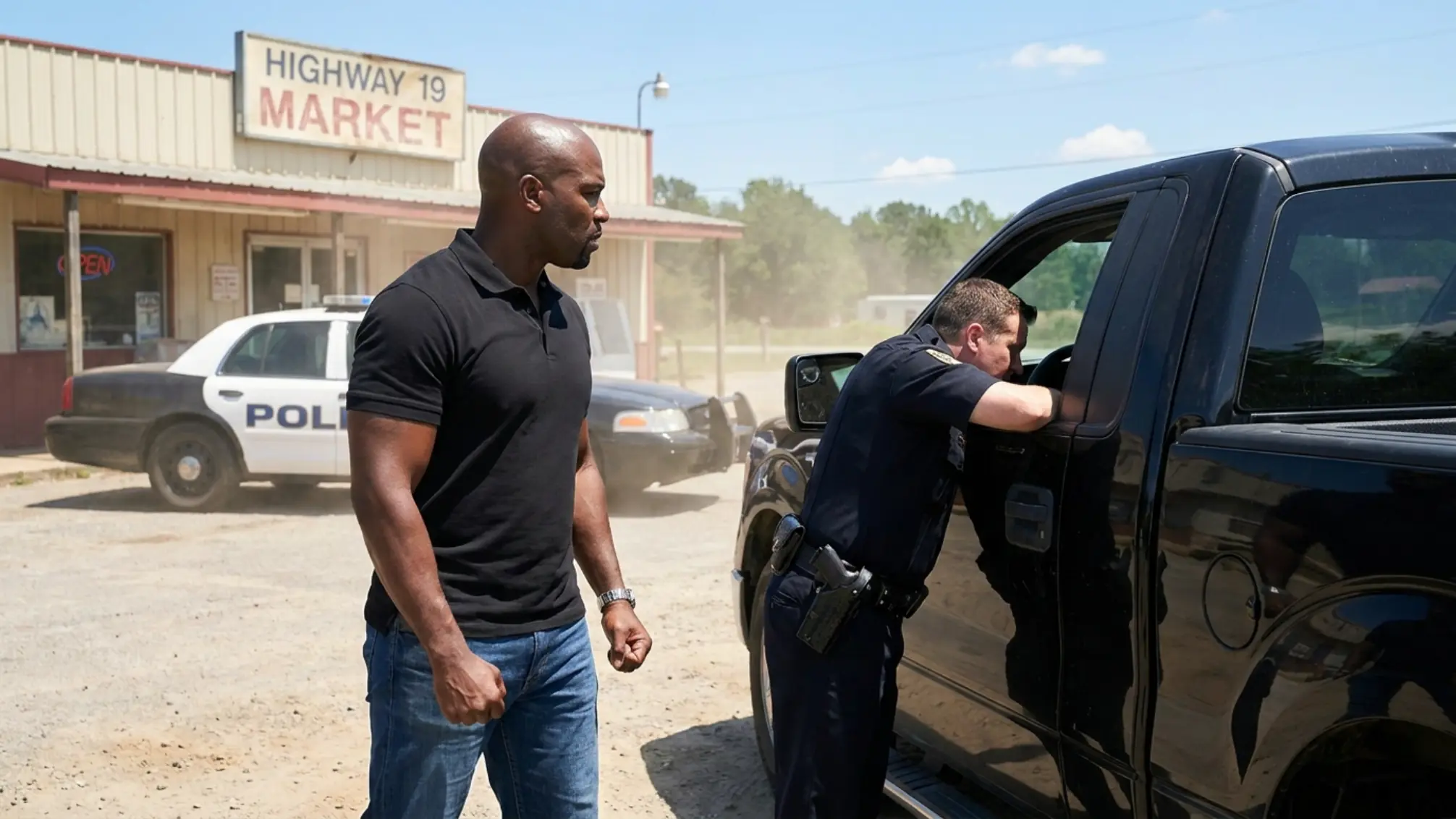
Mercer gave a short laugh. “Relax. You act nervous enough to make this search worth my time.” He was thirty-six, compact and muscular, with closely cropped blond hair, mirrored sunglasses pushed onto his head, and the confidence of someone who expected his badge to end every argument before it began. A patrol cruiser sat behind the pickup with its lights flashing, turning the windows of the Highway 19 roadside store red and blue. Terrence stared at the officer’s back and said, “Touch one more thing in there, and you’ll be explaining this stop to people above your rank.”
Mercer laughed again until his fingers closed around something beneath the seat. He pulled out a hard black leather case, flipped it over, and saw the embossed seal pressed into the cover. His smirk weakened when he read the name beneath it. “Why does this badge case have your name on it?”
Terrence said nothing. That silence finally forced Mercer to turn around completely. The officer looked from the case to the Black man standing three feet away, then back to the case as though an answer might appear if he stared long enough.
The stop had begun twenty minutes earlier on Highway 19, shortly after Terrence left his mother’s seventy-first birthday dinner. He had eaten too much peach cobbler, packed two slices of cake into a cardboard container for the drive home, and promised his mother he would call when he reached Atlanta. The evening had been ordinary enough that Terrence barely remembered the white patrol cruiser parked behind a billboard near the county line. Then headlights appeared behind him and remained there for nearly four miles.
Terrence checked his speed. Fifty-three in a fifty-five. His seat belt was fastened, every light on the truck worked, and the vehicle had passed inspection less than a month earlier. When the cruiser finally activated its emergency lights, Terrence signaled and continued another quarter mile until he reached a brightly lit roadside store where surveillance cameras covered the pumps and parking lot.
Officer Mercer approached quickly. “License.” Terrence kept both hands high on the steering wheel and answered, “Good evening, Officer. May I ask why I was stopped?” Mercer shined a flashlight directly into his face.
“You drifted.”
“Across the center line?”
“Enough.”
Terrence nodded. “All right.” He handed over his license, registration, and insurance while Mercer looked around the truck’s interior.
The cake sat on the passenger seat. A garment bag hung behind Terrence. Two folders were tucked beside the center console, but nothing inside the vehicle suggested drugs, alcohol, weapons, or criminal activity. Mercer nevertheless kept sweeping his flashlight across every compartment.
“Where you coming from?”
“My mother’s house.”
“Where?”
“Marion County.”
“What were you doing there?”
“Celebrating her birthday.”
Mercer looked at the cake box. “You drinking?”
“No.”
“Not even one beer?”
“No.”
“Drugs?”
“No.”
Mercer stared at him for another several seconds. “Step out.”
Terrence did not argue. He had spent enough years around law enforcement to understand how rapidly a roadside misunderstanding could become dangerous when ego entered the conversation. He opened the door slowly, announced his movements, and stepped onto the pavement with his hands visible.
Mercer immediately began asking whether Terrence had anything illegal inside the truck. Terrence answered no. The officer asked whether he could search the vehicle. Terrence replied just as clearly, “No, I do not consent to a search.”
Mercer’s expression changed. “Why not?”
“Because I don’t consent.”
“If there’s nothing inside, what are you worried about?”
“I’m not worried.”
“Sure sounds worried.”
Terrence looked directly at him. “My refusal is not evidence of a crime.”
Mercer’s face tightened. “You a lawyer?”
“No.”
“You talk like one.”
Terrence almost smiled. “I read.”
That answer irritated Mercer more than an insult probably would have. He ordered Terrence to stand near the front of the cruiser while he returned to his radio and spoke quietly enough that Terrence could hear only fragments. “Nervous behavior,” Mercer said. “Won’t consent. Something’s off.”
A second officer arrived five minutes later. Officer Jenna Cole was younger, perhaps thirty, with dark hair pulled tightly beneath her cap and an expression that shifted toward confusion when Mercer explained the circumstances. She asked whether he smelled alcohol.
“No.”
“Anything visible?”
“No.”
“Outstanding warrants?”
“Waiting.”
Dispatch returned seconds later. Terrence’s license was valid, his registration current, and there were no warrants attached to his name. Mercer still did not return the documents.
Instead, he called Terrence toward the truck. “Open the rear door.”
Terrence stared at him. “Why?”
“Because I told you.”
“I already declined consent.”
Mercer stepped closer. “You’re making this harder than it needs to be.”
Officer Cole looked between them. “Blake, what are we looking for?”
Mercer ignored her.
Terrence kept his voice calm. “Am I being detained?”
“Yes.”
“For the traffic violation?”
“And investigation.”
“Investigation of what?”
Mercer’s jaw tightened. “You ask too many questions.”
Terrence felt anger rise but refused to give it control. “Questions are not probable cause.”
That sentence shifted something.
Mercer walked to the pickup and opened the driver’s door himself.
Terrence immediately said, “I do not consent to that search.”
Mercer leaned inside anyway.
Cole stepped forward. “Blake.”
He waved her away. “I’ve got it.”
Terrence moved closer but kept several feet between them. “Stop. You don’t have permission to tear through my truck.”
That was when Mercer laughed.
“Relax. You act nervous enough to make this search worth my time.”
Terrence watched him move the jacket, open the center console, and then reach beneath the seat. “Touch one more thing in there,” Terrence said, “and you’ll be explaining this stop to people above your rank.”
Mercer pulled out the leather case.
“Why does this badge case have your name on it?”
Terrence held his gaze. “Open it.”
Mercer hesitated.
“You were comfortable opening everything else.”
Officer Cole moved closer. “Maybe don’t.”
Mercer ignored her and opened the case.
The first thing he saw was an identification card. The photograph showed Terrence in a dark formal uniform, face unmistakable. Beneath it sat credentials identifying him as Senior Chief Terrence Dawson, assigned to a federal investigative command specializing in logistics security, evidence diversion, and interagency misconduct reviews.
Mercer stopped breathing for a moment.
Cole leaned closer.
“Oh, hell.”
Terrence remained still.
Mercer closed the case quickly. “This doesn’t change anything.”
Terrence’s eyebrows lifted. “I hope not.”
Mercer stared at him.
“My title should have absolutely nothing to do with whether that search was lawful.”
Cole looked at Terrence differently now. Not fear. Recognition.
Mercer shoved the badge case toward him. “You should’ve told me who you were.”
Terrence took it. “Why?”
“Professional courtesy.”
Terrence slipped it into his pocket. “Would you have stopped searching?”
Mercer did not answer.
“That’s why I didn’t.”
The officer’s embarrassment turned immediately into aggression. “You concealed your status.”
“I handed you a valid driver’s license.”
“You deliberately let me think you were just some guy.”
Terrence looked at him for several seconds. “I am just some guy when I’m driving home from my mother’s birthday.”
The sentence seemed to land hardest on Cole.
Mercer looked toward the store, where several customers had begun watching through the windows. “Get back by the cruiser.”
“No.”
His head snapped around. “Excuse me?”
“You’ve finished your search.”
“I decide when I’m finished.”
“No,” Terrence replied. “The law does.”
Mercer stepped toward him until barely a foot separated them. “You want to pull rank?”
Terrence did not move. “I haven’t.”
“You threatened my career.”
“I told you there would be accountability.”
“Same thing.”
“No.”
Terrence’s voice became colder.
“It only sounds like the same thing if you already know what you did was wrong.”
Cole looked down.
Mercer saw her reaction. “You got something to say?”
She hesitated, then answered. “He denied consent.”
Mercer glared at her.
“You were here for half the stop.”
“I heard the denial.”
“You don’t know what I saw.”
“What did you see?”
Mercer did not answer.
Terrence noticed.
So did Cole.
“Blake,” she said, “what established probable cause?”
Mercer pointed toward Terrence. “Behavior.”
Terrence almost laughed. “Which behavior?”
“You were nervous.”
“I was calm.”
“You refused a search.”
“That is not probable cause.”
“You kept questioning me.”
“That is not probable cause either.”
Mercer became visibly angry. “You know what? Turn around.”
Cole stepped between them.
“No.”
Everyone froze.
Mercer stared at her. “What?”
“You are not putting cuffs on him because he challenged your search.”
“Move.”
“I’m not arresting somebody because you’re angry.”
Mercer’s hand moved toward his belt.
Terrence immediately raised both palms. “Nobody needs to make this worse.”
Mercer looked at him. “Stay out of it.”
“It’s my detention.”
Cole keyed her radio.
“Supervisor requested. Highway 19 Market.”
Mercer turned toward her with disbelief. “You calling a sergeant on me?”
“I’m asking for review.”
“This is my stop.”
“It stopped being simple when you searched after consent was denied.”
Terrence watched silently.
He had seen officers protect colleagues reflexively before. Cole’s decision to challenge Mercer in public probably felt more dangerous to her career than it appeared from outside.
Sergeant Paul Ramsey arrived eight minutes later.
He was fifty-three, heavy through the shoulders, and clearly irritated at being called to a roadside dispute. Mercer intercepted him before he reached Terrence. The two spoke near the cruiser.
Terrence heard pieces.
“Suspicious behavior.”
“Possible contraband.”
“Wouldn’t consent.”
“Started acting like he knows the law.”
Ramsey glanced toward Terrence.
Then Mercer apparently mentioned the credentials.
Ramsey’s posture changed.
He walked directly toward Terrence. “Senior Chief Dawson?”
“Yes.”
“I apologize for the inconvenience.”
Terrence shook his head.
“No.”
Ramsey looked confused.
“No?”
“Don’t apologize because you heard a title.”
Silence.
Terrence pointed toward his truck.
“Ask him why he searched it.”
Ramsey looked at Mercer.
“What gave you probable cause?”
Mercer answered, “Indicators.”
“Which?”
“Nervousness.”
Ramsey waited.
“Refusal to consent.”
Ramsey’s expression tightened.
“And?”
Mercer hesitated.
“Totality.”
“What totality?”
Nothing.
Terrence watched Ramsey slowly understand the situation.
“Did you search after he denied consent?”
Mercer looked away.
Cole answered. “Yes.”
Ramsey exhaled.
“Body cams?”
“Running,” Cole said.
Mercer looked toward his chest.
For the first time that evening, genuine fear appeared in his expression.
Terrence noticed the camera too.
“Preserve all footage.”
Ramsey looked at him.
Terrence continued. “Including dash camera and radio traffic.”
Mercer scoffed. “You don’t order our department around.”
Terrence nodded. “Correct.”
Then he looked at Ramsey.
“But you know your evidence-preservation policy.”
Ramsey did.
He radioed dispatch.
Terrence’s detention ended nine minutes later. No citation was issued for lane deviation because Mercer’s dash camera showed nothing clear enough to support the allegation. Terrence collected his documents, inspected the interior of the truck, and discovered the center console had been emptied, the garment bag opened, and several personal papers moved.
Nothing was missing.
But something had changed.
Before leaving, Terrence asked Mercer one question.
“Do you search everybody who refuses?”
Mercer stared at him.
“No.”
“Then why me?”
No answer.
Terrence nodded slowly.
“That answer is going to matter.”
He drove away.
At 10:41 p.m., Terrence called his mother.
“You home?”
“Almost.”
“You sound strange.”
“Long night.”
“You didn’t eat the cake, did you?”
Terrence looked toward the passenger seat.
The box had been crushed during the search.
“No.”
His mother laughed. “That’s because you never listen.”
Terrence smiled for the first time since the stop.
“I’ll call tomorrow.”
He did not tell her what happened.
Not yet.
The next morning, Terrence documented the encounter from memory. Times. Commands. Questions. The moment he refused consent. The exact sequence of Mercer entering the vehicle.
Then he made another decision.
He did not contact anyone through his federal chain of command.
The encounter had occurred while he was off duty.
Instead, he filed the same civilian complaint available to any member of the public.
That choice irritated several colleagues.
“You could have one phone call put this guy under a microscope.”
Terrence shook his head. “Then the system only works because of who I am.”
“What’s wrong with using your authority?”
“I wasn’t acting under authority.”
His colleague frowned.
Terrence continued. “If Mercer would get away with this against a mechanic but not against me, then the problem is bigger than Mercer.”
The county sheriff’s Professional Standards Division opened an investigation.
The body-camera footage answered the first question immediately.
Terrence denied consent clearly.
Three times.
Mercer acknowledged the refusal.
Then searched anyway.
The second question was harder.
Why?
Mercer claimed he smelled an odor he could not initially identify and believed Terrence might be transporting narcotics.
No mention of any odor appeared on video.
No mention appeared in his radio transmissions.
His written report, drafted after the encounter, contained the first reference.
Investigators examined previous stops.
A pattern emerged.
Mercer conducted thirty-seven vehicle searches during the prior fourteen months.
Twenty-nine followed drivers refusing consent.
Only four produced contraband.
The remaining twenty-five resulted in no arrest.
Another pattern appeared.
A disproportionate number involved Black drivers on Highway 19.
Investigators pulled body-camera recordings.
The language was familiar.
Why won’t you let me search if you have nothing to hide?
You’re making me suspicious.
Refusing cooperation tells me something.
One driver was a school principal.
Another was a nurse.
Another was a retired mechanic.
None carried badge cases.
None had known exactly how to preserve evidence afterward.
Several had complained.
Their complaints had been individually closed.
One supervisor wrote, Officer Mercer demonstrates proactive enforcement techniques.
Terrence read that sentence twice.
“Proactive.”
Professional Standards investigator Lisa Chen sat across from him.
“That’s how the evaluation described it.”
“How many supervisors reviewed the search numbers?”
“We’re determining that.”
Terrence closed the file.
“This isn’t one officer anymore.”
Chen nodded.
“We know.”
Mercer was placed on administrative leave.
His union representative immediately argued that the investigation had become politically influenced because Terrence worked for the federal government. Terrence anticipated that argument.
He requested in writing that his employer have no role in the administrative case.
The evidence would either support him or it would not.
It did.
Sergeant Ramsey’s response also came under review.
He had ended the encounter correctly once he arrived, but investigators discovered two earlier complaints involving Mercer had passed through his supervision.
One specifically alleged a search following refusal of consent.
Ramsey had closed it after reviewing only Mercer’s report.
He never watched the body-camera footage.
During his interview, Chen asked why.
“We had staffing problems.”
“That isn’t what I asked.”
Ramsey sighed.
“He was productive.”
“What does productive mean?”
“Stops. Arrests. Seizures.”
“And complaints?”
Ramsey looked down.
“We considered them part of proactive policing.”
Chen slid Terrence’s complaint across the table.
“Still?”
Ramsey did not answer.
The department eventually reviewed dozens of stops.
Several traffic citations were referred to prosecutors for re-evaluation.
Civilian complainants were contacted again.
One man named Andre Watkins returned the investigator’s call after nearly hanging up.
“Why now?”
Chen answered honestly.
“Because we should have listened earlier.”
Watkins laughed bitterly.
“You mean because he searched somebody important.”
Chen remained silent.
That silence contained more truth than any defensive answer.
Terrence later heard about the exchange.
It bothered him for days.
Watkins was right.
Terrence’s case had triggered attention because his credentials made dismissal difficult.
That did not make the investigation invalid.
But it revealed how many ordinary complaints had required someone important before anybody connected them.
Three months after the Highway 19 stop, the administrative report was completed.
Mercer was found to have conducted the search without sufficient legal justification.
Investigators also determined he had provided inconsistent explanations about the basis for entering Terrence’s truck.
Most damaging was the broader pattern.
Multiple recordings showed Mercer treating refusal to consent as an indicator of guilt.
Training records proved he had been explicitly instructed that refusal alone could not justify a search.
He knew.
He continued anyway.
Mercer was terminated.
Sergeant Ramsey received a lengthy suspension and was removed from direct supervisory review.
The sheriff announced new auditing requirements for vehicle searches.
Any officer conducting an unusually high number of consent or probable-cause searches would automatically trigger secondary review.
Body-camera footage had to be sampled rather than relying solely on written reports.
Refusal of consent could no longer appear as a supporting factor without additional articulable evidence.
Terrence attended none of the disciplinary meetings.
He did not need to.
Months later, he returned to the Highway 19 Market.
Not intentionally.
He needed fuel.
The parking lot looked exactly as it had that evening.
A new employee worked behind the counter.
Terrence filled the tank and walked inside for coffee.
When he returned, a patrol cruiser had parked beside the pumps.
Officer Jenna Cole stepped out.
They recognized each other.
“Senior Chief.”
“Officer.”
She smiled awkwardly. “Still driving the truck.”
“It survived.”
She looked toward the cab.
“Sorry about the cake.”
Terrence laughed.
“That was the real crime.”
Cole smiled.
Then her expression became serious.
“I should’ve stopped him before he got inside.”
Terrence nodded.
“Yes.”
She accepted the answer.
“I knew something was wrong.”
“But you waited.”
“Yes.”
“Why?”
Cole looked toward her cruiser.
“He trained me.”
Terrence understood.
That explanation did not excuse anything.
But he understood.
“I kept thinking maybe he saw something I didn’t.”
Terrence leaned against the truck.
“What changed?”
“You asked him what probable cause he had.”
“And?”
“He couldn’t answer.”
Cole looked toward Terrence.
“Then I realized I was waiting for his rank to make him right.”
Terrence nodded slowly.
“Remember that.”
“I do.”
She started walking toward the store.
Then stopped.
“What was actually in the badge case?”
Terrence smiled.
“Credentials.”
“That’s it?”
“That’s it.”
Cole laughed.
“Everyone tells the story like you had classified files in there.”
“People like better stories.”
She nodded toward the truck.
“You know that badge saved you.”
Terrence’s smile disappeared.
“No.”
Cole stopped.
“The body cameras saved me.”
She considered that.
Terrence continued.
“The badge made people care faster.”
That distinction stayed with her.
Years later, the Highway 19 incident became part of academy training without Terrence’s name attached.
Recruits watched a recreated scenario.
A driver refuses permission to search.
The officer becomes suspicious because of the refusal.
The exercise pauses.
What does refusal mean?
The correct answer appears.
Only that consent was refused.
Nothing more.
Terrence approved of that simplicity.
He kept the old leather badge case.
A scratch remained along one corner from where Mercer dragged it beneath the seat.
His mother eventually asked why he never replaced it.
Terrence told her the truth.
“It reminds me of something.”
“What?”
He thought for a moment.
“That knowing who someone is should never determine whether you respect what they’re allowed to say no to.”
His mother smiled.
“You always make everything complicated.”
Terrence laughed.
“You raised me.”
She handed him another piece of peach cake.
This one reached his house intact.
The story of the Highway 19 stop spread differently depending on who told it.
Some versions said Mercer discovered Terrence was the head of an entire federal unit and nearly fainted.
Others claimed agents arrived immediately and surrounded the parking lot.
None of that happened.
The truth was more ordinary.
A police officer searched a Black man’s truck after he clearly refused permission.
The Black man happened to understand the rules unusually well.
He happened to possess credentials that made supervisors nervous.
And because of that, investigators finally examined a pattern that other citizens had already been describing for years.
Terrence never believed Mercer’s greatest mistake was searching the truck of the wrong man.
That interpretation insulted everyone Mercer had stopped before him.
The school principal mattered.
The nurse mattered.
The mechanic mattered.
Andre Watkins mattered.
Terrence’s badge did not make the search more wrong.
It only made ignoring it harder.
That was why Terrence remembered Mercer’s face when the leather case opened.
The officer had not suddenly discovered the law.
He discovered consequences.
And those were never supposed to depend on who happened to be sitting behind the wheel.