The handcuffs clicked shut, their metallic sound echoing above the highway traffic behind them.
It was more than an arrest.
It was a desecration.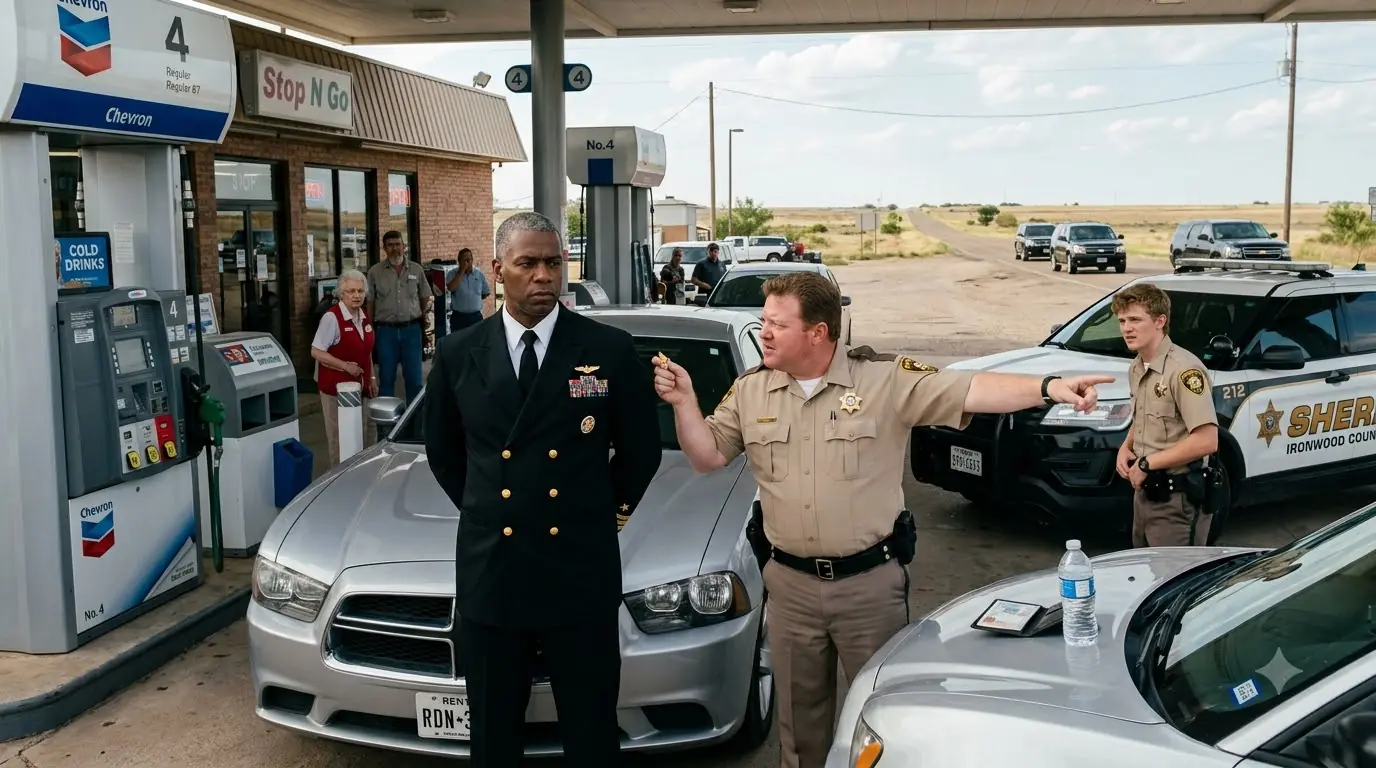
Commander Darius Kane stood beside pump number four in immaculate Navy dress blues, with the Medal of Honor ribbon resting against his chest, until a corrupt deputy decided to tear part of the uniform away.
They believed he was a drifter wearing a costume.
They thought they could hide him inside a holding cell, invent a report, and proceed as they had done many times before.
They were wrong.
They had not arrested an ordinary suspect.
They had challenged the Pentagon.
When a convoy of government SUVs finally entered the dusty Texas town, the officers realized their mistake too late.
For Deputy Royce Kendrick, fifty-eight years in federal prison would eventually become the merciful outcome.
The heat in Ironwood County was not merely a temperature.
It had physical weight.
It pressed against the asphalt outside Big Al’s Gas and Go and made the air shimmer above the fuel pumps.
Commander Darius Kane did not mind the heat.
He had endured suffocating jungles in Colombia and the dry, oven-like air of Kandahar.
Texas humidity was an inconvenience, nothing more.
Darius stood beside a rented silver sedan and watched the numbers rise on the pump.
His full dress uniform looked strikingly out of place against the dusty station, weathered signs, and sun-faded concrete.
He was traveling to a funeral.
Master Chief Petty Officer Thomas Langford, his mentor, was being buried three towns away at Oak Haven Veterans Cemetery.
Darius had flown from Washington that morning and driven directly from the airport.
He intended to pay his respects in full uniform.
It was the least he could do for the man who had saved his life twice.
Darius finished fueling the car and replaced the cap.
He took a bottle of water from the cooler built into the pump island, then turned toward the store to pay.
Gravel scattered violently behind him.
A mud-covered sheriff’s cruiser swerved into the lot and stopped diagonally across the rear of the rental car, blocking any attempt to leave.
The emergency lights were not activated.
They did not need to be.
The intention was obvious.
The cruiser door opened.
Deputy Royce Kendrick stepped out.
Kendrick wore his badge like a crown and his gun belt like a permanent threat.
He was heavy around the middle, with a face reddened by poor health and years of unchecked anger.
Although the sun was beginning to descend, he adjusted the sunglasses covering his eyes and hooked both thumbs through his belt.
“You look lost, boy,” Kendrick called.
His voice carried the false friendliness of a man accustomed to beginning unpleasant encounters with a smile.
Darius paused with the unopened water bottle in one hand.
His posture stayed relaxed.
His expression remained neutral.
“I am passing through, Deputy. I stopped for fuel.”
Kendrick approached with heavy steps.
He circled Darius and examined the uniform with exaggerated theatrical interest.
Then he stopped close enough for Darius to smell stale tobacco and peppermint gum.
“That is a very expensive-looking costume,” Kendrick said. “Is Halloween arriving early?”
“It is not a costume.”
Darius spoke in a calm, deep voice that normally silenced military briefing rooms.
“I am a commander in the United States Navy. I am traveling to a funeral in Oak Haven.”
Kendrick released a short, barking laugh.
He glanced toward the cruiser, where his younger partner watched from behind the windshield.
Deputy Finn Brooks had been with the Ironwood County Sheriff’s Department for only three months.
He looked nervous even while sitting still.
Kendrick turned back toward Darius.
“A commander?”
His smile widened.
“I did not realize the Navy allowed people like you to run things.”
His gaze moved over the ribbons and insignia.
“And look at all of this.”
Kendrick reached toward Darius’s chest.
His dirty finger flicked one row of ribbons.
Darius moved instantly.
His hand intercepted Kendrick’s wrist before the deputy could touch the Special Warfare insignia.
The motion was too fast for Kendrick to follow.
Darius did not squeeze or twist.
He merely held the wrist firmly in place.
“Do not touch the uniform.”
The temperature in his eyes seemed to fall.
Kendrick tore his arm back.
His face changed from red to a deeper, more dangerous color.
One hand dropped instinctively toward the grip of his service weapon.
“You put your hands on a law-enforcement officer. Have you lost your mind?”
“I prevented you from disrespecting a federal military uniform.”
Darius released him and lowered his hand.
“I have no dispute with you. Allow me to pay for the fuel and continue to the funeral.”
“You are not going anywhere.”
Kendrick unclipped his radio.
“Dispatch, I have a situation at Big Al’s. Possible military impersonation and assault on an officer. Send backup.”
Darius released a long, tired breath.
“Deputy, check my identification. It is inside my pocket. Contact the Navy if you need confirmation.”
He met Kendrick’s eyes.
“You are making a serious mistake.”
“The mistake was believing you could drive through my county playing dress-up.”
Kendrick pointed toward the vehicle.
“Turn around. Put your hands on the car.”
Darius calculated the situation.
He could disarm Kendrick in less than three seconds.
He could prevent Brooks from leaving the cruiser before the younger deputy fully understood what was happening.
Doing so would transform him into a fugitive and dishonor the purpose of his journey.
Master Chief Langford deserved better.
Slowly and deliberately, he turned around.
He placed both palms against the heated metal of the rental car.
Kendrick kicked his ankles apart with unnecessary force.
“Spread your feet. Are you carrying any weapons? Firearms? Knives?”
“No weapons.”
Kendrick searched him roughly.
He removed Darius’s wallet and opened it.
The military identification was clearly visible.
Kendrick examined it for less than a second.
“This looks like an impressive fake. Where did you buy it?”
He tossed the wallet onto the hood.
It slid several inches across the paint.
“That identification is government property,” Darius warned.
“Be quiet.”
Kendrick seized one wrist, forced it behind Darius’s back, and tightened a handcuff around it.
Then he pulled the other arm back and secured the second cuff.
The metal pressed hard enough to restrict circulation.
Kendrick shoved Darius against the sedan.
The commander’s cheek touched the hot surface.
“You are under arrest for impersonating a military officer, assaulting a deputy, and resisting arrest,” Kendrick announced loudly.
Several people had gathered near the gas station windows.
“You will regret this, Deputy,” Darius said quietly.
It was not a threat.
It was a statement of fact.
Kendrick leaned near his ear.
“My only regret is that I did not catch you sooner. Welcome to Ironwood, soldier boy.”
The trip to the sheriff’s station became a deliberate exercise in humiliation.
Kendrick accelerated aggressively and braked without warning, repeatedly throwing Darius against the divider inside the rear compartment.
Brooks sat silently in the passenger seat.
He kept glancing over one shoulder.
His eyes moved from Darius’s uniform to the ribbons on his chest.
“Royce,” Brooks finally whispered, “those decorations look real.”
Kendrick ignored him.
“That is a Silver Star, is it not?”
Brooks looked again.
“And the ribbon beside it. Is that the Medal of Honor?”
“Be quiet, Brooks.”
Kendrick struck the steering wheel with one hand.
“You think a man like him received the Medal of Honor? He bought everything at a pawnshop.”
His voice became self-righteous.
“People who steal military valor are sick. They want respect without sacrifice.”
Darius remained completely still in the rear seat.
He used a mental discipline learned during Survival, Evasion, Resistance, and Escape training.
He separated his thoughts from the pain in his wrists and Kendrick’s erratic driving.
Then he began memorizing details.
Deputy Royce Kendrick.
Badge 409.
Patrol unit seven.
Deputy Finn Brooks.
Badge 412.
The sheriff’s station was a low brick building that smelled of mildew, old paper, and floor wax.
Kendrick dragged Darius from the cruiser by the collar of his dress jacket.
“Watch the jacket,” Darius said.
“I do not care about your jacket.”
Kendrick pushed him through the rear entrance.
They passed a booking desk where a bored sergeant ate a sandwich.
“What did you bring in, Royce?” the sergeant asked with food still in his mouth.
“Military impersonation and assault.”
Kendrick smiled proudly.
“This one thinks he is some kind of elite commando.”
They moved Darius into the processing room.
Kendrick removed the handcuffs only because he intended to search and change the prisoner.
“Remove the jacket.”
Darius carefully took it off.
He attempted to fold it properly before Kendrick pulled it from his hands and threw it into a plastic property bin.
The pristine material crumpled against the bottom.
“Shoes and belt.”
Darius complied until he stood in a white undershirt and uniform trousers.
Kendrick picked up the dress jacket again.
He searched for another detail to mock.
His eyes stopped on the nameplate.
“Kane,” he muttered. “That sounds invented.”
Then he noticed the Special Warfare insignia.
Kendrick removed a folding knife from his belt.
“Do not,” Darius said.
His voice echoed across the tiled walls.
Kendrick looked toward him with open malice.
He slid the knife tip beneath the threads securing the gold trident to the uniform.
With one sharp movement, he tore it loose.
The insignia struck the dirty floor with a metallic sound.
“Oops.”
Kendrick smiled.
“It must have been loose. Cheap manufacturing.”
Darius stared at the trident.
A cold, white heat formed in his chest.
His commanding officer had pinned that insignia onto him after the completion of training.
It represented endurance, sacrifice, brothers lost, and promises kept.
“Pick it up,” Darius said softly.
“Or what?”
Kendrick stepped forward until their chests nearly touched.
“Will you strike me again? Please do. I would enjoy adding a felony to the charges.”
“Deputy Kendrick.”
Darius’s voice lowered another degree.
“I am giving you one opportunity to correct this.”
Kendrick’s smile remained.
“Run my fingerprints. Search my name through the federal system. Contact the Department of Defense.”
Darius stared directly through him.
“If you refuse, you will destroy your career and expose this entire department.”
Kendrick laughed.
“Book him, Brooks. Put him in holding cell three, the one with the broken air conditioning.”
Brooks did not move immediately.
He bent down and picked up the trident.
The insignia felt heavy in his hand.
It was not cheap.
It was real gold construction with an official serial mark.
Brooks placed it carefully on the booking counter.
He avoided meeting Darius’s eyes.
“Sorry,” he mouthed.
Darius gave no acknowledgment.
His attention remained on Kendrick.
“I am entitled to a telephone call.”
“You will call when I finish the paperwork.”
Kendrick turned away.
“That could be one hour. It could be tomorrow.”
They forced Darius into cell three.
It was a concrete box with a steel bench, a toilet, and no functioning air conditioning.
The heat gathered inside without escape.
Darius sat on the bench and closed his eyes.
He did not pace.
He did not shout.
He waited.
Several hours passed before the heavy door opened.
Brooks stood outside the cell.
He looked pale.
“Sir,” he said through the bars, “Kendrick went to dinner. The desk sergeant said you may make your call.”
Darius rose and approached.
“Open the door.”
Brooks unlocked the cell and led him toward a wall-mounted telephone.
“You have five minutes. Local calls only.”
Darius picked up the receiver.
He did not call an attorney.
He did not contact a family member.
He dialed a number memorized for absolute emergencies.
It connected directly to the special operations command watch floor at the Pentagon.
The line rang twice.
“Watch Officer Lieutenant Commander Hale.”
The voice was immediate and professional.
“Hale, this is Commander Darius Kane. Authorization Sierra Tango Nine-Four-Zero Zulu.”
A pause followed.
“I am being held unlawfully by the Ironwood County Sheriff’s Department in Texas. I was assaulted, and part of my uniform was deliberately damaged.”
The other end went silent.
Rapid keyboard sounds followed.
“Authorization confirmed. Commander Kane, we have your profile.”
Hale’s tone changed.
“Good God, sir. Are you injured?”
“Negative. I am being detained. The arresting officer is Deputy Royce Kendrick.”
Darius looked toward the booking area.
“He believes I am impersonating a service member. He removed and damaged my trident.”
“He did what?”
The watch officer’s voice hardened.
“Confirm your location.”
“Ironwood County Jail, Texas.”
“Remain calm, Commander. Do not answer further questions and do not sign anything.”
More keys moved.
“I am waking the Chief of Naval Operations.”
“Hale.”
“Yes, sir?”
“Preserve this call.”
“Already done.”
The officer took one breath.
“We are coming to retrieve you.”
Darius returned the receiver to its cradle.
He turned toward Brooks.
The young deputy’s eyes were wide.
“Who was that?”
Darius walked back into the cell and sat on the steel bench.
“That was the United States government.”
He looked at Brooks.
“They are extremely unhappy.”
The sun rose over Ironwood County beneath the same oppressive heat.
Inside the sheriff’s station, the atmosphere began changing.
At first, the signs were small.
The fax machine continued printing page after page.
Telephone lines rang repeatedly, sometimes with nobody speaking when dispatch answered.
Messages arrived from state and federal offices nobody in Ironwood normally dealt with.
Sheriff Harlan Voss entered carrying a large coffee and a paper bag filled with doughnuts.
He was a massive man who played football in high school and spent the following decades reminding everyone.
Voss governed the county like personal property.
“Morning,” he grunted as he passed the dispatch desk. “Quiet night?”
Kendrick sat behind his desk with his feet elevated and his phone in one hand.
“Easy night, Sheriff. I caught a lunatic wearing a Navy uniform at Big Al’s.”
He smiled.
“The man claims he is a SEAL.”
Voss laughed and bit into a glazed doughnut.
“Another one? People are losing their minds. Did you verify him?”
“No need.”
Kendrick made a dismissive gesture.
“Fake identification and a bad attitude. I left him in cell three overnight. We can bring him before the judge this morning and give everyone a laugh.”
Voss nodded.
“All right. Bring him out and finish it.”
Kendrick stretched, collected the keys, and walked toward the holding cells.
He opened cell three.
Darius was doing one-handed push-ups.
Each movement was controlled and rhythmic.
Despite the heat, his breathing remained measured.
He stopped, rose in one fluid motion, and faced the deputy.
“Morning, sunshine,” Kendrick said. “The judge is ready to see you.”
Darius walked toward the door with his hands behind his back.
“Is my uniform prepared?”
“It is inside the property bag where it belongs. You are going to court in orange.”
They brought him into the booking area.
Sheriff Voss examined him closely.
He noticed the posture.
The calm eyes.
The physical conditioning that did not come from casual exercise but from practical, disciplined training.
For the first time, doubt entered the sheriff’s mind.
“What is your name?” Voss asked.
“Commander Darius Kane, United States Navy.”
Voss frowned.
“Kendrick, you ran his fingerprints, correct?”
Kendrick froze.
“The scanner had trouble last night. I intended to do it this morning.”
Voss’s face darkened.
“You held a man overnight without running his fingerprints?”
“He is an impersonator, Sheriff. Look at him.”
“Run them now.”
Voss’s voice shook the room.
Kendrick moved reluctantly toward the scanner.
He seized Darius’s hand and pressed the fingers against the glass.
The machine beeped.
Processing appeared on the monitor.
Then the screen turned red.
A warning tone came from the speakers, one nobody inside the department had heard before.
A large message filled the monitor.
WARNING: CLASSIFIED IDENTITY
LEVEL FIVE SECURITY CLEARANCE
DO NOT DETAIN
CONTACT DEPARTMENT OF DEFENSE IMMEDIATELY
Kendrick stared.
“What is this? Some kind of malfunction?”
Voss shoved him away from the computer.
The sheriff read the message.
All color left his face.
“That is not a malfunction.”
At that moment, a telephone rang on Voss’s desk.
It was not the public line.
It was the red emergency telephone connected directly to state and federal agencies.
The device had never rung during Voss’s time as sheriff.
He stared at it.
Then he looked toward Darius.
Darius tilted his head.
“You should answer that.”
Voss lifted the receiver with a trembling hand.
“Sheriff Voss.”
“Sheriff Harlan Voss.”
The voice on the other end did not ask for confirmation.
“This is Admiral Donovan Hale, Chief of Naval Operations. I received a report that you are holding Commander Darius Kane. Is that correct?”
The sheriff’s knees weakened.
“Admiral, we have an individual here who claims—”
The admiral interrupted.
“You are holding a decorated Navy SEAL and recipient of the Medal of Honor.”
Nobody in the booking area moved.
“You have five minutes to release him and return every item of federal property you seized.”
Voss tried to speak.
“And, Sheriff,” the admiral continued, his voice falling to a dangerous quiet, “my staff reports that his uniform was deliberately damaged.”
Voss gripped the telephone.
“If Commander Kane has been injured, your department will answer to the full authority of the federal government.”
The line disconnected.
Voss slowly returned the receiver to its base.
He looked at Kendrick.
“Release him.”
“What?”
“Unlock him!”
Voss grabbed a ring of keys and threw it toward the deputy.
“You arrested a Navy SEAL. The Pentagon just called this office personally.”
Kendrick fumbled with the keys.
His arrogance had been replaced by confusion and fear.
He removed the handcuffs.
Darius rubbed his wrists once.
He did not smile.
“Sheriff, I want my uniform and Special Warfare insignia.”
“Yes. Absolutely.”
Voss’s forehead was covered in sweat.
“I also require preservation of all dashboard video from patrol unit seven, all body-camera footage, radio transmissions, booking records, and surveillance recordings from this building.”
“Yes, sir.”
Voss pointed toward the property room.
“Kendrick, retrieve everything. Brooks, get the commander coffee and a chair.”
Kendrick returned carrying the crumpled dress jacket and the damaged trident.
He pushed them toward Darius.
“Here. Take your things and leave.”
Darius accepted the jacket.
He spread it carefully across the counter and began smoothing the fabric.
Then he lifted the trident and examined the bent fastening pin where Kendrick had pried it from the uniform.
“I am not leaving.”
Voss looked confused.
“You are free to go, Commander. The entire matter was a misunderstanding. We will dismiss every charge.”
“The false charges against me may be dismissed.”
Darius raised his eyes.
“The crimes committed by this department are only beginning to emerge.”
Voss stiffened.
His instinct to protect his authority returned.
“We made an error. Do not push your luck.”
He lowered his voice.
“Leave town, and we can forget this happened.”
Darius walked toward a window overlooking the station parking lot.
“I cannot do that.”
“Why?”
Darius pointed outside.
“Because they are already here.”
Voss and Kendrick rushed toward the glass.
A convoy turned onto Ironwood’s main street.
Four SUVs with government plates moved between two military police vehicles.
Above them, the rhythmic sound of helicopter blades cut through the morning air.
A dark gray Hawk descended toward the high school football field across the road.
Kendrick whispered beneath his breath.
Darius faced him.
“I warned you, Deputy.”
The helicopter landing created more than noise.
It became a physical force that rattled the windows of the sheriff’s station.
Dust rose from the dry football field and settled across the county cruisers.
The department’s carefully maintained appearance disappeared beneath a layer of grit.
Sheriff Voss stood frozen.
He had spent years intimidating residents and challenging state troopers.
He had never faced the organized arrival of the United States military and federal law enforcement.
“Lock the doors,” Kendrick said suddenly.
He reached for his radio.
“Tell dispatch to secure the entrance.”
Voss knocked the device from his hand.
“You do not lock the federal government outside. You open the doors and hope they remain reasonable.”
The station entrance opened forcefully.
Two military police officers entered wearing tactical equipment and federal identification.
Their weapons remained holstered, but their hands stayed close and their posture communicated a complete security assessment.
A tall, silver-haired Navy officer followed them.
He wore an immaculate service khaki uniform.
Gold oak leaves marked the rank of lieutenant commander, and the insignia of the Judge Advocate General’s Corps appeared on his collar.
Lieutenant Commander Marcus Lang was known throughout military legal circles as the Shark of Norfolk.
Two FBI agents entered beside him.
Lang walked directly past the stunned desk sergeant.
His eyes moved to Voss, then settled on Darius standing by the window with the damaged jacket.
Lang stopped.
He brought his heels together and delivered a precise salute.
“Commander Kane, sir. Lieutenant Commander Marcus Lang, Judge Advocate General’s Corps. I am assuming control of the legal response.”
Darius returned the salute.
“At ease, Marcus. You took long enough.”
“Traffic was difficult, sir.”
Lang’s expression remained perfectly serious.
Then he turned toward Voss.
Any warmth disappeared.
“Who commands this facility?”
Voss stepped forward and attempted to expand his chest.
“I am Sheriff Harlan Voss. We appear to have a jurisdictional disagreement.”
“We do not have a disagreement.”
Lang removed a folded document from a leather portfolio.
“This is a federal warrant issued by the United States District Court for the Southern District of Texas.”
He opened it.
“It authorizes federal custody and protection of Commander Darius Kane, seizure and examination of his vehicle, and preservation of all evidence connected to his detention.”
“It was a standard arrest,” Kendrick said from behind the sheriff.
Lang looked toward him with open contempt.
“You must be Deputy Royce Kendrick.”
The deputy said nothing.
“The officer who assaulted a senior military commander and damaged federal property.”
Lang signaled toward the FBI agents.
“Secure Commander Kane’s vehicle. Isolate the server room. Nobody accesses or alters electronic records.”
“Wait.”
Voss raised his voice.
“You cannot enter a county building and seize our servers. They contain sensitive investigations.”
Special Agent Pendergast stepped forward.
A scar crossed one eyebrow.
“Sheriff, the commander transported classified material inside his vehicle.”
Pendergast spoke without emotion.
“Your department impounded that vehicle, searched his belongings, and may have compromised information protected under national-security procedures.”
He looked toward the back offices.
“That gives the federal investigation broad jurisdiction over every system connected to the seizure, including your communications, booking records, surveillance network, and anything used to document the arrest.”
Kendrick became pale.
“I did not steal anything. I threw his wallet onto the car.”
“We will determine precisely what you did.”
Pendergast turned.
“Agent Kovac, isolate the hard drives. Retrieve the dashboard recording from unit seven first.”
Kendrick lunged forward.
“You cannot take that video.”
The movement came from panic.
He attempted to block the doorway leading toward the server area.
Two military police officers reacted instantly.
They pressed Kendrick against the wall and controlled one arm behind his back, using the same restraint he had used on Darius.
“Interfering with a federal investigation,” Lang said calmly. “Add it to the report.”
Sheriff Voss watched his deputy being handcuffed.
The walls around him were closing.
He turned toward Darius.
“Commander, tell them this is unnecessary. We were releasing you.”
Darius approached Kendrick.
The deputy’s cheek pressed against the wall as he struggled to breathe normally.
“You asked whether I carried weapons,” Darius said quietly. “I told you I did not.”
Kendrick looked sideways.
“I never said I did not have an army.”
Darius turned toward Lang.
“Secure the station. Nobody leaves until we determine why Deputy Kendrick was terrified of a dashboard recording.”
Lang nodded.
“Lock down the building. Nobody enters or exits without authorization.”
He faced Voss.
“Sheriff, remain inside your office. Do not use the telephone or touch any computer.”
The station that had been the center of Voss’s power became federal territory.
The hunters were now being examined.
The occupation of the Ironwood County Sheriff’s Department lasted for hours.
Residents gathered outside and recorded as agents carried boxes of documents toward the SUVs.
Rumors spread through town.
Some believed terrorists had been arrested.
Others spoke about spies or murder.
Inside, the air conditioning continued humming, but every local officer was sweating.
Darius showered inside the locker room and changed into fresh fatigues brought by the response team.
He sat in the sheriff’s briefing room, which had been converted into a temporary command center.
He was no longer treated as a prisoner.
He was directing the operation.
Agent Pendergast entered carrying a tablet.
His expression was grim.
“Commander, we recovered the dashboard recording.”
Darius looked up.
“Kendrick attempted to delete it remotely approximately ten minutes before we entered. He did not understand that the system maintained a cloud backup.”
“Play it.”
Lang joined Darius near the tablet.
The video showed the interior of Kendrick’s cruiser before he entered Big Al’s parking lot.
Kendrick was speaking on a mobile telephone rather than the police radio.
The audio was clear.
“Yes, boss. I am near Big Al’s,” Kendrick said in the recording. “No, the shipment is late. The cartel contact said to wait.”
He paused and looked through the windshield while driving past the fuel station.
The camera captured Darius near pump number four in full dress uniform.
“Boss, we have a problem. There is a federal-looking officer at the station. Navy uniform, possibly senior command.”
A distorted voice answered through the telephone.
“Is he looking at the trucks? The tanker?”
“He is looking around,” Kendrick lied. “He may be observing the area.”
“If he sees the plates when the tanker arrives, remove him from the location.”
The voice was rough but understandable.
“I do not care how. Delay him, arrest him, or invent something. Keep him away until the delivery is completed.”
“Understood.”
Kendrick watched Darius through the windshield.
“I will use military impersonation. Easy enough.”
The recording ended.
Silence filled the command room.
Darius looked toward Pendergast.
“It was not only prejudice.”
“It was protection,” the agent replied.
He changed the screen.
“Big Al’s Gas and Go is more than a fuel station. Remote imaging shows that two underground tanks contain gasoline.”
Pendergast pointed toward another scan.
“The third tank is empty of liquid but contains heat signatures consistent with sealed crates.”
“Weapons?” Lang asked.
“Possibly narcotics. Ironwood connects to border routes through several isolated county roads.”
Pendergast looked toward Darius.
“Kendrick did not target you only because of bias. He saw a federal uniform and assumed the trafficking operation had been discovered.”
“He needed me away from the station before the tanker arrived.”
“Exactly.”
Darius stood and walked slowly across the room.
“Who was on the telephone?”
“The contact was stored as Boss. We traced the number to a disposable device.”
Pendergast allowed a faint smile.
“Normally, that would end the trail. This device connected through a tower sector covering this building.”
Darius looked through the glass wall toward the sheriff’s office.
Voss sat inside with his head in his hands.
“The sheriff.”
“We need a witness who can identify the voice,” Lang said. “The distortion gives a defense attorney room to challenge it.”
“We have a witness.”
Darius turned.
“Brooks was inside the cruiser.”
“He may be involved,” Pendergast said.
“He hesitated. He preserved my trident and attempted to apologize.”
Darius considered the young deputy.
“He is frightened, not committed. Bring him in.”
Minutes later, Finn Brooks sat inside an interview room.
He was not handcuffed.
He appeared to wish he were somewhere else.
His hands shook strongly enough to ripple the water inside a paper cup.
Darius entered alone and sat opposite him.
“Deputy Brooks.”
“I did not know, sir.”
Tears collected inside the young man’s eyes.
“I swear. I joined the department three months ago. Kendrick tells me to be quiet and follow instructions.”
“I know.”
Darius’s voice remained calm.
“I have encountered men like Royce Kendrick. They depend upon fear.”
He leaned forward slightly.
“Right now, you need to fear the truth more than you fear him.”
Brooks looked up.
“Kendrick is going to prison. That is no longer uncertain.”
Darius allowed the words to settle.
“The remaining question is whether you will go with him.”
Brooks started crying.
“You watched him assault a federal officer. You witnessed a false arrest and remained silent while he prepared fraudulent charges.”
Darius kept his voice quiet.
“A prosecutor could call that conspiracy. You are twenty-two years old. A serious conviction could take the next decade and leave you with no badge and no future.”
Brooks covered part of his face.
“Or you can tell us about the telephone call.”
Darius lowered his voice.
“Tell us about the tanker at Big Al’s. Tell us whom Kendrick calls Boss.”
Brooks drew a shaking breath.
He looked toward the mirrored wall, knowing federal agents were behind it.
“It is Sheriff Voss.”
The statement was barely audible.
“Voss controls everything. The gas station, the deputies, the deliveries.”
Brooks’s words began coming more quickly.
“They move methamphetamine inside compartments in the fuel tankers. Kendrick is the enforcer. If someone asks questions, he threatens them, arrests them, or forces them to leave town.”
He wiped his face.
“Yesterday’s shipment was worth approximately two million dollars. Voss thought federal agents had discovered it.”
Brooks looked directly at Darius.
“When Kendrick saw your uniform, he believed you were the advance officer for a raid. He had to remove you before the tanker reached the station.”
Darius nodded slowly.
“You made the correct decision by speaking.”
He left the room.
Pendergast and Lang waited outside.
“We have enough,” Pendergast said. “Racketeering, narcotics trafficking, unlawful detention, assault on a federal officer, and conspiracy.”
“What about Voss?” Lang asked.
Darius adjusted the collar of his fatigues.
“He is sitting inside his office believing this is still about an improper arrest.”
He looked toward the closed door.
“He thinks he can explain it.”
Darius walked to the sheriff’s office without knocking.
He pushed the door open.
Voss jumped and spilled coffee across the desk.
“Wait one moment.”
“Stand up.”
Darius’s voice carried command without effort.
“You cannot enter my office and speak to me that way.”
“It is no longer your office.”
Darius placed the tablet on the desk.
“And you are no longer functioning as sheriff.”
The screen showed the transcript of Brooks’s confession.
Voss read several lines.
His face became gray.
The confidence drained from him, leaving a frightened older man.
“It was business,” he whispered. “The town was dying. We needed money.”
“You sold poison to your own community.”
Darius’s voice was cold.
“When a serviceman passed through to bury a hero, you attempted to destroy him to protect your profit.”
He turned toward the open doorway.
“Agent Pendergast, he is yours.”
Federal agents entered and handcuffed Voss.
Darius walked into the main bullpen.
Kendrick was being escorted through the station in restraints.
He saw Darius and began shouting.
“You destroyed my life over a piece of metal!”
Darius stopped.
He approached and removed the damaged trident from one pocket.
“It is not merely metal.”
He held the insignia where Kendrick could see it.
“It represents a standard you were never capable of meeting.”
Darius turned toward Lang.
“Make certain every lawful charge is pursued. I want complete accountability.”
“They will not see freedom for a long time,” Lang promised.
The arrests were only the beginning.
The investigation exposed corruption extending far beyond Ironwood County.
Darius would eventually testify against the men who tried to break him, facing them one final time in federal court.
The trial of the United States versus Harlan Voss and Royce Kendrick did not occur in Ironwood.
The venue was transferred to Houston.
The federal courthouse looked more like a fortress than an ordinary hall of justice.
Media attention was intense.
Images of a Medal of Honor recipient being handcuffed in full dress uniform spread across the country.
Voss and Kendrick became known in news coverage as the Ironwood Two.
They were no longer seen only as small-town officials who abused power.
They became symbols of a deeper corruption the public wanted exposed.
Inside Courtroom 4B, however, the atmosphere did not resemble an inevitable victory.
It resembled a shark tank.
Voss and Kendrick hired one of the most expensive defense attorneys in Texas.
Marcus Thorn was known as the Razor.
He did not merely defend clients.
He separated facts from context until jurors could no longer recognize the original truth.
Thorn wore Italian suits worth more than a deputy earned in several months.
His smile never reached his calculating eyes.
Commander Darius Kane sat inside the gallery wearing restored dress blues.
The repaired trident gleamed on his chest.
He was the principal witness.
Lieutenant Commander Marcus Lang sat beside him.
“Thorn will attack you,” Lang whispered. “He will describe you as unstable and affected by combat trauma.”
Darius looked toward the defense table.
“He wants the jury to fear you.”
“Let him try.”
The trial continued for weeks.
Assistant United States Attorney Sarah Jenkins presented the prosecution’s case.
She introduced the dashboard recording, burner-phone records, narcotics recovered from the gas station tank, financial transfers, and testimony from Finn Brooks.
Brooks accepted a plea agreement.
In exchange for truthful cooperation, he would receive probation and permanently surrender his badge.
On the witness stand, he appeared broken.
He cried while describing how Voss operated the county like a private criminal organization.
Thorn attacked him during cross-examination.
“Deputy Brooks, you claim you feared Sheriff Voss.”
Thorn approached the witness box.
“Yet payroll records show you accepted a holiday bonus approved by him. You accepted overtime authorized by his office.”
Brooks stared at his hands.
“You enjoyed the benefits of belonging to the department until federal agents arrived, correct?”
“No.”
“You were not a helpless victim. You were a participant who changed sides to save himself.”
By the time Brooks left the stand, several jurors appeared uncertain.
Thorn had planted the question he wanted.
Was the department entirely corrupt, or had federal officials misinterpreted a small-town operation after one improper arrest?
Then the prosecution called Darius.
“Commander Darius Kane.”
Darius approached the witness stand with the same controlled movement he used aboard a naval vessel.
He took the oath.
His voice remained deep and steady.
Thorn began immediately.
“Commander Kane, let us discuss your hands.”
The question created quiet confusion.
“You are a Navy SEAL, correct?”
“I am.”
“You received training in lethal combat. You know how to kill a person with improvised objects or your bare hands.”
“I am trained to neutralize threats to the United States.”
“A threat.”
Thorn repeated the word.
“On the day in question, Deputy Kendrick asked for identification. You did not immediately hand it to him.”
“My identification was inside my pocket. I told him where it was and invited verification.”
“You argued with him.”
“I corrected false statements.”
“You grabbed his wrist.”
Darius looked toward the jury.
“I prevented him from tearing insignia from my uniform.”
Thorn moved closer.
“You, a trained lethal combatant, placed your hand on a law-enforcement officer. Is it not possible that Deputy Kendrick feared for his life?”
“He was not afraid.”
Darius remained calm.
“He was arrogant.”
“Objection. Speculation.”
“Sustained,” the judge said.
Thorn smiled.
He believed he had begun damaging the case.
“Commander, you experienced combat.”
“Yes.”
“You witnessed traumatic events.”
“Yes.”
“Is it possible that the encounter activated those memories?”
Thorn raised one hand.
“Perhaps you saw a police officer, interpreted ordinary authority as an enemy threat, and transformed a simple identification request into a federal crisis.”
The courtroom became silent.
Thorn had turned Darius’s military service into an accusation.
Darius looked at him.
He did not appear angry.
He appeared disappointed.
“Mr. Thorn, I have operated in places where one mistake results in death.”
His voice reached the rear of the courtroom without amplification.
“I have withheld fire when armed enemies positioned innocent children between themselves and my team.”
Darius leaned slightly forward.
“I exercised more restraint during one heartbeat in those situations than Deputy Kendrick demonstrated during the entire encounter.”
Nobody moved.
“I did not stop his wrist because I was confused by trauma.”
Darius looked directly at Kendrick.
“I stopped him because he was about to damage a uniform worn by better people who died serving this country.”
He faced the jury again.
“As for his alleged fear, if I intended to injure Deputy Kendrick, he would not have completed the arrest.”
Thorn paused.
He wanted an angry outburst.
Instead, Darius gave the courtroom a lesson in restraint.
“So you admit you possessed the ability to hurt him?”
“I admit that I chose not to.”
Darius held his gaze.
“That is the difference between a disciplined service member and a bully.”
Thorn began losing the room.
He turned to his final strategy.
A legal technicality.
“Your Honor, the defense moves to exclude all evidence related to the narcotics operation.”
Judge Margaret Caldwell looked toward him.
“On what grounds?”
“The FBI secured the sheriff’s electronic systems before the final warrant signature was entered.”
Thorn placed both palms on the podium.
“The dashboard footage was the foundation for probable cause. If agents accessed it unlawfully, everything discovered afterward is the fruit of an improper seizure.”
Assistant United States Attorney Jenkins stood.
“Agents preserved the system to prevent destruction. The warrant had been approved, and electronic confirmation was transmitted before any evidentiary review.”
“It was not finalized according to procedure,” Thorn insisted.
He faced the judge.
“In federal court, uncertainty concerning an unconstitutional search must favor the accused.”
Tension filled the room.
Voss and Kendrick exchanged small smiles.
They believed they had found an opening.
If Caldwell suppressed the recording, the narcotics case could weaken drastically.
The defendants might still face consequences for misconduct but escape the most serious charges.
The rear doors opened.
An elderly man entered using a cane.
His suit appeared to have been tailored during the 1970s.
A battered leather briefcase hung from one hand.
He continued past the gallery until the bailiff moved toward him.
“Who are you?” Judge Caldwell demanded.
The old man stopped.
“Albert Rossi, Your Honor. I own Big Al’s Gas and Go.”
Every trace of color disappeared from Voss’s face.
Judge Caldwell frowned.
“Mr. Rossi, you are not listed as a witness.”
“I was hiding.”
Rossi’s breathing was strained, but his voice remained clear.
“Sheriff Voss threatened to harm my grandson if I returned to Ironwood.”
He looked toward Darius.
“When I saw what happened to Commander Kane, I decided I could not remain silent.”
Rossi placed the briefcase on a table.
“I did more than rent underground storage space to Voss.”
He released the latches.
“I kept records. Dates, payments, vehicle numbers, and audio recordings.”
Thorn rose immediately.
“Objection. This is a surprise witness, and the defense received no notice.”
“Sit down, Mr. Thorn,” Caldwell ordered.
She looked toward Rossi.
“You possess evidence?”
“I recorded every meeting Voss held in the back office.”
Rossi’s hand tightened around the cane.
“That includes the meeting where he ordered an attack on a state trooper who discovered the operation last year.”
The courtroom erupted.
Kendrick lowered his head onto the defense table.
Voss stared toward the wall.
The dispute over the dashboard recording no longer determined the case.
A floodgate had opened.
The final turn did not come from a legal maneuver.
It came from the conscience of a frightened man who finally decided to speak because one service member had refused to surrender his dignity.
Darius met Rossi’s eyes and nodded.
Tears appeared in the older man’s face.
Rossi raised a trembling hand in salute.
Darius returned it.
The jury deliberated for less than three hours.
Both defendants were convicted on all major counts.
Racketeering.
Narcotics trafficking.
Conspiracy.
Assault on a federal officer.
Unlawful detention and deprivation of rights under color of law.
Harlan Voss and Royce Kendrick stood before Judge Caldwell for the last time.
They now wore orange detention uniforms.
Their badges, weapons, and arrogance were gone.
Caldwell adjusted her glasses.
“You were entrusted with a sacred duty to protect your community.”
She looked toward the defendants with a mixture of disgust and disappointment.
“Instead, you converted public authority into a license to steal, threaten, imprison, and destroy.”
Her voice remained level.
“You believed you were the law. You forgot that every officer remains accountable to it.”
Caldwell turned toward Kendrick.
“Mr. Kendrick, you mocked Commander Kane’s service. You described sacrifice as a costume and attempted to strip him of dignity.”
She looked down at the sentencing report.
“In doing so, you demonstrated how little dignity you possessed.”
The courtroom remained still.
“For racketeering and narcotics trafficking, the court imposes a sentence of thirty years.”
Kendrick gripped the defense table.
“For assault on a federal officer and the related civil-rights offenses, the court imposes twenty-eight years.”
Caldwell paused.
“The sentences will run consecutively.”
Fifty-eight years.
“You will first become eligible for release at an age when the majority of your life has already passed.”
Kendrick swayed.
The sentence was not formally called life imprisonment.
In practical terms, it was.
“Mr. Voss.”
Caldwell turned toward the former sheriff.
“You directed the organization and betrayed every honorable officer who wears a badge.”
She closed the sentencing file.
“You are sentenced to life in federal prison without the possibility of parole.”
The gavel struck.
The sound echoed through the courtroom.
The deeper consequence was not only the length of imprisonment.
It was where the defendants believed they would serve it.
As court officers prepared to remove them, Lieutenant Commander Lang approached the defense table and handed Thorn a document.
“Transfer recommendations.”
Thorn accepted it while packing his briefcase.
“Where are they sending them? A low-security federal facility?”
“No.”
Lang’s expression did not change.
“The Bureau of Prisons classified both as high-risk former law-enforcement officials. Placement among people connected to their previous arrests would create security problems.”
“Then where?”
“A protected federal administrative unit with military coordination at Fort Leavenworth.”
Kendrick stopped near the courtroom door.
He had heard the location.
“Leavenworth,” he whispered.
Darius approached the railing.
He looked at Kendrick for the final time.
“It is a difficult place, Deputy.”
Kendrick stared at him.
“Many staff members there served in the military. Every day, you will see men and women wearing versions of the uniform you mocked.”
Fear appeared in Kendrick’s face.
He would not enter prison as a respected officer among ordinary offenders.
He would enter as a disgraced former deputy who had assaulted a decorated service member and protected a criminal organization.
For decades, the uniforms around him would remind him of the decision made at pump number four.
Darius stepped back.
“Remember the standard.”
The heavy courtroom doors closed after Kendrick.
Several days later, the sun began setting over Oak Haven Veterans Cemetery.
The heat wave had finally broken.
Cool air moved between rows of white headstones.
Commander Darius Kane stood before a freshly covered grave.
The marker was simple.
MASTER CHIEF PETTY OFFICER THOMAS LANGFORD
UNITED STATES NAVY SEAL
THE ONLY EASY DAY WAS YESTERDAY
Darius was alone.
The news crews were gone.
The attorneys, agents, and military police had returned to their work.
Only Darius and the memory of his mentor remained.
He reached into a pocket and removed the trident Kendrick tore from the uniform.
Darius had straightened the bent fastening pin.
A small scratch remained across the gold.
It was a scar from the encounter.
He knelt and pressed the insignia into the soft earth at the base of Langford’s headstone.
“Sorry I was late, Chief.”
Darius’s voice was quiet.
“I encountered trouble on the road, but I handled it.”
He rose and brushed the soil from his knees.
Then he adjusted his cover and delivered a slow, perfect salute.
Darius turned toward the rental car.
He did not look back.
The conflict was over.
The uniform had been restored.
Justice had taken the long route, but it had finally arrived.
Royce Kendrick believed he was the most powerful man at a small gas station in a forgotten Texas county.
He saw a man in dress blues and assumed the uniform was false because the person wearing it did not match his narrow expectations.
He believed his badge allowed him to humiliate, arrest, and erase anyone who threatened the system he protected.
The arrest exposed more than one deputy’s prejudice.
It uncovered a sheriff who sold narcotics through his own county, an enforcement operation built on fabricated charges, and a community controlled through fear.
Kendrick’s downfall did not come because Darius possessed greater physical strength.
Darius had that strength from the beginning.
It came because he chose discipline instead of impulse.
He allowed the evidence to remain visible.
He memorized names, badge numbers, vehicle numbers, words, and procedures.
Finn Brooks survived because he eventually told the truth.
Albert Rossi helped complete the case because he found the courage to leave hiding.
The federal agents could act because records remained after Kendrick failed to erase them.
The trident on Langford’s grave was not merely an insignia.
It represented a standard.
Restraint when violence would be easier.
Truth when corruption depends upon silence.
Duty when personal anger would be understandable.
Darius Kane defended that standard at pump number four, inside a holding cell, on the witness stand, and before the grave of the man who taught it to him.
Kendrick tried to tear the symbol from the uniform.
Instead, he revealed why he had never deserved anything it represented.