The first thing Officer Daniel Crowley noticed was that the woman was alone.
That mattered to him.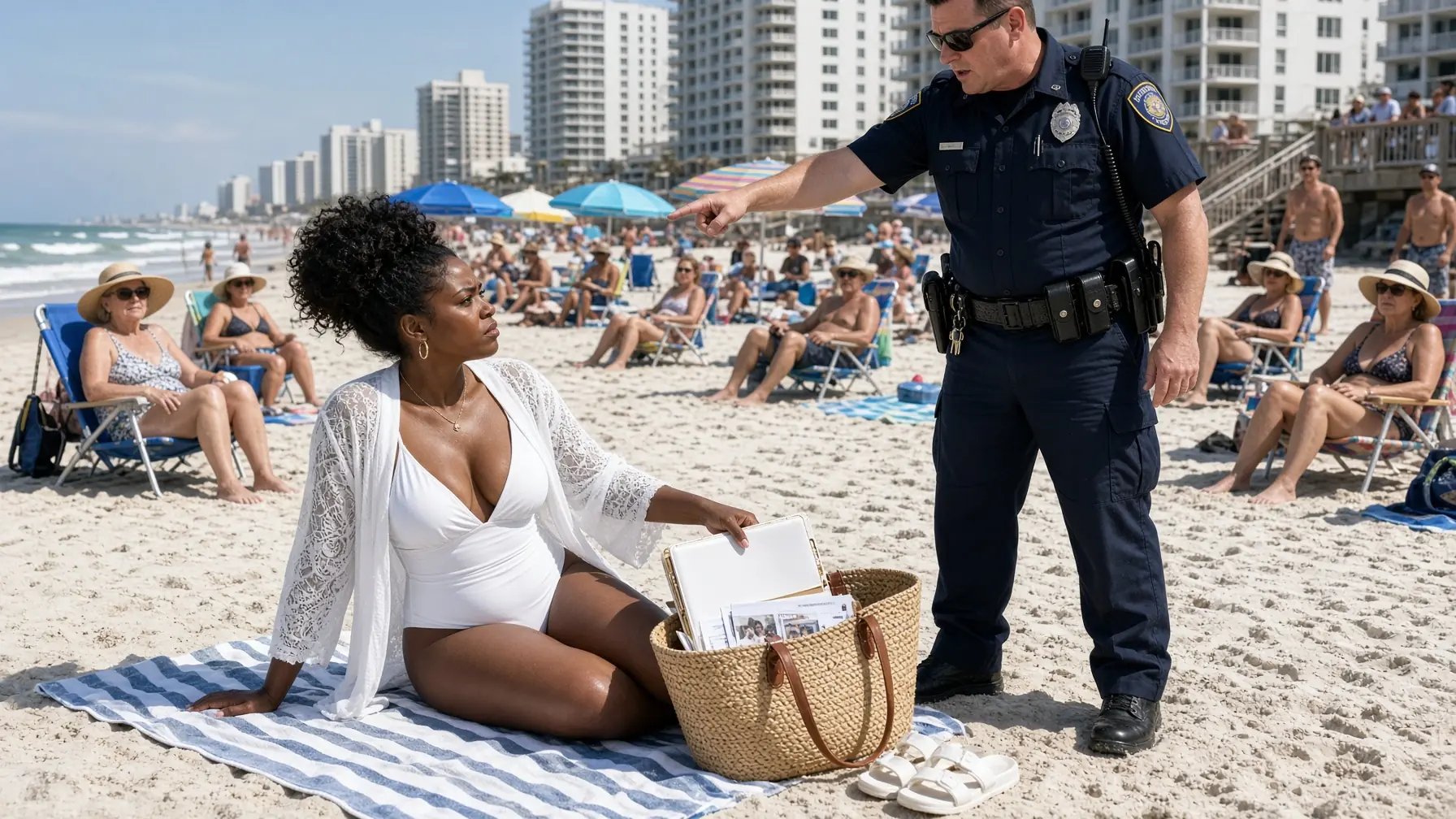
It was just after noon on a bright Saturday at Daytona Beach, Florida, and nearly every stretch of sand around her was crowded with families, tourists, umbrellas, coolers, folding chairs, and children racing toward the water.
The woman sat quietly on a striped towel perhaps thirty yards from the shoreline.
She was thirty-four-year-old Naomi Bennett, a striking Black American woman with deep-brown skin, intelligent dark eyes, thick black curls gathered into a loose high bun, and a calm expression that rarely gave strangers the reaction they expected.
She wore an elegant white one-piece swimsuit beneath a sheer white beach cover-up.
Her white sandals rested beside a woven tan bag.
A pair of sunglasses sat near her phone.
She had done nothing unusual.
That was precisely why she was there.
Officer Crowley approached from behind.
He was forty-three, broad through the shoulders, with short dark hair, black sunglasses, a navy police uniform, and a reputation for knowing how far he could push an encounter before somebody complained loudly enough to become inconvenient.
He stopped beside Naomi's towel.
"Hey."
Naomi looked up.
Crowley pointed toward the boardwalk.
"Pack your crap and move. I've had enough complaints about people like you hanging around where they don't belong."
Naomi did not immediately stand.
She looked around.
To her right, an elderly white couple sat beneath a blue umbrella.
Behind them, three college students threw a football.
Farther down the beach, tourists occupied nearly every available patch of sand.
Naomi returned her eyes to Crowley.
"Then tell me exactly what law I broke by sitting on a public beach."
Crowley's jaw tightened.
He stepped closer.
"Keep running your mouth and I'll drag you off this sand in cuffs."
A few nearby beachgoers turned toward them.
Naomi slowly rose.
She brushed sand from the side of her white cover-up.
Then she looked directly into his sunglasses.
"Touch me and this whole beach watches you lose your badge before your hand leaves my arm."
Crowley actually laughed.
It was short and ugly.
"You threatening me?"
"No."
Naomi reached into her woven bag.
Crowley's hand immediately shifted toward his duty belt.
"Keep your hands where I can see them."
Naomi stopped.
"What exactly do you think I'm reaching for?"
"I don't know."
"You just watched me put a folder in this bag five minutes ago."
Crowley hesitated.
That was true.
He had been watching her longer than Naomi initially realized.
"Take it out slowly."
Naomi removed a white leather folder.
Crowley stared at it.
"What's that supposed to be?"
Naomi opened it.
Inside were photographs.
Printed complaint summaries.
Body-camera timestamps.
Names.
Dates.
Crowley's name appeared more than once.
His smile disappeared.
Naomi looked past him.
"Turn around."
Crowley did not.
"Why?"
"Because the people you're about to lie to are standing fifty yards behind you."
He finally turned.
Near the boardwalk stood three people who had spent the previous twenty minutes pretending not to know Naomi.
Two men and one woman.
All three now walked toward them.
Crowley recognized one immediately.
Lieutenant Marcus Hale from Professional Standards.
The second was attorney Rebecca Sloan from the city inspector general's office.
The third was Investigator Thomas Reed from the state attorney's public integrity unit.
Crowley's face tightened.
He looked back at Naomi.
"Who are you?"
Naomi closed the folder.
"The woman you just threatened to arrest for sitting on a public beach."
Naomi Bennett had spent the previous fourteen months investigating a problem nobody inside the department initially wanted to call a pattern.
It started with a complaint from a seventy-two-year-old retired teacher named Lorraine Hayes.
Lorraine had been sitting near the same section of beach waiting for her granddaughter when Crowley ordered her to leave.
When she asked why, he allegedly told her there had been complaints about "vagrants."
Lorraine owned a condominium two blocks away.
She filed a complaint.
It was closed as a misunderstanding.
Three months later, a twenty-two-year-old Black college student named Jordan Miles complained that Crowley had threatened to arrest him after Jordan sat alone near a hotel beach entrance while waiting for friends.
That complaint was marked unsubstantiated.
Then came Carla Jimenez.
Then Vernon Price.
Then a visiting nurse from Jacksonville.
Then a Black father whose children were swimming twenty feet away while Crowley questioned whether he "belonged" near the private hotels.
Different dates.
Different people.
Similar location.
Similar language.
Most incidents happened along the same high-value section of beachfront lined with expensive hotels, vacation towers, and condominiums.
Crowley claimed he was responding to calls about trespassing, disorder, or suspicious persons.
But many of the people he confronted were sitting or walking on clearly public sand.
Several were Black.
Others were Latino.
Almost all were alone when the encounters started.
Naomi did not work for the police department.
She was a senior investigator with the city's independent accountability office, assigned to examine complaints involving abuse of public authority.
Her work rarely looked exciting.
Most days were documents.
Policies.
Interview transcripts.
Dispatch calls.
Body-camera files.
Hours of footage where nothing happened until suddenly one sentence changed everything.
Crowley's complaints bothered her because they looked minor when reviewed separately.
Rude officer.
Confused beach boundary.
Unclear instructions.
No arrest.
No serious injury.
No major headline.
But Naomi had learned that patterns often survived precisely because every individual incident could be dismissed as too small.
So she placed them side by side.
Fourteen complaints over six years.
Eleven involved people Crowley apparently believed were homeless, poor, minority, or unlikely to challenge him.
Nine contained accusations that he threatened arrest without clearly identifying an offense.
Seven involved the same stretch of beach.
And body-camera footage was strangely incomplete in five.
Naomi requested dispatch records.
Then hotel security calls.