"I'm going to need you two to pack it up and leave, right now."
"I'm sorry, on what grounds, Officer?"
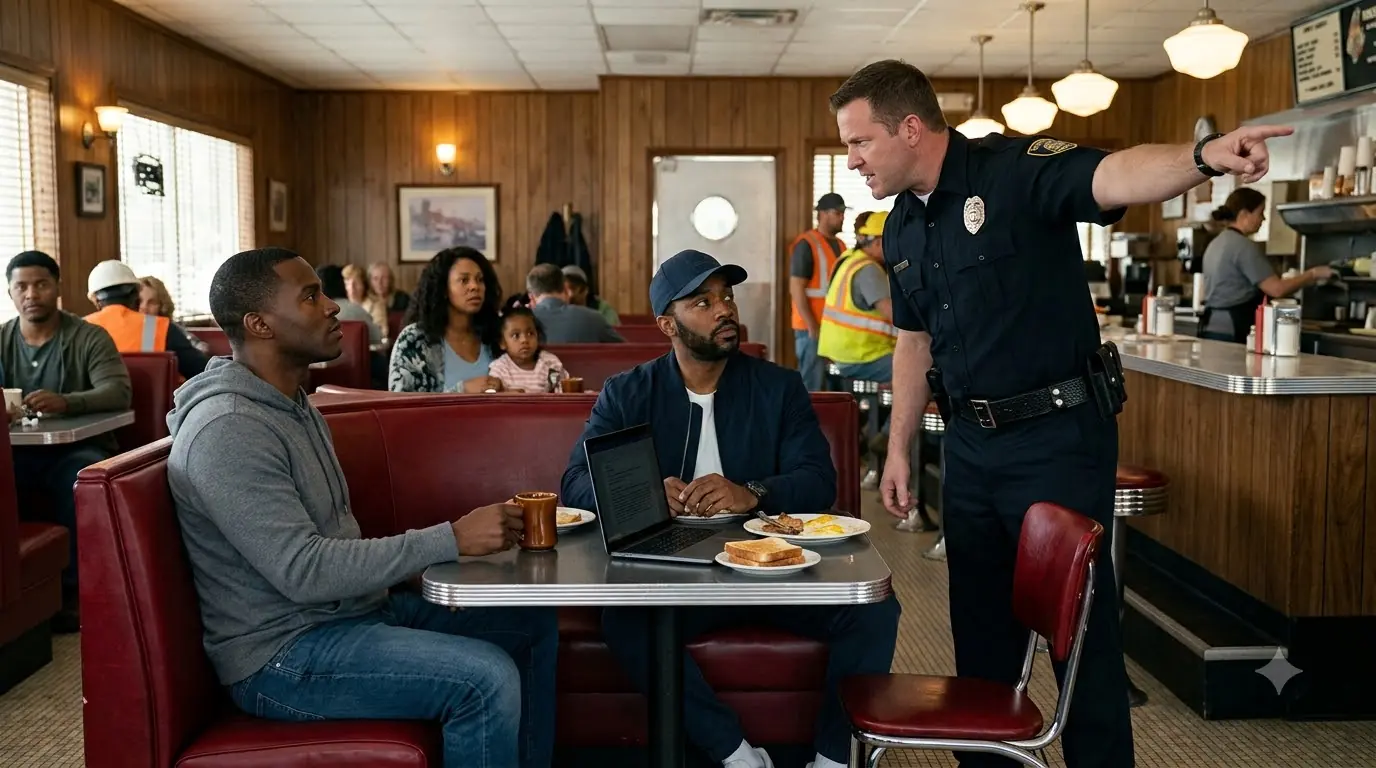
"Don't make this difficult. I said leave."
"You sure you want to do this here, son?"
"Don't you dare reach into..."
"Detective Sergeant Marcus Webb, Major Crimes Division, badge number 4471. Detective Sergeant Darnell Carter, same division."
At exactly 7:42 in the morning on a quiet Tuesday in Harlow City, Georgia, inside a corner booth at Rosie's Classic Diner on Fifth and Maple Street, a routine breakfast between two colleagues became one of the most talked-about law enforcement incidents in the state's recent history.
The diner's overhead security camera was rolling, and the responding officer's body camera was clipped to his chest and recording every second.
In less than nine minutes, a 14-year veteran of the Harlow City Police Department would make a decision that would cost him everything he had spent his entire career building.
This was not a civilian being mistreated on a roadside or someone being bullied in a parking lot. This was a uniformed patrol officer, in full view of a crowded breakfast diner, attempting to remove two of his own department's most decorated detectives from a public establishment for no reason other than the color of their skin.
What happened next would shock the Harlow City Police Department from top to bottom, spark a federal review of the department's internal culture, and prove that racism does not check credentials before it shows its face.
Marcus Webb was not an average 42-year-old. While most people his age were thinking about mortgages and weekend plans, Marcus Webb was running active surveillance on one of the largest drug trafficking networks in the southeastern United States.
He had joined the Harlow City Police Department at 22, fresh out of Georgia State University with a degree in criminal justice and a minor in constitutional law. He had not just studied law enforcement, he had studied the law itself, every amendment, every precedent, and every protection afforded to citizens under the United States Constitution.
By the time he was 30, Webb had already been promoted to detective. By 35, he had led the takedown of two major organized crime rings operating across three counties.
By 40, he had been awarded the department's Medal of Valor twice. He was known in the department as a man who never raised his voice, never lost his composure, and never forgot a face.
His clearance rate for homicide cases was 94 percent, one of the highest in the state. In his 20 years on the force, he had filed exactly zero disciplinary complaints against fellow officers.
That was not because he had never seen anything worth reporting. Until this morning, nothing had ever been quite this blatant.
Darnell Carter was Webb's partner, his closest friend, and in many ways his mirror image. Also 42 and also a Georgia State graduate, Carter had come to the department through a different route.
He had spent four years in the United States Army Military Police before joining Harlow City PD at 26. Where Webb was methodical and precise, Carter was instinctive and quick.
Between the two of them, they had more than 35 combined years on the force. They had worked undercover operations in some of the most dangerous situations the department had ever authorized.
They had sat across tables from murderers, traffickers, and gang leaders, men who would have killed them without hesitation if they had known who they really were. They knew how to stay calm, and they knew how to read a room.
They both knew, the moment Officer Brian Kowalski walked through that diner door and looked in their direction, exactly what was about to happen.
On the morning of Tuesday, March 14, Marcus Webb and Darnell Carter had been awake since 5:00 a.m. They were in the final week of a six-month undercover operation targeting a mid-level narcotics distribution ring operating out of the Westside district of Harlow City.
That morning they were dressed the way their cover required: casual, nondescript, nothing that would draw attention. Webb wore dark jeans, a plain gray hoodie, and clean white sneakers.
Carter wore dark joggers, a navy-blue jacket, and a baseball cap. No badges were visible, no department insignia showed, and their credentials were tucked inside their jacket pockets.
They had chosen Rosie's Diner because it was quiet in the early morning, close to the area where they needed to be by 9:00 a.m., and because Rosie made the best coffee in the county. They both needed it.
They slid into a corner booth at approximately 7:35 a.m., ordered coffee and eggs, opened a laptop between them, and quietly reviewed surveillance notes from the night before.
They were not loud, disruptive, or arguing. They were two men having breakfast and doing their jobs, and everything about what they were doing was lawful.
The diner was about half full. A few elderly couples sat near the window, a mother with two young children occupied the booth behind them, and a group of construction workers sat at the counter.
The smell of bacon and fresh coffee hung in the warm air. By every possible measure, it was an ordinary Tuesday morning.
Then the bell above the diner door rang.
Marcus Webb looked up from the laptop. His eyes moved to the door the way a seasoned detective's eyes always moved, automatically and instinctively, assessing in fractions of a second.
Officer Brian Kowalski stepped into the diner in full uniform. Webb watched him scan the room and saw Kowalski's eyes land on their booth.
He watched the officer's expression shift. Webb said nothing, looked back at the laptop, picked up his coffee cup, and spoke low enough that only Carter could hear.
"Here we go."
Carter did not look up. He nodded once and took a slow sip of his coffee.
Marcus Webb's pulse did not race with panic. It raced with recognition.
Officer Brian Kowalski was a 14-year veteran of the Harlow City Police Department, assigned to the Third Precinct patrol division. He was 38 years old, broad-shouldered, with the kind of permanent scowl that suggested he found most of the world personally irritating.