The orange cloud hit Denise Carter directly across the eyes before she could even finish saying her name. She jerked backward inside the white SUV, both hands rising instinctively as the chemical burned across her face and throat, while Officer Wade Mercer leaned through the open driver’s window with the pepper-spray can still extended. “Keep reaching and I’ll drop you where you sit, lady!” he shouted, loud enough for neighbors across the upscale Virginia cul-de-sac to hear. Denise forced one eye open through the burning and answered, “You just assaulted a federal officer in her own driveway.”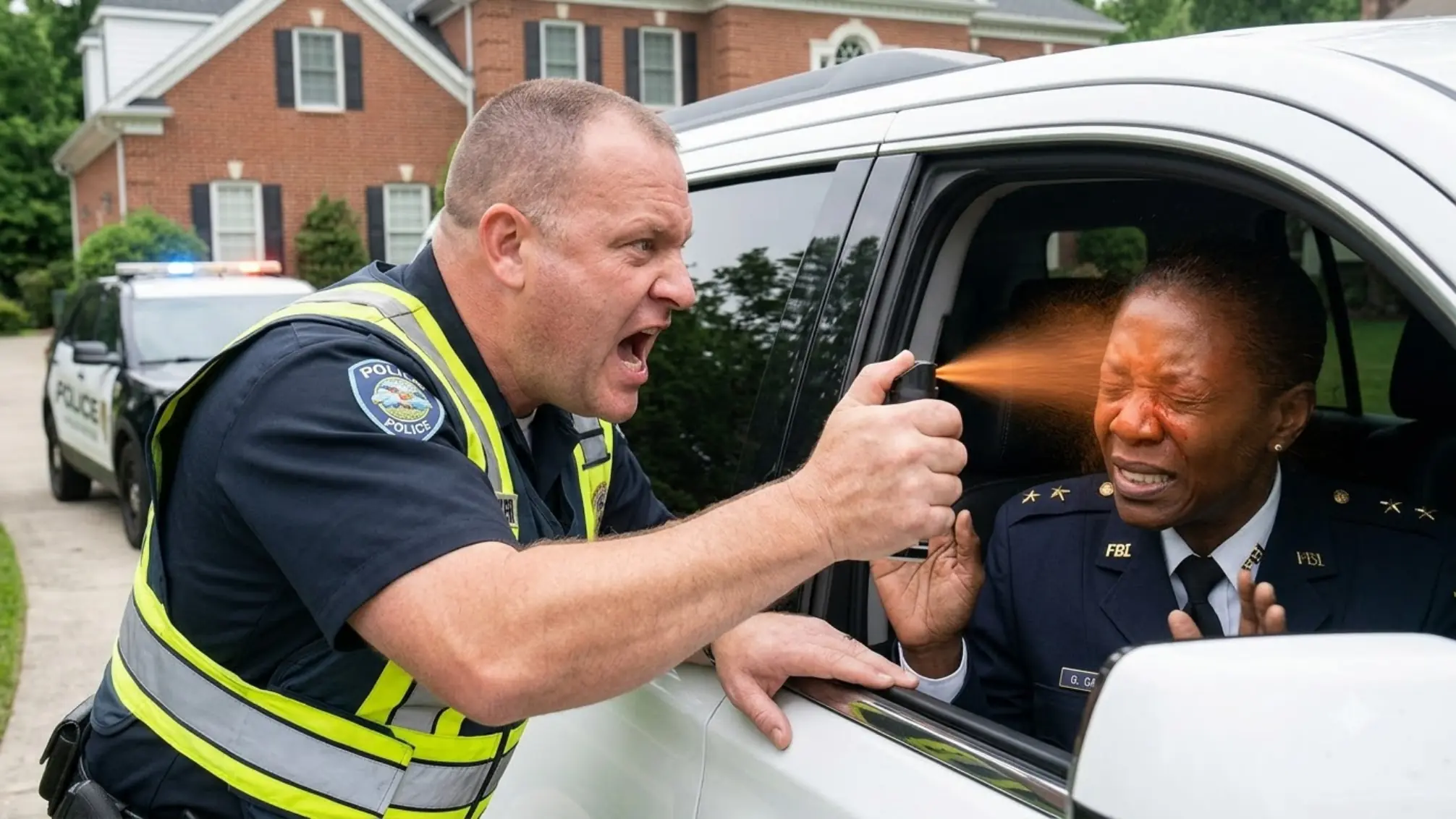
Mercer laughed as though she had delivered the punch line to a joke he had heard a hundred times. He was forty-three, bald, broad across the shoulders, and wore his dark Oak Haven police uniform with the aggressive confidence of a man who had spent years confusing immediate obedience with respect. “I don’t care who you pretend to be,” he snapped, pointing the canister at her again. “You’re going in cuffs.”
Denise reached for the door handle instead of her identification, because her vision had become too blurred to safely search the center console. She was fifty-four years old, with deep-brown skin, short neatly styled black hair, and a controlled face that rarely betrayed what she was thinking even when violent suspects were screaming across interrogation tables. Tonight she was dressed in a formal dark federal uniform because she had just returned from a memorial ceremony in Washington, and small gold insignia still caught the afternoon light across her shoulders. “Then cuff me fast,” she said through clenched teeth, “before your dispatcher learns who you just maced.”
The confrontation had begun less than seven minutes earlier. Denise had turned into Oak Haven Estates after a fourteen-hour workday and noticed a marked patrol SUV following her through two streets before activating its lights directly behind her own house. She assumed the officer needed directions or had mistaken her driveway for a turnaround, so she parked beside the garage and lowered her window. Mercer approached already shouting.
“Stay in the vehicle.” Denise kept both hands visible on the steering wheel and asked why she had been followed onto private property. Mercer’s eyes traveled across the expensive SUV, the brick house, the manicured lawn, and finally Denise herself, lingering with the particular suspicion she had learned to recognize long before she ever carried federal credentials. “We got a report about a suspicious vehicle casing houses,” he said.
Denise glanced toward the street. “What description?” Mercer answered, “White SUV.” She looked through the windshield at two other white SUVs parked within sight. “Anything more specific?”
His face tightened. “Don’t start playing lawyer.” Denise almost smiled despite herself. “I’m asking whether my license plate matches the reported vehicle.”
Mercer had not checked. Denise knew it from the hesitation before he answered. Instead of admitting that, he changed direction and demanded her license and registration.
“My wallet is in my handbag on the passenger seat,” Denise said. “I’m going to reach for it slowly.” Mercer told her to keep one hand visible, so Denise moved exactly as instructed and retrieved the wallet with two fingers. Her Virginia driver’s license showed the same address as the house directly behind them.
Mercer studied it. “Denise Carter.” She nodded. “That’s correct.”
He looked back toward the house. “You live here?” Denise stared at the license still in his hand. “That document answers your question.”
Mercer’s jaw shifted. “I asked you a question.” Denise answered, “Yes, Officer. I own this house.”
Instead of returning the license, Mercer asked how long she had lived there. Denise told him six years. Then he asked what she did for work.
That question changed the tone completely. Denise had spent twenty-seven years in federal law enforcement and currently served as Special Agent in Charge of one of the FBI’s largest regional field offices, supervising hundreds of agents, intelligence analysts, forensic specialists, and task-force officers. She understood investigative questioning better than almost anyone Mercer had ever stopped. She also understood when questions stopped serving the stated reason for a detention.
“What does my occupation have to do with a report about a suspicious vehicle?” Denise asked. Mercer leaned closer. “People who cooperate don’t ask this many questions.”
“People conducting lawful stops usually know what vehicle they’re looking for.” Mercer stared at her for several seconds. “Step out.”
Denise felt the familiar calculation begin inside her. She could invoke her title immediately, show the credentials in the locked compartment near her seat, and perhaps end the encounter within seconds. But something about the officer’s tone made her hesitate.
“Am I being detained?” she asked. Mercer pointed toward the door. “Get out of the car.”
Denise unlocked it. Before opening the door, she said clearly, “My federal credential is in the center console. I’m not reaching for it unless you instruct me to.”
Mercer’s expression changed. “Federal credential?” Denise nodded. “Yes.”
“What agency?” Denise met his eyes. “FBI.”
The officer smiled. “Of course.”
Denise did not react. “It can be verified.”
Mercer laughed louder. “You’re telling me you’re FBI?”
“I’m telling you I am Special Agent in Charge Denise Carter.”
A second Oak Haven officer had arrived by then, Sergeant Eric Bell, a thirty-nine-year-old patrol supervisor who parked behind Mercer’s SUV. Bell stepped out just as Denise began opening her door. He looked first at Mercer, then at Denise’s uniform, then toward the large brick house.
“What have we got?” Bell asked. Mercer responded before Denise could speak. “Possible casing vehicle. Driver’s giving inconsistent answers and claiming FBI.”
Bell frowned. “Inconsistent how?” Mercer ignored the question. “She says she owns this place.”
Denise stepped out carefully. “My license shows this address.”
Bell looked toward Mercer. “Did it?” Mercer folded his arms. “Licenses can be fake.”
Denise almost laughed. “Then run it.”
Bell studied her face. Something about her confidence made him uneasy, not because it felt threatening but because it felt professional. “You said you have federal identification?”
“Yes. In the center console.”
Mercer moved toward the open driver’s door. Denise immediately raised one hand. “Do not search my vehicle without consent.”
He stopped. “You hiding something?”
“I’m informing you that you do not have consent to search the vehicle.”
Mercer looked toward Bell as though expecting support. Bell instead asked, “Can you retrieve the credential yourself?”
“Yes.”
Denise leaned slightly toward the SUV. That was when Mercer sprayed her.
There was no warning beyond a sharp movement of his hand. The orange mist burst across Denise’s face before Bell even understood what Mercer was doing.
Denise cried out and stumbled against the SUV. Mercer grabbed her right wrist, twisted it behind her back, and shoved her toward the side of the vehicle. “Stop resisting!”
“I am not resisting.” Denise’s words came broken between coughs.
Bell rushed forward. “Wade, what are you doing?”
“She reached into the vehicle.” Mercer pulled Denise’s other wrist backward. “Possible weapon.”
“I told you I was retrieving identification.” Denise’s eyes burned so severely she could barely keep them open.
Metal cuffs snapped around her wrists.
Bell stared at Mercer. “Did you tell her not to reach?”
“She was acting suspicious.”
“That wasn’t my question.”
Across the street, three neighbors had come outside. One elderly man held a phone horizontally and was already recording.
Denise leaned against the SUV and forced herself to breathe. She knew from training that panic would worsen the sensation. She kept her voice measured even though every instinct inside her wanted to shout.
“My federal credential is still inside the console.” Mercer sneered. “And I’m the president.”
Bell looked at him sharply. “Enough.”
Mercer ignored him and leaned near Denise’s ear. “You think throwing around FBI is going to scare me?”
Denise turned her head despite the pain. “No.”
“Then what are you trying to do?”
“Give you one final opportunity to verify facts before you destroy your own report.”
That answer did something to Bell. He reached for his radio.
“Dispatch, supervisor unit twelve. Run Denise Carter, date of birth from license. Also check any federal law-enforcement flag attached.”
Mercer waved dismissively. “You’re wasting time.”
Bell did not answer.
Dispatch returned within thirty seconds. “Unit twelve, Virginia license valid. Address matches current location. Vehicle registration also returns Denise Elaine Carter at the same address.”
Bell looked directly at Mercer.
Mercer shrugged. “Doesn’t prove FBI.”
Denise coughed. “Credential. Center console.”
Bell moved toward the SUV. “I’m retrieving it with her permission.”
“Yes,” Denise said.
He opened the console and immediately froze.
Inside sat a black leather credential case, a secured government phone, and a small access badge marked for federal facilities. Bell opened the credential case.
The color drained from his face.
The identification carried Denise’s photograph, name, federal seal, badge number, and title.
SPECIAL AGENT IN CHARGE.
Bell stared at it for almost three seconds before turning toward Mercer.
“Take the cuffs off.”
Mercer frowned. “What?”
“Now.”
Mercer looked at the identification and visibly swallowed. “Could still be—”
Bell cut him off. “Take. Them. Off.”
Mercer released the restraints slowly.
Denise immediately rubbed her wrists but did not reach for the credential. “Call your dispatcher back.”
Bell understood. “You want independent verification.”
“Yes.”
Mercer finally looked nervous.
Bell radioed again. “Dispatch, verify federal credentials for Denise Elaine Carter, Special Agent in Charge.”
The answer took longer this time.
More neighbors had come outside. The elderly man across the street continued recording.
Then the dispatcher returned.
“Unit twelve, federal contact confirms Denise Carter is an active FBI Special Agent in Charge. Additional protective designation attached. Federal operations center requesting immediate welfare status.”
Nobody moved.
Bell looked at Denise.
Mercer stared at the pavement.
Denise took the credential from Bell and closed the leather case carefully. Her eyes were still watering from the pepper spray, but she held herself upright.
“Request medical assistance,” Bell said.
Denise shook her head. “First preserve both body cameras.”
Bell nodded.
“Dispatch audio.”
“Yes.”
“Vehicle computer queries.”
“Yes.”
“All communications associated with the original suspicious-vehicle call.”
Mercer suddenly spoke. “Look, this got out of hand.”
Denise turned toward him.
“This did not get out of hand.”
The officer fell silent.
“You made a sequence of choices.”
Mercer tried again. “I believed you were reaching for a weapon.”
“No. You knew I told you what I was reaching for.”
“You moved quickly.”
“Your body camera will answer that.”
Mercer looked toward Bell for support.
None came.
Denise continued. “You had my license. You had my registration. Both matched this house. You knew the original vehicle description consisted of two words, white SUV. You never obtained a plate, make, model, or direction of travel before deciding I was suspicious.”
Mercer’s face reddened. “There had been burglaries in the area.”
“So investigate burglaries.”
“I was.”
“No.”
Denise’s voice became colder.
“You were investigating me.”
The difference landed heavily.
An ambulance arrived five minutes later. Paramedics flushed Denise’s eyes while Bell contacted Oak Haven Police Chief Gregory Holland, who initially believed the message had to be exaggerated. When Bell repeated the verified identity, Holland stopped asking questions and left headquarters personally.
Denise’s federal operations center also responded. Two FBI agents arrived in an unmarked SUV, not with weapons drawn or sirens screaming, but carrying the exact kind of quiet seriousness that made Mercer’s discomfort deepen.
Assistant Special Agent in Charge Malcolm Price stepped out first. He was forty-eight, tall, and had worked beside Denise for eleven years.
He looked at her swollen eyes.
“What happened?”
Denise answered simply. “Traffic stop became something else.”
Malcolm looked toward Mercer. “Body cameras running?”
Bell nodded. “Yes.”
“Good.”
Mercer tried to explain. “Agent, she reached—”
Denise interrupted. “Do not interview him here.”
Malcolm looked at her.
“He is now potentially a subject in an administrative and criminal review,” Denise continued. “I don’t want anyone contaminating statements.”
Even after being pepper-sprayed and handcuffed in her own driveway, she was protecting the integrity of the investigation.
That unsettled Mercer more than anger would have.
Chief Holland arrived eleven minutes later. He stepped from his vehicle already knowing enough to understand that an apology was not going to solve what stood in front of him.
“Special Agent Carter,” he began.
Denise held up one hand.
“Chief, don’t apologize yet.”
He stopped.
“Find out what happened first.”
Holland nodded.
“What do you want from us immediately?”
“Preservation of evidence.”
“Already ordered.”
“Good.”
Denise looked toward Mercer.
“And pull his complaint history.”
The chief glanced at her. “Why?”
“Because this level of confidence doesn’t usually begin with one stop.”
Holland said nothing.
That answer came later that night.
Mercer had eleven prior citizen complaints over six years. Four alleged unnecessary force during vehicle stops. Five involved claims that he escalated encounters after drivers questioned the legal basis for searches or detentions.
Seven complaints came from Black or Hispanic residents.
Nine had been cleared internally.
Denise read the summary the following morning from her home office while her eyes still felt raw. She had declined to take the day off, but Malcolm had effectively forced her by cancelling every nonessential meeting.
Her phone vibrated.
Chief Holland.
Denise answered.
“We found something else,” he said.
“What?”
“Officer Mercer’s written reports.”
She waited.
“Several do not match body-camera footage.”
Denise leaned back slowly.
“Material differences?”
“Yes.”
Holland described one case involving a twenty-nine-year-old Black attorney stopped near his parents’ home. Mercer wrote that the driver became physically aggressive when questioned. Video showed the man standing beside his car with both hands visible, repeatedly asking whether he was free to leave.
Another incident involved a Hispanic nurse whose vehicle was searched after Mercer claimed she consented.
The camera suggested otherwise.
“Who reviewed these?” Denise asked.
“Different supervisors.”
“Anyone flag the inconsistencies?”
“No.”
Denise closed her eyes.
There it was.
The larger problem.
One bad officer could be removed.
A system that repeatedly saw warning signs and converted them into paperwork was harder.
“Chief,” Denise said, “don’t make this about what happened to me.”
Holland sounded surprised. “How could it not be?”
“Because the worst lesson your department could learn is that Mercer made a terrible mistake by pepper-spraying an FBI executive.”
She paused.
“The problem is what he would have done if I had been nobody you recognized.”
Three weeks later, Oak Haven announced an independent review of discretionary traffic stops, use-of-force reports, vehicle searches, and citizen complaints. Denise provided her statement like any other complainant and refused to use her position to influence the outcome.
Investigators reviewed Mercer’s body camera from her driveway.
The footage was devastating.
Denise clearly announced where her credential was located. She waited for instruction before moving. Her license and registration had already been confirmed.
Mercer sprayed her less than two seconds after she began reaching into the console.
The camera also recorded his earlier remarks.
People who cooperate don’t ask this many questions.
That sentence became central to the review.
Investigators concluded Mercer had treated lawful questions as evidence of hostility. That mindset had appeared repeatedly in other incidents.
Then came the written report.
Mercer claimed Denise “lunged suddenly toward the console despite repeated commands to remain still.”
The video showed no repeated commands.
He wrote that she had “refused to provide clear identification.”
Her license appeared on camera within the first ninety seconds.
He wrote that she “claimed federal status only after detention.”
The body camera captured her identifying herself as FBI several minutes before the pepper spray.
The investigation expanded into possible falsification of an official report.
Mercer was suspended.
Two months later, Oak Haven terminated him following administrative findings of excessive force, false statements, failure to follow investigative procedures, and improper escalation. The state certification board opened a separate case that ultimately revoked his ability to work as a sworn officer elsewhere.
Denise did not celebrate.
She had seen too many careers end to mistake consequence for victory.
The important meeting occurred six months later inside Oak Haven police headquarters.
Chief Holland sat beside Sergeant Bell, three training supervisors, two community representatives, and Denise. She had agreed to attend only after Holland promised the purpose was policy, not public relations.
Bell spoke first.
“I saw the problem before I acted.”
Denise looked at him.
He continued. “I knew the registration matched. I knew the credential should be checked. I knew Mercer was escalating.”
“Why didn’t you stop him sooner?” one community representative asked.
Bell looked down.
“Because he had more years on patrol than I did. And because correcting another officer in front of a civilian felt like undermining him.”
Denise leaned forward.
“That sentence matters.”
Bell nodded.
“I know.”
“No,” she said. “It matters because institutions often fail exactly there.”
Everyone became quiet.
“People see something wrong, but the discomfort of challenging someone inside the system feels more immediate than the harm being done to someone outside it.”
Holland wrote the sentence down.
New procedures followed. Officers handling suspicious-person calls were required to document specific conduct rather than merely repeating a caller’s assumptions.
Once identity and lawful presence were verified, continued detention required new articulable facts.
Supervisors received automatic alerts for repeated complaints involving the same officer.
Body-camera footage from contested use-of-force incidents underwent secondary review outside the officer’s chain of command.
None of those reforms made exciting headlines.
Denise preferred it that way.
Nearly a year after Mercer sprayed her, she returned home one afternoon in jeans, sneakers, and a plain black blouse. She parked the same white SUV in the same driveway and saw an Oak Haven patrol car slowing behind her.
For one moment, her body remembered before her mind did.
Her shoulders tightened.
Her hand paused on the door.
The patrol car stopped.
A young officer lowered his window.
“Ms. Carter?”
Denise waited.
He pointed toward the rear of her SUV.
“Your left brake light’s out.”
She looked back.
“Seriously?”
He smiled.
“Seriously.”
Denise laughed.
“Thank you.”
“No problem.”
He drove away.
That was all.
No demand to explain the house.
No question about where she got the SUV.
No hands on weapons.
No credentials.
Denise stood in her driveway for several seconds watching the patrol car disappear around the corner.
Malcolm happened to call at that exact moment.
“You coming to the six o’clock briefing?”
“Yes.”
“You sound amused.”
Denise looked at the broken brake light.
“Police just stopped me.”
Malcolm became instantly serious. “What happened?”
“They told me my brake light was out.”
A pause.
“That’s it?”
“That’s it.”
Malcolm laughed.
Denise looked toward the house.
“That might be the best traffic stop I’ve ever had.”
She went inside and changed before heading back to the office.
Her federal credential remained in its usual place.
The pepper-spray incident had never been important because the person sitting inside that SUV happened to be one of the most powerful federal officials in the region.
If anything, her title had complicated the lesson.
Mercer became frightened only after dispatch said her name.
Denise wanted Oak Haven to understand something harder.
The handcuffs should not become wrong only after someone discovers who they belong to.
The pepper spray should not become excessive only because the person blinking through it can call federal headquarters.
Facts should matter before status.
Procedure should matter before power.
And dignity should belong just as completely to the unknown woman sitting behind the wheel as it did to Special Agent in Charge Denise Carter.
That was the standard she carried back into her office.
It was also the standard Oak Haven had finally been forced to confront.